
Note: This article contains affiliate links. If you click on these links and make a purchase, we may earn a small commission at no extra cost to you. This helps support our research and content. Read our full affiliate disclosure here.
If your office relies on a steady stream of fresh coffee, choosing the right bean-to-cup coffee maker matters. These machines automate grinding, dosing, tamping, and brewing so you get consistent espresso-based drinks without a dedicated barista. In an office setting you need models that prioritize capacity, uptime, and simple maintenance so employees can get quality cups quickly throughout the day. This guide shortlists the top bean-to-cup coffee makers for offices and evaluates them on speed, reliability, drink range, and ease of upkeep. Read on for practical buying guidance and a clear checklist to match a machine to your workplace demand.
Top Picks at a Glance
| Best Overall The best all-around choice for most situations | De'Longhi TrueBrew Drip Coffee Maker |  |
| Best Quality Built to a higher standard if you want something more solid | Philips 5500 Series EP5544/94 | 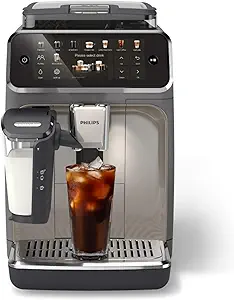 |
| Best Value The sweet spot between price and what you get | VEVOR Coffee Maker with Grinder |  |
| Best Budget The cheapest option that still gets the job done reliably | AIRMSEN Grind & Brew CGM501HB |  |
| Top Rated A top-rated pick with lots of positive feedback | Gevi 10-Cup Grind & Brew |  |
| Most Popular A crowd favorite that many people choose with confidence | AIRMSEN BCM2316 Espresso Machine |  |
| Best Seller A high-volume bestseller chosen again and again | Gevi 10-Cup Grind & Brew |  |
De'Longhi TrueBrew Drip Coffee Maker
| Operation Mode | Fully Automatic |
|---|---|
| Wattage | 1500 watts |
| Human Interface Input | Touchscreen |
| Coffee Input Type | whole_beans |
| Filter Type | Reusable |
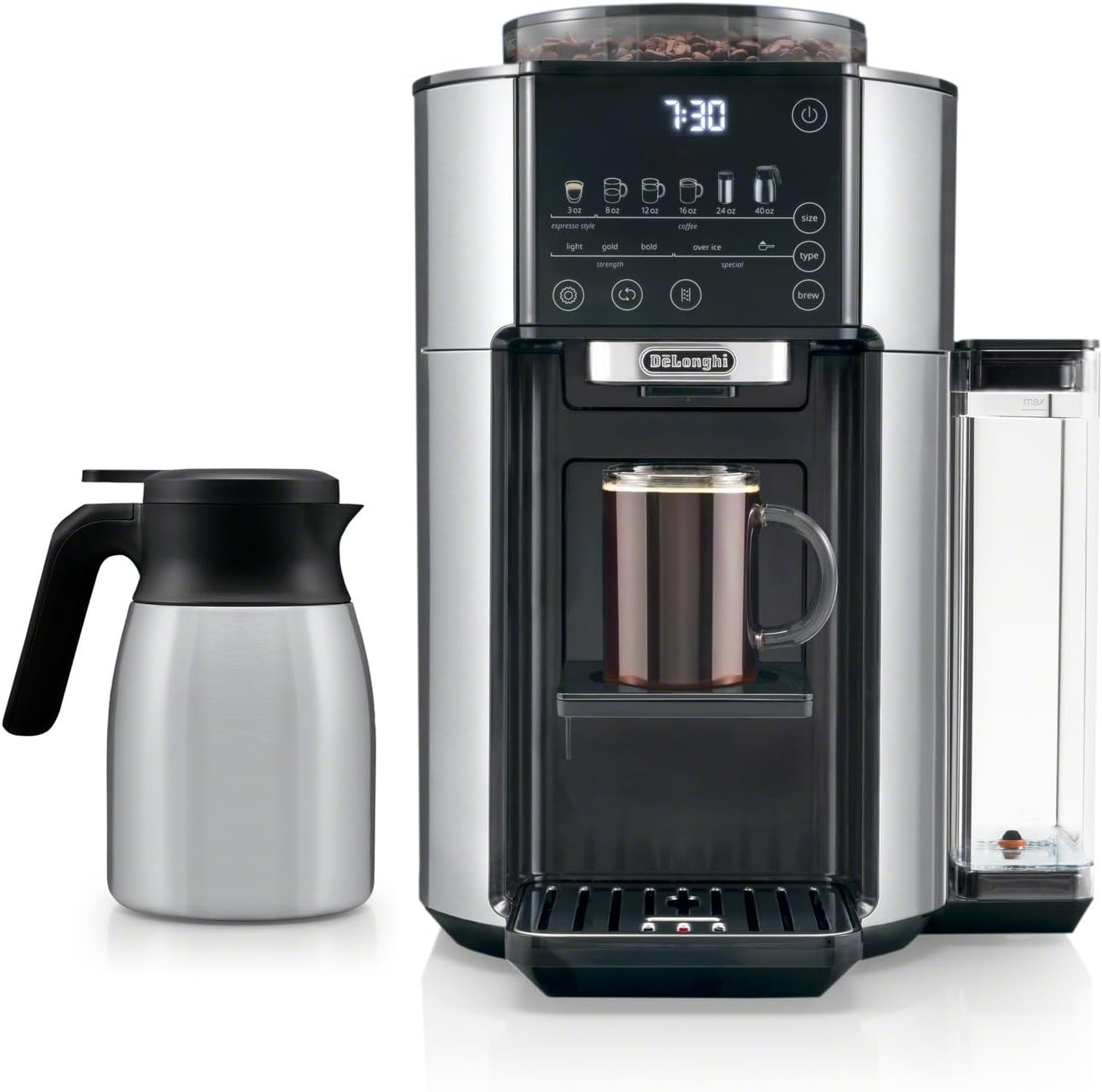
The De'Longhi TrueBrew is a bean-to-cup drip machine that grinds whole beans and brews at the touch of a button, aimed at making consistent fresh coffee for individual cups or a 40 oz carafe. It automatically grinds, doses, and brews using De'Longhi's Bean Extract Technology and offers six size settings and five brew styles including an Over-Ice mode that adjusts dose for iced coffee. The integrated conical burr grinder and reusable filter remove the need for pods and reduce waste, while the thermal carafe keeps larger batches hot for serving. Controls are via a touchscreen and the machine includes programmable features like Auto-On and Auto Shut-Off plus an Auto-Clean routine that packs spent grounds into disposable pucks for easier cleanup. Trade-offs to expect are the machine's footprint and weight compared with compact single-serve units, and a higher power draw at 1500 watts which may matter in constrained office kitchens. For offices that need flexible serving sizes and freshly ground flavor without daily barista work, TrueBrew performs as a capable all-around solution.
Best for: Buyers who want an office machine that delivers freshly ground coffee for both single cups and group servings with straightforward automatic controls and minimal daily effort.
Less Ideal for: People who need an ultra-compact, low-power single-serve brewer or who prefer capsule-based convenience for individual portions.
- Built-in conical burr grinder for consistent fresh grounds on demand
- Six brew sizes and five brew styles including an Over-Ice mode for iced coffee
- Thermal carafe suitable for serving groups without immediate reheating
- Programmable Auto-On, Auto Shut-Off and touchscreen controls for scheduled, one-touch brewing
- Reusable filter and no-pod operation reduce waste and ongoing pod costs
- Relatively large and heavy compared with single-serve machines, requiring dedicated counter space
- 1500 watt power draw may be high for some office outlets or shared kitchen circuits
Verdict: A flexible bean-to-cup brewer that makes freshly ground single cups or a 40 oz carafe with one-touch convenience, ideal for office use where quality and capacity both matter.
Philips 5500 Series EP5544/94
| Operation Mode | Fully Automatic |
|---|---|
| Output Pressure | 15 bar |
| Coffee Input Type | Ground, Whole Bean |
| Capacity | 1.8 liters |
| Wattage | 1500 watts |
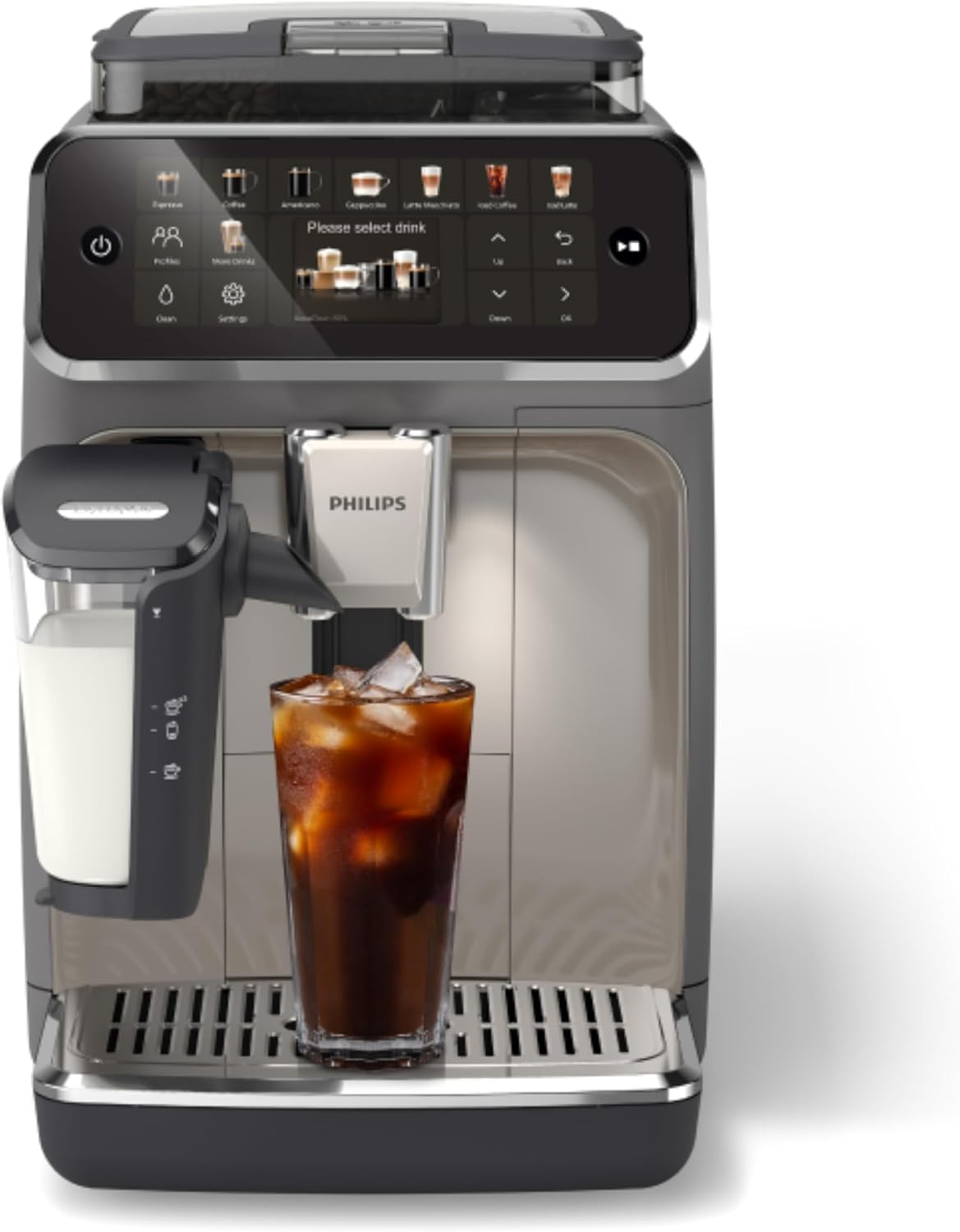
The Philips 5500 Series (EP5544/94) is a fully automatic bean-to-cup espresso machine designed to deliver café-style drinks with minimal user input. It grinds, tamps, brews and steams automatically and offers 20 presets ranging from espresso and cappuccino to iced coffee, plus adjustable strength, volume and milk froth level saved to user profiles. The LatteGo milk system produces smooth microfoam and is easy to clean because it uses only a few detachable parts, and the machine wakes in about 3 seconds for fast service. SilentBrew sound shielding and a ceramic grinder make brewing noticeably quieter, which helps in office settings, and a 15-bar pump gives consistent extraction. Practical limitations include the machine's reliance on regular cleaning and filter replacement for peak performance and the requirement to use either beans or ground coffee rather than alternative capsules. For performance-focused office use the Philips balances speed, consistency and quiet operation, though it works best with a routine for maintenance and descaling to keep flavors optimal.
Best for: Small to medium offices seeking a high-performance, bean-to-cup machine that delivers consistent, café-style espressos and milk drinks quickly and with low noise.
Less Ideal for: Teams that want a completely maintenance-free solution or need capsule-based convenience should consider other formats.
- Built-in ceramic grinder and 15-bar pump for consistent flavor extraction
- LatteGo milk system produces smooth milk froth and is quick to clean
- Ready-to-brew in 3 seconds with QuickStart for fast drink turnaround
- SilentBrew and quiet grinding reduce noise for shared workspaces
- 20 presets and saveable profiles let multiple users customize drinks
- Requires regular cleaning, descaling and filter replacement to maintain performance
- Limited to beans or ground coffee and does not support capsule systems
- May need routine maintenance in high-volume office use
Verdict: A fast, quiet bean-to-cup machine that delivers consistent, customizable espresso and milk drinks ideal for office environments focused on performance.
VEVOR Coffee Maker with Grinder

| Capacity | 8 cups |
|---|---|
| Coffee Input Type | whole bean, ground |
| Operation Mode | Fully Automatic |
| Power Source | AC adapter |
| Other Special Features of the Product | Auto Shut-Off |
This VEVOR unit combines a bean grinder and drip brewer into a single programmable machine aimed at everyday office use. It grinds beans directly into the brewing funnel with a user-adjustable grind coarseness and three strength settings, and it also accepts pre-ground coffee when you need a faster brew. The removable water tank and reusable filter make routine refills and cleanup straightforward, and an auto shut-off plus a two-hour keep-warm function add convenience for shared environments. The machine is fully automatic and runs on 110V power, so setup is simple on a standard office outlet. Expect straightforward controls rather than high-end espresso features; it is a drip-style brewer, not a pressure espresso maker, so it will deliver classic brewed coffee rather than espresso shots. The stainless steel body looks durable but the overall footprint and 8-cup capacity fit small office kitchens rather than large break rooms. For teams that want freshly ground drip coffee without a steep learning curve, this hits the practical sweet spot.
Best for: Buyers who prioritize practical, fresh-ground drip coffee for a small office and want a single, easy-to-use machine that minimizes daily steps and upkeep.
Less Ideal for: Teams that need espresso shots, cappuccinos, or high-volume brewing for large groups should consider commercial machines or dedicated espresso equipment instead.
- Built-in grinder with adjustable grind size for fresher flavor
- Programmable brewing with three strength settings to match team preferences
- Removable water tank and reusable filter for easier refills and cleaning
- Auto shut-off and 2-hour keep-warm function for office safety and convenience
- Drip-style brewer only, so it will not produce true espresso or milk-based espresso drinks
- 8-cup capacity may be small for larger offices during peak times
Verdict: A compact bean-to-cup drip machine that delivers fresh-ground coffee and simple programmable controls ideal for small office use.
AIRMSEN Grind & Brew CGM501HB

| Capacity | 5 cups |
|---|---|
| Wattage | 900 watts |
| Operation Mode | Whole Bean Mode, Ground Coffee Mode |
| Display Type | Digital Display |
The AIRMSEN Grind & Brew CGM501HB combines a small-footprint drip brewer with a built-in grinder so you can brew from whole beans or pre-ground coffee without extra equipment. It is typically used on a countertop in a small office, dorm, or apartment to deliver up to five standard cups per brew and has a 24-hour programmable timer so you can wake up to freshly brewed coffee. Notable features include three grind settings for adjusting strength, a digital touchscreen with memory for scheduled starts, an automatic keep-warm plate, and a descaling reminder to simplify maintenance. The unit is reasonably powerful at 900 watts and includes removable parts and a water filter to reduce mineral buildup. Limitations are its 5-cup capacity, which is best for 1 to 3 people rather than larger teams, and the grinder and reservoir sizes mean you will refill beans and water more often for continuous office use. For a budget-focused office needing fresh-ground coffee without a full commercial machine, this model delivers convenient, programmable bean-to-cup brewing in a compact package.
Best for: Small office or apartment buyers who want fresh-ground coffee on a tight budget and value a compact, programmable bean-to-cup machine over a larger commercial brewer.
Less Ideal for: Workplaces that need to serve many people frequently or teams that prefer large batch brewing should choose a higher-capacity commercial machine instead.
- Built-in grinder with three grind settings for adjustable flavor and strength
- 24-hour programmable timer and memory function for scheduled brewing
- Compact 5-cup design fits small offices and limited counter space
- Removable parts, water filter, and descaling reminder simplify cleaning
- 5-cup capacity is too small for medium or large office teams
- Smaller grinder and water reservoir require frequent refills during heavy use
Verdict: A budget-friendly, compact bean-to-cup brewer that brings programmable fresh-ground coffee to small offices without needing separate equipment.
Gevi 10-Cup Grind & Brew

| Capacity | 1.5 liters |
|---|---|
| Wattage | 1000 watts |
| Voltage | 120 volts |
| Coffee Input Type | ground, whole bean |
The Gevi 10-Cup Grind & Brew combines a built-in burr grinder with a programmable drip brewer to deliver fresh grind-and-brew coffee for small offices or households. You load beans into the hopper, set cup count and strength on the touchscreen, and the machine grinds, doses, and brews into the included glass carafe. Practical features include a programmable timer for scheduled brewing, adjustable brew strength, a keep-warm plate with a customizable 60–240 minute hold, and a "GRIND CUP" setting that controls grinding time for consistent flavor. At 1000 watts the unit brings water up to brew temperature quickly, and the permanent filter reduces consumable waste. Expect straightforward daily operation and easy access to the hopper and water tank for refills and cleaning. Limitations are typical for combo machines: the grinder's dosing is controlled by time rather than weight so exact yields require adjustment, oily dark roasts may stick in the grinder, and the carafe is glass rather than insulated so long-term heat retention depends on the warming plate.
Best for: Buyers prioritizing a reliable, automated bean-to-cup routine for small shared spaces who want scheduled, consistent coffee with minimal daily setup.
Less Ideal for: People needing precise weight-based dosing, high-volume commercial cafes, or anyone who prefers an insulated thermal carafe for long heat retention.
- Built-in burr grinder for fresh coffee straight from beans
- Programmable delay brew so the office can wake to ready coffee
- Adjustable brew strength and grind-time control for flavor tuning
- Customizable keep-warm timer up to 240 minutes to match schedules
- Permanent filter and included carafe reduce ongoing accessory costs
- Grinder doses by grind time not weight, so precise yields need manual adjustment
- Glass carafe with warming plate does not insulate as well as thermal carafes
- Oily dark-roast beans can stick and require more frequent grinder cleaning
Verdict: A dependable grind-and-brew machine that delivers scheduled, freshly ground coffee for small offices and shared workspaces.
AIRMSEN BCM2316 Espresso Machine
| Output Pressure | 20 bar |
|---|---|
| Wattage | 1350 watts |
| Operation Mode | Semi-Automatic |
| Coffee Input Type | Coffee Ground |
| Capacity | 1.8 liters |
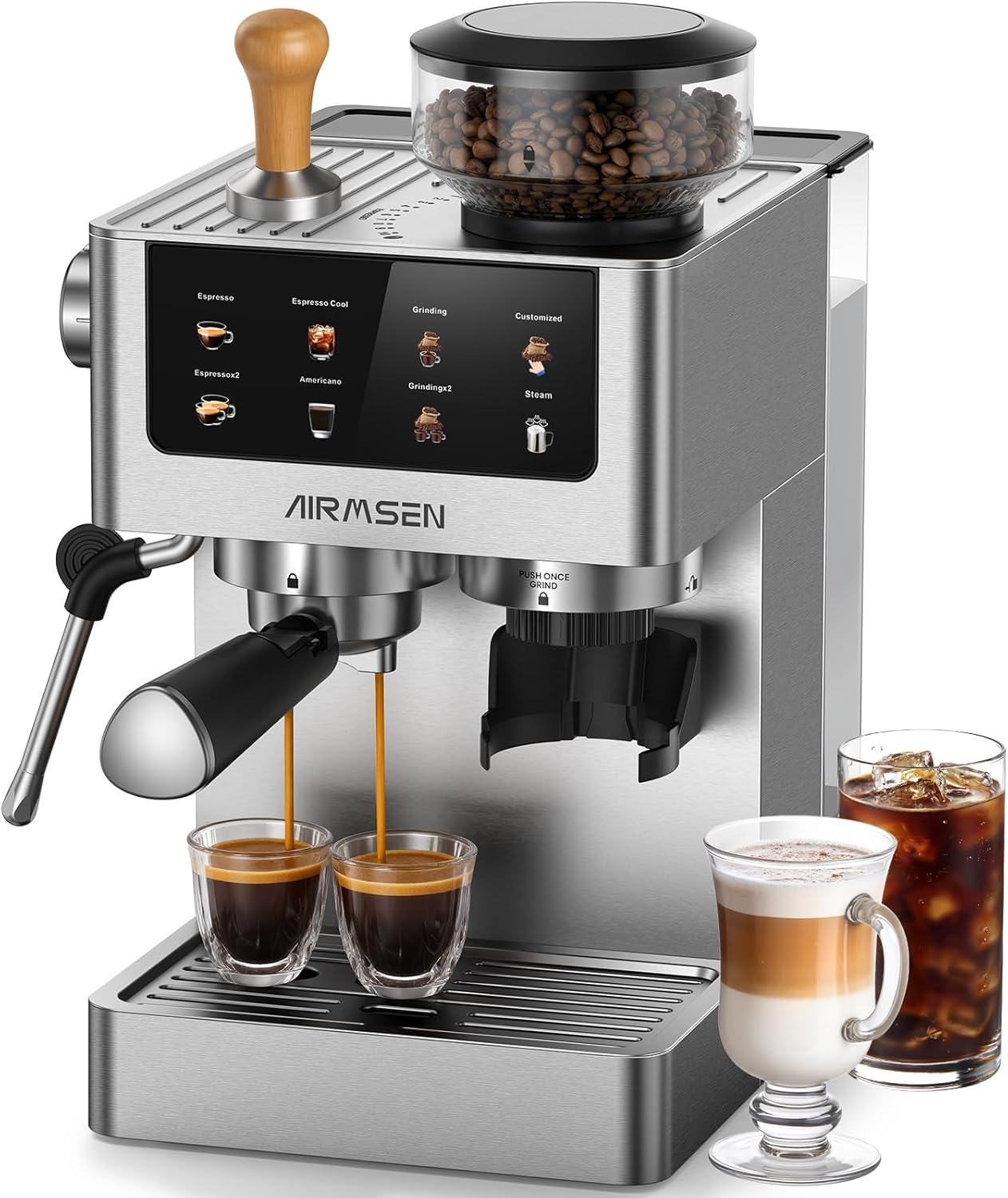
This AIRMSEN BCM2316 is a compact bean-to-cup semi-automatic espresso machine built for daily use in small office settings. It grinds beans with a removable conical burr grinder offering 10 grind settings and anti-static tech, then brews with a 20-bar pump and pre-infusion to extract richer flavors; a full touchscreen controls single or double shots. The manual steam wand textures milk for cappuccinos and lattes, while the 61 oz removable water tank and removable drip tray reduce refill and cleaning frequency. Practical office-friendly touches include a stainless steel cup warmer, self-cleaning mode, and reusable filter baskets for single or double shots. Expect a learning curve to dial grind and tamp for repeatable extraction, and the manual steam wand demands some technique for consistent microfoam. The machine is fairly large for a personal countertop and its parts are a mix of plastic and stainless steel, so longevity may vary with heavy commercial use. For a small team that wants in-house fresh espresso and milk drinks without separate grinder gear, this model covers most needs.
Best for: Small offices or teams that want fresh bean-to-cup espresso and milk-based drinks in-house and value integrated grinder convenience with easy daily operation.
Less Ideal for: Large busy office environments needing high-volume commercial machines or buyers seeking fully automatic milk systems and hands-off latte production.
- Integrated conical burr grinder with 10 grind settings and anti-static design for consistent grounds
- Professional 20-bar pump with pre-infusion for richer extraction
- 61 oz removable water tank reduces refill frequency for small office use
- Manual steam wand for hand-textured milk and a stainless steel cup warmer
- Full touchscreen controls and removable drip tray for easier daily operation and cleaning
- Manual steam wand requires practice to produce consistent microfoam
- Construction mixes plastic and stainless steel, which may limit heavy commercial durability
- Not optimized for high-volume commercial use despite office-friendly tank capacity
Verdict: A compact bean-to-cup machine that combines a built-in burr grinder and 20-bar extraction to deliver fresh espresso and milk drinks for small office use.
Gevi 10-Cup Grind & Brew

| Capacity | 1.5 liters |
|---|---|
| Wattage | 900 watts |
| Voltage | 120 volts |
| Coffee Input Type | ground, whole bean |
| Filter Type | Permanent Filter |
The Gevi 10-Cup Grind & Brew combines a conical burr grinder with a programmable drip brewer to deliver fresh coffee for small offices or shared kitchens. You load whole beans into the hopper, choose grind and strength settings, and set the 24-hour programmable timer to have coffee ready when needed. Notable features include three grind strength levels, an adjustable grind selector, pre-brew extraction that evenly wets grounds, and a reusable permanent filter for less waste. The stainless steel warming plate keeps brewed coffee hot, and auto shut-off adds convenience and safety for workplaces. Practical limits include a modest 1.5 L tank and a plastic-stainless construction that is typical at this price point, so very large teams will need more frequent refills and heavier-duty commercial machines for continuous brewing. Regular cleaning of the grinder and grounds compartment is required to avoid oil buildup from dark roasts. For mainstream, risk-averse buyers this unit offers straightforward controls and predictable performance without complicated setup.
Best for: Offices and small teams that want a simple, low-risk bean-to-cup solution that delivers fresh ground coffee with programmable convenience and minimal setup.
Less Ideal for: High-volume workplaces or cafés that need continuous, large-batch brewing or a commercial-grade, heavy-duty machine.
- Built-in conical burr grinder for fresh-ground brewing
- 24-hour programmable timer for ready-at-shift-start coffee
- Pre-brew extraction improves flavor consistency
- Reusable permanent filter reduces disposable waste
- Auto shut-off and keep-warm plate add safety and convenience
- 1.5 L capacity requires frequent refilling for larger teams
- Plastic-heavy construction may feel less durable than commercial units
Verdict: A reliable, easy-to-use grind-and-brew machine that delivers fresh coffee on a programmable schedule for small offices.
Choosing the Right Bean-to-Cup Coffee Maker for Offices: Key Factors to Consider
Throughput and Brew Speed
How many drinks the machine can produce per hour and how quickly it produces each cup matters in an office. A higher throughput reduces queues during busy periods like morning rush or meeting breaks. Consider machines with dual boilers or fast-heating thermoblocks and generous bean hoppers to sustain continuous use without frequent refills.
Throughput also affects perceived quality. Machines that attempt to multitask poorly may produce inconsistent shots when pushed. Think about your typical peak demand and choose a unit whose stated output comfortably exceeds that level so coffee quality and speed remain steady.
Ease of Maintenance and Cleaning
Offices rarely have staff dedicated to machine care, so look for designs that simplify daily and weekly chores. Removable brew groups, easy-access water and grounds bins, and clear descaling indicators reduce the time needed for upkeep. Machines with automated cleaning cycles or one-touch rinse options cut down on manual intervention.
Maintenance affects uptime and operating cost. If a machine is hard to clean, staff will postpone tasks and that leads to flavor degradation or clogs. Prioritize models with straightforward maintenance procedures that any employee can follow after a short demonstration.
Drink Range and Customization
Offices need to serve multiple preferences, from plain black coffee to espresso-based milk drinks. A machine that offers programmable drink sizes, adjustable strength settings, and a reliable milk delivery system will satisfy more people. Automatic milk frothers or steam wands should be evaluated for speed and hygiene.
Customization also matters for repeatability. Preset buttons or user profiles let colleagues get their familiar cup quickly without fiddling, which boosts satisfaction and reduces wasted beverages.
Capacity and Refill Frequency
Look at bean hopper size, water tank or plumbed-in capability, and waste grounds container capacity. Larger hoppers and the option to connect to a water line reduce interruptions from refills, which is important in medium to large offices. Waste bin size determines how often someone must empty spent puck containers during a busy day.
Choosing appropriate capacities depends on staff count and consumption patterns. If your team consumes many drinks daily, pick a model designed for continuous operation rather than one meant for light-duty use.
Serviceability and Longevity
Frequent use increases the likelihood of wear and occasional failures. Machines built with modular components that technicians can service quickly will get you back online faster. Check whether common wear items are user-replaceable and how straightforward the access points are for repairs.
Longevity also ties to warranty terms and availability of replacement parts. While you will not see these details directly in the machine spec sheet, prioritize designs that emphasize commercial-grade components and straightforward servicing to minimize long-term downtime.
Sizing Your Machine to Office Demand
Estimate peak and average daily drink counts before selecting a machine. A five-person team has very different needs than a 50-person office. Calculate morning peak demand plus typical mid-day and meeting-related usage to determine the safe throughput target for your machine.
If you have unpredictable spikes—conference rooms with frequent visitors or open-plan floors with high foot traffic—lean toward higher-capacity units or models that allow plumbed water and larger waste containers to reduce manual intervention.
- Track typical daily consumption for one week to capture real usage.
- Plan for at least 20 to 30 percent headroom above peak demand.
- Consider multiple machines for distributed service in very large offices.
Plumbed Vs. Water-Tank Models
Plumbed machines connect directly to the office water line, eliminating the need to refill tanks and making them better for high-use environments. Water-tank units are simpler to install and more flexible when a water hookup is unavailable, but they require regular refilling and monitoring.
If you choose a plumbed setup, factor in water filtration and scale management. Hard water builds scale faster and will increase descaling frequency unless a filter or softening system is used.
- Water line: best for continuous, hands-off operation.
- Tank models: good for smaller teams or temporary setups.
- Add filtration when office water hardness is high.
Milk Systems and Hygiene
Milk-based drinks are a major portion of office coffee consumption. Automatic milk systems are convenient but demand careful cleaning to avoid bacterial growth and off flavors. Look for machines with easily removable milk containers or auto-clean cycles that reach all milk-contact points.
If multiple people use milk routines, establish a quick daily cleaning protocol and a weekly deeper clean. Consider models that use replaceable milk lines or closed milk containers that can be stored in a refrigerator between uses to maintain freshness.
- Prefer removable or dishwasher-safe milk tanks when possible.
- Use machines with automatic milk rinse cycles to lower maintenance burden.
- Create a simple posted cleaning checklist for staff to follow.
Noise, Location, and User Experience
Grinders and pumps can be noisy during operation, which matters in open-plan offices or meeting areas. Evaluate noise levels when placing the machine near desks or quiet zones. A machine with a quieter grinder or one placed in a small pantry can reduce disruption.
User interface design affects adoption. Intuitive touchscreens with labeled presets speed service and reduce confusion. Provide a short how-to note near the machine to help new users select common drinks quickly.
- Locate machines away from quiet desks if possible.
- Choose interfaces with one-touch presets for common drinks.
- Label water and bean refill points to avoid accidental errors.
Cost of Consumables and Routine Care
Beyond the machine, consider the ongoing needs for beans, filters, cleaning tablets, and descaling solutions. Higher throughput increases consumable turnover and should factor into the operating budget. Some office setups also prefer single-origin beans or pre-ground coffee for simplicity, which affects stocking choices.
Factor in staff time for routine maintenance. Machines that ask for frequent manual cleaning will consume minutes each day from employees or facilities staff, so choose a model whose upkeep time matches what your office can realistically provide.
- Estimate monthly bean and cleaning supply use based on drink counts.
- Keep a small supply of essential consumables on hand to avoid interruptions.
- Plan a maintenance rota so tasks are shared and not neglected.
How We Chose the Best Bean-to-Cup Coffee Maker for Offices
We focused on criteria that matter for daily office use rather than home features. First, throughput and brew speed were key filters because offices need machines that can serve multiple drinks in short bursts. Second, we evaluated maintenance and serviceability, including how easy routine cleaning tasks are and whether the design minimizes downtime. Third, drink variety and customization were considered to ensure staff can make common espresso-based beverages without extra equipment. Fourth, build quality and component durability were assessed to determine long-term reliability under frequent use. Finally, integration with standard office power and water arrangements, plus available programmability for user presets, influenced selection. We excluded machines designed purely for occasional home use or single-cup pod-only systems. We also filtered out units that required professional installation beyond standard water and electrical hookups. The shortlist therefore emphasizes commercial-capable bean-to-cup coffee makers that balance speed, reliability, simple maintenance, and a useful range of drink options for office environments.
Our full evaluation process is outlined in our review methodology.
FAQ
How often should I descale a bean-to-cup coffee maker in an office?
Descale frequency depends on water hardness and usage. In a typical office with moderate hardness, plan for descaling every 2 to 3 months; high-use or hard-water environments may need monthly descaling. Using a water filter can extend intervals.
Can office staff handle machine maintenance without a technician?
Many bean-to-cup models are designed for user maintenance such as emptying grounds, refilling beans, and running automatic cleaning cycles. For more involved servicing, schedule periodic technician checks. Clear, simple maintenance instructions help nontechnical staff perform routine tasks.
Is it better to plumb a machine into the water line for office use?
Plumbing is ideal for continuous, high-volume use because it removes the need to refill tanks. However, plumbed machines may require additional setup and filtration. For smaller offices or temporary locations, a tank model is often more practical.
What features reduce queues during morning rush times?
Look for machines with high throughput ratings, dual boilers or fast heating systems, and multiple programmable drink presets. Larger bean hoppers and quick milk delivery systems also speed service and reduce waiting times.
How do automatic milk systems affect hygiene protocols?
Automatic milk systems are convenient but require regular cleaning to prevent bacterial buildup. Choose machines with removable milk components or robust auto-clean cycles and establish a simple daily rinse plus weekly deep-clean routine.
Final Verdict
For office environments prioritize machines that deliver consistent throughput, simple maintenance, and a flexible drink range. Match capacity to peak demand and prefer units that minimize manual refills or provide plumbed water options when practical. Expect tradeoffs between advanced customization and upkeep time; machines with more automation can save staff time but may need specific cleaning steps. Choose a bean-to-cup coffee maker for offices that aligns with your team size, available maintenance support, and desired drink selection. Focus on throughput, maintenance ease, and durable design to keep the office caffeinated with minimal disruption.