
Note: This article contains affiliate links. If you click on these links and make a purchase, we may earn a small commission at no extra cost to you. This helps support our research and content. Read our full affiliate disclosure here.
Hard water shortens the life of coffee makers and dulls flavor by depositing mineral scale in boilers, heaters, and brew paths. If you live in a hard-water area, choosing a model that handles scale well can save you service headaches and keep brewed coffee tasting clean. This guide shortlists the top coffee makers designed to manage hard water challenges and explains the practical tradeoffs buyers face. The picks below focus on models that make descaling easier, control brewing temperature and flow despite mineral buildup, and minimize maintenance time. Read on for the features we evaluated and what to look for when buying a coffee maker for hard water.
Top Picks at a Glance
| Best Overall The best all-around choice for most situations | Cuisinart PerfecTemp DCC-3200 |  |
| Best Quality Built to a higher standard if you want something more solid | Technivorm Moccamaster KBGV Select |  |
| Best Value The sweet spot between price and what you get | Ninja CE251 Coffee Brewer |  |
| Best Budget The cheapest option that still gets the job done reliably | OVENTE 12-Cup Drip Coffee Maker CM412B |  |
| Top Rated A top-rated pick with lots of positive feedback | Cuisinart Brew Central DCC-1200P1 |  |
| Most Popular A crowd favorite that many people choose with confidence | BLACK+DECKER 12-Cup Digital Coffee Maker |  |
| Best Seller A high-volume bestseller chosen again and again | Mr. Coffee Mini Brew Switch |  |
Cuisinart PerfecTemp DCC-3200

| Capacity | 14-Cup |
|---|---|
| Wattage | 1100 watts |
| Operation Mode | Fully Automatic |
| Coffee Input Type | Ground Coffee |
| Other Special Features | Auto Shut-Off, Programmable, Water Filter |
The Cuisinart PerfecTemp DCC-3200 is a 14-cup drip machine designed for daily household use and timed brewing. It brews hotter coffee using Cuisinart's PerfecTemp system, offers regular or bold strength settings, and has a 24-hour programmable timer so your coffee can be ready on schedule. The warming plate temperature is adjustable to low, medium, or high, which helps keep brewed coffee at a preferred drinking temperature without overheating it. Practical touches include a reusable gold-tone filter to cut waste, an easy-to-read backlit LCD with an optional ready tone, and an indicator that signals when decalcification is needed. At the same time, users in hard-water areas should expect routine descaling because mineral buildup affects any drip brewer; the machine does provide a decalcify indicator but still requires regular maintenance. The unit uses ground coffee and simple push-button controls, making it straightforward to operate for everyday use.
Best for: Buyers who want a reliable, programmable drip brewer that makes larger batches and offers straightforward controls and temperature adjustments for daily household use.
Less Ideal for: People who need a thermal carafe for long-term heat retention or those seeking a single-cup or espresso-style machine should consider different appliance types.
- 14-cup capacity suitable for households and entertaining
- Programmable 24-hour timer for ready-to-drink coffee
- Adjustable warming plate temperature to prevent overheating brewed coffee
- Brew strength control for regular or bold flavor
- Reusable gold-tone filter reduces paper waste and ongoing filter costs
- Requires frequent descaling in hard-water areas despite decalcify indicator
- Glass carafe and warming plate can overcook coffee if left long on high setting
Verdict: A dependable, programmable 14-cup drip brewer that balances batch capacity, hotter brew performance, and user-friendly controls for everyday home use.
Technivorm Moccamaster KBGV Select

| Capacity | 40 fluid ounces |
|---|---|
| Wattage | 1475 watts |
| Power Source | AC adapter |
| Filter Type | Paper |
| Coffee Input Type | Ground |
The Technivorm Moccamaster KBGV Select is a premium drip brewer that reliably extracts coffee to specialty coffee standards by controlling temperature, flow, and brew time. It uses a copper heating element and a simple selector switch to brew either a half or full 40 oz carafe in about 4–6 minutes, with the hotplate temperature adjusted to match the selected volume. The automatic drip-stop brew basket prevents spills when you lift the glass carafe and the unit shuts off automatically after 100 minutes for safety. Build quality is robust with a metal housing and mostly metal and glass components, and the machine is handmade and individually tested. There is no pump or complicated electronics, so maintenance is straightforward, but hard-water owners should plan for regular descaling since the brewer uses a copper element and internal tubing that will accumulate mineral deposits. The machine favors performance and longevity over flashy features, delivering consistent, fast brews for someone who prioritizes extraction quality and durable construction.
Best for: Buyers who prioritize best-in-class brewing performance and durable, serviceable construction over smart features or convenience bells and whistles.
Less Ideal for: People who want built-in water treatment, smart scheduling, or a fully hands-off programmable brewer should consider other models or add a separate filtration solution.
- Brews to Specialty Coffee Association golden-cup standards for consistent, high-quality extraction
- Selector switch for optimized half- or full-carafe brewing with adjusted brew speed and hotplate temp
- Copper boiling element and tested temperature control for reliable heat stability during extraction
- Durable metal housing and simple mechanical controls reduce points of failure and extend longevity
- No built-in water filtration or softening, so hard water requires frequent descaling to avoid scale buildup
- Limited automation and no programmable schedules or connectivity features
Verdict: Choose the Moccamaster KBGV Select if you want a fast, consistently high-quality drip brewer built for precise extraction and long-term reliability.
Ninja CE251 Coffee Brewer
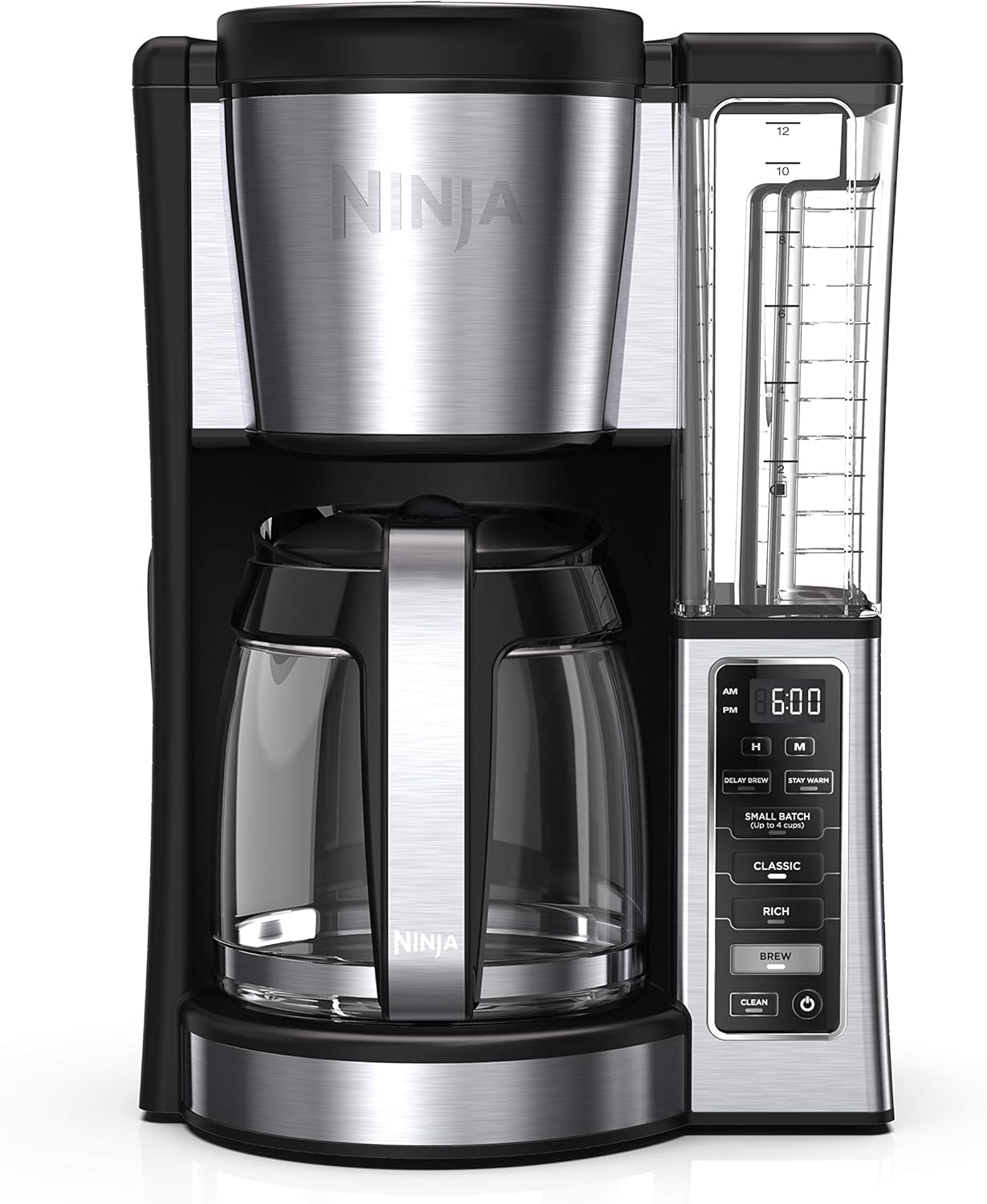
| Capacity | 12 cups |
|---|---|
| Wattage | 1100 watts |
| Operation Mode | Fully Automatic |
| Filter Type | Reusable |
The Ninja CE251 is a programmable 12-cup drip brewer that focuses on consistent, flavorful coffee with two brew profiles, Classic and Rich, plus a Small Batch mode for 1–4 cups. It uses a hotter-brewing system and even saturation to extract more flavor without bitterness, and the removable 60-oz water reservoir and mid-brew pause make daily use convenient. Practical features include a permanent reusable filter, a 24-hour delay-brew timer, an adjustable warming plate that holds coffee up to four hours, and a one-touch clean/descale setting that simplifies maintenance. For homes with hard water, the clean/descale cycle and accessible water reservoir help with routine limescale care, though regular descaling is still necessary. The unit is fully automatic with button controls and an included scoop and carafe, but it does not include a water filter to address mineral content automatically, so buyers should plan for periodic descaling or use filtered water if hard-water buildup is a concern. The CE251 delivers reliable, hot, customizable drip coffee with easy day-to-day handling but requires user upkeep in hard-water environments.
Best for: Buyers who prioritize consistent, customizable drip coffee and easy everyday handling and who are willing to perform basic maintenance to keep performance steady.
Less Ideal for: People who want a coffee maker that automatically treats hard water or who need the best thermal temperature retention without a glass carafe.
- Two brew strengths plus Small Batch mode for flexible flavor control
- Removable 60-oz water reservoir for easy filling and cleaning
- 24-hour programmable delay brew and mid-brew pause for convenience
- One-touch clean/descale setting simplifies limescale maintenance
- Adjustable warming plate keeps coffee hot up to four hours
- No built-in water filter to reduce hard-water minerals
- Plastic exterior components may require careful cleaning to avoid staining
- Glass carafe and warming plate can affect long-term temperature retention compared with thermal options
Verdict: A practical, programmable 12-cup brewer that delivers hot, flavorful drip coffee while making routine descaling straightforward for hard-water households.
OVENTE 12-Cup Drip Coffee Maker CM412B

| Capacity | 1.8 liters |
|---|---|
| Wattage | 1000 watts |
| Power Source | AC adapter |
| Filter Type | Reusable |
| Material | Borosilicate Glass |
The OVENTE CM412B is an entry-level 12-cup drip brewer built for straightforward daily use. You load grounds and water, press the single brew button and the machine delivers a full carafe into a heat-resistant borosilicate glass pot with an anti-drip spout and a clear water gauge for accurate fills. Its reusable filter cuts ongoing paper filter costs and is easy to rinse, while non-slip feet and a stable carafe make pouring safe. At 1000 watts it heats quickly and the glass carafe preserves flavor without absorbing odors. For households on a budget this model covers the basics without extra features like programmability, thermal carafes, or built-in water treatment. That means in hard water areas mineral buildup will require regular descaling and the machine lacks advanced filtration to reduce scale or mineral taste. Expect reliable, no-frills brewing and low running costs if you perform routine maintenance and use a separate water filter when needed.
Best for: Buyers who want an affordable, no-frills drip coffee maker that reliably brews larger pots for households or small offices and keeps ongoing costs low.
Less Ideal for: People who prioritize built-in water filtration, hard-water scale prevention, or advanced programmable brewing should consider models with dedicated filtration or descaling features.
- Large 1.8 L capacity brews up to 12 cups for gatherings or office use
- Borosilicate glass carafe resists heat, odors and preserves flavor
- One-touch operation makes brewing fast and easy
- Reusable filter reduces ongoing cost and waste
- No built-in water filtration or hard-water treatment features
- Lacks programmable settings, warming plate control, or thermal carafe
Verdict: If you need a budget-friendly 12-cup drip maker that brews consistently and keeps filter costs down, the OVENTE CM412B is a practical choice when paired with separate water filtration for hard water.
Cuisinart Brew Central DCC-1200P1

| Capacity | 12 cups |
|---|---|
| Wattage | 1200 watts |
| Filter Type | Reusable |
| Power Source | corded-electric |
The Cuisinart Brew Central DCC-1200P1 is a 12-cup programmable drip coffeemaker designed for daily household use. It brews with a permanent gold-tone filter and includes a built-in charcoal water filter to reduce taste issues from tap water, plus a #4 paper starter kit and scoop for easy setup. Programmable 24-hour start, 1-4 cup settings, brew-pause, and an adjustable heater plate let you control brew time and serving temperature for different routines. The machine also offers an auto-off timer and an alert to descale when buildup requires attention. In practice it produces consistent, full-strength coffee when used with proper grind and regular cleaning, and the dripless carafe spout and ergonomic handle make pouring tidy. The trade-offs are that it uses a glass carafe that loses heat faster than thermal models and the machine is largely manual for advanced water treatment beyond the included charcoal filter, so homeowners in very hard-water areas will still need regular descaling or a separate water-softening step for long-term reliability.
Best for: Buyers who prioritize a dependable, programmable drip machine that reduces common tap-water taste and alerts you when descaling is needed for consistent daily brewing.
Less Ideal for: Users who need extended heat retention or who want an all-in-one solution for very hard water without separate water treatment should consider alternatives.
- Built-in charcoal water filter helps reduce common tap-water tastes
- Programmable 24-hour start and 1-4 cup settings for flexible daily use
- Permanent gold-tone filter reduces ongoing paper filter costs
- Adjustable heater plate lets you set serving temperature
- Brew-pause feature and dripless carafe make pouring convenient
- Glass carafe does not keep coffee hot as long as a thermal carafe
- Included charcoal filter is helpful but not a substitute for water softening in very hard-water areas
Verdict: Choose this Cuisinart if you want a reliable, programmable 12-cup drip brewer with a built-in charcoal filter and descaling alerts to help manage brewing on hard water.
BLACK+DECKER 12-Cup Digital Coffee Maker

| Capacity | 12 cups |
|---|---|
| Wattage | 975 watts |
| Power Source | AC adapter |
| Filter Type | Paper Filter |
The BLACK+DECKER 12-Cup Digital Coffee Maker is a straightforward drip brewer designed for everyday home or office use. It brews up to 12 cups into a Duralife glass carafe and uses a standard paper filter or the included washable basket, while Sneak-A-Cup lets you pause brewing to pour a cup mid-cycle. Large rubberized QuickTouch buttons and a clear water window make filling and programming simple, and the 24-hour auto-brew plus 2-hour auto shutoff add convenience and safety. At 975 watts it heats quickly and the programmable timer is useful for waking to fresh coffee. For homes with hard water, the unit has no built-in water-softening or descaling reminder features, so mineral buildup will require regular manual descale and filter care to maintain performance and flavor. The brewer is basic in feature set but reliable for routine pots of coffee and easy to operate and clean thanks to the removable carafe and basket.
Best for: Buyers who prioritize a simple, programmable drip machine with reliable daily performance and easy controls and who prefer visible water level and a traditional glass carafe.
Less Ideal for: Anyone seeking a coffee maker with integrated hard-water management, a thermal carafe for longer heat retention, or advanced brew customization should consider other models.
- Programmable 24-hour auto-brew for scheduled brewing
- Sneak-A-Cup feature lets you pour a cup before brewing finishes
- Washable brew basket plus included carafe and paper filter compatibility
- Large rubberized buttons and easy-view water window simplify daily use
- No built-in descaling reminder or water-softening system, so hard water requires manual maintenance
- Glass carafe retains heat less than thermal carafes
Verdict: Choose this model if you want a no-frills, programmable 12-cup drip brewer that delivers dependable daily coffee with simple controls.
Mr. Coffee Mini Brew Switch

| Capacity | 25 fluid ounces |
|---|---|
| Wattage | 650 watts |
| Power Source | AC adapter |
| Filter Type | Reusable |
The Mr. Coffee Mini Brew Switch brews up to 25 ounces of drip coffee and is aimed at simple daily use in small kitchens or offices. It uses ground coffee and a reusable filter inside a lift-and-clean brew basket, with a single on/off button and a Grab-a-Cup auto pause that lets you pour mid-cycle. The glass carafe has ounce markings to help measure servings and the compact footprint fits tight counters. Practical touches include a clear water window for easy fill levels and a two-hour auto shutoff for safety. For households on hard water, this machine's straightforward design means fewer electronics exposed to mineral buildup and the removable parts are easy to descale by hand, though it has no built-in water-softening or descaling indicators. Expect reliable, no-frills performance rather than advanced filtration or programmable features. The unit is low-wattage and uncomplicated to operate and maintain, making it a sensible everyday brewer if you want dependable basic coffee without extras.
Best for: Buyers who prioritize a safe, simple, and easy-to-maintain drip brewer for small spaces and predictable daily use. Ideal for people who prefer straightforward operation and quick cleanup over advanced features.
Less Ideal for: Those who need large-volume brewing, programmable scheduling, or integrated water filtration to manage very hard water should look for larger or feature-rich models.
- Compact footprint fits small counters and dorm rooms
- Grab-a-Cup auto pause lets you pour before brewing finishes
- Reusable filter and lift-and-clean basket simplify daily use
- Glass carafe with ounce markings makes measuring easy
- Two-hour auto shutoff adds safety and peace of mind
- No built-in water filtration or descaling reminder for hard-water conditions
- Limited capacity suitable for one to two people rather than larger households
Verdict: A compact, no-frills drip maker that delivers dependable daily coffee and easy cleanup for buyers who want a low-risk, simple brewer.
Choosing the Right Coffee Maker for Hard Water: Key Factors to Consider
Scale Management Features
Look for explicit scale-management systems such as built-in water filters, replaceable cartridges, or integrated descaling cycles. These features reduce mineral buildup inside boilers and heaters and can extend the functional life of the machine. A unit with a clear indicator or scheduled descaling reminder helps you stay ahead of scale before it affects flavor or flow.
Without these features, regular manual descaling becomes mandatory. Consider how often the manufacturer recommends descaling with your local water hardness and whether the machine offers an automated or guided process to make that maintenance straightforward.
Ease of Descaling
Descaling can be time-consuming, so choose a design that makes the process simple and low-mess. Removable water reservoirs, wide openings for access, and one-button descaling cycles reduce time and the chance of user error. Machines that allow you to run a descaling solution through the system without disassembly are usually easier to maintain.
Also evaluate whether the machine uses common descaling agents or a proprietary solution. Common agents are often more affordable and widely available, whereas proprietary cartridges may add long-term cost and complexity.
Brew Temperature Stability
Hard water can cause scale on heating elements and flow paths, which in turn alters how consistently a machine hits target brew temperatures. Look for machines with robust heating systems, PID or multi-thermostat controls, and stable flow design to reduce temperature drift as scale accumulates. Consistent temperature is essential for extracting predictable flavor and avoiding under- or over-extraction as mineral deposits build up.
Consider models that report or regulate temperature precisely and that isolate heating components from areas likely to collect heavy deposits for simpler maintenance.
Water System Design
The shape and accessibility of tanks, tubing, and valves affect how easily minerals can be flushed or removed. Transparent or removable tanks and minimal restrictive tubing help you inspect and clean areas where scale tends to form. Also check whether the machine supports inline or onboard filtration to treat water before it contacts heat exchangers or boilers.
A steam-driven or external pump configuration can have different scale vulnerabilities, so understand where minerals will accumulate and whether those parts are user-serviceable.
Build Materials & Coatings
Materials influence how readily scale adheres. Stainless steel, certain plastics, and nonstick coatings on water-contact surfaces can slow mineral buildup compared with untreated metals. Corrosion-resistant materials are especially important for components that see high temperatures and constant wetting. Durable finishes also reduce the frequency of deep cleanings and help preserve internal tolerances that affect brewing performance.
When possible, choose machines with replaceable parts for the most scale-prone items so you can restore performance without replacing the entire unit.
Serviceability and Parts Access
Even with great preventative features, some scale will eventually require intervention. Machines that offer clear serviceaccess, user-replaceable heating elements, and straightforward part availability will be easier to keep running long term. Check whether the manufacturer documents common service tasks and whether routine parts are designed to be replaced without specialized tools.
Good serviceability lowers the total cost of ownership in hard-water conditions and reduces the likelihood of irreversible failures caused by neglected deposits.
Types of Coffee Makers and Hard Water Vulnerabilities
Different coffee maker designs interact with hard water in different ways. Drip machines use internal boiling or hotplate systems that can collect scale in boilers and spray lines. Single-serve pod brewers route water through small-diameter passages where minerals can quickly restrict flow. Manual-brew devices with separate kettles avoid internal scale but shift the problem to the kettle and filter system.
Understanding which parts of a machine are exposed to untreated water helps you predict where scale will form and how often you will need to descale or replace parts.
- Drip coffee makers: scale tends to form in the boiler, sprayhead, and heating element.
- Single-serve pod systems: narrow channels and pumps are vulnerable to clogs from mineral buildup.
- Espresso-style machines: boilers and group heads are high-risk areas for scale accumulation.
- Manual brewers: fewer internal parts collect scale, but kettles and pour-over systems still require descaling.
Water Treatment Options Before Brewing
Pre-treating water reduces the burden on your coffee maker. Simple options include using a countertop or pitcher filter to lower hardness, installing an inline filter on the water line, or using bottled water with lower mineral content. Each method has tradeoffs in cost, convenience, and environmental impact.
If you choose onboard filtration, confirm the filter removes hardness-causing minerals or exchanges them via ion-exchange media. Some filters primarily improve taste but do not substantially reduce scale formation, so read specifications closely.
- Pitcher filters: cheap and easy, but require frequent cartridge changes.
- Inline or countertop systems: more effective long term but need installation and maintenance.
- Bottled or low-mineral water: consistent performance but higher recurring cost and waste.
Routine Maintenance Schedule
Set a realistic maintenance schedule based on local water hardness and your machine's recommended descaling interval. High-hardness areas may require monthly descaling, whereas softer supplies might allow quarterly or semiannual cycles. Keep a log or use the machine's reminder if available.
In addition to full descaling cycles, perform small checks: rinse removable tanks weekly, inspect sprayheads and tubing for visible buildup, and run a short flush cycle after extended idle periods.
- Weekly: rinse and refill the tank, wipe surfaces, and run a short water-only cycle if unused for several days.
- Monthly: inspect sprayheads and visible tubing for deposits.
- Every 1-3 months: run a full descaling cycle based on local hardness and usage.
When to Replace Parts Versus Replace the Machine
Many scale-related issues are repairable by replacing worn components such as gaskets, pumps, or heating elements. Replacing these parts can be cost-effective if the chassis and control electronics are in good condition and parts are readily available. However, if multiple core components are heavily scaled or corroded, replacement may be the sensible option.
Factor in service access, expected part longevity in hard-water environments, and the cost and availability of replacement components when deciding whether to repair or retire a machine.
- Replace pumps or heating elements when performance drops despite routine descaling.
- Replace gaskets and seals at the first sign of leak-related wear from mineral abrasion.
- Consider machine replacement if multiple internal parts show irreversible scaling or corrosion.
Practical Tips for Homeowners in Hard-Water Areas
Use measuring tools to find your exact water hardness. Knowing parts per million or grains per gallon helps you estimate descaling frequency and choose a filtration strategy. Hardness maps from local utilities or inexpensive test strips provide a quick baseline.
Keep a small kit of commonly used descaling agents and replacement filters on hand so maintenance does not become a barrier. Train household members on the machine's descaling steps and where to find service documentation.
- Test water hardness before you buy to set realistic maintenance expectations.
- Stock common replacement parts that are likely to fail in hard-water conditions.
- Follow manufacturer descaling instructions closely to avoid damage.
How We Chose the Best Coffee Maker for Hard Water
We selected machines that minimize the operational problems caused by hard water while still delivering reliable brewing. Our editorial filters prioritized tangible engineering features and user-facing systems that reduce scale impact: accessible descaling procedures, built-in or compatible water-softening elements, materials and coatings that resist mineral adhesion, and thermal systems that maintain stable brew temperatures even with some scale present. We also considered user convenience like removable water tanks, clear descaling indicators, and ease of service for components most affected by minerals. Excluded from consideration were units that require frequent, nonstandard maintenance, lack any descaling option, or use materials known to accelerate scaling without mitigation. We did not include models that rely solely on paper filters to solve hard-water issues because those do not address mineral accumulation inside heating components. Our evaluation weighed real-world durability and how much ongoing upkeep a buyer should expect when using local water without pre-treatment.
Our full evaluation process is outlined in our review methodology.
FAQ
How often should I descale a coffee maker in a hard-water area?
Frequency depends on hardness and usage. In very hard water, monthly descaling is common for daily-use machines. Moderate hardness often allows descaling every 2 to 3 months. Use the machine's performance and flow as a guide to adjust intervals.
Will a water filter remove the need to descale?
Most water filters reduce taste and odor and some suspended minerals, but only specific softening or ion-exchange filters significantly cut hardness. Even with filtration, periodic descaling is still recommended because few consumer filters eliminate all scale-forming minerals.
Can I use vinegar to descale a coffee maker?
Vinegar is effective at dissolving mineral deposits for many machines, but some manufacturers advise against it because of lingering odor or potential damage to certain materials. If using vinegar, rinse thoroughly and consult your machine's manual for compatibility.
Are stainless-steel boilers better for hard water?
Stainless steel resists corrosion and can slow scale adhesion compared with some untreated metals. However, stainless still accumulates scale over time, so material alone is not a complete solution. Combine durable materials with good descaling procedures for best results.
Will softened water affect coffee flavor?
Water softening exchanges hardness minerals for sodium or potassium ions, which can alter extraction and taste. Some softening approaches produce a flatter flavor profile. Consider partial softening or using a blend to balance scale control and flavor.
Final Verdict
When choosing a coffee maker for hard water, prioritize scale-management systems, easy descaling, and serviceable designs. Strong heating systems and materials that resist mineral adhesion reduce the frequency of deep maintenance and preserve brewing consistency. Balance filtration or pre-treatment options against how they affect flavor to find the right combination for your household. Focus on machines that make maintenance straightforward and offer replaceable parts for the most scale-vulnerable components. That approach will give you reliable brewing and lower long-term upkeep even in areas with challenging water chemistry.