
Note: This article contains affiliate links. If you click on these links and make a purchase, we may earn a small commission at no extra cost to you. This helps support our research and content. Read our full affiliate disclosure here.
If your household runs out of hot water during back-to-back showers or heavy appliance use, a Booster Water Heater can restore temperature and flow without replacing your main heater. You want a unit that brings faster recovery, steady output, and sensible energy use so everyone gets hot water when needed. This guide shortlists the best booster water heaters available and explains how we evaluated capacity, recovery rate, installation needs, and running cost. Read on to find the right booster water heater for steady hot-water delivery and an easier plumbing upgrade.
Top Picks at a Glance
| Best Overall The best all-around choice for most situations | EcoSmart ECO 11 Tankless Water Heater |  |
| Best Quality Built to a higher standard if you want something more solid | Hatco C-45 Booster Water Heater |  |
| Best Value The sweet spot between price and what you get | Ranein Mini Tank Water Heater RC25G |  |
| Best Budget The cheapest option that still gets the job done reliably | xwdzswgs 3000W Tankless Water Heater |  |
| Top Rated A top-rated pick with lots of positive feedback | ThermoMate ES800 8-Gallon |  |
| Most Popular A crowd favorite that many people choose with confidence | Bosch Tronic 3000 T ES2.5 |  |
| Best Seller A high-volume bestseller chosen again and again | GE 18 Gallon Electric Water Heater |  |
EcoSmart ECO 11 Tankless Water Heater

| Wattage | 13000 watts |
|---|---|
| Voltage | 220 volts |
| Flow Rate | 3.1 gpm |
| Maximum Temperature | 140 °F |
| Heat Output | 11 KW |
The EcoSmart ECO 11 is a small wall-mounted electric tankless heater intended to deliver on-demand hot water for a single bathroom, sink, or other low-flow point-of-use locations. It uses self-modulating technology to adjust power draw to the incoming water temperature and setpoint, and the digital temperature control lets you set output in 1 degree increments up to about 140°F. In practice the unit provides roughly 1.3 to 3.1 gallons per minute depending on inlet temperature, so it will comfortably run a shower in warm climates or serve a sink and light shower together in milder conditions. Its slim footprint saves floor space and installation is straightforward when the proper electrical supply is available. Important limitations are its electrical requirements and limited flow rate compared with whole-house models, so sizing and breaker/wiring capacity must be confirmed before purchase. For small or supplemental installations the ECO 11 is a space-saving, energy-efficient option that avoids standby tank losses and delivers consistent set temperatures at low flow rates.
Best for: Buyers who want an efficient, space-saving point-of-use heater to supply a single bathroom or sink and prioritize steady set temperatures and lower operating energy use.
Less Ideal for: Not a good fit for households needing simultaneous high-flow hot water for multiple fixtures or for installs without adequate 240V electrical capacity.
- Compact, wall-mounted design that saves floor space
- Self-modulating technology reduces energy use by matching output to demand
- Digital temperature control with 1°F increments for precise setpoints
- Suitable for point-of-use installations and low-flow applications
- Provides consistent on-demand hot water without a storage tank
- Limited flow rate not intended for full whole-house demands
- Requires a dedicated high-amperage 240V circuit and correct wire gauge
Verdict: A compact, energy-efficient point-of-use tankless heater that reliably delivers precise on-demand hot water for single fixtures or light bathroom use.
Hatco C-45 Booster Water Heater

| Wattage | 45 KW |
|---|---|
| Voltage | 208 volts |
| Capacity | 6 gallons |
| Material Type | Stainless Steel |
The Hatco C-45 is a compact electric booster designed to deliver high-temperature, high-flow supplemental hot water where demand spikes occur. It uses a 6-gallon castone-lined storage tank and a powerful 45 kW element on 208-volt service to rapidly raise and maintain water temperature, and the stainless steel front and powder-coated body make it suitable for commercial indoor installations. Typical uses include providing instant boost to dishwashers, glasswashers, or small service stations that need consistent hot-water delivery at elevated temperatures. Certifications such as NSF and cULus plus a Made in USA build are practical for foodservice and light commercial settings. The unit is purpose-built rather than decorative, so plumbing and electrical professionals will need to size supply and service appropriately and accommodate its 6 inch fixed legs and indoor mounting. It is not a whole-building heater but a high-power supplemental unit that excels at short-duration, high-temperature demand rather than long-term bulk storage.
Best for: Commercial or performance-focused buyers who need a compact, high-power booster to supply consistently hot water to appliances with intermittent high-temperature demand.
Less Ideal for: Households or facilities seeking a primary water heater or large-volume hot water storage should choose a larger-capacity unit instead.
- High 45 kW heating capacity for fast temperature recovery and short duty cycles
- Compact 6-gallon storage tank fits tight commercial spaces
- NSF and cULus certifications make it suitable for foodservice applications
- Stainless steel front and durable powder-coated body for commercial durability
- Requires 208-volt high-power electrical supply and professional installation
- Small 6-gallon capacity is not suitable for sustained large-volume needs
Verdict: Choose the Hatco C-45 when you need a compact, factory-quality electric booster that delivers rapid, high-temperature hot water for commercial appliances.
Ranein Mini Tank Water Heater RC25G

| Capacity | 2.5 gallons |
|---|---|
| Wattage | 1440 watts |
| Voltage | 120 volts |
| Maximum Temperature | 167 °F |
| Maximum Pressure | 150 psi |
The Ranein RC25G is a 2.5-gallon electric mini tank intended for under-sink or point-of-use boosting where a small dedicated supply of hot water is needed. It uses a 1440W heating element and claims high thermal efficiency for fast recovery and adjustable temperatures up to 167°F, making it suitable for handwashing, dishwashing, or a single fixture that needs extra hot water. Installation is straightforward on a 120V circuit with standard 1/2" NPT fittings and the unit includes a pressure relief valve and a 43" power cord with plug. Practical protections such as dry combustion protection, high-pressure protection, IPX4 splash resistance and an LED display add confidence in routine use. The compact footprint fits inside cabinets but needs some clearance for safe installation. Expect limited hot-water volume for simultaneous multi-fixture use and a 12 A power draw that may not be appropriate for heavily loaded circuits. For a small kitchen, bathroom, or booster application this unit offers a durable, corrosion-resistant inner tank and simple point-of-use performance.
Best for: Buyers who want a practical, space-saving booster to deliver reliable hot water at a single sink or appliance and prioritize straightforward installation and built-in safety.
Less Ideal for: Homes that need hot water for multiple fixtures at once or larger households that require continuous high-volume hot water should choose a larger heater or whole-house solution.
- Compact 2.5-gallon tank suitable for under-sink point-of-use boosting
- 1440W heating element with adjustable temperature up to 167°F for fast recovery
- Multiple safety features including dry combustion protection, pressure relief valve, high-pressure protection and IPX4 rating
- Triple-layer enamel-coated tank construction for corrosion resistance and longer service life
- Small capacity limits use to one fixture at a time or short tasks
- Requires a dedicated 12 A circuit and some clearance for safe installation
Verdict: A compact, safety-forward point-of-use booster that delivers fast hot water for a single sink or appliance without complicated installation.
xwdzswgs 3000W Tankless Water Heater

| Wattage | 3000 watts |
|---|---|
| Voltage | 110 volts |
| Flow Rate | 0.5 gpm |
| Maximum Temperature | 131 °F |
| Mount Type | Wall |
This compact 3000W tankless water heater is a point-of-use booster designed to deliver near-instant hot water at a sink or small fixture. It mounts vertically under a sink or on a wall and uses 110V power to heat incoming water quickly; the LED display shows outlet temperature and can switch between Celsius and Fahrenheit. Its small footprint and 1/2-inch G1/2 threaded interface make it straightforward to fit into tight spaces such as kitchens, bathrooms, RVs, or utility sinks. Safety features include dry-burn protection, leakage protection, IPX4 splash resistance, and automatic shutoff on over-temperature. Practical limitations are its low flow rate — rated about 0.5 gpm — so it is best for single fixtures rather than whole-house use, and it requires proper vertical installation and a robust circuit (recommended trip switch over 32A and heavier gauge wiring) to meet power needs and avoid nuisance trips. For buyers seeking an inexpensive, compact booster to supply immediate hot water at one point of use, this unit offers solid functionality and safety for the price.
Best for: Buyers looking for an affordable, space-saving point-of-use booster to supply immediate hot water to a single sink or small fixture and who prioritize low cost over high flow performance.
Less Ideal for: Homes needing hot water for multiple fixtures at once, larger households, or anyone who cannot supply the recommended circuit capacity and vertical installation conditions.
- Fast on-demand heating with 3000W output and digital temperature display
- Compact, wall-mounted design fits under sinks and in tight spaces
- Multiple safety protections including dry-burn, leakage protection, IPX4 splash resistance
- Universal G1/2 1/2-inch interface for standard plumbing connections
- Low maximum flow rate (~0.5 gpm), unsuitable for multiple fixtures or high-flow tasks
- Requires vertical installation and a dedicated heavy-gauge circuit with a high-capacity trip switch
Verdict: A budget-friendly, compact 110V point-of-use tankless heater that reliably delivers instant hot water to a single sink with essential safety features.
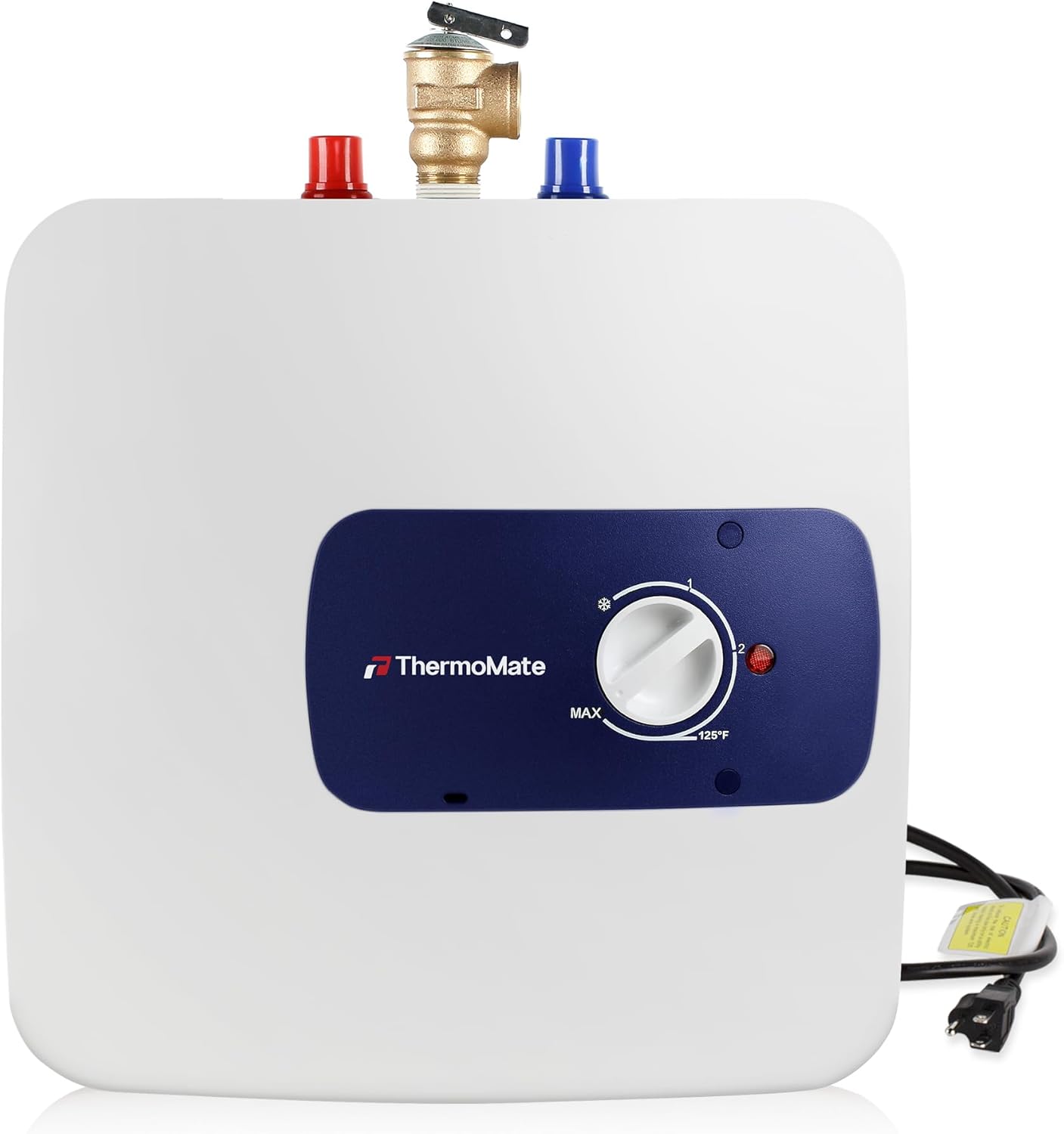
ThermoMate ES800 8-Gallon
| Capacity | 8 gallons |
|---|---|
| Wattage | 1440 watts |
| Voltage | 120 volts |
| Maximum Temperature | 140 °F |
| Maximum Pressure | 150 psi |
The ThermoMate ES800 is an 8-gallon point-of-use electric tank heater meant to provide near-instant hot water to a single fixture or to act as a booster for a distant tap. It uses a 1440W, 120V plug-in element and an adjustable thermostat with a 50°F to 149°F range, and installs on the floor or wall with 1/2" NPT plumbing connections. Notable build details include a three-layer tank with fused porcelain enamel glass lining, an Incoloy 800 heating element for corrosion resistance, and a thick CFC-free polyurethane insulation to hold heat longer. Practical benefits are quick recovery for small loads, UL-listed safety components including a T&P valve, and a compact footprint that fits under sinks or in small service spaces. Expect it to serve single sinks, RVs, or remote fixtures well, but it is not sized for showers or larger simultaneous demands. Installation is straightforward for those with basic plumbing access and a 120V outlet, and the included mounting kit and T&P valve simplify setup.
Best for: Buyers who prioritize dependable, long-lasting point-of-use hot water for a single fixture or as a booster and want a straightforward, safety-focused installation.
Less Ideal for: Homes needing hot water for showers, multiple simultaneous fixtures, or higher flow-rate applications should choose a larger or on-demand solution.
- Compact plug-in design for easy under-sink or wall mounting without hardwiring
- Incoloy 800 heating element and porcelain-enamel glass lining resist corrosion for longer life
- UL-listed safety components and included T&P valve for pressure and temperature protection
- Thick polyurethane insulation improves standby heat retention and reduces cycling
- 8-gallon capacity is too small for showers or multi-fixture use
- Limited to 120V/1440W power, so recovery and flow support are modest compared with higher-watt models
Verdict: A compact, safety-minded 8-gallon booster with corrosion-resistant internals that delivers reliable point-of-use hot water for a single fixture.
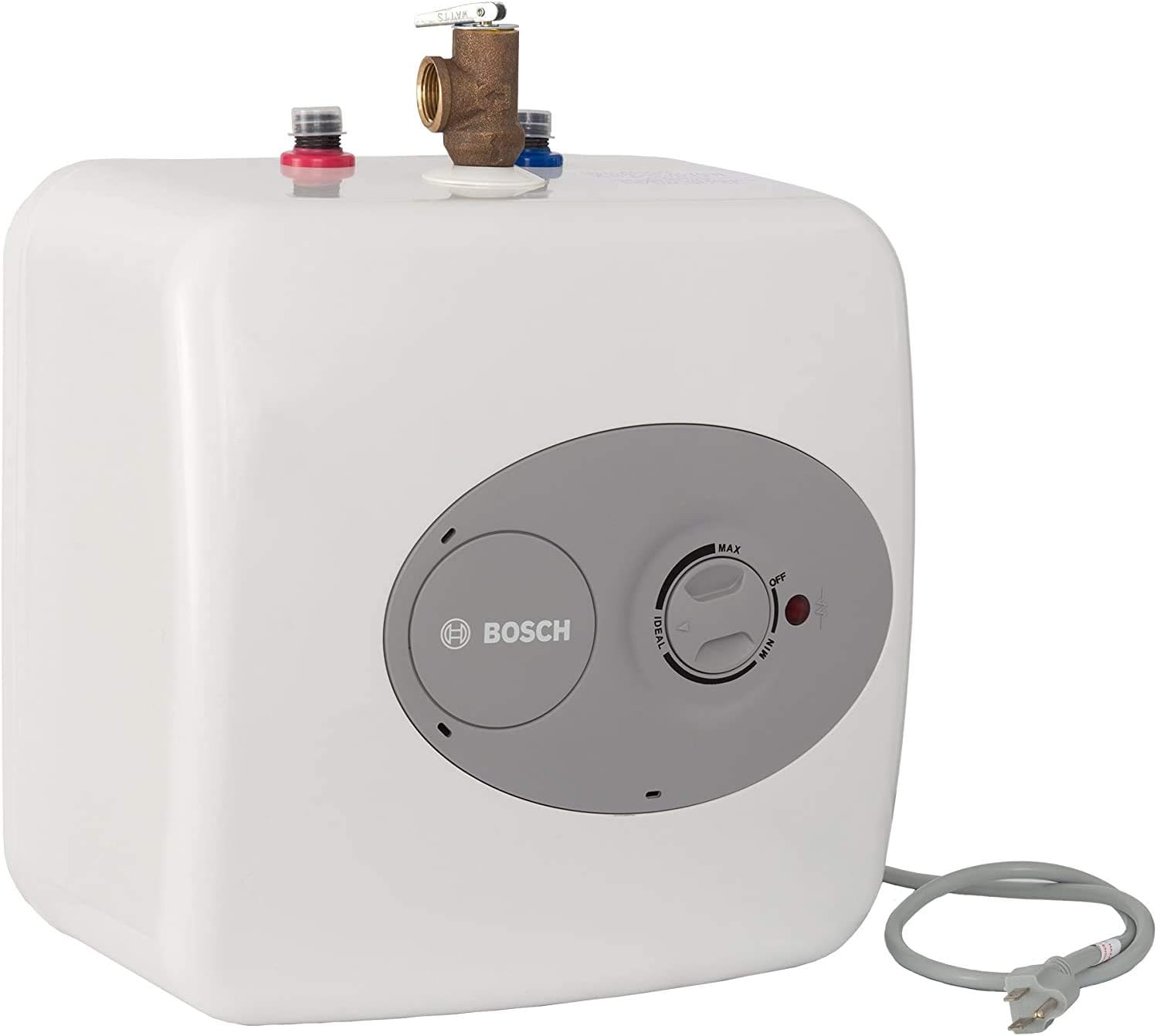
Bosch Tronic 3000 T ES2.5
| Capacity | 2.5 gallons |
|---|---|
| Wattage | 1440 watts |
| Voltage | 120 volts |
| Maximum Temperature | 140 °F |
| Efficiency | 98% |
The Bosch Tronic 3000 T ES2.5 is a compact electric mini-tank that sits under a sink or mounts on a wall to provide immediate hot water without running a long line from a central heater. It plugs into a standard 120V outlet and uses a 1440 W element to heat a 2.5-gallon glass-lined tank, making it a good booster for a single sink or for supplying two nearby fixtures. The external temperature dial and an included temperature-and-pressure relief valve make it simple to control and maintain, and the high reported thermal efficiency means less standby heat loss. Installation options are flexible — shelf, wall, or floor mounting — and the unit is light enough for easy handling. Limitations are its small capacity, which suits point-of-use needs but will not replace a whole-house system, and the 120V/12.5A electrical requirement may require dedicated circuit planning in some installations.
Best for: Buyers who want a proven, compact booster to cut wait time for hot water at a sink and value a durable, easy-to-install solution backed by strong user feedback.
Less Ideal for: Households needing hot water for multiple high-flow fixtures or full-bath supply should choose a larger point-of-use or whole-house heater instead.
- Compact 2.5-gallon tank provides near-instant hot water at the point of use
- Glass-lined tank for durability and corrosion resistance
- Plugs into a standard 120V outlet for independent installation
- Flexible mounting options: shelf, wall, or floor mount
- Small capacity not suitable for showers or high-demand uses
- Requires 120V/12.5A electrical connection which may need circuit planning
Verdict: A compact, reliable mini-tank booster that brings fast hot water to a sink or nearby fixtures without complex electrical changes.
GE 18 Gallon Electric Water Heater

| Capacity | 45 liters |
|---|---|
| Wattage | 14400 watts |
| Voltage | 120 volts |
| Heat Output | 140 °F |
| Maximum Pressure | 150 psi |
This GE 18-gallon electric water heater is designed as a point-of-use booster or standalone unit for small homes, condos, cabins, or isolated hookups. It connects to any standard 120-volt supply and uses common 3/4-in NPT water fittings, so installation is straightforward where space is limited. The stainless steel heating element and included anode rod aim to resist corrosion and extend service life, and a rust-proof drain valve simplifies maintenance. The adjustable thermostat and 140°F heat output let you tune delivery for chores like laundry or a distant bathroom. Because it is a compact floor-mounted tank, it provides quick local hot water but will not match the continuous output of larger whole-house systems, so expect limited runtime for multiple simultaneous uses. Practical benefits are easy installation, flexible placement, and reliable construction; compromises are capacity and recovery compared with larger or tankless units. For someone who needs extra hot water close to a fixture or to boost a long run, it is a sensible, low-friction solution.
Best for: Buyers who want a reliable, easy-to-install local hot-water booster for a single fixture, small apartment, or to support a distant washing machine and prefer a low-risk, straightforward solution.
Less Ideal for: Homes that require continuous whole-house hot water or households with frequent simultaneous showers and appliances should choose a larger-capacity or tankless system instead.
- 120-volt plug-in design that installs on standard household supply for easy placement
- Standard 3/4-in NPT water connections for simple hookup to existing plumbing
- Stainless steel heating element and anode rod for corrosion resistance and longer service life
- Adjustable thermostat allows straightforward temperature control up to 140°F
- Compact footprint fits tight spaces like kitchens, laundry rooms, RVs, and garages
- 18-gallon capacity limits simultaneous hot water use and shortens runtime between recoveries
- Not intended for whole-house continuous demand compared with larger tanks or tankless systems
Verdict: Choose this GE compact electric heater when you need a dependable, easy-to-install point-of-use booster to deliver extra hot water where space and simplicity matter.
Choosing the Right Booster Water Heater: Key Factors to Consider
Recovery Rate and Heating Capacity
Recovery rate determines how quickly a booster water heater can raise incoming water to your desired temperature. Higher recovery means the unit can support more simultaneous fixtures or shorten the time between showers. Evaluate recovery in gallons per minute at realistic temperature rises rather than relying on vague ratings.
Matching capacity to household demand prevents undersizing, which leads to frequent cold-water drops, while avoiding oversizing that increases installation complexity and cost. Consider expected peak draws such as multiple showers plus dishwasher use when estimating required recovery.
Usable Flow at Temperature Rise
A booster's published flow numbers are only useful when paired with the temperature rise you need. Cold inlet temperatures vary by season and location, so check flow rates at the temp rise that reflects your cold-water conditions.
Focus on the usable flow at the specific temperature rise you expect during winter months. That tells you whether the booster will actually sustain two showers or a shower plus a laundry cycle without dropping below comfortable temperature.
Installation Needs and Space
Booster water heaters can be wall-mounted or floor-mounted and may require dedicated electrical or gas connections. The physical footprint, service clearances, and access to hot and cold plumbing lines affect where you can place the unit.
Think about venting, electrical capacity, and any additional fittings required for integration with your existing water heater. Tight spaces or retrofit situations often favor compact, wall-hung designs with flexible connection options.
Energy Efficiency and Operating Cost
Efficiency determines how much energy the booster uses to keep water at set temperatures or during frequent demand spikes. Look for low standby losses, well-insulated tanks if present, and efficient heating elements or burners. These features reduce long-term operating costs.
Calculate typical daily runtime for your household to estimate operating expense. Higher upfront efficiency can pay off in homes with heavy hot-water use, while intermittent-use homes may prioritize lower standby losses.
Controls, Temperature Stability, and Safety
Accurate temperature controls and consistent output are essential to avoid scalding and to maintain comfort across varying flow rates. Digital or thermostatic controls that hold setpoint under changing demand are preferable.
Safety features such as over-temperature protection, pressure-relief compatibility, and clearly labeled service access points matter for code compliance and long-term reliability. Simple, serviceable controls reduce repair time and cost.
Compatibility with Existing Water Heater
A booster must integrate cleanly with your current water-heating system. Consider whether the unit is designed to preheat inlet water, post-boost outgoing hot water, or operate in a recirculation setup. Matching the booster's intended role to your plumbing layout avoids unintended temperature or pressure issues.
Confirm the required plumbing configuration, check valve needs, and any recommended piping arrangements to prevent heat exchange or cross-flow that would impair performance.
Sizing a Booster for Your Home
Sizing a booster water heater starts with two numbers: your expected peak hot-water flow and the inlet water temperature. Estimate peak flow by summing typical simultaneous fixture draws, for example one shower plus a dishwasher. Then determine the temperature rise the booster must deliver to reach a comfortable use temperature.
Once you have flow and required temperature rise, use manufacturer flow charts to select a booster that sustains that flow at the specified rise. Allow a margin for seasonal cold-water drops and future changes in household demand.
- Measure or estimate peak simultaneous fixture flows in gallons per minute.
- Use a conservative winter inlet temperature for calculations.
- Select a booster rated for the required flow at that temperature rise plus a 10 to 20 percent margin.
Placement, Venting, and Service Access
Think about where the booster will be mounted and how it will be serviced. Wall-mounted boosters save floor space but must be installed on structurally sound walls and near plumbing runs. Floor-mounted units may need a dedicated footprint and clearance around the unit for maintenance.
Venting and electrical routing are common constraints. Some boosters require mechanical venting or specific electrical circuits. Plan routing early to avoid expensive rerouting during installation.
- Verify structural support for wall-mounted installations.
- Confirm clearance requirements for panel removal and routine service.
- Plan venting and electrical access before ordering the unit.
Controls and Integration with Plumbing
Modern boosters offer digital thermostats, adjustable temperature limits, and diagnostics that simplify setup and troubleshooting. Consider units with lockout features or tamper-resistant settings if you have children.
Integration details include check valves, mixing valves, and pressure-balancing arrangements. A mixing valve can protect against scalding and let you set a safe delivery temperature even when the booster can produce higher temperatures.
- Prioritize stable controls that hold temperature under varying flows.
- Plan for mixing or tempering valves when delivering hot water to fixtures.
- Check whether the booster supports simple diagnostic readouts for service.
Maintenance and Longevity
Routine maintenance extends the life of any booster water heater. Tasks include checking pressure-relief valves, flushing to remove scale where applicable, and inspecting electrical or gas connections. Easy access to service points reduces maintenance time and cost.
Materials and corrosion resistance in wet areas matter. Choose units with serviceable components and clear documentation to simplify repairs and part replacement over time.
- Ensure accessible service panels and replaceable parts.
- Follow recommended flushing intervals if the unit contacts hard water.
- Inspect safety devices annually as part of home maintenance.
When to Consider a Recirculation or Multiple-Point Solution
In large homes or layouts with distant bathrooms, a single booster may not solve long wait times at remote fixtures. Recirculation systems or multiple boosters zoned to high-demand areas can provide more consistent delivery.
Recirculation improves perceived responsiveness but adds plumbing complexity and potential standby losses. Evaluate whether targeted boosters at problem zones or a whole-house recirculation loop better match your priorities and budget.
- Map hot-water demand by location before deciding on recirculation.
- Consider zoning boosters to serve specific clusters of fixtures.
- Weigh the tradeoff between convenience and ongoing energy use for recirculation.
How We Chose the Best Booster Water Heater
We prioritized specifications and features that most directly affect how well a booster water heater improves hot-water availability in a typical household. Key evaluation dimensions included recovery rate, which determines how quickly the unit can raise incoming water temperature; usable flow rate at target temperature rise, which shows practical simultaneous fixture support; installation flexibility, covering mounting options and plumbing/electrical hook-up requirements; energy efficiency and standby losses, since continuous or frequent use affects operating cost; control accuracy and temperature stability, to avoid scalding and maintain comfort; and safety features such as overheat cutoffs and pressure-relief compatibility. We excluded units intended only for niche industrial processes or specialty commercial boilers because the typical residential buyer needs compact, code-compliant solutions. We also filtered out models lacking clear published flow and temperature-rise data, since those specs are essential for predicting real-world performance. The products that made the list demonstrate balanced outcomes across the dimensions above and include options suited to different household sizes and installation constraints.
Our full evaluation process is outlined in our review methodology.
FAQ
How much hotter can a booster water heater make my water?
Boosters are sized to raise inlet water to a target delivery temperature, often by 30 to 60 degrees Fahrenheit depending on the model. The achievable temperature rise depends on the unit's heating capacity and the flow rate in use.
Can I install a booster myself?
Installation can involve plumbing, electrical, or venting work that typically requires a licensed professional to meet local codes. Homeowners with strong plumbing and electrical experience may handle some installs, but inspections and permits are often required.
Will a booster water heater save energy?
A booster can be more efficient than oversizing a primary heater because it heats only the water near demand points. However, operating efficiency depends on usage patterns, standby losses, and control strategy, so savings vary by household.
Do boosters work with existing mixing valves and thermostats?
Yes. Most boosters integrate with mixing valves and existing thermostatic controls, but you should confirm compatibility and recommended wiring or piping configurations to ensure stable temperature control and safety.
How do I decide between a wall-mounted or floor-mounted booster?
Choose wall-mounted units for tight utility closets or when floor space is limited, provided the wall can support the weight. Floor-mounted units may offer larger tank capacity and simpler servicing, so prioritize access and structural support when deciding.
Final Verdict
A booster water heater can be an efficient way to eliminate cold-water gaps without replacing your main heater. Prioritize recovery rate and usable flow at realistic temperature rises to ensure the booster meets peak demands. Balance installation constraints, control stability, and long-term operating cost when choosing a unit. When in doubt, size conservatively for peak simultaneous draws and plan installation details early. That approach helps you pick a booster that reliably restores hot water where you need it, with clear expectations for performance and maintenance.