
Note: This article contains affiliate links. If you click on these links and make a purchase, we may earn a small commission at no extra cost to you. This helps support our research and content. Read our full affiliate disclosure here.
If you want fresh bread from home without a big up-front cost, a budget bread maker can deliver warm loaves and fewer grocery trips. Choosing the right inexpensive machine matters because lower-priced models vary widely in loaf consistency, durability, and how easy they are to operate and clean. This guide walks through a short list of the top budget bread makers so you can pick one that reliably produces the loaf size, crust type, and program options you need. We evaluated usability, baking results, and long-term convenience to focus only on practical, everyday performance.
Top Picks at a Glance
| Best Overall The best all-around choice for most situations | KITCHENARM Smart Bread Machine 2 lb |  |
| Best Quality Built to a higher standard if you want something more solid | KBS 2.2LB Convection Bread Maker |  |
| Best Value The sweet spot between price and what you get | Amazon Basics Bread Maker BM1349 |  |
| Best Budget The cheapest option that still gets the job done reliably | Elite Gourmet Bread Maker EBM8103M |  |
| Top Rated A top-rated pick with lots of positive feedback | Elite Gourmet Bread Maker EBM8103B |  |
| Most Popular A crowd favorite that many people choose with confidence | Cuisinart Bread Maker CBK-110P1ES |  |
| Best Seller A high-volume bestseller chosen again and again | OSIPOTO Bread Maker BM8205 | 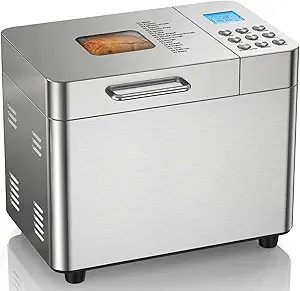 |
KITCHENARM Smart Bread Machine 2 lb

| Voltage | 120 volts |
|---|---|
| Capacity | 2 pounds |
| Wattage | 550 watts |
| Number of Programs | 29 |
The KITCHENARM 29-in-1 Smart Bread Machine is a full-featured countertop bread maker aimed at people who want both convenience and customization. You pick a menu, add ingredients, and use presets for common loaves like basic, whole wheat, gluten free or specialty options such as brioche and sourdough; it also handles non-bread tasks such as cake, jam and yogurt. Notable features include three loaf sizes (2 lb, 1.5 lb, 1 lb), three crust colors, a 15-hour delay timer, 1-hour keep-warm, and an LCD that stores recent settings for one-press repeats. Advanced users can program up to four personalized cycles to tweak knead, rise and bake stages, which is useful for experimenting with alternative flours or recipes. The unit is ETL certified and ships with a nonstick pan and recipe resources. Limitations to consider are hand-wash care and a mid-range 550-watt motor that can be slower than higher-powered models, so very dense artisan-style loaves may require recipe adjustments.
Best for: Buyers who want a budget-friendly machine that still offers many presets plus deeper customization for experimenting with different breads and diets.
Less Ideal for: People who need fully dishwasher-safe parts or who bake very large, heavy artisan loaves frequently and want a higher-wattage commercial-style unit.
- Wide program selection with 29 automatic menus covering breads and non-bread recipes
- Three loaf sizes and three crust settings for flexible batch control
- Customizable HOME MADE menu lets you program cycle-level times for advanced recipes
- Delay timer, keep-warm and one-press repeat make daily use convenient
- ETL certified build and a nonstick bread pan simplify safe operation and cleanup
- Bread pan and parts require hand washing rather than dishwasher-safe cleaning
- 550-watt motor is adequate but not as fast or powerful as premium models
Verdict: A versatile, budget-oriented bread maker that balances easy presets with programmer-level control for home bakers who want flexibility without a high price.
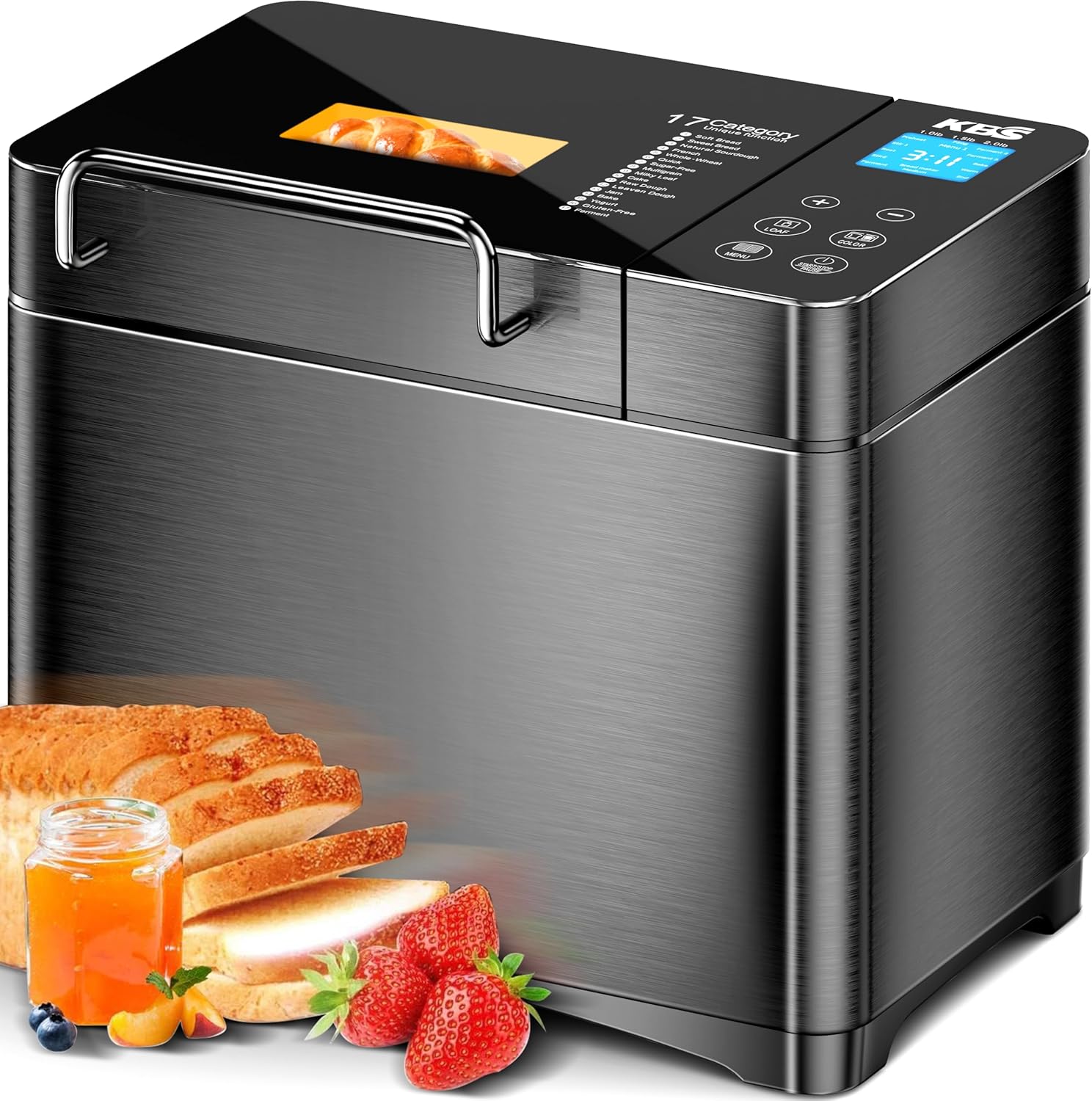
KBS 2.2LB Convection Bread Maker
| Capacity | 2.2 pounds |
|---|---|
| Wattage | 710 watts |
| Number of Programs | 17 |
| Voltage | 120 volts_of_alternating_current |
The KBS 2.2LB Convection Bread Maker is built for cooks who want faster, more consistent home loaves without much babysitting. It uses a 710W motor, dual heaters and 360° convection to speed baking and promote an even, crisper crust while a ceramic horizontal pan produces traditional rectangular loaves. The machine offers 17 programs covering basics, sourdough, gluten-free, jam and yogurt plus three loaf sizes and three crust colors, and a built-in nut/fruit dispenser automates add-ins. Practical touches include a 15-hour delay timer, 1-hour keep-warm, 15-minute power-interruption recovery and a large viewing window. Cleaning is easier thanks to the nonstick ceramic pan and removable paddles, and the stainless steel body feels durable. Expect a bit more countertop footprint and weight than compact models, and advanced bakers who want full manual control over bake profiles may find some preset limits. For the price, it delivers strong performance and consistent results for everyday bread baking.
Best for: Buyers who prioritize reliable, bakery-style results on a budget and want a machine that speeds baking while automating add-ins and timing.
Less Ideal for: Those who need a very small, ultra-light unit for limited counter space or hobbyists who require full manual control over every bake parameter.
- Convection plus dual heaters for faster, more even baking and crisper crusts
- Wide program selection (17) including sourdough and gluten-free for versatile baking
- Healthy nonstick ceramic pan free of PTFE/PFOA and easy to clean
- Auto nut/fruit dispenser for hands-off mix-ins and consistent distribution
- 15-hour timer, keep-warm and power-interruption recovery for reliable timed baking
- Heavier and larger than some compact budget bread makers
- Presets limit fine-grained manual control over baking profiles
Verdict: A performance-leaning, budget-friendly bread maker that delivers faster, more consistent bakery-style loaves with convenient automation features.
Amazon Basics Bread Maker BM1349

| Voltage | 120 volts |
|---|---|
| Capacity | 2 pounds |
| Wattage | 550 watts |
| Number of Programs | 14 |
This Amazon Basics bread maker handles the full bread cycle—mixing, kneading, rising, and baking—automatically and is aimed at simple, day-to-day loaf production. You choose from 14 preset programs that cover standard breads, doughs, gluten-free mixes, and even jam, and a three-position crust selector lets you dial crust darkness. The 550-watt motor supports up to a 2-pound loaf and an ExpressBake mode can finish a loaf in under 90 minutes when you need bread fast. The machine is built with a stainless-steel exterior and a nonstick pan, so loaf release and cleanup are straightforward; controls use an LCD display for program selection. Expect consistent basic loaves and good convenience for meal-to-meal baking, but it is not a professional machine for specialty artisan techniques and crust shaping is limited by the fixed pan. For buyers focused on routine home baking on a budget, this delivers the core features without extra complexity.
Best for: Buyers who want a no-frills, budget-friendly way to bake regular loaves, doughs, and gluten-free breads at home with easy setup and reliable presets.
Less Ideal for: Anyone seeking artisan-style baking control, large or custom-shaped loaves, or a machine built for high-volume or professional use should consider higher-end alternatives.
- 14 preset programs including gluten-free and dough settings for versatile baking
- ExpressBake option produces a loaf in under 90 minutes
- Nonstick pan simplifies loaf removal and cleaning
- Three crust color settings let you choose light, medium, or dark crust
- Fixed loaf pan limits shaping and crust variation compared with ovens or pro machines
- 550-watt motor and basic controls are designed for standard home use, not heavy or commercial workloads
Verdict: A practical, budget-friendly bread maker that covers everyday loaves and quick bakes with straightforward presets and easy cleanup.
Elite Gourmet Bread Maker EBM8103M

| Capacity | 2 pounds |
|---|---|
| Wattage | 550 watts |
| Number of Programs | 19 |
| Voltage | 120 volts |
The Elite Gourmet EBM8103M is a straightforward countertop bread maker aimed at home bakers on a budget. It handles mixing, kneading, rising, and baking for 1 lb, 1.5 lb, or 2 lb loaves and offers 19 one-touch programs including gluten-free, quick bread, pizza dough, and jam, so you can try a variety of recipes without manual steps. The 15-hour delay timer and 60-minute keep-warm function make it easy to time fresh bread for breakfast, and the light/medium/dark crust settings let you dial in loaf color. Practical inclusions like a nonstick bread pan, kneading blade, measuring tools, and a blade removal tool keep cleanup and maintenance simple, though the unit requires some hand washing. At 550 watts it uses less energy than an oven and its compact footprint fits small kitchens. Limits to consider are the basic metal construction and simple controls—this is not a high-end, feature-packed machine—but for straightforward, reliable home bread baking at a low price it does the job well.
Best for: Price-conscious home cooks who want an easy, no-fuss machine to make fresh bread, dough, and simple extras without learning complicated settings.
Less Ideal for: Bakers seeking a premium, commercial-style machine with advanced programmability, touchscreen controls, or heavy daily production should look at higher-tier models.
- 19 preset programs cover gluten-free, quick bread, dough and specialty options
- Three loaf sizes (1, 1.5, 2 lb) and crust color settings for flexible results
- 15-hour delay timer plus 60-minute keep-warm for scheduled fresh bread
- Compact, energy-efficient operation uses less power than a full oven
- Basic metal construction and manual cleaning required for some parts
- Controls and feature set are simple compared with higher-end machines
Verdict: A reliable, budget-friendly bread maker that covers basic baking needs and scheduled fresh loaves without unnecessary complexity.
Elite Gourmet Bread Maker EBM8103B

| Capacity | 2 pounds |
|---|---|
| Wattage | 550 watts |
| Number of Programs | 19 |
| Voltage | 120 volts |
The Elite Gourmet EBM8103B is a straightforward programmable bread machine that handles kneading, rising, and baking for 1, 1.5, or 2 lb loaves. It is typically used by adding ingredients to the nonstick pan, choosing one of 19 preset programs (including gluten-free, whole wheat, quick bread, and jam), and letting the unit complete the cycle; a 15-hour delay timer and 60-minute keep-warm let you schedule fresh bread for specific times. Notable features include multiple loaf sizes, three crust darkness settings, and included accessories such as a measuring cup, spoon, and blade removal tool. In practice the machine makes baking hands-free and predictable, producing evenly baked loaves without heating a full oven, which is convenient for small kitchens or hot weather. Limitations are that the controls and display are basic rather than premium, and the aluminum construction and compact footprint mean it is optimized for home use rather than heavy daily commercial baking.
Best for: Buyers who want a dependable, no-frills machine to produce consistent homemade loaves on a schedule and who prioritize simple, reliable operation over premium features.
Less Ideal for: Users who need pro-level throughput, advanced customization, or smart/home integration should consider higher-end models instead.
- Wide selection of 19 preset programs for different bread types and doughs
- Supports three loaf sizes (1, 1.5, 2 lb) for flexible batch sizes
- 15-hour delay timer and 60-minute keep-warm for scheduled baking
- Nonstick bread pan and included accessories make setup and cleanup easier
- Basic control panel and display lack advanced programmability or app connectivity
- Aluminum construction and compact motor are intended for home, not high-volume commercial use
Verdict: A reliable, budget-friendly bread maker that delivers consistent, hands-off loaves and scheduled baking for everyday home use.
Cuisinart Bread Maker CBK-110P1ES

| Capacity | 2 pounds |
|---|---|
| Wattage | 550 watts |
| Number of Programs | 12 |
| Voltage | 120 volts |
The Cuisinart CBK-110P1ES is a compact, fully automatic bread machine that mixes, kneads, and bakes loaves up to 2 pounds using one of 12 preset programs. Typical use involves adding ingredients, choosing loaf size and crust color on the LCD panel, and either starting immediately or setting the 13-hour delay timer so fresh bread is ready when you want it. The machine offers 3 loaf sizes and 3 crust settings, a 60-minute keep-warm cycle, and audible beeps to signal progress. Its vertical nonstick baking pan and simple controls make it straightforward for daily home baking and experimenting with recipes from standard loaves to cakes and jams. Practical benefits include a small counter footprint, a broad set of presets for beginners, and a reliable mix-knead-bake sequence at 550 watts. Limitations are that the unit is basic compared with high-end models: controls are simple rather than highly customizable, the pan is vertical which affects loaf shape, and some parts require hand washing rather than dishwasher convenience.
Best for: Buyers who want a reliable, easy-to-use machine that automates bread-making with presets and a delay timer and who value social proof and established brand reliability when choosing a budget-friendly option.
Less Ideal for: If you need a machine for large specialty loaves, advanced manual programming, or fully dishwasher-safe parts, look at higher-end or specialized models instead.
- 12 preset programs cover common breads and nonbread recipes
- Three loaf sizes and three crust color choices for customization
- Compact footprint fits small kitchens and counters
- 13-hour delay-start lets you schedule fresh bread for a specific time
- Vertical loaf pan produces taller, narrower loaves compared with traditional horizontal pans
- Controls and display are basic with limited manual customization options
Verdict: A dependable, compact bread maker with plenty of presets and a delay timer that delivers homemade loaves without complexity, making it a smart budget pick.
OSIPOTO Bread Maker BM8205

| Capacity | 2 pounds |
|---|---|
| Wattage | 600 watts |
| Number of Programs | 17 |
| Voltage | 120 |
The OSIPOTO BM8205 is a user-friendly countertop bread machine designed for straightforward, everyday loaves. You add ingredients to the nonstick pan, choose one of 17 programs (including whole wheat, gluten-free, jam, and cake), set one of three loaf sizes and crust colors, and let the 600 W motor handle kneading and baking. The machine offers a 15-hour delay timer and a keep-warm function so you can have fresh bread when you want it, and the manufacturer cites even heat distribution for consistent crust and crumb. Practical touches include a clear LCD, a low-noise motor and an overheat-protection feature that pauses operation if temperatures run high. Limitations to note: the 2 lb maximum capacity is aimed at families but may be large for singles, the recipe book and included measuring tools are basic, and the unit requires hand-washing for care. For buyers focused on predictable results on a budget, the BM8205 delivers a simple, reliable way to bake a variety of breads at home.
Best for: Buyers who want a dependable, easy-to-use bread machine that produces consistent loaves with minimal fuss and a wide set of preset programs.
Less Ideal for: Bakers seeking a fully hands-on sourdough or artisan workflow or those who need dishwasher-safe parts should consider other options.
- 17 automatic programs cover basic, whole wheat, gluten-free, jam and cake options
- 2 lb capacity with three loaf-size and three crust-color settings for flexible batches
- 600 W motor with low-noise operation and claimed 360° even heat for consistent baking
- 15-hour delay timer and 1-hour keep-warm function for scheduled baking
- Stainless steel body and nonstick pan simplify cleaning and durability
- Requires hand washing for care rather than dishwasher-safe components
- Recipe accessories are basic and may not cover advanced formulas like sourdough starters
Verdict: A straightforward, budget-friendly bread maker that reliably bakes a range of standard loaves with programmable convenience.
Choosing the Right Budget Bread Maker: Key Factors to Consider
Loaf Size and Shape
Loaf size and shape determine how much bread you get per bake and how it fits your household usage. Budget machines often offer one or two size options such as 1-pound and 1.5-pound loaves. Choose a size that matches how quickly your household consumes bread; too large a loaf leads to waste, too small increases bake frequency.
Shape matters for slicing and storage. Taller, narrower loaves can be easier to slice thinly for sandwiches, while wider loaves may brown differently and change crumb texture. Confirm the pan dimensions when possible and think about how you usually use sliced bread to make the best choice.
Program Variety and Control
Program variety affects how flexible the machine is for different flours and recipes. Even on a budget model, look for essential programs like white, whole wheat, quick/rapid, and a dough-only setting. Some machines also include gluten-free, sourdough, or artisan crust profiles which expand what you can bake.
Control options like crust darkness, delayed start, and programmable timers let you fine-tune results and schedule baking to fit your routine. A simple, predictable control layout typically reduces user error, which is particularly valuable for inexperienced bakers.
Kneading System and Motor
The kneading paddle design and motor strength shape dough development and overall reliability. A well-designed paddle creates consistent gluten formation for a uniform crumb. Underpowered motors or awkward paddle placements can leave unincorporated flour pockets or require repeated bakes to correct texture.
Look for machines with a proven knead-and-rest cycle pattern and a motor rated to handle the recommended flour capacity. Heavier duty motors tend to last longer, especially if you plan to bake frequently or use denser flours.
Cleaning and Maintenance
Regular cleaning keeps your bread maker hygienic and preserves nonstick surfaces. Budget models with removable pans and dishwasher-safe paddles simplify cleanup. Nonstick coatings vary in durability, so consider how aggressive you are with scrubbing and whether the paddle area is easy to reach.
Maintenance also includes replaceable parts like paddles and seals. Machines that let you remove the kneading paddle easily or replace worn components extend usable life and reduce long-term frustration.
Noise, Cycle Time, and Energy Use
Noise level affects where you can run the bread maker in your home. Budget units can be noisier, particularly during kneading. If you bake early in the morning or overnight, quieter operation matters for household comfort.
Cycle time and energy use influence convenience and running cost. Rapid programs shorten wait time but can compromise crumb. Longer standard cycles usually yield better texture. Consider the tradeoff between faster cycles and final loaf quality when selecting a model.
Why Budget Bread Makers Can Be a Smart Buy
Low-cost bread makers strip away premium bells and whistles but still deliver the core function: mixing, kneading, and baking. For many cooks, the goal is consistent homemade bread without the complexity and cost of advanced machines. Budget models can excel at that if you match features to your habits and expectations.
These machines are especially practical for first-time bakers or households that bake once or twice a week. You get hands-off convenience, consistent timing, and the ability to experiment with simple recipes without a large investment.
- Simpler controls reduce the chance of mistakes.
- Lower initial cost lowers the risk of trying new techniques.
- Smaller footprint works well in compact kitchens.
Common Tradeoffs in Lower-Priced Models
Budget bread makers often trade advanced features for affordability. Expect fewer preset programs, simpler displays, and lighter construction. These tradeoffs affect long-term durability and the range of recipes you can reliably make.
Be aware that kneading paddles and nonstick coatings on cheaper units can wear faster. You may need to plan for occasional part replacement or adjust cleaning methods to preserve surfaces.
- Fewer specialty programs like sourdough or artisan crust.
- Basic timers rather than highly precise scheduling.
- Potential for louder kneading cycles.
Tips to Improve Results with a Budget Machine
Small adjustments in ingredients and technique can compensate for the limits of a budget bread maker. Measure flour by weight when possible to improve consistency, and be prepared to tweak water amounts depending on humidity and flour type. Letting dough rest longer before baking often improves crumb even in machine cycles.
Use the dough cycle for delicate recipes so you can shape and proof by hand before the final bake. Removing the kneading paddle before the last rise can also reduce the hole at the bottom of the loaf, improving presentation and sliceability.
- Weigh ingredients for consistency.
- Use dough cycle plus manual shaping for artisan results.
- Consider slight hydration adjustments for whole-grain flours.
Maintenance That Extends Useful Life
Routine cleaning after each bake prevents buildup and preserves nonstick finishes. Remove crumbs and wipe the interior while warm but not hot, then wash pans and paddles according to manufacturer guidance. Avoid abrasive cleaners that can damage coatings.
Inspect the paddle and pan for wear periodically and replace parts when performance drops. Storing the unit in a dry place and avoiding overfilling the pan will reduce stress on the motor and seals.
- Clean pans and paddles after every use.
- Avoid metal utensils that scratch nonstick surfaces.
- Check for loose fittings or unusual noises during kneading.
Recipes That Work Well in Budget Bread Makers
Simple white sandwich loaves and basic whole-wheat breads are the most reliable outcomes on budget machines. These recipes tolerate slight inconsistencies in kneading and rise times while still producing good texture and flavor.
Quick breads and enriched doughs with eggs, butter, and sugar are also viable, but they may need minor hydration tweaks. Heavier doughs like dense rye or large seed-filled loaves can stress the motor and might require smaller batches or partial hand mixing.
- Basic white and whole-wheat recipes for daily use.
- Enriched doughs with adjusted hydration.
- Avoid very dense or oversized recipes on a first try.
How We Chose the Best Budget Bread Maker
We shortlisted budget bread makers that balance reliable baking performance with affordability and low ongoing fuss. Selection focused on machines that consistently produce even crumb structure and crust, so loaf consistency was a primary filter. We also prioritized user-facing features that matter day to day, including programmable loaf sizes and crust settings, simple control panels, and straightforward bread programs for white, whole wheat, and quick loaves. Durability and build quality were assessed by looking at materials, motor and kneading-paddle design, and ease of replacement for high-wear parts. Ease of cleaning and maintenance was another deciding factor, including removable pans and nonstick coatings that withstand frequent use. Finally, we considered energy efficiency and run-time for typical loaf cycles to favor machines that are economical to operate. We excluded models that lacked essential bake or knead programs, used nonstandard loaf sizes, or had consistently poor user feedback on cleaning or breakdowns. The resulting list targets budget-conscious buyers who still expect dependable baking and low hassle.
Our full evaluation process is outlined in our review methodology.
FAQ
How long does a typical bread cycle take on a budget machine?
A standard loaf cycle usually takes between 3 and 4 hours, depending on loaf size and program. Quick cycles can finish in about 1.5 to 2 hours but may sacrifice some crumb development.
Can I use whole-grain or gluten-free flours in a budget bread maker?
You can use whole-grain flours with slight adjustments to hydration and kneading. Gluten-free flours often require specific program profiles; budget machines may lack dedicated gluten-free settings, so results depend on the recipe and willingness to experiment.
How do I prevent a hole from the kneading paddle in the bottom of the loaf?
Removing the paddle after the final knead and before the last rise helps, as does using the dough cycle followed by hand shaping and a final proof. Some bakers also slather a little oil in the paddle area to reduce sticking.
What maintenance keeps a budget bread maker working longer?
Wipe out crumbs after each bake, wash pans and paddles according to the instructions, and avoid abrasive scrubbing. Periodically check the paddle and pan for wear and replace parts if performance declines.
Is it worth buying a larger loaf capacity on a budget model?
Larger capacity makes sense if you regularly feed a family or need larger slices, but bigger loaves take longer and can be harder to bake evenly on lower-powered motors. Match capacity to your typical consumption.
Final Verdict
For most home bakers on a tight budget, prioritizing loaf consistency, a handful of reliable programs, and ease of cleaning will yield the best long-term satisfaction. Accepting some tradeoffs in bells and whistles lets you get dependable fresh bread without overspending. Focus on the features that match how you bake—loaf size, essential programs, and durable kneading components—and you can confidently choose a budget bread maker that meets your routine needs.