
Note: This article contains affiliate links. If you click on these links and make a purchase, we may earn a small commission at no extra cost to you. This helps support our research and content. Read our full affiliate disclosure here.
When cold weather arrives, a budget heater for home use can make a room comfortable without overextending your energy bill. You want reliable warmth, safe operation, and a unit that fits the size of the space you plan to heat. This guide shortlists the top picks for affordable, practical home heaters and explains the most important features to compare. We evaluate options based on measurable heat output, energy use, and safety features so you can pick a model that keeps bedrooms, living rooms, or home offices comfortable. Read on for our top picks and the criteria we used to select them.
Top Picks at a Glance
| Best Overall The best all-around choice for most situations | DREO Atom One Space Heater |  |
| Best Quality Built to a higher standard if you want something more solid | DR. Infrared Heater DR-968 |  |
| Best Value The sweet spot between price and what you get | Amazon Basics Ceramic Space Heater |  |
| Best Budget The cheapest option that still gets the job done reliably | Amazon Basics 500W Ceramic Mini Heater |  |
| Top Rated A top-rated pick with lots of positive feedback | DREO Space Heater HSH006 |  |
| Most Popular A crowd favorite that many people choose with confidence | GiveBest Portable Space Heater PTC-905 |  |
| Best Seller A high-volume bestseller chosen again and again | WINHL PTC-150A Space Heater |  |
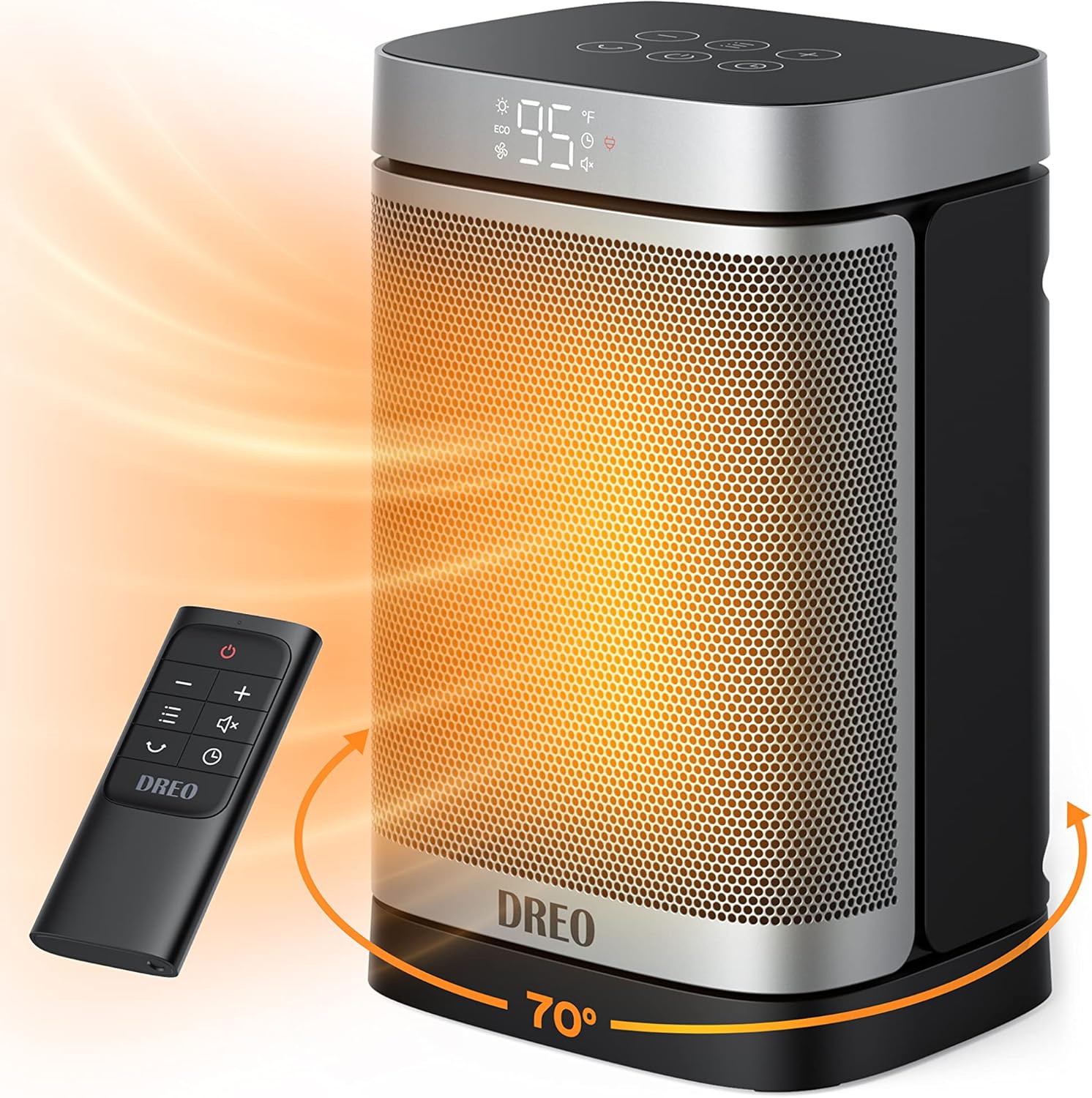
DREO Atom One Space Heater
| Heating Coverage | 200 sq.ft |
|---|---|
| Heat Output | 1500 watts |
| Number of Speeds | 5 |
| Min Temperature Setting | 41 °F |
| Max Temperature Setting | 95 °F |
The DREO Atom One is a compact, feature-packed electric tower heater meant for spot-warming bedrooms, home offices, and small living areas. It uses PTC ceramic heating with up to 1500 watts and a programmable digital thermostat that adjusts from 41 to 95°F in 1°F steps, so you can set a precise target rather than guessing heat settings. Practical controls include 70° oscillation to spread heat, a 1–12 hour timer, ECO mode for automated energy savings, five fan speeds and a detachable filter for basic dust control. The unit is ETL-listed and includes multiple safety measures such as tip-over and overheat protection and an enhanced safety plug, and the included remote and LED display make operation convenient from across the room. On the downside it is designed for ~200 sq ft coverage so it is best for single rooms rather than whole-house heating, and as a compact, fan-forced ceramic heater it produces airflow noise at higher fan settings. For buyers seeking a budget-friendly, programmable bedroom or office heater with broad convenience features, this is a solid, practical choice.
Best for: Buyers who want an affordable, programmable room heater for bedrooms or home offices that balances safety, convenience and energy-conscious operation.
Less Ideal for: Users needing to heat large, open-plan areas or whole houses should look at higher-capacity or whole-home heating options instead.
- 1500W PTC ceramic element for fast, effective spot heating
- Programmable digital thermostat with 1°F increments for precise temperature control
- 70° oscillation and five speeds to spread heat more evenly across a room
- ECO mode and 1–12 hour timer to reduce runtime and energy use
- Built-in safety features including tip-over and overheat protection and ETL listing
- Rated for about 200 sq ft so not suitable for heating large open spaces
- Fan-forced design can be noticeable at higher speeds
Verdict: A compact, budget-friendly 1500W tower heater that delivers precise, programmable room heating with solid safety and energy-saving features.
DR. Infrared Heater DR-968

| Wattage | 1500 Watts |
|---|---|
| Heating Coverage | 576 square feet |
| Number of Speeds | 3 |
| Voltage | 120 |
| Amperage | 12.5 A |
The DR. Infrared Heater DR-968 combines a quartz infrared tube and a PTC element with a high‑velocity low‑noise blower to heat rooms quickly and more evenly than a standard 1500 W unit. It is used freestanding on caster wheels and offers Auto, Low (1000W) and High (1500W) modes with an electronic thermostat and timer so you can set a target temperature and let the unit cycle between power levels to maintain it. The heater includes practical features such as tip‑over and overheat automatic shutoff, an IR remote, and a long power cord for flexible placement. In real rooms it is aimed at heating living spaces, bedrooms, or home offices up to the manufacturer's stated coverage and feels warm faster than simple ceramic fan heaters because it uses radiant heat. The tradeoffs are typical for portable electric heaters: it still consumes mains power at up to 1500 W and is best as a supplemental heater rather than a whole‑house solution, and its physical weight and size make it less convenient to tuck away than smaller personal heaters.
Best for: Buyers who want a performance‑focused supplemental heater that heats a living room or bedroom quickly and reliably while offering programmable control and safety features.
Less Ideal for: People seeking a tiny personal heater for a desk or those who need whole‑house heating should look at other solutions.
- Dual heating system (quartz infrared + PTC) for faster, more even warmth
- Auto energy‑saving mode cycles between high and low to maintain temperature
- Built‑in safety features including tip‑over and overheat auto shutoff
- Remote control, timer, and caster wheels for convenient placement and control
- 1500 W power draw still requires household mains and is not a whole‑home solution
- Relatively heavy and bulky compared with compact personal heaters
Verdict: A performance‑oriented 1500 W portable infrared heater that delivers faster, more even room warmth with convenient controls and strong safety features.
Amazon Basics Ceramic Space Heater

| Heat Output | 1500 watts |
|---|---|
| Number of Speeds | 3 |
| Power Source | Corded Electric |
| Max Temperature Setting | 130 °F |
| Heating Method | Convection |
This compact Amazon Basics ceramic heater delivers quick convection warmth for small rooms and personal spaces. It offers three modes — high (1500W), low (900W), and fan-only — with an adjustable thermostat so you can dial in comfort without fuss. The unit is lightweight and portable, meant to sit on a table or floor and warm a home office, bedroom, or dorm room; ceramic heating gives rapid heat-up and the fan-only setting helps circulate air when heat is not needed. Safety features include tip-over and overheat protection plus a power indicator light, which makes it a low-risk choice for everyday use. Noise is modest at about 43 dB on the manufacturer's spec, so it is unlikely to disturb work or sleep. Limitations are its small coverage area and lack of oscillation or smart controls, so it is best for spot heating rather than larger open-plan spaces or whole-room climate control.
Best for: Buyers seeking an affordable, no-frills personal heater to warm a single room, desk area, or bedroom who value simplicity, portability, and built-in safety.
Less Ideal for: Users needing to heat large living spaces, multiple rooms, or who want smart controls and remote operation should consider larger or feature-rich models instead.
- 1500W ceramic heater provides fast, efficient spot heating
- Three settings (High, Low, Fan) and adjustable thermostat for simple control
- Built-in tip-over and overheat protection for safer operation
- Compact and lightweight for easy moving between rooms
- Quiet operation around 43 dB suitable for bedrooms and offices
- Not designed to heat large or open-plan rooms
- No oscillation, remote, or smart connectivity features
Verdict: A budget-friendly, portable ceramic heater that reliably delivers quick spot heat with basic safety features for single-room use.
Amazon Basics 500W Ceramic Mini Heater

| Heat Output | 500 watts |
|---|---|
| Heating Element | Ceramic |
| Power Source | Corded Electric |
| Voltage | 120 volts |
| Special Features | Tip-Over Protection |
This Amazon Basics 500W ceramic mini heater is a small, lightweight tabletop unit built for delivering fast, local warmth in personal spaces like desks or small rooms. It uses a ceramic heating element and convection to produce heat quickly at a modest 500-watt draw, which keeps power use low compared with larger space heaters. The unit is portable and easy to move thanks to its 1.4 pound weight and compact footprint, and tip-over protection adds a layer of safety for unattended use on a desk or nightstand. Noise is moderate at around 48 dB, so it runs quietly enough for home office or bedroom use. The trade-offs are obvious: this is a personal heater meant for short-range warming and will not replace central heating or warm large rooms, and controls are basic without thermostatic scheduling. For buyers wanting a low-cost, energy-light option to take the chill off a small area, it is a practical choice.
Best for: Buyers looking for an inexpensive, energy-light way to warm a desk, bedside, or other small personal space will appreciate this unit.
Less Ideal for: People who need to heat medium to large rooms or want precise temperature control and programmable features should consider larger or more advanced heaters.
- Low 500-watt power draw for energy-conscious, short-range heating
- Compact and lightweight design makes it easy to move between rooms
- Ceramic heating element provides quick heat-up times
- Built-in tip-over protection for safer unattended use
- Only suitable for heating a small personal area, not whole rooms
- Simple controls with no programmable thermostat or timer
Verdict: A budget-friendly, low-wattage personal heater that delivers quick, energy-conscious warmth to a small spot like a desk or bedside.
DREO Space Heater HSH006

| Heat Output | 1500 watts |
|---|---|
| Heating Element | PTC Ceramic |
| Heating Coverage | 200 sq.ft |
| Noise Level | 34 dB |
| Power Source | Corded Electric |
The DREO HSH006 is a compact tower heater that delivers fast forced-air warmth using a 1500W PTC ceramic element and an adjustable thermostat that ranges from 41 to 95°F in 1°F increments. It is designed for small rooms and offices and includes multiple heat modes (Power, ECO, Fan), four fan speeds, a 12-hour timer, and a remote for hands-off control. Practical safety features include tip-over detection, overheat protection, child lock, V0 flame-retardant materials, and an ETL listing. In everyday use the brushless DC motor and winglet fan keep noise low at around 34 dB, making it suitable for bedrooms and workspaces, and the built-in handle and small footprint make it easy to move and tuck away. Limitations are typical for 1500W electric heaters: it is best for single-room supplemental heating rather than whole-house use, and it requires a standard 120V outlet. For buyers prioritizing consistent, quiet, and safety-minded heating on a budget, this model offers a solid balance of performance and protections.
Best for: Buyers who want a dependable, safety-focused supplemental heater for bedrooms, home offices, or small living rooms and prefer quiet operation and precise temperature control.
Less Ideal for: Households seeking high-capacity or whole-home heating or those who need a heater that runs off nonstandard voltages should look at larger heating solutions.
- 1500W PTC ceramic element provides quick, even heat
- Wide thermostat range with 1°F increments for precise temperature control
- Multiple modes, 4 speeds, 12-hour timer and remote for flexible, convenient operation
- Built-in safety features including tip-over detection, overheat protection and child lock
- Brushless DC motor and aerodynamic fan design keep operating noise low (~34 dB)
- Designed for single-room coverage up to about 200 sq ft, not for whole-house heating
- Requires a 120V outlet and will draw full circuit power at high setting
Verdict: A reliable, safety-minded 1500W tower heater that delivers quiet, precise supplemental heat for single rooms on a budget.
GiveBest Portable Space Heater PTC-905

| Heat output | 1500 watts |
|---|---|
| Heating modes | 1500W/750W/cool fan |
| Coverage | 200 sq.ft |
| Number of speeds | 2 |
| Voltage | 120 volts |
The GiveBest PTC-905 is a small ceramic space heater designed to warm single rooms quickly and quietly. It offers two heat modes (1500W and 750W) plus a cool-fan setting, and an electronic thermostat that cycles the unit to hold a set temperature, which makes it suitable for desks, bedrooms, and small living areas. Safety features include V0 flame-retardant housing, automatic overheat shutoff, and tip-over protection that beeps and disables the heater until it is righted. A built-in carry handle and a six-foot cord make it easy to move around the house, and the manufacturer rates coverage around 200 sq. ft., so positioned near the user it can noticeably raise comfort without running central heat. Trade-offs are expected: as a budget compact heater it is best for spot heating rather than whole-home heating and the two-speed fan limits precise airflow control. For buyers prioritizing low cost, straightforward controls, and safety, it is a practical choice for supplemental heat in small to medium rooms.
Best for: Buyers who want an inexpensive, safety-focused heater for targeted warming of bedrooms, home offices, or small living spaces and who value quiet operation and simple controls backed by lots of user feedback.
Less Ideal for: People who need to heat large rooms or whole apartments, or who want advanced controls, variable fan speeds, or high-end styling should consider more powerful or feature-rich models.
- Dual heat modes plus cool-fan for year-round use
- Electronic thermostat that cycles to maintain set temperature
- Multiple safety systems including overheat shutoff and tip-over protection
- Compact, lightweight design with carry handle and long power cord
- Quieter operation suitable for bedrooms and home offices
- Best suited for spot heating; not intended to heat large open areas
- Limited fan speed options reduce fine control over airflow
Verdict: A budget-friendly, safety-oriented ceramic heater that delivers quiet, effective spot heating for small rooms.
WINHL PTC-150A Space Heater

| Heat Output | 1500 watts |
|---|---|
| Heating Method | PTC ceramic |
| Number of Speeds | 5 |
| Max Temperature Setting | 95 °F |
The WINHL PTC-150A is a small, fast-heating tower heater built for bedrooms, home offices, and other small indoor spaces. It uses PTC ceramic heating to warm up quickly and provides wide-angle automatic oscillation to spread heat more evenly across a room. Controls include a thermostat, five fan speeds/modes, a 12-hour timer and a remote for adjusting settings from a distance, and the unit also offers safety features such as overheat protection and tip-over shutoff. At 1500 watts it delivers substantial output for its size, and the tabletop form factor and light weight make it easy to move between rooms. Important limitations are the modest maximum temperature setting and small coverage scope compared with larger heaters, and it must be plugged directly into a wall outlet rather than used with extension cords or power strips. For buyers prioritizing straightforward, safe, budget heating for small rooms, it is a practical, no-frills choice.
Best for: Buyers who want a low-risk, easy-to-use supplemental heater for bedrooms or home offices and who prioritize safety features and simple remote/timer controls.
Less Ideal for: Those seeking whole-room or multi-room heating, or buyers who need higher maximum temperature output for very cold spaces.
- Rapid PTC ceramic heating provides quick warmth in seconds
- Wide-angle automatic oscillation improves heat distribution
- Remote control and 12-hour timer permit convenient hands-off operation
- Built-in overheat protection and tip-over shutoff enhance safety
- Designed for small rooms so it may not heat larger spaces effectively
- Requires direct wall outlet use and should not be connected to extension cords
Verdict: A compact, safety-focused 1500W PTC tower heater that delivers quick, convenient supplemental heat for small rooms on a budget.
Choosing the Right Budget Heater for Home Use: Key Factors to Consider
Heat Output Relative to Room Size
Matching a heater's output to room size determines how effectively it will warm the space. Output is typically listed in watts or BTUs. Smaller rooms can reach comfortable temperatures with lower output, while larger or poorly insulated rooms require higher output. Choosing a unit that is underpowered will leave you running it at maximum for long periods, increasing wear and operating time. Conversely, an oversized heater may cycle on and off inefficiently and create hot spots rather than even warmth.
Measure the room or estimate its square footage and consult manufacturer guidance or general watt-per-square-foot rules to pick a heater sized for that area. Consider ceiling height and insulation quality too, since high ceilings or thin walls increase heating demand.
Energy Use and Operating Cost
Upfront price is only part of the cost; ongoing energy use has a larger impact over a season. Look at the wattage and whether the heater offers adjustable power levels, an ECO mode, or programmable thermostats that reduce runtime. Units with accurate thermostatic control and timers can maintain temperature without running continuously, lowering electricity consumption.
Estimate operating cost by multiplying wattage by local electric rates and expected daily hours of use. Efficient heat transfer methods and automatic shutoff features help reduce wasted energy. For budget buyers, a modestly efficient heater with good controls often offers the best long-term value.
Safety Features and Certifications
Safety is essential for any space heater used in living areas. Essential features include tip-over shutoff, overheat protection, and cool-touch housing where applicable. Look for units with clear certification marks from recognized testing organizations, which indicate the product met standardized safety tests.
Placement and usage also affect safety. Avoid blocking air inlets or placing heaters near flammable materials. Models with automatic shutoffs and straightforward status indicators reduce the risk of accidental misuse, which is especially important in homes with children or pets.
Noise and Comfort
Noise level matters in bedrooms, home offices, and media rooms. Fan-forced heaters can produce audible sound at higher power settings, while radiant and oil-filled models are usually quieter. If you need quiet warmth for sleeping or concentrating, prioritize models with low decibel ratings or those designed for whisper-quiet operation.
Also consider how quickly the heater produces feelable warmth. Radiant units offer immediate localized heat, whereas convection or oil-filled units warm the air gradually but provide more even distribution. Balance quiet operation with the speed of warming you need.
Portability, Footprint, and Placement
A budget heater for home use should fit both the physical space and the intended use scenario. Lightweight portable units with handles and casters are easier to move between rooms and store when not in use. Slim or low-profile designs fit under desks or in tighter spaces. Larger oil-filled radiators provide steady baseline heat but are heavier and take up more floor area.
Consider cord length and whether the heater needs a dedicated outlet. Placement impacts performance and safety, so choose a size and shape that allows stable positioning with adequate clearance from furniture and curtains.
Controls, Thermostat Accuracy, and Convenience
Good controls help you maintain comfort while minimizing waste. A programmable thermostat, timer, and multiple heat settings allow more precise temperature management. Digital thermostats with clear readouts and temperature setpoints are usually more accurate than basic mechanical dials. Remote control or simple onboard buttons increase convenience and make it easier to adjust settings without interrupting your activities.
Also check for useful extras like memory settings, child locks, and easily accessible filters. These small features improve daily usability, reduce the chance of accidental setting changes, and can extend the effective lifespan of the unit.
Types of Budget Heaters and How They Heat
Budget heaters generally fall into a few heat-delivery categories: fan-forced, radiant, convection, and oil-filled. Fan-forced heaters blow air across a heating element to warm a room quickly, making them effective for spot heating but sometimes noisier. Radiant heaters warm objects and people directly and work well for close-range use.
Convection heaters warm the air in a room gradually and distribute that air naturally for more even temperatures. Oil-filled radiators store heat in a mass of oil and release it slowly, offering steady background warmth without fans. Each type has tradeoffs among speed of heat, noise, and energy use, so pick the style that matches how and where you will use the heater.
- Fan-forced: fast heat, lightweight, can be noisy
- Radiant: immediate localized warmth, quiet
- Convection: even room heating, moderate speed
- Oil-filled: steady, low-maintenance background heat
Sizing a Heater for Different Rooms
To pick the right size, estimate the square footage and consider ceiling height and insulation. A common rule of thumb for supplemental heating is about 10 watts per square foot for average-insulation homes, but poorly insulated rooms may need more.
For bedrooms and offices where you want quick comfort, choose units with adjustable settings and a thermostat for better control. For living rooms or open-plan areas, larger convection or oil-filled units provide more even heat over time.
- Small rooms (up to 150 sq ft): lower wattage or radiant units
- Medium rooms (150–300 sq ft): mid-range fan or convection heaters
- Large rooms (300+ sq ft): higher-output convection or multiple units
Safety Best Practices for Home Use
Even with safety features, correct placement and use are crucial. Keep heaters at least the manufacturer-recommended distance from furniture, curtains, and bedding. Place heaters on flat, stable surfaces and avoid running long extension cords.
Regularly inspect cords for damage and never drape fabric over the unit to dry. If the heater will be used around children or pets, prioritize models with cool-touch surfaces and automatic shutoff systems to reduce accident risk.
- Maintain clearance around the unit
- Use grounded outlets and avoid extension cords
- Check cords and plugs periodically for wear
Reducing Running Costs Without Sacrificing Warmth
Use thermostatic controls and timers to limit runtime. Set a comfortable but not excessive target temperature and let the thermostat cycle rather than running the heater continuously at full power. Pair heaters with good insulation and draft sealing to retain heat longer and reduce demand.
Consider using the heater only in occupied rooms rather than trying to raise the temperature of the whole house. Layering clothing and using rugs can also reduce the needed output for comfort, further lowering operating costs.
- Use timers and thermostats
- Heat only occupied spaces
- Improve room insulation and sealing
Maintenance Tips to Keep Units Working Efficiently
Regular maintenance ensures safe operation and consistent performance. Clean air inlets and filters if present, and remove dust build-up around vents and fans. For fan-driven models, a light vacuuming of intake grills can prevent buildup that reduces airflow.
Store portable units in a dry place during the off-season and inspect for any damage before redeploying. Follow the manufacturer's maintenance recommendations to avoid affecting warranty coverage and to keep the heater operating safely and efficiently.
- Keep vents and grills dust-free
- Inspect cords and controls before seasonal use
- Store in a dry, protected location when not in use
How We Chose the Best Budget Heater for Home Use
We focused on practical, measurable attributes that matter for everyday home heating. Our selection prioritized steady heat output in relevant room sizes, verified energy consumption figures or typical wattage ranges, and clear safety features such as tip-over shutoff and overheat protection. Portability and footprint were evaluated to ensure units fit typical living spaces and can be moved easily between rooms. Noise level and user controls were considered for bedrooms and work areas where quiet operation and simple thermostatic control matter. Ease of upkeep and filter requirements were examined to favor low-maintenance options suited to budget-conscious buyers. We excluded specialty or industrial heaters, units intended exclusively for outdoor use, and any products lacking basic safety certifications. We also filtered out models with unclear wattage specifications or unverifiable energy claims. The result is a curated list of affordable home heaters that score well across heat output, operating cost, safety, portability, and user-friendliness.
Our full evaluation process is outlined in our review methodology.
FAQ
How do I estimate the right wattage for my room?
A simple estimate is about 10 watts per square foot for a room with average insulation. Adjust upward for high ceilings or poor insulation and downward for well-insulated rooms.
Are oil-filled heaters safer than fan heaters?
Oil-filled heaters run cooler on the surface and are typically quieter, which can reduce some risks. However, safety depends on features like tip-over shutoff and overheat protection, so check for those regardless of heater type.
Can I run a space heater overnight in a bedroom?
Running overnight is common but requires a unit with reliable overheat protection and tip-over shutoff. Use timers and thermostats to avoid continuous full-power operation and follow placement and clearance guidelines.
Will a small heater heat my whole house?
Typically no. Portable budget heaters are best for zone or supplemental heating. They heat individual rooms effectively but are not designed to replace central heating for an entire house.
Do heaters increase fire risk in the home?
Any heating appliance increases risk if misused, but modern units with safety features and proper placement significantly reduce that risk. Avoid obstructing vents and keep heaters away from flammable materials.
Final Verdict
When choosing a budget heater for home use, focus on matching heat output to the room, minimizing running costs through good controls, and prioritizing safety features. Consider the type of heat delivery you need—quick spot warmth or steady background heating—and balance that with noise preferences and portability. By weighing sizing, energy use, and safety together, you can choose an affordable heater that reliably keeps the rooms you use most comfortable.