
Note: This article contains affiliate links. If you click on these links and make a purchase, we may earn a small commission at no extra cost to you. This helps support our research and content. Read our full affiliate disclosure here.
If you need affordable supplemental heat for a bedroom, home office, or small living area, choosing the right Budget Plug-In Heater matters. The right unit delivers reliable warmth, manageable energy use, and safe operation without taking up much space. This guide covers seven shortlisted plug-in heaters that we selected for their efficiency, safety features, and suitability for confined spaces. We evaluate practical factors like heat output, energy efficiency, thermostat control, and safety protections to help you pick the one that matches your heating needs and budget. Read on for a concise comparison of features and buying considerations.
Top Picks at a Glance
| Best Overall The best all-around choice for most situations | Minetom MH-20 Plug-In Space Heater |  |
| Best Quality Built to a higher standard if you want something more solid | Minetom MH-04 Plug-In Heater |  |
| Best Value The sweet spot between price and what you get | HMOLIKH Handy Heater Turbo |  |
| Best Budget The cheapest option that still gets the job done reliably | GiveBest Cyber 800W Plug‑In Heater |  |
| Top Rated A top-rated pick with lots of positive feedback | Brightown 800W Plug In Heater |  |
| Most Popular A crowd favorite that many people choose with confidence | Ontel Handy Heater Turbo 800 |  |
| Best Seller A high-volume bestseller chosen again and again | Minetom MH-04 Plug-In Space Heater |  |
Minetom MH-20 Plug-In Space Heater
| Heat Output | 800 watts |
|---|---|
| Heating Coverage | 150 sq.ft. |
| Heating Element | PTC |
| Number of Speeds | 3 |
| Voltage | 120 volts |
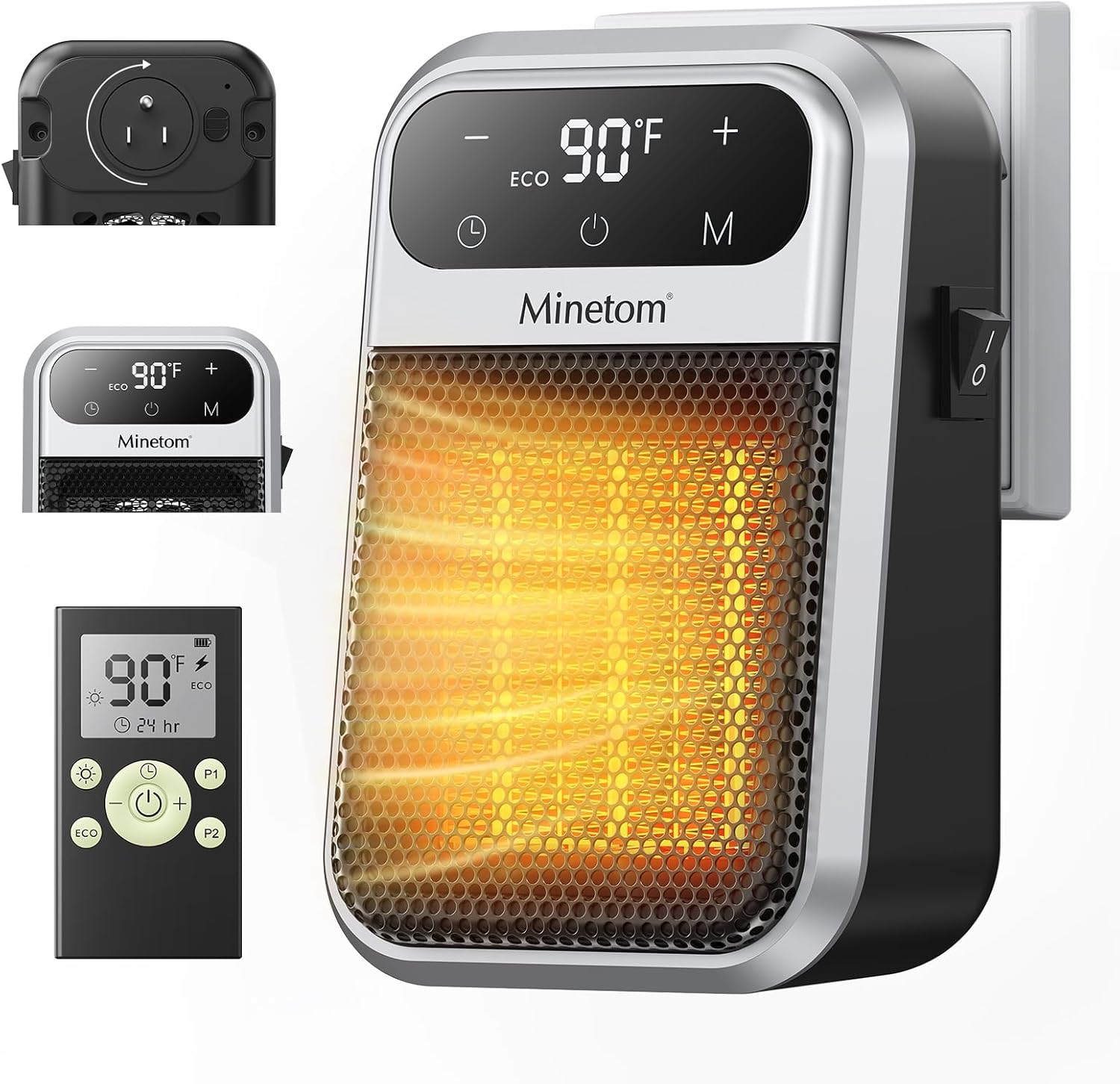
The Minetom MH-20 is a compact plug-in heater designed to deliver quick, localized warmth in small indoor spaces. It uses a PTC heating element and forced-air fan to bring a room up to temperature on 400W or 800W settings, plus an ECO mode that modulates power for better efficiency; a digital display and remote let you set temperatures from 60°F to 90°F and use a 12-hour timer. The rotating 180° plug and slim cabinet make it easy to install in tight areas without taking floor space, and built-in safeguards such as overheat protection and ETL-listed construction provide basic safety for bathrooms, bedrooms, offices, or garages. Noise is low in normal use and a small bottom light can double as a night light. Trade-offs are expected: at 800 watts this unit is meant for small zones (advertised ~150 sq ft) and will not replace whole-room heating, and its plug-in form limits placement to outlets. For buyers who want affordable, fast heat for a specific spot, it is a practical choice with useful controls and safety features.
Best for: Buyers who want an inexpensive, space-saving heater for a single room or spot heating and value easy controls, safety features, and energy-saving operation.
Less Ideal for: People seeking whole-room or whole-home heating, or those who need flexible placement away from wall outlets should consider larger portable heaters or hardwired solutions.
- Rapid PTC forced-air heating that reaches set temperature quickly
- Multiple power modes (400W, 800W, ECO) and precise digital temperature control with remote
- Compact plug-in design with 180° rotating plug saves floor space and is easy to install
- ETL-listed safety features including overheat protection and timer for unattended use
- Limited heat output suitable only for small rooms or targeted zones
- Requires an available wall outlet at the desired location which restricts placement options
Verdict: A compact, budget-friendly plug-in heater that delivers fast, controllable warmth for single rooms while keeping energy use and footprint low.
Minetom MH-04 Plug-In Heater
| Heat Output | 450 watts |
|---|---|
| Power Source | ac |
| Voltage | 120 volts |
| Number of Speeds | 2 |
| Min/Max Temp | 60 °F–90 °F |
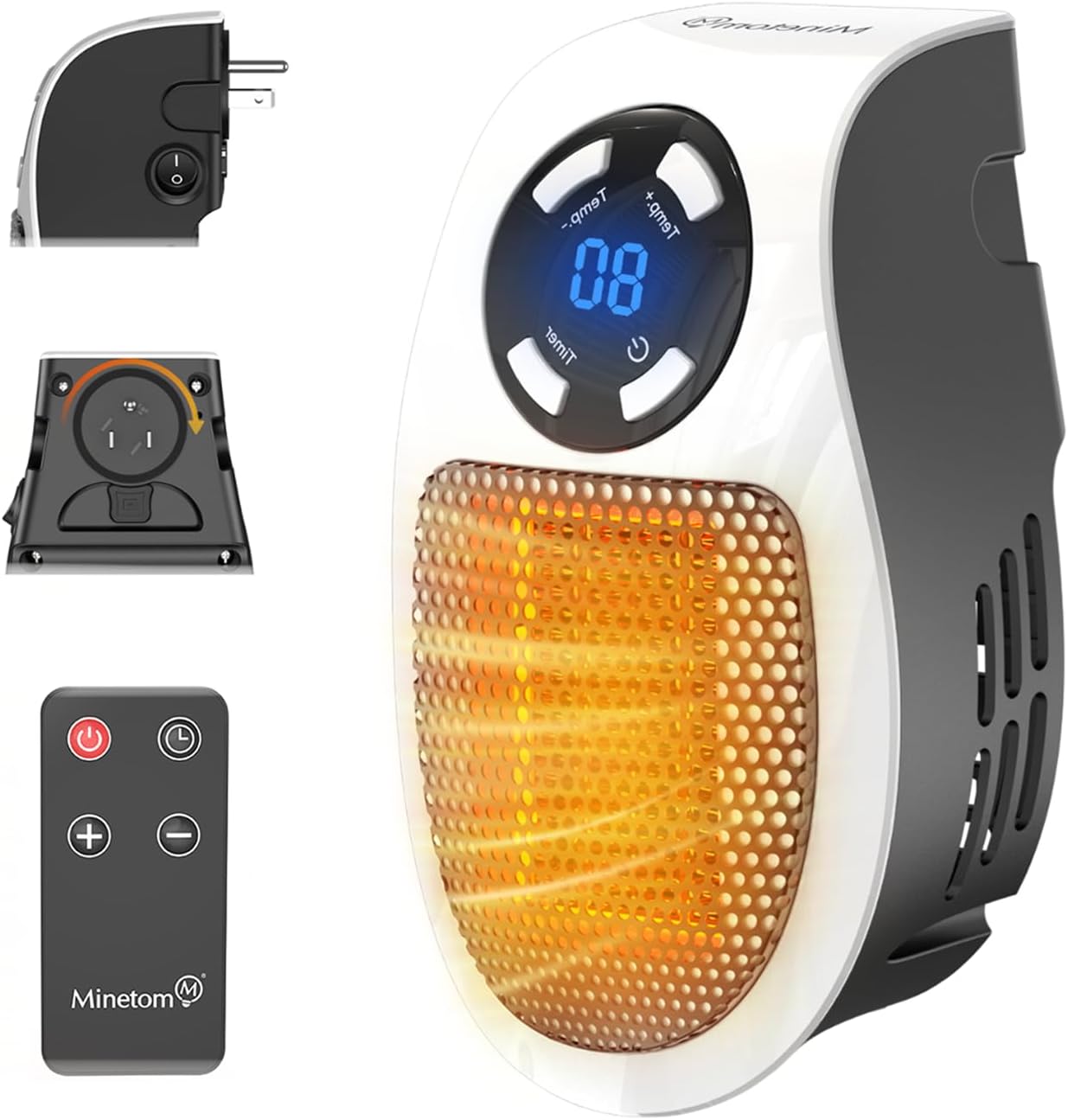
The Minetom MH-04 is a small plug-in ceramic heater designed to deliver quick, low-watt warmth in tight spaces. It uses PTC ceramic heating elements and a built-in fan to reach set temperatures rapidly, and the LED display plus remote lets you choose between 60°F and 90°F and program a 1–12 hour timer. At 450 watts it is intentionally low-power, so it is best for heating a single bedroom, bathroom or a small office without tripping circuits in older homes. Safety features include ETL/CSA certification, overheat protection and a safety plug, and the 180° rotatable plug makes wall mounting straightforward. Practical limits are its low heat output and small coverage area—it will not replace central heating or warm large rooms quickly—but for targeted spot heating it is energy efficient and quiet enough for night use. The compact footprint and simple controls make it convenient where space and outlet access are limited.
Best for: Buyers who need an inexpensive, low-power heater for a single small room or occasional spot heating and prioritize quick warmth and energy efficiency over whole-room heating.
Less Ideal for: People who need to heat medium or large rooms, or who want a permanent in-wall or high-output supplemental heating solution.
- Fast PTC ceramic heating that begins producing warmth within seconds
- Low 450W power draw reduces risk of tripping circuits and saves energy
- Adjustable thermostat (60°F–90°F) with 1–12 hour timer and remote control
- Multiple safety certifications and built-in overheat protection
- Limited heat output suitable only for small rooms or spot heating
- Must remain upright and dry, so placement options are constrained
Verdict: A budget-friendly, low-watt plug-in heater that delivers quick, efficient spot warmth for small rooms without overloading household circuits.
HMOLIKH Handy Heater Turbo

| Power Source | Plug in |
|---|---|
| Heating Method | convective heater |
| Special Features | Adjustable Temperature, Digital Display, Energy Efficient, Fast Heating, Flame Resistant |
| Mounting Type | Wall Mount |
The HMOLIKH Handy Heater Turbo is a small plug-in ceramic heater intended to deliver quick, localized warmth for spaces up to about 25 sq ft. It mounts directly into a wall outlet to eliminate cords and uses ceramic convective heating to produce steady heat quietly while the cool-touch housing keeps the surface safe to handle. Controls include an adjustable thermostat (59–90°F) and a programmable 12-hour timer so you can set a target temperature and runtime without babysitting the unit. At roughly 400W it is energy efficient for quick spot heating but is not meant to heat larger rooms or replace central heating. Safety-minded features such as auto shut-off and flame resistant construction add reassurance for use in bedrooms or bathrooms. The small footprint and plug-in convenience make it easy to move between rooms or take on trips, though its limited coverage and lower power mean it is best for single-person use or supplementing a colder area rather than whole-room heating.
Best for: Buyers who want an inexpensive, fuss-free way to heat a single small area—like a bedside, home office, or bathroom—without running a freestanding heater or extending cords.
Less Ideal for: People who need to heat mid-size or large rooms, or those seeking a primary home heating solution, should choose a higher-powered unit instead.
- Plugs directly into wall outlet to eliminate cords and save floor space
- Adjustable thermostat and 12-hour timer for set-and-forget use
- Ceramic heating provides quiet, fast convective warmth for small spaces
- Cool-touch housing and auto shut-off improve safety during unattended use
- Only suitable for very small rooms or localized spot heating
- Lower wattage limits how quickly and how much air it can warm
Verdict: A compact, low-power plug-in ceramic heater that delivers safe, quiet spot heating and timer control for tiny rooms or supplemental use.
GiveBest Cyber 800W Plug‑In Heater

| Heat Output | 800 watts |
|---|---|
| Power Source | Corded Electric |
| Voltage | 120 volts |
| Special Features | Remote Control |
| Mounting Type | Wall Mount |
The GiveBest Cyber 800W plug‑in heater is a compact, wall‑mountable electric heater designed to add quick, local warmth to small rooms, bathrooms, offices, and RVs. It uses a ceramic PTC heating element with a brushless motor and aerodynamic fan to produce heat quietly, and the unit lists an operating noise level under 40 dB for sleep‑friendly use. Controls include an LED temperature display, a 12‑hour timer, a 15‑ft remote, and an adjustable thermostat with a low ECO mode that cycles power between roughly 400 and 800 watts to save energy. Safety features include overheat protection, flame‑retardant materials, and UL/CSA certification. Because it plugs into an outlet and rotates 180 degrees, installation is simple and there is no plumbing or permanent wiring required. Trade offs are its limited 800W output, which is intended for small zones rather than heating whole rooms, and the small footprint means it is best used close to occupants. For buyers prioritizing low upfront cost, portability, and simple installation, it delivers sensible features and safety credentials in a budget package.
Best for: Buyers looking for an inexpensive, easy‑to‑install heater to provide focused warmth in small spaces like bathrooms, offices, or RVs who prioritize low upfront cost and simple controls.
Less Ideal for: People needing to heat medium to large rooms or whole‑house supplemental heating should choose a higher‑output or central heating solution instead.
- Compact plug‑in design with 180° rotating plug for easy installation and portability
- Quiet operation under 40 dB suitable for bedrooms and offices
- LED display, 12‑hour timer, adjustable thermostat, and 15 ft remote for convenient control
- ECO mode that cycles power between lower and higher wattage to reduce energy use
- UL and CSA safety certifications plus overheat protection and flame‑retardant materials
- 800W heat output is best for spot heating and will not warm large rooms quickly
Verdict: A budget‑friendly plug‑in wall heater with remote, timer, and ECO mode that delivers quiet, efficient spot heating for small indoor spaces.
Brightown 800W Plug In Heater
| Power Source | Corded Electric |
|---|---|
| Power | 800W |
| Heating Method | Forced Air |
| Heating Coverage | 100 square feet |
| Max Temperature Setting | 85 °F |
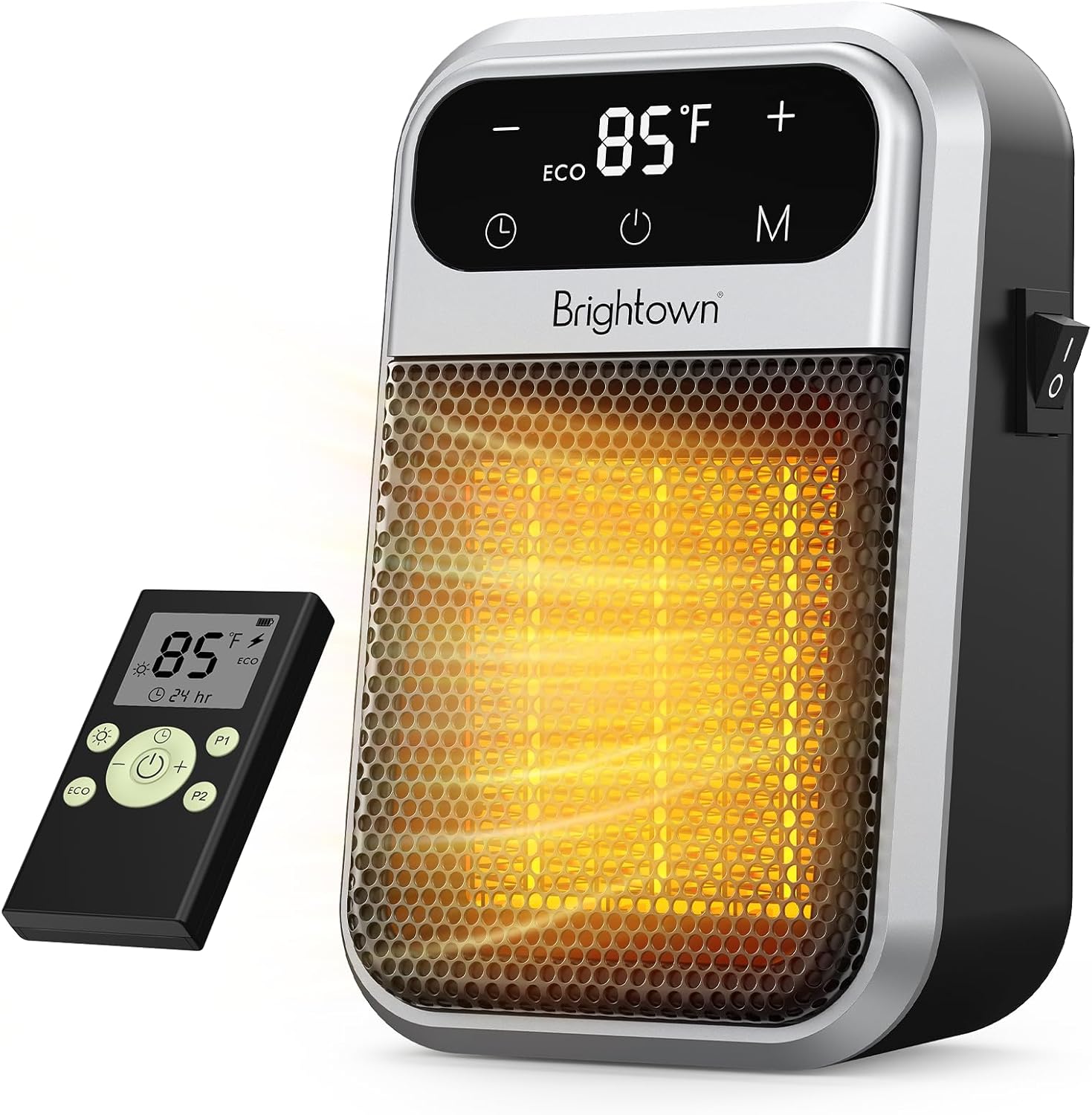
This compact Brightown plug-in heater delivers targeted warmth for small rooms and workspaces using an 800W low-wattage forced-air element. It plugs directly into a standard outlet and its 180-degree rotating plug and tabletop mount option make placement flexible in tight areas; the unit is best used to supplement central heating or provide fast spot warmth for a single room up to about 100 square feet. A clear LED touch display, remote control, and 12-hour timer make temperature and schedule adjustments easy from across the room, and built-in overheat protection with flame-retardant materials keeps continuous use reassuring. The heater is unusually quiet for its class, rated under 40 dB, and its low wattage helps avoid tripping circuits and lowers operating cost compared with higher-power space heaters. Expect modest warmth relative to higher-wattage models and limited suitability for very cold rooms, but for reliable, energy-conscious supplemental heating in a bathroom, office, dorm, or bedside, this unit is a practical budget choice.
Best for: Buyers who want a dependable, low-wattage supplemental heater for single rooms or spot heating and prioritize quiet, energy-conscious operation and simple controls.
Less Ideal for: People seeking a primary heat source for large or poorly insulated rooms or those who need high-output, rapid whole-room heating should look at higher-wattage alternatives.
- Low 800W power draws less energy and reduces risk of tripping household circuits
- 180° rotating plug allows flexible positioning around outlets without bending the cord
- LED touch display, remote control, and 12-hour timer for convenient adjustments
- Built-in overheat protection and flame-retardant materials for safer continuous use
- 800W output provides limited heating power, so it is not suitable for large or very cold rooms
- Compact size means shorter runtime effectiveness before surrounding space cools again
Verdict: A reliable, energy-efficient plug-in heater that delivers quiet, safe spot heating for small rooms on a budget.
Ontel Handy Heater Turbo 800

| Heating Coverage | 250 sq ft |
|---|---|
| Heat Output | 800 watts |
| Number of Speeds | 3 |
| Min Temperature Setting | 60 °F |
| Max Temperature Setting | 90 °F |
The Ontel Handy Heater Turbo 800 is a plug-in ceramic space heater designed to warm small rooms up to about 250 sq ft without taking floor space. You plug it directly into a standard wall outlet and use the adjustable thermostat (60 to 90°F), three fan speeds, and a programmable 12-hour timer to tailor warmth for a bedroom, office, or den. Its ceramic element and convection design deliver steady heat at an 800-watt output while cool-touch housing, auto shut-off, and a low-noise operation make it suitable for overnight use or quiet workspaces. The compact, lightweight form is easy to move between rooms and removes the need for extension cords, though the fixed plug means placement depends on outlet location. Performance is appropriate for spot heating and smaller spaces but it will not replace a whole-house heating system or heat large open areas. For buyers seeking simple, energy-conscious supplemental heat in a small footprint, this unit offers straightforward controls and reliable basic performance.
Best for: Buyers who want an inexpensive, low-profile supplemental heater for a bedroom, office, or other small room and who value straightforward controls and safety features backed by many user reviews.
Less Ideal for: People needing to heat large open-plan rooms, whole apartments, or those who require high-output or whole-house heating solutions.
- Plugs directly into wall outlet to eliminate extra cords and save floor space
- Adjustable thermostat (60–90°F) and 12-hour programmable timer for customized comfort
- Quiet ceramic heating with auto shut-off and cool-touch housing for safe overnight use
- Compact and lightweight for easy relocation between rooms
- 800-watt output is suitable only for small rooms and not for heating large or open areas
- Fixed plug limits placement to available outlets and may block adjacent receptacles
Verdict: A budget-friendly plug-in ceramic heater that delivers quiet, customizable spot heating for small rooms with minimal fuss.
Minetom MH-04 Plug-In Space Heater

| Heat Output | 450 watts |
|---|---|
| Heating Coverage | 100 square_feet |
| Power Source | Corded Electric |
| Number of Speeds | 2 |
| Max Temperature Setting | 90 °F |
The Minetom MH-04 is a low-wattage plug-in heater made for heating a single small room or workstation without using much power. It plugs directly into a wall outlet and mounts on the receptacle so there is no standing footprint or trailing cord to trip over, and its 450-watt output is intended to warm about 100 square feet. The unit includes a digital thermostat that can be set between 60 and 90°F, a 1–12 hour timer for auto on/off, a two-speed fan, and an LED display for straightforward controls. Its compact size and rotating 180-degree plug make it easy to install in tight spaces like dorms, offices, or bedrooms, and the manufacturer emphasizes quiet operation and surface that stays cool to the touch. Limitations are its low heat output—unsuited for larger rooms or very cold climates—and the direct plug-in design means the heater must occupy that outlet. For buyers prioritizing safety and modest energy use, it gives predictable, simple supplemental heat at a budget price.
Best for: Buyers who want a conservative, energy-light supplemental heater for a small bedroom, office, or dorm where safety, quiet operation, and simple controls matter more than high heat output.
Less Ideal for: People who need to heat larger rooms, very cold spaces, or want a portable freestanding heater that can share outlets or be moved without occupying a receptacle permanently.
- Direct plug-in design saves floor space and removes a trailing cord
- Digital thermostat with LED display lets you set and maintain a specific temperature
- Built-in timer supports auto on or auto-off for unattended use
- Low 450W power draw reduces circuit load and operating cost compared with higher-wattage heaters
- 450W output insufficient for heating medium or large rooms
- Occupies the wall outlet it plugs into, preventing other use of that receptacle
Verdict: A compact, low-watt plug-in heater that delivers quiet, predictable supplemental warmth for small rooms while minimizing circuit load.
Choosing the Right Budget Plug-In Heater: Key Factors to Consider
Heat Output and Room Size
Heat output determines how quickly a plug-in heater brings a room to a comfortable temperature and how well it maintains that temperature. For budget plug-in heaters, wattage is the primary spec buyers see. Higher wattage usually means faster heating, but room geometry, ceiling height, insulation, and window area also affect real-world performance.
Match the heater's capacity to the room size. Small bedrooms and offices often do well with lower-wattage units, while poorly insulated spaces or rooms with high ceilings need more sustained output. Choosing an underpowered heater will result in constant runtime, higher energy use, and uneven warmth, while an oversized unit may cycle frequently or waste energy if it lacks good thermostat control.
Energy Efficiency and Modes
Energy efficiency matters for running cost and environmental impact, especially for units that will operate for several hours daily. Budget plug-in heaters vary in how they manage power: some offer single fixed-wattage operation, while others provide low/high settings, ECO modes, or programmable timers.
A heater with multiple power settings or an ECO mode can reduce consumption by lowering output once a set temperature is reached. Timers let you run the heater only when needed rather than leaving it on all day. When evaluating efficiency, consider both the nominal wattage and the available controls that help limit actual energy use during typical operation.
Thermostat and Temperature Control
Accurate temperature control prevents overheating, reduces cycling, and improves comfort. Some budget plug-in heaters include simple mechanical thermostats, while others have digital controls with setpoint increments.
A responsive thermostat holds room temperature more steadily and can lower operating time and power draw. If you plan to use the heater in a sleeping area, look for units with fine control or programmable schedules to avoid temperature swings overnight. Poor thermostat accuracy can lead to short run cycles that are inefficient and noisy.
Safety Features and Certification
Safety is a primary concern with any portable heater. Essential protections for plug-in heaters include automatic shutoff on tip-over, overheat protection that cuts power if internal temperatures get too high, and cool-touch housing to reduce burn risk.
Verify that the heater has been tested to an independent safety standard. Built-in timers and child-lock functions add layers of protection for households with children or pets. Budget units sometimes skimp on redundancies, so prefer designs that include multiple safety features rather than relying on a single cutoff.
Installation, Footprint, and Portability
Plug-in heaters are prized for their convenience, but how and where you plug them in matters. Consider the physical footprint of the unit and whether it occupies a full electrical outlet or leaves space for another device. Some designs plug directly into a wall receptacle and fold away when not in use, while others are floor-standing with small footprints.
Portability influences where you can use the heater around the home. Lightweight models are easy to move between rooms, but very small units may lack the output needed for larger spaces. Think about cord length, plug orientation, and whether you will need an extension or a dedicated outlet for safe use.
Noise Level and Daily Use Comfort
Noise can be a deciding factor if the heater will run in a bedroom or workspace. Fan-forced heaters typically produce more sound than radiant or oil-filled convectors. Budget models vary widely in noise performance and how the sound is perceived over time.
Consider whether you need near-silent operation for sleep or concentration. Units with variable fan speeds often let you trade some efficiency for quieter operation. Readability of controls and ease of adjusting settings also contribute to daily comfort and user satisfaction.
Where Budget Plug-In Heaters Work Best
Plug-in heaters are ideal for spot heating and supplemental warmth in well-defined areas. They excel at warming a single occupant or a localized section of a room without needing to raise the temperature of the entire home.
Use them in bedrooms, small home offices, or rooms you occupy intermittently. Because they are inexpensive and portable, they are a practical short-term solution for drafty rooms or cold floors, provided you manage expectations about coverage and efficiency.
- Best for rooms up to moderate size depending on wattage
- Good choice for renters or temporary heating needs
- Not intended as a whole-home heating replacement
Types of Plug-In Heating Technology
Plug-in heaters use a few common heating methods, each with tradeoffs in noise, speed, and perceived warmth. Fan-forced ceramic heaters heat a ceramic element and use a fan to move warm air quickly. They heat rapidly but produce audible noise. Radiant or infrared-style plug-in heaters deliver heat directly to objects and people, offering instant warmth with minimal noise, though they do not warm air as well for whole-room comfort. Oil-filled or convection-style plug-in units operate more quietly and hold heat longer, but they typically warm the space more slowly.
- Fan-forced: fast heat, louder
- Radiant/infrared: instant direct warmth, quiet
- Oil-filled convection: slow, steady, and quiet
Safe Placement and Electrical Considerations
Correct placement keeps the heater effective and reduces hazards. Keep the unit away from combustible materials, at least a few feet from curtains and furniture. Avoid using plug-in heaters with extension cords unless the extension is rated for the heater's full current draw and is heavy-gauge.
Plug directly into a grounded outlet when possible and avoid running the heater from power strips or overloaded circuits. If you notice tripped breakers or warm outlets, stop using the heater until the electrical issue is diagnosed.
- Keep clearances per the manufacturer guidelines
- Avoid extension cords unless rated for the heater
- Monitor the outlet and circuit load for any signs of trouble
Tips to Minimize Running Costs
Running costs are driven by wattage, run time, and how well the space retains heat. To limit energy use, pair the heater with sensible behavior: close doors to the heated room, add insulating measures like rugs or draft stoppers, and use timers or ECO modes to avoid long continuous runtimes. Lowering the setpoint by a few degrees can reduce consumption substantially.
Use zone heating strategies rather than trying to heat unused areas. Also consider combining a plug-in heater with short-term strategies such as warming blankets or targeted clothing layers to reduce reliance on electric heat.
- Use timers and ECO modes where available
- Improve room insulation and limit drafts
- Reduce setpoint slightly to cut energy use
Maintenance and Longevity for Budget Units
Budget plug-in heaters often have fewer replaceable parts or service options, so simple maintenance can extend useful life. Keep air inlets and fan blades free of dust and lint to preserve airflow and prevent overheating. Periodically check cords and plugs for wear, and replace the unit if wiring shows damage.
Treat the heater gently to avoid rattles and loose connections. Proper storage during warmer months prevents moisture and dust buildup that can degrade components over time.
- Regularly clean air intakes and fan housing
- Inspect cords and plugs before each season
- Store dry and dust-free when not in use
How We Chose the Best Budget Plug-In Heater
We focused on plug-in heaters that balance upfront affordability with efficient, safe daily operation. Our selection criteria prioritized measurable performance and user-facing features that matter for budget-minded buyers. Key evaluation criteria included steady heat output relative to the advertised wattage, thermostat and temperature control accuracy, energy use and efficiency features such as ECO modes or adjustable power settings, built-in safety systems like tip-over and overheat cutoffs, and space and installation suitability for small rooms. We excluded heavy-duty hardwired units, whole-home systems, and designs meant specifically for outdoor use. We also filtered out models lacking basic safety certifications or those that rely solely on vague manufacturer claims without clear control features. The final shortlist represents compact, plug-in heaters that offer clear specifications and sensible tradeoffs between cost, comfort, and operational safety.
Our full evaluation process is outlined in our review methodology.
FAQ
Are plug-in heaters safe to run overnight?
Running overnight depends on the unit's safety features. Many models include tip-over and overheat shutoffs that allow safe overnight use if placed on a stable surface and kept away from combustibles. Still, use models with thermostats and timers for more controlled overnight operation.
How much area will a typical budget plug-in heater cover?
Coverage depends on wattage and room characteristics, but most budget plug-in heaters are best for small to medium rooms. Expect effective comfort in a focused zone or single room rather than whole-house heating.
Can I use a plug-in heater on the same circuit as other appliances?
You can, but be cautious about total circuit load. High-wattage heaters draw significant current and can trip breakers if combined with other heavy appliances. If you notice repeated trips or warm outlets, relocate the heater to a less loaded circuit.
Do plug-in heaters raise electricity bills a lot?
They can increase bills if used for long periods at high power. Using eco modes, timers, and lower setpoints reduces runtime and limits cost. Zone heating a single room instead of raising whole-home thermostats is often more economical.
What maintenance do budget plug-in heaters require?
Maintenance is minimal: keep vents and fans free of dust, check cords for wear, and store the unit dry when not in use. Avoid DIY repairs on electrical components and discontinue use if you detect burning smells or smoke.
Final Verdict
When choosing a budget plug-in heater, prioritize a balance of adequate heat output for your room size and reliable safety features. Thermostat accuracy and energy-saving modes are key to comfortable, cost-effective operation, while quiet performance matters for bedrooms and workspaces. Accept that budget units may trade advanced controls or premium materials for affordability; focus on models with clear specifications, good safety protections, and simple maintenance. With sensible placement and use, a compact plug-in heater can be an effective, low-cost way to add warmth where you need it most.