
Note: This article contains affiliate links. If you click on these links and make a purchase, we may earn a small commission at no extra cost to you. This helps support our research and content. Read our full affiliate disclosure here.
If you brew away from a full kitchen or need a small, reliable grinder for daily travel, the right budget portable coffee grinder matters. A compact grinder can dramatically improve extraction by providing a fresh, consistent grind whether you are at a campsite, in a hotel room, or simply short on countertop space. This guide covers seven shortlisted budget portable coffee grinders chosen for their balance of grind quality, portability, and durability. We evaluated ease of use, grind consistency, noise, power source, and cleanup to help you pick the best compact grinder for your routine. Read on for what to expect from each style and which features matter most for your brewing setup.
Top Picks at a Glance
| Best Overall The best all-around choice for most situations | TOBEFORT Portable Burr Grinder 995 |  |
| Best Quality Built to a higher standard if you want something more solid | Hario Ceramic Coffee Mill MSS-1B |  |
| Best Value The sweet spot between price and what you get | CEVING Mini Manual Coffee Grinder | 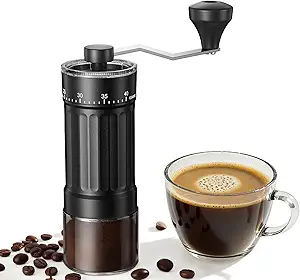 |
| Best Budget The cheapest option that still gets the job done reliably | Rsoilch Manual Coffee Grinder HS-011 |  |
| Top Rated A top-rated pick with lots of positive feedback | JavaPresse Manual Coffee Grinder |  |
| Most Popular A crowd favorite that many people choose with confidence | Amazon Basics Electric Coffee Grinder |  |
| Best Seller A high-volume bestseller chosen again and again | BLACK+DECKER Coffee Grinder CBG110S |  |
TOBEFORT Portable Burr Grinder 995

| Capacity | 25 cups |
|---|---|
| Power Source | rechargeable battery |
| Voltage | 5 volts_of_direct_current |
| Material Type | Plastic |
This compact TOBEFORT grinder is designed for people who want consistent, adjustable coffee on the go. It uses a ceramic conical burr and an external dial with 38 settings so you can dial in anything from coarse French press to fine espresso-like grounds, and the external adjustment works while grinding. The rechargeable 1500mAh battery and USB-C port make it convenient for travel, and the manufacturer claims about 25 25g batches per charge with a one-hour charge time using a 5V/1A adapter. Practical touches include one-touch operation, a fully detachable grind chamber and bin for easy cleaning, and a lightweight form that fits backpacks. Expect slower grind times at finer settings and longer runs for espresso-style grinds, and the motor and ceramic burrs are meant for coffee beans only—hard spices or nuts will damage the unit. For frequent heavy home use or very fast fine grinding, a plugged-in, higher-power grinder will be faster, but this grinder balances portability and control well for casual daily use and travel.
Best for: Buyers who want a budget-friendly, travel-ready grinder that still offers precise grind control and easy cleaning for occasional daily use away from a power outlet.
Less Ideal for: Users who need rapid, heavy-duty grinding at home or who regularly make large espresso-volume batches should choose a higher-power, plug-in grinder instead.
- Ceramic conical burr preserves flavor and reduces heat buildup.
- Wide 38-step external grind adjustment for precise control across brew methods.
- USB-C rechargeable battery with claimed multi-batch runtime for travel use.
- Detachable parts and included brush simplify cleaning and maintenance.
- One-touch operation and compact, lightweight design for portability.
- Slower grind times, especially on the finest settings.
- Not intended for grinding anything other than coffee beans; hard materials can damage burrs.
Verdict: A compact, affordable portable burr grinder that delivers precise, low-heat grinding and easy cleaning for travelers and casual daily coffee drinkers.
Hario Ceramic Coffee Mill MSS-1B

| Capacity | 2 cups |
|---|---|
| Material Type | Ceramic |
| Power Source | Manual |
The Hario Ceramic Coffee Mill is a hand-crank grinder that delivers consistent, rust-free grinding for fresh coffee at home or on the go. It uses a ceramic milling mechanism with an adjustable knob to change grind size and a transparent container so you can monitor dose and coarseness. Its slim profile and removable handle make it easy to store or pack for travel, and the parts disassemble for straightforward cleaning. Because it is manual, grinding is quiet and requires no power, but it does take more effort for larger doses and is best suited to single-cup to two-cup portions. The ceramic mill resists rust and preserves flavor, though it will be slower than electric models and less convenient for very fine espresso grind or high-volume use. For someone who prioritizes grind consistency and portability on a tight budget, this grinder offers a reliable, low-maintenance option.
Best for: Buyers who want a portable, durable manual grinder that gives consistent small-batch grinds without electricity and prioritizes flavor over speed.
Less Ideal for: People who need fast, high-volume grinding or very fine, repeatable espresso grinds should choose an electric or larger burr grinder instead.
- Ceramic milling parts resist rust and preserve coffee flavor.
- Adjustable grind knob lets you dial coarseness for different brew methods.
- Compact, slim design with removable handle for easy storage and travel.
- Transparent grounds container makes portioning and monitoring simple.
- Manual operation requires physical effort and is slower than electric grinders.
- Limited capacity best suited to one or two cups, not high-volume grinding.
Verdict: A compact, budget-friendly manual grinder that delivers consistent, rust-resistant grinds for flavorful small-batch coffee.
CEVING Mini Manual Coffee Grinder

| Capacity | 30 g |
|---|---|
| Material Type | Ceramic |
| Power Source | manual winding |
The CEVING Mini Manual Coffee Grinder is a small, travel-friendly hand mill built around ceramic conical burrs and an external 40-step adjustment ring. You use it by loading up to 30 g of beans, turning the crank by hand and choosing a grind setting for espresso, pour-over, French press or drip. The external adjustment makes dialing in grind size quick without disassembling the unit, and the ceramic burrs run cooler for more consistent flavor. Its three-piece construction is easy to take apart and wipe with the included brush, which keeps maintenance simple on the road. Because it is manual and compact, grinding larger batches or very fine espresso will take extra effort and time compared with electric grinders, and the 30 g capacity is limiting if you routinely brew for several people. For budget-minded brewers who want a reliable portable grinder that produces uniform grinds and is easy to carry, this is a sensible pick; users needing fast, high-volume grinding should choose an electric model instead.
Best for: Buyers who prioritize a compact, affordable grinder for travel or occasional single-serve brewing and who value precise grind adjustment over speed.
Less Ideal for: People who need quick, high-volume grinding for multiple cups or daily high-output use should consider an electric countertop grinder instead.
- 40 external grind settings let you fine-tune particle size without disassembly
- Ceramic conical burrs produce uniform grinds and minimize heat transfer
- Compact, lightweight design made for travel and small-batch use
- Simple three-part construction is easy to clean with the included brush
- 30 g capacity limits batch size for multi-cup brewing
- Manual operation is slower and more tiring than electric grinders for frequent use
Verdict: A budget-friendly, portable manual grinder that delivers consistent, adjustable grinds for solo brewers and travel use.
Rsoilch Manual Coffee Grinder HS-011

| Capacity | 30 g |
|---|---|
| Included Components | Ceramic Burr, Stainless Steel Body |
| Model Number | HS-011 |
This manual grinder is aimed at simple, portable grinding for travelers and budget-minded home brewers. It uses a ceramic conical burr that produces consistent grounds across 40 click-adjustable settings, so you can tune from fine for espresso to coarse for French press. The clear glass grounds jar makes it easy to watch progress and avoid spills, and the handheld crank runs quietly without electricity, which is handy for camping or early-morning use. The body is mostly ABS plastic with a stainless steel accent and a modest 25 to 30 g capacity, so you should expect to grind one to two cups at a time rather than batches. Its lightweight, compact build makes it easy to pack, but the small capacity and plastic construction mean it is not designed for heavy daily use or large households. For its price and portability it delivers solid, consistent grinds for single-serve brewing styles.
Best for: Buyers who want an inexpensive, portable grinder for single-serve brewing or travel and prioritize adjustable grind control over high-capacity or heavy-duty use.
Less Ideal for: People who need to grind for large households, make multiple cups at once, or want a heavy-duty daily-use grinder.
- Ceramic conical burr preserves oils and yields even grind consistency
- 40 adjustable grind settings cover espresso to French press
- Quiet manual crank works without power, ideal for travel and camping
- Clear glass grounds jar lets you monitor progress and reduces mess
- Small capacity limits grinding to single-serve amounts
- Primarily ABS plastic construction may feel less durable under heavy use
Verdict: A low-cost, travel-friendly manual grinder that gives reliable, adjustable grinds for single cups without needing power.
JavaPresse Manual Coffee Grinder

| Grind settings | 18 adjustable settings |
|---|---|
| Burr type | Ceramic conical burr |
| Power source | Manual |
The JavaPresse Manual Coffee Grinder is a hand-crank conical burr grinder built for travel and everyday use when you want fresh grounds without electric noise or cords. It uses a ceramic burr assembly with 18 grind settings to cover espresso through French press, and the compact stainless steel body makes it easy to pack for camping or commute mornings. In practice the grinder delivers fairly consistent grinds for its size and the ceramic burrs resist wear and heat better than typical steel in this class, which helps maintain performance over time. Its manual operation is quiet and battery-free, though hand grinding takes longer and requires effort compared with an electric grinder. The included adjustment system is simple to set but dialing in exact espresso fines can take a few tries. For buyers prioritizing durability and low-noise portability, this grinder offers a reliable, no-frills way to get fresh grounds anywhere, while those who need rapid large-batch grinding or perfectly repeatable espresso-level precision may prefer a small electric alternative.
Best for: Buyers who want a durable, low-noise portable grinder for fresh coffee on the go and value reliable long-term performance over speed.
Less Ideal for: People who routinely grind large amounts of coffee, need rapid single-handed operation, or require perfectly repeatable espresso-level precision should consider an electric grinder instead.
- Ceramic conical burrs for consistent grind and longer wear life
- 18 adjustable grind settings cover a wide range of brew methods
- Compact, cord-free design ideal for travel and camping
- Quiet manual operation eliminates electric motor noise
- Manual grinding is slower and requires physical effort for larger doses
- Takes some trial-and-error to fine-tune very fine espresso grinds
Verdict: If you need a compact, reliable, and quiet budget grinder for travel or daily small-batch use, the JavaPresse manual grinder is a durable and practical choice.
Amazon Basics Electric Coffee Grinder

| Capacity | 2.1 ounces |
|---|---|
| Voltage | 120 volts |
This Amazon Basics electric coffee grinder is a no-frills, budget-friendly blade grinder meant for quick home grinding tasks. It handles small batches — the 2.1 ounce cup is enough for one to two servings — and can grind beans, spices, grains, and nuts in seconds thanks to a heavy-duty stainless steel blade. A clear safety lid makes it easy to watch progress so you can stop when you reach your preferred consistency, and the unit runs on standard 120V power. Because it is a blade grinder, grind size is less uniform than a burr grinder, so it works best for drip coffee and recipes where precise particle size is not critical. The compact footprint keeps it easy to store on a countertop or in a cabinet, and simple operation makes it beginner friendly. Expect some noise during operation and the small capacity means multiple batches for larger servings. For buyers prioritizing low cost and speed over cafe-level grind consistency, this is a practical everyday grinder.
Best for: Buyers who want an inexpensive, simple grinder for occasional single-serve coffee or for grinding spices and small amounts of ingredients, and who value speed and straightforward operation over precision.
Less Ideal for: Users seeking uniform, cafe-quality grind consistency for espresso or large-batch brewing should choose a burr grinder or higher-capacity model instead.
- Fast grinding—can process about 30 g (1 oz) of beans in roughly 10 seconds
- Heavy-duty stainless steel blade suitable for coffee, spices, and small grains
- Clear safety lid lets you monitor grind progress
- Compact, easy-to-store design
- Small 2.1 ounce capacity requires multiple batches for larger servings
- Blade grinder produces less consistent particle size compared with burr grinders
Verdict: A very affordable, compact electric blade grinder that delivers fast, usable grinds for single-serve drip coffee and kitchen spice tasks.
BLACK+DECKER Coffee Grinder CBG110S

| Capacity | 56.6 g |
|---|---|
| Wattage | 130 |
| Voltage | 110 volts |
The BLACK+DECKER CBG110S is a straightforward, budget-friendly blade grinder designed for small daily use. It uses stainless steel blades and a stainless steel grinding bowl to pulverize coffee beans, spices, herbs, and grains, and a one-touch push-button makes operation simple. A lid-locking safety feature prevents the motor from running unless the lid is secure, which is helpful in a busy kitchen, and the modest 130-watt motor handles short grinding bursts for coarse to fine results. Its 56.6 g capacity suits single-serve or two-cup batches but means you will need multiple passes for larger totals. Because it is a blade grinder, particle size is less uniform than with burr models, so it is best for drip, French press, or spice use rather than precision espresso. The small footprint and stainless finish keep it easy to store and wipe clean. For buyers who want a dependable, no-frills grinder for everyday drip coffee and occasional spice work, this model is a sensible pick; those seeking cafe-level consistency should look at burr alternatives.
Best for: Buyers who prioritize a reliable, easy-to-use grinder for everyday drip coffee, quick spice grinding, and a low-maintenance appliance that minimizes risk and fuss.
Less Ideal for: Users seeking precise, uniform grinds for espresso or large-volume grinding sessions should consider a burr grinder or a larger-capacity model instead.
- Stainless steel blades and bowl for durability and easy cleaning
- Simple one-touch push-button operation
- Lid-locking safety feature prevents accidental operation
- Compact footprint that stores easily in small kitchens
- Blade grinder yields less uniform particle size compared with burr grinders
- Small 56.6 g capacity requires multiple batches for larger servings
Verdict: A simple, safe, and compact blade grinder that delivers dependable everyday grinding for drip coffee and spices at a budget price.
Choosing the Right Budget Portable Coffee Grinder: Key Factors to Consider
Grind Consistency and Range
Grind consistency determines how evenly coffee particles are sized, which directly affects extraction and flavor. For a portable grinder, you want a mechanism—typically burrs rather than blades—that produces uniform particles for the brew styles you use most often.
Range matters because different methods require different particle sizes. A good budget portable will offer a sensible spread from fine for espresso-style aero-press or concentrated pours to coarse for French press or manual steeping. Limited range can lock you into one method or force you to over- or under-extract your coffee.
Portability and Form Factor
Portability includes physical size, weight, and how the grinder fits into luggage or a daypack. Compact grinders that are stable when in use and secure while stored reduce the chance of spills and damage during travel.
Consider assembly and packing too. Grinders that disassemble into a few pieces or nest together save space. Think about where you will use the grinder and whether it needs to be ultra-light for backpacking or simply compact enough for a commuter bag.
Power Source and Runtime
Budget portable grinders come in manual and battery-powered options. Manual grinders require no charging and are often lighter, but they need more physical effort and take longer to grind larger volumes. Battery-powered grinders speed grinding and can be better for consistent daily use, but they add complexity with charging, motor wear, and potential battery degradation.
Assess how many doses you typically grind in one session, whether you will have access to charging, and how important quiet operation is. Runtime and charge time are crucial if you plan to grind multiple doses away from home.
Adjustment Mechanism and Repeatability
An intuitive and repeatable adjustment system saves time and frustration. Look for grinders with clear click stops, numbered settings, or indexed steps that let you return to a previous grind size reliably. Stepless systems allow fine tuning but can be harder to reproduce without markings.
For travel use, a stable adjustment that resists shifting during transport is important. Loose or easily bumped settings can leave you with an unintended grind size when you arrive at your destination.
Durability and Material Quality
Durability affects how long the grinder will provide acceptable performance. Pay attention to burr material, shaft robustness, and housing construction. Metal burrs typically hold up better than low-quality molded options, and a solid shaft reduces wobble and uneven wear.
Also consider how the grinder handles exposure to dust, moisture, or occasional knocks. Budget options vary widely in build quality, so choose one with reinforced components if you expect heavy travel use.
Cleaning and Maintenance
Regular cleaning prevents stale oils from degrading flavor and keeps moving parts working smoothly. Portable grinders should be easy to disassemble for brushing and rinsing where appropriate. Designs that trap grounds in hard-to-reach crevices increase maintenance time and can reduce consistency over time.
Check whether parts that contact coffee are removable and whether the manufacturer recommends specific cleaning methods. For battery models, consider how to clean without exposing electronics to moisture.
Manual Vs Electric: Choosing the Right Operation
Manual grinders are attractive for budget travel because they require no charging, are usually quieter, and can be lighter. They demand more effort and time per dose, but many manual designs achieve excellent consistency for pour-over and French press with steady hand-cranking.
Electric portable grinders save time and reduce fatigue, which matters if you grind multiple doses or prefer precise, repeatable operation with minimal effort. For budget electric models, expect tradeoffs in motor noise, battery life, and slightly larger size.
- Manual: lowest ongoing cost, simple maintenance, best for occasional single servings.
- Electric: faster, less effort, good for multiple daily doses but requires charging and potentially more care.
Packing and Travel Tips
Protect the burrs and adjustment mechanism when packing by storing loose grounds separately and securing any removable parts. Storing a grinder empty reduces mess and prevents ground buildup that can shift settings or damage burrs.
For air travel and backpacking, consider weight and whether the grinder can be disassembled to fit inside other gear. Use a padded pouch to avoid dings to the casing and keep the grinder away from heavy items that could crush it.
- Empty the hopper and brush out grounds before stowing.
- Use a small cloth or padded sleeve to protect the exterior and adjustment knob.
Matching Grind Size to Brew Method
Decide your primary brew methods before choosing a grinder. If you mostly use pour-over or drip, prioritize fine-to-medium adjustments that stay consistent. French press and cold brew require a coarser range and tolerance for larger particle variance.
If you use multiple methods, pick a grinder with a broad, repeatable range or one that offers consistent performance at the sizes you use most. Some portable grinders perform very well at a single range but less well outside it.
- Fine: espresso-style or concentrated methods.
- Medium: pour-over and drip.
- Coarse: French press, cold brew, and steeped methods.
Noise, Speed, and Practical Use
Noise matters in shared spaces like hotel rooms or early-morning campsites. Manual grinders are the quietest option. Battery grinders vary widely; budget electric motors can be louder than premium equivalents.
Speed affects how convenient the grinder feels in daily use. Faster grinds are helpful for routine morning use, but speed should not sacrifice consistency. If quick grinding is essential, prioritize models with proven, stable motors and efficient burr geometry.
- Manual = quiet, slower.
- Electric = faster, potentially noisier; check runtime and charge behavior.
Replacement Parts and Long-Term Care
A grinder that lets you replace burrs or other wear items extends usable life. Even on a budget, favor designs that allow basic servicing rather than fully sealed units that must be discarded when performance drops.
Regular light maintenance—brushing out grounds, occasionally wiping burrs and threads—keeps operation smooth and preserves grind consistency. Pay attention to how easy it is to access the burrs and whether the adjustment mechanism tolerates routine cleaning.
- Look for removable burrs or accessible internals.
- Avoid permanently glued or fixed housings that prevent maintenance.
How We Chose the Best Budget Portable Coffee Grinder
We focused on budget portable coffee grinders that deliver reliable, repeatable grinding without adding bulk or complexity. Selection criteria prioritized grind consistency across common brew methods, durability of moving parts and burrs, portability including weight and packed dimensions, power and operation type, ease of cleaning, and how straightforward the grinder is to set and use on the go. We emphasized models that maintain a useful range of grind sizes rather than designs that only suit one brew style. Durability filters excluded units with fragile housings, nonreplaceable critical components, or known issues with burr alignment. Usability filters removed grinders with confusing adjustments, excessive noise for travel, or difficult cleanup procedures. Finally, we considered battery or manual systems separately to ensure picks worked for battery-free travel or for users who prefer electric convenience. These criteria align with the scoring metrics used in our assessments and reflect the real tradeoffs budget-conscious travelers and small-space brewers face.
Our full evaluation process is outlined in our review methodology.
FAQ
Do manual portable grinders make a noticeable taste difference compared with electric ones?
Often manual grinders with quality burrs can produce as consistent a grind as budget electric units for many brew methods. The main differences are speed and effort rather than inherent taste advantage. Taste depends more on burr type and consistency than on whether the grinder is hand-cranked or motorized.
How often should I clean a portable grinder?
Usually a light brush after each use prevents buildup, and a deeper cleaning every few weeks is sufficient for regular users. If you switch beans frequently or use oily roasts, clean more often to avoid stale flavors and clogged burrs.
Can a budget portable grinder handle espresso grind?
It depends. Some budget portables can reach a fine grind suitable for concentrated methods, but many do not produce the uniformity required for pressurized espresso machines. For non-pressurized or concentrated recipes, check the grinder's fine-end performance and repeatability before assuming espresso-level results.
Are battery-powered portable grinders reliable on long trips?
Battery grinders can be reliable if you manage charging and do not exceed the device's runtime expectations. Bring a charging plan or spare power bank if you need multiple sessions away from outlets. For extended remote trips, a manual grinder removes the worry of depleted batteries.
What should I pack with a portable grinder for travel maintenance?
Pack a small stiff brush for clearing grounds, a soft cloth for wiping the exterior, and a tiny container for spare parts like screws or a gasket if included. A padded pouch helps prevent dings that can misalign adjustments during travel.
Final Verdict
When choosing a budget portable coffee grinder, prioritize the few features that most affect daily brewing: grind consistency for your preferred methods, a stable adjustment mechanism, and a build that survives travel. Decide whether manual simplicity or electric convenience better fits your routine and travel profile. Expect tradeoffs between weight, speed, and battery complexity; choose the combination that minimizes friction in your brewing workflow. With those priorities set, you can confidently pick a compact grinder that delivers consistently better coffee wherever you brew.