
Note: This article contains affiliate links. If you click on these links and make a purchase, we may earn a small commission at no extra cost to you. This helps support our research and content. Read our full affiliate disclosure here.
If countertop space and a modest budget matter, a small burr coffee grinder can deliver the grind consistency you need without crowding your kitchen. A compact burr grinder produces more even particle sizes than blade alternatives, which helps cups taste cleaner and extraction behave more predictably whether you prefer espresso, Aeropress, or pour-over. This guide covers the top shortlisted budget small burr coffee grinders that balance grind quality, footprint, and durability. We evaluated each model for grind range, ease of cleaning, and user controls so you can pick the right compact option for your brewing style. Read on for the factors we weighed and how to match a grinder to your routine.
Top Picks at a Glance
| Best Overall The best all-around choice for most situations | Ollygrin Burr Coffee Grinder BG702S |  |
| Best Quality Built to a higher standard if you want something more solid | KRUPS Precision Burr Grinder GX550850 |  |
| Best Value The sweet spot between price and what you get | JavaPresse Manual Coffee Grinder |  |
| Best Budget The cheapest option that still gets the job done reliably | CEVING Mini Manual Coffee Grinder | 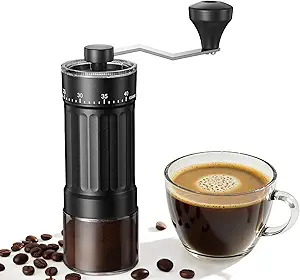 |
| Top Rated A top-rated pick with lots of positive feedback | OXO Brew Compact Conical Burr Grinder |  |
| Most Popular A crowd favorite that many people choose with confidence | SHARDOR Burr Coffee Grinder CG835B |  |
| Best Seller A high-volume bestseller chosen again and again | Wancle Electric Burr Grinder CBG-8000 |  |
Ollygrin Burr Coffee Grinder BG702S

| Capacity | 10 ounces |
|---|---|
| Wattage | 150 watts |
| Voltage | 220 volts |
| Material Type | Stainless Steel |
The Ollygrin Burr Coffee Grinder is a countertop electric grinder built around 40 mm stainless steel conical burrs and a gear-reduction motor to produce consistent grounds with minimal heat. It offers 30 grind settings that span ultra-fine to coarse, so you can dial in textures for espresso, pour-over, or French press, and an adjustable 2–12 cup selector for dosing. A 10-ounce removable hopper and grounds container make it practical for daily home use or small gatherings, while an auto-locking hopper and included cleaning brush simplify handling and maintenance. Safety features include a friction clutch to protect the burrs from debris and built-in overheating protection for the motor. The unit is straightforward to operate with a rotary one-button control and the upper burr can be lifted for cleaning. Trade-offs are typical for its price class: it runs on 150 watts and 220 volts so check compatibility, and while the grinder aims for consistency, advanced home espresso users may prefer larger or higher-end machines for the absolute finest espresso tuning.
Best for: Buyers seeking an affordable, all-purpose burr grinder that balances consistent grind quality, straightforward controls, and easy cleaning for daily home brewing.
Less Ideal for: Those who need professional-level espresso tuning, very large daily volumes, or strict voltage compatibility without adapters should consider higher-end or region-specific alternatives.
- 40 mm stainless steel conical burrs for uniform grounds
- 30 grind settings covering espresso to French press
- Large 10-ounce removable hopper for several servings
- Gear-reduction motor reduces heat to preserve flavor
- Safety features include friction clutch and overheating protection
- Rated for 220 volts which may require an adapter or limit use in some regions
- 150-watt motor may be slower than higher-powered grinders for large batches
Verdict: A budget-friendly burr grinder that delivers reliable, heat-minimized grinding and a wide range of settings for most home brewing needs.
KRUPS Precision Burr Grinder GX550850

| Wattage | 110 watts |
|---|---|
| Capacity | 8 ounces |
| Voltage | 110 volts |
| Grind settings | 12 settings |
The KRUPS Precision Burr Grinder is a small, performance-focused burr grinder aimed at home users who want more control than a blade grinder. It uses flat metal burrs driven by a 110W motor and offers 12 grind settings so you can dial in coarser textures for French press or cold brew and finer settings for drip and espresso. A removable grounds container and top burr make cleanup easier, and the grinder includes a brush for quick maintenance. You select a cup quantity from 2 to 12 and the unit auto-stops when the chosen amount is reached, which helps produce consistent batch sizes and reduces waste. The 8 oz hopper handles multiple doses without taking much counter space, but like many small grinders it performs best when not overfilled and when grinding smaller amounts for uniform results. For buyers seeking a compact, budget-friendly burr grinder that delivers noticeably better consistency than blade models, this Krups is a practical choice; users needing commercial-level throughput or the absolute finest espresso grind may want a higher-end unit.
Best for: Buyers who prioritize getting consistent, tunable grinds on a budget and want a compact grinder for home brewing across methods from French press to espresso.
Less Ideal for: People who need high-throughput grinding for large households or small cafés should consider a larger commercial-style grinder instead.
- Flat metallic burrs provide more uniform grind consistency than blade grinders
- Twelve grind settings cover a wide range of brew methods from coarse to fine
- Removable grounds container and top burr simplify cleaning and reduce mess
- Auto-stop and cup selection (2 to 12) deliver measured, repeatable batches
- Small hopper and recommended smaller batches limit large-volume grinding
- Not optimized for high-volume or commercial use
Verdict: A compact, budget-focused burr grinder that delivers measured, consistent grinds across a wide range of brew methods for home users who care about performance without a high price.
JavaPresse Manual Coffee Grinder

| Material Type | Stainless Steel |
|---|---|
| Power Source | Manual |
| Grind Settings | 18 adjustable settings |
The JavaPresse Manual Coffee Grinder is a hand-crank conical burr grinder built for people who want control over grind size without the noise or bulk of an electric unit. It uses a ceramic burr assembly with over 18 settings to produce consistent grinds for espresso, pour over, drip, and French press, and the manual crank removes the need for power, making it truly portable for camping or travel. The metal body and ceramic burrs are designed for durability and reduced heat transfer during grinding, and the quiet operation is a practical benefit for early mornings. Because it is hand operated, grinding larger quantities takes more time and effort than an electric grinder, and it lacks the speed and convenience of powered models. The grinder is best for single-cup prep or travelers who prioritize compactness, precise grind control, and low noise over throughput and automatic operation.
Best for: Buyers who want a low-cost, compact burr grinder that delivers precise grind control and portability for single-cup brewing and travel.
Less Ideal for: If you regularly brew large batches, need fast hands-free grinding, or want electric convenience, this manual grinder is not the best choice.
- Ceramic conical burr provides consistent, uniform grinds across 18 settings.
- Manual crank is quiet and requires no power, good for travel and camping.
- Compact stainless steel body is portable and durable.
- Simple user-adjustable grind mechanism for precise control.
- Hand grinding is slower and more physically demanding for multiple cups.
- Not suited for high-volume or fast-paced use compared with electric grinders.
Verdict: A budget-friendly, portable burr grinder that delivers precise, quiet grinds for single-cup and travel use.
CEVING Mini Manual Coffee Grinder

| Capacity | 30 g |
|---|---|
| Material Type | Ceramic |
| Power Source | manual winding |
The CEVING Mini Manual Coffee Grinder is a small hand grinder built for travel and budget-minded brewers who still want control over grind size. It uses ceramic conical burrs and an external ring with 40 indexed settings so you can dial in grinds for espresso, pour-over, and French press without opening the unit. The 30 g bean capacity is enough for one to two cups and the unit disassembles into a few pieces for brushing out grounds. Because it is manually powered, you get quiet, consistent grinding without electronics, but faster session times require steady cranking and it will not match electric grinders for speed or large batches. Ceramic burrs help limit heat buildup and preserve flavor, though they can be slightly slower than steel burrs on very fine settings. For a low-cost, portable burr grinder that puts grind control ahead of power, this is a pragmatic choice.
Best for: Buyers seeking an affordable, portable burr grinder who prioritize adjustable grind control and quiet manual operation for occasional single-serve or travel use.
Less Ideal for: People who need to grind large daily volumes, very fast sessions, or want an electric grinder with automated dosing and speed.
- 40 external grind settings for fine control across brew methods
- Ceramic conical burrs that reduce heat and promote uniform grind
- Compact, lightweight design suited for travel and camping
- Easy to disassemble and clean with included brush
- 30 g capacity limits it to small batches
- Manual cranking is slower than electric grinders for frequent use
Verdict: A low-cost, highly portable burr grinder that gives serious grind control for travelers and budget buyers who only need small batches.
OXO Brew Compact Conical Burr Grinder

| Capacity | 50 g |
|---|---|
| Burr type | Stainless steel conical burrs |
| Settings | 15 settings, 29 micro-adjustments |
| Power source | AC adapter |
| Voltage | 120 volts |
The OXO Brew Compact Conical Burr Grinder packs stainless steel conical burrs and 15 settings with 29 micro-adjustments into a slim countertop unit designed for small batches. It is used like a standard timed grinder: load the 50 g hopper, choose a setting, and run the motor for the desired grind; the integrated spout and grounds container make transferring grounds tidy. Notable features include removable upper and lower burrs for deeper cleaning, a chuteless design that improves access to internals, and a compact footprint with cord wrap for easy storage. Practical benefits are consistent grinds from the conical burrs, easy maintenance thanks to disassemblable parts, and recycled Tritan material for the hopper and grounds container. Limitations include the small 50 g capacity that suits single-cup or small-pot brewing but requires frequent refills for larger households and a plastic exterior that is not as rugged as all-metal competitors.
Best for: Buyers who prioritize a dependable, easy-to-maintain grinder for single-cup or small-batch home brewing and want consistent grind control without a large appliance footprint.
Less Ideal for: Those who regularly grind large quantities for multiple people or prefer a heavy-duty all-metal build should consider larger-capacity or more robust models instead.
- Stainless steel conical burrs for consistent grind quality
- 15 settings with 29 micro-adjustments for precise control
- Removable upper and lower burrs for easier, thorough cleaning
- Compact footprint and cord wrap for tidy countertop storage
- Small 50 g hopper requires frequent refilling for multiple cups
- Plastic body is less durable-feeling than metal-bodied grinders
Verdict: A compact, reliable small-batch conical burr grinder that delivers consistent grinds and easy cleaning for budget-conscious home brewers.
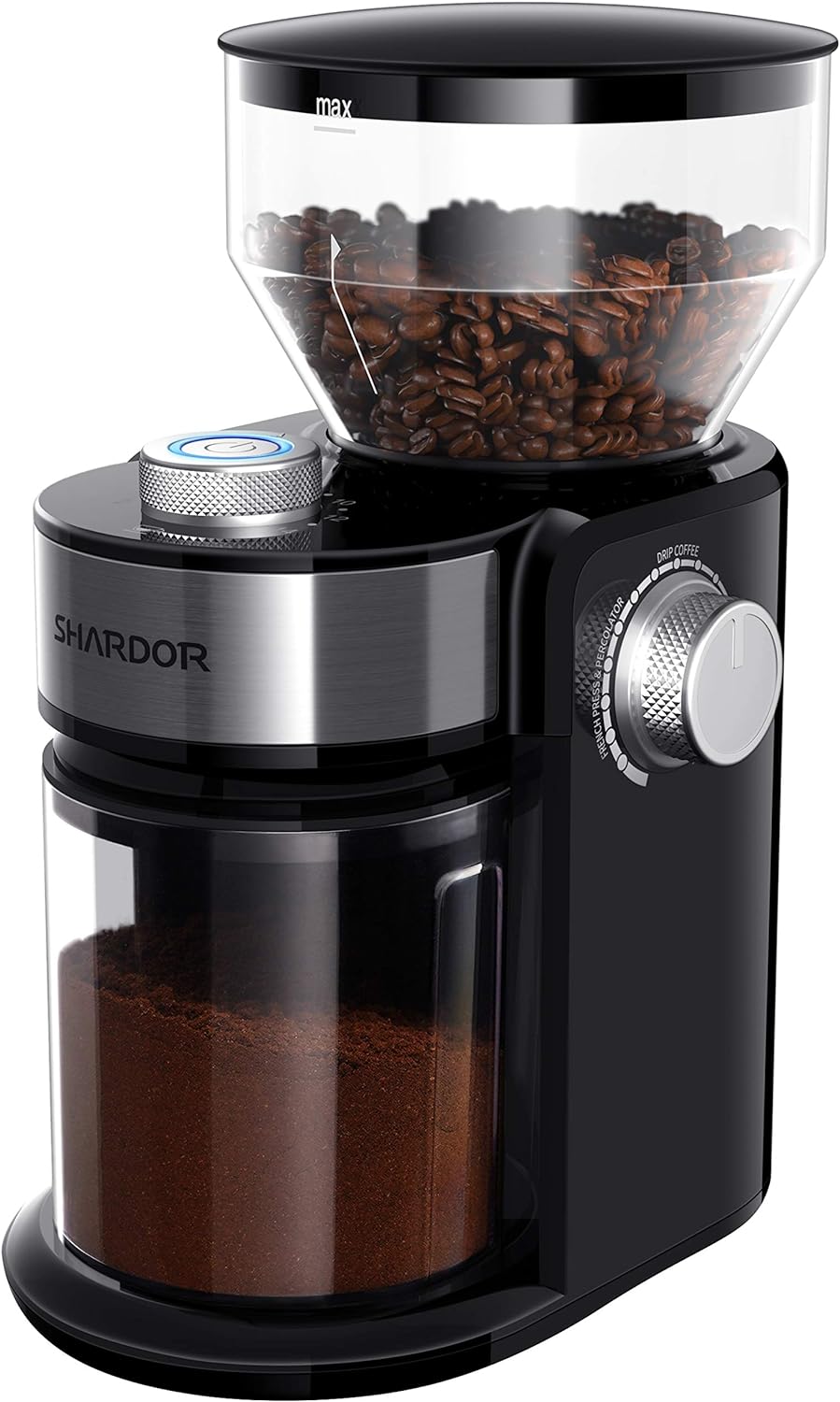
SHARDOR Burr Coffee Grinder CG835B
| Capacity | 8.5 ounces |
|---|---|
| Wattage | 150 watts |
| Voltage | 120 volts |
| Grind settings | 16 settings |
The SHARDOR CG835B is a budget-oriented flat burr grinder aimed at everyday home brewing. It uses a metallic flat burr to produce more consistent grounds than blade models and offers 16 micro-adjustable grind settings to cover espresso through French press. Operation is simple: set the grind, select the 2–14 cup timer, press the one-touch start and the grinder stops automatically when the selected dose is reached. Practical touches include a removable hopper and grind chamber for easier cleaning, a cleaning brush, and dual safety locks that prevent the motor from running unless parts are locked in place. The motor includes overheating protection, which helps longevity under regular use. Expect good value for drip, pour-over, and coarse-brew methods, but the 16-step range and flat-burr design mean it may not match the precision or low-heat performance of higher-end commercial grinders. Size and capacity make it suitable for small households rather than high-volume daily grinding.
Best for: Buyers who want a reliable, inexpensive burr grinder that produces more consistent grounds than a blade model and are guided by reviews and practical safety features when choosing value gear.
Less Ideal for: Users seeking cafe-grade precision, extremely quiet low-heat grinding, or high-volume daily grinding should consider higher-end commercial-style grinders instead.
- Flat metallic burr for more uniform grounds compared with blade grinders
- 16 grind settings to cover espresso, drip, and French press
- 2–14 cup timer with one-touch automatic operation to reduce waste
- Removable hopper and grind chamber plus included brush for easier cleaning
- Dual safety interlock and overheat protection for safer operation
- Flat burrs can heat slightly more than premium conical/large burrs under heavy use
- Capacity and build are aimed at home rather than commercial throughput
Verdict: A compact, review-backed burr grinder that delivers consistent, versatile daily grinding at a budget-friendly price.
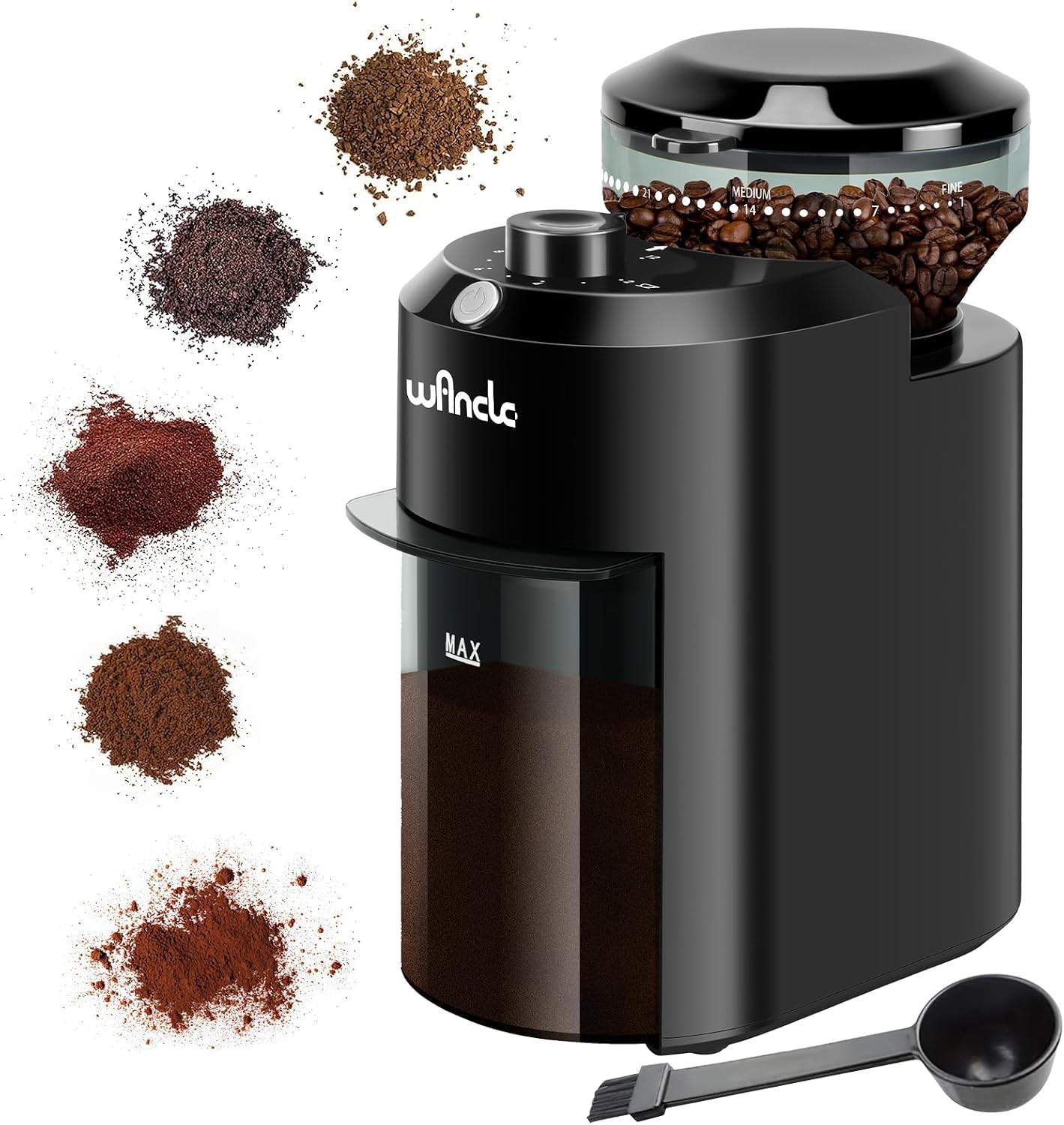
Wancle Electric Burr Grinder CBG-8000
| Wattage | 200 watts |
|---|---|
| Capacity | 12 cups |
| Voltage | 120 volts |
The Wancle Electric Burr Grinder CBG-8000 is a small countertop burr grinder aimed at home users who want consistent, adjustable grinds without a large machine. It uses a 200W motor and 28 stepped grind settings to cover everything from coarse to fine, and the on-demand cup selection lets you grind only what you need for 2 to 12 cups. The plastic grounds container is treated to reduce static and includes a brush for easier cleanup, and the grinder is described as running quietly compared with blade units. Its compact footprint makes it easy to store in a small kitchen. Expect practical benefits like improved extraction versus blade grinders and flexible portion control, but be aware this is a budget, plastic-bodied unit with a relatively small capacity and a modest motor—serious home baristas may prefer heavier-duty metal burr machines. Assembly and correct placement of the parts matter for reliable operation, so follow the included guidance if it does not start.
Best for: Buyers who want an affordable, easy-to-use burr grinder that improves coffee consistency over blade grinders and who prioritize quiet operation and compact storage.
Less Ideal for: If you routinely grind large volumes, prefer a heavy-duty metal build, or need commercial-level throughput, this compact budget grinder will feel underpowered.
- 28 grind settings for precise coarse-to-fine control
- On-demand cup selector to grind only 2 to 12 cups as needed
- Low-noise operation compared with blade grinders
- Anti-static treated grounds container and included brush simplify cleanup
- Compact design that stores easily in small kitchens
- Plastic exterior and components feel less durable than metal-bodied grinders
- Smaller capacity and modest motor limit heavy daily use or large-batch grinding
Verdict: A compact, budget-friendly burr grinder that delivers noticeably better, adjustable grinds and quiet, small-batch convenience for everyday home use.
Choosing the Right Budget Small Burr Coffee Grinder: Key Factors to Consider
Grind Consistency
Even particle size distribution is the main reason to choose a burr grinder. Consistency affects extraction uniformity and the clarity of flavors in your cup. For budget small burr grinders, look for models that specify burr material and show clear adjustment steps so you can achieve repeatable settings across shots or brews.
In practice, grinders with finer step control produce better espresso and finer manual brewing settings. For pour-over and French press, the absolute finest microns matter less than avoiding excessive fines and a wide spread of particle sizes.
Grind Range and Adjustment Precision
A compact grinder needs a usable grind range that covers at least several settings from espresso through medium-coarse. Check how the adjustment mechanism works: stepless dials let you micro-adjust but can be harder to return to exact positions, while stepped systems offer repeatable stops. Either approach can be fine if the steps are well-defined and labeled.
Consider whether the grinder will need to switch frequently between methods. If you plan to toggle between espresso and pour-over regularly, a model with quick, repeatable adjustments will save time and frustration.
Build Quality and Burr Materials
Durability is especially important on budget models where cheaper plastics and thin metal parts are common. Pay attention to the burr material—hardened steel burrs typically last longer and resist chipping, while ceramic burrs can stay sharp but may fracture if mishandled. Housing and hopper materials influence long-term wear and how the grinder feels day to day.
Motor robustness and gearing matter too. A grinder that bogs down on fine settings or produces excessive heat can wear faster and deliver inconsistent results. Solid assembly and accessible replacement parts extend usable life, even for lower-cost units.
Dosing, Hopper Capacity, and Static Control
Dosing options determine how convenient the grinder is for routine use. Some compact grinders have timed electronic dosing or single-dose-friendly hoppers that accept pre-measured beans. Others rely on manual on/off operation. Hopper capacity affects how often you refill beans, and for small kitchens a single-dose or small-capacity hopper is often preferable.
Static and retention influence how much ground coffee stays in the grinder between uses. High retention increases waste and makes consistent dosing harder. Features that reduce static, such as anti-static coatings or portafilter-friendly chutes, improve workflow and reduce mess.
Ease of Cleaning and Maintenance
Budget grinders often lean on simpler designs to keep costs down, and that can be an advantage if the unit is easy to disassemble. Look for grinders with removable burrs or easily detached chutes and hoppers so you can clear trapped grounds and oils. Simple cleaning reduces stale coffee buildup and preserves flavor clarity.
Also consider how accessible replacement parts are. Even inexpensive grinders can last much longer when replacement burrs, gaskets, or hopper lids are available without complex repairs.
Size, Noise, and Kitchen Fit
Compact dimensions matter for small counters and limited cabinet space. A grinder that fits under cabinets or tucks beside other appliances will be used more often. Noise level is another practical factor for shared living situations; some small grinders have surprisingly loud motors or high-frequency buzzes that are disruptive.
Balance your priority between footprint and noise. A slightly larger unit with a quieter motor may be a better fit if you grind early in the morning or in close quarters.
Single-Dose Vs Small Hopper Designs
Single-dose grinders and small-capacity hoppers are popular for budget compact grinders because they minimize stale beans and reduce countertop clutter. Single-dose setups let you weigh beans directly into the hopper for repeatable results and are ideal for people who brew one or two cups daily.
Small hoppers are convenient for households that do not roast at home or that prefer to keep a limited amount of beans accessible. However, tiny hoppers mean more frequent refills when you host guests or make multiple pots.
- Single-dose: best for precise small-batch work and minimal retention
- Small hopper: convenient for daily single-cup routines but requires refills for multiple servings
- Consider whether you want the option to store a few days worth of beans versus strictly single-dose workflow
How Burr Type Affects Flavor and Longevity
Burr geometry and material influence grind particle distribution and how long the set holds an edge. Conical burrs can be forgiving and compact, while flat burrs often deliver tighter particle distributions but are sometimes found in larger machines. In the budget small-burr segment, manufacturers typically use compact conical or smaller flat burrs that balance performance with size.
Ceramic burrs resist corrosion and can stay sharp a long time, but they are brittle. Steel burrs tend to be more durable under everyday use. Neither is a magic bullet; good design and consistent tolerances matter as much as material.
- Ceramic: long-lasting edge, fragile if dropped
- Steel: durable, resistant to chipping
- Burr geometry affects fines and extraction uniformity
Minimizing Retention and Static
Retention is the coffee that stays in the grinder between doses. High retention forces you to purge grounds and makes dose-to-dose consistency harder. Look for short chutes, small grinding chambers, or designs that facilitate a single-dose workflow to keep retention low.
Static causes grounds to cling to plastics and the chute, increasing mess and losing small amounts of coffee. Anti-static treatments, metal chutes, or simple grounding strategies reduce cling and make dosing more consistent.
- Short chute and small grinding chamber reduce retention
- Metal portafilter adapters or grounded chutes cut static
- Single-dose operation is an effective retention mitigation strategy
Practical Tips for Using a Compact Burr Grinder
Calibrate your grinder once you install it by dialing in a starting setting for your preferred method and then adjusting in small increments. Keep a simple log of settings by brew method so you can return to them quickly.
Clean the grinder regularly to prevent buildup of oils and stale grounds. For single-dose users, empty the chamber after each session. For higher-frequency use, schedule a deeper clean every few weeks.
- Weigh beans for consistent dosing
- Purge a small amount of grounds when switching between grind sizes
- Use a brush designed for burrs and avoid soaking motors or electrical parts
When to Prioritize Noise or Speed
If you grind early in the morning while others sleep, prioritize quieter motors even if it means slightly slower grind times. Conversely, if you prepare multiple brews quickly, a faster grinder with adequate cooling will be more convenient.
Remember that very high-speed motors can generate heat that affects grind quality on extended runs. For most home users, a moderate grind speed with good thermal behavior is preferable to raw speed alone.
- Quiet motors for early-morning or shared living environments
- Moderate speed to avoid excessive heat buildup
- Consistency over raw throughput for single-portion home use
How We Chose the Best Budget Small Burr Coffee Grinder
We focused on small-format burr grinders that cost less than typical specialty-countertop units while still delivering genuinely improved grind consistency over blade grinders. Our editorial filters prioritized units with hardened burrs or ceramic burr sets, a compact footprint meant for tight counters, and straightforward grind adjustments suitable for common home brewing methods. Key evaluation criteria included the measurable grind range and step size, build durability and materials for the burr set and hopper, user controls and dosing precision, ease of cleaning and maintenance, and how well the grinder handled common household use patterns such as daily single-cup grinding versus multiple doses. We also considered noise and speed as practical factors for kitchen use. We excluded large commercial-style grinders, hand mills, and machines that require complex professional tuning. Units with unclear specifications or poor parts availability were not considered. The resulting selections reflect grinders that offer the best tradeoffs between compact size, consistent grind performance, and straightforward upkeep for budget-conscious home brewers.
Our full evaluation process is outlined in our review methodology.
FAQ
Will a budget small burr grinder make a noticeable difference over a blade grinder?
Yes. Even compact burr grinders produce a more uniform particle size than blades, which typically reduces over-extraction and bitterness. Expect clearer flavor separation and more control across espresso and manual-brew methods.
Can small burr grinders handle espresso and pour-over?
Many compact burr grinders cover a usable range from fine to medium-coarse, but the ease of switching between methods depends on the adjustment system. If you plan to alternate often, choose a model with repeatable settings or a short dial range between methods.
How often should I clean a budget small burr grinder?
Light cleaning after every few uses and a deeper disassembly clean every 2 to 6 weeks is typical. Frequency depends on how oily your beans are and how often you switch roast types. Regular cleaning preserves flavor clarity and prevents buildup.
What is the typical lifespan of burrs on an entry-level small grinder?
Lifespan varies by burr material and usage, but many quality budget burrs last for hundreds of pounds of coffee before noticeably dulling. Proper cleaning and avoiding hard contaminants extends burr life.
Does grinder retention matter for single-dose brewing?
Yes. High retention forces you to purge old grounds and undermines dosing accuracy for single-dose work. Single-dose-friendly designs or small chambers help maintain freshness and repeatability.
Final Verdict
For small kitchens and limited budgets, prioritize consistent grind performance, a usable adjustment range, and durable burr materials. Compact grinders that are easy to clean and offer low retention will deliver the best day-to-day experience for espresso and manual brewing alike. Balance tradeoffs between noise, speed, and footprint based on your routine. Focus on models with clear adjustments and accessible maintenance so you get reliable, repeatable results without unnecessary complexity.