
Note: This article contains affiliate links. If you click on these links and make a purchase, we may earn a small commission at no extra cost to you. This helps support our research and content. Read our full affiliate disclosure here.
You rely on clean, sharp blades for efficient, safe butchery and big kitchen tasks. A butcher knife sharpener makes quick work of dull edges, keeps slicing consistent, and reduces effort and wrist strain during extended prep. This guide covers seven shortlisted sharpeners that excel at restoring heavy-use blades and maintaining durable bevels. We evaluated units for how quickly they re-establish a working edge, how long that edge lasts, and how easy they are to use and maintain. Read on to find a sharpener that fits your routine and the types of butcher knives you use.
Top Picks at a Glance
| Best Overall The best all-around choice for most situations | Work Sharp MK2 Knife Sharpener |  |
| Best Quality Built to a higher standard if you want something more solid | Chef's Choice Trizor 15XV |  |
| Best Value The sweet spot between price and what you get | Sharp Pebble Adjustable Knife Sharpener |  |
| Best Budget The cheapest option that still gets the job done reliably | AccuSharp Knife Sharpener |  |
| Top Rated A top-rated pick with lots of positive feedback | Victorinox Round Butcher Sharpening Steel 30cm |  |
| Most Popular A crowd favorite that many people choose with confidence | KITCHELLENCE 3-Stage Knife Sharpener |  |
| Best Seller A high-volume bestseller chosen again and again | Intelitopia Knife Sharpening Kit |  |
Work Sharp MK2 Knife Sharpener

| Included Components | Abrasive Belts, Knife Sharpener |
|---|---|
| Model Number | WSKTS2 |
| Grit Type | Medium |
| Material Type | Plastic |
The Work Sharp MK2 is an electric belt-based sharpener built to handle everything from chef knives to axes and scissors. It uses flexible abrasive belts that conform to blade edges so you can sharpen bevels consistently and even work serrations, while the adjustable edge guide helps maintain angle all the way to the tip. A two-speed motor gives extra power for heavier grinding on tools and mower blades and a lower speed for controlled finishing on kitchen knives. The unit ships with belts and is compact enough to sit on a countertop or workbench, and belts are simple to swap when they wear. This system is fast and repeatable compared with stones or handheld pull-throughs, but it removes more metal than gentle honing and requires some care to avoid overheating thin blades. It is also an electric tool, so it is less suitable for very delicate restorations where a strop or waterstone would be preferable.
Best for: Buyers who want a fast, reliable all-purpose sharpener that can service kitchen knives plus outdoor and workshop blades and prefer repeatable results with minimal technique learning.
Less Ideal for: If you only need delicate edge polishing or want a fully manual, low-material-removal restoration process, a waterstone or strop-focused setup is a better choice.
- Flexible abrasive belts conform to edges for consistent sharpening across different blade profiles
- Two-speed motor provides power for heavy grinding and control for fine sharpening
- Adjustable edge guide supports consistent angles to the tip for repeatable results
- Compact benchtop design with replaceable belts for ongoing maintenance
- Removes more material than stones or honing rods, so not ideal for very fine finishing
- Requires electricity and produces more heat than manual methods
Verdict: Choose the MK2 when you want a fast, repeatable electric sharpener that covers kitchen knives and heavier tools with minimal fuss.
Chef's Choice Trizor 15XV

| Material Type | Diamond |
|---|---|
| Grit Type | Fine |
| Stages | Three |
| Included Components | Knife Sharpener |
The Chef's Choice Trizor 15XV is a professional three-stage electric sharpener built to convert and refine household knives to a 15-degree Trizor edge. You use knives through the three slots: stage 1 shapes the bevel with medium diamond abrasives, stage 2 hones with finer diamonds, and stage 3 stropps and polishes with patented flexible disks for a mirror finish. Its precision angle guides and spring-loaded guides remove the guesswork, making it fast and consistent—first-time sharpening takes about a minute and touch-ups take only seconds. Because the abrasive elements are 100 percent diamond, the unit cuts faster and stays effective longer than typical ceramic systems, which is useful for frequent, heavy-duty use like butcher knives. The sharpener handles straight-edge and serrated blades and can reprofile 20-degree edges to a keener 15-degree profile. Limitations are the fixed angle design focused on 15-degree edges, which may not suit every knife geometry, and the unit is a dedicated countertop appliance rather than a portable tool.
Best for: Buyers who prioritize razor-sharp, restaurant-quality edges and need a fast, repeatable sharpening solution for heavy kitchen use such as butcher or chef knives.
Less Ideal for: Users who need multiple angle options for specialty blades or who prefer manual or portable sharpening tools for off-site use.
- Three-stage system (shape, hone, strop) for a finished, polished edge
- 100% diamond abrasives deliver fast material removal and long-lasting performance
- Precision angle and spring guides produce consistent, repeatable edge geometry
- Works on both straight-edge and serrated knives and can convert 20° edges to 15°
- Fixed 15-degree target limits flexibility for knives that require wider angles
- Designed as a countertop electric unit, so it is not suitable for field or travel sharpening
Verdict: If you want fast, repeatable professional-grade edges on butcher and chef knives, this three-stage diamond electric sharpener is built for that job.
Sharp Pebble Adjustable Knife Sharpener
| Grit Type | Coarse, Medium, Fine |
|---|---|
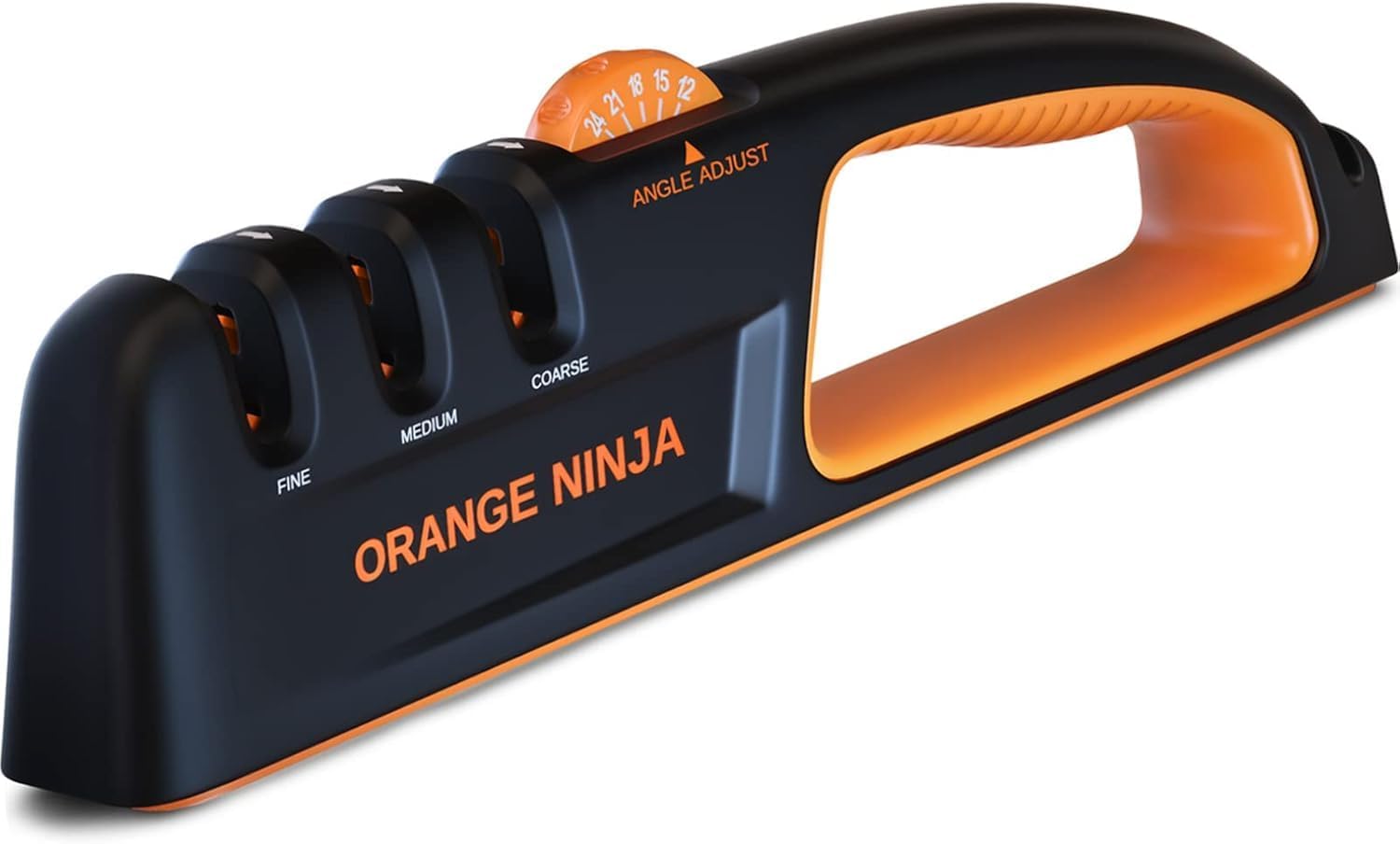
| Angle Settings | 12°, 15°, 18°, 21°, 24° |
| Included Components | Knife Sharpener |
| Material Type | Acrylonitrile Butadiene Styrene, Rubber |
The Sharp Pebble Adjustable Knife Sharpener is a compact, handheld system that restores straight-edge blades using three grit stages and five preset sharpening angles (12°, 15°, 18°, 21°, 24°). You use it by seating the blade in the appropriate slot and pulling through a few passes: start on the coarse stage for damaged or very dull edges, move to medium for shaping, then finish on fine for polishing. The ergonomic ABS body and rubberized base make it stable and easy to hold on a countertop, and the selectable angles let you match common chef and butcher blade bevels for consistent results. It is not meant for serrated blades or scissors, and because it uses guided slots the system removes metal quickly only when using the coarse stage, so users should avoid overworking fine or premium stainless blades. For routine maintenance and bringing neglected butcher knives back to usable condition this sharpener is fast, repeatable, and simple to use, though those seeking micro-bevel finishing or work on serrations will need a different tool.
Best for: Buyers who want a quick, reliable way to restore and maintain straight-edge butcher and chef knives with minimal setup and a repeatable guided angle system.
Less Ideal for: People who need to sharpen serrated blades, scissors, or who prefer freehand stone sharpening for precision micro-bevels and custom grinds.
- Adjustable angle settings covering common bevels for better edge matching
- Three-stage grit progression (coarse, medium, fine) for reshaping and polishing
- Ergonomic ABS body with rubberized base for stable countertop use
- Compact handheld design suitable for quick maintenance and travel
- Not suitable for serrated knives or scissors
- Guided slots limit custom sharpening techniques and micro-bevel work
Verdict: A fast, easy handheld sharpener that reliably restores straight-edge butcher knives with preset angles and three grit stages.
AccuSharp Knife Sharpener

| Material Type | Acrylonitrile Butadiene Styrene |
|---|---|
| Grit Type | Coarse |
| Included Components | Sharpener |
The AccuSharp Knife Sharpener is a simple, handheld pull-through tool that restores a usable edge to kitchen and butcher knives in seconds. You use it by placing the blade in the V-shaped sharpening slot and pulling through a few times while the ergonomic full-length handle keeps your fingers behind the guard. The diamond-honed tungsten carbide blades are reversible for longer life and are coarse enough to quickly reshape dull edges, making it handy for prepping large cuts and everyday kitchen use. It is dishwasher-safe and lightweight, so it is easy to store or toss in a prep drawer, and most users report years of service before needing blade replacements. The design is best for basic edge recovery rather than precision honing to a razor finish, and the coarse grit can remove more material than a fine stone if used aggressively. It also does not replace a professional sharpening system for high-end chef or specialty butcher knives that need exact bevel angles.
Best for: Buyers looking for an affordable, no-fuss sharpener to quickly restore kitchen and butcher knives between professional hones will appreciate its speed and ease of use.
Less Ideal for: Users who want precision sharpening for high-end chef or specialty butcher knives or those who prefer controlled, stone-based honing should look at more advanced systems.
- Very quick edge restoration—most blades sharpened in about 10 seconds
- Diamond-honed tungsten carbide blades are durable and reversible
- Ergonomic handle with full-length finger guard improves safety and control
- Dishwasher-safe and compact for easy storage
- Coarse grit is not suitable for refining a razor edge or delicate bevel work
- Not ideal for repeated use on high-end specialty blades that require precise angles
Verdict: A low-cost, durable pull-through sharpener that delivers fast, practical edge restoration for everyday butcher and kitchen knives.
Victorinox Round Butcher Sharpening Steel 30cm

| Material Type | Plastic |
|---|---|
| Grit Type | Fine |
| Included Components | 1 x butchers sharpening steel |
The Victorinox round fine-cut butcher sharpening steel is a simple, reliable tool for keeping kitchen and butcher knives keen between sharpenings. Its 30 cm round rod is intended for regular honing of straight and slightly curved blades, restoring edge alignment rather than removing significant metal. The fine-cut surface gives a smooth, controlled stroke that is well suited to polished blades and routine maintenance in busy kitchens. The plastic handle provides a secure grip and the length offers good reach for larger knives used by butchers. This steel is compact, easy to store, and straightforward to use with little setup, making it practical for pro and home cooks who want consistent edge feel. It does not replace a stone or grinder for restoring damaged or very dull edges, and the plastic handle may be less durable under heavy industrial use, but for dependable day-to-day honing it performs exactly as intended.
Best for: Buyers who prioritize dependable, low-maintenance tools for routine edge upkeep on kitchen and butcher knives and want a straightforward honing solution.
Less Ideal for: Users who need to restore heavily damaged or very dull blades or who require a heavy-duty industrial tool for continuous commercial sharpening.
- 30 cm length suitable for honing large butcher and chef knives
- Fine-cut rod surface for smooth, controlled edge realignment
- Simple, no-frills design that is easy to use and store
- Not intended for re-profiling or repairing very dull or damaged blades
- Plastic handle may wear faster than metal or composite handles in heavy commercial use
Verdict: A dependable 30 cm fine-cut honing steel for routine maintenance of butcher and chef knives.
KITCHELLENCE 3-Stage Knife Sharpener
| Material Type | Plastic |
|---|---|
| Included Components | Yes |
| Number of Items | 1 |
| Unit Count | 1 Count |
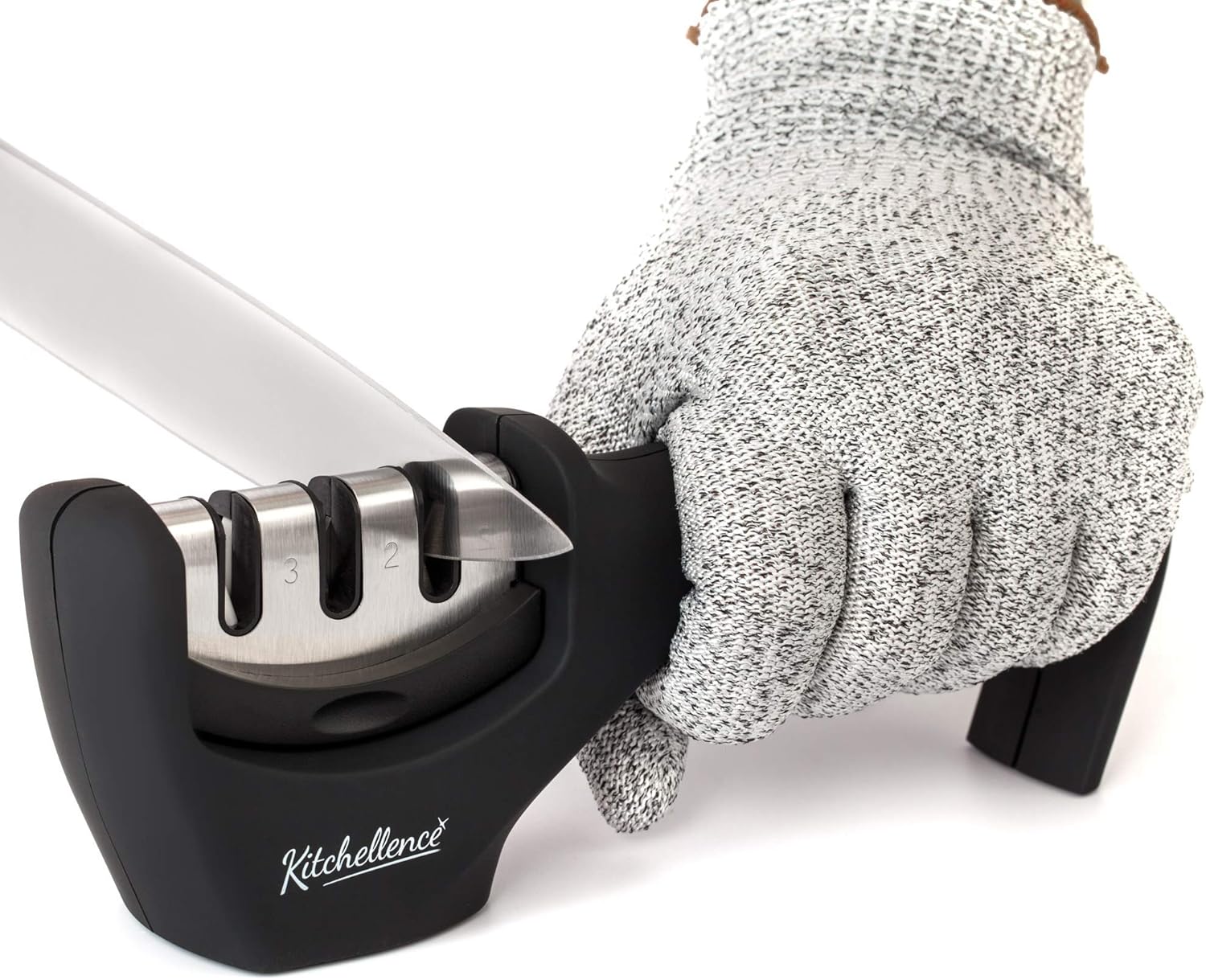
This three-stage sharpener repairs, sharpens, and polishes blades using a diamond rod in the first stage, a coarse slot to re-establish the edge, and a fine slot to hone and polish it. It is used by securing the unit on a countertop and pulling the blade through each slot a few times; the ergonomic handle and nonslip base make it usable by right- or left-handed cooks. The included cut-resistant glove adds a safety layer during handling. Constructed from ABS plastic, the unit is lightweight and easy to store, and the simple pull-through design makes it quick for routine edge maintenance on butcher and kitchen knives. Limitations are that pull-through sharpeners remove metal quickly if overused and do not give the same control as a whetstone for precision bevel angles, and the plastic body may not feel as robust as metal-bodied options for heavy workshop use.
Best for: Buyers who want a straightforward, safe way to restore and maintain butcher and kitchen knives quickly using an easy pull-through system supported by strong social proof.
Less Ideal for: Users seeking workshop-grade precision or those who prefer adjustable-angle or stone-based sharpening methods for professional blades should look elsewhere.
- Three distinct stages (diamond rod, coarse, fine) for repair through polish in one compact tool
- Ergonomic handle and nonslip base for stable, easy use
- Includes cut-resistant glove to reduce accidental cuts during sharpening
- Lightweight and easy to store in a kitchen drawer
- Not suitable for precision angle control compared with whetstones
- Plastic construction may feel less durable for heavy professional use
Verdict: A compact, easy-to-use three-stage sharpener with safety glove that quickly restores home butcher and kitchen knives for everyday use.
Intelitopia Knife Sharpening Kit

| Included components | Sharpening Stones |
|---|---|
| Grits | 400/1000 and 3000/8000 |
| Material Type | Stone (corundum/aluminum oxide) |
| Included accessories | Flattening stone, leather strop, bamboo base, angle guide |
This kit bundles the basic tools needed to sharpen and polish butcher and kitchen knives at home. It includes two dual-sided whetstones (400/1000 and 3000/8000 grits) for progressing from edge repair to fine polishing, a coarse flattening stone to maintain stone flatness, a leather strop for burr removal, a bamboo non-slip base, and an angle guide to help consistent bevels. In practice the 400 grit quickly removes nicks and reshapes a dull edge while the 1000 grit refines it; the 3000/8000 side is useful for smoothing and achieving a keen finish. The angle guide and bamboo base make the set approachable for less experienced users, and the included instructions help reduce mistakes. Expect to spend time learning proper technique and using water with the stones, and heavy-duty or very hard steel may require more passes than premium professional stones, but for home cooks and hobbyists this kit is a practical, all-in-one way to keep butcher knives sharp without buying separate components.
Best for: Buyers who want a single kit to maintain and restore butcher and kitchen knives at home and prefer clear guidance and accessories to reduce beginner mistakes.
Less Ideal for: Professional knife sharpeners or users who need the fastest removal on ultra-hard specialty steels should consider higher-end single-grit and specialty stones instead.
- Includes dual-grit whetstones covering coarse reshaping through fine polishing
- Comes with flattening stone and leather strop to maintain stones and finish edges
- Non-slip bamboo base and angle guide make learning technique easier and safer
- Complete kit removes need to buy separate accessories for basic sharpening workflow
- Stone material is mid-range corundum so very hard steels may take longer to sharpen
- Requires practice and proper water use to get consistent results
Verdict: This all-in-one whetstone kit is the sensible choice for home cooks who want a guided, complete solution to keep butcher knives sharp without buying separate tools.
Choosing the Right Butcher Knife Sharpener: Key Factors to Consider
Sharpening Method
The sharpening method determines how a dull butcher blade is restored. Stones and waterstones remove metal gradually and give fine control over the bevel, which is useful for re-profiling or repairing chips. Pull-through carbide or ceramic systems are faster for basic restoration but can remove material aggressively if misused. Guided rod or guided abrasive systems help maintain a consistent angle, which is important for large blades that need uniform edges.
Choose a method that matches how dull the blade gets in your use. For frequent heavy use, a combination system with coarse and fine stages is often the most practical because it lets you quickly reconstruct the edge and then refine it for slicing performance.
Angle Control and Adjustability
Butcher knives typically have wider bevels than delicate chef knives, so the ability to set and maintain the correct sharpening angle matters. Devices with stable guides or preset angle slots reduce the chance of over-grinding and help keep both sides symmetrical. For thicker blades, look for a system that accommodates larger angles and holds them consistently during repeated passes.
If you need to match an existing factory bevel, pick a sharpener with fine angle increments or a clear way to measure and replicate the angle. Poor angle control leads to an edge that dulls faster or feels waxy when cutting.
Abrasive Grit Range
A good sharpener offers several abrasive grits or stages to handle different states of blade wear. Coarse grits are essential for repairing nicks or re-profiling a blunt edge, while medium grits establish a working edge and fine grits polish and refine the bite for clean slicing. The availability of diamond, ceramic, or waterstone grits affects both material removal speed and the final edge polish.
Consider whether abrasives are replaceable or resurfaceable. Replaceable wheels or stones simplify upkeep in high-volume kitchens where abrasives will wear down more quickly.
Stability and Safety Features
Sharpening butcher knives involves large blades and significant pressure, so a stable base and secure blade support are critical. Non-slip feet, clamping jigs, and blade guides that prevent lateral movement reduce the risk of accidents. Some systems include guards or finger protection that make repeated sharpening safer for busy users.
Safety also ties into how the device is mounted. Table clamps or heavy cast bases reduce wobble and promote consistent contact between blade and abrasive, which improves sharpening results and lowers the chance of slips.
Ease of Use and Learning Curve
How quickly you can get consistent results affects whether a sharpener is practical for regular use. Guided systems and pull-through devices offer fast learning and repeatable outcomes, while freehand stones require technique and more time to master. Consider how much time you can dedicate to learning and whether the device includes angle guides, push-through aids, or clear instructions.
Maintenance tasks such as flattening stones, cleaning debris, and replacing consumables also influence day-to-day usability. For commercial or high-volume home kitchens, low-maintenance options reduce downtime.
Compatibility With Blade Types
Butcher knives vary in length, thickness, and steel hardness. A good sharpener accommodates the blade length and can handle both thinner slicing knives and thicker boning blades without causing uneven wear. Check that the sharpening path or jig supports the full cutting edge and that the device does not force an unnatural curve when working long blades.
Some sharpeners are optimized for very hard steel and use diamond abrasives, while others are gentler and suited to softer, high-carbon steels. Matching the sharpener's abrasive type to your blade metallurgy preserves edge life and prevents premature over-grinding.
When To Reprofile Versus Hone
Reprofiling is necessary when the edge has chips, a rolled bevel, or has been thinned by repeated improper sharpening. This process uses coarser abrasives to restore the basic geometry and is a more aggressive material removal technique. Hone or polish steps are lighter and intended to align or refine the existing edge for immediate cutting performance.
For butcher knives that see heavy daily use, expect to reprofil less often but hone more frequently. Regular light honing preserves the working bevel and delays the need for coarse regrinds. Matching your maintenance cadence to how the knife performs in real tasks extends the blade life and keeps slicing efficient.
- Reprofile with coarse grits when there are chips or a rounded edge
- Hone with fine abrasives to maintain a sharp edge between reprofiles
- Frequent light honing reduces metal removal over time
Maintaining Stone and Abrasive Surfaces
Waterstones and oil stones require periodic flattening to stay effective. A hollowed or uneven stone produces inconsistent contact and a poor edge profile. Diamond plates tend to retain flatness longer but still benefit from cleaning abrasive slurry off the surface.
Replaceable wheels and belts wear predictably and should be swapped before they negatively impact the angle or surface quality. Follow manufacturer guidance for cleaning and storage to avoid clogged abrasives and to prolong the life of consumables.
- Flatten stones regularly with a lapping plate
- Clean diamond and ceramic surfaces to remove metal buildup
- Track consumable wear and replace before performance declines
Setting Up a Safe Sharpening Station
Designate a stable, well-lit area with a non-slip surface for sharpening. Keep the blade direction and any cutting motion away from your body, and use clamps or jigs to stabilize long knives. Wear cut-resistant gloves if you are learning new techniques or frequently adjusting your grip.
Store abrasives and accessories within reach but out of the way to avoid knock-overs. Good organization speeds the process and reduces the chance of accidental contact with a sharp edge.
- Ensure the base is secure and will not shift during use
- Use blade clamps or jigs for long or heavy knives
- Keep a dedicated towel and water source for clean-up
Matching Technique to Sharpener Type
Different sharpeners call for different hand positions and pressure levels. Pull-through systems are more forgiving of inconsistent pressure, while stones require steady, even strokes and attention to angle. Guided rod systems usually specify a number of passes per grit and whether to alternate sides or complete strokes on one side first.
If you are transitioning from a basic pull-through to a stone or guided system, start with coarser grits and practice on a less valuable blade to learn how pressure and stroke length affect the edge. Adapting technique to the tool preserves steel and achieves more reliable results.
- Use lighter pressure on fine grits to avoid over-polishing
- Match stroke length to the blade: long blades need full edge coverage
- Alternate sides consistently to keep the bevel symmetrical
Care for Different Butcher Knife Profiles
Boning knives, slicers, and cleavers may have different bevel angles and thicknesses. Thicker blades tolerate more aggressive sharpening and higher angles, while thinner slicers benefit from finer finishes. Recognize the intended use of each blade and avoid forcing one profile onto a blade designed for another task.
When maintaining a matching set, note the starting bevels and preserve them during routine maintenance to keep their intended cutting characteristics. This practice reduces the need for full reprofiles and keeps each knife performing its specialized role.
- Keep cleaver edges at higher angles for durability
- Polish slicers to a finer finish for smoother cuts
- Document original bevels for future reprofiling
How We Chose the Best Butcher Knife Sharpener
We shortlisted sharpeners based on performance criteria that matter for heavy-duty butcher blades. Priority went to methods that reliably restore blunt, rolled, or damaged edges while preserving the original bevel geometry. We tested for edge retention potential by checking available abrasive grades and the ability to produce a consistent microbevel. Speed and ease of use were key, especially for pros who need rapid turnarounds during busy prep periods. Durability and build quality were evaluated to ensure the sharpener will withstand frequent use without excessive wear or calibration drift. Safety features and clamping stability were included because butchery tasks often involve large blades and fast motions. We also considered maintenance: how easy it is to replace or clean abrasives and whether guides hold their settings. Excluded were specialty or decorative-only honers that cannot address heavily dulled blades, and devices intended solely for small kitchen knives. Our filters favored tools that work across common butcher blade steels and thicknesses and that offer clear user controls for angle and pressure.
Our full evaluation process is outlined in our review methodology.
FAQ
How often should I sharpen a butcher knife?
It depends on use. Heavy daily use may require light honing weekly and a coarse reprofiling every few months. Occasional home use can extend intervals between coarse sharpening but still benefits from periodic honing.
Can I use the same sharpener for my cleaver and slicer?
Often yes, but choose a system that supports the length and thickness of both blades. You may need different angle settings or abrasive stages to suit each blade's intended edge geometry.
Are electric sharpeners safe for butcher knives?
Electric sharpeners can be safe and fast when they have stable guides and coarse-to-fine stages. They can remove material quickly, so use them carefully to avoid over-thinning blades. Stability and consistent angle control are the most important safety considerations.
What grit do I start with for a very dull blade?
Start with a coarse grit to remove damaged metal and re-establish the bevel, then work up to medium and fine grits to refine the edge. The exact grit numbers depend on the abrasive type, but expect several staged passes rather than a single grit jump.
How do I know when a stone needs flattening?
You will notice uneven contact or a rocking feeling during strokes, and sharpening results will be inconsistent across the edge. Regularly check the stone against a flat lapping plate to confirm and restore flatness when needed.
Final Verdict
Choose a sharpener based on how dull your butcher knives get, how often you need to work, and how much hands-on technique you want to apply. Prioritize systems that let you control angle, offer multiple abrasive stages, and provide stable clamping or bases for safe use. Balance speed against precision: faster methods save time but can remove metal quickly, while stones and guided systems give more control and longer-lasting edges. Focus on durability and maintenance simplicity if you sharpen frequently, and on fine abrasive options if you need exceptionally clean slices. With the right tradeoffs, you can keep butcher blades performing reliably and extend their service life.