
Note: This article contains affiliate links. If you click on these links and make a purchase, we may earn a small commission at no extra cost to you. This helps support our research and content. Read our full affiliate disclosure here.
Choosing the right manual knife sharpener matters because a good sharpening tool keeps blades safer, more efficient, and longer lasting. Whether you maintain kitchen knives at home or need a simple bench-side tool, the wrong sharpener can remove too much metal or fail to restore a reliable bevel. This guide covers seven shortlisted manual knife sharpeners that represent different approaches to hand-powered sharpening. We evaluated each option on practical shop and kitchen concerns like ease of use and how long the edge holds up under normal cooking tasks. Read on to find a straightforward sharpening solution that fits your skill level and blade types.
Top Picks at a Glance
| Best Overall The best all-around choice for most situations | Work Sharp Precision Adjust |  |
| Best Quality Built to a higher standard if you want something more solid | Work Sharp Ken Onion Knife Sharpener |  |
| Best Value The sweet spot between price and what you get | Longzon 4-Stage Knife Sharpener |  |
| Best Budget The cheapest option that still gets the job done reliably | AccuSharp Knife Sharpener ACCU-001C |  |
| Top Rated A top-rated pick with lots of positive feedback | Victorinox Swiss Classic Honing Steel 10-Inch |  |
| Most Popular A crowd favorite that many people choose with confidence | KitchenIQ Edge Grip 2-Stage Sharpener |  |
| Best Seller A high-volume bestseller chosen again and again | KITCHELLENCE 3-Stage Knife Sharpener |  |
Work Sharp Precision Adjust

| Included components | 320 & 600 Grit, Diamond, Fine Ceramic; Angle Adjustable Chassis; Benchtop Base; Knife Clamp; Slide Rod |
|---|---|
| Sharpening angle range | 15 to 30 degrees (1-degree increments) |
| Material type | Acrylic, Ceramic, Neoprene, Plastic, Steel |
| Manufacturer | Work Sharp |
The Work Sharp Precision Adjust is a benchtop guided sharpening system that makes manual sharpening repeatable and accessible. It clamps the blade in a v-block and uses a three-sided abrasive rod (coarse diamond, fine diamond and fine ceramic) that slides on an angle-adjustable chassis so you can set precise bevels from 15 to 30 degrees in 1-degree steps. In practice it speeds up reprofiling dull edges and finishing to a polished edge, and the guided jig keeps blade contact consistent across the grind. The included base and clamp make setup stable on a counter, and the kit covers most kitchen, pocket and utility knives rather than relying on freehand skill. It is not an electric belt or powered system, so sharpening still requires several passes and some attention to technique, and very large or unusually shaped blades may be awkward to clamp. For a buyer who wants controllable, repeatable manual sharpening with a full set of abrasives, this system is a strong, practical choice.
Best for: Buyers who want a reliable, guided manual system that delivers consistent, repeatable sharpening for everyday kitchen and pocket knives without needing freehand expertise.
Less Ideal for: People who prefer instant results from powered sharpeners or who need a solution specifically for oversized or specialty blades that do not fit a benchtop clamp.
- Angle-adjustable chassis with 1-degree increments for precise, repeatable bevels
- Tri-brasive rod includes coarse diamond, fine diamond and fine ceramic stones for reprofiling and polishing
- Benchtop base and v-block clamp hold blades securely for consistent sharpening
- Covers a wide range of kitchen, pocket and utility knives without freehand skill
- Requires manual passes and user attention rather than offering a powered, faster option
- Large or irregularly shaped blades can be difficult to clamp securely
Verdict: Choose this guided, adjustable benchtop sharpener if you want precise, repeatable manual sharpening for a broad range of knives without relying on freehand skill.
Work Sharp Ken Onion Knife Sharpener

| Brand Name | WORK SHARP |
|---|---|
| Item Type Name | Knife Sharpener |
| Manufacturer | Work Sharp |
| Grit Type | Fine |
The Work Sharp Ken Onion Edition Mk.2 is a benchtop sharpening system built for users who want precise, repeatable edges without mastering freehand techniques. It uses flexible abrasive belts and guided angle fixtures so you can sharpen kitchen knives, scissors, serrated blades, and small tools by running the edge against the rotating belt while the guide holds the bevel. Electronic speed control and a seven-speed motor let you tune material removal for fast reprofiling or finer finishing passes, and the system's design — developed with knife maker Ken Onion — emphasizes consistent, keen results. In practice it cuts sharpening time compared with stones, is easy to set up, and the belt-based approach handles both coarse shaping and fine polishing when you swap grits. Limitations are that it is a powered bench unit, so it is bulkier than pocket or handheld options and produces abrasive dust and heat during heavy work, and it requires replacement belts over time. For cooks and hobbyists who value speed and repeatable pro-quality edges, it delivers a reliable sharpening workflow.
Best for: Buyers who prioritize fast, repeatable, pro-quality edge results and want a benchtop system that shortens reprofiling and finishing compared with stones or guided rods.
Less Ideal for: People seeking a compact, travel-friendly, or purely manual sharpening solution should consider lightweight handheld sharpeners or stones instead.
- Flexible abrasive belts and guided angle fixtures produce consistent, repeatable edges
- Electronic speed control with multiple motor speeds for coarse shaping to fine polishing
- Works on knives, scissors, serrated blades, and small tools for wide versatility
- Designed with knife maker Ken Onion, reflecting pro-level sharpening intent
- Bench-mounted powered unit is bulkier than handheld or pocket sharpeners
- Generates abrasive dust and heat during heavy sharpening sessions
- Requires periodic purchase and replacement of abrasive belts
Verdict: If you want professional, repeatable edges quickly from a benchtop system, this Ken Onion–designed Work Sharp delivers a fast and controllable sharpening workflow.
Longzon 4-Stage Knife Sharpener

| Material Type | Ceramic, Tungsten Steel |
|---|---|
| Grit Type | Ultra Fine |
| Included Components | Knife sharpener |
| Unit Count | 1 Count |
This Longzon 4-stage manual sharpener is a straightforward tool for restoring dull blades at home. It offers dedicated slots for scissors, coarse grinding, fine grinding, and precision polishing so you can reshape a damaged edge then refine it to a keen finish. The unit sits on a non-slip base for stable one-handed use and comes with a cut-resistant glove for safer handling. Construction mixes ABS housing with tungsten steel and ceramic abrasive stages, which makes routine touch-ups quick and predictable without learning complex sharpening angles. It is best used for regular kitchen maintenance and sharpening scissors or pocket knives, not for heavy blade re-profiling or replacing professional sharpening gear. The compact footprint stores easily in a drawer, and the included glove and clear stage progression make it approachable for users who want consistent results with minimal setup.
Best for: Practical home cooks who want an easy, low-skill way to keep kitchen knives and scissors performing well between professional services.
Less Ideal for: Users who need precise angle control for specialty blades or who frequently restore heavily damaged or high-end knives should consider a bench stone or guided system instead.
- Four-stage slots cover scissors, coarse sharpening, fine sharpening, and precision polishing for progressive edge work
- Non-slip base improves stability during one-handed use
- Includes a cut-resistant glove for safer handling
- Uses ceramic and tungsten steel abrasives for effective honing and edge restoration
- Compact, drawer-friendly design for easy storage
- Not adjustable for custom sharpening angles for professional re-profiling
- May wear more quickly than dedicated bench sharpeners under heavy use
Verdict: A simple, safe, and compact 4-stage sharpener that helps everyday cooks quickly restore and maintain knife edges without special skills.
AccuSharp Knife Sharpener ACCU-001C

| Material Type | Acrylonitrile Butadiene Styrene |
|---|---|
| Grit Type | Coarse |
| Included Components | Sharpener |
The AccuSharp is a simple, no-frills pull-through sharpener designed to restore dull kitchen and outdoor knives quickly. You use it by drawing the blade through the carbide sharpening slot while the ergonomic handle and full-length finger guard keep your hand steady and safe. The diamond-honed tungsten carbide edges cut aggressively so most blades regain a usable edge in around ten seconds, and the reversible blades extend the tool's service life. It is lightweight, dishwasher-safe, and easy to store, so it works well for busy home cooks or campers who need a fast fix rather than precision sharpening. The coarse grit makes edge re-profiling fast but it will leave a more aggressive finish than finer stones, so it is best for routine maintenance and rescue sharpening rather than refining a razor edge. Replacement blades are available if the cutter eventually dulls. For buyers on a tight budget who want a dependable, straightforward sharpener, this is a practical choice with few complications.
Best for: Buyers who need an inexpensive, fast way to restore everyday knife edges for cooking or outdoor use and prefer a low-maintenance tool that works reliably with minimal skill.
Less Ideal for: People seeking precision honing or a very fine, razor edge for professional chef work should choose a stone or guided sharpening system instead.
- Very quick edge restoration—most blades sharpened in about ten seconds
- Diamond-honed tungsten carbide cutters provide durable, aggressive sharpening
- Ergonomic handle with full-length guard for safe, two-handed use
- Lightweight and dishwasher-safe for easy cleaning and storage
- Reversible and replaceable blades extend usable life
- Coarse grit leaves a more aggressive finish not suited for achieving a razor polish
- Limited control compared with whetstones or guided systems for precise angles
Verdict: A budget-friendly, easy-to-use pull-through sharpener that restores usable knife edges fast for everyday home and outdoor needs.
Victorinox Swiss Classic Honing Steel 10-Inch

| Material Type | Stainless Steel |
|---|---|
| Grit Type | Fine / Medium |
| Item Type Name | Swiss Classic Steels 10" Continental Cut Black |
The Victorinox Swiss Classic 10-inch honing steel is a simple, professional-style tool for keeping kitchen knives performing well without removing significant metal. It is used by drawing the blade along the textured, chrome-plated steel at a consistent angle to realign the edge, which helps maintain sharpness and can reduce how often you need full sharpening. The textured Swiss Classic handle gives a secure grip and the steel is balanced and weighted for controlled strokes, making it comfortable for frequent use. Because it is brush chrome plated stainless steel and described as fine/medium grit, it adds some surface hardness and stain resistance while remaining easy to clean. This is not a sharpening stone and will not reprofile a dull blade, so users should still plan periodic sharpening when the edge is worn. For home cooks who prioritize durable, no-nonsense kitchen tools, this honing steel delivers reliable, repeatable maintenance in a compact package.
Best for: Buyers who want a durable, professional-style tool to keep knives in regular use sharp and minimize full sharpening frequency.
Less Ideal for: If you need to restore very dull or damaged blades, choose a sharpening stone or guided sharpener instead of this honing steel.
- Professional-grade 10-inch steel suitable for standard kitchen knives
- Textured Swiss Classic handle provides secure, comfortable grip
- Chrome-plated stainless steel resists staining and is easy to maintain
- Balanced, weighted design enables controlled, repeatable honing strokes
- Does not sharpen or reprofile heavily dulled blades—only realigns edges
Verdict: A durable, Swiss-made 10-inch honing steel that reliably maintains knife edges between professional sharpenings.
KitchenIQ Edge Grip 2-Stage Sharpener

| Material Type | Plastic |
|---|---|
| Grit Type | Fine |
| Model Number | 50009 |
The KitchenIQ Edge Grip 2-Stage Sharpener is a small, hand-held pull-through sharpener meant for quick edge repair and routine touch-ups. It uses a carbide slot to reset very dull or nicked edges and crossed ceramic rods to polish and refine the blade, so you can restore cutting performance in a few pulls. The patented V-shaped edge grip and non-slip rubber feet let you use it safely on a countertop edge or flat surface, and the soft-grip handle makes pulling the blade steady and comfortable. Because the sharpening angles are preset, it is very easy to use even if you do not know knife bevel geometry, and the compact plastic body stores well in a drawer. The unit works best on straight-edged kitchen knives and can handle serrated blades for light touch-ups, but it is not a precision system for professional reprofiling or for restoring heavily damaged specialty steels. For everyday home cooks who want a fast, low-skill way to keep knives cutting, this is a practical and reliable option.
Best for: Buyers who want a simple, low-effort way to restore household kitchen knives and prefer a proven, widely used tool backed by many user reviews.
Less Ideal for: Users who need exact edge geometry, professional sharpening results, or who frequently restore heavily damaged or high-end specialty blades.
- Two-stage system: carbide for quick edge setting and ceramic for honing
- Patented V-grip and non-slip feet enable stable use on countertop edges
- Preset sharpening angles make it easy for beginners to get consistent results
- Compact, lightweight design stores easily in a drawer
- Not suitable for precision reprofiling or heavy professional use
- Plastic body may feel less durable than metal-bodied sharpeners
Verdict: A compact, easy-to-use two-stage pull-through sharpener that reliably restores everyday kitchen knives for home cooks.
KITCHELLENCE 3-Stage Knife Sharpener
| Material Type | Plastic |
|---|---|
| Number of Items | 1 |
| Included Components | Yes |
| Model Number | KS37 P |
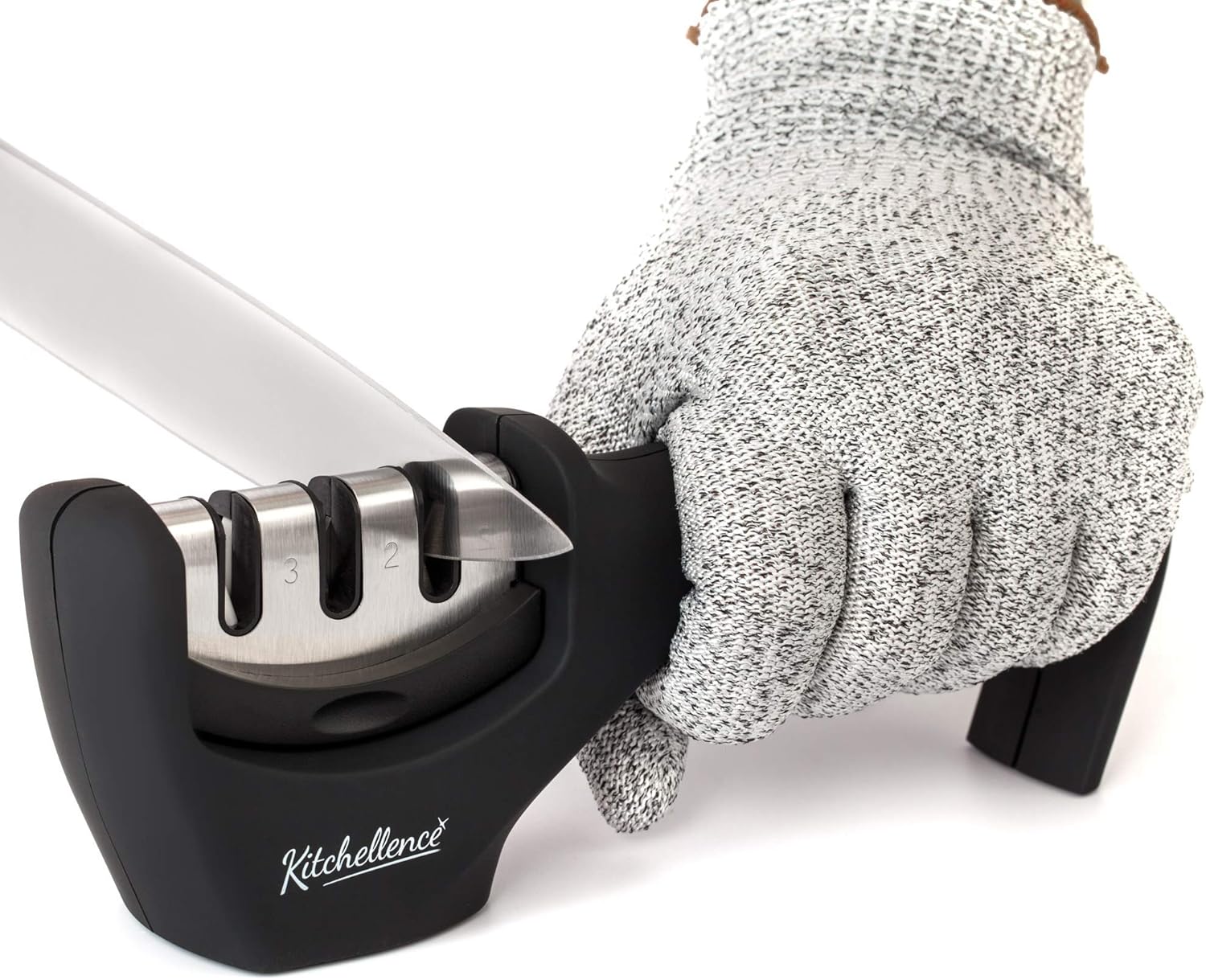
This 3-stage sharpener uses a diamond rod to realign damaged edges, a middle slot to re-form the bevel, and a fine polishing slot for a smoother cutting edge, so you can restore kitchen knives quickly without tools or stones. The unit is handheld with an ergonomic non-slip base for one-handed stability and is ambidextrous, letting right- or left-handed users pull blades through each slot a few times to remove burrs and restore sharpness. Made of ABS plastic, it is lightweight and easy to store, and the included cut-resistant glove adds a layer of safety during use. The system works well for routine maintenance on chef, utility, and paring knives but is not a substitute for professional sharpening on very high-end or damaged specialty blades. Because it is a guided manual sharpener, blade angle is mostly fixed by the slots which makes it simple for risk-averse users but less flexible for custom bevels. For everyday home cooks who want a fast, safe way to refresh dull knives, this kit is practical and low effort.
Best for: Buyers who prioritize safety and simplicity and want an easy, low-risk way to refresh household knives without learning freehand sharpening.
Less Ideal for: Users seeking professional-level edge reprofiling, precise angle control, or who work with high-end specialty knives should consider whetstones or pro sharpening services instead.
- Three distinct sharpening stages (repair, sharpen, polish) for stepwise edge restoration
- Ergonomic non-slip base for stable one-handed use
- Includes cut-resistant glove for added safety
- Lightweight ABS construction that is easy to store and handle
- Fixed slot angles limit control over custom bevels and professional reprofiling
- Plastic housing may feel less durable than metal-bodied sharpeners
Verdict: A simple, safe 3-stage manual sharpener that lets cautious home cooks quickly restore dull knives with minimal skill required.
Choosing the Right Manual Knife Sharpener: Key Factors to Consider
Sharpening Method and Angle Control
How the sharpener guides the blade determines the final bevel geometry and consistency. Devices with fixed-angle guides simplify the process for casual users, producing repeatable results without needing to eyeball the angle. Pull-through slots, V-grooves, and guided rods each create a different contact pattern and abrasion rhythm. Loose or poorly machined guides can alter the intended angle over multiple passes, leading to uneven edges.
If you prefer to control the angle manually, look for a tool with stable contact surfaces and tactile feedback so you can maintain a consistent wrist position. For home cooks who want a faster learning curve, systems with preset angles reduce user error and make it easier to restore a dull blade to a functional edge.
Abrasive Types and Grit Progression
Abrasive material and available grit steps affect how quickly metal is removed and how refined the final edge becomes. Coarse abrasives reshape a damaged or very dull edge faster but leave visible scratches that need finer grits to polish out. A three-stage progression that includes coarse, medium, and fine steps is often sufficient for most blades and simplifies the workflow.
Consider whether the abrasives are fixed, replaceable, or serviceable. Replaceable stones or inserts extend the tool's useful life and let you tailor abrasives to different steel hardnesses. Ceramic, carbide, and diamond abrasives cut at different rates and require different pressures; diamond cuts fastest and lasts longest, while ceramic often yields a smoother final polish.
Handle and Base Stability
A stable sharpener reduces the chance of slips and inconsistent strokes, directly impacting both safety and sharpening quality. Look for non-slip bases, rubber feet, or clamps that hold the tool steady on a countertop. Ergonomic handles or finger guards improve control during each pass and reduce fatigue on repeated use.
If the sharpener is intended for workshop use or heavier re-profiling, choose models with heavier bases or the option to mount to a bench. Lightweight or flimsy constructions can shift during use, increasing the risk of over-angling the blade and removing excess material.
Compatibility With Blade Types
Not all sharpeners handle every blade shape or hardness. Consider whether you need to sharpen straight-edge chef knives, small paring knives, or harder specialty steels. Some manual sharpeners include special slots or attachments for serrated edges, while others are limited to plain edges only.
If you own knives with harder steels, ensure the abrasive can effectively cut those alloys. Softer abrasives are gentle but can be ineffective on very hard steels, leaving the edge under-sharpened. Conversely, overly aggressive abrasives can remove material too quickly from softer blades, shortening their service life.
Maintenance and Replacement Parts
A sharpener is an ongoing tool, not a disposable accessory. Ease of cleaning the contact surfaces and availability of replacement abrasive systems matter for long-term value. Tools with sealed or non-serviceable abrasives often require replacement of the entire unit when worn, while models with replaceable rods or stones let you refresh the cutting surfaces affordably.
Also evaluate whether the tool needs occasional realignment or lubrication. Simpler maintenance routines reduce downtime and ensure you get consistent edges over the tool's lifetime.
Safety Features and User Guidance
Manual sharpening is a hands-on task that can be hazardous without the right safeguards. Look for finger guards, clear angle markings, and built-in stops that prevent over-insertion of the blade. Good instructions and visible guides reduce user error and improve outcome consistency.
Training aids such as angle markings or simple step-by-step guides help new users achieve reliable results and minimize the risk of accidents during re-profiling.
Basic Sharpening Workflow
A consistent sharpening workflow improves results and reduces the chance of mistakes. Start by assessing the edge for chips or rolling, then choose the appropriate grit for reshaping or polishing. Use light, controlled passes and let the abrasive do the work rather than forcing the blade.
Finish with a finer abrasive or a stropping step to remove burrs and restore smooth slicing performance. Wipe the blade clean between grit changes to avoid dragging coarse particles onto finer surfaces.
- Inspect the edge and choose coarse or fine grit accordingly
- Set a stable workstation with good lighting and a non-slip surface
- Use consistent stroke length and pressure for even wear
- Deburr and polish after reshaping to smooth the edge
Techniques for Different Knife Profiles
Wide chef knives demand slightly longer strokes and steady angle control to maintain an even bevel along the blade. Short blades like paring knives require shorter, more precise strokes to avoid over-sharpening the tip.
For serrated knives, many manual sharpeners do not work effectively. When an included serration tool is present, run the conical or tapered rod carefully into each scallop, matching the original bevel without widening the serration excessively.
- Use longer strokes for larger blades to keep the bevel uniform
- Support the spine when sharpening small knives to prevent tipping
- Treat serrations individually with a tapered rod when available
Caring for Sharpening Abrasives
Diamond and carbide abrasives require minimal maintenance but benefit from an occasional wipe to remove metal filings. Ceramic stones can clog with metal particles; cleaning with a soft brush and a mild abrasive cleaner restores cutting action.
Replace worn inserts before performance degrades noticeably. Tracking wear visually or by testing on a sacrificial blade helps you know when abrasives need replacement.
- Wipe diamonds and carbides to remove filings
- Brush ceramic stones to unclog pores
- Keep spare inserts or rods on hand if the system supports replacements
Setting Up a Safe Sharpening Station
Choose a flat, stable work surface and secure the sharpener with its non-slip feet or a clamp. Clear the area of distractions and keep fingers behind any guards while drawing the blade.
Wear cut-resistant gloves if you are new to sharpening or handling very slippery blades. Good lighting helps you see burr formation and edge continuity as you work.
- Work on a flat, stable surface with good lighting
- Use clamps or non-slip pads to stabilize the sharpener
- Consider cut-resistant gloves for initial practice sessions
When to Reprofile Instead of Honing
Honing restores alignment to an already sharp edge and uses minimal metal removal. Reprofiling uses coarser abrasives to change the bevel angle or remove chips. Choose re-profiling when the edge is visibly rolled, chipped, or has lost its primary bevel shape.
Frequent light honing extends intervals between re-profiling sessions and preserves blade life. Reserve coarse abrasive work for when performance noticeably declines or when repairing damage.
- Hone regularly to extend the time between re-profiles
- Reprofile only for chips, rolls, or major dulling
- Match the new bevel angle to the knife's intended use
How We Chose the Best Manual Knife Sharpener
We focused on criteria that reflect how people actually use manual knife sharpeners at home and in small workshops. We prioritized tools that produce a repeatable and controllable bevel, selecting units with clear angle guidance or consistent contact geometry. Durability of the abrasive surfaces and the construction of handles or bases were key because a worn or unstable sharpener quickly degrades results and can create safety hazards. We also evaluated how easy each tool is to use for first-time sharpeners, including the number of steps, required pressure, and whether the tool supports both coarse reshaping and fine polishing. Safety features and secure mounting were considered to reduce the risk of slips during use. Finally, we looked at versatility across common kitchen steels, including whether the tool can handle harder blades and serrations where applicable. We excluded motorized and electric-driven systems, knife hones that require specialized training, and tools intended solely for maintenance stropping without edge re-profiling. The result is a list of manual sharpeners that balance controllability, longevity, safety, and practical ease of use.
Our full evaluation process is outlined in our review methodology.
FAQ
How often should I use a manual sharpener on kitchen knives?
It depends on use intensity. Light home use may only need honing every few uses and a full re-sharpen with a manual sharpener a few times per year. Heavier daily use requires more frequent attention. Monitor cutting performance rather than sticking to a rigid schedule.
Can a manual sharpener damage high-hardness steels?
Some abrasives are too aggressive and can remove material faster than intended, but many diamond or ceramic abrasives are suitable for harder steels. Use the gentlest effective abrasive and follow manufacturer guidance when available to avoid over-grinding.
Will a manual sharpener work on serrated knives?
Not all manual sharpeners handle serrations. Some include a tapered rod or dedicated accessory to address scallops individually. If your set includes that feature, work each serration carefully; otherwise, serrated knives often require specialized tools.
How do I know when the abrasive needs replacement?
You will see slower cutting action, longer sharpening times, or inconsistent results when abrasives are worn. Visual wear, glazing, or loss of grit texture indicate it is time to replace or service the abrasive elements.
Is it safe to sharpen very thin or brittle blades with a manual sharpener?
Proceed cautiously. Thin blades can overheat or chip if too much pressure is applied. Use lighter, controlled strokes and finer abrasives to preserve edge geometry at the tip and avoid forcing the blade into aggressive grits.
Final Verdict
Manual knife sharpeners are practical tools for keeping kitchen blades functional and safe when you match the tool to your skill level and blade types. Prioritize devices that provide consistent angle control, durable abrasives, and a stable platform to reduce user error and material loss. Routine honing combined with occasional re-profiling using appropriate grits will extend blade life and maintain cutting performance. Choose a sharpener that balances ease of use with the abrasive capability needed for the steels in your collection to get reliable, repeatable results.