
Note: This article contains affiliate links. If you click on these links and make a purchase, we may earn a small commission at no extra cost to you. This helps support our research and content. Read our full affiliate disclosure here.
When you add audio to video surveillance, you get more context for events and a greater ability to deter intruders or communicate with visitors. Choosing the right CCTV security camera with audio means balancing microphone quality, speaker power for two-way talk, and core imaging performance for day and night. This guide covers seven shortlisted CCTV Security Cameras with Audio that represent the best mix of clarity, reliability, and installation flexibility for typical home and small-business setups. Below we explain the evaluation criteria used and what to expect from each top pick, so you can match features to your monitoring needs.
Top Picks at a Glance
| Best Overall The best all-around choice for most situations | ANNKE 8-Camera DVR System | 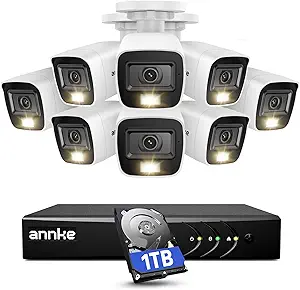 |
| Best Quality Built to a higher standard if you want something more solid | REOLINK RLK8-800PT4 4K PTZ System |  |
| Best Value The sweet spot between price and what you get | Gianteye 2K Solar Wi‑Fi Camera |  |
| Best Budget The cheapest option that still gets the job done reliably | ZOSI 2MP Bullet Camera ZG2612F |  |
| Top Rated A top-rated pick with lots of positive feedback | REOLINK RLC-1224A 12MP Dome Camera |  |
| Most Popular A crowd favorite that many people choose with confidence | ZOSI 3K Lite 8CH DVR System |  |
| Best Seller A high-volume bestseller chosen again and again | SensForge Indoor Pan-Tilt Camera SF-C2 |  |
ANNKE 8-Camera DVR System
| Connectivity Technology | Wired |
|---|---|
| Video Capture Resolution | 1080p |
| Number of Channels | 8 |
| Memory Storage Capacity | 1 TB |
| Other Special Features of the Product | Human Detection, Vehicle Detection |
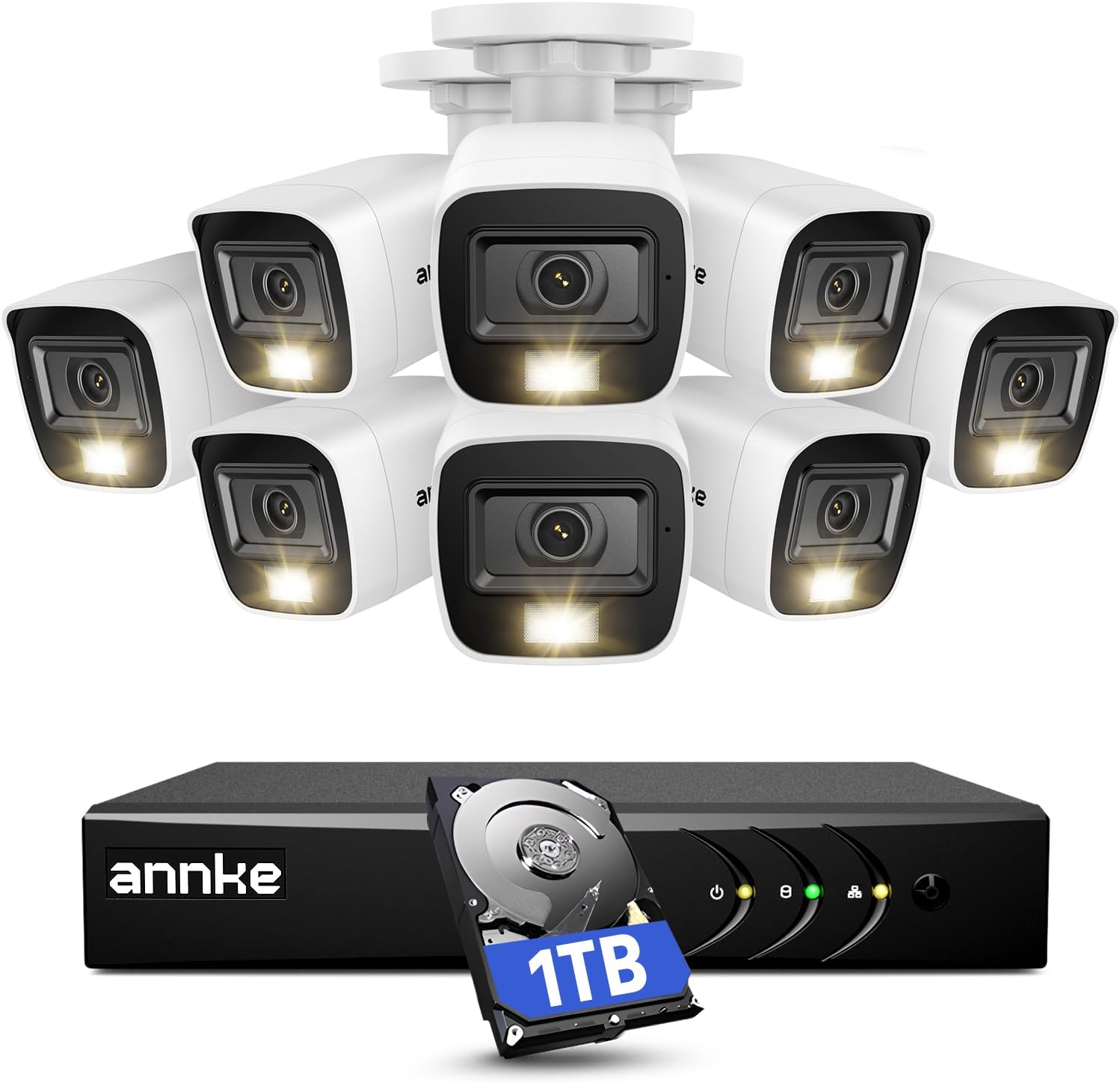
This ANNKE kit bundles an 8-channel H.265+ DVR with eight 2MP (1080p) weatherproof cameras that have dual-light heads and built-in mics, plus a preinstalled 1 TB drive for local storage. It is typically installed around a home or small business where wired runs are practical and constant power is available; each camera uses BNC cabling and includes long 60 ft cables and power splitter leads to simplify setup. The system offers smart motion filtering with AI human and vehicle detection to cut down false alerts, three night modes including color white-light night vision, and app push notifications for remote alerts and viewing. Practical benefits include secure local recording without mandatory cloud service, microphone audio on captured clips, and robust IP67 weatherproofing for outdoor placement. Trade-offs are the wired installation requirement and analog/BNC signal format which limits resolution to 1080p rather than newer higher-resolution IP systems, and the DVR interface and features are more utilitarian than modern cloud-native camera solutions.
Best for: Buyers who want a balanced, all-in-one wired security package with local storage and audio on every camera, and who value reliable detection over cutting-edge resolution or cloud dependency.
Less Ideal for: People who need a no-cable wireless solution, want native cloud-first features, or require ultra high-resolution IP cameras for very large properties.
- Complete kit with DVR and eight prewired cameras and necessary cables for out-of-the-box local recording
- Built-in microphones capture audio alongside video for fuller incident context
- Dual-light design and 3 selectable night modes provide usable color night vision as well as IR for darker scenes
- AI human and vehicle detection reduces false motion alerts and speeds relevant notifications
- IP67 rating makes cameras suitable for exposed outdoor installation
- Wired BNC/analog setup limits maximum resolution compared with modern IP/PoE systems
- Installation requires cable runs and basic DVR configuration which may need more time or professional help
- User interface and feature set are more traditional and less cloud-centric than newer systems
Verdict: A practical, fully wired 8-camera kit that delivers local 1080p recording with audio and AI detection for buyers who want dependable, all-around home or small-business surveillance.
REOLINK RLK8-800PT4 4K PTZ System

| Connectivity Technology | Wired |
|---|---|
| Video Capture Resolution | 8MP (3840 x 2160) |
| Number of Channels | 8 |
| Memory Storage Capacity | 2 TB |
| Frame Rate | 25fps |
The RLK8-800PT4 is a wired PoE CCTV system built for high-resolution, active perimeter monitoring. It pairs an 8‑channel NVR (with a preinstalled 2TB drive) and four 4K PTZ PoE cameras that offer 355° pan, 50° tilt and auto-tracking to follow moving subjects. Cameras use varifocal lenses, an F1.6 aperture and adjustable warm spotlights for color night vision plus IR for black-and-white night mode, and the NVR records continuously or by motion using H.265 compression. Setup is simplified by PoE so each camera needs a single Ethernet cable for power and data, and remote access is available via Reolink apps and desktop client. Practical benefits include long-range 4K detail, two-way audio for live interaction, smart person/vehicle/animal detection to reduce false alerts, and support for multi-user remote viewing. Limitations are that the system is designed to work with Reolink PoE cameras only and requires wired cabling and basic networking knowledge for optimal placement and performance.
Best for: Buyers who prioritize high-resolution, active outdoor monitoring and want a self-contained wired PoE system with auto-tracking and on-site recording for property perimeter security.
Less Ideal for: Users who need a wireless or plug-and-play battery camera solution or who cannot run Ethernet cabling for each camera.
- True 4K (8MP) capture for clear identification at distance
- PTZ with 355° pan, 50° tilt and auto-tracking to follow moving targets
- PoE cabling simplifies installation by delivering power and network over one cable
- Built-in 2TB HDD with H.265 support for 24/7 recording and expandable storage
- Smart detection plus two-way talk and adjustable spotlights for color night monitoring
- Only guaranteed fully compatible with Reolink PoE cameras and NVRs
- Requires running Ethernet cables and some network setup knowledge
Verdict: Choose this system if you need a performance-focused wired PoE kit that delivers 4K detail, active PTZ tracking and local two-way audio for serious perimeter surveillance.
Gianteye 2K Solar Wi‑Fi Camera

| Video Capture Resolution | 2k |
|---|---|
| Night Vision Range | 328 feet |
| Power Source | Solar Powered |
| Connectivity Protocol | Wi-Fi |
This Gianteye outdoor camera is a fully wireless solar and battery‑backed security solution that mounts without running power cables. It records in 2K resolution, offers remote pan/tilt/zoom for full 360° coverage, and uses a built‑in spotlight to deliver color night vision on motion events. The camera pairs with your phone over 2.4GHz or 5GHz Wi‑Fi, sends real‑time motion alerts using AI human detection to cut false alarms, and supports two‑way talk so you can speak with visitors from the app. Storage is flexible: local microSD recording or optional cloud storage with no mandatory subscription. Practical owners will appreciate the IP65 weather rating and detachable solar panel that keeps the internal battery topped up for continuous operation. Expect a few limits: microSD card is not included, the spotlight and battery life will depend on sunlight exposure and placement, and advanced features require the companion app and network access. For everyday perimeter monitoring and audio-enabled visitor interaction, this camera covers the essentials without a wired install.
Best for: Buyers who want a low‑hassle, wireless outdoor camera that provides clear 2K video, remote PTZ control, and two‑way audio for practical perimeter monitoring and visitor interaction without running power cables.
Less Ideal for: Customers who need continuous wired power or guaranteed indoor surveillance where a non‑solar wired camera would be more suitable.
- True wireless setup with solar panel and internal backup battery for cable-free outdoor installation
- 2K resolution plus spotlight-enabled color night vision for clearer night footage
- 360° pan‑tilt control lets you monitor wide areas from the app
- AI human detection reduces false motion alerts and sends instant mobile notifications
- Two‑way audio lets you communicate with visitors or deter intruders remotely
- MicroSD card not included so local recording requires an extra purchase
- Performance depends on sunlight—battery runtime may vary in low light or shaded locations
Verdict: A practical, cable‑free outdoor camera that combines 2K video, PTZ coverage, and two‑way audio for straightforward perimeter security with minimal installation.
ZOSI 2MP Bullet Camera ZG2612F

| Video Capture Resolution | 1080p |
|---|---|
| Night Vision Range | 100 feet |
| Waterproof Rating | IP67 |
| Power Source | Corded Electric |
| Viewing Angle | 90 degrees |
The ZOSI ZG2612F is a wired 2MP (1080p) HD-TVI bullet camera intended as an add-on to a compatible DVR system. It captures daytime color video and uses a 36-IR LED array plus an IR-cut filter for night visibility up to about 100 feet in total darkness, and supports one-way audio via the built-in microphone when the connected DVR accepts audio over coax. The aluminum housing and IP66/IP67-level weather resistance make it usable outdoors, and the adjustable mount and 90 degree viewing angle simplify aiming. Installation requires separate coax cable and a 12V power feed since no cable or adapter is included, and it cannot operate as a standalone Wi-Fi camera. Expect clear, durable basic surveillance footage at a budget price, but plan for a compatible ZOSI or HD-TVI DVR that supports audio to get full functionality.
Best for: Buyers seeking an affordable wired camera to expand or build a DVR-based home surveillance system who prioritize solid day/night video and weatherproof durability over wireless convenience.
Less Ideal for: Users who need a standalone Wi‑Fi camera, two-way talk, or a wireless plug-and-play solution should consider network or smart cameras instead.
- 1080p HD video for clear daytime footage
- Built-in microphone for one-way audio monitoring when DVR supports audio
- Robust metal housing with IP66/IP67 weatherproofing for outdoor use
- 36 IR LEDs and IR-cut filter provide usable night vision up to ~100 feet
- Requires a compatible HD-TVI DVR and separate power/video cabling; not plug-and-play
- No two-way audio or onboard storage and cannot connect to Wi‑Fi
Verdict: A budget-friendly wired bullet camera that delivers reliable 1080p day/night video and one-way audio when paired with a compatible DVR.
REOLINK RLC-1224A 12MP Dome Camera

| Video Capture Resolution | 12MP (4512×2512) at 20fps |
|---|---|
| Video Compression Format | H.265 |
| Night Vision | Color night vision with 700 lumens spotlight / up to 30 meters IR |
| Power Source | Power over Ethernet (IEEE 802.3af) |
| Storage | microSD up to 512 GB |
The RLC-1224A is an outdoor PoE dome camera built for continuous monitoring where clear evidence and reliable operation matter. It delivers 12MP video at 20fps using H.265 encoding to save bandwidth and storage, and the PoE connection provides a single-cable link for power and network that reduces points of failure. A built-in 700-lumen spotlight enables color night vision and can act as a deterrent, while the mic and speaker support real-time two-way talk for visitor interaction or warnings. Smart detection classifies people, vehicles, and pets and lets you set motion zones and delays to cut down on false alerts. The camera is housed in an IP67 metal enclosure for weather resistance and works with the Reolink app and compatible Reolink NVRs for local 24/7 recording and microSD backup. Important limits are that it is a wired PoE device so it needs Ethernet infrastructure and it relies on Reolink software and certain Reolink NVR models for full feature support with firmware updates required for NVR integration.
Best for: Buyers who prioritize dependable, always-on outdoor surveillance that produces high-detail evidence and want a camera designed for robust wired installation and app/NVR management.
Less Ideal for: Users who need a wireless or battery-powered camera for temporary or off-grid installs or those who prefer cloud-only systems with mandatory subscriptions.
- Very high 12MP resolution for detailed footage
- PoE power and Ethernet for a stable single-cable connection
- 700-lumen spotlight enables color night vision and deterrence
- Built-in mic and speaker provide two-way audio
- Smart person/vehicle/pet detection and configurable motion zones
- Requires PoE wiring and may need a PoE switch or injector
- Full feature set is best when paired with Reolink NVRs and up-to-date firmware
Verdict: A high-resolution, weatherproof PoE dome camera with color night vision and two-way audio that is built for reliable, always-on outdoor surveillance.
ZOSI 3K Lite 8CH DVR System
| Number of Channels | 8 |
|---|---|
| Video Capture Resolution | 1080p |
| Memory Storage Capacity | 1 TB |
| Night Vision Range | 100 feet |
| Connectivity Technology | Wired |
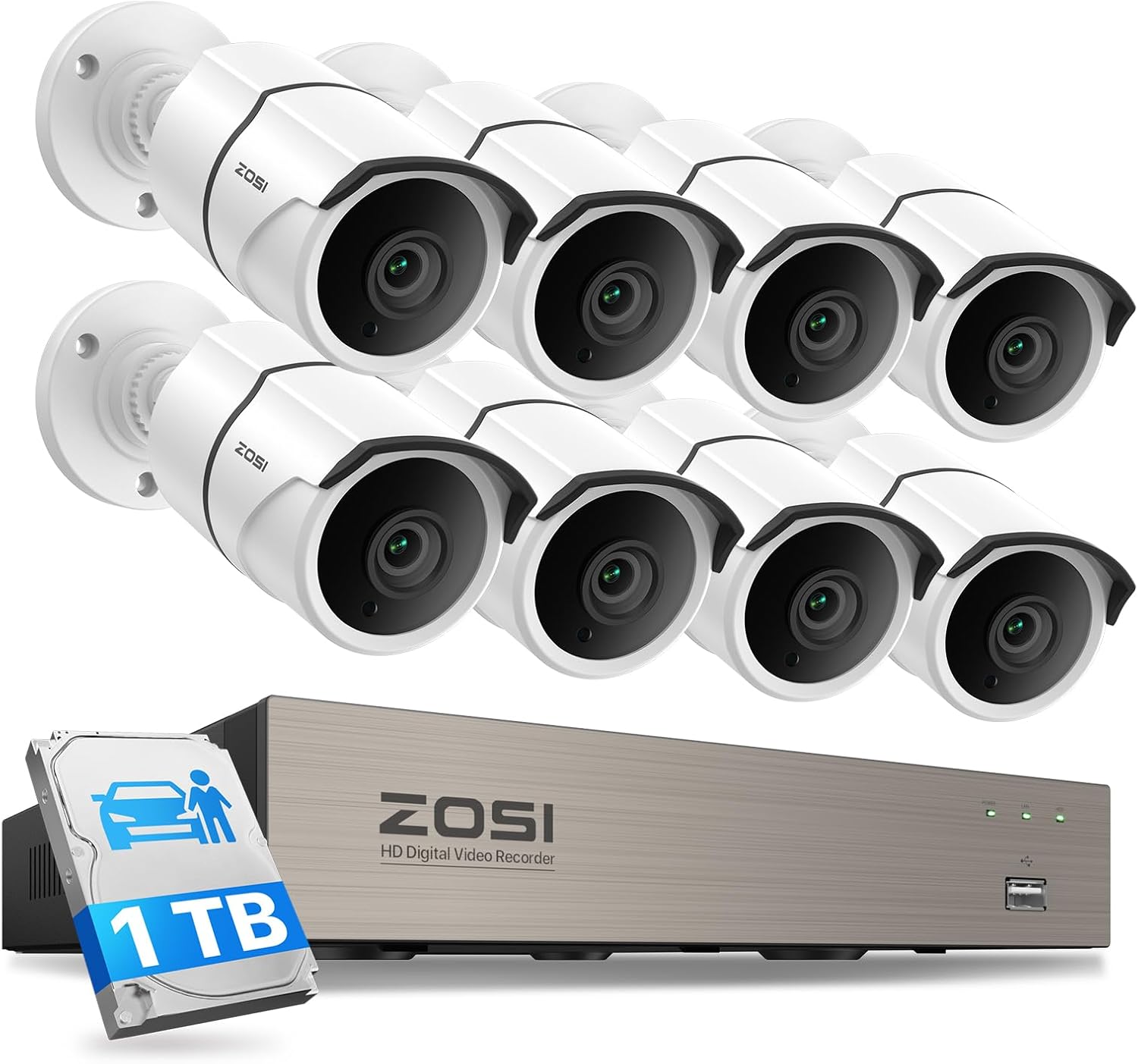
The ZOSI 3K Lite 8CH DVR System is a wired home security kit that combines an 8-channel H.265+ DVR with eight weatherproof metal bullet cameras and a preinstalled 1TB hard drive for local 24/7 recording. It is typically mounted around a home perimeter or attached to a monitor for local playback while remote viewing is available through the ZOSI Smart app. Notable features include AI human and vehicle detection to cut down false alarms, one-way audio captured by the cameras, customizable motion zones for privacy, and up to about 120 feet of night vision for low-light coverage. The DVR supports multiple recording modes (continuous, motion, schedule) and will overwrite oldest footage when the drive is full, avoiding subscription fees thanks to local storage. Because the cameras are analog HD (BNC/coax) and require wired power, installation needs routing cables and basic DIY or pro installation; the system does not include cloud storage. For buyers who want local control, clear night footage, and reduced false alerts, this kit delivers a solid set of practical features, though it requires wired setup and network configuration for remote access.
Best for: Buyers who prioritize local control, evidence-grade continuous recording, and reliable motion filtering and want a complete wired kit for perimeter monitoring backed by community-tested performance.
Less Ideal for: Users who need an out-of-the-box wireless setup, cloud-only storage, or two-way audio communication should consider alternate systems designed for those needs.
- Preinstalled 1TB HDD for local continuous or scheduled recording with no monthly fees
- AI human and vehicle detection reduces false motion alerts
- IP66 metal camera housings suitable for outdoor 24/7 use
- One-way audio capture built into cameras for recorded sound context
- Supports multiple recording modes and easy local playback via HDMI/VGA
- Wired BNC/coaxial cameras require running power and video cables for installation
- No built-in cloud storage option included
- One-way audio only, no two-way talk capability
Verdict: Choose this wired 8-channel kit if you want a complete, no-subscription local recording system with AI detection and built-in audio for reliable home perimeter surveillance.
SensForge Indoor Pan-Tilt Camera SF-C2
| Video Capture Resolution | 2.5K |
|---|---|
| Night Vision Range | 30 feet |
| Flash Memory Installed Size | 64 GB |
| Connectivity Protocol | Wi-Fi |
| Power Source | Corded Electric |
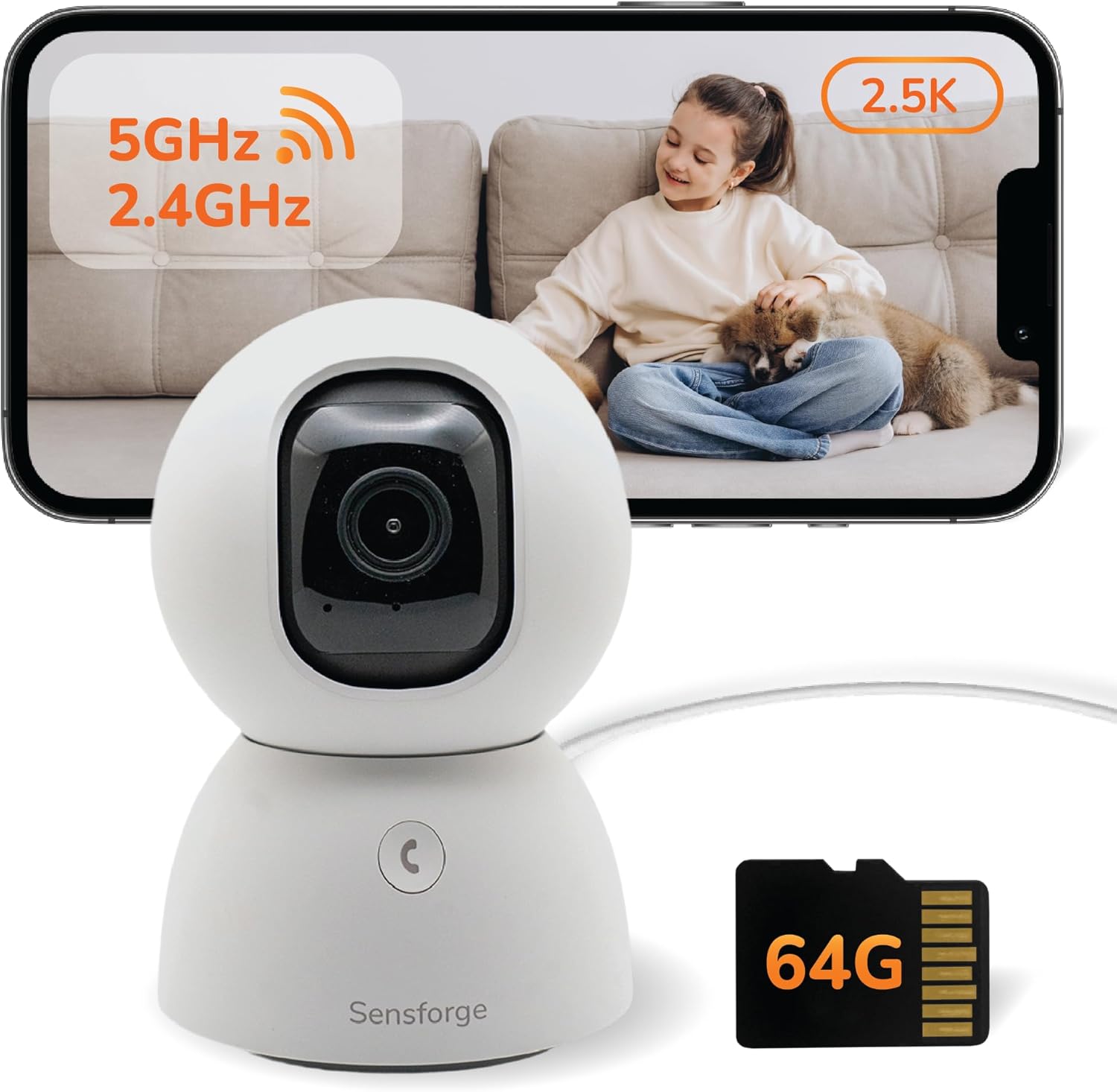
The SensForge SF-C2 is an indoor pan-tilt dome camera built for straightforward whole-room monitoring. It captures 2.5K video and can pan 360 degrees and tilt 90 degrees to remove blind spots, while AI detection classifies humans and pets to cut down on false alerts. Setup is designed for consumer simplicity with dual-band Wi-Fi support and a SensForge app for live view, instant push notifications, two-way audio, and privacy shutter control. The camera includes a preinstalled 64GB microSD card for local storage so you can record continuously without a subscription, and night color vision extends usability after dark. Practical limits to expect are reliance on the vendor app for many smart features and cloud-style highlights that require an optional Pro membership, and like many indoor devices it is not intended for outdoor or behind-glass placement. For everyday home use the SF-C2 delivers clear footage, reliable local recording, and responsive two-way talk, making it a sensible choice for buyers who prioritize simple setup and subscription-free local storage.
Best for: Buyers who want an easy-to-install indoor camera that prioritizes clear local recordings, reliable motion classification, and simple two-way audio without ongoing subscription fees.
Less Ideal for: People who need weatherproof outdoor surveillance, integration with non-proprietary cloud ecosystems, or who prefer a camera that stores footage only to third-party cloud services.
- 2.5K video resolution for sharper detail than 1080p cameras
- 360° pan and 90° tilt for full-room coverage
- AI human and pet detection to reduce false motion alerts
- Two-way audio for real-time communication
- 64GB microSD preinstalled for local recording with no subscription required
- Advanced cloud features and highlight reels require an optional Pro membership
- Not rated or recommended for outdoor or behind-glass installations
Verdict: A user-friendly indoor pan-tilt camera that gives subscription-free local 2.5K recording and AI detection for risk-averse buyers who want reliable, private monitoring.
Choosing the Right CCTV Security Camera with Audio: Key Factors to Consider
Microphone Quality and Placement
A camera's microphone specification is central to whether audio is actually useful. Look for stated sensitivity, frequency response, and whether the mic is omnidirectional or directional. Higher sensitivity and a broader frequency range capture speech more naturally, but placement matters more in practice. A microphone recessed behind weather seals or mounted pointing away from a doorway will pick up less usable sound.
When planning placement, consider typical speaking distance and ambient noise sources like traffic or HVAC. If the device supports external or adjustable microphones, that can dramatically improve pickup in challenging locations. Also check for wind noise reduction and mechanical isolation to avoid vibration artifacts.
Speaker Power and Two-Way Talk
If you need to speak through the camera, speaker loudness and clarity determine how well the other party hears you. Speaker wattage and driver size give a rough idea, but published specs can be optimistic. Clear midrange reproduction is important for speech intelligibility, and reduced distortion at higher volumes prevents words from becoming garbled.
Consider echo cancellation and full-duplex capability. Simple half-duplex systems force push-to-talk or produce awkward delays. Full-duplex systems allow natural conversation but require better network performance. If the camera includes voice-activated messaging or pre-recorded alerts, confirm the speaker can reproduce those messages clearly at typical mounting distances.
Audio Synchronization With Video
Audio must stay in sync with video for events to be meaningful. Unsynchronized streams make it hard to verify actions or identify who said what. Devices that process audio and video on different chips or send separate streams over the network are more likely to desynchronize under load.
Check whether the camera uses a single integrated encoder for A/V or how the manufacturer addresses latency. If you plan to integrate footage into a separate recorder or NVR, verify compatibility and whether the recorder maintains sync when ingesting both streams.
Low-Light Imaging and Noise
Good audio is less useful if the video is too noisy to identify faces or actions at night. Look for cameras with strong low-light performance, larger sensors, or infrared illumination that preserves facial detail. Noise reduction algorithms can help, but aggressive smoothing may erase fine details that confirm identities.
Also consider color reproduction under low-light. Some cameras offer color night modes that help with recognition. Balance the need for visible detail against potential audio masking; for example, some IR systems create a high-frequency hum or electrical noise that can bleed into microphones unless properly shielded.
Network Bandwidth and Latency
Audio streams are small compared with video but still sensitive to packet loss and jitter. A congested network can cause choppy audio, delayed two-way talk, or dropped segments. Check the camera's supported bitrates, adaptive streaming features, and whether it uses prioritized QoS tags for audio.
If you will run multiple cameras, estimate total upstream bandwidth and consider wired connections where possible for the most reliable two-way talk. For wireless setups, assess signal strength at the installation point and account for interference from neighboring devices.
Privacy Controls and Local Storage
Audio can raise privacy and legal considerations in some jurisdictions. A camera that lets you disable the microphone, mute the speaker, or record audio only after specific triggers gives you more control. Local storage options remove dependence on cloud providers and let you retain raw audio/video under your own terms.
Also look for per-zone audio sensitivity or motion-triggered audio capture. These features limit unnecessary recording and reduce the volume of captured data while still providing audio when it matters.
Wired Versus Wireless Audio Reliability
Wired PoE or Ethernet-connected cameras generally provide more consistent audio performance than wireless models because they avoid Wi-Fi interference and variability. If two-way talk is critical, a wired connection reduces latency spikes and the chance of dropouts during a conversation.
Wireless cameras can still perform well if the network is strong and properly configured. Use 5 GHz for video and audio when possible to reduce congestion, and place access points to minimize walls and obstructions between the camera and router.
- Wired: lower latency, consistent bandwidth, preferred for full-duplex talk
- Wireless: more flexible placement, ensure strong signal and good throughput
- Hybrid setups can use wired backhaul with wireless field cameras for convenience
Acoustic Environment and Mounting Best Practices
Assess ambient noise where you plan to mount the camera. Busy streets, compressors, and HVAC systems can mask speech and reduce audio usefulness. Mount cameras so the mic points toward the main sound source and away from predictable noise.
Use foam wind protection or place cameras under eaves to reduce wind noise outdoors. For doorways, mount slightly above eye level to favor capture of speech directed outward and to reduce obstruction from people passing by.
- Avoid mounting directly on vibrating surfaces
- Keep mic openings clear of debris and paint
- Test different angles during installation for best pickup
Integrating Audio Into Recording Systems
When feeding audio into a network video recorder or security system, verify that the recorder supports the camera's audio codec and maintains synchronization. Some NVRs only accept video and drop audio by default, so check settings and compatibility before deployment.
Consider retention policies for audio. Storing continuous audio can consume storage and raise compliance questions. Use event-triggered audio recording or scheduled capture windows to balance evidence needs with storage and privacy considerations.
- Confirm codec support (G.711, AAC, etc.) for seamless recording
- Enable trigger-based audio capture to save space
- Label and timestamp audio tracks for easier review
Legal and Privacy Considerations
Legal rules about recording audio vary by location. In some places, recording private conversations without consent is restricted. Before enabling audio capture, review local regulations and use clear signage if required. Choose devices that let you disable audio quickly if compliance becomes a concern.
From a privacy perspective, consider policies for who can listen to live audio and access recordings. Role-based access and audit logs help prevent misuse and protect occupant privacy while preserving necessary security functions.
- Check local wiretapping and consent laws
- Limit access to audio with user permissions
- Use visible notices where legally required
Maintenance Tips to Preserve Audio Quality
Regularly inspect microphone openings and speakers for dust, cobwebs, and water ingress that can muffle sound. Outdoor cameras in particular benefit from periodic cleaning and checks of seals that keep moisture away from audio components.
Keep firmware current. Manufacturers often issue audio and network stability improvements in updates. After updates, verify audio/video sync and run a quick two-way test to confirm the device still performs to expectations.
- Clean mic grilles gently with compressed air
- Run periodic two-way talk tests
- Monitor for new noises after storms or repairs
How We Chose the Best CCTV Security Camera with Audio
We shortlisted CCTV security cameras with audio that meet common real-world needs for home and small-business monitoring. Selection started with technical sound and image specs, prioritizing cameras that record and transmit clear audio, support two-way communication, and maintain intelligible sound in typical distances for entryways and yards. We prioritized image quality metrics including resolution, low-light performance, and compression efficiency because audio usefulness depends on synchronised, clear video. Reliability and network behavior were another filter. We favored devices with stable wired or wireless connections, robust handling of packet loss, and sensible bitrates to avoid audio dropouts. Privacy and control features were considered, such as local storage options and ability to mute or disable microphones. Installation flexibility and mounting options were evaluated to ensure the microphone and speaker can be properly positioned relative to likely sound sources. We excluded devices lacking any integrated audio capability, cameras with only unreliable or anecdotal audio reports, and units without clear specifications for microphone sensitivity or speaker output. The criteria that mattered most were audio clarity, two-way talk quality, video performance in low light, network stability, and privacy controls.
Our full evaluation process is outlined in our review methodology.
FAQ
Does a CCTV camera with audio require extra bandwidth?
Audio adds a small amount of bandwidth compared with video, but it is sensitive to latency. Ensure your upstream bandwidth can handle the combined video streams plus audio, especially if using multiple cameras or full-duplex two-way talk.
Can I disable audio recording if I only want video?
Yes. Many cameras offer options to mute the microphone or disable audio capture entirely. Look for devices that let you control audio per schedule or per event to balance privacy and security needs.
Is two-way talk private and secure?
Two-way talk depends on the device and network for security. Use cameras that support encrypted streams and enforce user authentication. Limit who can initiate live audio to reduce unauthorized use.
Will wind or traffic make audio unusable outdoors?
Strong wind and nearby traffic can significantly degrade audio clarity. Wind protection, strategic mounting, and directional microphones mitigate these issues, but placement and acoustic conditions remain the primary determinants of success.
Do all recorders capture audio from cameras?
Not always. Some recorders ingest only video by default. Verify that your recorder supports the camera's audio codec and that recording settings are enabled to capture audio alongside video.
Final Verdict
Choosing a CCTV security camera with audio means balancing microphone and speaker performance with reliable video and network behavior. Prioritize audio clarity and two-way talk capability only if you have a clear use case for speaking or gathering spoken evidence, and ensure low-light imaging and sync between streams are strong enough to make the audio meaningful. Consider installation location, network bandwidth, and privacy controls when deciding. If you focus on clear audio pickup, stable connectivity, and sensible privacy options, you will end up with a system that provides both contextual information and actionable alerts without creating unnecessary storage or compliance burdens.