
Note: This article contains affiliate links. If you click on these links and make a purchase, we may earn a small commission at no extra cost to you. This helps support our research and content. Read our full affiliate disclosure here.
Choosing the right ceiling fan with remote matters more than you might expect. The right model balances airflow, noise, and easy control so rooms stay comfortable without fuss. Whether you want a simple single-speed replacement or a multi-speed unit that pairs with a dimmable light, the remote changes how you use the fan every day. This guide shortlists seven top ceiling fans with remote control based on practical criteria like airflow, installation complexity, and control features. Read on to see which features matter most and why these picks stand out for typical home installations.
Top Picks at a Glance
| Best Overall The best all-around choice for most situations | Honeywell Xerxes 62-Inch Ceiling Fan |  |
| Best Quality Built to a higher standard if you want something more solid | DREO CLF521 52-inch Ceiling Fan |  |
| Best Value The sweet spot between price and what you get | Passky 52-Inch Ceiling Fan |  |
| Best Budget The cheapest option that still gets the job done reliably | GJeg 42" Low Profile Ceiling Fan |  |
| Top Rated A top-rated pick with lots of positive feedback | Honeywell Carnegie 52" Ceiling Fan |  |
| Most Popular A crowd favorite that many people choose with confidence | Amico 42‑Inch Ceiling Fan |  |
| Best Seller A high-volume bestseller chosen again and again | ASALL FAN011-42 Ceiling Fan Light |  |
Honeywell Xerxes 62-Inch Ceiling Fan

| Number of Blades | 8 |
|---|---|
| Light Type | LED |
| Number of Speeds | 3 |
| Wattage | 18 watts |
| Power Source | Corded Electric |
The Honeywell Xerxes is a large indoor ceiling fan designed for rooms over roughly 400 sq ft, pairing an 8-blade layout with a dimmable LED light and remote control. It installs as a standard downrod or on angled/vaulted ceilings with a longer rod (sold separately) and includes a 4-inch downrod and wall mount for the remote. The fan uses a brushless motor with three speeds and a reversible direction to help cool in summer and redistribute warm air in winter. The integrated LED board delivers about 1,400 lumens at 18 watts with a 3000K color temperature and supports dimming from the remote. Dual-finish blades (white and gray wash) give flexibility for contemporary decor. Practical benefits include efficient, powerful airflow from the extra blades and simple operation via remote with features like walk-away light delay. Limitations are that it is dry-rated for indoor use only and requires a compatible downrod for steep ceilings, and the lighting and speed options are basic compared with multi-function smart fans.
Best for: Buyers who want a high-capacity, easy-to-control ceiling fan for large living spaces and prioritize strong airflow with a simple remote-operated light.
Less Ideal for: Those who need an outdoor-rated fan, advanced smart-home integration, or a wide range of speed and scene customization should consider other models.
- Large 62-inch sweep suited to rooms over 400 sq ft for strong circulation
- Dimmable LED light providing about 1,400 lumens at low power draw (18W)
- Remote control with wall dock for convenient speed, light, and delay functions
- Reversible airflow for year-round use to move cool or warm air efficiently
- Eight dual-finish blades deliver higher airflow and a contemporary look
- Dry-rated for indoor use only, not suitable for wet/outdoor locations
- Only three fan speeds and no integrated smart/home connectivity
Verdict: A powerful, remote-controlled 62-inch fan with dimmable LED lighting that delivers strong airflow and year-round comfort for large indoor rooms.
DREO CLF521 52-inch Ceiling Fan

| Power Source | dc |
|---|---|
| Air Flow Capacity | 5673 cfm |
| Light Type | LED |
| Wattage | 54 watts |
| Noise Level | 43 db |
The DREO CLF521 combines a quiet brushless DC motor with a 24W integrated LED to deliver strong air circulation and flexible lighting for living spaces and bedrooms. It supports remote, app, and voice control and offers timer presets, reversible airflow for year-round use, and adjustable light temperature and stepless dimming for precise mood control. The fan is designed for easy self-installation with included downrods and a preassembled approach, and the manufacturer rates airflow up to about 5673 CFM while keeping noise low enough for bedrooms. Practical benefits include energy-efficient operation from the DC motor, multiple wind modes (Natural, Normal, Sleep) and memory functions so your preferred settings persist after power cycles. On the downside this model is a 52-inch indoor fan only and the nominal number-of-speeds listings vary between 6 and 12 depending on control method, which may confuse buyers who expect fixed speed steps on the physical remote. App and voice features add convenience but mean you will rely on networked controls for the fullest feature set.
Best for: Buyers who prioritize strong airflow and quiet, energy-efficient performance and want a smart ceiling fan that integrates with voice assistants and mobile routines.
Less Ideal for: If you need a damp-rated or outdoor-capable fan or prefer a strictly mechanical fan without app or voice features, choose a different model.
- Brushless DC motor for efficient, quiet operation and higher airflow.
- Dimmable integrated 24W LED with adjustable color temperature and stepless brightness.
- Multiple control methods: remote, mobile app, and Alexa/Google voice control.
- Reversible airflow and timer presets for year-round comfort and automation.
- Preassembled design and included downrods simplify installation.
- Indoor use only, not rated for damp or outdoor locations.
- Speed labeling varies between sources (6 vs 12), so physical remote may offer fewer discrete steps than the app.
Verdict: Choose the DREO CLF521 if you want a quiet, energy-efficient smart ceiling fan with strong airflow and fully adjustable LED lighting controlled by remote, app, or voice.
Passky 52-Inch Ceiling Fan

| Size | 52 Inch |
|---|---|
| Power Source | AC input, DC motor |
| Speeds | 6 Speeds |
| Light Output | 2500 lumen |
| Color Temperature | 3000/4500/6000K |
This Passky 52-inch ceiling fan combines a reversible, quiet DC motor with an adjustable LED light and multiple control options to deliver flexible airflow and lighting for bedrooms and living areas. Installation is designed to swap into a standard ceiling junction box without new drilling, and the fan supports six speed settings, a 1/2/4-hour timer, and a memory function so it returns to the last used settings after power cycles. Lighting is dimmable from 10 to 100 percent and selectable between three color temperatures, while the two-sided blades let you choose a lighter or darker look. Control comes via the included handheld remote, a Bluetooth app, or a standard wall switch; note the fan must use an on/off wall switch and cannot be wired to dimmers or smart wall speed controllers. The DC motor is engineered for low noise, making it suitable for light sleepers, and the unit is rated water resistant for covered outdoor areas but not direct exposure to rain. If you want a quiet, energy-efficient fan with flexible light settings and renter-friendly installation, this model covers those needs well.
Best for: Buyers who want an energy-efficient, low-noise ceiling fan with adjustable lighting and flexible remote or app control for bedrooms, living rooms, or covered outdoor spaces.
Less Ideal for: People who need wall-dimmer or integrated smart home (WiFi) switch compatibility or who require separate hardwired control of fan and light.
- Quiet reversible DC motor with six speeds for efficient, low-noise airflow
- Dimmable LED light with three color temperatures and 10–100% brightness range
- Multiple control options: handheld remote, Bluetooth app, and wall switch with memory function
- Renter-friendly flush mount installation that fits standard junction boxes
- Cannot be wired to dimmer or fan-speed wall switches and the fan and light cannot be separately wired with some installations
- Bluetooth app control uses Bluetooth only, not WiFi
Verdict: A quiet, energy-efficient 52-inch fan with dimmable multi-temp LED lighting and versatile remote or app control that fits renter-friendly installs.
GJeg 42" Low Profile Ceiling Fan

| Power Source | dc |
|---|---|
| Light Source | LED |
| Light Color | warm white, cool white, natural white |
| Wattage | 30 watts |
| Control Method | Remote |
This GJeg 42" low-profile ceiling fan pairs a dimmable LED light with a six-blade reversible DC motor and a full-function remote, making it a compact option for bedrooms and small living spaces. Installation is DIY-friendly and the flush mount lets it sit close to the ceiling where headroom is limited. The remote controls fan speed across six levels, toggles the light separately, selects from three color temperatures, and sets a 2-hour timer, while memory function restores your last fan speed and light settings. The DC motor promises quieter operation and better energy efficiency than comparable AC models, and the integrated LED supports dimming from 10 to 100 percent. On the downside the fan is intended for indoor use only and the listing gives limited detail about airflow (CFM) and long-term durability, so buyers focused on maximum cooling performance or outdoor use should look elsewhere. Overall it is a practical, feature-rich remote-controlled fan for tight rooms where a low-profile fixture and flexible lighting are priorities.
Best for: Buyers looking for an affordable, compact ceiling fan with flexible lighting and a full remote control for bedrooms or small living areas.
Less Ideal for: People who need high airflow for large rooms, outdoor-rated fixtures, or who require detailed performance specs for precise climate control.
- Low-profile flush mount fits rooms with limited ceiling clearance
- Reversible DC motor for quieter, more efficient operation and year-round use
- Included remote controls fan speed, light on/off, color temperature, timer, and memory function
- Dimmable integrated LED with three color temperatures (warm, natural, cool)
- Not rated for outdoor or damp locations
- No manufacturer CFM or detailed airflow specs provided
Verdict: A budget-friendly, low-profile ceiling fan with a quiet DC motor and a versatile remote-controlled LED light, ideal for small indoor rooms.
Honeywell Carnegie 52" Ceiling Fan

| Number of Blades | 5 |
|---|---|
| Number of Speeds | 3 |
| Air Flow Capacity | 5046.48 cfm |
| Motor Type | Brushless |
| Wattage | 4.5 watts |
The Honeywell Carnegie is a 52-inch indoor ceiling fan that pairs a cage-style LED light with a five-blade design and a remote for convenient operation. It is typically mounted in living rooms, master bedrooms, or large open spaces where steady air movement is needed; the reversible motor lets you push warm air down in winter and create a cooling breeze in summer. Notable features include a brushless high-capacity motor, three quiet speed settings, a dimmable LED board rated at 1350 lumens with a 2700K color temperature, and a remote that supports Walk Away Light Delay and a wall dock for storage. Installation offers dual-mounting with a short downrod included and an option for angled/vaulted ceilings with a longer rod. Practical benefits are strong airflow over large rooms, energy-efficient LED lighting, and simple wireless control. Limitations to consider are a modest three-speed control set rather than fine-grained speed steps and the dry/indoor rating which means it is not suited for outdoor or wet locations.
Best for: Buyers who prioritize a durable, straightforward ceiling fan that reliably moves a lot of air and offers simple remote control for living rooms or large bedrooms.
Less Ideal for: Homes that need an outdoor-rated fan or users who want more granular speed control or smart home integration.
- Powerful, brushless motor delivering high airflow suitable for rooms over 400 sq ft
- Dimmable, energy-efficient LED light providing about 1350 lumens at 2700K
- Remote control with wall dock and useful features like Walk Away Light Delay
- Reversible airflow for year-round use to help distribute warm air in winter
- Dual-mount options include short downrod and compatibility with vaulted ceiling installation
- Only three fan speeds which limits finer control of airflow
- Dry/indoor rating prevents use in damp or outdoor-covered locations
Verdict: Choose the Honeywell Carnegie when you want a reliable, high‑airflow indoor ceiling fan with convenient remote control and efficient LED lighting.
Amico 42‑Inch Ceiling Fan

| Mounting Type | Flush Mount |
|---|---|
| Number of Speeds | 6 |
| Motor Type | Brushless |
| Noise Level | 35 db |
| Special Features | 1/2/4H Timer, 3CCT (3000K/4000K/6000K), Dimmable, Reverse |
The Amico 42‑inch ceiling fan combines a flush‑mount, low‑profile design with a dimmable 3‑color LED and a quiet brushless DC motor, making it a practical option for small bedrooms, offices, and covered patios. Installation is renter‑friendly when mounting to a standard ceiling junction box, and the package includes a remote, light kit, and batteries so you can control six fan speeds, set a 1/2/4 hour sleep timer, and pick a color temperature (3000K, 4000K, 6000K). The reversible motor and dual‑sided blades give seasonal flexibility and two looks without swapping parts, while the memory function restores the last fan and light settings after power is cut. At normal operating speeds the fan is very quiet (around 35 dB), which suits light sleepers and nurseries. Important constraints: the fan must not be wired to a dimmer, smart switch, or fan speed controller because of the DC motor design, and the light and fan cannot be powered separately via wall wiring. The unit is damp rated for covered outdoor spaces but should not be exposed to direct rain.
Best for: Buyers who want a compact, low‑noise ceiling fan with an included remote and customizable light for small rooms or covered outdoor spaces and who value easy installation and predictable performance backed by customer feedback.
Less Ideal for: People who need wall‑integrated dimmer or smart switch control, require separately wired fan and light circuits, or want a fan for fully exposed outdoor locations.
- Low‑profile flush mount suits low ceilings and renters with a standard junction box
- Quiet brushless DC motor with six speeds and reversible direction for year‑round use
- Dimmable LED with three selectable color temperatures and memory function
- Includes remote and timer (1/2/4 hour) for easy, cordless control
- Damp rated for covered outdoor areas such as patios and pergolas
- Cannot be used with wall dimmers, fan speed controls, or smart switches
- Fan and light cannot be wired to separate wall controls
Verdict: Choose this fan if you want a quiet, renter‑friendly 42‑inch flush mount with remote control and a dimmable multi‑temperature LED for small rooms or covered outdoor areas.
ASALL FAN011-42 Ceiling Fan Light
| Power | 22 watts |
|---|---|
| Bulb Base | E26 |
| Brightness | 1000 lm |
| Light Source | LED |
| Connectivity Protocol | Infrared |
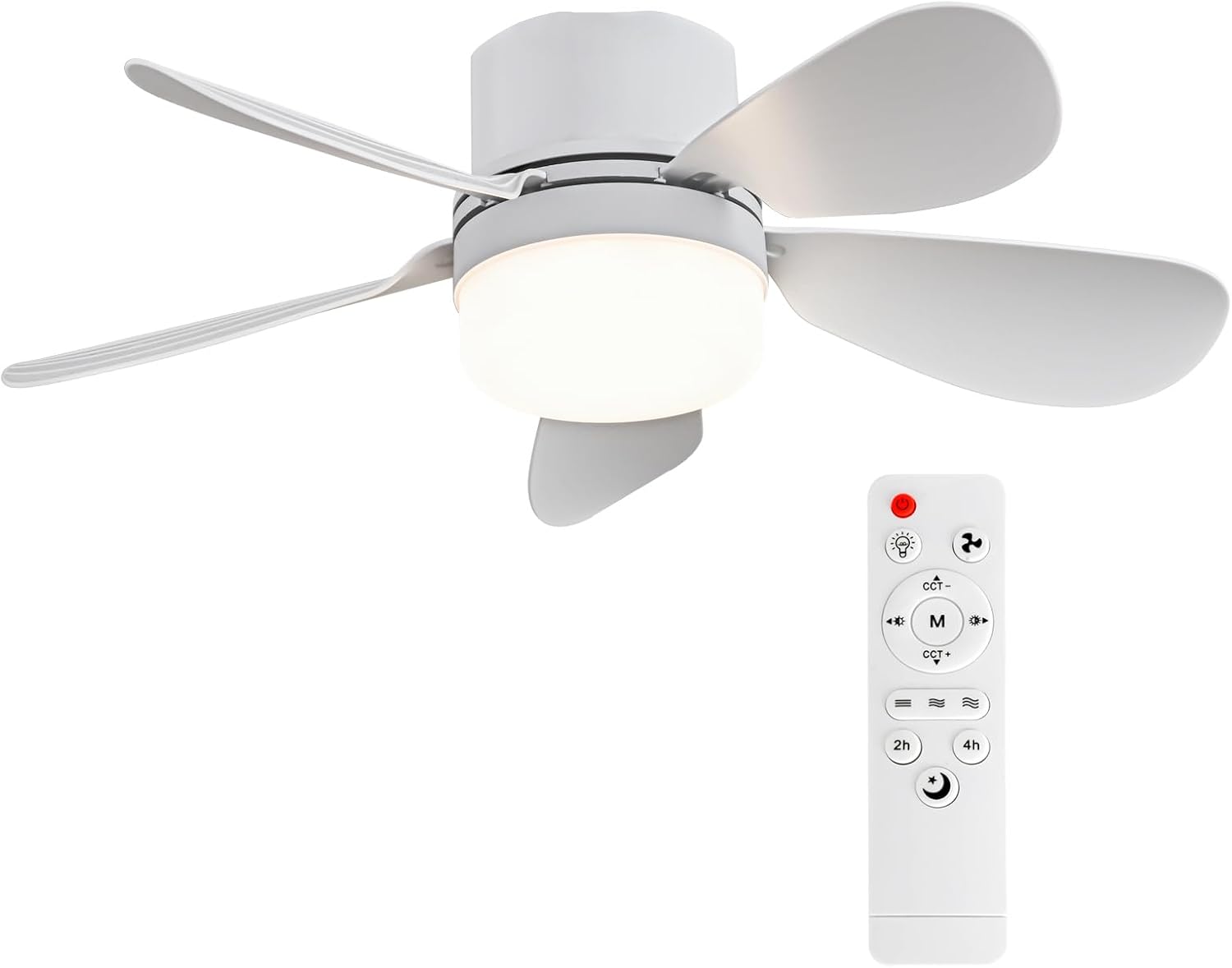
This socket-style ceiling fan light screws into a standard E26/E27 fixture and combines a small three-speed fan with a 10 W LED light and remote control. It is intended for indoor rooms such as bedrooms, kitchens, or living rooms where a full ceiling fan installation is not practical. The unit offers dimming from 10 to 100 percent, color temperature options (warm, natural, cool), a night-light mode, and a timer, all controlled by an infrared remote for easy on/off and speed changes. Installation is as simple as replacing a bulb, so there is no wiring or mounting box work, and the low-wattage LED keeps power use modest. Expect modest airflow because the fan is compact (about 16.5 inch diameter) and the fan motor is low-power, so it is best for supplemental cooling or air circulation rather than cooling large rooms. The product is certified to common safety standards and includes mounting hardware and a one-year warranty, which suits buyers who prefer lower-risk purchases and simple returns to factory-quality replacements.
Best for: Buyers who want an easy, low-risk way to add gentle air circulation and a dimmable LED ceiling light without rewiring or a full fan installation.
Less Ideal for: Homes needing strong whole-room cooling, large open spaces, or users who require weatherproof fixtures for outdoor areas.
- Installs like a bulb into standard E26/E27 sockets with no wiring or ceiling box work
- Built-in dimmable LED light with adjustable color temperatures and night-light mode
- Infrared remote offers timer, dimming, and three fan speeds for convenient control
- Low power draw with combined 22 watts for light and fan, suitable for continuous use
- Small diameter and low motor power limit airflow to supplemental circulation rather than whole-room cooling
- Infrared remote requires line-of-sight and may have shorter range than RF remotes
Verdict: Choose this unit if you want a simple, low-risk screw-in ceiling fan light that adds dimmable LED lighting and gentle airflow without electrical work.
Choosing the Right Ceiling Fan with Remote: Key Factors to Consider
Airflow and Blade Span
Airflow determines how effectively a ceiling fan moves air through the room. Look for CFM ratings or manufacturer airflow figures when available, and consider blade span relative to room size. Larger blades typically move more air at lower speeds, which can provide consistent cooling with less noise.
For rooms under 150 square feet, a smaller fan with a 42-inch span may be sufficient, while living rooms or open-plan spaces often benefit from 52 inches or more. Blade pitch and motor design also affect airflow; steeper pitch usually improves circulation. Choosing the right blade span helps avoid undersized fans that struggle to create noticeable airflow.
Remote Control Features
Not all remotes are created equal. Basic remotes offer on/off and a few speed settings, while advanced remotes can reverse direction, control integrated lighting, set timers, and store presets. Consider whether you need a handheld remote, a wall-mount option, or both, and whether the remote uses RF or infrared signaling. RF remotes usually work through walls and do not require line-of-sight.
Battery type and the availability of replacement remotes matter for long-term convenience. If you plan to integrate the fan into a whole-home routine, look for remotes with simple programming or compatibility with third-party controllers.
Installation Complexity and Mounting Options
Installation impacts total cost and feasibility. Check whether the fan supports standard ceiling boxes and whether it includes a downrod for higher ceilings or a flush-mount option for low ceilings. Some fans come with an easy-install mounting bracket that simplifies wiring and hanging; others require more hands-on wiring and support.
If you lack a fan-rated junction box or have angled ceilings, verify that the fan includes adapters or support for those conditions. Consider whether the installation will require cutting in a new box, running new wiring for a light kit, or hiring an electrician for safe, code-compliant work.
Noise and Motor Type
Noise level affects whether a fan is suitable for bedrooms, nurseries, or living spaces. Brushless DC motors tend to run quieter and use less energy than traditional AC motors, and they often provide smoother speed transitions. Also consider whether the motor produces vibrations that can transfer to the ceiling and create rattle.
Manufacturers sometimes list decibel ratings, but listening tests and user reports are valuable. For sleeping areas choose fans rated for quiet performance or those specifically marketed for bedrooms.
Lighting Integration and Compatibility
Many ceiling fans include integrated lights or accept a light kit. If you want a combined fan-light fixture, verify the type of bulbs supported, whether the remote controls the light independently, and if the light is dimmable. LED-integrated fixtures reduce maintenance but limit future bulb choices.
If you prefer to use a separate fixture, ensure the fan can be ordered without a light or that the light kit is removable. Also confirm that the wiring supports independent light and fan control if you want wall switches or smart control.
Build Quality and Long-Term Maintenance
Durable construction extends service life and reduces noise and wobble over time. Look for quality bearings in the motor, corrosion-resistant finishes for damp locations, and well-balanced blades. Ease of maintenance matters: accessible housing for cleaning, replaceable remote modules, and available replacement blades or parts are practical considerations.
For ceiling fans in humid or covered outdoor spaces, pick finishes and materials rated for damp locations to prevent premature deterioration.
Matching Fan Size to Room Dimensions
Choosing the correct fan size is the first step to effective cooling. Measure the room and match the blade span to the square footage to ensure the fan moves enough air without overwhelming the space.
As a quick guideline, small rooms under 100 square feet generally suit 29 to 36-inch fans, medium rooms 100 to 300 square feet do well with 42 to 52 inches, and large open areas often require multiple fans or a 56-inch plus option. Ceiling height also affects the decision; higher ceilings may need a longer downrod to position the blades for best circulation.
- Confirm ceiling height and choose a downrod length that places blades about 8 to 9 feet above the floor when possible.
- Account for obstacles like exposed beams or light fixtures that can interfere with blade sweep.
Wiring, Switches, and Remote Integration
Before buying, inspect the existing ceiling wiring and decide how you want control arranged. Many remotes can take over fan and light functions, which can simplify wall wiring but may remove independent wall switch control unless a compatible wall receiver is used.
If you want wall-mounted control plus a remote, look for fans that support both or can be wired to allow the wall switch to control the light while the remote manages fan speed. Clarify whether the remote requires a receiver module in the canopy and whether the canopy has room for the extra hardware.
- Verify the presence of a fan-rated junction box and its load capacity.
- Plan for a separate neutral or switched hot if you need independent light control.
Selecting Quiet Fans for Bedrooms
If the fan will be used in a bedroom, prioritize low noise and steady airflow. Brushless DC motor designs often provide the quietest operation and can be more energy-efficient over time.
Also look for fans with good balance and solid mounting hardware to reduce vibration. Features like a nighttime lower-speed preset or a timer on the remote can improve comfort without manual adjustments.
- Choose fans with sound ratings or verify quiet operation in practice-oriented reviews.
- Consider models with multiple low-speed settings for gentle circulation while sleeping.
Damp-Rated Fans for Covered Outdoor Spaces
For porches, screened patios, or other covered outdoor areas, select a fan rated for damp locations. These fans use finishes and materials designed to resist moisture and corrosion but should not be used in fully exposed wet locations unless explicitly rated.
Damp-rated fans often have sealed bearings and corrosion-resistant hardware. Confirm that the remote and receiver are protected from humidity and that the finish suits outdoor conditions.
- Check manufacturer specifications for damp-location listing.
- Opt for synthetic or sealed wooden blades that better handle humidity.
Energy Use and LED Lighting Options
Integrated LED fixtures paired with efficient motors can reduce electricity use. When evaluating energy performance, consider both the fan motor wattage and the lighting wattage if an integrated light is present.
Look for fans with efficient motor technology and LEDs with good color rendering if lighting is important. Remotes that allow dimming and multiple speed presets help tailor energy use to actual needs throughout the day.
- Compare wattage at typical operating speeds rather than relying solely on advertised efficiency claims.
- Prefer LED modules with replaceable drivers where possible for future serviceability.
How We Chose the Best Ceiling Fan with Remote
We narrowed the field by focusing on features that directly affect everyday use and installation. Key evaluation criteria included measured airflow and efficiency, control flexibility and remote feature set, mounting and installation complexity, noise levels in typical settings, build quality and durability of moving parts, and compatibility with common ceiling electrical boxes and lighting fixtures. We favored fans that deliver strong airflow for their blade span while keeping energy use reasonable. We excluded specialty industrial units, obscure legacy models, and ceiling fans without a dedicated handheld or wall-mount remote. We also filtered out options with unclear wiring requirements or that required extensive canopy modifications. Our selection process emphasized real-world suitability: fans that a typical homeowner or renter can install or have installed without specialized electrical work, while offering reliable remote control functionality and acceptable noise performance.
Our full evaluation process is outlined in our review methodology.
FAQ
Can a ceiling fan remote be installed on an existing fan?
Often yes, if the fan has space in the canopy for a receiver and the wiring matches common configurations. Installation usually involves wiring a receiver between the house wiring and the fan motor. If the existing wiring is nonstandard or the canopy lacks space, professional installation may be required.
Do remote-controlled fans use batteries in the remote only?
Typically the handheld remote uses batteries while the fan uses household power through a receiver. The receiver is powered by the ceiling wiring and relays commands from the remote to the fan motor and light.
Are RF remotes better than infrared for ceiling fans?
RF remotes do not require line-of-sight and can operate the fan through walls, which is convenient for many installations. Infrared requires direct pointing at the receiver. RF remotes are usually more flexible, especially if the receiver is hidden in the canopy.
Will a remote disable wall switch control?
Not necessarily. Some remote kits are designed to work alongside existing wall switches, while others assume the remote will be the primary control and may override wall switch functions. Check wiring compatibility if you want both types of control.
How do I choose a fan for a sloped ceiling?
Choose a fan that includes angled ceiling adapters or supports longer downrods and angled-mount hardware. Ensure the manufacturer states compatibility with your ceiling angle and that the downrod length positions the blades safely and effectively for airflow.
Can remotes control multiple fans?
Some remotes and receiver systems support grouping multiple fans so one remote can control several units, but the capability depends on the remote protocol and receiver coding. Confirm grouping support before assuming one remote will operate multiple fans.
Final Verdict
When choosing a ceiling fan with remote, prioritize the features that matter most for how you will use the space. Match blade span and airflow to room size, pick a motor type and remote feature set that meet your noise and control needs, and verify mounting and wiring compatibility before purchase. Expect tradeoffs between quieter brushless motors and upfront cost, and between integrated lighting convenience and future flexibility. Focus on airflow, installation ease, and remote capability as the primary decision drivers. With those priorities in mind, you can select a fan that provides reliable, quiet comfort and straightforward control for your room.