
Note: This article contains affiliate links. If you click on these links and make a purchase, we may earn a small commission at no extra cost to you. This helps support our research and content. Read our full affiliate disclosure here.
Picking the right coffee grinder matters more than most people expect. A single grinder that can handle both fine espresso and coarse French press settings gives you flexibility without sacrificing consistency. In this guide we shortlisted the top options that hold steady across the grind range, offer reliable adjustment mechanisms, and stand up to regular daily use. You will find models suited for tight espresso dosing and also for coarser immersion brews, with notes on noise, ease of cleaning, and grind uniformity. Read on for our top picks and the criteria we used to evaluate them.
Top Picks at a Glance
| Best Overall The best all-around choice for most situations | Baratza Encore Grinder |  |
| Best Quality Built to a higher standard if you want something more solid | Breville Smart Grinder Pro BCG820BSS | 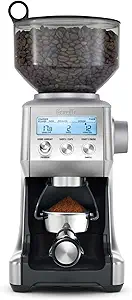 |
| Best Value The sweet spot between price and what you get | SHARDOR Coffee Grinder CG0802 |  |
| Best Budget The cheapest option that still gets the job done reliably | Rsoilch Manual Coffee Grinder HS-011 |  |
| Top Rated A top-rated pick with lots of positive feedback | OXO Brew Conical Burr Grinder |  |
| Most Popular A crowd favorite that many people choose with confidence | Cuisinart Supreme Grind DBM-8P1 | 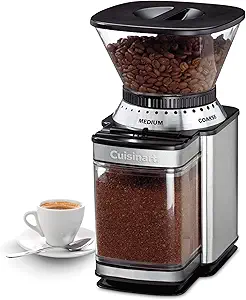 |
| Best Seller A high-volume bestseller chosen again and again | CEVING Mini Manual Coffee Grinder | 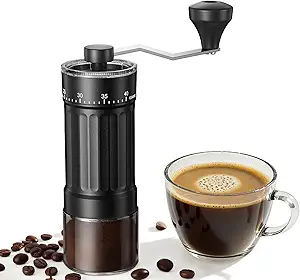 |
Baratza Encore Grinder

| Capacity | 5 ounces |
|---|---|
| Wattage | 70 watts |
| Voltage | 120 volts |
| Burr type | Conical steel, 40mm |
The Baratza Encore is a straightforward, beginner-friendly burr grinder designed for everyday home use. It uses 40mm commercial-grade conical steel burrs and a DC motor to deliver consistent grounds across 40 settings, so you can dial in everything from drip and pour-over to coarse French press and many filter methods. Controls are simple: an on/off switch and a front pulse button make short runs and adjustments easy without a steep learning curve. The grinder holds about 5 ounces of beans and has a small footprint that fits most kitchen counters. Practical strengths include reliable, even grinding from durable burrs and easy maintenance using replaceable parts. Limitations are that it is not a timed or doserless model for precise single-dose espresso workflow, and the hopper capacity and motor design make it better suited to household batch grinding rather than high-volume commercial use. For buyers prioritizing consistent everyday performance and serviceable parts, it is a sensible choice.
Best for: Home brewers who want a reliable, easy-to-use burr grinder that can handle a wide range of brew methods and who value consistency and serviceability over advanced dosing features.
Less Ideal for: Users seeking a precision single-dose or high-volume commercial espresso workflow should consider purpose-built timed or doserless machines instead.
- 40mm commercial-grade conical burrs for consistent grind distribution
- Wide range of 40 grind settings covering espresso-adjacent fine to coarse French press
- Simple, intuitive controls with a front pulse button for short bursts
- Compact footprint that fits most kitchen counters
- Durable, serviceable design with replaceable burrs and motor support
- No built-in timer or dosing system for exact single-dose espresso routines
- 5-ounce hopper limits capacity for frequent large-batch grinding
Verdict: A durable, user-friendly burr grinder that delivers consistent, versatile grind quality for home brewers seeking a balanced everyday performer.
Breville Smart Grinder Pro BCG820BSS

| Wattage | 165 |
|---|---|
| Voltage | 120 |
| Capacity | 1.1 pounds |
The Breville Smart Grinder Pro is a countertop conical-burr grinder built for precise, repeatable dosing from espresso to French press. It grinds directly into a portafilter or a container and uses an LCD that displays grind setting, grind time and selected shots or cups. The standout features are 60 stepped grind settings and Dosing iQ, which lets you program grind time in 0.2-second increments for consistent doses, plus preprogrammed cup and shot modes to simplify daily use. Included portafilter cradles and a sealed grinds container make it easy to move from grinder to espresso machine without extra mess. At 165 watts the motor is strong enough for regular home use, and stainless-steel conical burrs produce uniform particle size for better extraction. Limitations are typical of stepped grinders: you get defined notches between settings rather than an infinite micro-adjust, and it is a bit heavier and takes counter space. For someone focused on dialing in dose and repeatability across espresso and filter brews, it delivers reliable, practical control.
Best for: Buyers prioritizing precise, repeatable dosing and the ability to switch between espresso and brewed coffee will appreciate its programmable controls and stepped grind range.
Less Ideal for: If you need ultra-fine continuous micro-adjustments or a very compact travel-friendly grinder, this is not the best choice.
- Wide 60-step grind range for espresso through French press
- Digital dosing with 0.2-second increments for repeatable doses
- Grinds directly into portafilter or airtight container for flexible workflow
- Clear LCD shows grind setting, time, and shot/cup selection
- Includes portafilter cradles and sealed grinds container to reduce mess
- Stepped adjustment offers notched increments rather than infinite micro-adjust
- Relatively heavy and requires dedicated counter space
Verdict: Choose this grinder when you want programmable, repeatable dosing and a broad stepped grind range that covers both espresso and French press.
SHARDOR Coffee Grinder CG0802
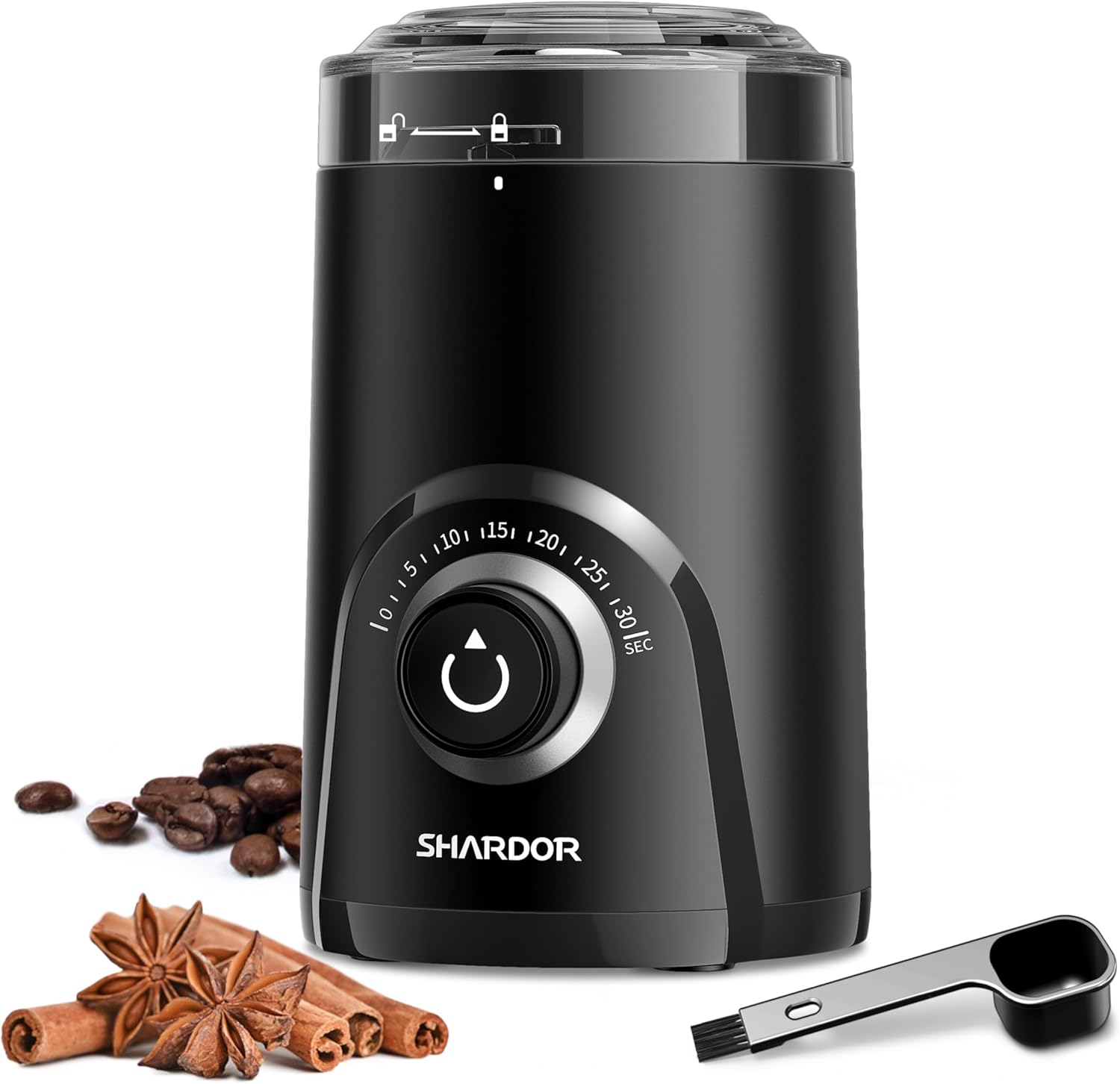
| Capacity | 70 g |
|---|---|
| Material Type | Stainless Steel |
| Power Source | Electric |
| Model Number | CG0802 |
The SHARDOR CG0802 is a small electric blade grinder intended for home coffee preparation and kitchen use. You load up to the 70 g stainless steel bowl, lock the lid, set the clear timing knob to the desired seconds and press start to produce grounds suitable for espresso, drip and French press depending on how long you run it. The visual timing knob makes it easy to repeat grind times instead of guessing, and the included 2-in-1 spoon with brush helps tidy the bowl after use. SHARDOR rates the motor noise at about 63 dB, which is noticeably quieter than many blade grinders and useful for early mornings. Because it is a blade grinder, fine-tuning a consistent particle size will require short pulses and some trial to match burr-style results, and it is best for small batches up to roughly a dozen cups of brewed coffee. The unit also handles dry spices, grains and nuts, so it doubles as a versatile kitchen tool. Overall, it is a practical, space-saving choice for buyers who value repeatable timing and quieter operation in a multi-use grinder.
Best for: Buyers who want a compact, low-noise grinder that gives repeatable grind times and doubles as a spice grinder for everyday kitchen use.
Less Ideal for: Users seeking the most consistent, professional-grade espresso grind or those who need to grind large volumes in one run should choose a burr grinder or larger-capacity unit instead.
- Clear timing knob for repeatable grind times
- 70 g stainless steel bowl accommodates up to about 12 cups of brewed coffee
- Quieter operation (about 63 dB) than many blade grinders
- Can grind coffee, dry spices, herbs, grains and nuts
- Includes a cleaning brush and measuring spoon for convenience
- Blade design cannot match the uniformity of burr grinders for espresso-level fineness
- Small single-bowl capacity requires multiple batches for larger households
Verdict: Choose the SHARDOR CG0802 if you want a compact, quieter blade grinder that gives repeatable grind times and multitasks as a spice grinder.
Rsoilch Manual Coffee Grinder HS-011

| Capacity | 30 g |
|---|---|
| Included Components | Ceramic Burr, Stainless Steel Body |
| Material Type | Ceramic, Plastic |
This handheld grinder uses a ceramic conical burr and 40 adjustable grind clicks to produce consistent grounds for espresso, pour-over, and French press. You load beans into the top, turn the low-noise hand crank and collect grounds in the clear glass jar so you can monitor progress and stop when you reach the desired dose. The lightweight ABS body and 25–30 g capacity make it well suited to travel, camping, or single-serve home use, and the lack of power requirement means it works anywhere. The precision burr preserves oils and aromas better than blade-style mills, but the small capacity and manual operation mean it is slower and less convenient for brewing multiple cups or busy mornings. Build materials are primarily plastic with ceramic internals, so it is a solid budget pick rather than a premium, long-term workshop piece.
Best for: Buyers who want a low-cost, portable grinder that can produce café-style grounds for espresso and French press and who prioritize compactness and manual control over speed.
Less Ideal for: People who need to grind large quantities quickly, want electric convenience, or expect heavy-duty metal construction for intensive daily use.
- Ceramic conical burr delivers uniform grounds and preserves coffee oils
- 40 adjustable grind settings cover espresso to French press ranges
- Compact, lightweight, and fully manual for travel or off-grid use
- Transparent glass grounds jar lets you monitor dose and stop precisely
- Small 25–30 g capacity requires multiple batches for more than one cup
Verdict: An affordable, travel-friendly manual grinder that gives controllable, café-quality grounds for single-serve espresso or French press brewing.
OXO Brew Conical Burr Grinder

| Burr type | 40mm stainless steel conical burrs |
|---|---|
| Grind settings | 15 settings plus micro-adjustments |
| Hopper capacity | 12 ounces |
| Power source | AC adapter |
The OXO Brew Conical Burr Grinder is built to deliver consistent, even grounds for a wide range of brew methods from fine espresso to coarse French press. It uses 40mm stainless steel conical burrs and offers 15 grind settings with additional micro-adjustments, so you can dial in grind size precisely; a one-touch start with a remembered timer makes repeatable dosing fast and simple. The removable 12-ounce UV-tinted hopper stores beans and helps preserve freshness while the motor is engineered for low vibration and relatively quiet operation during early-morning use. In practice this grinder is compact enough for typical kitchen counters and handles single- to multiple-cup routines without complicated setup. Important limitations are that it is an electric, countertop unit so it requires outlet space and will need occasional cleaning and burr replacement over years of heavy use; extremely fine micro-adjustment demands for professional espresso shops may still prefer commercial machines. For home users seeking steady, reproducible results across brew styles, it is a dependable choice.
Best for: Home brewers who prioritize consistent, repeatable grinds for espresso and manual brew methods and want an easy-to-use, durable grinder that performs well across grind sizes.
Less Ideal for: People running a busy cafe or anyone needing a heavy-duty commercial grinder for nonstop, high-volume use should look at professional equipment instead.
- 40mm stainless steel conical burrs for uniform, even grounds
- 15 grind settings plus micro-adjustments for precise tuning
- One-touch timer that remembers last setting for consistent dosing
- 12-ounce removable, UV-tinted hopper preserves bean freshness
- Motor designed for low vibration and relatively quiet operation
- Not a commercial-grade machine for high-volume cafe use
- Requires counter space and an AC outlet for operation
Verdict: Choose this grinder if you want a reliable, easy-to-use home burr grinder that consistently produces precise grounds for both espresso and French press.
Cuisinart Supreme Grind DBM-8P1

| Wattage | 500 |
|---|---|
| Voltage | 110 volts |
| Capacity | 0.23 kg |
The Cuisinart Supreme Grind DBM-8P1 is a straightforward flat-burr grinder built for everyday home use, offering 18 grind settings from ultra-fine to extra-coarse so you can prepare anything from espresso-style fine grounds up to a coarse French press texture. It grinds directly into a removable chamber that holds enough for roughly 4 to 18 cups and the 8-ounce removable bean hopper simplifies refilling and cleaning. A one-touch power bar and internal timer automate the grind cycle and stop the motor when the selected time completes, making operation quick and repeatable. Practical touches like cord storage, an included scoop and cleaning brush, and a robust 500-watt motor mean the unit sits well on a busy counter. Limitations include the lack of micrometric stepless adjustment favored by espresso purists and a smallish grind chamber for those who want to grind large weekly batches at once. For most home brewers who want reliable, repeatable grinds across brew methods, this model delivers consistent, easy-to-maintain performance.
Best for: Buyers who want a reliable, easy-to-clean burr grinder that delivers consistent grinds for drip, French press, and near-espresso home brewing and who value proven performance backed by many user reviews.
Less Ideal for: Home espresso enthusiasts seeking micro-adjustable, commercial-grade grinding or users who need to grind very large quantities in a single cycle should consider other options.
- 18-position grind selector covers ultra-fine to extra-coarse settings for multiple brew methods
- Removable 8 oz bean hopper and grind chamber for easy refilling and cleaning
- One-touch power bar with internal timer provides consistent, hands-off grinding
- 500-watt motor and cord storage make it sturdy and convenient for countertop use
- Not stepless so fine tuning for espresso dial-in is limited
- Grind chamber capacity may be small for users who want to grind large batches at once
Verdict: A dependable, user-friendly flat burr grinder that gives repeatable grinds across brew methods for most home coffee drinkers.
CEVING Mini Manual Coffee Grinder

| Capacity | 30 g |
|---|---|
| Material Type | Ceramic |
| Power Source | manual winding |
| Adjustable Settings | 40 |
This compact manual grinder uses ceramic conical burrs and an external adjustment ring to offer 40 distinct grind settings, making it usable for fine espresso attempts up through coarser French press grinds in small batches. You load up to 30 g of beans in the bean bin, turn the crank by hand and collect freshly ground coffee without electricity, which is convenient for travel, camping, or a countertop back-up. The ceramic burrs reduce heat and can deliver a consistent grind for single cups, and the detachable three-part construction makes it straightforward to take apart and dry-clean with the included brush. Limitations are the small 30 g capacity and manual operation, so it is slow for multiple servings and not ideal if you need daily large-volume grinding or perfectly repeatable espresso dosing in a busy home setup. For cautious buyers who prefer simple, mechanical gear, this grinder is a low-tech, low-risk way to get fresh grounds for espresso-style shots or French press when used for one to two cups at a time.
Best for: Buyers who value reliability and simplicity and want a portable, mechanical grinder for single-cup espresso attempts or small French press batches while traveling or as a backup at home.
Less Ideal for: People who routinely grind large daily volumes, need rapid consistent dosing for heavy espresso use, or prefer hands-free electric grinders.
- 40 external grind settings for fine control across brewing methods
- Ceramic conical burrs that reduce heat and preserve flavor
- Portable, manual design that works without power for travel
- Detachable three-part construction for easy cleaning
- 30 g capacity is small and requires multiple batches for more than two cups
- Manual crank operation is slower and more effort than electric grinders
Verdict: A dependable, travel-ready manual burr grinder that gives precise grind control for small espresso and French press batches without electricity.
Choosing the Right Coffee Grinder for Espresso and French Press: Key Factors to Consider
Burr Type and Material
Burr geometry and material determine how cleanly beans are cut and how long the burrs stay sharp. Steel burrs are durable and affordable, while hardened steel or special coatings can resist wear longer. Ceramic burrs run cooler and may preserve flavor but can be more fragile. For a grinder that must cover both espresso and French press, look for burrs designed to produce a narrow particle distribution across a wide range of settings.
A grinder with poorly made burrs will produce fines and boulders that harm extraction consistency. Burr diameter also matters: larger burrs often grind faster and with less heat buildup, which helps when switching between fine and coarse settings frequently.
Grind Adjustment Mechanism
The quality of the adjustment system affects how easy it is to dial in espresso and then switch to coarser French press settings. Stepped adjustments give repeatable stops that are useful for users who want precise recall. Stepless systems allow micro-adjustments that can be necessary for fine-tuning espresso but require more care to record exact positions. The best all-around grinders offer a clear, tactile adjustment mechanism with indexing or markings to help reproduce settings.
Consider how many clicks or marks the grinder has and whether those clicks correspond to meaningful changes in extraction. For households that prepare both espresso and French press regularly, an adjustment that moves predictably across the range saves time and reduces wasted coffee.
Retention and Dosing Accuracy
Grind retention is the amount of ground coffee left inside the grinder after a run. High retention can cause stale grounds to mix with fresh ones and make dosing inconsistent, which is especially problematic for espresso where small weight differences affect shot quality. Low retention designs or accessible catch cups minimize waste and help maintain consistent doses.
Dosing accuracy also ties to how the grinder dispenses grounds: single-dosing-friendly chutes, grounds trays with clear volume cues, or straightforward portafilter compatibility improve repeatability. If you rely on precise dosing for espresso, prioritize machines that reduce retention and let you measure or deliver grounds consistently.
Speed, Heat, and Noise
Grinding speed affects workflow and heat generation. High-RPM grinders complete a dose quickly but can generate more heat, which may affect aroma compounds during extended runs. Slower, high-torque motors with larger burrs can produce less heat and often yield a cleaner flavor profile, but they take longer per dose. Noise level matters in homes where morning coffee should not disturb others; quieter designs are generally preferable for shared living spaces.
Balance these factors based on your routine. If you pull multiple espresso shots back-to-back, a faster grinder with thermal control could be useful. For occasional use, a quieter, controlled-speed unit may be more pleasant.
Ease of Cleaning and Maintenance
Regular cleaning preserves flavor and performance. Grinders that allow quick burr removal and have minimal crevices for trapped grounds make maintenance straightforward. Access to the burrs without tools or with a single fastener reduces the barrier to routine cleaning. Consider how the hopper and catch components detach and whether the mechanism can be reassembled without misalignment.
Maintenance also includes part replacement availability and clarity of user guides. Even a well-built grinder will need occasional burr replacement, so designs that support straightforward service extend the product life and protect your investment.
Size and Countertop Fit
Physical footprint and hopper capacity affect where the grinder will live in your kitchen. A compact grinder with a modest hopper suits small counters and single-user households, while larger hoppers reduce refilling frequency for multiple daily users. Also consider clearance needed for portafilter docking if you use an espresso machine, and whether the grinder's height fits under shelves or cabinets.
Think about how often you will adjust settings and where you will empty the grounds. A grinder that is awkward to place or operate can reduce the likelihood of consistent use and upkeep.
How Grind Size Affects Espresso and French Press
Grind size directly controls extraction rate. Espresso requires a fine, uniform grind to create the proper surface area and resistance for a short, pressurized extraction. French press needs a coarse, even grind to avoid excessive fines passing through the mesh filter and producing a muddy cup. Understanding these differences helps explain why a multi-purpose grinder must handle extremes without sacrificing uniformity.
Switching between the two methods also changes dosing habits and tamping or immersion times, so expect to re-dial variables when you move from espresso to French press. A grinder that preserves particle distribution across settings makes those shifts predictable and repeatable.
- Fine grind increases extraction speed and requires precise dosing for espresso.
- Coarse grind limits fines and slows extraction for French press immersion.
- Consistent particle size reduces under- and over-extraction errors for both methods.
Single Dosing Versus Hopper Use
Single dosing involves loading only the coffee you need for a shot directly into the grinder. It reduces retention and preserves freshness, and it is popular with users who rotate beans frequently. Hopper use is convenient for households that brew multiple times a day or for users who prefer to store beans on the machine.
Consider which approach matches your routine. Some grinders handle single dosing better thanks to low-retention dosing chutes and easy feed methods. Others work best with a full hopper but may leave more stale grounds between uses.
- Single dosing reduces waste and simplifies bean rotation.
- Hopper use improves convenience for high-frequency brewing.
- Check if the grinder's chute and catch system support the dosing style you prefer.
Cleaning Routines That Preserve Flavor
A short cleaning routine that you can do weekly will preserve flavor and prevent buildup of oils and stale grounds. Brush or blow out loose grounds, and periodically disassemble the burrs for a deeper clean according to the manufacturer's instructions. Avoid using water on burr sets unless expressly allowed, and use dedicated grinder cleaning pellets as an occasional maintenance tool if appropriate.
Set a simple schedule: light sweep after daily use, full burr clean every few weeks depending on dosage and oiliness of beans. Keeping the grinder clean improves consistency and reduces carryover between different beans or roast levels.
- Daily: brush or shake out loose grounds.
- Weekly: check hopper and chute for buildup.
- Monthly: remove burrs for deep cleaning if the design allows.
Noise Management and Household Considerations
If you live with others or prepare coffee early, noise can be a deciding factor. Some grinders use sound-dampening housings or slower motors to minimize disturbance. Others are loud but fast. Think about when and where you grind and whether noise will limit your use.
Look for grinders with predictable noise profiles and consider placing them on a rubber mat to reduce vibration and perceived loudness. If you frequently grind at odd hours, prioritize quieter operation over pure speed.
- Quieter grinders favor slower, controlled motor systems.
- Rubber mats and anti-vibration pads can reduce perceived noise.
- Test for noise at typical dosing loads rather than brief bursts.
Adjusting for Different Bean Types and Roast Levels
Different beans and roast levels respond differently to the same grind setting. Darker roasts are oilier and may produce more fines, while lighter roasts can be denser and require slightly different settings to extract correctly. A versatile grinder should let you make micro-adjustments to compensate for these variations without losing consistency.
When trying a new bean, start with a baseline setting and adjust in small increments while tasting. Keep notes on settings that work for a given bean and roast to speed up future dialing.
- Oily beans may require more frequent cleaning and slightly coarser settings.
- Light roasts often need finer adjustments to reach ideal extraction.
- Record successful settings for repeatable results across beans.
How We Chose the Best Coffee Grinder for Espresso and French Press
We focused on grind consistency, adjustment precision, durability, and user ergonomics to identify grinders that perform well for both espresso and French press. Consistency was judged by how evenly a grinder distributes particle sizes across the fine-to-coarse range, since uneven grind leads to over- or under-extraction for both brewing styles. Adjustment precision was a priority because dialing in espresso requires small, repeatable steps while French press benefits from predictable coarse settings. Durability factors included burr material and drive mechanism reliability, along with hopper and catch-cup construction to withstand daily use. Ease of cleaning and maintenance was another filter, favoring designs with accessible burrs and minimal retention. We also considered noise and speed for typical home routines, looking for grinders that balance quick grinding with thermal control to avoid heating beans. Exclusions: grinders that only work well at one end of the spectrum, blade grinders, and models lacking clear adjustment or serviceability were removed from consideration. The shortlist reflects machines that deliver repeatable results across brewing styles and are practical for everyday home use.
Our full evaluation process is outlined in our review methodology.
FAQ
Can one grinder truly do both espresso and French press well?
Often a single grinder can handle both if it offers precise adjustment and good burr geometry. Look for wide grind range, low retention, and repeatable settings. Some compromises in speed or noise may be necessary to achieve versatility.
How often should I replace the burrs?
Burr replacement depends on use and burr material. Home users typically replace burrs after several hundred to a few thousand pounds of coffee. Watch for declining consistency or increased retention as signs it is time to service or replace burrs.
Is it better to use stepped or stepless adjustments for switching between brew methods?
Stepped adjustments help you return to known positions quickly, which is handy when switching between espresso and French press. Stepless adjustments allow finer tuning for espresso but require careful noting of positions. Choose based on whether you prefer repeatability or micranging.
How much retention is acceptable for consistent dosing?
Lower retention is preferable, especially for espresso. A small amount of residual grounds is normal, but designs that trap significant grounds in the chute or burr chamber will make dosing and flavor consistency harder to control.
Will grinding speed affect flavor?
Speed can influence heat buildup. Faster grinders may warm beans slightly during long runs, which can alter flavor. For typical home doses the effect is often minor, but if you do consecutive doses consider models with thermal control or larger burrs that reduce heat.
Can I clean burrs with water?
Most burrs should not be submerged unless the manufacturer permits it. Use dry brushing and approved cleaning products. If the hopper or exterior parts are washable, follow instructions to avoid damaging bearings or electrical components.
Final Verdict
Choose a grinder that prioritizes consistent particle distribution and a reliable adjustment mechanism to cover both espresso and French press needs. Expect tradeoffs between speed, noise, and thermal control; prioritize the dimensions that match your routine such as dosing accuracy for espresso or hopper capacity for regular French press use. With the right balance of burr quality, low retention, and maintainability, a single well-chosen grinder can deliver satisfying shots and robust immersion brews for years.