
Note: This article contains affiliate links. If you click on these links and make a purchase, we may earn a small commission at no extra cost to you. This helps support our research and content. Read our full affiliate disclosure here.
If you rely on a percolator for morning coffee, grind consistency and particle size matter more than sheer speed. The right coffee grinder for percolators produces the coarse, even grounds that allow water to cycle without over-extraction or clogging. This guide covers seven shortlisted grinders that suit percolator brewing, with attention to grind-size control, build quality, and ease of cleaning. You will find practical notes on what matters when pairing a grinder with a percolator and how each pick meets those needs. Read on for concise buying guidance and the evaluation criteria we used.
Top Picks at a Glance
| Best Overall The best all-around choice for most situations | OXO Brew Conical Burr Grinder | 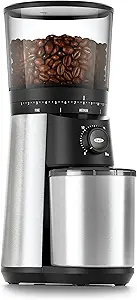 |
| Best Quality Built to a higher standard if you want something more solid | Baratza Encore Coffee Grinder |  |
| Best Value The sweet spot between price and what you get | Cuisinart Coffee Grinder DCG-20BKN |  |
| Best Budget The cheapest option that still gets the job done reliably | Amazon Basics Electric Coffee Grinder CG9402-UL |  |
| Top Rated A top-rated pick with lots of positive feedback | Ksionka Conical Burr Grinder BD-CG011 |  |
| Most Popular A crowd favorite that many people choose with confidence | Hamilton Beach Fresh Grind Coffee Grinder |  |
| Best Seller A high-volume bestseller chosen again and again | BLACK+DECKER Coffee Grinder CBG110S |  |
OXO Brew Conical Burr Grinder
| Burr Type | 40 mm stainless steel conical burrs |
|---|---|
| Grind Settings | 15 settings plus micro-adjustments |
| Hopper Capacity | 12 ounces |
| Power | 100 watts |
| Voltage | 120 volts |
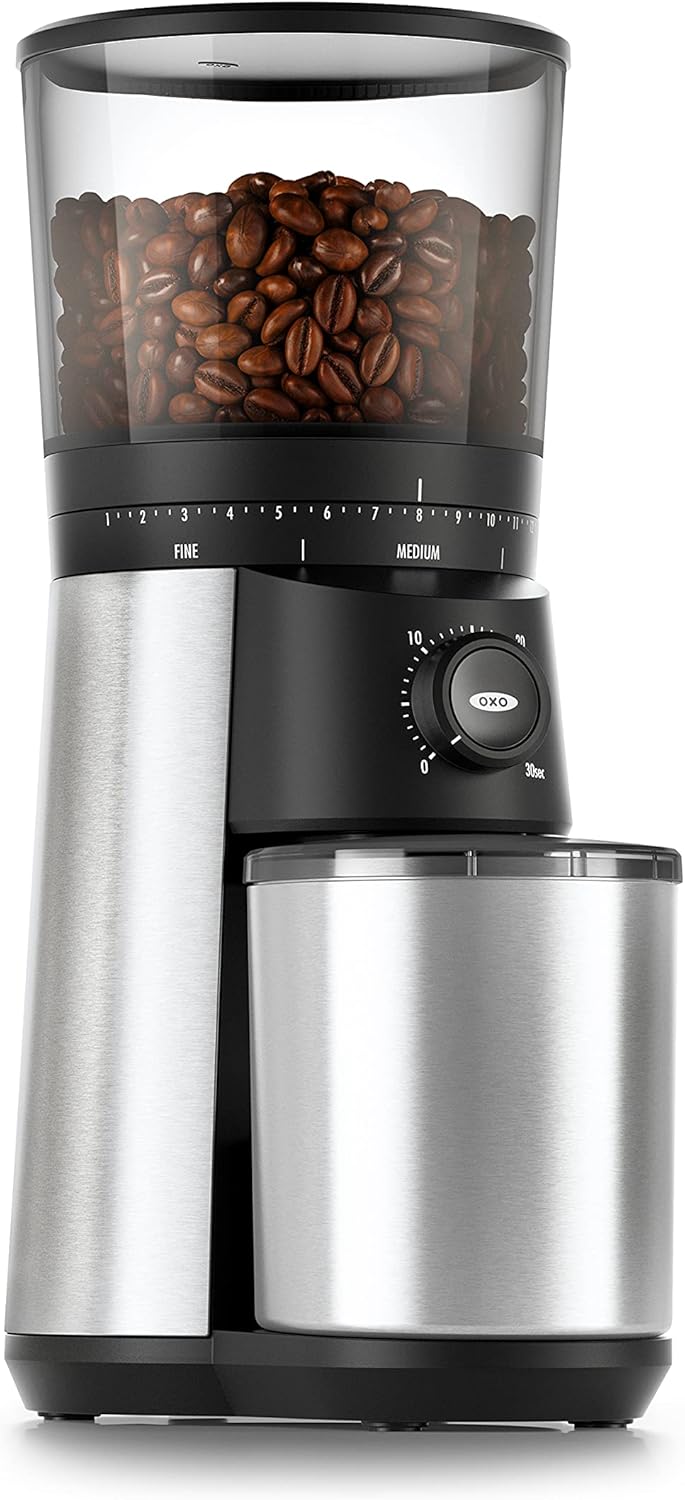
The OXO Brew Conical Burr Grinder is a compact electric grinder built around stainless steel 40 mm conical burrs that produce consistent, uniform grounds for many brewing methods. You use the front dial to choose one of 15 grind sizes plus fine micro-adjustments, then press the one-touch start and the grinder remembers your last setting for fast repeatable runs. The removable, UV-tinted hopper holds up to 12 ounces of beans so you can grind multiple batches without refilling, and the motor is engineered for relatively low vibration and noise for early-morning use. Practical benefits include a durable stainless exterior, a grounds container that reduces static, and a range of grind sizes that cover drip, percolator-coarse settings, French press and finer options. Important limits are that it is an electric timed grinder rather than a weight- or dose-based grinder, so dialing in exact grams requires separate measuring, and its 100-watt motor and capacity suit home use rather than heavy commercial workloads.
Best for: Home brewers who want a reliable, compact burr grinder that covers everything from coarse percolator or French press grinds to finer drip and espresso-ish settings and value repeatable, low-noise operation.
Less Ideal for: Users who need commercial throughput, built-in weighing/dosing features, or ultra-fine control for high-volume espresso shops should look at pro-level equipment instead.
- Stainless steel 40 mm conical burrs for uniform grind distribution
- 15 grind settings plus micro-adjustments for a wide range of brew methods
- Large removable, UV-tinted hopper preserves beans and reduces light exposure
- One-touch timer that remembers the last setting for quick, repeatable grinding
- Low-vibration motor design suitable for early-morning use
- Timer-based dosing instead of a built-in scale means you must weigh grounds for precise dosing
Verdict: A versatile, compact conical-burr grinder that reliably produces uniform grounds across coarser percolator and finer brew styles while staying quiet and convenient for home use.
Baratza Encore Coffee Grinder

| Capacity | 5 ounces |
|---|---|
| Wattage | 70 watts |
| Voltage | 120 volts |
The Baratza Encore is a straightforward, performance-focused burr grinder aimed at home brewers who want consistent, grind-ready coffee for a wide range of methods. It uses 40mm commercial-grade conical steel burrs driven by a 70 W DC motor and offers 40 discrete grind settings that cover everything from coarse methods like percolator and French press up through finer filter and espresso-adjacent grinds. Operation is simple with a front pulse button and on/off switch, and the compact footprint fits easily on most counters. In practice the Encore produces a uniform particle distribution for a given setting, which helps extraction consistency in percolators where coarser, even grounds are important. It is not a timed-dosing or high-speed prosumer machine, so expect modest throughput suitable for home batches rather than café volumes, and the hopper and 5-ounce capacity mean you may refill for larger servings. Build quality favors serviceability with replaceable burrs and Baratza support, but the plastic body keeps weight and cost down. For home users who prioritize steady, repeatable grinds over flashy features, the Encore delivers reliable performance.
Best for: Home brewers who care about consistent, grind-specific results and want a durable, serviceable burr grinder for manual and automatic brewing methods, including percolators.
Less Ideal for: People who need large-capacity or commercial-speed grinding for frequent high-volume use should consider larger, production-oriented grinders.
- 40mm commercial-grade conical steel burrs for consistent particle size
- Wide 40-step grind range covers coarse percolator grind through finer methods
- Compact footprint that fits easily on most kitchen counters
- User-friendly controls with a front pulse button and simple on/off switch
- Replaceable burrs and accessible support for long-term serviceability
- Small 5-ounce hopper requires refilling for larger batches
- Not optimized for high-volume or commercial throughput
Verdict: Choose the Encore if you want a compact, serviceable burr grinder that reliably produces consistent coarse grinds ideal for percolators.
Cuisinart Coffee Grinder DCG-20BKN

| Capacity | 2.5 ounces |
|---|---|
| Wattage | 150 watts |
| Material Type | Stainless Steel |
| Power Source | AC adapter |
The Cuisinart DCG-20BKN is a small, no-frills blade grinder meant for everyday home use and easily handles up to 2.5 ounces of whole beans in one batch. It uses stainless steel blades driven by a 150-watt motor and operates with a simple press-and-hold on/off control; a safety interlock prevents the unit from running unless the lid is secured. In practice it produces quick, consistent coarse to medium grounds suitable for drip machines and percolators when you pulse to control particle size, and the stainless bowl and removable lid make cleanup straightforward. Its compact footprint and cord storage make it easy to tuck away, but like most blade grinders it does not produce the uniform grind of a burr grinder, so very fine or precision extraction is limited. For someone who wants fast, reliable grinding for daily brewed coffee or percolator use, this is a practical, durable option that keeps operation simple.
Best for: Buyers who want a simple, durable grinder for daily home brewing and need a compact unit that delivers quick coarse to medium grounds suitable for percolators.
Less Ideal for: Users seeking precise, uniform grind for espresso or specialty filter brewing should consider a burr grinder instead.
- Compact design with cord storage saves counter space
- Stainless steel bowl and blades are easy to clean and durable
- 150-watt motor gives quick, consistent grinding for coarse to medium textures
- Safety interlock prevents operation unless the lid is secured
- Blade grinder cannot match the grind uniformity of burr grinders
- Small 2.5 oz capacity requires multiple batches for larger amounts
Verdict: A compact, tough blade grinder that quickly produces coarse to medium grounds ideal for everyday percolator brewing.
Amazon Basics Electric Coffee Grinder CG9402-UL

| Capacity | 2.1 ounces |
|---|---|
| Voltage | 120 volts |
| Material Type | Stainless Steel |
This Amazon Basics electric coffee grinder is a small, no-frills blade grinder built for quick daily use. It grinds up to about 2.1 ounces (roughly 30 grams) in a single run and can turn beans, spices, grains, and nuts into a coarse-to-fine powder in seconds thanks to its stainless steel blade and 120V motor. The clear safety lid makes it easy to watch grind progress so you can stop when you reach the texture you want, and the compact stainless steel body stores easily on a counter or in a cabinet. Expect fast results that are well suited to drip coffee and coarser grinds for percolators, but do not expect the consistent particle size of a burr grinder, so extraction can be uneven for fine brewing methods. It is simple to use and easy to clean by wiping the bowl and blade, though small grounds can cling to crevices. For buyers who want an affordable, space-saving grinder for occasional use and coarser percolator grinds, this model delivers reliable basic performance.
Best for: Buyers prioritizing a very affordable, compact grinder for occasional home use who need quick coarser grinds suitable for percolators and simple brewing.
Less Ideal for: Serious home baristas seeking highly consistent grind size for espresso or specialty pour-over should consider a burr grinder instead.
- Compact stainless steel design fits small kitchens and stores easily
- Grinds beans, spices, grains, and nuts quickly using a heavy-duty stainless steel blade
- Clear safety lid lets you monitor grind progress for better control
- Can grind roughly 30 grams in about 10 seconds for fast single-dose use
- Blade grinder produces uneven particle sizes compared with burr grinders
- Small capacity limits use to single servings or small batches
Verdict: A budget-friendly, compact blade grinder that delivers fast, single-dose grinding ideal for percolator users who want simple, low-cost performance.
Ksionka Conical Burr Grinder BD-CG011

| Wattage | 200 watts |
|---|---|
| Voltage | 120 volts |
| Material Type | Stainless Steel |
| Grind Settings | 38 settings |
The Ksionka Conical Burr Grinder is built for steady, repeatable home grinding with a 40mm stainless steel conical burr set and 38 precise grind settings that cover espresso through French press. You select grind time using the 7-step timer (5–60 seconds) and the unit remembers your last setting, so it reliably reproduces the same dose each use. Anti-static technology and a built-in air blower reduce retained grounds and mess, making cleanup faster and minimizing waste between grinds. At 200 watts the motor delivers consistent performance for typical daily batches (2–12 cups) while keeping heat low to protect bean flavors. The grinder is compact and designed for counter use; it is not a commercial machine, so very heavy daily throughput or professional café workflows would push its limits. For home users after repeatable grind size and low retention for percolator-style brewing, it offers practical features that simplify consistent results.
Best for: Home brewers who prioritize consistent, repeatable grind size and low grind retention for percolator and other manual brewing methods and who want an easy-to-use machine that remembers settings.
Less Ideal for: People needing a commercial-grade, high-throughput grinder or users who require precise weight-based dosing for espresso competition use.
- 40mm conical stainless steel burrs for uniform particle size
- 38 precise grind settings from espresso to French press
- Programmable 5–60s timer with memory for repeatable dosing
- Anti-static technology and built-in air blower reduce retention and mess
- Designed for home use so not suited for high-volume commercial grinding
- Timer-based dosing may require calibration by weight for ultra-precise dosing
Verdict: A compact, reliability-focused conical burr grinder that delivers repeatable grind sizes and low retention ideal for percolator and everyday home brewing.
Hamilton Beach Fresh Grind Coffee Grinder

| Capacity | 4.5 ounces |
|---|---|
| Wattage | 125 watts |
| Voltage | 110 |
| Material Type | Plastic, Stainless Steel |
| Power Source | AC |
The Hamilton Beach Fresh Grind is a small, no-frills electric blade grinder intended for everyday home use and quick batches. It grinds coffee beans, spices, and seeds by pressing and holding the top button, and the removable stainless steel grinding bowl makes filling, pouring, and cleanup straightforward — the bowl is dishwasher-safe while the lid is hand-washable. Built-in cord storage keeps counters tidy and the 125-watt motor powers the blades to produce grounds fine enough for drip brewers or percolators when pulsed carefully. Because it is a blade grinder, grind size is less consistent than a burr unit, so expect a mix of fine and coarse particles rather than uniform grinds; that said, its capacity covers enough beans for up to a 12-cup pot, so it is handy for batch brewing. The unit is lightweight and compact, which is convenient for small kitchens but not meant for heavy daily commercial use. Overall it is an affordable, easy-to-use choice for someone wanting freshly ground beans without complex settings.
Best for: Buyers who want a simple, reliable grinder to make freshly ground coffee or to process spices without fuss and who prioritize ease of cleanup and compact storage over precision grind control.
Less Ideal for: Those seeking consistently uniform grind sizes for espresso or precision brewing methods should look at burr grinders instead, and users needing high-volume or commercial-grade performance should consider larger machines.
- Removable stainless steel grinding bowl that is dishwasher-safe for easy cleanup
- Compact footprint with built-in cord storage to save counter space
- Simple one-button operation that is intuitive for quick use
- Enough capacity to grind beans for a 12-cup pot in a single batch
- Blade grinder produces less uniform particle size compared with burr grinders
- Not designed for heavy commercial use or very frequent large-volume grinding
Verdict: A compact, easy-to-clean blade grinder that delivers freshly ground beans for percolators and drip pots without complexity.
BLACK+DECKER Coffee Grinder CBG110S

| Capacity | 56.6 g |
|---|---|
| Wattage | 130 |
| Voltage | 110 volts |
| Power Source | Electric |
The BLACK+DECKER CBG110S is a small, one-touch blade grinder built for everyday kitchen use. It uses stainless steel blades and a removable stainless bowl to quickly grind coffee beans, herbs, spices, and grains with a single push-button control and a lid-lock safety feature that prevents the motor from running unless the lid is secured. The unit's 130-watt motor and modest 56.6 g capacity make it well suited for single-cup or small-batch grinding, and the simple design is easy to operate and clean. Blade grinders are best for coarse to medium grinds, which works fine for percolators that need a coarser grind, but it will not produce the ultra-uniform, espresso-fine grind that burr grinders deliver. If you want a compact, safe, and affordable grinder for occasional percolator use or seasoning tasks, this model is a practical choice; if you need consistent, precise grind size for specialty brewing, consider a burr-style alternative.
Best for: Buyers who prioritize a simple, safe, and compact grinder for occasional or small-batch percolator brewing and multiuse kitchen grinding tasks.
Less Ideal for: Users seeking highly consistent, precision grind sizes for specialty brewing or high-volume daily grinding should choose a burr grinder instead.
- Stainless steel blades and bowl for durability and easy cleaning
- One-touch push-button and lid-lock safety make operation simple and secure
- Compact footprint suited to small kitchens and single-batch grinding
- Capable of grinding coffee, spices, herbs, and grains for multiuse
- Blade grinder produces less uniform particle size than burr grinders
Verdict: A compact, safe, and affordable blade grinder that reliably handles small batches and coarse-to-medium grinds for percolator users who want simplicity over precision.
Choosing the Right Coffee Grinder for Percolators: Key Factors to Consider
Grind Consistency and Particle Distribution
Percolators rely on multiple passes of water through the coffee bed, so a narrow particle distribution is crucial. Uneven particle sizes create a mix of under-extracted and over-extracted flavors because fine particles extract quickly while coarse ones take longer. A grinder that produces uniform coarse grounds will yield a clearer, less bitter cup when used in a percolator.
When evaluating consistency, look beyond single-number settings and focus on how the grinder performs across a range of coarse settings. Small adjustments should predictably shift the particle size without producing large amounts of fines.
Adjustment Range and Coarse Settings
Not all grinders reach or hold a true coarse setting suitable for percolators. You need a stable, repeatable coarse range that lets you dial in particle size for your specific percolator and roast level. Stepped adjustments can be easier for repeatability, while stepless systems offer finer tuning if you are comfortable calibrating them.
Consider whether markings or detents align with real-world coarse sizes and whether the mechanism resists drift during use. A grinder that loses its calibration after a few uses will make consistent percolator brewing difficult.
Burr Type and Material
Burrs determine the baseline capability for producing uniform grounds. Conical and flat burr designs can both work for percolator grinds, but material choice matters for durability and heat transfer. Hardened steel burrs retain sharpness longer, while ceramic burrs resist corrosion and can stay cooler, lowering the chance of heat-related flavor changes.
Think about replacement availability and whether the burr size and design suit coarse grinding. Larger burr diameters often process beans faster with less heat, which helps when you need multiple cups for a percolator.
Motor Torque and Heat Management
Grinding at coarse settings can still tax a grinder when processing larger batches. Higher-torque motors at lower RPMs reduce heat buildup and produce fewer fines. Excess heat during grinding can affect volatile aroma compounds and accelerate staling.
If you plan to grind for a multi-cup percolator, prioritize devices with robust motors or low-speed designs that can maintain consistent performance over several back-to-back grinds.
Capacity and Throughput
Percolators are typically used for multiple servings, so hopper capacity and grind throughput matter. A small hopper that requires constant refilling interrupts workflow and increases the chance of measurement errors. Throughput is the grinder's ability to process enough beans quickly without clogging or producing too many fines.
Consider whether you prefer to grind one full batch at once or dose several times. Larger hoppers and faster coarse throughput are more convenient for group brewing but check that speed does not compromise uniformity.
Cleaning Access and Retained Grounds
Coffee oils and old grounds build up inside grinders and can taint future batches. Easy access to remove the hopper and expose the burrs simplifies maintenance and ensures better flavor over time. Look for designs that allow quick disassembly without tools and minimal hard-to-reach nooks where grounds accumulate.
Regular cleaning is more important for percolator users because coarse grinds can lodge in burr chambers. A grinder that makes cleaning straightforward will keep extraction consistent and reduce stale or rancid flavors.
Why Coarse Grind Matters for Percolators
Percolators operate by cycling hot water through the coffee grounds multiple times. If the grounds are too fine, they extract rapidly and produce bitterness or clog the filter. Coarse, even grounds allow water to flow and extract more evenly across repeated passes. That even extraction produces a cleaner cup and reduces the risk of over-extraction during long percolation.
Understanding this brewing dynamic explains why grinders with reliable coarse settings and low fines are better suited to percolator users. Grind selection also interacts with roast level and brew time, so coarse grounds are a starting point rather than a fixed rule.
- Coarse grounds reduce clogging and channeling in the percolator basket
- Fewer fines mean less over-extraction and bitterness
- Even particle distribution yields more balanced flavor across cycles
Stepped Vs Stepless Adjustment: Which Works Best?
Stepped grinders use fixed detents to mark positions and make repeated settings easier to hit. That repeatability is useful if you settle on one coarse number for your percolator. Stepless grinders allow infinite adjustment within a range, which is helpful if you want to fine-tune for different roasts and batch sizes, but they require careful marking or notes to repeat a setting precisely.
For percolator users who want a simple, consistent workflow, a stepped coarse stop with clear markings often provides the best balance of convenience and control. Active fine-tuners who enjoy ongoing calibration may prefer stepless systems.
- Stepped: easier repeatability
- Stepless: finer control but requires calibration
- Choose based on how much dialing in you plan to do
Practical Tips for Grinding for a Percolator
Measure grind by weight if possible. Volume measures vary with bean density and roast level, and weight-based dosing improves consistency between brews. Grind a small test batch and adjust coarseness incrementally until the percolator produces a balanced cup without bitterness.
Clean the grinder regularly and purge a small amount of grounds before brewing to remove stale residue. If you notice metallic or stale notes, deeper cleaning of the burr chamber is warranted. Also, allow the grinder to cool between large batches if you perform multiple back-to-back grinds to minimize heat transfer to the beans.
- Dose by weight for repeatable results
- Purge a small amount of grounds before brewing
- Let the grinder cool between large batches
Maintenance Routines That Keep Grounds Consistent
Routine maintenance preserves grind consistency and flavor. Empty the hopper weekly, brush out loose grounds from the burrs, and use manufacturer-recommended cleaning methods for the burrs and chute. Avoid using water on metal burrs unless specified and ensure all parts are fully dry before reassembly.
Replacing burrs at the manufacturer-recommended intervals maintains cutting sharpness and particle uniformity. Track the number of pounds or kilograms ground if the grinder's manufacturer provides an estimated burr life to know when replacement is due.
- Brush and vacuum loose grounds after each use
- Perform deeper cleaning monthly depending on usage
- Replace burrs per recommended lifespans to retain uniformity
Batch Size Strategies for Different Percolator Capacities
Match your grinding approach to the percolator capacity. For single-pot use, grind just enough beans to avoid prolonged storage of ground coffee. For multiple pots or larger gatherings, grind in one session but store grounds in an airtight container in a cool, dark place for short-term use only. Avoid grinding for days in advance because grounds lose volatile aromas quickly.
If you frequently brew large batches, favor grinders with larger hoppers and steady throughput so you do not have to refill repeatedly. That reduces measurement error and keeps workflow efficient when preparing multiple pots.
- Grind per session for best flavor
- For large batches, use grinders with larger hoppers
- Store grounds airtight and use within hours for peak freshness
How We Chose the Best Coffee Grinder for Percolators
We prioritized grinders that deliver a consistent coarse grind and intuitive, repeatable adjustment. For percolator brewing you want particles that extract steadily during multiple cycles of water passing through the grounds, so we filtered for machines and burrs that are capable of coarse settings with narrow particle distribution. Motor torque and speed control were considered because low-speed, high-torque designs tend to produce less heat and fewer fines. We also evaluated build quality and hopper-to-port capacity to ensure the grinder can serve typical percolator batch sizes without repeated refills. Ease of cleaning and access to burrs mattered since retained grounds can stale and affect subsequent brews. Finally, we checked user-facing controls and durability indicators such as metal burrs or reinforced gearing. Excluded from consideration were blades or grinders that cannot produce a stable coarse setting suitable for percolators, and any units lacking clear adjustment or with known issues that create excessive fines. The selection emphasizes grind uniformity, adjustment range, throughput for percolator batch sizes, cleaning convenience, and reliable mechanical design.
Our full evaluation process is outlined in our review methodology.
FAQ
What grind setting should I use for a percolator?
Use a coarse setting that produces large, even particles roughly similar to sea salt or coarse sand. Exact settings vary by grinder, so perform a test brew and adjust coarseness until the brew is balanced without bitterness.
Can I use a blade grinder for percolators?
Blade grinders usually produce a wide range of particle sizes and many fines, which makes them a poor match for percolators. For reliable results choose a burr-style grinder that can reach stable coarse settings.
How often should I clean my coffee grinder when using a percolator?
Light cleaning like brushing out loose grounds should be done after each use. Perform a deeper cleaning of the burr chamber and chute monthly or more often if you notice off flavors or residue buildup.
Does grind size change with roast level for percolators?
Yes. Darker roasts are more brittle and can break into finer particles, so you may need to choose a slightly coarser setting than with lighter roasts. Adjust by small increments and test to find the sweet spot.
Is it better to grind fresh for each percolator brew or grind in advance?
Grinding fresh just before brewing preserves aromatics and gives the best flavor. If you must grind in advance for convenience, store grounds airtight and use them within a few hours for the best results.
Final Verdict
When choosing a coffee grinder for percolators, prioritize consistent coarse grind, a reliable adjustment range, and a design that supports regular maintenance. Expect tradeoffs between convenience features like large hoppers and the need for low-speed, high-torque grinding to minimize fines and heat. Focus on drift-free settings and easy burr access so you can repeat the same grind over time. With those priorities, you can pick a grinder that makes percolator brewing simple and yields a cleaner, balanced cup.