
Note: This article contains affiliate links. If you click on these links and make a purchase, we may earn a small commission at no extra cost to you. This helps support our research and content. Read our full affiliate disclosure here.
If you brew coffee at home on a budget, the grinder you pick shapes flavor more than many realize. A steady, even grind improves extraction and reduces bitterness, while simple controls and fast cleaning keep your morning routine painless. This guide covers seven shortlisted coffee grinders under $30 that meet basic performance and usability standards for everyday home brewing. We evaluated options for grind consistency, ease of cleaning, and practical features that matter for small-batch use. Read on for a concise breakdown of what to expect and which features to prioritize before the product list.
Top Picks at a Glance
| Best Overall The best all-around choice for most situations | KRUPS F203 Coffee Grinder |  |
| Best Quality Built to a higher standard if you want something more solid | Lonkion Burr Coffee Grinder CBG-8002 |  |
| Best Value The sweet spot between price and what you get | Amazon Basics Electric Coffee Grinder |  |
| Best Budget The cheapest option that still gets the job done reliably | Wancle Electric Coffee Grinder P00273 |  |
| Top Rated A top-rated pick with lots of positive feedback | BLACK+DECKER Coffee Grinder CBG110S |  |
| Most Popular A crowd favorite that many people choose with confidence | Hamilton Beach Fresh Grind Coffee Grinder |  |
| Best Seller A high-volume bestseller chosen again and again | CEVING Mini Manual Coffee Grinder MCG-01 | 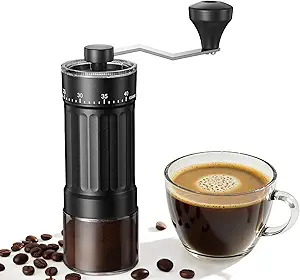 |
KRUPS F203 Coffee Grinder

| Wattage | 200 watts |
|---|---|
| Capacity | 85 g |
| Voltage | 240 volts |
The KRUPS F203 is a small, one-touch electric blade grinder designed for home use and quick batch grinding. It uses a 200W motor and stainless steel blades to turn beans, spices, herbs or nuts into a coarse-to-fine grind by controlling grind time, and the 3-ounce (85 g) bowl is large enough for roughly 12 cups of brewed coffee. Operation is simple: add ingredients, snap on the lid and press the button; a lid-activated safety switch prevents the motor from running unless the lid is secure. The removable lid doubles as a measuring cup and the compact footprint fits easily on a countertop or in a cabinet. Because it is a blade grinder, grind consistency is time-dependent rather than preset, so it works best for drip, French press and basic espresso preparations where absolute uniformity is not critical. Cleaning is straightforward with a wipe and brush-out, but the grinding chamber is not dishwasher-safe. For buyers seeking a reliable, no-frills grinder under $30, the F203 delivers fast results and versatility beyond coffee.
Best for: Buyers wanting an inexpensive, easy-to-use grinder that handles coffee and spices for everyday home use and occasional entertaining.
Less Ideal for: Those who prioritize perfectly uniform grind size for specialty espresso or who want a larger-capacity, commercial-style grinder.
- Powerful 200W motor and stainless steel blades for quick grinding
- One-touch operation with lid-activated safety for simple, safe use
- 3 oz (85 g) capacity handles multiple cups or larger spice batches
- Compact footprint that stores easily on countertops or in cabinets
- Blade design produces less uniform grind than burr grinders
- Grinding chamber is hand-clean only and not dishwasher-safe
Verdict: A compact, budget-friendly grinder that reliably delivers fresh coffee and spice grinding with simple one-touch operation.
Lonkion Burr Coffee Grinder CBG-8002

| Wattage | 200 watts |
|---|---|
| Capacity | 3 ounces |
| Voltage | 120 volts |
| Power Source | AC adapter |
The Lonkion Burr Coffee Grinder is a compact home grinder that uses flat metal burrs and 28 grind settings to deliver consistent particle size from fine to coarse. You set the grind coarseness, choose 2 to 12 cups with the cup timer, and the grinder stops automatically when the selected volume is reached, which makes it handy for daily drip, pour-over, French press, or espresso-style preps at home. The motor runs at relatively low noise and includes overheat protection, so short batches feel safe and reliable. The grounds container is treated to reduce static and the package includes a cleaning brush for quick maintenance. Practical limits are its small 3-ounce hopper capacity and compact motor, so it is best for single- to small-household use rather than heavy daily commercial workloads, and very fine espresso-level dialing may be harder to perfect compared with higher-end machines.
Best for: Buyers who want an affordable, performance-focused home grinder that can produce consistent grinds for a variety of brew methods and who make small daily batches.
Less Ideal for: Those who need large-capacity grinding for entertaining, commercial use, or customers seeking a pro-level espresso grinder with ultra-fine, repeatable dosing.
- 28 precise grind settings allow a wide range from fine to coarse
- Flat metal burrs promote more even particle size than blade grinders
- Cup-based auto-stop for 2 to 12 cups simplifies repeatable dosing
- Low-noise operation with overheat protection for safer short runs
- Small 3-ounce hopper limits batch size and requires frequent refills for multiple servings
- Compact motor may struggle with heavy continuous use or very dense roasts
Verdict: A compact, budget-friendly burr grinder that delivers more consistent, adjustable grinds than blade alternatives for small household brewing needs.
Amazon Basics Electric Coffee Grinder

| Capacity | 2.1 ounces |
|---|---|
| Voltage | 120 volts |
This Amazon Basics electric coffee grinder is a small, no-frills blade grinder designed for quick home use. It grinds up to about 2.1 ounces (roughly 30 grams) of beans in a single run and can produce coarse to fine results depending on how long you pulse the motor. The stainless steel blade and clear safety lid let you see progress and handle beans, spices, nuts, and grains with minimal effort, making it handy for single-serve drip or French press prep and for grinding small amounts of spices. It is compact and easy to store, and the simple push-to-grind operation keeps use straightforward. Expect a blade-style grind texture rather than the uniform size a burr grinder provides, so it is best for everyday drip and manual brewing rather than precision espresso. Overall it is a practical, budget-minded option when you need a fast, small-capacity grinder for routine home brewing and occasional spice grinding.
Best for: Buyers who want a low-cost, space-saving grinder for everyday drip or manual-brew coffee and occasional spice grinding and who prioritize speed and simplicity over precision.
Less Ideal for: Users seeking highly consistent, adjustable grind sizes for espresso or large-volume brewing should consider a burr grinder or higher-capacity model instead.
- Grinds up to 2.1 ounces in a single run, suitable for single-serve brewing
- Stainless steel blade handles coffee, spices, grains, and nuts
- Clear safety lid lets you monitor grind consistency
- Compact footprint stores easily on a countertop or in a cabinet
- Blade grinder produces uneven particle sizes compared with burr grinders
- Small capacity requires multiple batches for larger coffee quantities
Verdict: A compact, budget-friendly blade grinder that delivers fast, convenient grinding for single-serve and casual home coffee drinkers.
Wancle Electric Coffee Grinder P00273

| Wattage | 150 W |
|---|---|
| Capacity | 60 g |
| Voltage | 120 volts |
| Power Source | AC adapter |
The Wancle Electric Coffee Grinder is a small, budget-friendly blade grinder meant for quick home use. You add up to about 60 g of beans, press the single button and the stainless steel blade driven by a 150W pure copper motor pulverizes beans in seconds for drip or French press prep; it also works for spices, nuts and seeds. The transparent lid makes it easy to watch grind progress so you can stop when you reach the desired coarseness, and a small brush is included for simple cleanup. Because it is a blade grinder, particle size is less uniform than a burr grinder, so it is best for machines that tolerate mixed grind sizes rather than espresso. The compact plastic body and AC power source keep it lightweight and convenient for small counters or travel. For the price this unit delivers fast, reliable grinding for everyday brewed coffee and occasional spice chopping, but buyers looking for precise grind control should consider a burr model instead.
Best for: Buyers on a tight budget who want a fast, no-frills grinder for daily brewed coffee or occasional spice chopping and who prioritize speed and convenience over precision.
Less Ideal for: Those needing consistently uniform particle size for espresso, large-batch grinding, or long-term heavy use should choose a burr grinder or a higher-capacity model instead.
- One-touch operation for fast, simple grinding
- 150W copper motor provides quick and consistent power
- Transparent lid lets you monitor grind level
- Multi-use: grinds coffee, spices, nuts and seeds
- Includes cleaning brush for easy maintenance
- Blade design yields less consistent grind size compared with burr grinders
- Small 60 g capacity requires multiple batches for larger servings
Verdict: A cheap, compact one-touch grinder that delivers fast, usable grounds for brewed coffee and spice work when you need an inexpensive, space-saving option.
BLACK+DECKER Coffee Grinder CBG110S

| Capacity | 56.6 g |
|---|---|
| Wattage | 130 |
| Voltage | 110 volts |
The BLACK+DECKER CBG110S is a small, no-frills blade grinder built for everyday kitchen use. It uses stainless steel blades and a matching bowl to grind coffee beans, spices, grains, and herbs with a one-touch push-button operation and a lid-lock safety that only allows the motor to run when the lid is secured. The 130-watt motor and 56.6 g capacity suit single- to small-batch grinding; use short pulses for coarser results and longer runs for finer powder, keeping in mind blade grinders produce less uniform particle size than burr units. Practical benefits include quick cleanup because the bowl is removable and durable stainless-steel parts that resist staining and odor retention. Limits are its small capacity and blade-style grind consistency, which means it is best for occasional brewing, spice prep, or travel rather than precision espresso dosing or large-volume roasting batches.
Best for: Buyers who prioritize a dependable, easy-to-use grinder for everyday small batches and occasional spice grinding will appreciate its simple safety features and durable stainless-steel construction.
Less Ideal for: People who need precise, uniform grinds for espresso or who regularly grind large quantities should choose a burr grinder or a larger-capacity model instead.
- Stainless steel blades and bowl for durability and easier cleaning
- One-touch push-button control with lid-lock safety for simple, safe operation
- Compact footprint fits small kitchens and travel bags
- Quick grinding for coffee, spices, herbs, and grains
- Blade grinder produces less consistent particle size compared with burr grinders
- Small 56.6 g capacity requires multiple batches for larger servings
Verdict: A reliable, compact blade grinder that delivers durable, straightforward performance for small daily batches and spice grinding.
Hamilton Beach Fresh Grind Coffee Grinder

| Capacity | 4.5 ounces |
|---|---|
| Wattage | 125 watts |
| Voltage | 110 |
The Hamilton Beach Fresh Grind is a straightforward, no-frills electric blade grinder for home use. It uses 125W motor-driven stainless steel blades to quickly break down coffee beans, spices, and small seeds into a usable grind for drip machines or recipes. The removable stainless steel grinding bowl and dishwasher-safe lid make cleanup simple, and the push-to-grind lid control is intuitive for one-handed operation. Built-in cord storage keeps the counter tidy when the unit is not in use and its small footprint fits easily in cramped kitchens. Because it is a blade grinder, grind size is less consistent than a burr grinder, so it is best for drip coffee, French press coarse grinds when pulsed carefully, and general spice or seed grinding rather than precision espresso. The unit can grind enough beans for up to a 12-cup pot in a single batch, and its durable blades handle tougher seeds and spices with little fuss. For buyers who want an affordable, compact way to freshen grounds at home, this delivers solid everyday performance with easy maintenance.
Best for: Buyers seeking a reliable, easy-to-use grinder for daily drip coffee and kitchen spice use who prioritize low cost and straightforward maintenance backed by many positive reviews.
Less Ideal for: People who need precise, repeatable grind consistency for espresso or specialty brewing methods should consider a burr grinder instead.
- Removable stainless steel grinding bowl that is dishwasher-safe for easy cleaning
- Compact footprint with hidden cord storage for tidy countertop placement
- Durable stainless steel blades power through coffee, spices, and seeds
- Simple one-button press-to-grind operation that is easy to use
- Blade grinder design yields less uniform grind size compared with burr grinders
Verdict: A compact, easy-clean blade grinder that gives fresh grounds for drip coffee and kitchen use at a very affordable price.
CEVING Mini Manual Coffee Grinder MCG-01

| Capacity | 30 g |
|---|---|
| Material Type | Ceramic |
| Power Source | manual winding |
| Adjustable Settings | 40 |
The CEVING Mini Manual Coffee Grinder is a portable hand mill built for small batches and on-the-go brewing. It uses conical ceramic burrs and an external 40-step adjustment ring so you can dial in grind sizes from fine to coarse for espresso, pour-over, or French press. The 30 g bean hopper and manual winding mechanism make it suitable for single servings or travel; the unit disassembles into three parts for straightforward cleaning and packing. Ceramic burrs run cooler than steel and help preserve flavor, though grinding is slower than electric models and requires hand effort. The plastic and ceramic construction keeps weight down for camping or office use, but the limited capacity and manual operation mean it is not ideal for brewing for groups. For buyers seeking a reliable, budget-friendly manual grinder that gives precise grind control without electronics, this model delivers consistent, portable performance at a low price point.
Best for: Buyers who prioritize a low-cost, dependable grinder for single cups, travel, or occasional home use and want precise manual control without electronics or complexity.
Less Ideal for: People who need to grind large volumes, want fast electric operation, or prefer a fully hands-off electric grinder for daily multi-cup brewing.
- 40-step external grind adjustment for precise control across brewing methods
- Ceramic conical burrs that preserve flavor by producing uniform grinds and less heat
- Compact, lightweight design easy to pack for travel or outdoor use
- Simple disassembly for cleaning and low-maintenance upkeep
- 30 g capacity limits it to single servings or small batches
- Manual operation is slower and requires effort compared with electric grinders
Verdict: A compact, budget-friendly manual grinder that gives precise 40-step grind control for travelers and solo brewers under $30.
Choosing the Right Coffee Grinder: Key Factors to Consider
Grind Mechanism and Consistency
The grind mechanism determines particle uniformity, which directly affects extraction and flavor. Blade grinders chop beans and tend to produce a wide range of particle sizes, while burr-style mechanisms crush beans more evenly. At this price point, true conical burrs are uncommon, so look for models that advertise improved consistency or multi-stage blades.
Consistency matters because uneven particles lead to overextracted fines and underextracted coarse bits, producing sour or bitter cups. For filter or pour-over brewing you need a relatively fine and consistent output, while coarse grinders are more forgiving for French press. Consider how many grind settings the unit offers and whether those settings are discrete and repeatable.
Build Quality and Materials
Materials influence longevity and the quality of the grind. Metal burrs or hardened steel blades hold up better than cheap stamped steel or soft plastics that can warp. The housing should be stable during operation to avoid vibration that alters grind size.
Durable designs also make maintenance easier and reduce the chance of loose parts. Check for sturdy lids, well-fitted hoppers, and solid switch or timer components. While under $30 limits premium materials, thoughtful engineering and tighter tolerances can still yield a dependable grinder.
Ease of Cleaning and Maintenance
Coffee oils and fine particles build up quickly and affect flavor over time, so easy cleaning is critical. Removable chambers, straightforward blade or burr access, and smooth internal surfaces speed cleaning and reduce trapped residues.
Consider how often you will need to deep clean versus a quick wipe, and whether the unit's design prevents grounds from lodging in crevices. Models with simple disassembly or a brush included will be easier to keep in good condition, extending useful life and preserving flavor.
Capacity and Dose Control
Capacity matters for how convenient the grinder is for your routine. Smaller hoppers and chambers are fine for single-serve or two-cup brewing, while larger capacity saves repeated grinding for multi-cup needs. Precision in dose control lets you grind just the right amount without wasting beans.
Look for clear markings, measured dosing cups, or consistent timers. If you usually make one or two servings, a compact device with accurate small-dose control is preferable. Larger built-in containers add convenience but can trap stale grounds if not emptied regularly.
Noise, Speed, and Heat
Noise level and speed affect usability, especially for morning routines or small apartments. Faster grinders often produce more heat, which can slightly alter flavor by warming the beans during grinding. Quieter, slower options can preserve aromatic compounds but may take longer to produce the required dose.
Balance how quickly you need grounds against the noise you can tolerate and the potential for heat buildup. Consider whether the motor duty cycle allows repeated use without overheating and if any cooling breaks are needed for back-to-back grinding.
Safety and User Controls
Simple, reliable controls reduce user error and risk. Safety features such as lid interlocks or automatic shutoff when the chamber is removed prevent accidental operation. Clear on/off switches, short pulse options, or straightforward timers improve control over grind time and particle size.
Also consider ergonomics: easy-to-read switches and a stable base help avoid spills or accidental starts. At lower price points, check that electrical components feel secure and that cord length and strain relief are practical for typical kitchen setups.
Blade Vs Burr at a Budget
At this price range, blade grinders are more common but some compact burr-style units exist that prioritize consistency. Blade grinders are simple and typically faster, but they produce a wider particle distribution which affects extraction. Burr-style mechanisms, when present, offer tighter particle distribution and more consistent results for manual brewing.
If you primarily make drip coffee or French press, a good blade grinder can be serviceable when used with short, controlled pulses. For pour-over or espresso-style extractions where particle uniformity is more important, seek any model that advertises stepped settings or improved burr geometry within the budget.
- Blade: fast, inexpensive, variable grind distribution
- Burr: consistent, slower, better for precision brewing
- Pulsing technique improves blade performance
How to Get a Finer Grind Without Burrs
You can achieve a relatively finer and more usable grind from a blade grinder by using short, consistent pulses and shaking the unit slightly between bursts to redistribute particles. This reduces large clumps and helps approach a more even particle size distribution.
Another trick is to separate finer particles from coarser ones by tapping the container or using a sieve to remove the extremes. These workarounds add steps but can yield better extraction from inexpensive grinders.
- Use short pulses and rest intervals
- Shake or tap the container during grinding
- Sift grounds before brewing for more consistency
Maintaining Flavor with Regular Cleaning
Routine cleaning preserves flavor by removing built-up oils that can go rancid and impart off notes. For most budget grinders, a weekly quick clean and a monthly deeper clean prevents residue buildup.
Use a dry brush to clear loose grounds and a damp cloth for external surfaces. When disassembly is possible, wash removable parts and allow them to dry completely to avoid moisture in the grinder chamber.
- Brush out grounds after each use
- Deep clean removable parts monthly
- Avoid water on electrical components
Practical Tips for Small Kitchens
Compact grinders under $30 are a good fit for small kitchens since they take up little counter or cabinet space. Choose a model with a small footprint and a storage-friendly cord to minimize clutter. Lightweight units are easy to stow but ensure the base remains stable during operation.
If storage space is limited, consider grinders with stackable or nestable parts that can be kept with your coffee gear. Easy-to-clean surfaces reduce the need for extensive counter space during maintenance.
- Look for compact footprint and cord storage
- Prefer stable bases to prevent shifting
- Choose removable parts that nest for storage
What To Expect From Durability
At this price point, expect basic components and moderate longevity. Durability often depends more on construction quality than on nominal price. Tight-fitting parts, thicker plastics around the motor housing, and simple mechanical switches increase the chance of longer useful life.
Treat these grinders as entry-level tools. Regular cleaning, avoiding overfilling, and not running the motor continuously for long periods will extend service life. Replacement is sometimes more practical than extensive repair for inexpensive units, so factor that into your value expectations.
- Prioritize solid assembly and well-seated lids
- Avoid continuous long runs to protect the motor
- Routine maintenance extends life
How We Chose the Best Coffee Grinder
We focused on models that deliver reliable, repeatable grinds without adding complexity or cost. Our evaluation emphasized grind consistency across common settings, the build and materials that affect durability with daily use, and how straightforward the grinder is to operate and maintain. We also weighed capacity and speed for typical single-serve or two-cup home brewing, plus safety and ease-of-cleaning features that reduce ongoing hassle. Exclusions: we excluded units with unclear materials or safety issues and any that required specialized replacement parts not commonly available at this price point. The final shortlist reflects concrete specs and user-focused design: grind mechanism and adjustment range, hopper and burr or blade materials, cleaning accessibility, accepted dose size, and consistency under repeated use.
Our full evaluation process is outlined in our review methodology.
FAQ
Can a coffee grinder under $30 produce consistent grounds for pour-over?
Often it depends on the mechanism. Some budget grinders with better-designed blades or compact burrs can produce acceptable pour-over grounds if you use controlled pulsing. Expect more variability than with higher-end burr grinders, and plan to sift or adjust technique for best results.
How often should I clean a budget coffee grinder?
Usually a quick brush after each use and a deeper disassembly and cleaning once a month keeps oils and trapped grounds from affecting flavor. If you switch bean types frequently, clean more often to avoid flavor transfer.
Are blade grinders bad for espresso or fine grind needs?
Blade grinders struggle to produce the uniform, fine particles required for true espresso. They can approximate finer grinds with careful pulsing, but the particle distribution will be less consistent, which may affect extraction and crema.
Will grinding a lot of beans at once damage a $30 grinder?
Budget grinders often have limited motor duty cycles and small chambers. Grinding large batches back-to-back can overheat the motor or cause excessive wear. For larger doses, grind in smaller batches and allow cooling breaks to protect the unit.
How can I reduce noise when using a compact grinder?
Place the grinder on a soft, stable surface and run it in short bursts rather than continuous operation. Some units are inherently louder due to motor design, so reducing vibration and running time are the simplest ways to lower perceived noise.
Final Verdict
When shopping for a coffee grinder under $30, prioritize the features that most directly impact daily brewing: how consistent the grind is, how easy the unit is to clean, and whether the construction will hold up to regular use. Expect tradeoffs between speed, noise, and precision, and choose based on your typical brew method and dose size. With careful technique and regular maintenance, a modestly priced grinder can significantly improve home coffee compared with pre-ground beans and provide reliable performance for simple brewing routines.