
Note: This article contains affiliate links. If you click on these links and make a purchase, we may earn a small commission at no extra cost to you. This helps support our research and content. Read our full affiliate disclosure here.
If you brew coffee at home on a budget, the right Coffee Grinder can make a big difference in flavor and consistency without costing much. Affordable grinders under $20 vary widely in build, grind uniformity, and how easy they are to clean, so choosing one that matches your brewing method and maintenance preferences matters. This guide shortlists the top seven coffee grinders under $20 and evaluates them across practical criteria like grind consistency, ease of cleaning, build durability, and usability. Read on to find a compact, reliable option that fits your routine and brewing setup.
Top Picks at a Glance
| Best Overall The best all-around choice for most situations | OVENTE Electric Coffee Grinder CG225W |  |
| Best Quality Built to a higher standard if you want something more solid | Capresso Cool Grind Coffee Grinder 505.01 |  |
| Best Value The sweet spot between price and what you get | Wancle Electric Coffee Grinder |  |
| Best Budget The cheapest option that still gets the job done reliably | Lovskoo Coffee Grinder |  |
| Top Rated A top-rated pick with lots of positive feedback | Proctor Silex Fresh Grind 80301PS |  |
| Most Popular A crowd favorite that many people choose with confidence | Amazon Basics Electric Coffee Grinder CG9402 |  |
| Best Seller A high-volume bestseller chosen again and again | CEVING Mini Manual Coffee Grinder MCG-01 | 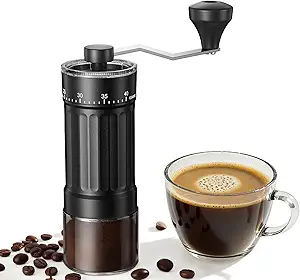 |
OVENTE Electric Coffee Grinder CG225W

| Capacity | 2.5 ounces |
|---|---|
| Wattage | 150 watts |
| Voltage | 120 volts |
| Material Type | Stainless Steel |
The OVENTE CG225W is a small, no-frills blade grinder that quickly turns whole beans, spices, or nuts into a usable grind with a single push-button pulse control. Its 150-watt motor and stainless steel blades pulverize beans fast, and the 2.5 oz stainless bowl is sized for one to two cups worth of coffee, making it useful for daily home brewing or occasional spice prep. The transparent lid with a safety lock lets you monitor texture while the ergonomic body and cord storage make it easy to handle and tuck away on a countertop. Cleanup is straightforward because the stainless interior wipes clean, though blade grinders do leave some uneven particle sizes compared with burr models and can heat beans slightly with extended runs. For the price and size, it is a convenient, versatile option for someone who wants quick grinding for drip or French press without complicated settings.
Best for: Buyers seeking a budget-friendly, compact grinder for daily single-cup or small-batch coffee and occasional spice or nut grinding who prioritize speed and simplicity over precision.
Less Ideal for: Those who need consistently uniform grind for espresso or who regularly make large batches of coffee should consider a larger burr grinder instead.
- Compact, countertop-friendly footprint with built-in cord storage
- 150W motor and sharp stainless steel blades grind quickly
- Transparent lid with safety lock for easy monitoring
- Stainless steel grinding bowl is easy to wipe clean
- Versatile for coffee, spices, herbs, and small batches of nuts
- Blade grinder yields less uniform grind than burr grinders
- Small 2.5 oz capacity limits batch size for larger households
Verdict: A fast, compact, and inexpensive blade grinder that delivers everyday convenience for small-batch coffee and spice grinding under $20.
Capresso Cool Grind Coffee Grinder 505.01

| Capacity | 3.5 ounces |
|---|---|
| Wattage | 150 watts |
| Power Source | Corded-Electric |
| Material Type | Stainless Steel |
The Capresso Cool Grind is a simple, no-frills blade grinder built for everyday use at home. It uses a stainless steel grinding chamber and blades driven by a 150-watt motor to grind up to 3.5 ounces of whole beans or dried spices in one batch, making it useful for drip makers, French press and percolators. Practical touches include a clear lid to monitor grind consistency, cord storage under the base, and a fast-stopping blade for safer handling. Because it is a blade grinder it produces medium-to-coarse and variable particle sizes rather than uniform burr-style grounds, so it is best for brew methods that tolerate some inconsistency. The compact ABS housing and modest footprint keep it easy to store on the counter. For buyers prioritizing simple performance on a budget, this delivers quick results and multi-purpose use, but it will not match the grind control or consistency of higher-end burr grinders.
Best for: Buyers seeking an affordable, compact grinder that reliably produces fresh grounds for drip, French press, and percolator brewing and who prioritize quick, everyday performance over precision.
Less Ideal for: Users who need consistently uniform, very fine grinds for espresso or specialty brewing should choose a burr grinder instead.
- Stainless steel grinding chamber and blades reduce heat for better aroma preservation
- Compact 3.5-ounce capacity handles enough beans for multiple cups in one batch
- Clear lid lets you watch and stop grinding at desired consistency
- Cord storage under the base keeps countertop tidy
- Fast-stopping blade improves safety after use
- Blade design yields less uniform grind compared with burr grinders
- Limited fine-grind control for espresso or very precise brewing methods
Verdict: A budget-friendly, compact grinder that delivers fast, multi-purpose grinding for everyday coffee and spices when consistent burr-level precision is not required.
Wancle Electric Coffee Grinder

| Capacity | 60 g |
|---|---|
| Wattage | 150 |
| Voltage | 120 volts |
| Power Source | AC adapter |
The Wancle Electric Coffee Grinder is a small one-touch blade grinder intended for home use when you need quick, fresh grounds for drip coffee or to chop spices and seeds. It holds up to 60 g of beans and uses a 150W motor with stainless steel blades and a transparent lid so you can watch grind consistency; the manufacturer emphasizes short bursts of grinding (generally under 15 seconds) to reach the desired fineness. Practical touches include a cleaning brush and a simple press-to-run control that makes it easy to use for single-serve or small batch work, and the compact footprint saves counter space. Because it is a blade grinder, grind uniformity will not match a burr grinder and it is best for brewed coffee methods that tolerate some particle variation rather than espresso. The unit runs on 120V AC and is marketed as durable with a pure copper motor, though heavy daily use or large-volume grinding will push its limits. For buyers who want a low-cost, space-saving way to get fresher grounds than pre-ground coffee, this is a straightforward, usable option.
Best for: Buyers looking to upgrade from pre-ground coffee who want a cheap, compact grinder for single-serve or small-batch brewing and occasional spice chopping.
Less Ideal for: Users who need very consistent grind size for espresso or who regularly grind large volumes should consider a burr grinder or a higher-capacity model.
- Compact footprint that fits small kitchens and saves counter space
- One-touch operation and transparent lid for simple, visible grinding
- Stainless steel blade and 150W motor handle coffee, spices, and seeds
- Includes cleaning brush for easier maintenance
- Blade grinding produces less uniform particle size than burr grinders
Verdict: A no-frills, space-saving blade grinder that delivers quick, fresh grounds for small-batch brews at a very low cost.
Lovskoo Coffee Grinder

| Wattage | 200 watts |
|---|---|
| Capacity | 4.2 ounces |
This compact Lovskoo grinder is a budget-friendly blade grinder geared toward quick, small batches of coffee, spices, or herbs. It uses a 200W motor and dual stainless-steel blades to grind up to the 4.2-ounce capacity in seconds, operated by a simple push-to-run lid so you control grind time manually. Safety features include automatic shutoff for overheating and a lid interlock that stops the motor when opened. The unit is lightweight and easy to store, and the stainless interior and removable lid make it straightforward to empty and rinse. Expect coarse-to-fine powder determined by how long you hold the lid down rather than preset grind settings, and blade grinders generally produce less uniform particle size than burr models, which matters for precision coffee brewing. For occasional single-cup grinding, spice blends, or baby food prep, this delivers fast convenience at a low cost, but it is not aimed at espresso‑level consistency or large-volume daily roasting workflows.
Best for: Buyers who want the cheapest practical electric grinder for occasional single-cup coffee, spices, or quick food prep and value simple, fast operation over precision.
Less Ideal for: Users who need consistent, repeatable grind sizes for pour-over or espresso routines or who regularly grind large volumes should consider higher-end or burr-style options.
- Powerful 200W motor for rapid grinding
- Stainless steel dual blades and inner chamber for food-safe contact
- Simple push-to-run lid makes operation intuitive
- Automatic overheat and lid-interlock protection for safety
- Compact footprint that stores easily in small kitchens
- Blade design yields less uniform grind compared with burr grinders
- Small 4.2 oz capacity limits use to single cups or small spice batches
Verdict: A no-frills, low-cost electric grinder that delivers fast single‑cup and spice grinding for budget-focused buyers.
Proctor Silex Fresh Grind 80301PS

| Capacity | 45 g |
|---|---|
| Wattage | 150 watts |
| Voltage | 120 volts |
| Power Source | AC adapter |
The Proctor Silex Fresh Grind is a straightforward, no-frills blade grinder that makes quick work of whole beans and small spices. You operate it by pressing the top button to grind and releasing to stop, and a lid interlock keeps it from running unless the lid is locked, which reduces accidental starts. Its stainless steel blades and 150-watt motor handle single cups up to a full 12-cup batch in the 45 g chamber, making it useful for daily coffee or occasional spice grinding. Cleanup is simple because the small plastic body and removable chamber are easy to wipe, though the chamber is not reported as dishwasher-safe on this listing. Expect an uneven grind compared with burr grinders, so it is best for drip and French press rather than precision espresso; it also produces some noise typical of small blade units. Given its compact footprint and proven, durable construction, it is a practical, budget-focused grinder for everyday home use.
Best for: Buyers who prioritize a dependable, easy-to-use grinder for everyday brewed coffee or occasional spice grinding and want a low-maintenance, long-lasting basic appliance.
Less Ideal for: Users who need precise, uniform grinds for espresso or large households that frequently grind big batches should consider a different grinder.
- Simple one-button operation with a safety interlock to prevent accidental starts
- Stainless steel blades and a 150-watt motor for reliable basic performance
- Grinds enough coffee for a single cup up to a full 12-cup pot
- Compact, easy-to-clean body that fits small kitchens or countertop storage
- Blade design gives inconsistent particle size compared with burr grinders
- Small 45 g capacity may require multiple batches for larger households
Verdict: A reliable, compact blade grinder that delivers simple, durable daily performance for brewed coffee and spice grinding under $20.
Amazon Basics Electric Coffee Grinder CG9402

| Capacity | 2.1 ounces |
|---|---|
| Voltage | 120 volts |
| Material Type | Stainless Steel |
This Amazon Basics electric coffee grinder is a no-frills blade grinder designed for quick small-batch grinding. It handles about 2.1 ounces (roughly 30 grams) and can produce a drip-coffee grind in around 10 seconds, making it useful for single-cup or two-cup brewing. The stainless steel grinding blade and clear safety lid make operation simple and let you watch consistency as you pulse. Because it is a blade grinder, particle size is less uniform than a burr grinder, so it works best for coarse to medium grinds for drip, French press coarse, or for grinding spices and herbs. The unit is compact and easy to store, and its straightforward on-off/pulse use is beginner friendly. Key limitations are the small capacity and the inherent inconsistency of blade grinding, so expect some fines and variability if you need precision for espresso or pour-over. For the price and size, it is a durable, practical choice for occasional grinders and spice use.
Best for: Shoppers who want an inexpensive, easy-to-use grinder for occasional single-cup coffee or for grinding spices and herbs and who value quick results over precision.
Less Ideal for: People who routinely brew for large groups or require very consistent grind size for espresso or specialty pour-over brewing should choose a burr grinder instead.
- Quick single-batch grinding suitable for 1-2 cups
- Heavy-duty stainless steel blade for efficient chopping
- Clear safety lid lets you monitor grind progress
- Compact footprint that stores easily on counters or in cabinets
- Blade design yields less consistent particle size than burr grinders
- Small 2.1-ounce capacity limits larger batches
Verdict: A compact, reliable blade grinder that delivers fast single-batch grinding and practical spice use at a very low price.
CEVING Mini Manual Coffee Grinder MCG-01

| Capacity | 30 g |
|---|---|
| Material Type | Ceramic |
| Power Source | manual winding |
| Adjustable Settings | 40 |
The CEVING Mini Manual Coffee Grinder is a portable hand mill designed to give you consistent small-batch grinds without power. It uses ceramic conical burrs and an external adjustment ring with 40 settings so you can dial in grinds for espresso, pour-over, French press, and similar methods. The unit breaks down into a few pieces for easy brushing and maintenance, and its 30 g bean chamber is sized for one or two cups—handy for travel, camping, or office use. Because it is manually operated it produces minimal heat and preserves flavor better than blade grinders, though it requires more time and elbow grease than an electric model. The compact build and low weight make it genuinely portable but also limit capacity and continuous use; if you need larger batches or very fast grinding an electric household grinder is a better choice. For buyers wanting a low-cost, reliable manual option that still offers fine adjustment, this grinder delivers predictable performance and straightforward upkeep.
Best for: Buyers seeking a dependable, low-cost manual grinder for travel or occasional home use who prioritize adjustable grind control and flavor preservation over speed.
Less Ideal for: Users who regularly grind larger quantities, want hands-free fast grinding, or need an appliance for busy household use should choose an electric grinder instead.
- 40 external grind settings for fine-tuning across brew methods
- Ceramic conical burrs that produce uniform grinds and reduce heat
- Compact, lightweight design suited to travel and single-serve grinding
- Detachable construction for simple brushing and cleaning
- 30 g capacity limits batch size to one or two cups
- Manual operation is slower and requires physical effort compared with electric grinders
Verdict: If you want an inexpensive, portable manual grinder with precise 40-step adjustment for better-tasting small batches, this is a solid choice.
Choosing the Right Coffee Grinder: Key Factors to Consider
Grind Consistency and Adjustment
How uniformly a grinder breaks coffee beans affects extraction and flavor. Even on a strict budget, look for units that offer multiple grind settings or stepped adjustments so you can fine-tune for drip, pour-over, or coarser methods like French press.
Inconsistent particle size leads to over- or under-extraction, which will be noticeable even with fresh beans. For grinders under $20, accept that perfection is unlikely, but prioritize models that minimize fines and offer repeatable settings so you can replicate a preferred profile session to session.
Ease of Cleaning and Maintenance
Regular cleaning prevents stale oils and grounds from building up and affecting flavor. Choose a grinder that disassembles without tools or with minimal parts to access the grinding chamber and blades or burrs.
Materials that resist residue buildup and parts that rinse or brush clean quickly make maintenance less of a chore. For budget grinders, the ability to reach crevices and remove trapped grounds is more important than fancy self-cleaning claims.
Build Materials and Durability
Lower-priced grinders often use more plastic and lighter metals. Prioritize solid construction at stress points such as the adjustment mechanism, lid, and motor housing if electric, or the crank and shaft if manual.
Metal contact surfaces or reinforced plastics at load-bearing points extend service life. Consider how the grinder will be handled daily and whether replacement parts or simple repairs are feasible. A sturdier feel usually correlates with longer useful life even at a lower price.
Capacity and User Convenience
Capacity matters for how often you need to grind. Small-capacity grinders are fine for single cups but become tedious for larger batches. Check the usable bean or ground capacity versus your typical brew size.
Convenience features like clear markings, one-handed operation, consistent dosing, and a secure lid improve the user experience. Inexpensive models vary in how thoughtfully they balance capacity and ergonomics, so pick one that suits how you brew daily.
Noise, Vibration, and Practical Use
Noise and vibration affect where and when you can grind. Budget electric grinders often run louder and vibrate more than higher-end models; manual grinders are quieter but require more effort.
Consider whether you need a quieter unit for early mornings or an apartment setting. Also think about how stable the grinder sits during use. Excessive vibration can reduce grind uniformity and make the device harder to control.
Power Source and Portability
Decide between manual and electric options based on where and how often you grind. Manual grinders are portable, quiet, and avoid electrical issues, while electric units save time and effort for larger volumes.
For travel or occasional use, compact, battery-free manual grinders are attractive. For daily, larger-volume use, low-cost electrics that provide consistent rotation and adequate motor protection are more practical even within a tight budget.
Manual Vs Electric on a Budget
Manual grinders at this price point tend to offer better control over particle size per dollar and are quieter and more portable. They are a good choice if you brew single servings or travel and are willing to spend a little effort for each cup.
Electric options save time and are convenient for multiple cups, but low-cost electrics can be noisier and sometimes less consistent. If you choose electric, prioritize models with a simple, secure lid and a stable base to reduce vibration and uneven grinding.
- Manual: quiet, portable, lower maintenance, requires physical effort
- Electric: faster, better for larger batches, watch for vibration and noise
Cleaning Routines That Improve Flavor
Establish a quick daily shake or brush-out after each use and a more thorough monthly clean where you disassemble accessible parts. Even inexpensive grinders benefit significantly from regular removal of fines and oils.
Avoid soaking parts that contain adhesives or non-waterproof bearings. Use a small brush, a dry cloth, and, where safe, a quick rinse of removable cups and lids. Proper cleaning keeps even budget grinders performing closer to their potential.
- Daily: brush or shake out loose grounds
- Weekly: wipe accessible surfaces and inspect seals
- Monthly: disassemble and deep-clean removable parts where possible
Matching Grind Setting to Brewing Method
Different brewing styles require different particle sizes. Even inexpensive grinders should let you dial in a setting suitable for your preferred method. For drip and pour-over, aim for a medium-fine to medium grind. For French press, choose a coarser setting.
When settings are coarse or too fine, adjust in small steps and test with taste. Because budget grinders may have stepped adjustments rather than continuous micro-adjustment, note which step corresponds to your preferred extraction and stick with it to ensure repeatability.
- French press: coarse grind
- Pour-over: medium-fine to medium
- Drip automatic: medium
Small Upgrades That Extend Lifespan
Simple maintenance such as keeping the burr area free of oil buildup and avoiding overfilling the hopper can noticeably extend life. Using a short burst for electric units rather than continuous long runs prevents overheating.
For manual grinders, occasionally check the crank and shaft connection for wear and tighten fasteners if needed. Treating a budget unit with basic care reduces the chance of early failures and keeps performance stable over months of use.
- Avoid overfilling to reduce strain on the motor or crank
- Clean regularly to prevent abrasive buildup
- Operate in short intervals for electric models to avoid heat
What to Expect From Grinders Under $20
Grinders at this price are designed to provide functional grinding with reasonable durability for light daily use. Expect compromises in materials, fewer grind settings, and less refined noise control compared with higher-priced alternatives.
That said, careful selection can yield a dependable unit that delivers acceptable grind uniformity for common home brewing methods. Focus on build quality at key points, ease of cleaning, and how the grinder fits into your morning routine.
- Limited adjustments but usable settings for common brews
- More plastic components and simpler motors or mechanisms
- Good candidates for casual brewers or as a backup/portable option
How We Chose the Best Coffee Grinder
We focused on realistic expectations for grinders priced under $20 and used concrete, category-specific filters to identify products that deliver the most usable performance for the money. Primary evaluation criteria included grind consistency across settings, ease of cleaning and maintenance, mechanical durability of parts, and everyday usability such as capacity and noise level. We also considered how well each grinder performs for common brewing methods that budget buyers use, like drip, French press, and pour-over. Products were excluded if they lacked clear adjustment settings, had materials or fastener issues commonly reported for early failure, or did not provide enough usable capacity for a single- or two-cup brew. We favored grinders with straightforward disassembly for cleaning and durable contact materials for the burrs or blades. The final list represents items that balance workable grind quality with simple upkeep and reasonable construction for under $20.
Our full evaluation process is outlined in our review methodology.
FAQ
Can a grinder under $20 produce a consistent grind for pour-over coffee?
Often it can produce an acceptable pour-over grind, but consistency will vary. Look for models with repeatable adjustment steps and a stable grinding mechanism. Expect more fines and a wider particle distribution than higher-end units.
Are manual grinders better than electric ones at this price point?
Manual grinders are typically quieter and more consistent per dollar, especially for single cups. Electric grinders are faster for larger batches but may sacrifice noise and uniformity at lower prices.
How often should I clean a budget coffee grinder?
Brush or shake out loose grounds after each use, wipe accessible surfaces weekly, and perform a deeper disassembly clean monthly where parts allow. Regular cleaning helps preserve flavor and component life.
Will a cheap grinder damage my coffee beans or affect flavor permanently?
A budget grinder can alter flavor through inconsistent particle size or retained old oils, but it will not permanently damage beans. Proper cleaning and using fresh beans minimize negative effects.
What is the best way to reduce noise from an electric budget grinder?
Place the grinder on a thick, stable surface or a silicone mat to damp vibration, and avoid overloading the hopper. Short burst operation can also reduce prolonged loud running.
Final Verdict
For buyers seeking a Coffee Grinder under $20, prioritize models that deliver the most repeatable grind settings, simple cleaning access, and solid construction at stress points. Accepting some tradeoffs in adjustment range and noise will let you focus on practical benefits such as maintenance ease and usable capacity. Choose the unit that matches how you brew most often. If you value silence and portability, a manual grinder is a sensible pick. If you need speed for multiple cups, an electric model with a stable base and straightforward maintenance will serve you best.