
Note: This article contains affiliate links. If you click on these links and make a purchase, we may earn a small commission at no extra cost to you. This helps support our research and content. Read our full affiliate disclosure here.
Picking the right coffee grinder with ceramic burrs matters because grind consistency and heat control are the foundation of better extraction and flavor. Whether you brew espresso, pour-over, or French press, ceramic burrs can help keep grounds uniform while resisting wear. This guide presents seven shortlisted grinders that prioritize stable particle size, low retention, and practical cleanup. Below you will find concise evaluations and a clear explanation of the criteria we used, plus buying factors to match a grinder to your routine and brew method.
Top Picks at a Glance
| Best Overall The best all-around choice for most situations | Hario Skerton Pro |  |
| Best Quality Built to a higher standard if you want something more solid | Baratza Forte AP |  |
| Best Value The sweet spot between price and what you get | LHS Manual Coffee Grinder |  |
| Best Budget The cheapest option that still gets the job done reliably | Rsoilch Manual Coffee Grinder HS-011 |  |
| Top Rated A top-rated pick with lots of positive feedback | Hario Mini Mill Slim MSS-1B |  |
| Most Popular A crowd favorite that many people choose with confidence | CEVING Mini Manual Coffee Grinder | 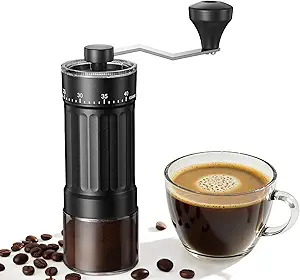 |
| Best Seller A high-volume bestseller chosen again and again | CEVING Manual Coffee Grinder MCG-MEGA-60 |  |
Hario Skerton Pro

| Capacity | 100 g |
|---|---|
| Material Type | Ceramic, Glass, Stainless Steel |
| Power Source | Manual |
The Hario Skerton Pro is a hand coffee mill that uses ceramic conical burrs to deliver an even grind across a wide range of settings, making it suitable for filter, pour-over, and French press brewing. It is used by removing the detachable crank, loading beans into the glass hopper, and turning the handle to produce up to about 100 g of grounds in a single session. Notable features include a reinforced grind shaft and improved adjustment screw for steadier, more consistent grinding, a heat-proof glass bowl that is fully washable, and an anti-slip grip for stability during use. Because it is manual, it is quiet, portable, and requires no power, which is handy for travel or small kitchens. The trade-offs are the physical effort and time needed for larger batches and the slower throughput compared with electric grinders, but the Skerton Pro delivers a durable, precise grind quality for someone who values control and low-heat grinding over speed.
Best for: Buyers who want a durable, travel-friendly manual grinder that emphasizes flavor-preserving ceramic burr grinding and precise control rather than speed.
Less Ideal for: People who need fast, hands-off grinding for large daily volumes or who prefer the convenience of electric grinders.
- Ceramic conical burrs provide uniform, low-heat grinding for better flavor
- Adjustable grind settings cover a wide range for different brew methods
- Reinforced grind shaft and improved handle increase durability and stability
- Glass hopper is washable and holds about 100 g for multiple cups
- Detachable crank and compact design make it portable for travel
- Manual operation is slower and requires more effort than electric grinders
- Not ideal for very large batches due to limited capacity and hand grinding
Verdict: Choose the Skerton Pro if you want a sturdy, flavor-focused manual ceramic-burr grinder that gives precise, low-heat grinds and travels well.
Baratza Forte AP

| Burrs | 54 mm flat ceramic |
|---|---|
| Capacity | 10 ounces hopper |
| Power | 130 watts |
| Voltage | 120 volts |
The Forte AP grinds for espresso through coarser brew methods using 54 mm flat ceramic burrs that deliver consistent, precise particle size with minimal heat transfer. Its compact metal body and small footprint make it suitable for counter use in small cafes or serious home setups, and you can dose by time or by weight thanks to the grounds bin and portaholder for direct portafilter grinding. The control panel offers macro and micro adjustment so you can fine-tune extraction, and the grinder's speed is adequate for moderate volume—espresso at about 2 g/sec and filter at roughly 3.5 g/sec. Practical benefits include durable construction, quiet-running ceramic burrs that resist corrosion, and a hopper large enough for daily use. Important limitations are the modest grounds bin capacity if you need high-throughput service and a price point and feature set aimed more at prosumers and commercial users than casual drinkers.
Best for: Buyers who prioritize grind consistency and precise control for espresso and specialty brew methods and want a compact, durable grinder suitable for serious home or small commercial use.
Less Ideal for: Casual coffee drinkers who only make occasional coffee or need a very large-capacity, high-throughput machine should consider simpler, lower-cost grinders.
- 54 mm flat ceramic burrs for consistent, low-heat grinding
- Compact commercial-grade metal chassis with small countertop footprint
- Weight-based and time-based dosing options plus portaholder for direct-to-portafilter use
- Fine macro and micro grind adjustment for precise dialing in extraction
- Grounds bin capacity is limited for high-volume commercial use
- Designed for prosumer/commercial use so it may be more than needed for casual home drinkers
Verdict: Choose the Forte AP if you want a compact, commercial-quality ceramic-burr grinder that delivers precise, low-heat grinding for serious espresso and specialty brewing.
LHS Manual Coffee Grinder

| Material Type | Stainless Steel |
|---|---|
| Power Source | manual |
| Specific Uses For Product | Coffee Grinder |
| Recommended Uses For Product | Grinding |
This handheld grinder uses a ceramic conical burr and a stainless steel hand crank to grind coffee beans by hand for drip, pour-over, espresso and French press brewing. You set coarseness with an adjustable rotor under the hopper and turn the crank to produce a consistent grind without heat buildup that can dull flavor. The body and burr are positioned for portability and everyday use: it is lightweight, easy to disassemble for filling and rinsing, and sturdy enough for travel or office use. Practical benefits include quiet, electricity-free operation and a ceramic burr that resists wear and reduces friction heat. Limitations are inherent to manual mills — grinding larger quantities takes time and effort, and achieving perfectly uniform espresso-fine grinds requires patience and careful adjustment. Overall it is a straightforward, durable choice when you want control over grind size and prefer a non-electric, portable grinder.
Best for: Buyers who prioritize flavor preservation, portability, and precise manual control over grind size for home brewing and travel use.
Less Ideal for: People who need to grind large daily volumes quickly or who want a fully automatic, hands-off grinder should look at electric models instead.
- Ceramic conical burr reduces heat and wear for cleaner flavor preservation
- Adjustable grind rotor lets you go from coarse to fine for multiple brew methods
- Stainless steel construction and hand crank feel durable and portable
- Manual operation is quiet and requires no power so it is travel-friendly
- Manual grinding is slow for larger batches
- Achieving ultra-fine, uniform espresso grind can be challenging without careful adjustment
Verdict: A small, durable manual grinder that preserves bean flavor with a ceramic burr and gives precise adjustable control without electricity.
Rsoilch Manual Coffee Grinder HS-011

| Capacity | 30 g |
|---|---|
| Included Components | Ceramic Burr, Stainless Steel Body |
| Material Type | Ceramic, Plastic |
This handheld grinder uses a ceramic conical burr and 40-step adjustment to produce consistent grounds for espresso, pour-over and French press. You operate it by hand with the included crank so it requires no power, making it useful for travel, camping, or small kitchens; the low-noise design keeps operation quiet. The clear glass grounds jar collects up to about 25–30 g of ground coffee and lets you monitor progress to stop at the right point, while the stainless-steel body and ABS components keep the unit lightweight and durable. The precision burr preserves oils and flavor better than blade grinders, and the many grind settings let you dial in finer or coarser textures. Limitations are its small capacity and manual effort, which make it less convenient for brewing for large groups or for users who prefer an electric model, and ceramic burrs can chip if handled roughly.
Best for: Buyers who want a low-cost, portable grinder that makes noticeably better grounds than a blade mill and are comfortable grinding by hand for single-serve brewing and travel.
Less Ideal for: People who regularly brew for groups, need high daily throughput, or prefer push-button electric convenience should choose a larger electric grinder instead.
- Ceramic conical burr delivers uniform grounds that preserve flavor
- 40 adjustable grind settings cover espresso through French press
- Compact, lightweight, and power-free for travel and camping
- Clear glass grounds container lets you watch and measure grinding
- Small 25–30 g capacity requires multiple batches for several cups
- Manual operation is slower and requires physical effort compared with electric grinders
Verdict: An affordable, portable ceramic-burr manual grinder that gives better, adjustable grounds than blades and is ideal for solo brewers and travel.
Hario Mini Mill Slim MSS-1B

| Capacity | 2 cups |
|---|---|
| Material Type | Ceramic |
| Power Source | Manual |
The Hario Mini Mill Slim is a hand crank coffee grinder built around a ceramic burr for consistent, rust-free grinding at home. It is used by filling the small hopper, adjusting grind size with the knob, and turning the handle to produce enough grounds for one to two cups. The slim profile and removable handle make it easy to store and take on trips, and the transparent grounds container helps you see and measure output. Ceramic burrs resist corrosion and stay sharp for many uses, producing a clean taste compared with cheaper blades. Because it is manual, grinding is quiet and requires no power, but it is slower than electric grinders and best suited to single-serve or small household use rather than high-volume brewing. The compact design disassembles for straightforward cleaning, though the limited 2-cup capacity and manual effort mean it is not ideal for brewing for large groups or for users who prefer push-button convenience.
Best for: Buyers who prioritize reliable, long-lasting grind quality and want a compact manual grinder for daily single-cup or small-batch brewing.
Less Ideal for: People who routinely grind large amounts, need fast electric operation, or prefer one-touch convenience should look at electric burr grinders instead.
- Durable ceramic burr that resists rust and preserves flavor consistency
- Slim, space-saving design with removable handle for easy storage
- Transparent grounds container lets you monitor yield and dosing
- Manual operation is quiet and does not require electricity
- Small 2-cup capacity limits batch size
- Manual grinding is slower and requires physical effort for larger quantities
Verdict: Choose the Hario Mini Mill Slim when you want a compact, reliable ceramic-burr manual grinder that delivers consistent small-batch results.
CEVING Mini Manual Coffee Grinder

| Material Type | Ceramic |
|---|---|
| Capacity | 30 g |
| Power Source | manual winding |
The CEVING Mini Manual Coffee Grinder is a portable hand grinder built for small, precise batches. It uses ceramic conical burrs and an external 40-step adjustment ring to deliver a wide range of grind sizes for espresso, pour-over, and French press. You operate it by manual winding, which keeps heat low and preserves flavor but requires a little elbow grease for finer grinds. The 30 g bean hopper is sized for one or two cups, making the grinder suited to travel, camping, or single-serve home use. It disassembles into a few parts for straightforward cleaning with the included brush, though the manufacturer advises against rinsing with water. Notable benefits are the stable ceramic burrs and the fine-grain control provided by external adjustments, while limitations include the small capacity and slower manual operation compared with electric grinders. Build and finish look consistent with similarly priced manual mills and the portable form factor makes it easy to pack for trips.
Best for: Buyers who prioritize consistent ceramic-burr grinds in a small, portable package and who value peer-reviewed performance over feature hype.
Less Ideal for: Households that need to grind large batches quickly or users who prefer the convenience and speed of an electric grinder.
- Ceramic conical burrs for more uniform grind and reduced heat
- 40 external grind settings for precise control across brew methods
- Compact, lightweight design suited for travel and single-cup grinding
- Detachable three-part design for easy assembly and dry cleaning
- Only 30 g capacity limits it to one or two cups per grind
- Manual winding is slower and more effortful than electric grinders
Verdict: Choose this grinder if you want a travel-ready ceramic-burr mill with fine external grind control for reliably brewed single cups.
CEVING Manual Coffee Grinder MCG-MEGA-60

| Capacity | 60 g |
|---|---|
| Material Type | New Model |
| Power Source | manual winding |
| Number of Settings | 40 external settings |
The CEVING MCG-MEGA-60 is a hand-powered burr grinder built for people who want precise, consistent grinds without electricity. It holds up to 60 g of beans—about double the capacity of typical travel grinders—so you can grind for multiple cups or coarser methods like French press in one session. The ceramic conical burrs reduce heat transfer and preserve coffee oils, and the external click-ring offers 40 distinct settings so you can quickly switch between espresso-fine and coarse grounds with tactile feedback. Because it is manually operated, it is quiet, portable, and usable anywhere from the kitchen to campsite. Expect a bit more effort when grinding larger volumes compared with electric grinders, and the hand crank means grind speed is moderate rather than instantaneous. The body and parts appear durable for daily use, though maintenance and occasional recalibration are part of ownership. For buyers focused on flavor fidelity and control, this grinder delivers lab-style adjustments in a compact, travel-ready package.
Best for: Buyers who prioritize consistent flavor and precise grind control but want a low-risk, easy-to-understand manual tool for home or travel use.
Less Ideal for: Those who need one-touch speed for daily large-volume brewing or who prefer fully automated electric grinders for convenience should consider electric options instead.
- Generous 60 g capacity reduces the need for multiple grinds
- 40 external click-settings let you dial grind size quickly and repeatably
- Ceramic conical burr preserves flavor by minimizing heat and metal contact
- Portable and manual so it works without power and is quiet in use
- Manual operation requires physical effort and is slower than electric grinders
- Larger capacity and moving parts may require occasional cleaning and maintenance
Verdict: If you want a portable, flavor-focused manual grinder with industry-leading external adjustment and a large hopper, this CEVING model is a reliable choice.
Choosing the Right Coffee Grinder with Ceramic Burrs: Key Factors to Consider
Grind Consistency and Particle Distribution
Uniform particle size is the single most important factor for predictable extraction and balanced flavor. Ceramic burrs are known for holding sharp edges longer than some alternatives, which helps maintain consistent grind size across many sessions. When evaluating consistency, consider the grinder's ability to produce tight particle distribution at both fine and coarse settings.
Consistency affects clarity, body, and extraction rate. For espresso you need a narrow particle distribution at very fine settings, while for immersion methods you want even coarse particles to avoid over-extraction. Look for evidence of both stepped or stepless adjustment and repeatable settings so you can return to a preferred grind reliably.
Burr Material Longevity
Ceramic burrs resist corrosion and often remain sharp longer than softer materials, which translates to longer intervals between replacements and stable performance over time. However, ceramic can chip if struck by hard foreign objects, so hopper screens and bean inspection remain important.
Consider whether the grinder allows easy burr replacement and whether replacement burrs are straightforward to source. Long-life burrs reduce total ownership hassle and help maintain consistent results without frequent recalibration.
Heat Management and Motor Load
Heat generated during grinding can change the coffee's flavor by warming oils and causing volatile loss. Ceramic burrs typically run cooler than some alternatives, but motor design, burr diameter, and throughput also influence heat buildup. For heavy daily use or dosing multiple shots consecutively, look for grinders with larger burrs or slower RPMs that reduce heat transfer.
Also consider duty cycle limits and whether the manufacturer provides guidance on continuous use. Adequate ventilation and motor cooling help protect both the beans and the burr geometry from thermal stress.
Adjustment Range and Repeatability
A useful grinder must cover the range of grind sizes you need with fine control and the ability to return to set points. Stepped systems give quick, repeatable stops for common settings, while stepless systems allow micro-adjustments for dialing in espresso. The best choice depends on your brew methods and how precise you need to be.
Repeatability is equally important. Features such as numbered rings, detents, or digital presets help you reproduce a setting day to day, which speeds workflow and consistency in a routine.
Capacity, Dosing, and Hopper Design
Hopper size and dosing method influence convenience and freshness. A larger hopper is useful if you brew for multiple people, but it also increases the volume of beans exposed to air. Transparent or lockable hoppers help manage freshness and prevent spillage.
Dosing options range from timed grinders to weight- or dose-by-hand systems. Consider whether you need single-dose flexibility, a doser cup, or a direct-to-portafilter chute, and how hopper design affects ease of refilling and cleaning.
Ease of Cleaning and Maintenance
Regular cleaning keeps flavors bright and prevents stale residue buildup. Look for grinders with easy access to the burr chamber and removable components that can be wiped or brushed without tools. Minimal retention and straightforward disassembly speed daily upkeep.
Maintenance considerations include how simple it is to realign parts after cleaning, whether brushes are provided or recommended, and how the design prevents oil and fines from accumulating in hard-to-reach places.
Matching Burr Size and RPM to Your Brew Method
Burr diameter and rotational speed change how quickly beans are ground and how much heat is introduced. Larger burrs typically grind faster with less heat for a given setting, which helps preserve aroma and oils during larger-volume sessions. Smaller burrs can still produce excellent results but may require shorter dose cycles or cooling breaks when grinding many doses back to back.
For home espresso, prioritize grinders that deliver fine, consistent particles with precise adjustment. For pour-over and drip, a broader adjustment range and good coarser performance matter more. For French press and cold brew, look for grinders that produce uniform coarse particles without excessive fines.
- Larger burrs = faster grind, lower heat per gram
- Smaller burrs = often more affordable, may need pauses for heavy use
- Consider rpm and motor cooling for frequent dosing
Practical Dosing Workflows
Think about how you like to dose: direct to portafilter, into a grounds bin, or single-dose by weight. A direct-to-portafilter chute speeds espresso routines but may need adapters for different basket sizes. Grounds bins or catch cups work well for manual methods and make it easier to measure by weight.
If you prefer weight-based dosing, ensure the grinder integrates cleanly with a scale or has an accurate timed setting that matches your typical dose. Single-dosing strategies reduce stale beans in the hopper but add an extra step at each use.
- Direct dosing suits fast espresso workflows
- Grounds bins help with batch brew and pour-over prep
- Single dosing preserves freshness but takes more time
Noise, Footprint, and Countertop Considerations
Noise levels vary by motor type, housing, and burr speed. If you brew early in shared spaces, prioritize quieter designs or place the grinder on a soft mat to damp vibration. Consider the physical footprint and how the hopper, chute, and grounds bin will fit on your counter or storage area.
Also check for stable footing and materials that resist coffee oil staining. A compact grinder that balances capacity and noise may be preferable for small kitchens.
- Look for dampening feet or compact housings for small counters
- Quieter motors improve early-morning usability
- Larger bases often provide more stability for portafilter work
Durability and Long-Term Ownership Costs
Durability stems from build materials, burr longevity, and how easy it is to replace wear parts. Ceramic burrs typically reduce the frequency of replacements, but consider whether the grinder's mechanical parts and bearings are serviceable. A straightforward parts supply and user-replaceable components reduce long-term ownership headaches.
Also evaluate warranty terms and how clearly the manufacturer documents maintenance tasks. A grinder that is easy to service will retain consistent performance longer and lower the risk of sudden failures.
- Serviceable bearings and replaceable burrs extend life
- Clear maintenance access reduces downtime
- Sturdy housings withstand regular daily use
Cleaning Routine Tips for Ceramic Burr Grinders
Establish a regular brushing and vacuuming routine to remove fines and oils from the burr chamber and chute. Use a soft brush to avoid damaging ceramic edges and remove the hopper to clear residual grounds. Periodic deeper cleaning may require removing the burrs per manufacturer instructions.
Avoid harsh chemicals. A dry brush and, when recommended, a manufacturer-approved cleaning pellet can restore flow without risking burr damage. Reassemble carefully and check alignment if your grinder requires it.
- Brush daily or after heavy use
- Perform deep cleaning monthly or as needed
- Use manufacturer-approved cleaning tools when available
How We Chose the Best Coffee Grinder with Ceramic Burrs
We focused on attributes that directly affect the brewing result and the grinder's long-term utility. Primary evaluation criteria included grind consistency across multiple settings, burr durability and material benefits, and how effectively the grinder controls heat buildup during extended use. We also assessed user-facing practicalities such as hopper capacity and dosing mechanisms, ease of cleaning and maintenance, and noise and build quality for daily use. Products were excluded if they lacked stepped or stepless adjustment sufficient for common brew methods, had unclear burr material claims, or demonstrated poor retention and cleaning access in user documentation. We prioritized grinders that balance consistent particle distribution with accessible maintenance and durable ceramic burr geometry. The final list reflects models that meet those performance and usability thresholds across typical home brewing scenarios.
Our full evaluation process is outlined in our review methodology.
FAQ
Are ceramic burrs better than steel for home use?
Ceramic burrs resist corrosion and often hold their edge longer than some steel options, which can be beneficial for long-term consistency. Ceramic can be more brittle, so careful handling and good hopper screening are important to avoid chipping.
How often should I clean a ceramic-burr grinder?
Light brushing is useful after each use or daily for heavy users. A deeper cleaning that includes removing the burrs is typically done monthly or when you notice buildup affecting flow or taste.
Can ceramic burrs handle oily or flavored beans?
Ceramic handles oils well but flavored beans can leave residues that increase cleaning needs. Regular maintenance prevents buildup and preserves both flavor clarity and burr performance.
Do ceramic burrs produce more static or retention?
Static and retention depend on grinder design, chute geometry, and environmental humidity as much as burr material. Some ceramic setups show lower heat and stable particle flow, but retention varies by model and chamber design.
Is burr replacement difficult with ceramic grinders?
Replacement difficulty varies by design. Many home grinders allow user replacement with simple tools and clear instructions, while others may require professional servicing. Check serviceability before purchasing if ease of replacement matters to you.
Final Verdict
Prioritize grind consistency, adjustment range, and maintenance access when choosing a coffee grinder with ceramic burrs. Balance the burr size and motor design against how much daily throughput you expect and the brew methods you use. If you value long-term stability and cooler grinding, ceramic burrs are a sensible choice, but also plan for routine cleaning and occasional burr inspection. Decide first on the grind range and dosing workflow you need, then use the other factors to narrow options. That approach helps you select a grinder that delivers reliable, repeatable results and fits your daily routine.