
Note: This article contains affiliate links. If you click on these links and make a purchase, we may earn a small commission at no extra cost to you. This helps support our research and content. Read our full affiliate disclosure here.
If you run a busy cafe or need a heavy-duty grinder for high-volume service, picking the right commercial coffee grinder matters. A grinder shapes the flavor profile, controls extraction, and must keep pace during rush hours without overheating or clogging. This guide highlights seven carefully shortlisted commercial coffee grinders that meet professional demands. We focus on real-world factors like grind consistency, hopper and dosing capacity, motor durability, and serviceability. Read on to see which options match your throughput needs and workflow, and which features to prioritize before you buy.
Top Picks at a Glance
| Best Overall The best all-around choice for most situations | AMZCHEF Flat Burr Coffee Grinder FC6202 |  |
| Best Quality Built to a higher standard if you want something more solid | Baratza Forte AP Grinder |  |
| Best Value The sweet spot between price and what you get | Huanyu Commercial Flat Burr Grinder |  |
| Best Budget The cheapest option that still gets the job done reliably | Tuni G3 64mm Flat Burr Grinder |  |
| Top Rated A top-rated pick with lots of positive feedback | Flyseago Commercial Burr Grinder LSN-06 |  |
| Most Popular A crowd favorite that many people choose with confidence | LOYALHEARTDY Conical Burr Grinder BI-751 |  |
| Best Seller A high-volume bestseller chosen again and again | Flyseago Commercial Burr Grinder LSN-32 |  |
AMZCHEF Flat Burr Coffee Grinder FC6202

| Burr size | 64mm flat burrs |
|---|---|
| Grind settings | 90 settings |
| Motor power | 200 watts |
| Capacity | 9.88 ounces |
| Voltage | 120 volts |
The AMZCHEF FC6202 is a heavy-duty home/entry-level commercial grinder built around 64mm flat burrs and a 200W DC motor to deliver consistent, fine-to-coarse grinds across 90 stepped settings. It is used for pulling espresso as well as drip, pour-over, and coarse methods, and the large flat burrs and metal chamber aim to produce uniform particles and reduced heat transfer for cleaner extraction. The touch LED panel with a 0.1-second timer and +/- controls makes dosing repeatable and convenient for one-dose workflows, and the included magnetic dosing cup and angled stainless exit help keep grounds contained. The all-metal housing and anti-static system target durability and a tidier counter compared with plastic-bodied grinders. Expect a relatively heavy, solid unit that reduces vibration and looks substantial on the counter, but plan for buying a 58mm portafilter separately if you want to grind directly into a portafilter. This grinder is positioned for users who want a commercial feel and precise dosing without stepping up to professional price points.
Best for: Buyers who want a durable, near-commercial grinder that delivers precise, repeatable dosing and can handle espresso to coarse brew methods as they upgrade their home setup.
Less Ideal for: Casual coffee drinkers who only need occasional coarse grinds or those who need a compact, lightweight grinder for limited counter space.
- Large 64mm flat burrs for tighter, more uniform grind particle distribution
- 90 stepped settings covering espresso through French press for dialed-in flexibility
- All-metal chamber and stainless steel body for reduced vibration and improved durability
- Triple anti-static features and magnetic dosing cup minimize flyaway grounds and counter mess
- LED touch panel with 0.1-second timer enables precise, repeatable single-dose dosing
- Does not include a portafilter so direct-to-portafilter grinding requires buying a 58mm portafilter separately
- Relatively heavy and substantial footprint may not suit very small kitchens
Verdict: A solid, metal-built grinder with 64mm flat burrs and precise digital dosing that gives home users a commercial-style grinding experience.
Baratza Forte AP Grinder

| Wattage | 130 watts |
|---|---|
| Voltage | 120 volts |
| Capacity | 10 ounces |
The Baratza Forté-AP is a compact commercial grinder built for consistent, high-quality grinding across brew methods from espresso to press pot. It uses 54 mm flat ceramic burrs that deliver precise particle distribution and a steady grind rate suitable for busy counters, and it supports dosing by time or by weight plus a portafilter holder for direct dosing. The metal construction and small footprint make it durable and easy to fit into a cafe or office workflow, while the intuitive control panel and macro/micro adjustment let a trained operator dial in grind size quickly. Practical benefits include accurate dosing options for repeatable shots and a grounds bin for batch grinding when not dosing directly to a portafilter. Limitations are its focus on commercial use rather than consumer convenience features and the higher upfront cost that accompanies a commercial-grade unit.
Best for: Buyers who prioritize reliable, consistent grind quality for commercial or high-volume brewing and need a compact, durable grinder that can handle multiple brew methods.
Less Ideal for: Home users who want a low-cost, simple grinder for occasional use or those who prefer consumer conveniences like fully automatic dosing features.
- 54 mm flat ceramic burrs provide precise, consistent grind for multiple brew methods
- Supports both timed dosing and weight-based dosing for repeatable results
- Compact commercial metal construction with a small footprint for busy counters
- Intuitive control panel with macro and micro adjustments for fine tuning
- Designed for commercial use so it lacks consumer-focused convenience features
- Higher initial cost compared with domestic home grinders
Verdict: A compact commercial grinder that delivers precise, repeatable grinds for cafes and high-volume settings where performance matters most.
Huanyu Commercial Flat Burr Grinder

| Burr type | 64mm SUS420 stainless steel flat burr |
|---|---|
| Hopper capacity | 35 oz |
| Wattage | 400 watts |
| Dosing modes | Time-based and manual |
The Huanyu Commercial Flat Burr Grinder is built to deliver consistent, shop-style grounds for espresso and other brew methods. It uses a 64mm SUS420 stainless steel flat burr and a large 35oz light-block hopper to handle extended runs without frequent refills. Operation is straightforward: touchscreen controls with time-based dosing for single or double shots plus a manual dosing option, and an adjustable portafilter holder for stable grinding into baskets. The grinder's vertical anti-static outlet and included silicone film help reduce mess and clumping, and the one-touch dosing makes busy service practical. Expect robust performance for medium-to-high volume settings thanks to a 400W motor and a 3.5 g/sec dispensing rate, but fine-tuning beyond the eight-step adjustment may be limited for extreme micro-adjustments sought by precision espresso techs. Build appears utilitarian with plastic housing and a stainless burr, so factory-quality parts like the burr are the key durability points rather than premium finishes. Overall this grinder is aimed at small cafes or serious home baristas who need reliable, repeatable dosing without complex setup.
Best for: Buyers who need a dependable, high-throughput grinder for a small cafe or dedicated home barista station and prioritize consistent dosing and low-maintenance operation.
Less Ideal for: Users seeking top-tier micrometric grind adjustment or a premium all-metal aesthetic should consider higher-end commercial grinders with finer stepless adjustments.
- Large 35oz light-block hopper reduces refill frequency and preserves bean freshness
- 64mm SUS420 stainless steel flat burrs for uniform grounds and improved extraction
- Dual dosing modes (time-based and manual) with one-touch operation for quick, repeatable shots
- Anti-static vertical outlet and spare silicone film minimize clumping and countertop mess
- Adjustment system uses eight coarse steps which may not satisfy users seeking very fine grind calibration
- Plastic exterior suggests less premium fit and finish compared with higher-end commercial grinders
Verdict: A practical, high-capacity grinder that delivers consistent shop-style dosing and low-mess operation for small commercial use or serious home setups.
Tuni G3 64mm Flat Burr Grinder

| Burr type | 64mm flat stainless steel |
|---|---|
| Grind settings | 100 stepless settings |
| Capacity | 250 g (large hopper) + 50 g (single-dose hopper) |
| Wattage | 260 watts |
| Voltage | 120 volts |
The Tuni G3 is built like a small commercial grinder for home or light café use, using 64mm flat stainless steel burrs and a 260W motor to deliver consistent, fast grinds across a wide range of brew methods. It offers 100 grind settings via a stepless adjustment ring and an LED touchscreen with programmable single-shot, double-shot and continuous grind times in 0.5-second increments, which makes dialing in doses straightforward. Two bean hoppers—one large 250 g and one small 50 g single-dose hopper—let you switch between bulk grinding and single-origin experiments without emptying the main hopper. The grinder also uses an anti-static system to reduce mess and a portafilter holder that fits 51–58 mm baskets for espresso work. Practical limitations include the grinder's weight and footprint for tight home counters and that full commercial-duty cafés may prefer heavier-duty motors or service plans, but for strong performance at this price point it covers espresso through coarse methods reliably.
Best for: Buyers who need near-commercial grind performance on a budget and want a versatile grinder capable of espresso and coarser brews while allowing single-dose testing and repeatable dosing.
Less Ideal for: Large-volume coffee shops that require industrial-duty continuous operation and on-site service contracts should consider commercial-rated grinders instead.
- Large 64mm flat burrs for consistent, fast grinding and reduced heat buildup
- Stepless 100-setting grind adjustment for fine dialing from espresso to French press
- Programmable LED touchscreen with single/double shot and 0.5s timing for repeatable doses
- Dual hoppers (250 g + 50 g) support bulk use and single-dose flexibility
- Anti-static system keeps grounds from clinging and reduces countertop mess
- Relatively heavy and tall compared with compact home grinders, so it needs counter space
- Not positioned as a full commercial service-grade grinder for high-volume café use
Verdict: If you want commercial-style grind consistency and programmable dosing on a budget, the Tuni G3 delivers versatile, cafe-ready performance without commercial pricing.
Flyseago Commercial Burr Grinder LSN-06

| Wattage | 400 watts |
|---|---|
| Capacity | 2.2 pounds |
| Voltage | 110 volts |
| Power Source | AC adapter |
This Flyseago grinder is built for steady, high-volume grinding where consistency and low maintenance matter. Its 64mm stainless steel flat burrs and 18 grind settings deliver repeatable particle size from espresso to French press, while the anti-static silicone pad reduces mess and bean waste. The touch-control panel with dose timing makes single or double dosing straightforward for busy service or morning routines, and the 35oz hopper minimizes refills during peak periods. The 400W motor and aluminum construction feel substantial and aimed at commercial workloads, and the manufacturer highlights quieter operation and reduced heat to protect flavor. It is straightforward to clean with included brush and removable hopper components, though the unit is large and heavy compared with consumer grinders, so counter placement and service access should be planned. For operators who need reliable, repeatable grinds in an office, cafe, or serious home setup, this grinder focuses on durability and practical controls rather than compact design or lightweight portability.
Best for: Operators who prioritize dependable, repeatable grinding and low-maintenance workflow in cafes, offices, or busy home kitchens where uptime and consistent extraction matter most.
Less Ideal for: Buyers who need a compact, lightweight grinder for occasional travel or those who require ultra-fine stepless adjustments for advanced specialty espresso dialing.
- Large 64mm stainless steel flat burrs for consistent particle size and reduced heat
- Anti-static silicone pad reduces countertop mess and wasted grounds
- 35oz hopper capacity cuts down on frequent refills in busy settings
- Touch-control panel with dose timing for quick single/double dosing
- Robust 400W motor and aluminum build aimed at commercial durability
- Relatively heavy and bulky, requiring dedicated counter space
- Only 18 grind settings may limit ultra-fine incremental adjustments for some specialty setups
Verdict: Choose this grinder when you need a durable, commercial-capable machine that delivers consistent, low-mess grinds for high-volume use.
LOYALHEARTDY Conical Burr Grinder BI-751

| Wattage | 350 watts |
|---|---|
| Voltage | 110 volts |
| Burrs diameter | 64 mm |
| Bean hopper capacity | 1.2 kg |
This LOYALHEARTDY BI-751 is a heavy-duty conical burr grinder aimed at commercial or high-volume home use. Its cast aluminum body and 64 mm hardened steel burrs are built to withstand frequent grinding while the 350 W motor spins at about 1400 RPM to deliver steady output. The large 1.2 kg hopper and 200 g dispenser let you dose multiple shots or batches without constant refilling, and the micro-adjust table provides finer control over grind size for espresso to coarser brews. In practice it handles continuous runs reasonably well and the wider dosing range makes it useful for busy cafes or serious home baristas who pull many shots. Limitations include a relatively heavy industrial footprint and the need to follow safety cautions when adjusting settings or cleaning—parts are not intended to be submerged. Also, some users may find the controls and dosing mechanism less refined than higher-end specialty grinders, so it performs best where robustness and capacity matter more than quiet operation or ultra-precise retail-level dosing.
Best for: Buyers who need a robust, high-capacity grinder for cafe service or heavy home use and prioritize durability and throughput over compact size or ultra-quiet operation.
Less Ideal for: Casual coffee drinkers with limited counter space or anyone seeking a compact, near-silent grinder with boutique-level dosing precision.
- Durable cast aluminum body built for heavy use
- Large 1.2 kg hopper and 200 g dispenser reduce refills during busy periods
- 64 mm hardened steel burrs provide consistent crushing for espresso-grade grounds
- Micro-adjust grind table gives practical control over grind size
- Industrial size and weight make it less suited to small counters or lightweight home kitchens
- Not designed for immersion cleaning; maintenance requires careful handling
- Controls and dosing are functional but less refined than premium specialty grinders
Verdict: Choose this grinder when you need a tough, high-capacity conical burr unit that can handle continuous commercial-style grinding reliably.
Flyseago Commercial Burr Grinder LSN-32
| Wattage | 300 watts |
|---|---|
| Capacity | 1 kg |
| Voltage | 110 volts |
| Material Type | Stainless Steel |
| Power Source | AC adapter |
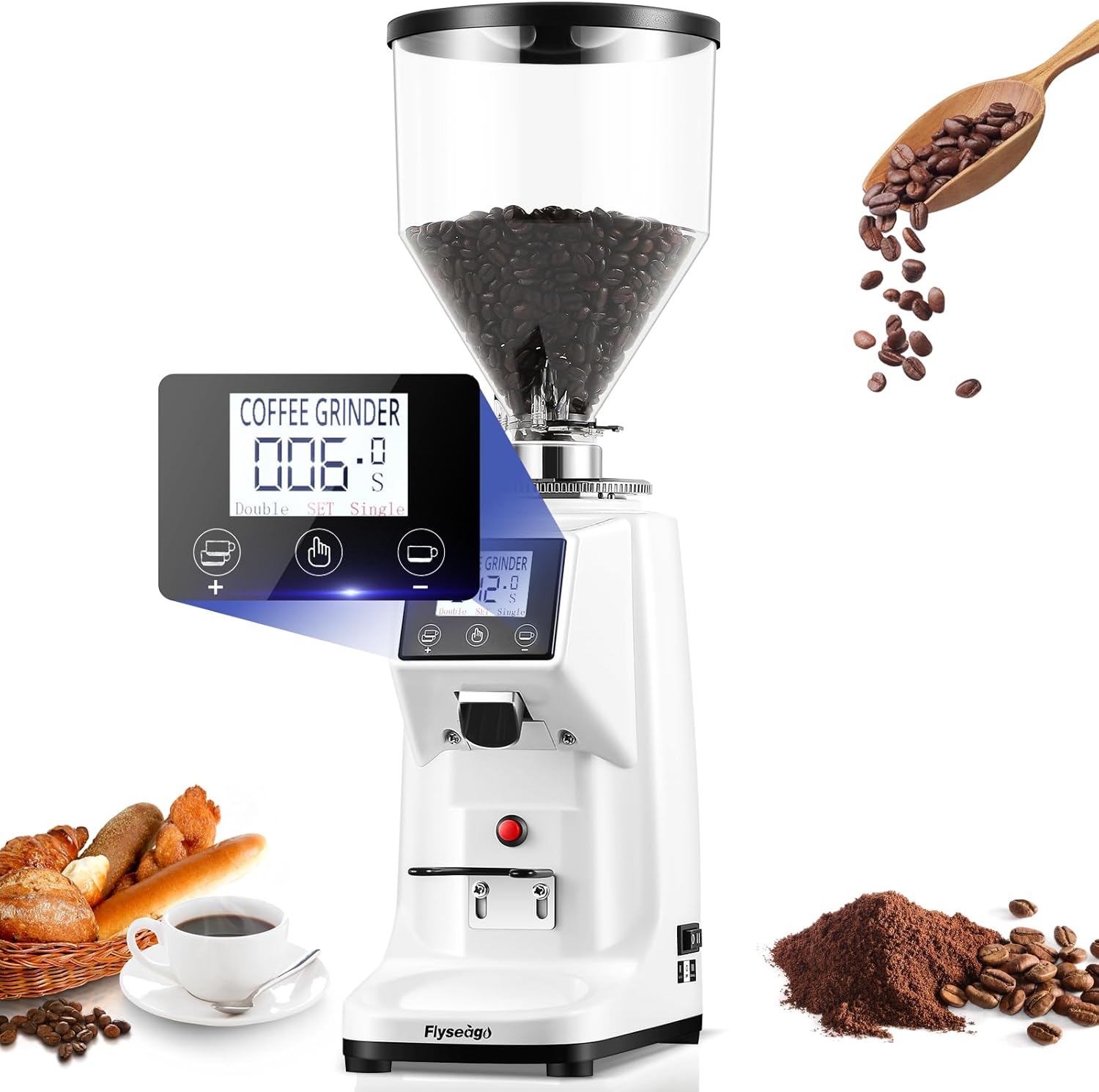
The Flyseago LSN-32 is a heavy-duty burr grinder built for cafe and commercial environments but sized for serious home use as well. It uses 64mm stainless steel flat burrs and a 300W motor to deliver consistent grinds across 19 settings, and the digital touch display allows dosing adjustment in 0.1 second increments for repeatable single or double doses. The detachable 35oz hopper and bean baffle make it easy to load and run larger batches, while a closeable funnel door and anti-clump/anti-static design help channel grounds into a portafilter or container with less mess. Built-in overload protection and stainless steel construction speak to durability for frequent use, and the product notes low-noise operation and tools for cleaning. Limitations to consider are that this is a purpose-built commercial-style grinder so it is heavier and larger than consumer countertop models and may be more machine than needed for casual, infrequent brewing; some users will also prefer stepless adjustments for micro-tuning espresso rather than 19 preset steps.
Best for: Buyers who want a reliable, durable grinder for a small cafe, office, or home barista setup and prioritize consistent dosing and high daily throughput.
Less Ideal for: Casual coffee drinkers who only grind small amounts infrequently or anyone needing a compact, lightweight countertop grinder for limited space.
- Large 35oz removable hopper supports high-volume grinding without constant refills
- 64mm stainless flat burrs and 19 grind settings for consistent results across brew methods
- Digital touchscreen dosing with 0.1s increments enables repeatable single or double doses
- Stainless steel construction and overload protection suit frequent commercial use
- Commercial footprint and weight make it less convenient for small kitchens or occasional users
- Grind adjustments use indexed settings rather than a continuous stepless dial preferred by some espresso tuners
Verdict: Choose this grinder when you need a rugged, repeatable commercial-grade grinder that delivers consistent dosing and high-volume performance.
Choosing the Right Commercial Coffee Grinder: Key Factors to Consider
Grind Consistency and Particle Distribution
Consistent particle size is the single most important factor for reliable extraction. Uniform grinds reduce channeling in espresso and yield cleaner cups for filter brewing. Look for grinders with burr geometries and manufacturing tolerances that minimize fines and large particles across the full adjustment range.
In practice, a grinder that holds a stable particle distribution across repeated doses will produce more predictable shots and less wasted product. Consider models with stepped or stepless adjustments depending on how precisely you need to dial in espresso recipes and whether multiple baristas will be adjusting the grind during service.
Throughput and Heat Management
Throughput matters when volume peaks occur. A grinder must move sufficient coffee per minute without overheating the beans or the burrs. Machines designed for continuous duty typically have larger burrs, stronger motors, and cooling strategies that preserve grind quality during extended runs.
Heat from excessive speed or poor ventilation can alter flavor by warming beans mid-grind. For commercial use, prioritize grinders with rated throughput that matches your busiest periods and features that mitigate heat buildup, such as low-RPM gearing or ventilation paths that remove motor heat.
Hopper Size and Dosing Options
Hopper capacity affects how often staff need to refill beans during service. Larger hoppers reduce interruptions but take up more counter space and increase exposure to light and air for stored beans. Evaluate both the physical size and whether the hopper is designed for easy removal and cleaning.
Dosing controls determine how consistently you deliver coffee to portafilters, batch containers, or airpots. Look for straightforward programmable dosing, manual override, or weight-based options when precision is required. The right combination will speed service while keeping dose variability low between baristas.
Burr Type and Material
Burrs come in different materials and profiles that affect sharpness retention and heat transfer. Steel burrs are durable and common in commercial grinders, while ceramic burrs can retain sharpness and transfer less heat but may be more brittle. The burr diameter also correlates with throughput and consistency; larger burrs generally produce more uniform grinds at higher rates.
Consider the ease and cost of burr replacement since commercial grinders will require periodic service. Machines that use widely available burrs or have modular burr carriers make maintenance faster and reduce downtime.
Serviceability and Ease of Cleaning
Daily cleaning and periodic maintenance should be straightforward for commercial equipment. Easy access to burrs, simple disassembly procedures, and clear maintenance intervals reduce the time staff spend on upkeep and lower the risk of service errors. Look for grinders with cleaning-friendly hoppers, removable doser chambers or chutes, and parts that can be cleaned without tools where possible.
Detail-level support matters too. Machines with clear documentation, replaceable wear items, and easy access to service parts will stay in service longer and cost less to maintain across years of heavy use.
Controls, Interface, and Workflow Integration
The grinder interface affects how efficiently staff operate during busy shifts. Intuitive controls, programmable presets, and clear indicators reduce training time and dose errors. Consider whether the grinder supports single-dose workflows or timed dosing for high-throughput environments.
Integration with existing workflows includes physical fit, location of the chute or portafilter cradle, and whether the grinder can be mounted or locked down for safety. A well-matched interface will speed service and minimize interruptions.
Understanding Burr Geometry and What It Means
Burr geometry defines how coffee is cut and impacts particle distribution and heat. Conical and flat burrs each have tradeoffs: conical burrs often excel at lower-speed, flavorful milling while flat burrs can produce very uniform particle sizes at higher throughput. The profile, surface finish, and cutting angle influence how quickly burrs blunt and how they handle oily or flavored beans.
When evaluating grinders, consider how burr shape matches your cafe's priorities. If you aim for precision espresso extraction at steady volume, look for burrs and drive systems designed to sustain consistent performance across long service periods.
- Conical vs flat: different extraction and throughput characteristics
- Burr diameter correlates with capacity and uniformity
- Replaceable burr modules minimize service downtime
Matching Grinder Capacity to Your Service Model
Estimate peak beans-per-hour and choose a grinder whose rated throughput meets or exceeds that demand. A grinder undersized for your busiest hour will create queues and inconsistent shots as it overheats or chokes. Conversely, an oversized grinder can be wasteful on low-volume days and consume more counter space.
Think in terms of both continuous pounds-per-hour and dose-per-shot. For cafes with many short espresso orders, fast dosing and a reliable portafilter cradle help maintain speed. For batch-brew or single-origin filter programs, steady medium-to-low speed grinding may be preferable.
- Calculate peak hourly demand before selecting throughput
- Balance hopper size against refill frequency and freshness
- Consider dual-grinder setups for mixed workflows
Workflow Tips to Extend Burr Life
Routine habits can extend burr life and preserve grind quality. Use whole beans that are free of debris, avoid running flavored beans with high sugar content through the same burrs used for plain single-origin coffees, and follow recommended cleaning intervals to prevent buildup. Gentle, regular backflushing of the grinder where applicable reduces residue.
Rotate burr replacement on a predictable schedule based on daily volumes rather than waiting for obvious wear. Documenting hours of operation and maintenance tasks helps predict when components need replacing and reduces unexpected downtime.
- Avoid flavored beans on the same burrs as plain coffees
- Schedule burr inspections and replacements based on use
- Keep a small inventory of common wear parts for quick swaps
Installation, Footprint, and Counter Considerations
Commercial grinders vary widely in footprint and mounting requirements. Measure counter depth and height to ensure the grinder fits comfortably with surrounding equipment and that the hopper clears overhead shelves. Consider how the grinder's placement affects the barista's movement between machine, grinder, and cash register.
Noise and vibration also matter in customer-facing spaces. Look for models with vibration-dampening feet or options to secure the grinder to the counter. Proper installation improves ergonomics and reduces long-term wear on both the grinder and surrounding equipment.
- Confirm vertical clearance for the hopper and lid
- Plan for vibration and noise mitigation in front-of-house
- Leave room for routine maintenance access
Safety and Electrical Requirements
Commercial grinders can require specific electrical ratings and dedicated circuits. Check the power requirements and ensure your setup provides stable voltage and appropriate grounding. Improper electrical provision can reduce motor lifespan and create safety hazards.
Also consider guarding and safety interlocks for high-speed rotating parts. Choose grinders with well-designed covers and switches that prevent accidental contact during operation or cleaning.
- Verify voltage and circuit capacity before installation
- Look for clear safety guards and accessible switches
- Ensure compliance with local electrical and safety codes
How We Chose the Best Commercial Coffee Grinder
We selected grinders based on performance metrics that matter most in commercial settings. Primary filters were grind consistency across settings, sustained throughput without heat-related degradation, and motor durability for long daily run times. We also prioritized hopper and dosing configurations that support cafe workflows, ease of maintenance for busy back-of-house staff, and serviceability including parts access and standard replaceable components. Excluded from consideration were consumer-grade domestic grinders, models rated for light home use, and units lacking documented duty-cycle specifications. We focused on grinders with proven burr designs and materials suitable for high-volume milling. Key evaluation criteria included repeatable particle-size distribution, continuous-duty motor thermal management, user controls for dosing and grind adjustment, hopper capacity and refill ergonomics, and accessibility for routine cleaning and burr replacement. These criteria guided selection and ensured each pick is appropriate for professional operations.
Our full evaluation process is outlined in our review methodology.
FAQ
How often should I replace commercial grinder burrs?
Burr replacement frequency depends on daily volume and bean type. High-volume cafes often replace burrs every 6 to 12 months, while lower-volume operations can stretch that interval. Inspect burr sharpness and particle distribution regularly and plan replacement based on measured decline in consistency rather than a fixed calendar date.
Can I use the same grinder for espresso and filter coffee?
It is possible but not ideal. Switching between very fine espresso settings and coarser filter settings can require frequent recalibration and may prolong wear. Many shops use separate grinders or dedicated burr sets to preserve flavor clarity and speed up workflow.
What maintenance tasks should staff perform daily?
Daily tasks typically include emptying and cleaning the hopper, brushing out the chute and dosing chamber, and wiping external surfaces. Regular light cleaning prevents buildup that affects grind distribution and dosing accuracy. Deeper cleaning and burr inspection can be scheduled weekly or monthly depending on use.
How important is hopper size for freshness?
Hopper size balances convenience and freshness. Larger hoppers reduce refill interruptions but can expose more beans to air and light, speeding staling. For high-volume operations, a larger hopper is often appropriate because beans turn over quickly. For lower-volume or specialty shops, smaller hoppers or frequent refilling helps preserve bean freshness.
What should I look for in grinder controls for a busy cafe?
Prioritize intuitive dosing options, programmable presets for common doses, and straightforward grind adjustment mechanisms. Controls that allow quick manual overrides and clear feedback reduce errors during rush periods. Durable, tactile buttons and clear displays help when staff are working quickly.
Final Verdict
Choosing a commercial coffee grinder is about matching capacity, consistency, and serviceability to your operation. Prioritize grind consistency and throughput that align with peak demand, and pick burrs and materials that are maintainable and replaceable. Consider how hopper size, controls, and physical footprint integrate with your workflow to minimize downtime and dosing errors. Balance the tradeoffs between raw capacity and precision. For busy cafes, durability and easy maintenance often outweigh marginal differences in tuning. Use the evaluation criteria here to select a grinder that delivers dependable results day after day.