
Note: This article contains affiliate links. If you click on these links and make a purchase, we may earn a small commission at no extra cost to you. This helps support our research and content. Read our full affiliate disclosure here.
If you brew espresso by hand or use a home espresso machine, the grinder you pair with it has an outsized effect on shot quality. A good manual coffee grinder for espresso gives you precise, repeatable adjustments and a fine, uniform particle distribution that helps with extraction, crema, and taste. These picks focus on durability, grind consistency at espresso settings, and ergonomics for daily use. The shortlist includes the top manual coffee grinders vetted for espresso-level performance and real-world usability. Read on to see which features matter most and how we evaluated the options before the product list.
Top Picks at a Glance
| Best Overall The best all-around choice for most situations | TIMEMORE Chestnut C3S Pro |  |
| Best Quality Built to a higher standard if you want something more solid | 1Zpresso K-Ultra Manual Grinder |  |
| Best Value The sweet spot between price and what you get | ALPACA VENTURES Manual Coffee Grinder AV 1 | 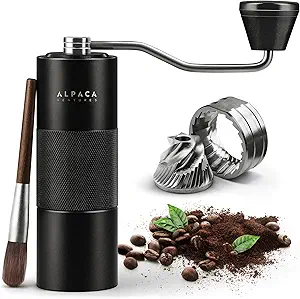 |
| Best Budget The cheapest option that still gets the job done reliably | CEVING Mini Manual Coffee Grinder | 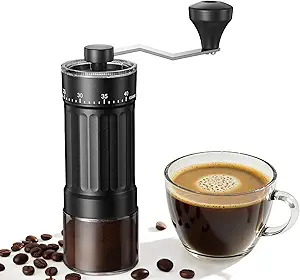 |
| Top Rated A top-rated pick with lots of positive feedback | TIMEMORE C5 ESP Pro Manual Grinder | 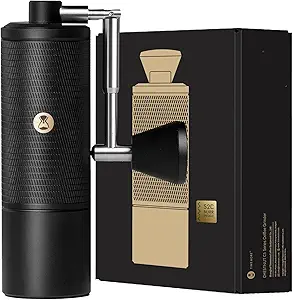 |
| Most Popular A crowd favorite that many people choose with confidence | JavaPresse Manual Coffee Grinder |  |
| Best Seller A high-volume bestseller chosen again and again | CEVING Manual Coffee Grinder MCG-02 | 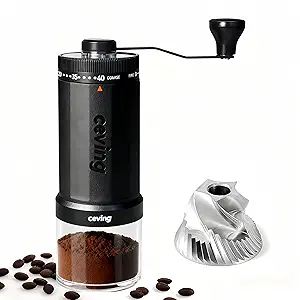 |
TIMEMORE Chestnut C3S Pro

| Capacity | 25 g |
|---|---|
| Power Source | manual |
The TIMEMORE Chestnut C3S Pro is a compact, all‑metal manual coffee grinder built around TIMEMORE's S2C conical steel burr and a double bearing central axis. You use it by loading up to about 25 g of beans, setting one of roughly 36 stepless grind positions, and turning the foldable crank; the built construction and bearings make grinding noticeably smooth and relatively low effort. The upgraded S2C660 steel burrs are CNC machined for consistent particle size, which helps when dialing in for espresso and other fine grinds, and the aluminum alloy body resists cracking and dissipates heat. Practical touches include a fold‑away handle for travel and easy disassembly for cleaning. Limits to consider are the small 25 g capacity—so it is best for single shots or travel rather than high‑volume cafe use—and manual operation means extra time and effort compared with electric grinders when making multiple espresso shots back to back.
Best for: A buyer who wants a durable, travel‑friendly manual grinder capable of producing consistent fine grinds for single‑shot espresso and precise home dialing.
Less Ideal for: If you need to grind large batches, prepare multiple back‑to‑back espresso shots, or want a fully automated workflow, an electric grinder is a better choice.
- All‑metal aluminum alloy body for durability and better heat dissipation
- S2C steel conical burrs with CNC machining for consistent grind size suitable for fine espresso settings
- Double bearing central axis and smooth rotation reduce hand effort
- Foldable crank handle improves portability and storage
- Stepless adjustment with about 36 levels for precise grind control
- Small 25 g bean capacity limits usefulness for multiple consecutive shots or group brewing
- Manual operation is slower and requires physical effort compared with electric espresso grinders
Verdict: Buy this if you want a durable, portable manual grinder that can deliver consistent fine grinds for single‑shot espresso sessions.
1Zpresso K-Ultra Manual Grinder

| Burr material | Stainless steel |
|---|---|
| Burr size | 48 mm |
| Adjustment | External dial, 100+ clicks (~20 microns per click) |
| Capacity | 35–40 g catch cup |
| Power source | Manual |
The 1Zpresso K-Ultra is a metal-bodied hand grinder built to deliver very fine, consistent grounds for espresso while still covering pour-over and other methods. It uses a 48mm stainless steel conical K-burr and an external adjustment dial that offers over 100 clicks with roughly 20 micron steps, so you can make small, repeatable changes when dialing in a shot. The magnetic catch cup holds about 35–40 g of grounds and snaps on for a tidy workflow, and the foldable handle and included travel case keep it compact for transport. Tool-free disassembly and the included brush and air blower make cleaning straightforward, and the burr is factory-calibrated for long-term stability. At the same time, it is a manual grinder, so grinding larger doses or daily heavy-volume espresso prep will be slower than electric options, and the price positions it toward enthusiasts rather than casual users.
Best for: A home espresso enthusiast who wants a high-precision, portable manual grinder for careful dial-ins and occasional travel.
Less Ideal for: Users who need to grind large daily volumes quickly or prefer fully automatic, hands-free grinding solutions.
- 48mm stainless steel conical burr for consistent, espresso-capable grind
- External adjustment dial with 100+ clicks for precise micro-adjustments
- Magnetic catch cup and foldable handle improve workflow and portability
- Tool-free disassembly and included cleaning tools simplify maintenance
- Manual operation is slower for multiple or large-dose espresso shots
Verdict: Buy this if you want a durable, travel-ready manual grinder that gives the fine, repeatable adjustments needed to dial espresso precisely.
ALPACA VENTURES Manual Coffee Grinder AV 1

| Material Type | Aluminum, Stainless Steel |
|---|---|
| Power Source | Manual |
| Number of Items | 3 |
| Included Components | Brush |
This hand grinder uses stainless steel conical burrs and a lengthened stainless steel crank to deliver consistent, adjustable grounds without electricity. It is sized for portability and breaks down easily for cleaning, with a dual bearing design that reduces wobble and effort while turning. The adjustable dial lets you dial in fine settings for espresso and coarser settings for French press or drip, making it usable across brewing methods. Build materials emphasize durability — aluminum body, 420 stainless burrs, and a sturdy crank — so it feels solid in daily use and on trips. You get an included brush for maintenance and an interior bearing that lowers resistance during long grinds. Expect manually paced grinding: it is quieter and more energy efficient than grinders that require power, but grinding larger volumes by hand takes time and effort. The compact profile is great for single-cup or travel use but not ideal for heavy daily batch grinding in a busy household.
Best for: Buyers who prioritize control, durable construction, and portability for making espresso-quality shots by hand and who prefer optimizing grind precision over automated speed.
Less Ideal for: Users who routinely need to grind large quantities quickly or who prefer push-button electric convenience should look elsewhere.
- Stainless steel conical burrs for consistent grind and durability
- Adjustable grind dial suitable for espresso through French press
- Dual bearing and lengthened crank reduce effort and improve smoothness
- Easy to disassemble for cleaning and includes a brush for maintenance
- Compact, lightweight design made for travel and single-cup use
- Manual operation is slow for larger batch grinding
- Not suited to users who need fast, high-volume grinding
Verdict: Choose this grinder if you want a durable, travel-friendly manual grinder that delivers precise espresso-ready grinds without electricity.
CEVING Mini Manual Coffee Grinder

| Capacity | 30 g |
|---|---|
| Material Type | Ceramic |
| Power Source | manual winding |
The CEVING Mini Manual Coffee Grinder is a portable hand mill that uses ceramic conical burrs and an external ring with 40 adjustable settings to dial in grind size from fine to coarse. It is typically used for travel, camping, or small home-brewing sessions where you want freshly ground beans without electricity. The ceramic burrs help keep temperature down and produce a consistent grind that suits pour-over, French press, and finer settings for espresso-style brewing in small doses. Its 30 g bean capacity and lightweight construction make single-serve prep fast, and the grinder disassembles into a few parts for easy cleaning with the included brush. Trade-offs are its small capacity and manual operation, which make it less convenient for brewing larger batches or heavy daily espresso use, and the ceramic burrs can be slower than powered grinders when producing very fine espresso grinds.
Best for: Buyers on a tight budget who need a portable, precise manual grinder for single-serve espresso-style shots or occasional travel brewing.
Less Ideal for: Those who make daily multiple-shot espressos, need high throughput for a household, or prefer the speed and convenience of an electric grinder.
- 40 external grind settings let you precisely adjust grind size without disassembly
- Ceramic conical burrs produce uniform grinds with less heat buildup
- Compact, lightweight design is easy to pack for travel or camping
- Simple disassembly and included brush make maintenance straightforward
- 30 g capacity is small for multiple espresso shots or brewing for several people
- Manual winding is slower and more effortful than electric grinders for fine espresso grinds
Verdict: A budget-friendly, travel-ready manual grinder that gives surprisingly precise, low-heat grinds for single-shot espresso-style use.
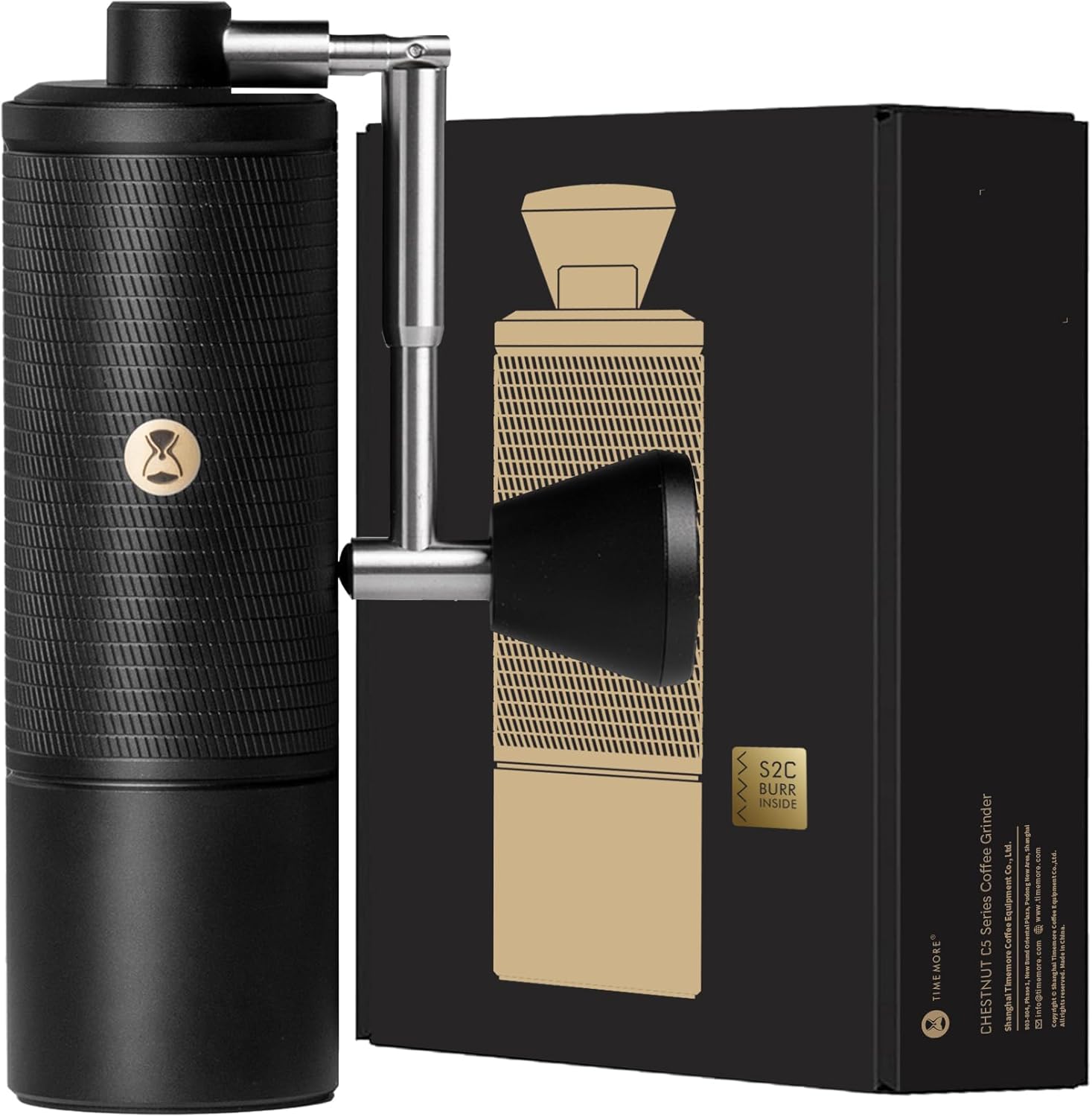
TIMEMORE C5 ESP Pro Manual Grinder
| Capacity | 25 g |
|---|---|
| Burr | S2C-042-III 42 mm stainless steel conical |
| Adjustment accuracy | 0.015 mm per click |
| Material Type | Aluminum |
| Power Source | manual winding |
The TIMEMORE C5 ESP Pro is a hand coffee grinder built for precision and daily reliability, aimed at espresso and other fine brews. It uses a patented S2C-042-III 42 mm stainless steel conical burr and a fine stepped adjustment that changes grind by roughly 0.015 mm per click, letting you dial in tight espresso settings or back off for pour-over and French press. The all-metal CNC-machined body and double-bearing central axis keep the shaft steady for uniform particle size, and the enlarged one-piece metal housing feels durable in regular use. Labor is reduced by a smooth bearing-loaded handle and an ergonomic 53 mm grip that makes repeated grinding easier. The 25 g hopper capacity and folding handle make it portable for travel or cafe use, and disassembly for brushing is straightforward. The main limitations are the modest capacity for multi-cup batches and the manual effort required for larger quantities, so it is best suited to single-serve or two-cup prep rather than high-volume grinding.
Best for: Buyers who prize consistent, repeatable espresso grinds and a durable, metal-built grinder for daily single-serve or small-batch use.
Less Ideal for: People who need to grind large volumes quickly or who prefer an electric grinder for hands-off, high-throughput brewing.
- High-precision adjustment at 0.015 mm per click for consistent espresso dialing
- Large 42 mm CNC stainless steel conical burrs for efficient, uniform grinding
- All-metal one-piece body and double-bearing axis for stable, durable performance
- Smooth, bearing-assisted handle and compact grip reduce effort and improve ergonomics
- Folding handle and easy disassembly make it portable and serviceable
- 25 g capacity limits batch size and requires multiple passes for larger servings
- Manual operation can be tiring for frequent large-volume grinding
Verdict: Choose the C5 ESP Pro if you want a compact, all-metal manual grinder that delivers repeatable, high-precision espresso grind control.
JavaPresse Manual Coffee Grinder

| Grind settings | 18 adjustable settings |
|---|---|
| Burr type | Ceramic conical burr |
| Power source | Manual |
| Material type | Stainless Steel |
The JavaPresse Manual Coffee Grinder is a portable hand-crank grinder that uses a ceramic conical burr and an adjustable mechanism with 18 grind settings to cover everything from espresso to coarser brew methods. You use the removable crank to rotate the burr assembly and collect ground beans in the lower chamber, which makes it well suited for travel, camping, or quiet home use where electric noise is a concern. The ceramic burr is marketed as durable and provides consistent particle size for better extraction, and the simple adjustment ring lets you dial in finer settings required for espresso. Being manual, it needs no power and is compact enough to pack in a bag, though grinding for multiple cups or very fine espresso doses requires more effort than an electric grinder. Build quality is stainless steel and the grinder is easy to disassemble for cleaning, but it lacks the speed and hands-off convenience of an electric espresso grinder.
Best for: Buyers who prioritize quiet, portable grinding and want a proven manual burr grinder with lots of social proof to dial in espresso-level fineness for single-serve or travel use.
Less Ideal for: People who grind for many cups daily or need rapid, repeatable dosing and speed for a busy home espresso setup should choose an electric grinder instead.
- Wide grind range with 18 settings suitable down to fine espresso-like grinds
- Ceramic conical burrs for consistent grind and long-lasting wear
- Portable, cordless design good for travel and camping
- Quieter operation than electric grinders due to manual crank
- Stainless steel construction that is simple to disassemble and clean
- Manual operation is slower and requires physical effort for fine espresso doses
- Not as fast or precise as dedicated electric espresso grinders for high-volume use
Verdict: Choose this grinder if you want a compact, well-reviewed manual burr that can be tuned for espresso-level grinds when portability and low noise matter.
CEVING Manual Coffee Grinder MCG-02

| Capacity | 60 g |
|---|---|
| Adjustable settings | 40 |
| Burr material | Stainless steel conical burrs |
| Item weight | 0.5 kg |
The CEVING MCG-02 is a hand grinder built for convenience and precision, notable for its unusually large 60 g bean capacity and an external 40-click grind dial that covers espresso to coarse settings. You load beans into the top and rotate the crank to grind directly into the collection chamber, making it useful for single shots or multiple espresso doses without repeating sessions. CNC stainless steel conical burrs provide consistent particle size and faster throughput than many small manual mills, while the external adjustment ring lets you change grind size quickly without disassembling the unit. Its size and weight make it travel friendly for camping or coffee on the go, and the larger hopper reduces interruptions during morning routines. Expect typical manual effort for fine espresso grinds; dialing in very fine settings takes steady cranking and occasional burr cleaning to maintain peak performance. Also keep in mind manual grinders are slower than electric grinders for high-volume use, and achieving absolute espresso-fine uniformity requires patience and trial adjustments.
Best for: Buyers who want a reliable, travel-capable manual grinder that minimizes refills and provides precise, repeatable grind control for dialing in espresso at home or on the road.
Less Ideal for: People who need fast, high-volume grinding or want a fully effortless espresso workflow should choose a compact electric grinder instead.
- Large 60 g capacity reduces the need for multiple grind sessions
- External 40-click adjustment makes switching grind sizes quick and repeatable
- CNC stainless steel conical burrs deliver uniform particle size for better extraction
- Portable and lightweight for travel, camping, or small kitchens
- Fine espresso grinding requires sustained manual effort and can be slower than electric grinders
- May need periodic disassembly and cleaning to prevent buildup and retain consistency
Verdict: Choose this grinder if you want a travel-friendly manual mill with a large hopper and precise external adjustment for consistent espresso dialing.
Choosing the Right Manual Coffee Grinder for Espresso: Key Factors to Consider
Grind Consistency and Particle Distribution
Uniform particle size is critical for espresso because uneven grounds lead to channeling and variable extraction. For a manual espresso grinder, look for burr geometries and alignment that produce a tight particle distribution at fine settings.
If the grinder churns out a lot of fines or oversized particles at espresso settings, you will see inconsistent shot timing and flavor. Consistent output reduces the amount of dialling-in required and helps you replicate shots day to day.
Adjustment Resolution and Repeatability
Espresso requires very small tweaks to grind size to dial in shot extraction. High-resolution stepless or finely notched stepped adjustments let you change the grind in tiny increments and lock settings reliably.
Repeatability matters: the adjustment mechanism should hold its position under load so your chosen setting stays the same between sessions. If you cannot return precisely to a prior setting, you will spend more time re-dialing than pulling shots.
Burr Material and Shape
Burrs make or break a grinder's longevity and grind quality. Hardened steel burrs are common and durable, while ceramic can hold sharpness but is more brittle. The burr profile—conical versus other shapes—affects flow and heat buildup.
For espresso, burrs that maintain sharp cutting edges and resist glazing at fine settings help preserve consistency. Consider whether the burrs are replaceable and how easy it is to source spares.
Ergonomics and User Comfort
Hand grinding for espresso can be physically demanding because you are working at very fine settings and often grinding multiple doses. A comfortable crank, appropriate gear ratio, and solid handle make the process faster and less fatiguing.
Also consider base stability and whether the grinder clamps securely to a portafilter or sits stably on a counter. Good ergonomics shorten prep time and make daily use enjoyable rather than a chore.
Capacity and Dose Control
Espresso dosing usually requires small, consistent amounts of coffee. A grinder with a small, well-shaped hopper or a doser that aligns with your workflow helps avoid wasted beans and minimizes retention.
Low retention designs are preferable so the beans you just loaded are the ones you grind. If you frequently prepare multiple shots back to back, look for a capacity that matches your typical dosing without causing overflow or excess waste.
Maintenance and Serviceability
Regular cleaning keeps grind quality stable, especially at the fine settings used for espresso. Look for grinders with easily removable burrs and accessible internals so you can clear trapped fines and oils.
Serviceability also includes availability of replacement parts such as burr sets and adjustment components. A grinder that is easy to clean and repair will last longer and maintain performance with minimal downtime.
Why Manual Grinders Still Make Sense for Espresso
Manual coffee grinders remain popular among espresso enthusiasts because they combine precise control with low noise and high portability. For travelers, home users without a lot of counter space, or people who value simplicity and tactile control, a well-designed manual grinder can deliver espresso-level fineness without electricity.
Manual grinders force you to engage with the extraction process. That hands-on control can help you understand how small changes in grind size affect shot time and flavor. With the right burrs and adjustment, a manual option can produce very consistent results suitable for home espresso.
- Low noise and no electricity required
- High control over the grind setting
- Compact and travel-friendly designs
Stepped Versus Stepless Adjustment for Espresso
Stepped mechanisms click between predefined increments, which can simplify repeatability if the steps are fine and well-spaced. Stepless systems allow truly infinite micro-adjustments and are favored by users who want the ultimate control when dialing in a shot.
Which is better depends on your workflow. If you prefer quick, repeatable jumps back to known settings, a finely stepped grinder can save time. If you chase minute improvements and expect to micro-tune often, a quality stepless mechanism gives more precision.
- Stepped: easier to return to prior settings
- Stepless: highest micro-adjustment precision
- Choose based on how much micro-tuning you plan to do
Minimizing Retention for Accurate Dosing
Retention is leftover ground or whole beans that stay trapped inside the grinder between doses. For espresso, where doses are small, high retention makes it hard to know what is in the next shot and complicates repeatability. Look for low-retention pathways from hopper to burrs and clear-out designs that let you purge old grounds.
Some grinders include removable catch cups or easily accessed grounds chambers that simplify clearing. If you switch beans or roast profiles frequently, low retention will speed up your workflow and reduce confusion.
- Low retention improves dosing accuracy
- Removable grounds chambers simplify clearing
- Important for frequent bean switching
Travel and Storage Considerations
If you need an espresso-capable grinder for travel, consider size, weight, and how the unit disassembles for packing. Compact conical-burr units often strike the best balance between portability and performance. Pay attention to loose parts and how securely the crank and hopper attach for transport.
Also think about storage when not in use. A grinder that breaks down into a few components is easier to store and less likely to be damaged between uses. Some designs include protective cases or locking features to keep parts from rattling.
- Compact size and secure attachments for travel
- Easy disassembly protects components
- Consider weight relative to portability needs
Noise and Household Impact
Manual grinders are much quieter than electric grinders, but crank mechanics can still generate noise and vibration. If you live with others who sleep early or late, a manual grinder is often a considerate choice for early-morning espresso prep.
Noise is not the only household factor. Consider footprint, how easy it is to clean up stray grounds, and whether the grinder's base is stable on your counter or near your espresso machine.
- Low operational noise for shared living spaces
- Stable base reduces mess and vibration
- Small footprint fits tight kitchen setups
How We Chose the Best Manual Coffee Grinder for Espresso
We narrowed the field by focusing on factors that directly affect espresso extraction and everyday usability. First, grind consistency at fine settings was a primary screen because espresso requires a narrow particle distribution to avoid channeling and under- or over-extraction. We prioritized burr material and geometry since burr type and alignment determine how evenly beans are cut. Build quality and materials were next, with attention to durability of the adjustment mechanism and wear resistance of moving parts. We also evaluated adjustment resolution and stability so settings hold between shots, plus ergonomics for regular hand grinding including crank length and grip comfort. Capacity and portability were considered for users who grind small doses or travel with equipment. Finally, ease of maintenance and access to replaceable burrs influenced inclusion. We excluded grinders designed primarily for coarse brewing or those without sufficiently fine adjustment for espresso. The resulting selection reflects real-world tradeoffs between precision, durability, and usability for espresso-focused manual grinders.
Our full evaluation process is outlined in our review methodology.
FAQ
Can a manual grinder really reach espresso-fine settings?
Yes. Many high-quality manual grinders are capable of producing the fine particle sizes needed for espresso when they use proper burr geometry and a secure adjustment mechanism. The key is resolution and burr quality rather than whether the grinder is hand- or motor-driven.
How much effort is grinding for espresso by hand?
Effort varies with burr design, gear ratio, and dose size. Well-geared grinders reduce required force and make multiple doses manageable. For single or double shots, expect a short, steady crank rather than a prolonged effort if the grinder is designed for espresso.
Does manual grinding affect crema or extraction?
Manual grinding does not inherently worsen crema. What matters is grind uniformity and freshness. If the grinder produces an even fine grind and you dose and tamp consistently, you can achieve comparable crema and extraction to electric grinders.
How often should I clean a manual espresso grinder?
Clean the burrs and grounds chamber at least every few weeks with regular use, and more often if you switch beans frequently or notice flavor carryover. A quick brush and occasional deeper clean keep performance steady at fine settings.
Are ceramic burrs better than steel for espresso?
Both materials have tradeoffs. Steel burrs are durable and resist chipping under heavy use. Ceramic burrs can stay sharp longer but are more brittle. The overall burr profile and build quality are usually more important than material alone.
Final Verdict
For home espresso, prioritize a manual grinder that offers tight grind consistency at fine settings, a stable and repeatable adjustment mechanism, and comfortable ergonomics for daily use. Expect tradeoffs between portability and the mechanical advantage that reduces crank effort. If you value micro-adjustment and low retention, choose a design that supports stepless or fine-stepped control and easy cleaning. With the right features prioritized, a manual coffee grinder for espresso can be a long-lasting, low-noise partner for high-quality shots.