
Note: This article contains affiliate links. If you click on these links and make a purchase, we may earn a small commission at no extra cost to you. This helps support our research and content. Read our full affiliate disclosure here.
Basements are prone to high humidity, musty odors, and mold growth, so choosing the right commercial dehumidifier for basements matters for air quality and structural health. The correct unit keeps relative humidity in a safe range, reduces condensation on walls and mechanical systems, and lowers the chance of mold and musty smells. This guide shortlists the top commercial-grade dehumidifiers suited for basement use, focusing on extraction capacity, durability, and practical installation and maintenance considerations. Below you will find our top picks and the criteria we used to evaluate them, followed by guidance to help you choose the right unit for your basement.
Top Picks at a Glance
| Best Overall The best all-around choice for most situations | Waykar YDZ-150PM Dehumidifier |  |
| Best Quality Built to a higher standard if you want something more solid | ALORAIR Sentinel HD55 |  |
| Best Value The sweet spot between price and what you get | DECIUU 100‑Pint Dehumidifier |  |
| Best Budget The cheapest option that still gets the job done reliably | AEOCKY LEO-Lite 74 Pint Dehumidifier |  |
| Top Rated A top-rated pick with lots of positive feedback | Gasbye DryPrime-50 Dehumidifier |  |
| Most Popular A crowd favorite that many people choose with confidence | Waykar 120-Pint Dehumidifier CTH120A |  |
| Best Seller A high-volume bestseller chosen again and again | AEOCKY RHEA Dehumidifier |  |
Waykar YDZ-150PM Dehumidifier

| Capacity | 150 pints |
|---|---|
| Tank Volume | 1.85 gallons |
| Wattage | 520 watts |
| Air Flow Capacity | 212 cfm |
| Operation Mode | Auto, Continuous |
The Waykar YDZ-150PM is a commercial-scale dehumidifier designed to pull excess moisture from very large spaces such as basements, warehouses, and large rooms. It removes up to 150 pints per day under test conditions and offers three drainage choices: an internal pump that can lift discharge vertically, gravity drain via the included hose, or the removable 1.85 gallon tank. The unit includes practical controls—a digital humidity readout, adjustable humidity set points, 24-hour timer, two fan speeds, and an auto/continuous operation mode—so it can be set to run unattended and restart after power interruptions. Energy Star certification plus an efficient rotary compressor promise lower energy draw than older commercial units. Helpful service features include auto-defrost, self-drying to prevent internal moisture buildup, washable filter, casters for mobility, and cord storage. Trade-offs are that it is a heavy, floor-standing unit and its tank still requires occasional manual emptying if you do not route the pump or gravity drain; some buyers in very noisy environments may notice its operating sound despite Waykar's quiet claims.
Best for: Buyers who need a reliable, energy-efficient dehumidifier for very large basements or commercial spaces and prioritize consistent moisture control with flexible drainage options.
Less Ideal for: Those looking for a lightweight or discreet dehumidifier for small rooms, or users who cannot route a drain and want minimal maintenance-free operation in very small spaces.
- High dehumidification capacity rated at 150 pints/day for large spaces
- Built-in pump plus gravity hose and tank options for flexible drainage
- Energy Star certified with an efficient rotary compressor to lower energy use
- Convenient controls including digital humidity display, timer, and auto-restart after power loss
- Serviceable design with washable filter, self-drying mode, casters, and cord storage
- Large and relatively heavy so it requires floor space and may be harder to move across stairs
- Tank capacity is modest for a commercial-rate unit, so continuous drain is recommended to avoid emptying
- Performance spec (150 pints) is under high temperature/humidity test conditions and real-world output may be lower
Verdict: Choose the Waykar YDZ-150PM when you need a high-capacity, Energy Star commercial dehumidifier with a built-in pump and flexible drainage for large basements or warehouses.
ALORAIR Sentinel HD55
| Capacity | 113 pints |
|---|---|
| AHAM Dehumidification | 53 pints per day |
| Floor Area | 1200 square_feet |
| Air Flow Capacity | 120 cfm |
| Wattage | 460 watt-hours |
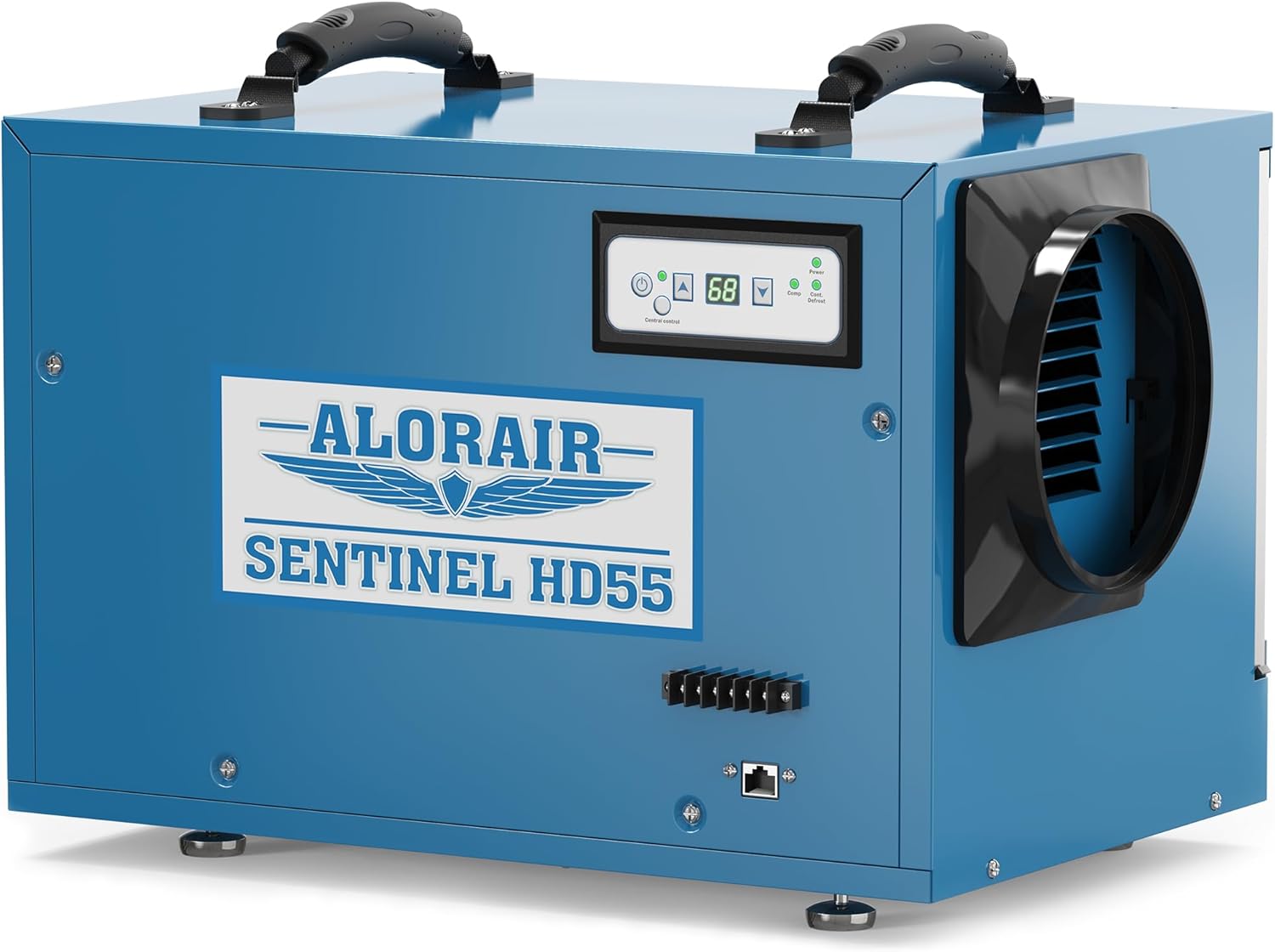
The ALORAIR Sentinel HD55 is a compact commercial dehumidifier built for basements, crawlspaces, and similar small commercial spaces where high moisture removal is required. It is rated to remove up to 113 pints per day at saturation (53 PPD at AHAM) and is designed for continuous drain operation so there is no internal tank to empty. The metal cabinet and cETL listing make it suited to tougher environments, and automatic defrost lets it operate in lower temperatures without manual intervention. Practical features include a MERV-1 intake filter to protect components, a built-in drain arrangement, and a 120 cfm airflow rating that helps move humid air effectively through ducting or open space. Trade-offs are that it does not include a built-in condensate pump and it is a heavier, more industrial unit than consumer home models, so installation and placement may need planning. For baseline commercial use where reliable, continuous dehumidification and rugged construction matter, the HD55 delivers focused, no-nonsense performance.
Best for: Buyers who prioritize steady, high-capacity moisture removal for basements or crawlspaces and need a rugged, serviceable commercial unit that runs continuously.
Less Ideal for: People seeking a lightweight, purely residential dehumidifier with a built-in water pump or compact consumer features should consider smaller home-focused models instead.
- High rated removal capacity up to 113 PPD (saturation) with 53 PPD at AHAM for realistic performance expectations
- Continuous drain operation eliminates the need to empty a tank
- Metal housing and cETL listing for commercial durability and safety
- Automatic defrost allows low-temperature operation without manual intervention
- MERV-1 intake filter protects internal components from dust and debris
- No built-in condensate pump for lifting drain water
- Heavier, industrial-style unit that may be less convenient to move or fit in very tight spaces
- Not Energy Star certified in this specific configuration
Verdict: Choose the Sentinel HD55 when you need a rugged, continuous‑drain commercial dehumidifier that delivers high real‑world moisture removal for basements and crawlspaces.
DECIUU 100‑Pint Dehumidifier

| Capacity | 100 pints_per_day |
|---|---|
| Floor Area | 5000 square_feet |
| Tank Volume | 1.45 gallons |
| Wattage | 300 watts |
| Air Flow Capacity | 9396 cubic_feet_per_hour |
This DECIUU unit is built to handle large, damp spaces such as basements and garages by removing up to 100 pints of moisture per day under high-humidity conditions. It runs continuously with three fan speeds, a programmable 24-hour timer, and a smart humidity controller that maintains a set RH between 35% and 80%, while Auto Defrost helps operation in cooler spaces. Practical design features include a 1.45 gallon removable tank, an included drain hose and garden-hose adapter for continuous or gravity drainage, washable filter, hidden handle and 360° swivel casters for room-to-room mobility. At 300 watts and ENERGY STAR Most Efficient 2024 recognition, it aims to balance performance with energy use for long run times. Trade-offs are its large physical footprint and weight compared with portable residential models, and it is intended for sizable areas rather than small rooms, so installation location and drainage planning matter for steady operation.
Best for: Buyers who prioritize efficient, energy-conscious moisture control for large basements or commercial-style spaces and want a unit that can run continuously with flexible drainage and simple mobility.
Less Ideal for: People seeking a compact, lightweight dehumidifier for a single small room or occasional use should consider smaller portable models instead.
- Very high dehumidification capacity up to 100 pints per day for large, damp spaces
- Three drainage options including tank, included drain hose, and garden-hose adapter for continuous operation
- Smart humidity control with setpoint range and Auto Defrost for reliable performance in varied conditions
- ENERGY STAR Most Efficient 2024 designation for improved energy use during extended runs
- Washable filter and caster/handle design make maintenance and relocation straightforward
- Large and relatively heavy compared with small room dehumidifiers, requiring planned placement
- Tank capacity is modest (1.45 gallons) relative to extraction rate, so continuous drainage is advisable
Verdict: If you need reliable, energy-efficient moisture removal for large basements or garages, this high-capacity DECIUU dehumidifier delivers strong continuous performance with flexible drainage options.
AEOCKY LEO-Lite 74 Pint Dehumidifier

| Capacity | 74 pints per day |
|---|---|
| Tank Volume | 1.45 gallons |
| Floor Area | 4500 square_feet |
| Operation Mode | Auto |
| Other Special Features of the Product | Timer |
The AEOCKY LEO-Lite is a high-capacity compressor dehumidifier built for large, damp spaces like basements. It removes up to 74 pints per day under peak conditions and uses a rotary compressor and a 3+2 evaporator/condenser layout to prioritize efficiency while keeping noise low. Controls include an intelligent humidistat with fast humidity sensing, an auto mode and timer, plus power-off memory for automatic recovery after outages. A 1.45 gallon tank and included drain hose let you choose between emptying the tank or continuous drainage. The unit meets ENERGY STAR Version 6.0 efficiency standards, so it runs more economically than many older basement models and includes an auto-defrost system to keep working in cooler basement temperatures. It is fairly quiet at low speed and is aimed at continuous or near-continuous operation for moisture control. Trade-offs are its single-speed fan control and relatively large footprint compared with tiny portable units, so it is best where sustained extraction and energy savings outweigh simple portability.
Best for: Buyers who want an efficient, high-capacity dehumidifier to control persistent basement humidity and reduce energy use over long runtimes.
Less Ideal for: If you need a lightweight, highly portable unit for small rooms or infrequent use, a compact low-capacity dehumidifier is a better fit.
- High dehumidification capacity rated at 74 pints per day for heavy basement humidity
- ENERGY STAR Version 6.0 rating for improved seasonal energy efficiency
- Auto-defrost keeps the unit operating in cool basement temperatures
- Included drain hose plus 1.45 gallon tank enables continuous drain or manual emptying
- Quiet operation for its class thanks to rotary compressor and low fan noise
- Single speed setting limits fine-grained control of airflow and sound
- Relatively large and heavier than compact room dehumidifiers
Verdict: Choose the LEO-Lite when you need a quiet, energy-efficient, high-capacity dehumidifier built to run continuously in a basement.
Gasbye DryPrime-50 Dehumidifier
| Capacity | 115 pints |
|---|---|
| Tank Volume | 1.72 gallons |
| Wattage | 500 watts |
| Air Flow Capacity | 12600 cubic_feet_per_hour |
| Operation Mode | Normal, Turbo, Comfort, Continuous Four Modes |
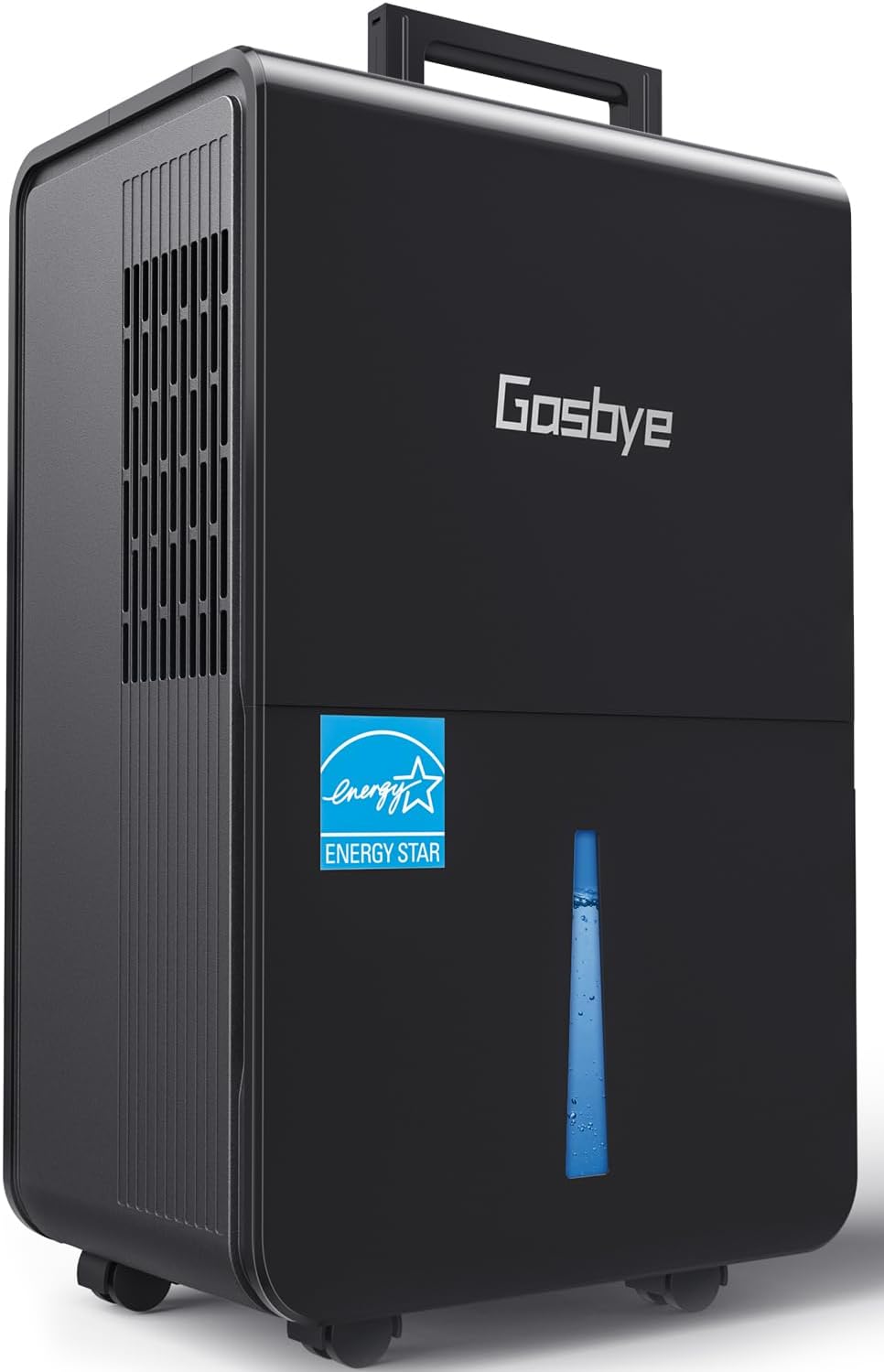
The Gasbye DryPrime-50 is a heavy-duty, compressor dehumidifier built for basements and other large rooms. It is intended to run continuously or in set humidity modes and uses a reinforced copper coil and thicker tubing for durability. In real use you get a few practical benefits: a high rated capacity (115 pints/day under 86°F/80% RH), Energy Star certified efficiency, a relatively quiet 45 dB operating level, and three drainage options including a 1.7 gallon tank, a 5-foot hose, and a threaded garden-hose outlet for longer drains. The unit also offers auto shut-off and auto restart after power loss, plus a smart control that cycles the compressor around the set point to save energy. Trade-offs are its weight and physical bulk compared with lightweight consumer models, and like all compressor units it will produce some warm exhaust and mechanical vibration. Expect this to be a robust, workhorse-style machine that favors longevity and continuous performance over portability or ultra-quiet bedroom operation.
Best for: Buyers who prioritize a durable, long-running dehumidifier for basements or large utility spaces and want a unit built for continuous operation and straightforward maintenance.
Less Ideal for: People seeking a lightweight, highly portable, or ultra-quiet bedroom dehumidifier should consider different consumer-focused models instead.
- High rated dehumidification with lab-tested capacity points for different temperature/humidity conditions.
- Energy Star 2026 certification for better energy efficiency in long-run operation.
- Durable construction with reinforced copper tubing aimed at longer service life.
- Three drainage methods including tank, included hose, and garden-hose thread for continuous drain setups.
- Auto shut-off and auto restart with humidity set-point cycling improves convenience and energy use.
- Relatively heavy and large compared with compact models, making it less convenient to move or store.
- Only one fan speed is listed, which limits fine control over airflow and noise.
- Compressor operation produces warm exhaust and vibration, so it is not ideal for quiet bedroom use.
Verdict: If you need a reliable, energy-efficient dehumidifier built for heavy basement use and long service life, the Gasbye DryPrime-50 is a practical commercial-style choice.
Waykar 120-Pint Dehumidifier CTH120A

| Capacity | 120 pints |
|---|---|
| Tank Volume | 1.24 gallons |
| Wattage | 470 watts |
| Air Flow Capacity | 230 cfm |
| Operation Mode | Auto Comfort, Continuous, Standard |
This Waykar 120-pint dehumidifier is built for high-humidity spaces such as basements and large homes, extracting up to 120 pints per day under hot, saturated conditions and covering up to 6,000 sq. ft. It offers Auto Comfort, Continuous, and Standard modes plus a humidity range of 30%–80% so you can set and maintain a target without constant manual adjustments. Practical details include a removable 1.24 gallon tank, an included 6.56 ft drain hose for continuous drainage, three fan speeds, and caster wheels for moving between rooms. Waykar emphasizes energy efficiency with a 2025 ENERGY STAR qualification and claims quieter operation around 40 dB on low, which makes it usable near living spaces. Safety and reliability features such as auto-defrost (works to lower temps), overflow protection, automatic restart, and simple error codes reduce maintenance surprises. The unit is relatively heavy and tall compared with some portable models and its tank still requires occasional emptying if not using continuous drainage, so plan placement accordingly in a commercial basement setting.
Best for: Buyers who prioritize proven performance and documented reliability for large, damp basements and want an energy-efficient, feature-rich unit that minimizes routine monitoring.
Less Ideal for: People needing a lightweight, ultra-compact dehumidifier for small rooms or those who cannot accommodate a drain hose or dedicated drainage route.
- High dehumidification capacity (120 pints/day) suitable for large basements and commercial basement spaces
- Meets 2025 ENERGY STAR standards for improved energy efficiency
- Includes continuous drainage hose and removable tank for flexible draining options
- Auto Comfort mode with temperature-based humidity targets reduces manual adjustments
- Multiple protections including auto-defrost, overflow prevention, and automatic restart
- Tank capacity (1.24 gallons) is modest relative to output and may require frequent emptying without hose drain
- Unit is fairly heavy, which can complicate placement in tight basement layouts
- Noise can reach higher levels on faster fan settings despite quiet low-speed operation
Verdict: A heavy-duty, energy-smart dehumidifier built to manage large basement humidity reliably while offering flexible drainage and automated comfort control.
AEOCKY RHEA Dehumidifier

| Capacity | 105 pints |
|---|---|
| Dehumidification Capacity | 100 pints_per_day |
| Tank Volume | 1.45 gallons |
| Wattage | 400 watts |
| Operation Mode | Auto, Constant Humidity, Continuous, Smart Drying, Sleep |
The AEOCKY RHEA-002 is a high-capacity compressor dehumidifier designed for large basements and whole-house use where persistent humidity is a problem. It is built to remove upwards of 100 pints per day under demanding conditions and pairs that extraction power with ENERGY STAR Most Efficient 2024 certification to reduce runtime and energy consumption. The unit includes an internal 1.45 gallon collection tank plus a drain hose and garden-hose adapter for continuous drainage, and its smart humidity control and multiple operating modes let you set and maintain a target RH automatically. Practical features for basement use include an auto-defrost system that prevents frost-related shutdowns in cool spaces and a reportedly quiet compressor/fan design that keeps noise near white-noise levels. The RHEA-002 is relatively large and relies on a compressor system, so it is best for permanent basement installation rather than occasional transport, and its water tank still requires attention if you do not use continuous drain. For buyers focused on reliable, energy-efficient moisture control in basements, this model delivers strong drying performance with thoughtful controls and durable core components.
Best for: Buyers who want a dependable, energy-efficient workhorse to control severe basement humidity and prioritize long-term, low-running-cost performance over portability.
Less Ideal for: People who need a lightweight, highly portable dehumidifier for occasional use or those who cannot provide a permanent place and drainage setup in the basement.
- Very high dehumidification capacity (listed up to 100–105 pints/day) suitable for large basements
- ENERGY STAR Most Efficient 2024 certification for improved energy use versus standard models
- Auto-defrost keeps operation continuous in cool basement temperatures
- Includes drain hose and garden-hose adapter for continuous drainage
- Multiple operation modes and smart humidity control for hands-off humidity management
- Large compressor-based unit that is heavier and less portable than small or thermoelectric dehumidifiers
- 1.45 gallon tank still requires emptying if continuous drain is not available
- Specific long-term durability claims and energy savings are manufacturer-stated and may vary by installation
Verdict: If you need a powerful, energy-efficient dehumidifier that runs reliably in cool basement conditions, the RHEA-002 is built to handle heavy, long-term moisture removal with low energy use.
Choosing the Right Commercial Dehumidifier for Basements: Key Factors to Consider
Extraction Capacity and Rated Conditions
Extraction capacity determines how quickly a dehumidifier can lower humidity and is usually specified in pints or liters per day. For basements, rated capacity at cooler temperatures matters because below-grade spaces are often cooler than living areas. A unit that lists capacity only at warm-room conditions may underperform in a damp basement.
Choose a commercial dehumidifier with clear performance curves or manufacturer data showing extraction at lower temperatures. Higher capacity reduces run time and can shorten the period the space spends in the mold-prone humidity range, but oversized units can short-cycle in small basements if not paired with proper controls.
Durability and Environmental Resistance
Basement environments can be harsh, with elevated humidity, occasional dust, and potential exposure to particulate matter from concrete and insulation. Durable compressors, corrosion-resistant coils, and reinforced cabinets extend service life in these conditions.
Look for units with protective coatings, stainless or coated drain ports, and heavy-gauge enclosures. Commercial units built for continuous operation typically use sturdier electrical components and compressors designed for repeated start-stop cycles, which reduces downtime and maintenance needs.
Drainage Options and Installation Flexibility
How the dehumidifier handles condensate is critical for unattended basement use. Gravity drain, pump-assisted drain, or direct plumb options each have tradeoffs depending on basement slope and available drain points. A unit with integrated pump simplifies placement away from floor drains but requires periodic pump maintenance.
Consider whether you need hose adapter fittings, external condensate pumps, or the ability to tie into existing plumbing. Proper installation reduces the risk of water spills, eases maintenance, and allows continuous operation during extended damp periods.
Energy Use and Operating Cost
Commercial dehumidifiers remove large volumes of moisture and can consume significant electricity during continuous operation. Energy efficiency should be evaluated relative to extraction capacity rather than raw wattage. Look for units with efficient compressors, variable-speed fans, or dehumidification modes that modulate operation.
Estimating annual operating cost involves local electricity rates and anticipated run hours. Efficient units often deliver lower lifetime operating expense, which matters for basements that require sustained humidity control over months.
Controls, Monitoring, and Integration
Effective control options improve usability and protect the basement environment. Digital humidistats, programmable timers, remote monitoring, and integration with building management systems give precise control over setpoints and runtime. Alarms for high humidity, full-tank indicators, or remote alerts are useful for unattended spaces.
Consider whether the unit supports external sensors placed where actual moisture problems occur, and whether it can maintain desired setpoints without frequent manual intervention.
Sizing a Commercial Unit for Your Basement
Sizing a dehumidifier depends on basement square footage, ceiling height, insulation, and the severity of moisture intrusion. Start with the cubic footage and expected humidity load from sources like wet walls, foundation leaks, or high indoor humidity transfer from above-grade spaces.
- Calculate conditioned volume: square feet times ceiling height.
- Account for moisture sources such as laundry, sump pump discharge, or groundwater seepage.
- Use manufacturer capacity curves that show extraction at cooler temperatures common to basements.
Placement and Airflow Considerations
Positioning affects a unit's ability to circulate air and reach damp corners. Commercial dehumidifiers need clearance for intake and discharge to avoid recirculating moist air or restricting airflow. Place units centrally if possible, or use ducting to target remote problem areas.
- Maintain clearance around intake and discharge grills per installation guidance.
- Avoid placing units directly against foundation walls where airflow is blocked.
- Use short supply or return ducts for zoned coverage when a single unit cannot reach all areas effectively.
Noise and Vibration Management
Commercial units can be louder than residential models due to larger fans and compressors. In finished basements or areas adjacent to living spaces, consider sound-dampening strategies like vibration mounts, insulated enclosures, or locating the unit in a mechanical room with sound-absorbing panels.
- Use rubber isolation feet to reduce transmitted vibration.
- Add flexible duct connectors to prevent structure-borne noise.
- Measure noise at typical operating distance to set expectations during placement.
Maintenance Tasks and Service Intervals
Regular maintenance keeps commercial dehumidifiers running efficiently. Tasks include cleaning or replacing filters, inspecting coils for dust and corrosion, checking condensate fittings and pumps, and verifying compressor and electrical connections. Establish a service schedule based on run hours rather than calendar days for basements with heavy use.
- Clean or replace air filters monthly during heavy use seasons.
- Inspect condensate pumps quarterly for wear and blockages.
- Schedule annual coil and electrical inspections with a qualified technician.
Handling Mold and Water Intrusion Alongside Dehumidification
A dehumidifier controls ambient humidity but does not fix active leaks or chronic water intrusion. Address the source of moisture first, using foundation repairs, improved grading, or sump systems when needed. Use dehumidification as part of a comprehensive moisture-management plan that includes ventilation and surface drying.
- Identify and repair active leaks before relying on dehumidification alone.
- Combine dehumidification with air circulation to dry surfaces more evenly.
- Monitor humidity and visible mold-prone areas after remediation to confirm control.
How We Chose the Best Commercial Dehumidifier for Basements
We evaluated commercial dehumidifiers for basements using criteria that reflect real-world basement conditions and long-term ownership. First, we prioritized extraction capacity at typical basement temperatures, focusing on units rated for continuous high humidity removal and measured liters or pints per day at cooler conditions. Second, durability and compressor design were critical; we looked for robust components, serviceable parts, and corrosion-resistant coils and housings suited to below-grade environments. Third, we considered airflow and drainage options, including condensate pump compatibility and gravity-drain configurations for extended unattended operation. Fourth, we assessed energy efficiency relative to capacity to estimate running costs during prolonged use. Finally, we examined ease of maintenance and controls, including filters, access panels, and serviceability. We excluded units intended only for small residential rooms or transient spot-drying and focused on commercial-grade equipment designed for continuous basement operation. The final list reflects units that meet these performance, durability, drainage, efficiency, and serviceability filters.
Our full evaluation process is outlined in our review methodology.
FAQ
How large a dehumidifier do I need for a finished basement?
Size by the basement's cubic footage and by the severity of moisture. For finished spaces with moderate humidity, choose a unit rated to handle the calculated load at cooler temperatures. If the basement has active water intrusion, pick a higher-capacity commercial-rated unit or address the source first.
Can a commercial dehumidifier run continuously in a basement?
Many commercial units are designed for continuous duty, but continuous operation increases wear and energy use. Ensure the unit is rated for round‑the‑clock use, has adequate drainage, and is maintained on a service schedule tied to operating hours.
Do I need a pump for basement condensate removal?
A pump is helpful when gravity drainage is not available or when the unit sits below the nearest drain. Integrated pumps simplify installation but require periodic maintenance. If you have a nearby floor drain at a lower elevation, gravity drain may be sufficient.
Will a dehumidifier prevent mold after a flood?
A dehumidifier speeds drying but is not a standalone solution after a flood. Remove standing water and wet materials, dry the area thoroughly with dehumidification and forced air, and inspect for moisture trapped in assemblies. Severe contamination or structural damage may require professional remediation.
How often should I change filters on a commercial dehumidifier?
Filter frequency depends on dust levels and run hours. In dusty basement environments, inspect filters monthly during heavy use and clean or replace them as needed. A scheduled inspection every 30 days helps maintain airflow and extraction efficiency.
Final Verdict
Choose a commercial dehumidifier for basements by matching extraction capacity to the actual basement conditions and by prioritizing durable construction and reliable drainage options. Balance energy efficiency against required run hours, and select controls that allow precise humidity management or remote monitoring if the space is unattended. Address any water intrusion or ventilation shortcomings before relying on dehumidification alone. With the right sizing, placement, and maintenance plan, a commercial unit will keep basement humidity in check and reduce long-term mold and moisture risks.