
Note: This article contains affiliate links. If you click on these links and make a purchase, we may earn a small commission at no extra cost to you. This helps support our research and content. Read our full affiliate disclosure here.
If you need a heavy-duty unit to control humidity in large rooms, basements, or whole-house applications, a commercial-grade dehumidifier can deliver the capacity and durability typical consumer units lack. Choosing the right commercial dehumidifier for home use matters because oversized or underspecified equipment wastes energy, creates noise problems, or fails to protect finishes and stored items. This guide shortlists the top commercial dehumidifiers suitable for residential settings and explains the evaluation criteria we used so you can match capacity, efficiency, and controls to your space. Read on for a practical look at features that matter and which units are best suited to common home scenarios.
Top Picks at a Glance
| Best Overall The best all-around choice for most situations | Airzentti 155 Pint Dehumidifier |  |
| Best Quality Built to a higher standard if you want something more solid | ALORAIR Sentinel HD55 |  |
| Best Value The sweet spot between price and what you get | Gasbye DryPrime-50 Dehumidifier |  |
| Best Budget The cheapest option that still gets the job done reliably | AEOCKY LEO-Lite 74 Pint Dehumidifier |  |
| Top Rated A top-rated pick with lots of positive feedback | Aprilaire E080W 80-Pint Dehumidifier |  |
| Most Popular A crowd favorite that many people choose with confidence | AEOCKY RHEA 80-Pint Dehumidifier |  |
| Best Seller A high-volume bestseller chosen again and again | Waykar YDZ-150PM Dehumidifier |  |
Airzentti 155 Pint Dehumidifier
| Capacity | 155 pints |
|---|---|
| Dehumidification Capacity | 73.5 liters_per_day |
| Air Flow Capacity | 220 cfm |
| Wattage | 860 watts |
| Floor Area | 7500 square_feet |
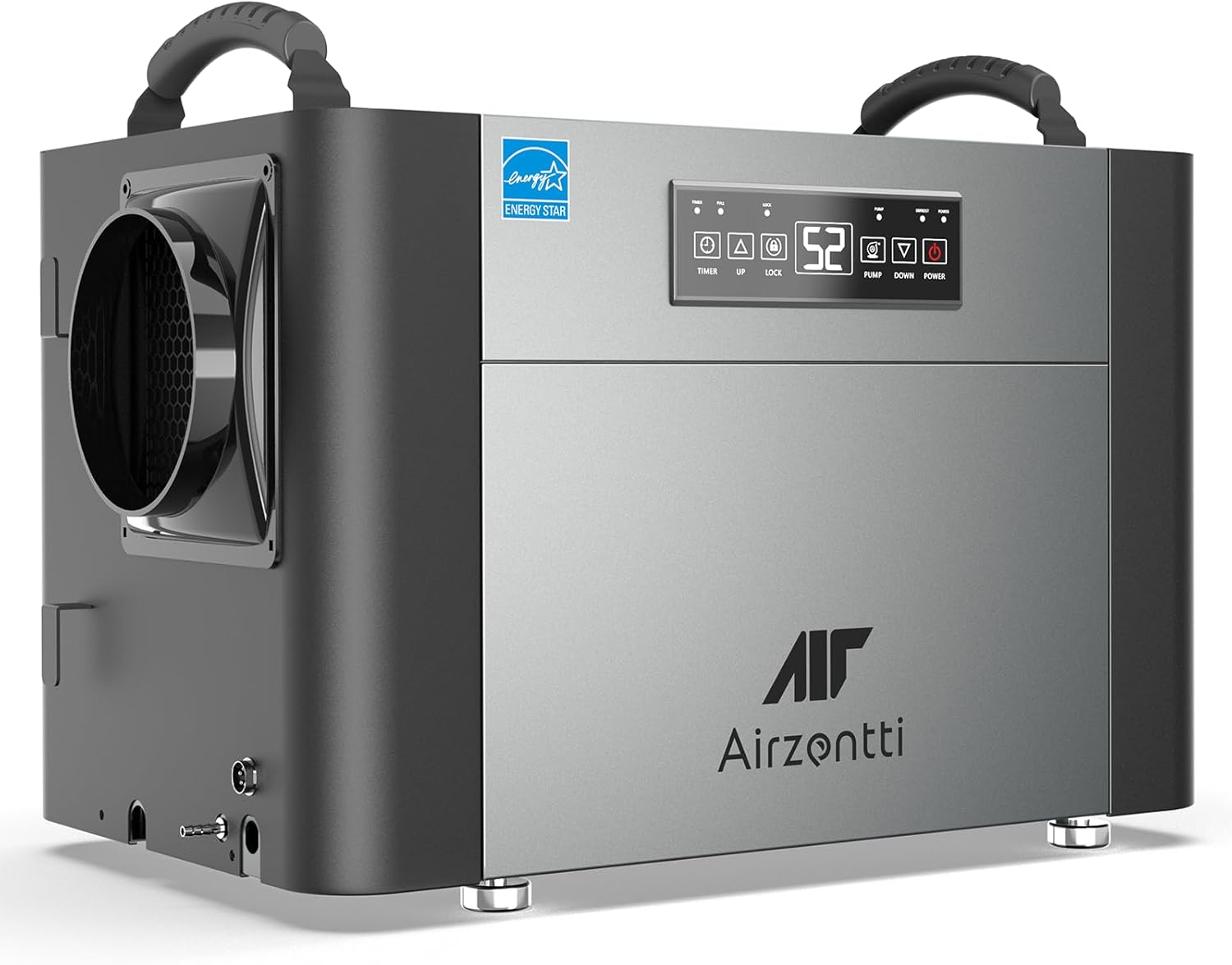
The Airzentti 155 Pint Dehumidifier is a heavy-duty unit meant to remove large volumes of moisture from basements, attics, crawlspaces and commercial areas. It runs in continuous, pump-drain, or timed modes and can move air at 220 CFM while extracting up to 73.5 liters per day, making it suitable for spaces up to about 7,500 sq ft. The built-in pump plus a gravity drain option lets you route water up to several meters away for set-and-forget operation, and safety features such as auto-defrost and auto-shutoff prevent frost buildup and overflow during long runs. Energy Star certification helps keep operating costs lower than older commercial models, and the included duct collar and leveling feet simplify installation in tight areas. Trade-offs are its industrial footprint and weight, which limit portability and may require a dedicated location or dolly for moves, and the unit uses significant power when running at full capacity.
Best for: Buyers who need a durable, high-capacity dehumidifier for large basements, whole-house or commercial moisture problems and value continuous unattended operation and energy efficiency.
Less Ideal for: People wanting a lightweight, easily moved household dehumidifier for a single small room or occasional use should consider smaller portable models instead.
- Very high moisture removal capacity suitable for large or water-damage jobs
- Built-in pump plus gravity drain for continuous unattended draining
- Energy Star certified for better efficiency than many commercial units
- Multiple operation modes and a humidity setpoint for automated control
- Includes duct collar and leveling feet for installation flexibility
- Heavy and bulky, not convenient for frequent room-to-room moves
- High wattage draw at peak operation compared with portable residential models
Verdict: If you need a robust, Energy Star commercial dehumidifier that can handle whole-house or restoration-level moisture removal with continuous pump drainage, this unit delivers the capacity and features to run unattended.
ALORAIR Sentinel HD55
| Capacity | 113 pints |
|---|---|
| AHAM Dehumidification | 53 pints per day |
| Coverage | 1200 square_feet |
| Air Flow Capacity | 120 cfm |
| Wattage | 460 watt-hours |
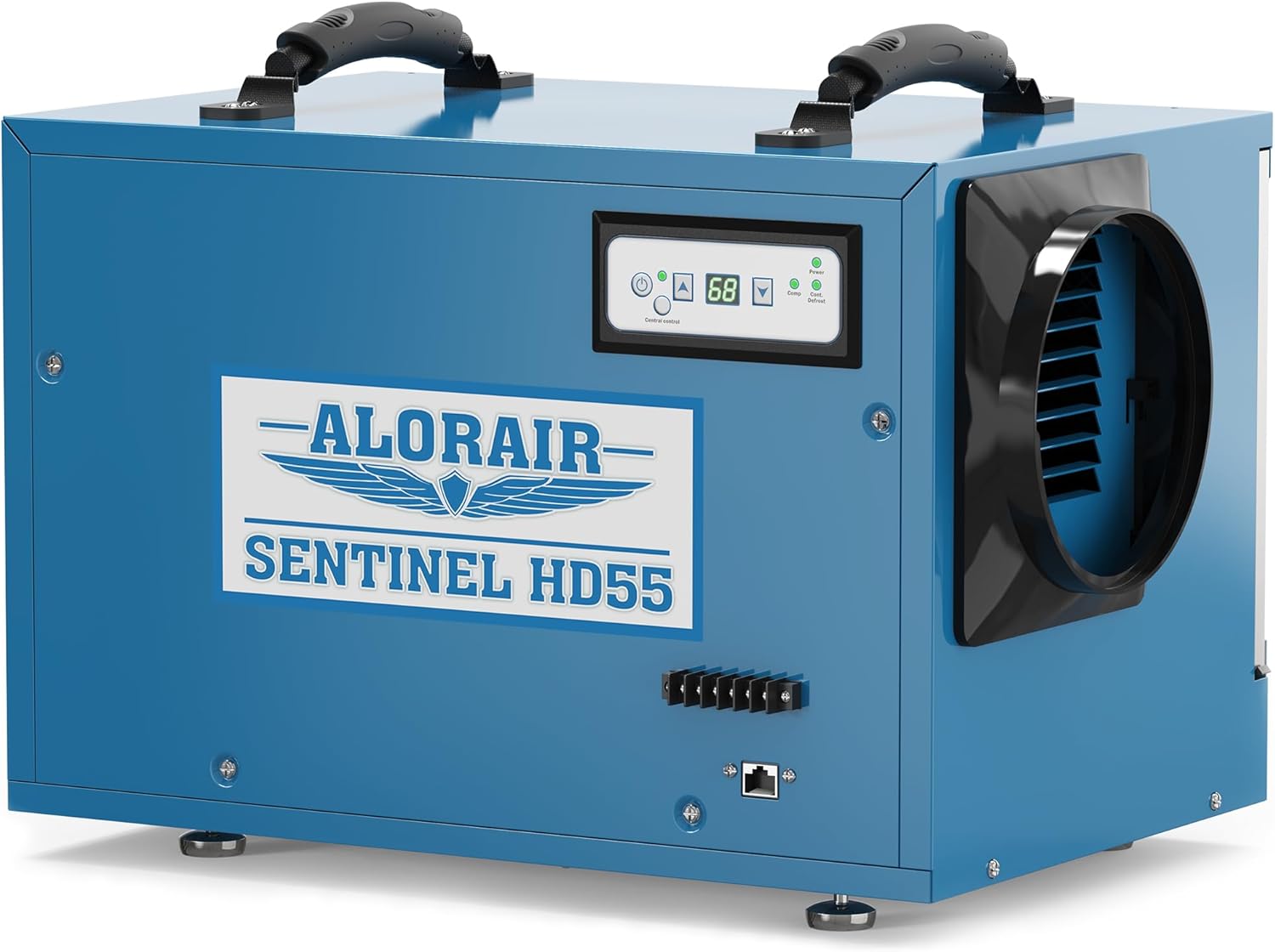
The ALORAIR Sentinel HD55 is a compact commercial dehumidifier designed for crawl spaces, basements, and similar low-clearance areas where continuous moisture control is needed. It removes up to 113 pints per day at saturation (53 pints per day AHAM) and is sized to handle spaces up to about 1,200 square feet, with automatic continuous drain so there is no internal water tank to empty. The unit is built with a metal cabinet, cETL listing, automatic defrosting for low-temperature operation, and a MERV-1 filter to protect internal components from dust. Practical benefits include rugged portability, a focused airflow of 120 CFM, and automatic defrost that avoids frost-related downtime in cooler spaces. Limitations to note are that it lacks a built-in condensate pump and some higher-end comfort features like integrated Wi-Fi or advanced filtration are optional or sold separately, so setup may require buying accessories for remote control or ducting in certain installs. For performance-focused buyers this is a workhorse that emphasizes reliable water removal and durability over consumer-style bells and whistles.
Best for: Buyers who prioritize fast, reliable moisture removal and rugged construction for crawlspaces, basements, or commercial utility spaces and want a unit that runs continuously without frequent maintenance.
Less Ideal for: Users seeking a consumer-style dehumidifier with integrated smart controls, built-in pump, or higher-efficiency filtration out of the box should consider other models or accessories.
- High water removal capacity (113 PPD at saturation) for fast humidity reduction in damp spaces
- Continuous drain design eliminates an internal tank and frequent manual emptying
- Metal housing and cETL listing for commercial durability and safer operation
- Automatic defrost allows effective operation in lower-temperature crawlspaces
- No built-in condensate pump, so gravity drain or external pump may be required
- Advanced features such as Wi-Fi or upgraded filters are optional and not included
Verdict: Choose the Sentinel HD55 when you need a compact, commercial-grade unit that quickly removes large volumes of moisture and runs continuously with rugged, job-site durability.
Gasbye DryPrime-50 Dehumidifier
| Capacity | 115 pints |
|---|---|
| Tank Volume | 1.72 gallons |
| Wattage | 500 watts |
| Air Flow Capacity | 12600 cubic_feet_per_hour |
| Operation Mode | Normal, Turbo, Comfort, Continuous |
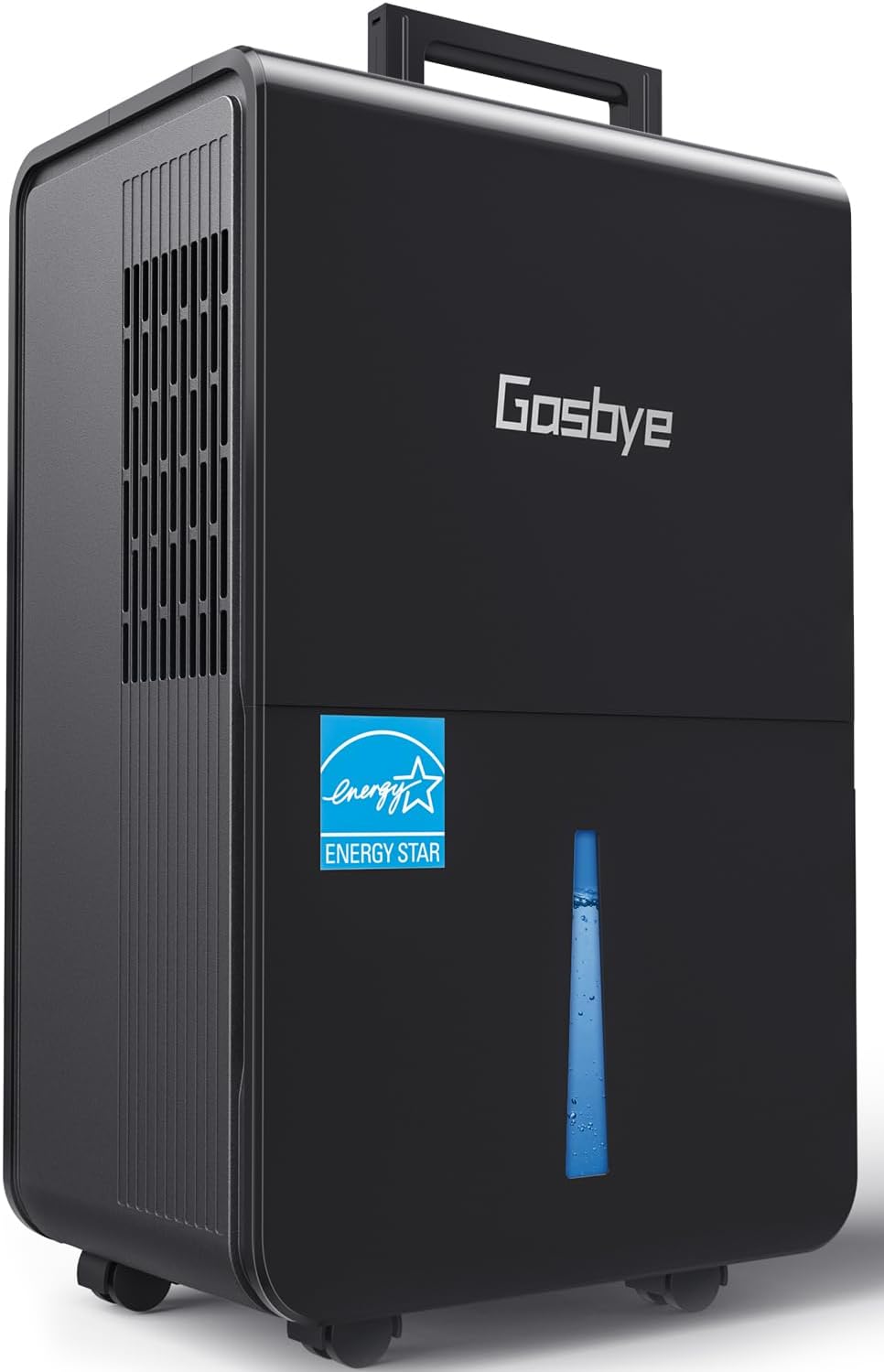
The Gasbye DryPrime-50 is a compressor dehumidifier built for large rooms and basements, offering lab-tested capacities up to 115 pints/day under hot, humid conditions and lower but realistic outputs at cooler temperatures. It is a heavier, sturdier unit that uses reinforced copper tubing and a five-tier coil to improve durability, and it is Energy Star certified for better efficiency. Typical use is continuous or scheduled dehumidification in basements, laundry rooms, garages, or large living areas where you need reliable moisture removal and flexible drainage. Notable features include an auto shut-off and auto restart humidity control that cycles the compressor to save energy, three drainage methods (1.7 gallon tank, included drain hose, or garden-hose connection), and a relatively quiet 45 dB compressor. Practical benefits are strong moisture removal for large spaces, easier maintenance with a washable filter, and lower running costs thanks to the Energy Star rating. Trade-offs are the unit size and weight that make it less suitable for small rooms or frequent moving, and it is a compressor model that emits some warm exhaust during operation.
Best for: Buyers who want a durable, energy-efficient dehumidifier to manage humidity in basements, large living areas, or utility spaces and prioritize reliable moisture removal and low operating cost.
Less Ideal for: People who need a lightweight, ultra-quiet unit for small bedrooms or who plan to move the unit frequently between rooms.
- High dehumidification capacity with lab-tested ratings at multiple temperature/humidity points
- Energy Star certified for improved energy efficiency
- Three drainage options including 1.7 gal tank and garden-hose connection for continuous drain
- Reinforced copper tubing and solid coil build aimed at long-term durability
- Auto shut-off and auto-restart humidity control for hands-off operation
- Relatively heavy and bulky compared with smaller portable models
- Produces warm exhaust as a compressor unit, so it is not ideal for small bedroom use
Verdict: Choose this unit if you need a heavy-duty, Energy Star certified dehumidifier that reliably removes large volumes of moisture from basements and other large indoor spaces.
AEOCKY LEO-Lite 74 Pint Dehumidifier

| Capacity | 74 pints per day |
|---|---|
| Tank Volume | 1.45 gallons |
| Floor Area | 4500 square_feet |
| Operation Mode | Auto |
| Other Special Features of the Product | Timer |
The AEOCKY LEO-Lite is a high-capacity compressor dehumidifier built for large, damp spaces like basements. It removes up to 74 pints per day under peak conditions and uses a rotary compressor and a 3+2 evaporator/condenser layout to prioritize efficiency while keeping noise low. Controls include an intelligent humidistat with fast humidity sensing, an auto mode and timer, plus power-off memory for automatic recovery after outages. A 1.45 gallon tank and included drain hose let you choose between emptying the tank or continuous drainage. The unit meets ENERGY STAR Version 6.0 efficiency standards, so it runs more economically than many older basement models and includes an auto-defrost system to keep working in cooler basement temperatures. It is fairly quiet at low speed and is aimed at continuous or near-continuous operation for moisture control. Trade-offs are its single-speed fan control and relatively large footprint compared with tiny portable units, so it is best where sustained extraction and energy savings outweigh simple portability.
Best for: Buyers who want an efficient, high-capacity dehumidifier to control persistent basement humidity and reduce energy use over long runtimes.
Less Ideal for: If you need a lightweight, highly portable unit for small rooms or infrequent use, a compact low-capacity dehumidifier is a better fit.
- High dehumidification capacity rated at 74 pints per day for heavy basement humidity
- ENERGY STAR Version 6.0 rating for improved seasonal energy efficiency
- Auto-defrost keeps the unit operating in cool basement temperatures
- Included drain hose plus 1.45 gallon tank enables continuous drain or manual emptying
- Quiet operation for its class thanks to rotary compressor and low fan noise
- Single speed setting limits fine-grained control of airflow and sound
- Relatively large and heavier than compact room dehumidifiers
Verdict: Choose the LEO-Lite when you need a quiet, energy-efficient, high-capacity dehumidifier built to run continuously in a basement.
Aprilaire E080W 80-Pint Dehumidifier

| Capacity | 80 pints |
|---|---|
| Dehumidification Capacity | 80 pints_per_day |
| Floor Area | up to 4,400 square_feet |
| Wattage | 612 watts |
| Air Flow Capacity | 185 cfm |
The Aprilaire E080W is a commercial-grade whole-house dehumidifier built to remove up to 80 pints of moisture per day for homes and large spaces. It is typically installed in basements, crawl spaces, or ducted into an HVAC system and ships with a hanging kit, condensate pump, drain tubing, and outlet/inlet collars for flexible placement. The unit features Wi‑Fi and Bluetooth‑assisted setup so you can monitor and change humidity set points from the AprilAire app, and an automatic on/off control lets it maintain a programmed relative humidity. Practical benefits include continuous draining with the included pump to avoid emptying tanks, dual-stage filtration with washable MERV 8 and a MERV 11 filter to reduce airborne particles, and an aluminum coil engineered for corrosion resistance. Expect robust daily dehumidification and energy‑efficient operation at typical household conditions, though the unit's size and 63 lb weight mean professional or two-person installation is advisable and it requires proper condensation routing. For buyers wanting long-term, low-maintenance humidity control, this model emphasizes dependable performance rather than portability.
Best for: Buyers who prioritize a durable, low‑maintenance whole‑house solution for controlling moisture in basements, crawl spaces, or entire homes and who value remote monitoring and reliable continuous drainage.
Less Ideal for: People looking for a lightweight, portable dehumidifier for single rooms or occasional use should consider smaller portable models instead.
- High 80‑pint/day dehumidification capacity suitable for homes up to 4,400 sq. ft.
- Built‑in Wi‑Fi and Bluetooth‑assisted setup for remote monitoring and control.
- Includes condensate pump, drain tubing, hanging kit, and collars for versatile installation.
- Dual filtration (washable MERV 8 plus MERV 11) and corrosion‑resistant coil improve indoor air quality and durability.
- Large and heavy unit requires two people or professional installation.
- Not designed for portable use or small, temporary spaces.
Verdict: A robust, install‑ready 80‑pint whole‑house dehumidifier with smart controls and included pump that delivers reliable, low‑maintenance moisture control for large homes.
AEOCKY RHEA 80-Pint Dehumidifier
| Capacity | 80 pints per day |
|---|---|
| Floor Area | 5500 square_feet |
| Tank Volume | 1.45 gallons |
| Wattage | 280 watts |
| Air Flow Capacity | 9006 cubic_feet_per_hour |
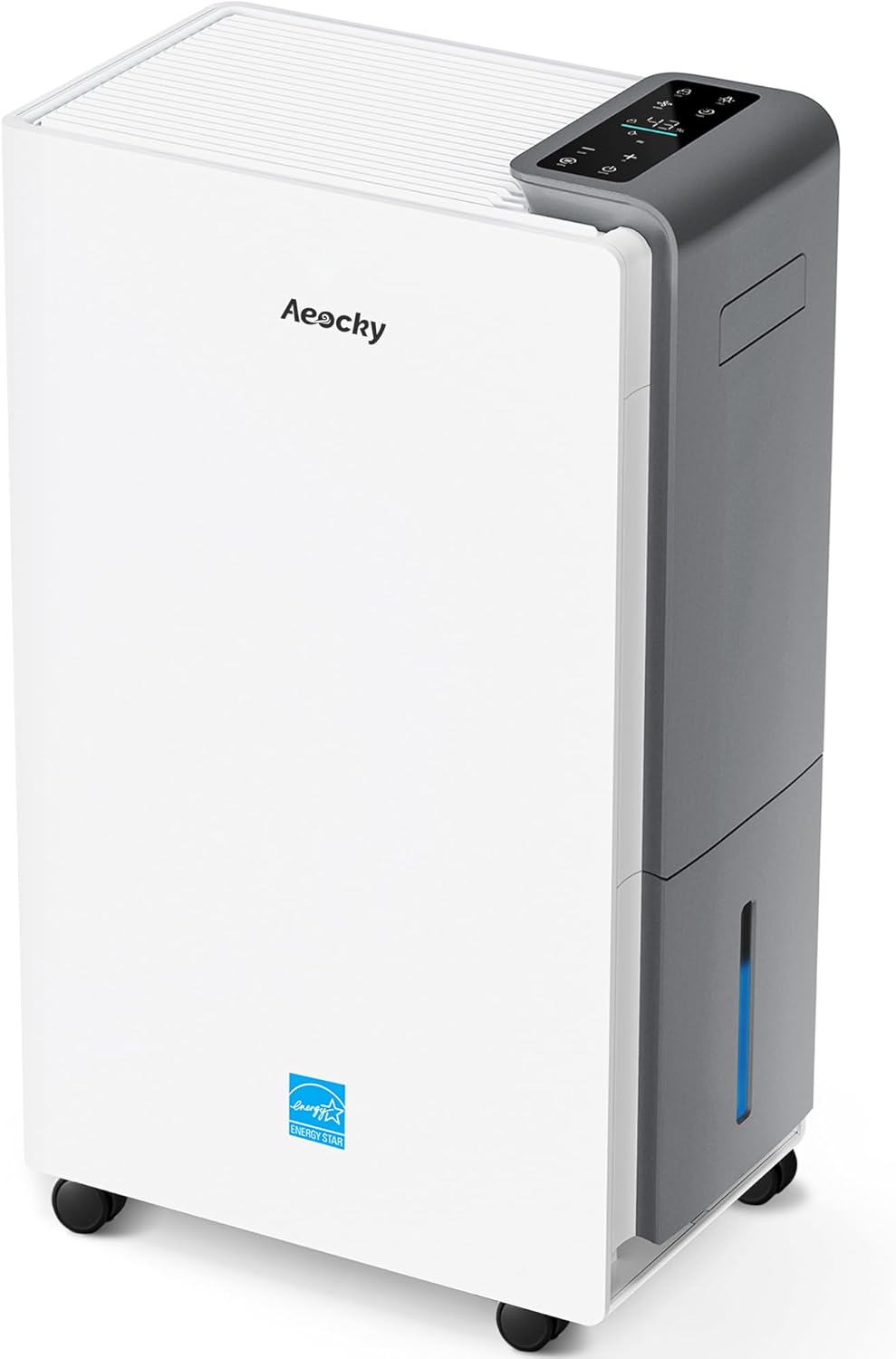
The AEOCKY RHEA is a high-capacity compressor dehumidifier designed for whole-house or large-space use. It removes up to 80 pints per day and is intended for coverage up to roughly 5,500 sq ft, with a 1.45 gallon internal tank and an included drain hose for continuous drainage. The unit offers multiple operation modes including Auto, Constant Humidity, Continuous, Smart Drying and Sleep mode, plus adjustable humidity control, child lock, timer and a single fan speed setting. Its advertised strengths are energy efficiency and low-noise operation thanks to a rotary compressor and a high-efficiency airflow design, which makes it suitable for basements or living areas where noise and electricity use matter. Important trade-offs are its large size and the relatively small internal tank compared with its extraction rate, so long continuous runs will need direct drainage or frequent emptying if not plumbed. The control set is practical but not elaborate, and it lacks multi-speed fan options. For buyers focused on verified efficiency and strong drying performance in big spaces, the RHEA is a capable commercial-grade choice adapted for home use.
Best for: Buyers who prioritize verified energy efficiency and strong, reliable moisture removal for large basements or whole-home use and who prefer a performance-focused, well-tested unit with practical controls.
Less Ideal for: People needing a compact, lightweight dehumidifier for small rooms or those who want large onboard water storage and multiple fan-speed options.
- High extraction rate up to 80 pints per day for large or very damp spaces
- ENERGY STAR Most Efficient 2025 certification for verified energy savings
- Multiple operating modes and smart humidity control for precise humidity management
- Includes drain hose and garden-hose adapter for continuous drainage
- Designed for quieter operation compared with similar-capacity units
- Water tank capacity (1.45 gallons) is small relative to extraction rate, requiring drain hookup for long unattended runs
- Only a single listed fan speed which limits fine-grained airflow control
Verdict: Choose the RHEA when you need a high-capacity, ENERGY STAR Most Efficient 2025 dehumidifier that delivers strong drying performance for large home spaces while minimizing energy use.
Waykar YDZ-150PM Dehumidifier

| Capacity | 150 pints |
|---|---|
| Tank Volume | 1.85 gallons |
| Wattage | 520 watts |
| Air Flow Capacity | 212 cfm |
| Operation Mode | Auto, Continuous |
The Waykar YDZ-150PM is a commercial-capacity dehumidifier intended for large basements, warehouses, or whole-house use where heavy moisture control is needed. It removes up to 150 pints per day (under test conditions) and offers an internal pump that can lift water nearly 10 feet for automatic drainage, plus a 1.85 gallon tank and a gravity drain hose. Controls are via an intuitive touch panel with adjustable humidity set points, a 24-hour timer, and auto-restart memory. The unit is Energy Star rated and includes auto-defrost, self-drying, overload protection, and a washable filter for easier maintenance. On the practical side it has two fan speeds and omnidirectional casters for moving between spaces, and the swing function helps spread airflow. Expect a relatively heavy, compressor-based machine that delivers high-capacity moisture removal but requires space and a dedicated spot for drainage; the tank is large but frequent drainage or the pump will be necessary in very damp conditions. For risk-averse buyers the Energy Star certification and built-in protections offer reassurance about efficiency and durability.
Best for: Buyers who prioritize reliable, high-capacity moisture control and want an energy-efficient, factory-quality commercial-style dehumidifier for large basements, garages, or utility spaces.
Less Ideal for: If you need a lightweight, highly portable unit for a single small room or an ultra-quiet bedroom unit, this high-capacity commercial model is more than necessary.
- Very high moisture removal capacity suitable for large spaces
- Built-in pump with upward drainage plus included gravity drain hose
- Energy Star certification for improved energy efficiency
- Auto-defrost, self-drying, and overload protection to reduce maintenance and extend life
- Touch controls, timer, and auto-restart make operation simple and reliable
- Physically heavy and requires floor space and a drainage plan
- Rated capacity is under ideal conditions and actual removal will vary with temperature and humidity
Verdict: Choose the Waykar YDZ-150PM when you need a factory-quality, high-capacity dehumidifier with a built-in pump to reliably handle very large, moisture-prone spaces.
Choosing the Right Commercial Dehumidifier for Home: Key Factors to Consider
Capacity Vs. Room Size
Matching a dehumidifier's rated moisture removal to the conditioned space and typical humidity load is the most important factor. A unit rated for much larger commercial spaces may cycle inefficiently in a small basement, while an undersized unit will run continuously and fail to lower humidity. Consider both the square footage and ceiling height when estimating air volume.
Also account for specific moisture sources such as laundry, frequent showers, or ground moisture in basements. If you plan to treat multiple rooms or a whole lower level, choose a higher-capacity unit or plan for ducting to distribute airflow effectively.
Energy Use and Operating Cost
Commercial dehumidifiers can draw significant power, so efficiency has a direct impact on monthly bills. Look for models with clear efficiency metrics and energy-saving modes that reduce runtime through accurate humidistat control. A more efficient unit may cost more up front but can save money over prolonged heavy use.
Also consider features that reduce runtime, such as automatic humidistats, variable-speed fans, and sleep modes. For installations expected to run daily in damp seasons, small percentage differences in efficiency compound into noticeable cost differences.
Noise and Placement
Noise becomes a practical concern when installing a commercial dehumidifier in or near living spaces. Higher-capacity compressors and fans typically produce more sound. Pay attention to rated decibel levels and look for units with multiple fan speeds so you can run quieter at night or when occupying the room.
Placement affects perceived noise: positioning the unit in a closet, utility room, or with ducted exhaust can mitigate sound in occupied areas. Also consider vibration isolation feet or pads to reduce transmitted noise through floors and walls.
Drainage and Condensate Handling
How a unit handles condensate is crucial for continuous operation. Commercial dehumidifiers may offer gravity drainage, internal condensate pumps, or plumb-to-drain options. For basements and other low-lying locations, an internal pump or a reliable external pump is often necessary to route water to a higher drain.
Evaluate the ease of installing permanent drains if you prefer hands-off operation. Removable water tanks are useful for temporary setups but are impractical for persistent high-moisture environments where frequent emptying would be required.
Controls and Integration
Good controls improve effectiveness and convenience. Integrated humidistats, programmable timers, remote sensors, and digital displays let you maintain a target humidity without constant adjustment. Some commercial units support external humidistats or remote condensate alarms which are helpful in monitored installations.
If you plan to connect the unit to existing ductwork or a home automation system, verify compatibility and available control interfaces. Simpler units may be easier to operate but lack flexibility for complex home setups.
Durability and Serviceability
Commercial machines are expected to run longer and harder than consumer models, so rugged components matter. Look for corrosion-resistant coils, heavy-duty compressors, and accessible panels for routine maintenance. Units designed with replaceable filters and easy-to-reach service points reduce downtime and maintenance costs.
Consider warranty provisions and availability of replacement parts. Even when using a unit in a home, the ability to repair or replace common wear items is important for long-term reliability.
Sizing Tips for Basements and Large Rooms
Estimate the volume of the area you need to dehumidify by multiplying square footage by ceiling height. Use that volume along with typical humidity levels to choose a unit rated to remove the necessary pints per day at realistic conditions rather than the often-quoted optimum lab rating.
For basements, factor in ground moisture and incomplete air sealing which increase the moisture load. If unsure, err slightly higher on capacity and pair the dehumidifier with improved ventilation or a vapor barrier for a balanced solution.
- Double-check capacity ratings at 60 percent relative humidity if available.
- Consider ducting a high-capacity unit to serve multiple rooms.
- Plan for easy access to the unit for maintenance and condensate routing.
Ducting, Placement, and Airflow Considerations
Ducting can make a commercial dehumidifier serve remote areas without relocating the entire unit. Ensure the unit supports external intake and discharge ducting and that static pressure limits are respected to avoid reduced performance.
Place the unit where airflow is unobstructed and cool air can reach the coils. Avoid tight corners that restrict intake or discharge and allow clearance for service panels and condensate connections.
- Short, straight duct runs preserve airflow and efficiency.
- Use insulated ducts to prevent condensation on duct surfaces in cool spaces.
- Keep intake clear of laundry or chemical storage that could contaminate coils.
Managing Noise Without Sacrificing Performance
If noise is a concern, choose a model with multiple fan speeds and use lower settings during occupied hours. Higher fan speeds increase dehumidification rate but also raise noise levels, so balancing runtime and speed often yields the best practical outcome.
Consider placing the unit in an adjacent utility room or closet and using ducting to move conditioned air. Vibration isolation feet and tight mounting reduce structure-borne noise that transmits through floors and walls.
- Run high fan speeds during unoccupied times to catch up on moisture removal.
- Install rubber pads under the unit to minimize vibration.
- Check manufacturer decibel ratings and compare them at common operating modes.
Installation Checklist for Reliable Operation
Before installing, confirm the electrical requirements and that the selected location has proper wiring and a nearby drain or a condensate pump path. Verify that the unit's clearance requirements are met for airflow and servicing.
Test the drain routing and run a full-start cycle to confirm condensate handling. Label switches and controls for household members and include a plan for seasonal maintenance such as filter cleaning and coil inspection.
- Verify circuit capacity and breaker sizing for continuous operation.
- Ensure condensate lines slope properly or use a pump for uphill drainage.
- Document maintenance intervals and keep replacement filters on hand.
When to Call a Professional
Hire a qualified technician if you need permanent drain plumbing, electrical upgrades, or ducting modifications. Professional help ensures code-compliant wiring, proper condensate routing, and secure mounting for heavy units.
A technician can also perform a room moisture-load assessment to size the unit more precisely and advise on integrating the dehumidifier with HVAC or ventilation systems for whole-house performance.
- Seek professional advice for whole-house or multi-room installations.
- Use a pro when modifications to home wiring or plumbing are required.
- Schedule annual professional service for heavy-duty units used in humid climates.
How We Chose the Best Commercial Dehumidifier for Home
We focused on criteria that matter to homeowners who need commercial-capacity moisture control without the compromises of industrial installations. First, we prioritized moisture-removal capacity, measured in pints per day at realistic household conditions, since getting the right capacity prevents persistent dampness and mold risk. Second, energy efficiency and operating cost were central. Commercial units can consume substantial power, so models with higher efficiency ratings or energy-saving modes scored better. Third, build quality and serviceability were evaluated, including robust compressors, corrosion-resistant coils, and accessible filters because durable construction reduces downtime and lifetime cost. Fourth, controls and flexibility mattered: intuitive controls, humidistats, programmable timers, and compatibility with external ducts or condensate pumps increase a unit's usefulness in varied home layouts. We also considered noise levels and portability features since residential users often run these units in living areas and may need to move them between spaces. We excluded units intended solely for industrial sites with hazardous-location ratings or those requiring permanent commercial electrical installations incompatible with typical home wiring. Final selections balanced measured capacity, efficiency, noise, and ease of installation.
Our full evaluation process is outlined in our review methodology.
FAQ
Can a commercial dehumidifier be used safely in a typical home?
Yes, many commercial dehumidifiers can be used safely in homes if the electrical supply and placement meet the unit's requirements. Ensure the unit's voltage and breaker match household wiring and that condensate drainage is handled properly to avoid water damage.
How often will a commercial unit need maintenance in a residential setting?
Frequency depends on operating hours and air quality. Expect routine filter cleaning every 1 to 3 months and coil inspection annually. Heavy continuous use may require more frequent checks and occasional professional servicing.
Will a higher-capacity unit always remove humidity faster?
Not necessarily. A higher-capacity compressor can remove moisture faster, but actual performance depends on placement, airflow, and the unit's ability to run efficiently in your space. Oversized units can short-cycle, reducing dehumidification effectiveness and increasing wear.
What are the drainage options for these dehumidifiers?
Common options include gravity drain to a nearby floor drain, internal condensate pumps for uphill routing, or removable tanks for temporary setups. Choose the method that matches your space and desired level of hands-off operation.
Are commercial units noisy compared to consumer models?
Commercial units typically produce more noise because of larger compressors and fans, but models with multi-speed fans and sound-dampening design can be acceptable for residential use. Placement and ducting also significantly affect perceived noise.
Final Verdict
Choosing the right commercial dehumidifier for home use means balancing real moisture-removal capacity, operating cost, and noise against installation constraints. Prioritize a unit sized for your air volume and moisture load, with efficient operation and reliable condensate handling for continuous use. If noise or wiring is a concern, look for units with variable fan speeds and confirm electrical compatibility before purchase. With the right match between capacity, efficiency, and placement, a commercial dehumidifier can provide durable, effective humidity control in demanding home environments.