
Note: This article contains affiliate links. If you click on these links and make a purchase, we may earn a small commission at no extra cost to you. This helps support our research and content. Read our full affiliate disclosure here.
Picking the right commercial mixer matters for kitchen efficiency, consistency, and food safety. Whether you run a busy bakery, a restaurant, or a catering operation, the mixer you choose affects batch size, mixing time, and how repeatable recipes turn out across service. This guide covers the top shortlisted commercial mixers suited to heavy daily use and varied dough and batter types. We evaluated motor power, bowl capacity, construction, safety features, and ease of upkeep to create a practical set of options for professional kitchens. Read on to compare the models that best match your production needs and workflow.
Top Picks at a Glance
| Best Overall The best all-around choice for most situations | Waring Luna Stand Mixer WSM7L |  |
| Best Quality Built to a higher standard if you want something more solid | KitchenAid Commercial 8-Quart Mixer |  |
| Best Value The sweet spot between price and what you get | CuisinAid Commercial Stand Mixer 15Qt |  |
| Best Budget The cheapest option that still gets the job done reliably | Generic 20Qt Commercial Mixer |  |
| Top Rated A top-rated pick with lots of positive feedback | KitchenAid Commercial 8-Quart Mixer KSM8990CU |  |
| Most Popular A crowd favorite that many people choose with confidence | ZACME 8.4QT Commercial Stand Mixer |  |
| Best Seller A high-volume bestseller chosen again and again | VEVOR Commercial Food Mixer 15Qt |  |
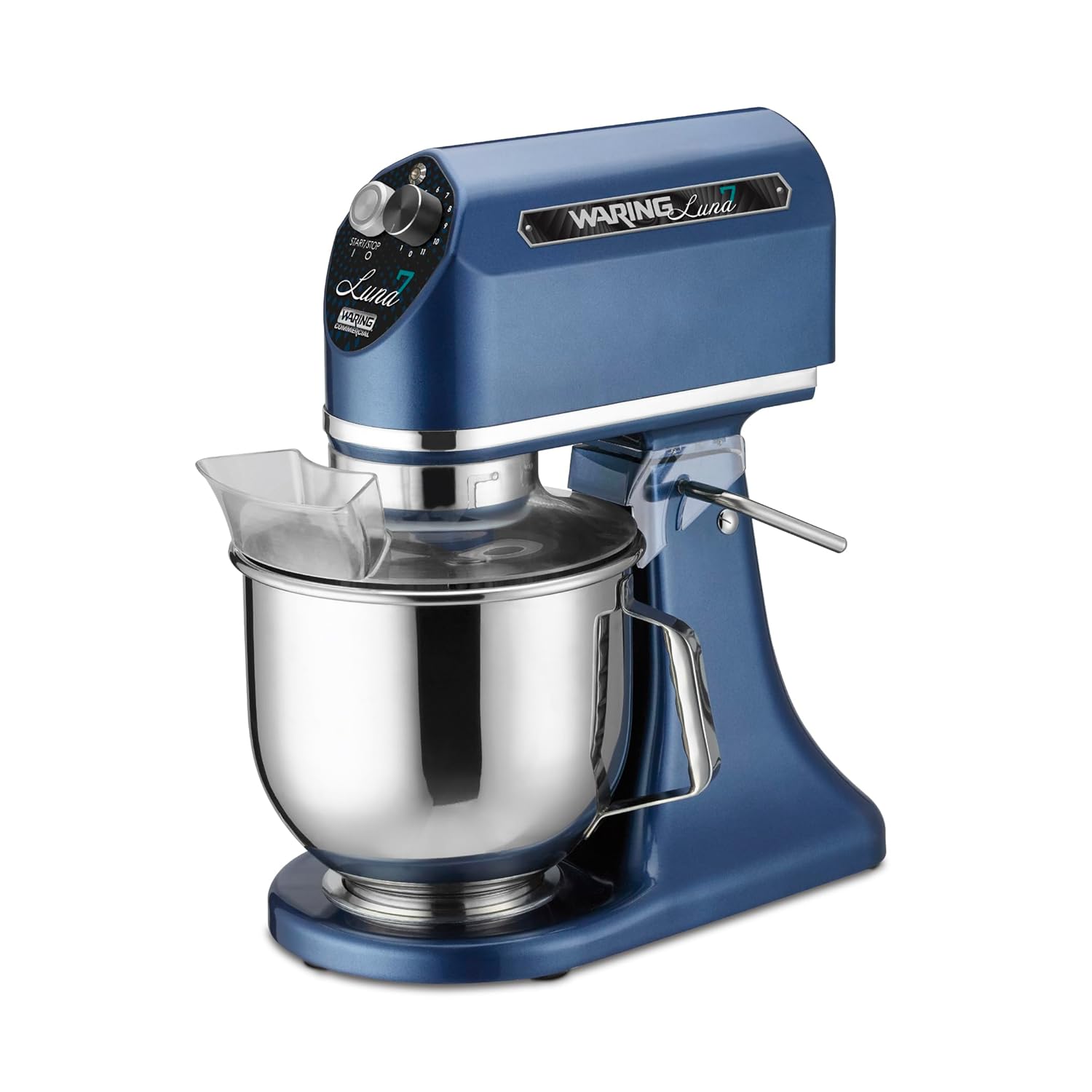
Waring Luna Stand Mixer WSM7L
| Capacity | 7 quarts |
|---|---|
| Motor power | 1/2 HP |
| Number of speeds | 11 |
| Wattage | 350 watts |
| Voltage | 120 volts |
The Waring Luna WSM7L is a compact commercial planetary mixer built for frequent kitchen use, offering a stainless steel 7-quart bowl and a 1/2 horsepower induction motor that handles batters, doughs, and heavy mixing tasks. It uses a front-mounted dial with 11 variable speeds for precise control from slow folding to vigorous whipping, and the tilt-back head plus lift lever make installing attachments and removing the bowl straightforward. The unit includes a stainless whisk, aluminum paddle, and dough hook, and a removable clear splash guard with feed chute keeps work areas cleaner when adding ingredients. Thermal overload protection and a permanently lubricated transmission improve reliability in demanding settings, and the mixer is NSF listed and ETL certified for commercial use. Trade-offs are its weight and countertop footprint that reflect its robust construction, and the motor is not intended for very heavy industrial doughs like thick pasta dough where larger models are recommended. For bakeries, restaurants, and catering operations that need a durable, versatile mixer in a medium capacity, the WSM7L delivers consistent, professional performance.
Best for: Buyers who need a reliable, medium-capacity commercial mixer for restaurants, bakeries, or catering that balances power, durability, and countertop footprint for frequent professional use.
Less Ideal for: Operators who primarily mix extremely dense or very large batches of dough or who need a compact consumer home mixer for occasional baking should consider other models.
- Powerful 1/2 HP induction motor with gear-driven transmission for sustained commercial use
- 11-speed variable control provides precise mixing from gentle folding to high-speed whipping
- Includes essential attachments (whisk, paddle, dough hook) and a stainless steel 7-quart bowl
- Tilt-back head and removable splash guard with feed chute simplify access and continuous ingredient addition
- NSF listed and ETL certified for professional foodservice environments
- Not intended for very heavy, dense doughs like thick pasta dough where larger models are recommended
- Heavier and bulkier than home mixers, requiring stable countertop space
Verdict: A rugged, medium-capacity commercial mixer that delivers precise, reliable performance for professional kitchens needing a versatile workhorse.
KitchenAid Commercial 8-Quart Mixer

| Capacity | 8 quarts |
|---|---|
| Wattage | 500 |
| Number of Speeds | 10 |
| Voltage | 120 |
The KitchenAid Commercial Series 8-Quart Bowl-Lift Stand Mixer is built for high-volume, repeatable performance in commercial kitchens. It pairs a robust 1.3 HP motor (delivering 0.44 HP to the bowl) with PowerCore technology and an 8-quart stainless steel bowl to handle large doughs, long mixing cycles, and multiple batches without excessive heat buildup. The bowl-lift design and stainless steel bowl guard keep heavy loads stable and improve safety during operation, and commercial-grade attachments including a spiral dough hook, flat beater, and 11-wire whip are included. NSF certification and an extra-durable cord make it suitable for foodservice environments, while speed control protection and a soft-start feature reduce splash and accidental starts. On the downside, its size and 25 pound weight mean it is intended for counter or stand placement rather than frequent moving, and the single-bowl 8-quart capacity may be overkill for casual home bakers. For users who need reliable, heavy-duty mixing day after day, this mixer delivers the power and build quality to match that need.
Best for: Bakers, caterers, and small commercial kitchens that need a durable, high-torque mixer able to handle long mixing cycles and large batches reliably.
Less Ideal for: Home cooks with only occasional baking needs or anyone who requires a lightweight, portable mixer for small batches.
- Commercial-grade motor with PowerCore technology for consistent power and reduced heat buildup
- NSF certified and equipped with an extra-durable orange cord for commercial environments
- Includes heavy-duty stainless steel attachments: spiral dough hook, flat beater, and 11-wire whip
- Bowl-lift design and stainless steel bowl guard for stable mixing and improved safety
- Large and heavy, so it is not convenient to move between workspaces
- 8-quart capacity and commercial focus may be excessive for casual home bakers
Verdict: Choose this mixer when you need a commercial-grade, heavy-duty stand mixer that reliably handles large batches and long mixing jobs.
CuisinAid Commercial Stand Mixer 15Qt

| Wattage | 600 watts |
|---|---|
| Number of Speeds | 3 |
| Capacity | 15 quarts |
| Voltage | 110 |
This CuisinAid commercial stand mixer is built for small bakery and pizzeria kitchens that need a robust, no-frills machine. The 600W motor and three speed settings (130/233/415 RPM) handle mixing, whipping, and dough work in a 15-quart stainless steel bowl, and the package includes a dough hook, flat beater, and wire whip. Practical safety touches include a stainless steel guard with an automatic shutdown if opened and separate start/stop controls, and non-slip feet help reduce vibration during operation. The unit is straightforward to operate and clean thanks to durable stainless steel components, though the three-speed knob limits fine speed control compared with machines that offer variable or many-speed settings. It is sized and powered for frequent, mid-volume commercial use but is relatively large and heavy for home kitchens. For those prioritizing simple, reliable mixing performance in a professional setting, this mixer delivers solid value and durability.
Best for: Operators who need a tough, easy-to-use commercial mixer for regular mid-volume baking or pizza prep and who value durability and safety over advanced speed control.
Less Ideal for: Casual home bakers with limited counter space or users who need fine-grain speed adjustment for delicate recipes should consider smaller or more feature-rich mixers.
- 600W motor with three speed settings suitable for mixing, whipping, and dough
- Generous 15-quart stainless steel bowl and food‑safe 304 stainless attachments
- Safety guard with automatic shutdown and separate start/stop controls
- Non-slip feet to reduce vibration and improve operational stability
- Only three fixed speeds limit precise speed tuning for delicate tasks
- Large footprint and weight make it impractical for smaller kitchens
Verdict: A sturdy, safety-focused 15-quart commercial mixer that reliably handles frequent mid-volume mixing tasks for small professional kitchens.
Generic 20Qt Commercial Mixer

| Capacity | 20 quarts |
|---|---|
| Wattage | 1100 watts |
| Voltage | 110 volts |
| Number of Speeds | 3 |
This 20Qt commercial stand mixer is built for high-volume kitchens that need a durable, no-frills workhorse. It uses a 750W motor with three speeds (105, 180, 408 RPM) to handle tasks from whipping egg whites to kneading dense pizza dough, and the 20-quart stainless steel bowl accommodates batches up to about 6.6 pounds of dough. The package includes a spiral dough hook, flat beater, and wire whip so you can mix doughs, batters, and creams without buying extras, and food-grade stainless-steel contact parts simplify cleanup and sanitation. Controls are button-based and straightforward, and the gear-driven heavy construction is aimed at continuous use in bakeries, pizzerias, and institutional kitchens. Limitations to consider are basic speed control with only three settings and a straightforward feature set without timers or electronic presets, so it is best where raw mixing power and reliability matter more than refined controls or accessory ecosystems.
Best for: Operators who need a rugged, high-capacity mixer that reliably handles frequent batch work in commercial kitchens while keeping features simple and maintenance low.
Less Ideal for: Home bakers seeking compact units with advanced electronic controls or hobbyists who want many speed increments and accessory ecosystems.
- Large 20-quart stainless steel bowl handles batch mixing for bakeries and pizzerias
- 750W motor with three speed options covers light to heavy mixing tasks
- Includes dough hook, flat beater, and wire whip for common commercial uses
- Food-grade stainless-steel contact parts resist corrosion and are easy to clean
- Only three fixed speeds limits fine control for delicate recipes
- Basic button controls without digital displays or timers
Verdict: A straightforward, heavy-duty 20-quart mixer that delivers reliable commercial mixing capacity and durability for budget-minded kitchens.
KitchenAid Commercial 8-Quart Mixer KSM8990CU

| Capacity | 8 quarts |
|---|---|
| Wattage | 500 watts |
| Number of Speeds | 10 |
| Voltage | 120 volts |
This KitchenAid Commercial 8-Quart bowl-lift mixer is built for frequent, heavy use in professional kitchens and bakeries. The bowl-lift design keeps large batches stable while the included commercial-grade spiral dough hook, flat beater, and 11-wire whip cover kneading, mixing, and whipping tasks without needing aftermarket accessories. A high-efficiency DC motor with PowerCore technology and an advanced motor control board delivers strong, consistent torque while minimizing heat buildup, which helps the mixer run longer under load. The mixer is NSF certified and uses an extra-durable orange commercial cord to meet health-inspection expectations, so it fits a commercial environment straight out of the box. Ten speed settings, soft-start operation, and speed-control protection make it easy to start heavy doughs without splash-out or accidental starts during cleaning. The unit is heavy and built from stainless steel and zinc, so it is stable but not designed for frequent portability. This is a purpose-built commercial machine that prioritizes durability and continuous performance over lightweight convenience.
Best for: Small bakery, cafe, or foodservice operators who need a reliable, NSF-certified mixer that stands up to daily, high-volume mixing and kneading.
Less Ideal for: Casual home cooks seeking a lightweight, compact mixer or anyone who needs a highly portable unit for occasional use.
- NSF certified and supplied with commercial-grade accessories for immediate use in professional kitchens
- PowerCore high-efficiency DC motor and advanced control board deliver sustained torque with reduced heat buildup
- Bowl-lift design provides stable mixing for large or heavy batches
- Soft-start and speed-control protection reduce splash-out and accidental starts
- Includes durable stainless-steel 8-quart bowl and premium 11-wire whip for reliable whipping performance
- Heavy, not suited for frequent moving or small home kitchens
- No built-in attachments beyond the included three, so specialty tasks may need additional purchases
Verdict: Choose this KitchenAid commercial mixer when you need a durable, NSF-certified 8-quart machine that delivers sustained power and dependable day-to-day performance.
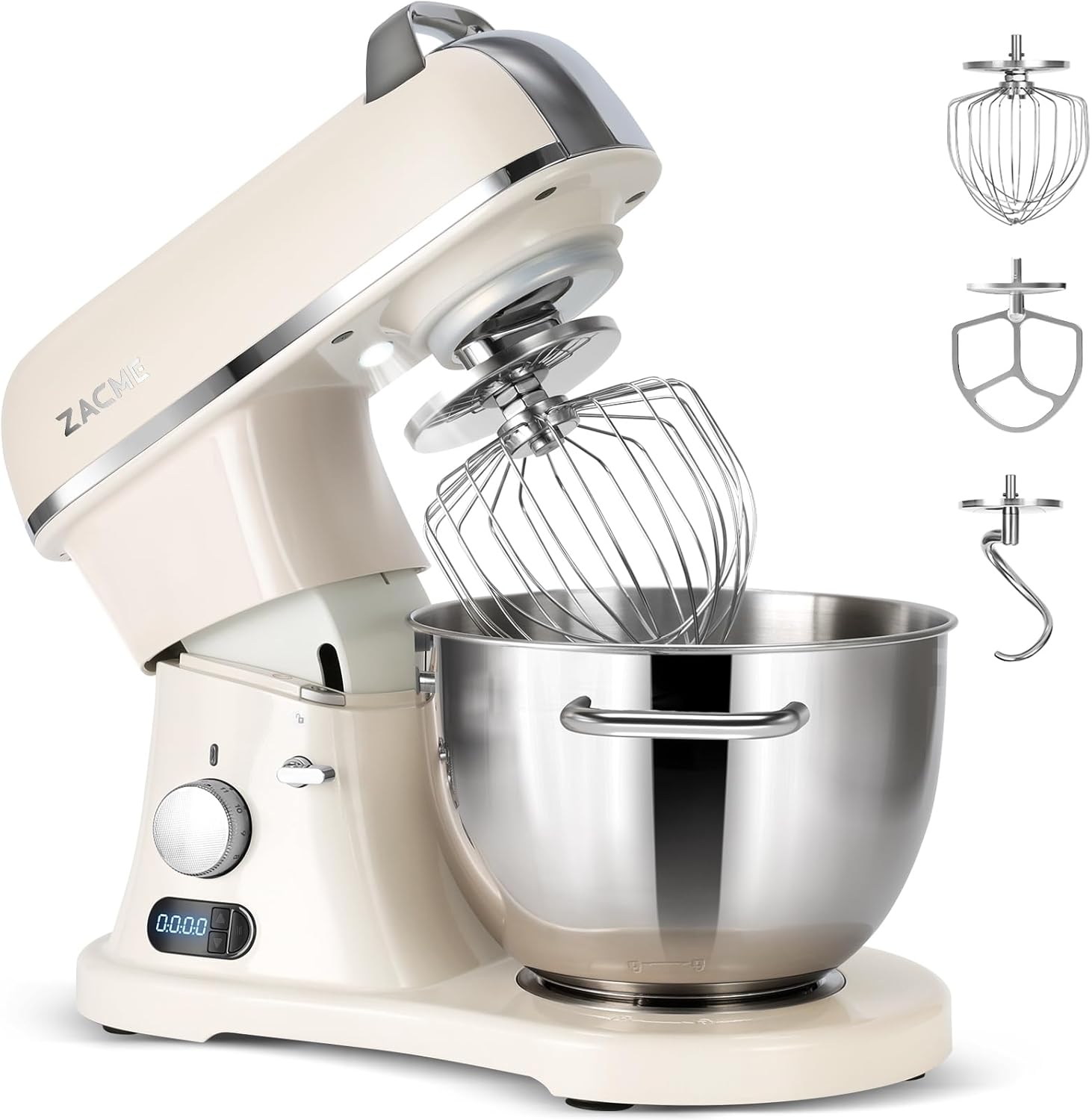
ZACME 8.4QT Commercial Stand Mixer
| Capacity | 8.4 quarts |
|---|---|
| Wattage | 800 watts |
| Number of Speeds | 11 |
| Noise Level | 48 db |
| Voltage | 120 volts |
The ZACME 8.4QT Commercial Stand Mixer is built for frequent, large-batch mixing: an 800W DC motor, metal gears and planetary action tackle doughs, batters and whipped creams without needing manual scraping. It uses a tilt-head design and an included 8.4 qt stainless bowl with dough hook, flat beater and wire whip, and the LED display includes a countdown timer so you can set mixes and walk away. Eleven speed settings plus a knob-plus-LCD control make it easy to dial in gentle folding or high-speed whipping, while dual cooling fans and overload protection help sustain longer runs. The aluminum die-cast body and suction-foot anti-slip base add stability and a commercial feel, and noise is kept relatively low on lower speeds. Trade-offs are its 33 lb weight and fairly large footprint, which demand a dedicated countertop spot, and while the machine meets NSF/ANSI 8-2023 it does not list replaceable factory-quality planetary attachments beyond the basic set.
Best for: Buyers who prioritize proven, high-capacity performance and want a mixer that can handle repeated commercial-style batches with visible user feedback and safety testing.
Less Ideal for: If you need a lightweight, highly portable mixer or want a wide range of specialty attachments out of the box, this heavier commercial unit is not the best match.
- Robust 800W DC motor with metal gears for heavy-duty kneading and long runs
- Large 8.4-quart stainless steel bowl suits family or small commercial batches
- Digital LED display with countdown timer and 11 speed settings for precise control
- Aluminum die-cast body and anti-slip base provide stability and commercial-grade durability
- Dual cooling fans and overload protection allow extended continuous use
- Heavy and relatively large, requiring permanent countertop space
- Included accessory set is basic; specialized or additional attachments are not listed
Verdict: Choose this mixer when you need a sturdy, commercial‑grade 8.4‑quart machine that reliably handles large batches and extended use.
VEVOR Commercial Food Mixer 15Qt

| Capacity | 14 liters |
|---|---|
| Wattage | 550 watts |
| Number of Speeds | 3 |
| Noise Level | 70 db |
| Voltage | 110 volts |
The VEVOR Commercial Food Mixer is a heavy-duty 15 qt stand mixer built for small commercial kitchens, bakeries, and cafes. It uses a 550W gear-driven motor and three selectable speeds (low, medium, high) to handle dough kneading, mixing batters, and whipping creams, and it includes a dough hook, flat beater, and wire whisk for common tasks. The machine has a lever-style bowl lift and a 0–30 minute timer that stops the motor automatically, which helps with repeatable batches and hands-off operation. Safety features include a splash guard and an automatic shutdown if the cover is open. Construction mixes cast iron and stainless-steel contact parts for durability and easier cleaning, but the unit is large and heavy, so it suits a fixed commercial workspace rather than a home countertop. Noise is listed around 70 dB and the control interface is a simple knob, which keeps operation straightforward but limits fine speed control. For buyers wanting a rugged, no-frills commercial mixer to run regular batches, this covers the basics well; those needing quieter, lighter, or more precisely controlled machines should compare other models.
Best for: Buyers seeking a durable, straightforward commercial mixer for regular batch production in restaurants, bakeries, or cafes who prioritize reliability and simple controls over portability or precision.
Less Ideal for: Home cooks with limited counter space or users who need a lightweight, ultra-quiet, or micro-adjustable speed mixer should consider lighter or consumer-grade alternatives.
- Heavy-duty construction with cast iron body and stainless-steel bowl for commercial durability
- 550W gear-driven motor with three speeds to handle dough, batters, and whipping
- Includes three standard attachments (dough hook, flat beater, wire whisk) for versatile mixing tasks
- Lever-style bowl lift and 0–30 minute timer for repeatable, hands-off batching
- Safety guard and automatic shutdown when cover is open for safer operation in busy kitchens
- Large and heavy, intended for a fixed commercial workspace rather than portable use
- Simple knob control limits fine speed adjustments compared with variable-speed electronic drives
Verdict: A no-frills, heavy-duty 15 qt commercial mixer that delivers reliable, repeatable mixing for small professional kitchens.
Choosing the Right Commercial Mixer: Key Factors to Consider
Motor Power and Torque
Commercial mixers must generate enough sustained power and torque to mix dense doughs and large batches without stalling. Higher continuous-duty motor ratings matter when you run multiple back-to-back batches or work with stiff bread doughs that require force to knead. Torque is especially important at low speeds; a mixer with strong low-speed torque will knead dough more effectively than a higher-rpm motor with less torque.
Assess the motor rating in horsepower or kilowatts and look for service-duty or continuous-duty specifications rather than short-term peak ratings. Consider how often you will run the mixer at heavy loads and factor in any future capacity increases to avoid chronically stressing the motor.
Bowl Capacity and Accessory Compatibility
Choose a bowl size that fits your typical batch size while leaving headroom for mixing action and ingredient expansion. Undersized bowls force smaller batches and slow production, while oversized bowls can be inefficient for low-volume kitchens. Also check what attachments and accessories the mixer supports, such as dough hooks, paddle beaters, whisks, and planetary or spiral mixing heads.
Interchangeable attachments and optional accessories expand a mixer's versatility, letting you handle batters, icings, and meats as well as doughs. Compatibility with standard commercial attachment platforms helps future-proof the machine and reduces the need for separate specialty equipment.
Construction Materials and Serviceability
A commercial mixer should be built from durable materials such as stainless steel and cast metal components that stand up to daily wear. Look for reinforced gears, metal housings, and corrosion-resistant bowls and attachments. Serviceability matters: mixers with accessible drive components, replaceable belts or gears, and available spare parts reduce downtime and lifetime cost of ownership.
Regular maintenance intervals and straightforward lubrication points make it easier to keep the machine in service. Confirm that replacement parts and authorized service channels are available for your location to avoid long repairs.
Cleaning, Sanitation, and Food Safety
Commercial kitchens require equipment that can be cleaned and sanitized quickly and reliably. Smooth surfaces, removable bowls, and attachments that are dishwasher-safe or easily washed by hand reduce labor time and help maintain food safety. Sealed switches and guarded moving parts prevent food ingress into mechanical areas.
Design features that minimize crevices and trap points are preferable. Consider how the mixer will be cleaned between production runs and whether the materials and finishes meet your operation's sanitation protocols and regulatory requirements.
Controls, Safety Features, and Noise
User-friendly controls and robust safety features help prevent accidents and improve workflow. Look for clear speed ranges, progressive start or variable-speed control, emergency stop capability, and bowl-guard interlocks that shut the machine off when the guard is open. Noise and vibration levels affect staff comfort and may determine siting or the need for isolation platforms.
Programmable timers or digital controls can aid consistency across shifts, but ensure any electronics are rated for commercial environments and are serviceable.
Choosing the Right Capacity for Your Operation
Match bowl size to typical batch volumes rather than theoretical maximums. Bakeries that produce large numbers of loaves or trays will favor higher-capacity bowls, while a restaurant with varied menu items may benefit from a mid-sized bowl that balances flexibility and efficiency.
Consider how many batches you run per shift and whether you will scale production. Running a mixer at or near full capacity every cycle shortens component life and increases maintenance needs, so leave a margin when deciding capacity.
- Estimate daily and peak batch sizes before selecting bowl capacity
- Prefer modular or accessory-driven systems for mixed-use kitchens
- Factor in the space and clearance needed to load and unload large bowls
Spiral Vs Planetary Mixers: Function and Fit
Spiral mixers are purpose-built for dough development, offering strong torque and gentle mixing action that preserves gluten structure. Planetary mixers are more versatile and handle a wider range of tasks via different attachments, but may not knead heavy dough as efficiently as a spiral.
If your core production is bread and high-hydration doughs, prioritize machines designed specifically for dough work. For multi-function kitchens that produce batters, icings, and small doughs, a planetary-style commercial mixer often provides better overall value.
- Spiral: best for high-volume dough production and consistent gluten development
- Planetary: best for versatility across batters, fillings, and smaller doughs
Maintenance Practices That Extend Service Life
Routine maintenance prevents unexpected downtime. Establish a schedule for inspecting drive belts or gears, lubricating moving parts, and checking fasteners. Clean the mixer after each use and perform deeper inspections weekly or monthly depending on workload.
Train staff on proper loading techniques and on the signs of motor strain, such as unusual noises or slower starts. Early detection of wear reduces repair complexity and cost.
- Daily: wipe down surfaces, remove and clean attachments
- Weekly: inspect guards and fasteners, check belt tension
- Monthly: verify lubrication points and listen for atypical noises
Space Planning and Installation Considerations
Commercial mixers can be heavy and require stable, level surfaces that support their weight and damp vibration. Verify floor loading, clearance for bowl removal, and access for maintenance. Consider workflow: position mixers near ingredient prep and proofing or refrigeration areas to streamline movement.
Electrical supply is critical. Confirm the motor's voltage and phase requirements and ensure circuit capacity and outlet placement match local codes. Ventilation and noise mitigation may also influence placement.
- Measure clearances for bowl swing and attachment removal
- Check floor rating and consider anti-vibration mounts if needed
- Confirm electrical supply type and dedicated circuits
Attachments and Accessories That Increase Versatility
A robust accessory ecosystem turns a mixer into a multi-purpose tool. Common attachments include dough hooks, paddles, whips, meat grinders, and vegetable slicers. Evaluate which accessories you will use immediately and which might be useful as your menu expands.
Also consider storage and changeover time for attachments; quick-release systems and labeled storage help staff switch tasks fast during peak service.
- Prioritize attachments that match your most frequent tasks
- Look for quick-change attachment systems to reduce downtime
- Plan for secure storage to prevent damage and cross-contamination
How We Chose the Best Commercial Mixer
We focused on attributes that determine a commercial mixer's real-world performance under continuous professional use. Primary evaluation criteria included motor power and torque to handle dense doughs, bowl capacity and accessory compatibility for volume flexibility, build quality and materials for long service life, and ease of cleaning and maintenance to minimize downtime. We also considered safety features such as guard design and automatic shutoffs, plus noise and vibration characteristics that affect the working environment. To be included, mixers had to be built to commercial duty cycles, use industrial-grade components, and provide clear specifications for power and capacity. We excluded light-duty domestic machines and units without replaceable service parts. Our selection emphasizes mixers that balance sustained power with practical bowl sizes and straightforward maintenance, so buyers can match machine capabilities to their production scale and menu requirements.
Our full evaluation process is outlined in our review methodology.
FAQ
What motor size do I need for commercial bread dough?
It usually depends on batch size and dough stiffness. Larger batches and high-hydration or whole-grain doughs require higher continuous-duty motor ratings with strong low-speed torque. Check the mixer's recommended maximum dough capacity as a guide.
How often should I service a commercial mixer?
Daily cleaning is essential, with basic inspections weekly and more thorough service monthly or quarterly depending on usage. Heavy-use operations may need professional servicing more frequently to replace wear parts before failures occur.
Can one mixer handle all kitchen tasks?
Often a single mixer can cover many tasks if it supports multiple attachments, but there are tradeoffs. Machines specialized for dough often outperform multi-purpose models on heavy kneading, while versatile mixers are better for varied batters and small-batch tasks.
Are commercial mixers difficult to clean?
Cleaning complexity varies by design. Mixers with removable bowls and attachments and smooth exterior surfaces are straightforward to sanitize. Units with exposed gears or hard-to-reach crevices require more disassembly and time.
What safety features should I expect on a commercial mixer?
Look for bowl guards, interlock switches that stop the mixer when the guard is opened, emergency stop controls, and clearly labeled speed settings. These features reduce the risk of injury during operation and maintenance.
Final Verdict
Prioritize the attributes that most affect your daily production: motor power and torque for heavy doughs, bowl capacity for batch sizing, and construction and serviceability for long-term uptime. Consider whether you need a specialized dough machine or a more versatile planetary-style unit and factor in cleaning and safety features that fit your workflow. Balance current needs against potential growth and choose a mixer that leaves some capacity margin to avoid routine overloading. With the right combination of power, capacity, and serviceability, you can select a commercial mixer that supports consistent product quality and reliable operation in a professional kitchen.