
Note: This article contains affiliate links. If you click on these links and make a purchase, we may earn a small commission at no extra cost to you. This helps support our research and content. Read our full affiliate disclosure here.
Choosing the right commercial oven for baking bread has a direct impact on product consistency, throughput, and kitchen workflow. Whether you run a bakery, cafe, or commissary, the oven you pick affects crust development, oven spring, and daily capacity. This guide presents a shortlist of the top commercial ovens for baking bread that meet the needs of professional bakers, from small-batch artisan producers to higher-volume operations. We evaluated models across practical criteria such as temperature accuracy, interior airflow, and usable capacity so you can match a unit to your production goals. Read on to see which options made the cut and why they might fit your bakery.
Top Picks at a Glance
| Best Overall The best all-around choice for most situations | CROSSON Commercial Convection Oven 125L |  |
| Best Quality Built to a higher standard if you want something more solid | 32-Tray Rotary Rack Oven |  |
| Best Value The sweet spot between price and what you get | KoolMore Commercial Countertop Convection Oven |  |
| Best Budget The cheapest option that still gets the job done reliably | Winco EPO-1 Pizza Oven |  |
| Top Rated A top-rated pick with lots of positive feedback | Avantco CO-14 Countertop Convection Oven |  |
| Most Popular A crowd favorite that many people choose with confidence | VEVOR Commercial Convection Oven 60Qt |  |
CROSSON Commercial Convection Oven 125L

| Capacity | 125 liters |
|---|---|
| Wattage | 4500 watts |
| Control Type | Knob Control |
| Number of Shelves | 4 |
This CROSSON commercial convection oven is a heavy-duty countertop unit built for baking larger batches. It uses a 4500W heater and a bi-directional fan that reverses every 30 seconds to promote even heat distribution across four adjustable shelves, which makes it suited to baking multiple loaves or trays at once. The oven adds a spray humidification function to help retain surface moisture for softer crusts, and the double-layer tempered glass with interior lighting makes monitoring bake progress easy while keeping the door cooler to the touch. Controls are simple knob-style dials so settings are quick to change but not as precise as digital presets, and the unit is large and requires a dedicated, properly rated 240V circuit. Practical details like a magnetic seal strip, ventilation, and stable feet help it behave reliably in a busy kitchen, but its size and power needs limit placement and may require professional electrical setup.
Best for: Bakers who need a robust countertop oven to produce medium-to-large commercial batches and who value airflow consistency and moisture control when baking breads.
Less Ideal for: Casual home bakers with infrequent use, those lacking commercial electrical capacity, or anyone needing a compact or highly portable oven.
- Large 125L/4.4 cu.ft. capacity handles multiple loaves or large batches
- Bi-directional fan with frequent reversal promotes even browning across racks
- Spray humidification helps retain moisture for softer bread crusts
- Double-layer tempered glass and interior light allow visual monitoring while reducing exterior heat
- Stainless steel construction with magnetic seal and stable feet designed for commercial use
- Requires a 240V/4500W supply which may need dedicated circuit installation
- Knob-only controls limit precision compared with digital timers and presets
- Large footprint may not fit small kitchens or limited counter space
Verdict: Choose this oven if you need a powerful, large-capacity countertop convection oven that delivers even airflow and added humidification for consistent bread baking results.
32-Tray Rotary Rack Oven

| Capacity | 0.9 cubic_meters |
|---|---|
| Size | 32-Tray |
| Material | Stainless Steel |
| Control Type | Button Control |
| Temperature Range | 1–300°C |
This 32-tray rotary rack oven is built for commercial baking environments where consistent, high-volume output matters. It uses a rotating rack and hot air circulation to deliver even heat across all trays, and the steam feature helps achieve desirable crust and crumb development for bread and pastries. Controls are button-driven with an LED display, adjustable thermostat, and timer, so operators can set temperature and cycles for repeatable results. The oven's large capacity and efficient convection airflow shorten bake times and let bakeries run continuous batches without obvious hot spots. Practical limitations include its industrial footprint and the need for proper installation, ventilation, and electrical setup in a commercial kitchen, plus the seller notes custom configuration options which require coordination before purchase. For bakeries and central kitchens focused on throughput and consistent bake quality, this oven provides a factory-quality solution; smaller artisan shops with limited space or simpler single-deck needs may find it more oven than required.
Best for: Bakeries, central kitchens, and food production facilities that prioritize high throughput and consistent bake quality for breads and pastries.
Less Ideal for: Small artisan bakers or cafes with limited space and lower daily output should consider smaller single-deck or countertop ovens instead.
- Rotating rack with hot air circulation for uniform baking across all trays
- Large 32-tray capacity suited to high-volume production
- Steam feature supports better crust and crumb development for bread
- LED display with adjustable thermostat and timer for repeatable control
- Stainless steel construction built for commercial use
- Requires significant floor space and proper commercial installation
- Seller-configured options mean buyers must verify voltage and accessories before ordering
Verdict: Buy this oven if you need a factory-quality, high-capacity rotary rack solution that delivers consistent, repeatable results for large-scale bread production.
KoolMore Commercial Countertop Convection Oven

| Wattage | 1600 watts |
|---|---|
| Temperature Range | 0-500 °F |
| Number of Shelves | 4 |
| Capacity | 1.5 cubic feet |
This KoolMore countertop convection oven is built for small professional kitchens and bakeries that need reliable, even baking in a compact footprint. It uses 1600 watts and convection airflow to produce consistent heat up to 500°F across four rack positions sized for half-size pans, so you can bake multiple loaves or trays at once. Controls are simple dial-style settings which keep operation straightforward for busy staff, and the stainless-steel body with tempered glass door is easy to clean and durable in daily use. The oven is best for low- to medium-volume batches; the 1.5 cu. ft. chamber and half-size pan orientation trade off maximum capacity for counter-friendly convenience. There are no advanced digital programs or precise timers, so operators who need tight programmable profiles or large-batch production may find it limiting. For bakeries or cafes that value space efficiency, robust construction, and steady convection baking for modest runs, this model offers practical performance without complexity.
Best for: Bakers running a small bakery, cafe, or test/batch kitchen who need reliable, even convection baking for modest daily batches and prefer a straightforward, durable countertop unit.
Less Ideal for: High-volume commercial bakeries that require large-capacity ovens, tight programmable controls, or continuous production should consider full-size deck or rack ovens instead.
- Convection heating with 1600W power for even baking across racks
- Four rack positions designed for half-size pans to bake multiple trays at once
- Stainless-steel construction and tempered glass door for durability and easy cleaning
- Compact countertop design that fits small commercial kitchens and cafes
- 1.5 cu. ft. capacity limits batch size for larger bakeries
- Dial controls lack advanced programmable settings or precision timers
Verdict: A compact, durable convection oven that delivers even baking for small commercial batches and tight counter spaces.
Winco EPO-1 Pizza Oven

| Wattage | 1500 watts |
|---|---|
| Control Type | Knob Control |
| Power Source | AC, 120V, 60Hz, 1-phase |
| Capacity | 12 cubic inches |
The Winco EPO-1 is a straightforward commercial countertop oven built to bake 12-inch pizzas and similar items like breadsticks and small loaves. It uses two heating elements to reach and maintain baking temperature quickly, and a 60-minute mechanical timer with bell helps track bake times; a stay-on setting supports continuous operation during busy shifts. Its stainless steel exterior and removable crumb tray simplify cleanup in a small foodservice environment. With knob controls and 1500 watts of power the unit is simple to operate and durable enough for light to moderate commercial use. Limitations include the modest internal capacity, which restricts throughput to single items at a time, and the lack of precise digital temperature controls or convection fans for advanced artisan bread shaping and multi-shelf baking. For bakeries or kitchens needing high-volume production or exact temperature profiles, a larger or more controllable deck oven would be a better fit.
Best for: Bakers or small foodservice operators who need an affordable, durable countertop oven for occasional to moderate batch baking of single 12" pizzas or similar items.
Less Ideal for: High-volume bakeries or shops that require multi-shelf baking, precise digital temperature control, or larger capacity ovens for continuous throughput.
- Dual heating elements for quick, even heating
- 60-minute timer with bell and stay-on option for continuous operation
- Stainless steel construction and removable crumb tray for easy cleaning
- Small internal capacity limits production to one 12" pizza or loaf at a time
- No digital temperature control or convection feature for precise artisan baking
Verdict: A budget-friendly commercial countertop oven that delivers quick, even baking for single 12" pizzas or small batches, ideal when affordability and simplicity matter most.
Avantco CO-14 Countertop Convection Oven

| Capacity | 0.8 cubic feet |
|---|---|
| Wattage | 1440 watts |
| Temperature Range | 150°F–500°F |
| Number of Shelves | 3 |
The Avantco CO-14 is a quarter‑size countertop convection oven built for small commercial kitchens or bakeries needing dependable, space‑saving capacity. It uses a 1440W forced‑air system to circulate heat evenly across up to three quarter sheet pans on the included wire racks, and its adjustable knob controls let you set temperatures from 150°F to 500°F for a wide range of baking applications. Stainless steel construction and a dropdown door make it straightforward to clean and service, and the NEMA 5-15P 120V plug means it runs on standard outlets without special wiring. Because it is a true compact unit, interior space is limited compared with full‑size ovens, so it is best for small batch production, proofing and finishing rather than large daily volume. The built‑in timer and ETL sanitation listing add to its reliability for foodservice use, while the simple mechanical controls reduce points of failure over time.
Best for: Bakers and small foodservice operators who need a reliable, no‑frills countertop convection oven for small batches and finishing tasks in limited space.
Less Ideal for: Large bakeries or operations that require high daily throughput or full‑size sheet pan capacity should choose a larger commercial oven.
- Compact quarter‑size footprint fits tight counters or prep stations
- Convection heating with 1440W fan for more even baking results
- Holds three 1/4 sheet pans for simultaneous small‑batch baking
- Stainless steel construction and simple knob controls are easy to clean and maintain
- Adjustable 150°F–500°F temperature range covers common baking needs
- Limited interior capacity not suited for high‑volume production
- Runs on 120V so heat-up and recovery are slower than higher‑voltage commercial ovens
Verdict: Choose the Avantco CO-14 when you need a dependable, compact convection oven for small-batch commercial baking in tight spaces.
VEVOR Commercial Convection Oven 60Qt
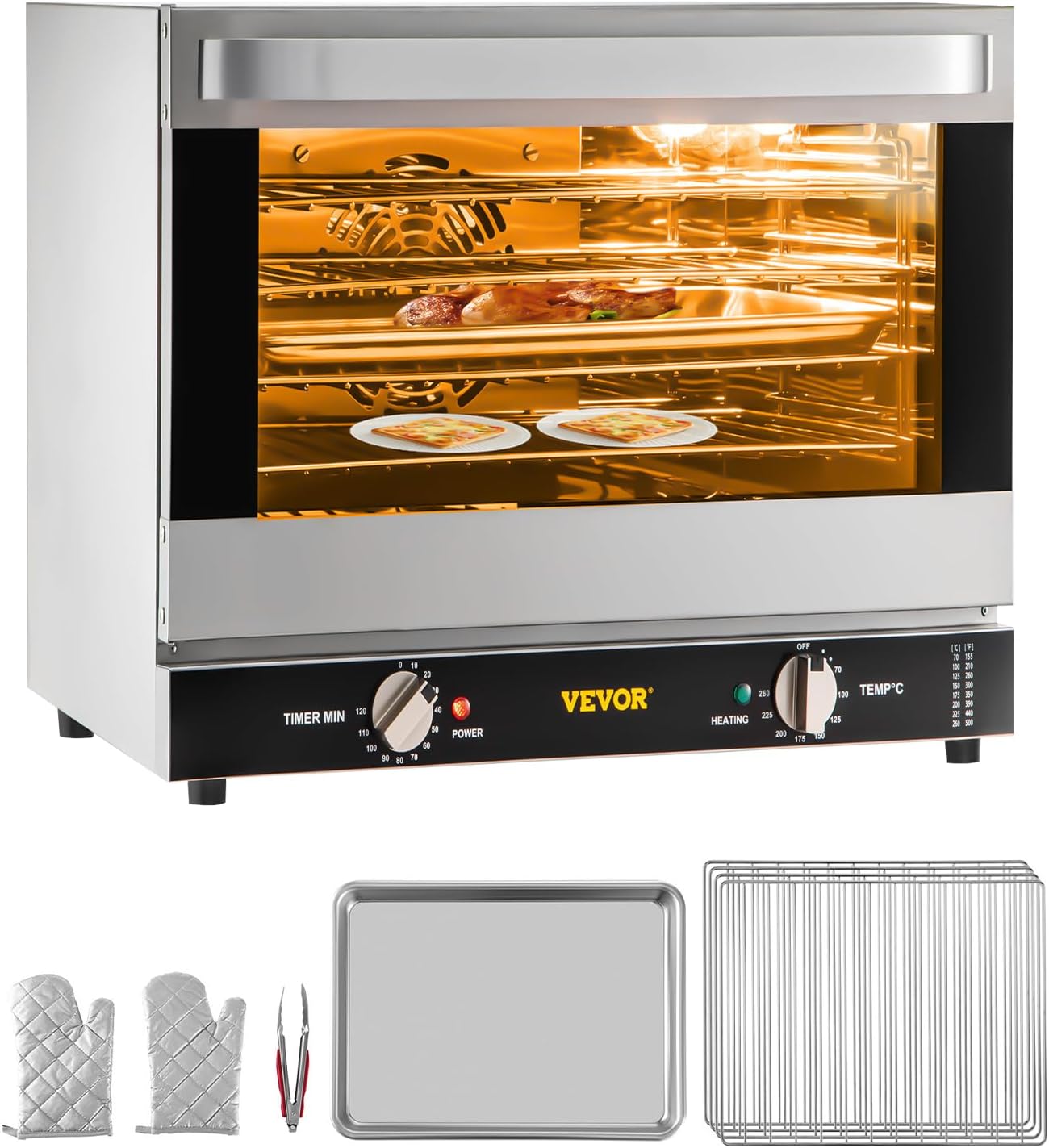
| Wattage | 1800 watts |
|---|---|
| Temperature Range | 65-250 °C |
| Number of Shelves | 4 |
| Capacity | 60 quarts |
| Control Type | Knob Control |
This VEVOR countertop convection oven is built for small bakery production and heavy home baking, offering a roomy 60‑quart (66 L) interior across four shelves so you can batch bake breads, pastries, pizzas and rotisserie-style proteins. It uses an 1800W heater with an internal fan to circulate hot air for more even browning and faster bake times than a conventional oven, and the temperature dial plus 0–120 minute timer make it straightforward to set custom cycles. The stainless steel cabinet and dual-wall tempered glass door feel durable and are easy to wipe clean, and included wire racks, a tray and heat-resistant gloves get you baking right away. Practical details like a magnetic door seal and vents for heat dissipation help maintain stable temperatures during longer bakes. Downsides to consider are basic knob controls with no digital precision or presets and the requirement for a 5-15P outlet, which limits installation locations in some commercial settings.
Best for: Bakers or small commercial operators who need a compact, high-capacity countertop convection oven for regular batch baking and value straightforward, durable equipment backed by positive user feedback.
Less Ideal for: Large commercial bakeries that require advanced programmable controls, multi-deck installations, or higher power capacities for continuous high-volume production.
- Large 60‑quart interior with four shelves supports batch baking multiple loaves or trays at once
- Convection fan and 1800W power promote even heat circulation and faster browning
- Durable stainless steel body and dual-wall tempered glass door are easy to clean and monitor
- Comes with wire racks, baking tray and heat-resistant gloves for immediate use
- Knob controls lack digital precision or programmable baking profiles
- Requires a standard 5-15P outlet which may limit placement in some commercial kitchens
Verdict: A sturdy, roomy countertop convection oven that delivers even, batch-friendly baking for small bakeries and serious home bakers who prioritize capacity and durability.
Choosing the Right Commercial Oven for Baking Bread: Key Factors to Consider
Temperature Control and Stability
Accurate temperature control is critical for bread baking because oven spring, crust formation, and crumb development all depend on predictable heat. Look for ovens with tight thermostat tolerances, clear digital controls, and the ability to hold setpoints over long bake cycles.
Stability matters more than peak heat. An oven that overshoots or cycles wildly produces inconsistent loaves, which increases waste and requires constant monitoring. Consider how quickly the oven recovers temperature after loading and how evenly it maintains that temperature across racks.
Heat Distribution and Airflow
Even heat distribution prevents uneven browning and underbaked centers. Assess whether the oven uses forced convection, deck heat, or a combination and how fan placement affects airflow. Forced-air systems can speed baking and improve color uniformity, while deck or stone configurations may give more direct radiant heat for crust development.
Airflow patterns also influence how many pans you can stack without compromising results. For multi-rack baking, check that the oven balances airflow across the whole cavity so top and bottom racks bake uniformly.
Steam and Humidity Control
Steam during the initial baking phase helps dough expand and forms a glossy, crack-free crust. Commercial ovens handle steam differently: some include built-in steam injection, others provide manual pans or humidity settings. Choose an oven whose steam method fits your baking process and volume needs.
Reliable, controllable steam is essential when producing products that need strong oven spring and thin, blistered crusts. Consider how steam is generated, how easy it is to refill or maintain, and whether the steam function can be timed or regulated during a bake cycle.
Usable Capacity and Rack Configuration
Capacity is more than internal volume. Rack layout, tray spacing, and the ability to load and unload quickly determine daily throughput. Match the oven's usable shelf area and number of usable positions to your typical batch sizes and peak service periods.
Think about how many proofed pans you load at once, whether you need mixed-product flexibility on different racks, and how the oven door design affects workflow. An oven with easy rack removal and sensible spacing reduces handling time and speeds production.
Energy Source and Operating Efficiency
Whether an oven is gas or electric affects long-term operating cost and installation needs. Gas ovens often provide strong radiant heat and fast recovery, while electric ovens can offer fine-grain temperature control and simpler site requirements.
Assess insulation quality and how quickly the oven reaches set temperatures. Efficient heat retention reduces fuel usage during long service days. Also consider duty cycle and how the oven performs under continuous use in a commercial environment.
Durability, Maintenance, and Serviceability
Commercial kitchens demand equipment that withstands heavy daily use and is straightforward to maintain. Look for robust construction materials, accessible service panels, and replaceable wear parts.
Easy cleaning of the bake chamber, straightforward access to heating elements and fans, and a clear parts/service pathway reduce downtime. Consider how frequently routine maintenance will be needed and whether common service tasks can be completed by on-staff technicians.
Deck Vs Convection: Which Works for Your Bread
Deck ovens provide strong radiant heat from stone or steel surfaces and are often favored for hearth-style loaves because they produce good bottom crust and oven spring. Convection ovens circulate hot air and deliver faster, more even baking across multiple racks, which suits higher-volume production and mixed-product runs.
When choosing between them, match the oven type to your typical product mix. If your menu emphasizes large hearth loaves and artisan baguettes, a deck configuration or stone deck insert can enhance crust. If you need consistent results across many pans and faster cycle times, convection or combi-convection units may be a better fit.
- Deck: Better radiant bottom heat, ideal for hearth-style breads
- Convection: Faster, more even multi-rack baking
- Combi options: Offer humidity control plus convection flexibility
Steam Options and Timing
Commercial ovens handle steam through built-in injection systems, removable water pans, or controlled humidity environments in combi units. Built-in injectors let you add short, timed bursts of steam at the start of the bake, which is ideal for consistent oven spring across batches.
If your baking relies heavily on steam, prioritize ovens with precise steam control and easy access for cleaning. Manual pan methods work for lower volumes but require more staff attention and create variability between batches.
- Built-in steam: Precise and repeatable results
- Water pans: Lower-tech option, needs frequent refilling
- Combi humidity: Best for flexible steam and proofing control
Capacity Planning and Workflow Integration
Plan around realistic daily volumes rather than peak hypothetical loads. Calculate how many loaves or pans you need per hour and choose an oven whose usable capacity supports that throughput with reasonable loading frequency. Under-sizing leads to overtime and bottlenecks, while oversized units can waste energy and counter valuable kitchen space.
Consider door swing, rack removal ergonomics, and whether the oven integrates with your existing workflow for proofing, cooling, and finishing. Where possible, test rack spacing with your actual pans to ensure fit and to avoid surprises after installation.
- Measure pans and load patterns before purchasing
- Account for door clearance and staff movement
- Prefer flexible rack systems that adapt to product changes
Controls, Programmability, and Ease of Use
Intuitive controls and bake programs reduce operator error and make it easier to train staff. Look for programmable recipes, clear temperature and time displays, and features like delayed steam or multi-stage temperature ramps for complex bakes.
Consider whether touchscreen interfaces are robust enough for kitchen use and whether mechanical knobs provide better reliability in high-heat, high-humidity environments. Backup manual controls are useful in case of electronic failures.
- Programmable recipes for repeatability
- Readable displays for busy kitchen conditions
- Manual override for critical bake steps
Installation, Venting, and Site Requirements
Commercial ovens may require specific utilities, clearances, and ventilation. Gas models need proper gas lines and adequate combustion air, while electric ovens demand sufficient amperage and circuit protection. Plan installation with a qualified technician to ensure the site meets manufacturer-specified clearances and venting needs.
Ventilation affects both safety and baking results. Poor venting can lead to condensation and inconsistent humidity control inside the cavity. Confirm hood capacity and any additional exhaust or make-up air required for the oven you select.
- Verify electrical and gas supply requirements before ordering
- Check manufacturer clearance and venting guidelines
- Coordinate with kitchen layout to minimize workflow disruption
How We Chose the Best Commercial Oven for Baking Bread
We prioritized characteristics that directly affect bread quality and bakery productivity. Key evaluation criteria included temperature control precision and stability, which determine oven spring and crumb structure; airflow and heat distribution, because even circulation prevents hot spots and uneven coloring; usable capacity and rack layout, which influence batch size and workflow efficiency; steam injection or humidity control, since surface gloss and oven spring depend on proper steam at the right time; and durability and serviceability, covering build materials and ease of routine maintenance. We excluded units that lack consistent temperature regulation, do not support adequate capacity for commercial use, or omit basic service accessibility. Our selection favors ovens whose specifications and feature sets align with typical bakery production requirements rather than residential or light-duty equipment. The listed criteria are the dimensions we relied on when comparing specification sheets, materials, and feature sets to assemble a balanced list of practical choices for professional bread baking.
Our full evaluation process is outlined in our review methodology.
FAQ
How much steam do I need for crusty artisan loaves?
It depends on the loaf size and dough formulation, but most artisan loaves benefit from a strong burst of steam during the first few minutes of the bake. Built-in steam injection or a controlled combi humidity feature provides the most repeatable results.
Is a convection oven always faster than a deck oven?
Convection ovens often bake faster and more evenly across multiple racks due to circulated air, but deck ovens can produce superior bottom crust for specific hearth-style breads. The best choice depends on product mix and throughput needs.
Can I use a commercial oven for different types of bakery products?
Usually yes. Many commercial ovens are designed for mixed-use baking and include programmable cycles or adjustable rack spacing. Make sure the oven's capacity and heat characteristics match the range of products you plan to make.
How do I estimate the oven size I need?
Start by calculating your hourly production targets, then compare that to the oven's usable tray positions and bake cycle time. Factor in loading and unloading time and plan for some extra capacity during peak periods.
What maintenance matters most for commercial bread ovens?
Regular cleaning of the bake chamber, descaling or flushing steam systems, inspecting door seals, and checking fan and heating element operation are key. Establish a routine maintenance schedule to prevent performance drift and avoid unexpected downtime.
Final Verdict
Prioritize temperature stability, consistent heat distribution, and dependable steam control when selecting a commercial oven for baking bread. Match usable capacity and rack configuration to your actual hourly production needs, and consider how installation, maintenance access, and control ergonomics will affect daily operations. Balancing these tradeoffs helps you choose an oven that supports consistent product quality and efficient workflow. Focus on the few criteria that most directly influence your signature breads to make a confident selection for your bakery.