
Note: This article contains affiliate links. If you click on these links and make a purchase, we may earn a small commission at no extra cost to you. This helps support our research and content. Read our full affiliate disclosure here.
When you bake cakes for customers or events, oven performance shapes your schedule, yields, and product consistency. A commercial oven for baking cakes must offer even heat, tight temperature control, and enough usable space to handle pans without compromising airflow. Whether you run a small bakery, cater events, or scale production in a cafe kitchen, choosing the right oven reduces wasted batches, speeds turnaround, and makes predictable decoration timing possible. This guide highlights six shortlisted commercial ovens that fit cake-baking workflows. We focus on the features that matter to bakers: temperature stability, rack and pan compatibility, airflow and uniformity, and serviceability. Read on for the evaluation approach and the factors that will help you match an oven to your production needs.
Top Picks at a Glance
| Best Overall The best all-around choice for most situations | VEVOR Commercial Countertop Oven FD-66B |  |
| Best Quality Built to a higher standard if you want something more solid | Rotary Rack Oven KR-P32-12 |  |
| Best Value The sweet spot between price and what you get | KoolMore Commercial Countertop Convection Oven |  |
| Best Budget The cheapest option that still gets the job done reliably | VEVOR Commercial Convection Oven 19Qt |  |
| Top Rated A top-rated pick with lots of positive feedback | KWS CO-3 Convection Oven |  |
| Most Popular A crowd favorite that many people choose with confidence | KoolMore Commercial Countertop Convection Oven KM-CTCO-44 |  |
VEVOR Commercial Countertop Oven FD-66B

| Capacity | 66 liters |
|---|---|
| Wattage | 2800 watts |
| Temperature Range | 70-260 °C |
| Number of Shelves | 4 |
The VEVOR 66L commercial countertop oven is a heavy-duty convection-style oven built for busy kitchens and serious home bakers who need extra capacity. It heats quickly with 2800W of power and supports four rack positions, so you can bake multiple cake pans or trays at once while the tempered glass door lets you monitor progress without opening the chamber. Controls are simple button-style with an adjustable thermostat from 70 to 260 C and a timer up to 120 minutes, which makes routine baking straightforward. The stainless steel interior and included wire racks and tray make cleanup manageable for regular use, and the oven ships with heat-resistant gloves and a clip for safe handling. This model is mains-powered with a 6-20P plug, so it requires a compatible outlet and appropriate electrical setup in some kitchens. While it is large and delivers fast, even heat, its size and power requirements mean it is best suited to commercial or dedicated home-bakery environments rather than casual countertop use.
Best for: Bakers who need a durable, high-capacity countertop oven to run multiple cake batches or larger pans reliably during busy service or frequent home-bakery use.
Less Ideal for: Casual home cooks with limited counter space or standard household outlets, and anyone who needs a compact, low-power countertop oven for occasional baking.
- Large 66L capacity with four rack positions for baking multiple cake pans simultaneously
- High 2800W power and convection-style airflow for faster, more even baking
- Stainless steel construction and tempered glass door for durability and easy monitoring
- Includes useful accessories like wire racks, baking tray, clip, and heat-resistant gloves
- Requires a 6-20P outlet which may need an electrical upgrade in some kitchens
- Large footprint and high power draw make it less suitable for casual or small-home countertop use
Verdict: Choose this oven if you need a robust, high-power countertop convection oven that lets you bake multiple cake pans or high volumes reliably.
Rotary Rack Oven KR-P32-12

| Size | 32-Tray |
|---|---|
| Capacity | 0.9 cubic_meters |
| Material | Stainless Steel |
| Control Type | Button Control |
| Other Features | Adjustable Thermostat, Steam Feature, Timer, LED Display |
This 32-tray rotary rack oven is built for commercial bakeries and high-volume cake production, pairing a rotating rack system with forced hot-air circulation to deliver even heating across multiple trays. Operators use it like a standard rack oven: load full-size racks, set temperature and timer via the LED/button controls, and rely on the rotation plus convection to reduce hot spots and shorten bake times. Notable features include a digital temperature display, adjustable thermostat, built-in timer, steam capability for crust and crumb control, and automatic shut-off and indicator lights for basic safety and monitoring. Its large 0.9 cubic meter capacity and stainless steel construction are aimed at production environments where consistency and uptime matter. Limitations include minimal spec detail on wattage (listed as 3, which appears incomplete) and the need for confirming electrical and installation requirements before purchase, plus typical commercial-size space and utility demands that make it unsuitable for small kitchens.
Best for: Bakeries, central kitchens, or caterers seeking a production-grade oven that delivers consistent, even results for large batches of cakes and pastries.
Less Ideal for: Home bakers or small businesses with limited floor space or without commercial electrical and ventilation infrastructure should consider smaller or countertop commercial ovens instead.
- Rotating rack system with hot air circulation for even baking across all trays
- Large 32-tray capacity suited to high-volume cake and pastry production
- Digital LED temperature display, adjustable thermostat, and timer for repeatable control
- Stainless steel construction designed for commercial durability
- Steam feature to help control crust formation and product texture
- Electrical wattage entry appears incorrect or incomplete in the listing
- Requires commercial space and proper electrical/ventilation set up before installation
Verdict: Choose this rotary rack oven when you need a production-capable, even-heating solution for baking large volumes of cakes and pastries.
KoolMore Commercial Countertop Convection Oven

| Heating Method | Convection |
|---|---|
| Wattage | 2800 watts |
| Capacity | 2.3 cubic feet |
| Defrost System Type | Auto Defrost |
This KoolMore 23-inch commercial countertop convection oven is built for small professional kitchens that need reliable, even baking across multiple half-size pans. It uses convection heating with steam injection and up to 2800 watts to produce consistent temperatures and faster bake times, and the four included rack positions let you run several cake pans at once. The stainless-steel construction and countertop design make it durable and easy to position for frequent use, while the 2.3 cu. ft. cavity fits multiple half-size pans without taking floor space. Controls are basic and there is no timer function, so you will manage timing externally, and the unit runs on 240V which suits commercial electrical setups but not standard household circuits. For baking cakes, the even heat and steam option help produce uniform rise and moist crumb, though workflow depends on a kitchen that can supply the required power and a user comfortable with manual timing.
Best for: Bakers running a small café, bakery, or restaurant who need a compact, durable convection oven that can handle multiple half-size cake pans and prioritizes even baking and moisture control.
Less Ideal for: Home bakers without 240V service or those who need very large single-sheet capacity or extensive digital controls should look elsewhere.
- High wattage convection heating up to 2800W promotes fast, even baking
- Four rack positions designed for half-size pans increase batch capacity
- Steam injection option helps retain moisture for cakes
- Durable stainless-steel countertop construction suits commercial use
- Requires 240V power, not compatible with typical household outlets
- No built-in timer, so users must track bake times separately
- Compact 2.3 cu. ft. capacity limits very large sheet cakes
Verdict: A compact, high-power countertop convection oven that delivers even, steam-assisted baking for small commercial cake production when you have 240V power available.
VEVOR Commercial Convection Oven 19Qt

| Capacity | 19 quarts |
|---|---|
| Wattage | 1440 watts |
| Power Source | AC Adapter |
| Number of Shelves | 3 |
This VEVOR countertop convection oven is a compact commercial-style unit aimed at small-batch baking tasks. It uses a 1440W heater and an internal fan to circulate hot air for more even baking, and the three-tier interior lets you run multiple small pans or racks at once. Controls are simple knob dials for temperature (65–250°C / 150–500°F) and a 0–120 minute timer, and the oven arrives with wire racks, a baking tray, a bread clip, and heat-resistant gloves so you can start baking immediately. The stainless steel body, tempered glass door, and magnetic seal help retain heat and make cleaning straightforward, while the interior light and cool-touch handle improve day-to-day usability. Limitations include basic mechanical controls rather than a digital preset system and a modest 19‑quart capacity that is best for small commercial stalls or home bakers rather than high-volume bakery production.
Best for: Bakers who need an affordable, pro‑style countertop oven for small-batch cakes and pastries in a cafe, concession stand, or home baking setup and value simple, durable equipment.
Less Ideal for: High-volume bakery operations or commercial kitchens that require large pans, precise digital programming, or continuous production throughout the day should look at larger, higher-capacity commercial ovens.
- Compact commercial layout with three shelves for baking multiple small pans
- Fan-forced convection and 1440W power for faster, more even baking
- Stainless steel construction and tempered glass door for durability and easy cleaning
- Includes practical accessories: wire racks, tray, bread clip, and heat-resistant gloves
- Small 19‑quart interior limits batch size and pan dimensions
- Knob controls lack digital presets or advanced programming
Verdict: A budget-friendly compact commercial convection oven that delivers even, small-batch baking with durable stainless construction and essential accessories.
KWS CO-3 Convection Oven

| Wattage | 1600 watts |
|---|---|
| Power Source | electric |
| Temperature Range | 572 °F |
| Number of Shelves | 4 |
| Capacity | 2 cubic feet |
The KWS CO-3 is a compact commercial countertop convection oven built for frequent baking and countertop use. It holds four standard sheet pans on removable racks, uses a 1600W electric heating system with knob controls and a timer, and reaches temperatures up to 572 F for fast, even browning. The stainless steel exterior and cool-touch dual-pane glass door make it easy to monitor and clean, while the adjustable thermostat gives predictable temperature control across multiple shelves—useful when baking cakes or multiple trays at once. The oven is straightforward to operate with simple controls and an indicator light for status. Trade-offs include the half-size footprint that limits batch capacity compared with full-size deck ovens and a basic control set without digital precision or programmed baking cycles, so dialing in exact temperatures may take a few runs. For small bakeries, cafe kitchens, or home bakers needing a durable workhorse, it delivers reliable, commercial-style baking performance without complex features.
Best for: Bakers and small commercial kitchens that prioritize a sturdy, easy-to-service oven capable of regular multi-tray baking and reliable temperature performance.
Less Ideal for: Large commercial bakeries that need full-size deck ovens or operators who require digital controls and programmable baking cycles.
- Commercial-grade stainless steel construction that is easy to clean and durable for frequent use
- Four removable rack positions accommodate up to four sheet pans for multi-tray baking
- Adjustable thermostat with a wide temperature range up to 572 F for versatile baking tasks
- Cool-touch dual-pane glass door allows viewing without losing heat
- Half-size capacity limits production compared with full-size commercial ovens
- Knob controls lack digital precision or programmable presets for repeatable baking schedules
Verdict: A durable, no-frills commercial countertop convection oven built for reliable multi-tray baking in small kitchens and bakeries.
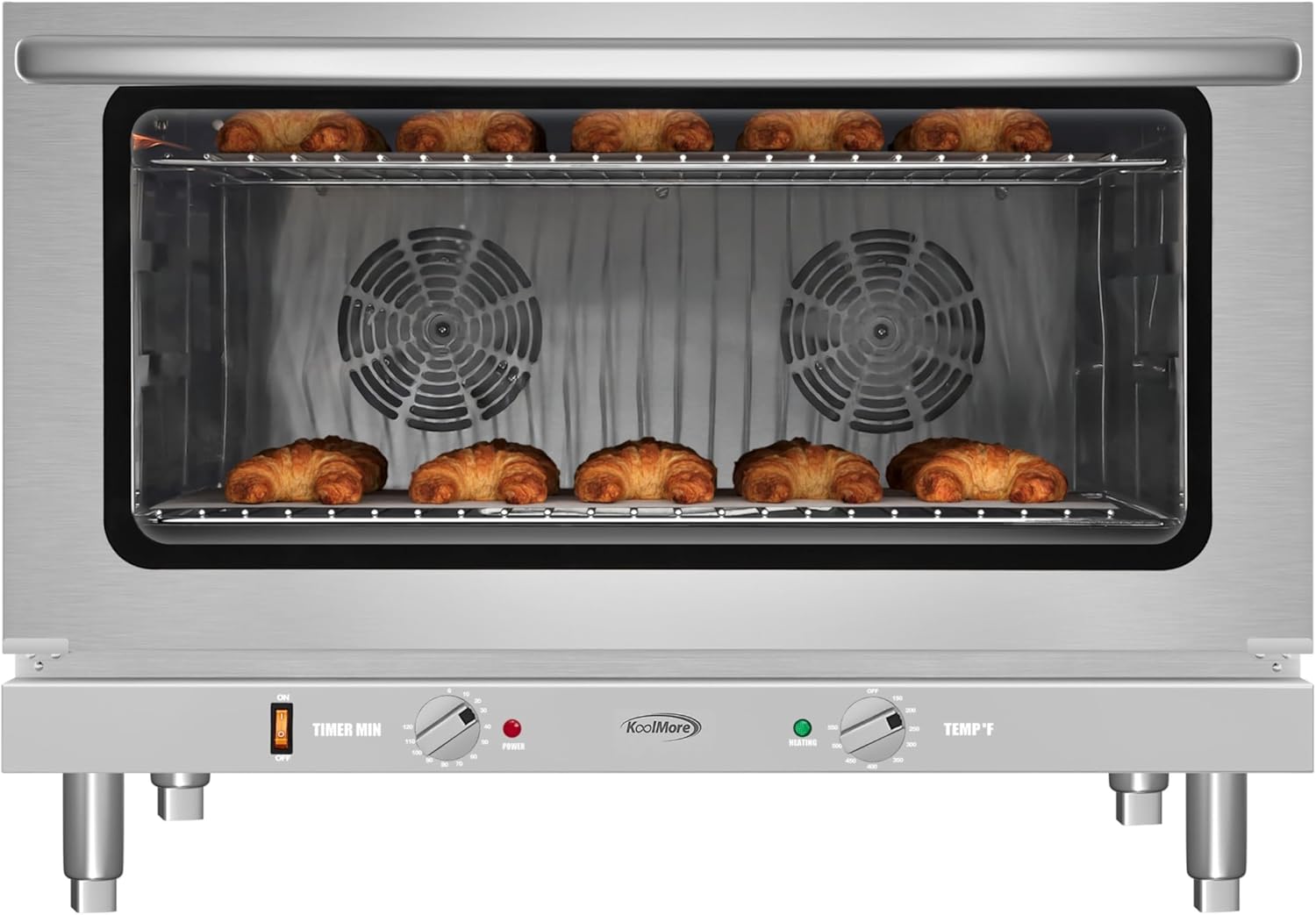
KoolMore Commercial Countertop Convection Oven KM-CTCO-44
| Wattage | 3500 watts |
|---|---|
| Power Source | Electric |
| Temperature Range | 0-550 °F |
| Number of Shelves | 4 |
| Capacity | 4.4 cubic feet |
The KoolMore KM-CTCO-44 is a countertop commercial convection oven built to handle small bakery and cafe workloads, with four rack positions that accept full-size pans and a 4.4 cubic foot interior for batch baking. Controls use simple dials and the oven reaches up to 550°F with 3500 watts of power to deliver fast, even heating across racks, which helps when baking cakes and layered goods. Its stainless steel construction and tempered glass door aim for durability and easy cleaning in a busy back-of-house. The unit is designed for 240V operation and ETL listing adds a level of safety and sanitation expected in commercial kitchens. Downsides to consider are the heavy, bulky build that requires a dedicated counter spot and the basic dial controls that lack digital timers or programmable baking profiles favored by precise pastry workflows. For bakeries that need straightforward, roomy rack capacity and robust heat, this oven covers the essentials; for shops needing fine-programmable controls or a lighter mobile unit, there are other options to evaluate.
Best for: Bakers and small commercial kitchens that prioritize roomy rack capacity and robust, reliable heating for frequent cake and batch baking rather than advanced digital programmability.
Less Ideal for: Operations that need lightweight, mobile equipment or chefs who rely on programmable, digital control profiles for repeatable pastry work.
- Holds full-size pans on four racks for simultaneous batch baking
- High maximum temperature (550°F) and 3500W power for fast, even heat
- Stainless steel exterior and tempered glass door for durability and easy cleaning
- ETL listed for safety and sanitation in commercial settings
- Heavy and bulky countertop footprint requires a dedicated space
- Manual dial controls lack programmable presets or precise digital timing
Verdict: Choose this oven if you need a sturdy, high-heat countertop unit with four-rack capacity for baking cakes in a small commercial setting.
Choosing the Right Commercial Oven for Baking Cakes: Key Factors to Consider
Temperature Accuracy and Stability
Accurate set temperatures and minimal fluctuation matter because cakes are sensitive to small temperature variations. If the thermostat reads high or low, cakes can dome, crack, or underbake. Look for ovens with precise digital controls, calibrated thermostats, or proven PID controllers.
Stability during long runs is equally important. Frequent door openings, bulk loading, and long proof-to-bake cycles challenge an oven's ability to hold steady. Consider how the oven recovers after loading and how much variance you can expect across production batches.
Even Heat Distribution
Even heat prevents uneven rise and color differences across pans and racks. For cake shops that bake multiple pans at once, airflow design, fan placement, and whether the oven uses true convection or static heat will influence results.
Pay attention to how airflow interacts with rack spacing and pan placement. Some ovens include adjustable fans or baffles to reduce hot spots. Testing or documented uniformity data is useful when you need consistent results across many racks.
Interior Capacity and Rack Flexibility
Capacity is not just volume but usable layout. You need enough vertical clearance for tall layer cakes, room for multiple full-size pans, and racks that adjust without tools. The ability to fit standard cake pans, sheet pans, and cake rings matters for production flexibility.
Also consider how racks slide and whether the interior design interferes with pan handles or decorating tools. A compact oven with optimized spacing can outperform a larger oven with inefficient rack layout for certain cake workflows.
Recovery Time and Throughput
Recovery time is how quickly the oven returns to set temperature after the door is opened or when cold pans are introduced. Faster recovery maintains schedule and reduces batch-to-batch variability when baking multiple loads.
Throughput considerations include how many pans you can bake per hour and how that maps to your order volume. If you need rapid turnaround during peak shifts, prioritize models with short recovery times and consistent heat under load.
Serviceability and Ease of Cleaning
Commercial kitchens demand equipment that is easy to maintain. Access to heating elements, removable baffles, and straightforward gasket and door repairs reduce downtime. Interiors with rounded corners and smooth surfaces simplify grease and sugar removal.
Also factor in filter access for ventilated units and how easy it is to remove racks and trays for washing. Serviceable designs lower the long-term operational burden and keep ovens performing consistently.
Safety, Controls, and Compliance
Safety features affect both staff and product outcomes. Look for reliable door latches, cool-touch handles, overtemperature protection, and clear control layouts that reduce operator error.
Controls should be intuitive for bakery staff, with programmable timers or multi-stage bake profiles when you need repeatable settings. Compliance with commercial electrical and ventilation requirements is also essential for safe installation and operation.
Convection Vs Steam-Assisted Baking for Cakes
Convection ovens that circulate air tend to brown crusts more quickly and can improve batch uniformity when racks are fully loaded. However, aggressive convection can dry cakes or cause excessive crusting on delicate sponge batters.
Steam-assisted units are useful when you need a humid bake for certain cake types that benefit from extra moisture during the initial bake phase. Some commercial ovens offer programmable steam injection, which lets you control humidity for better oven spring without over-browning.
- Use mild convection and rotate pans when baking delicate sponge cakes.
- Consider steam for high-hydration batters and certain specialty cakes.
- Programmable settings let you combine temperature and humidity stages for consistent results.
Rack and Pan Management Strategies
Standardizing on a limited set of pan sizes reduces guesswork and speeds loading. Use consistent pan materials and depths to minimize variations in bake time and color.
When loading multiple racks, stagger pans and avoid placing similar batters directly above one another if the oven shows a known hot spot. For high-volume runs, prepare staging racks at room temperature to reduce thermal shock to the oven.
- Preheat racks or use room-temperature staging to minimize recovery loss.
- Label rack positions and record small adjustments that improve evenness.
- Train staff on consistent loading patterns to replicate results across shifts.
Installation, Ventilation, and Utility Needs
Commercial ovens have varied electrical and exhaust requirements. Confirm power supply, required amperage, and whether the oven needs dedicated ventilation or hood modifications before purchase. Proper installation preserves temperature accuracy and prevents overheating in the bakery workspace.
Also plan for clearance and service access. Ovens need room to open doors fully and access panels for routine maintenance. Factor utility placement into kitchen layout to avoid disrupting workflow.
- Verify electrical circuit ratings and wiring needs with a licensed technician.
- Account for exhaust routing and hood integration where required.
- Leave service clearance as recommended by the manufacturer to simplify repairs.
Routine Maintenance and Calibration Tips
A routine cleaning and calibration schedule keeps thermal performance predictable. Clean interiors and fan assemblies regularly to prevent residue buildup that alters heat flow. Replace door gaskets that leak and check seals to maintain stable temperatures.
Periodically verify temperature accuracy with independent probes and log results. Minor control recalibration can correct drift before it impacts production. Keep a spare set of common consumables and parts to reduce downtime.
- Wipe spills immediately and deep-clean interior surfaces weekly.
- Log temperature checks and maintenance actions to spot trends.
- Stock gasket kits, fuses, and common fasteners for quick repairs.
Scaling Production Without Compromising Quality
As output grows, balance increased capacity with maintaining consistent bake conditions. Adding a second oven of the same type makes process replication easier than mixing different oven technologies. If mixing ovens is unavoidable, standardize processes per oven and log adjustments.
Consider workflow changes as production scales: stagger bake schedules, pre-bake partial batches, or invest in programmable profiles to keep product quality steady even as volume rises.
- Map production peaks and decide if capacity or speed is the limiting factor.
- Use programmable profiles to maintain repeatable bakes across operators.
- Train multiple staff on calibration and loading protocols to preserve consistency.
How We Chose the Best Commercial Oven for Baking Cakes
We prioritized ovens that demonstrate the consistent thermal control and interior layout required for professional cake production. Key evaluation criteria included temperature accuracy and recovery, usable interior capacity and rack spacing, airflow or convection design that affects evenness between racks, build quality and service access for busy kitchens, and safety plus ease-of-cleaning features. We also considered energy efficiency as it impacts operating cost during long bakery shifts. Our process excluded units designed solely for household use or countertop toaster-style ovens that cannot fit standard sheet pans or full-size cake pans. We filtered out ovens lacking documented temperature stability features or minimal rack adjustability. The selections emphasize units with specifications and design elements that support repeatable results in a commercial baking environment. These criteria align with the scoring metrics used in each product scorecard.
Our full evaluation process is outlined in our review methodology.
FAQ
What oven features most directly affect cake browning?
Airflow and heat source placement influence browning. Strong convection and top heating elements accelerate crust formation. Controlling fan speed, using lower baking racks, or reducing initial bake temperature can prevent over-browning.
How often should I calibrate the oven for reliable cake results?
Many bakeries check temperatures weekly and after any service or electrical changes. Regular calibration with an independent probe helps catch drift before it affects production.
Can I bake multiple different cake recipes at once?
You can, but results depend on similarity of bake times and temperatures. To maintain consistency, group recipes with comparable profiles or run them separately to avoid under- or overbaking.
Is steam necessary for most commercial cake baking?
Steam is not required for every cake, but it can improve oven spring and crust formation for specific batters. Consider steam when working with high-hydration or artisan-style cakes that benefit from controlled humidity.
What maintenance extends a commercial oven's service life?
Regular cleaning, gasket inspection, fan and element checks, and prompt repair of any seal or control issues will prolong service life. Keeping a maintenance log and replacing wear items on schedule reduces unexpected downtime.
Final Verdict
Choose a commercial oven for baking cakes by prioritizing temperature accuracy, even heat distribution, and usable interior layout. Tradeoffs will include throughput versus available space and whether you need steam capability or advanced programming for specialty cakes. Match oven features to your production rhythm and maintenance capacity. Focus on recoverability and serviceability to keep bake schedules predictable. With those priorities in place, you can select an oven that supports consistent, high-quality cake production.