
Note: This article contains affiliate links. If you click on these links and make a purchase, we may earn a small commission at no extra cost to you. This helps support our research and content. Read our full affiliate disclosure here.
When you handle large volumes of meat you need a vacuum sealer built for continuous use and reliable seals. Choosing the right commercial vacuum sealer for meat affects product shelf life, food safety, and how smoothly your kitchen or processing line runs. This guide covers our top shortlisted commercial vacuum sealers for meat, focusing on factors that matter in real-world operations such as seal strength, throughput speed, and serviceability. Below we summarize what to expect from each type of machine and the evaluation criteria used to pick the best options for meat handling. Read on to find the best fit for your throughput and facility needs.
Top Picks at a Glance
| Best Overall The best all-around choice for most situations | VEVOR Chamber Vacuum Sealer DZ-260C |  |
| Best Quality Built to a higher standard if you want something more solid | Vesta Precision V513 Chamber Vacuum Sealer |  |
| Best Value The sweet spot between price and what you get | POWOT Precision Vacuum Sealer VS8002 |  |
| Top Rated A top-rated pick with lots of positive feedback | Avid Armor USV32 Chamber Vacuum Sealer |  |
| Most Popular A crowd favorite that many people choose with confidence | Potane Precision Vacuum Sealer VS5736 |  |
VEVOR Chamber Vacuum Sealer DZ-260C

| Wattage | 320 watts |
|---|---|
| Voltage | 120 |
| Power Source | ac |
| Operation Mode | Automatic |
| Material | Stainless Steel |
The VEVOR Chamber Vacuum Sealer DZ-260C is a countertop chamber sealer built to handle wet and oily foods, bulk cuts of meat, and larger items that external sealers struggle with. It uses a 180W vacuum pump and a 320W heater to reach near 100KPa vacuum levels, and the deep stainless steel chamber lets you seal whole steaks, loaves, and marinated foods without trimming. Controls include an LED display and a gauge that shows chamber pressure in real time so you can avoid crushing fragile items. Practical benefits are reliable, wide 10 mm seals that resist freezer leaks and the ability to pack liquids and wet foods cleanly, which cuts waste and extends freezer storage. Expect a substantial, heavy unit that leans toward commercial bench use rather than casual countertop convenience, and factor in space and power needs; the machine is robust but not the quietest or smallest option. For meat packing it delivers strong seals and consistent vacuuming, though setup and handling are more work than on compact external sealers.
Best for: Buyers who need a reliable chamber sealer for packing large or wet cuts of meat regularly and want commercial-strength performance at a value-oriented price.
Less Ideal for: People who only seal occasional meals, have very limited counter space, or need a lightweight, portable external sealer.
- Deep stainless steel chamber handles whole cuts and wet or marinated foods
- High vacuum capability near 100KPa for longer freezer life
- Wide 10 mm seal and 320W heater produce durable, leak-resistant seals
- Built-in pressure gauge and LED controls for controlled, repeatable sealing
- Large and heavy unit that needs dedicated counter or bench space
- More suited to frequent or commercial use than occasional home sealing
Verdict: If you need a heavy-duty chamber sealer for frequent meat packing and wet or marinated products, this VEVOR unit delivers commercial-style vacuuming and tough, leak-resistant seals.
Vesta Precision V513 Chamber Vacuum Sealer

| Wattage | 360 watts |
|---|---|
| Voltage | 110 volts |
| Operation Mode | Automatic |
| Material | Stainless Steel |
| Chamber Volume | 5.6 qt (5.3L) |
The Vesta Precision V513 is a compact chamber vacuum sealer built for handling wet and dry foods, including soups, marinades, and family-sized cuts of meat. It uses a SmartVac system that automatically sets vacuum time based on food volume, which helps avoid over- or under-vacuuming and simplifies repeated packaging. Practical touches include a removable CleanTray and a washable seal bar that make rinsing spilled liquids straightforward, plus a soft-close glass lid that reduces noise and wear. The unit delivers commercial-grade vacuum pressure with a variable frequency pump that balances power and quieter operation, and it includes an accessory hose with mason jar adapters for sealing jars. The 5.6 qt chamber is deeper than many countertop external sealers, so you can pack liquids and larger portions without mess, although the overall footprint and 21.6 lb weight mean it is more of a bench machine than a portable one. For meat-focused kitchens it offers reliable, repeatable seals and easy cleanup, but buyers expecting the largest industrial capacity should consider larger models in the same line.
Best for: Buyers who need a compact but powerful chamber sealer for routine meat prep and sous-vide portions and who prioritize consistent, automated vacuuming and easy cleaning.
Less Ideal for: Large-scale commercial operations that require high-throughput, oversized chambers or floor-standing industrial sealers should choose a larger-capacity model.
- Automatic SmartVac timing eliminates manual setting guesswork for consistent seals
- Detachable CleanTray and washable seal bar simplify cleanup after sealing liquids
- Deep chamber suitable for sealing soups, marinades, and family-sized meat portions
- Variable-frequency commercial-grade pump provides strong vacuum with relatively low noise
- Includes mason jar adapters and accessory hose for sealing jars without extra purchases
- Chamber volume is smaller than full-size commercial machines, limiting very large cuts or bulk packaging
- Relatively heavy and takes counter space, so not ideal for mobile setups
Verdict: Choose the Vesta V513 when you want a compact, commercial-grade chamber sealer that delivers automated, reliable seals for wet meats and sous-vide portions with easy cleanup.
POWOT Precision Vacuum Sealer VS8002
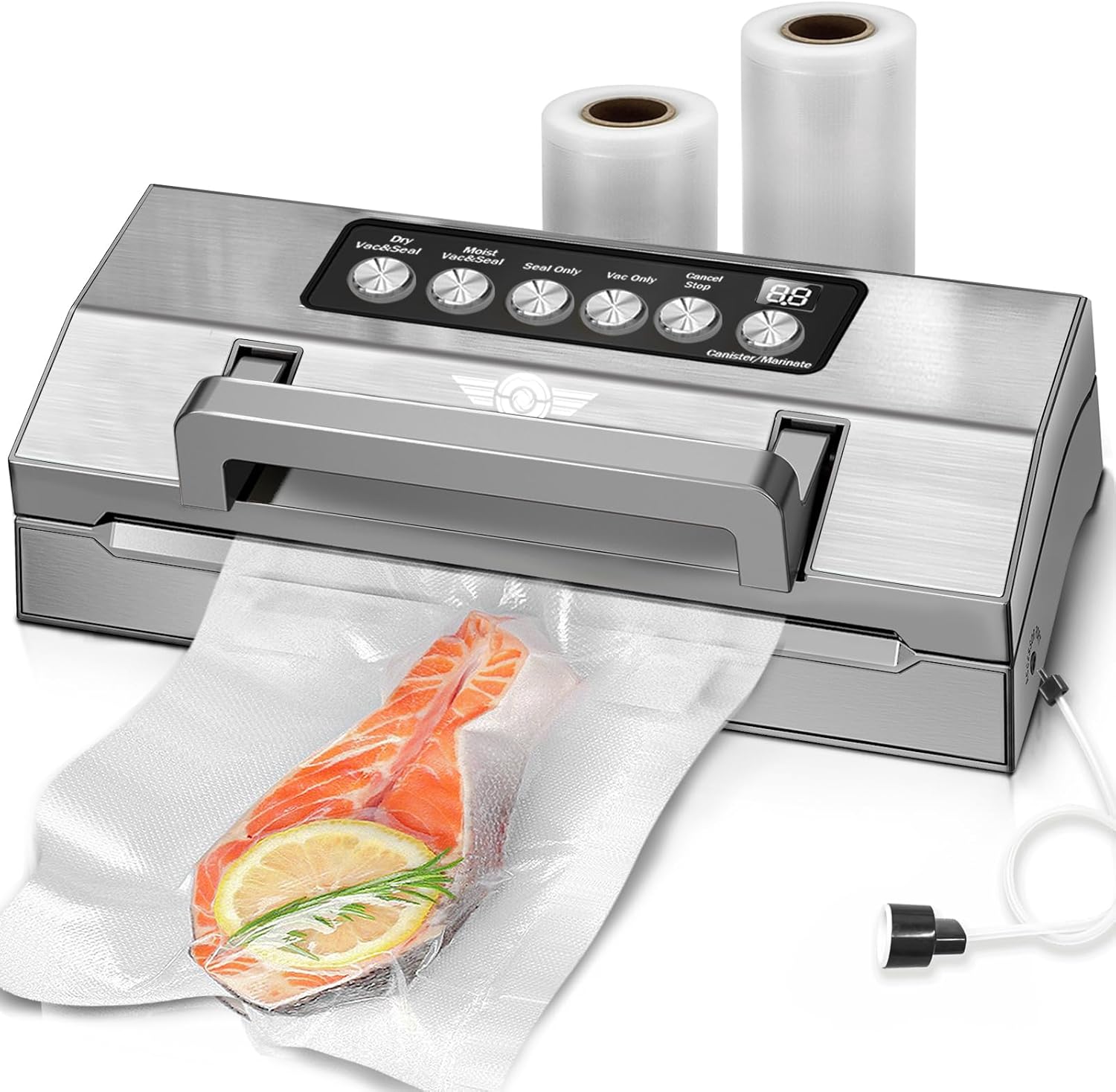
| Power Source | ac |
|---|---|
| Operation Mode | Automatic |
| Wattage | 125 watts |
| Voltage | 120 |
| Material | Stainless Steel |
The POWOT Precision Vacuum Sealer VS8002 is a heavy-duty countertop unit that vacuums and seals bags quickly for meal prep, sous vide, and bulk meat storage. It uses a dual high-pressure vacuum pump and widened 17mm double heat seal strips to create strong, near-leakproof seals that help prevent freezer burn and extend storage life. Controls are one-touch and the machine offers six modes, including Moist, Dry, Seal Only, Pulse Vac, Marinate/Canister, and Cancel, which makes it straightforward to adjust for raw meat, marinades, and delicate items. Practical touches like an integrated cutter, onboard bag storage, an easy-lock handle, and a removable drip tray simplify daily use and cleanup. Noise is relatively low for a high-capacity unit and the manufacturer rates continuous sealing capacity for dozens of bags in minutes, which suits batch processing. It is a larger, more purposeful machine than basic home sealers, so users should expect a countertop footprint and power draw consistent with frequent sealing needs.
Best for: Buyers who prioritize efficient, repeatable vacuum sealing for meat and batch cooking and want a durable, feature-rich unit that handles wet and dry foods reliably.
Less Ideal for: Casual users who only seal occasional snacks or need a compact, highly portable model should consider smaller, simpler sealers instead.
- Dual high-pressure pump and widened double heat seal deliver strong, commercial-grade seals
- Six operation modes cover moist and dry foods, pulse vacuuming, marinating, and seal-only tasks
- Built-in cutter and bag storage keep rolls tidy and let you make custom bag lengths
- Low-noise operation and ability to process many bags continuously for batch sealing
- Stainless steel build and removable drip tray for easier cleaning and durability
- Larger countertop footprint and heavier weight than entry-level home sealers
- Requires AC power and has higher wattage suited to frequent use, not portable operation
Verdict: A robust countertop vacuum sealer built to handle frequent meat sealing and batch meal prep with commercial-style seals and versatile modes.
Avid Armor USV32 Chamber Vacuum Sealer

| Power Source | AC |
|---|---|
| Operation Mode | Automatic |
| Wattage | 380 watts |
| Voltage | 110 volts |
The Avid Armor USV32 is a commercial-style chamber vacuum sealer built to deliver consistent, restaurant-grade seals for meat, soups, sauces, and marinades. It uses true chamber technology and a heavy-duty 11.5" dual-wire seal bar to handle wide pouches and thick bags without the mess associated with external sealers, and the tempered glass lid lets you watch the cycle. Controls are automatic and straightforward, making it easy to set vacuum and seal times for repeatable results, and the unit includes an accessory hose port for sealing jars or canisters. The stainless steel construction and robust 380-watt motor give the impression of a machine meant for frequent use, and the fast marinate function is useful for speeding flavor infusion in meats destined for sous vide. Trade-offs are its weight and footprint for home kitchens and the need for chamber-compatible bags rather than household roll bags, but for anyone packaging family-size cuts or liquid-rich items regularly this model brings dependable, professional-grade performance.
Best for: Butchers, hunters, sous vide cooks, and small commercial kitchens that prioritize reliable, repeatable seals for large or liquid-rich meat portions and need a robust chamber machine for regular use.
Less Ideal for: Casual home users who only seal occasional dry items or those with very limited countertop space should consider lighter external vacuum sealers instead.
- True chamber vacuum design seals liquid-rich foods cleanly without mess
- 11.5" dual-wire sealing bar handles wide bags and thick pouches
- Stainless steel build and tempered glass lid for durable, easy monitoring
- Automatic digital controls allow repeatable vacuum and seal settings
- Accessory hose port for sealing jars and canisters
- Significant weight and countertop footprint compared with external sealers
- Requires chamber-compatible bags rather than standard roll-style bags
Verdict: Choose the USV32 when you need a sturdy, chamber-style sealer that produces consistent, professional-grade seals for large or liquid-rich meat jobs.
Potane Precision Vacuum Sealer VS5736

| Power Source | Corded Electric |
|---|---|
| Operation Mode | Automatic, Manual, Dry, Moist |
| Wattage | 120 watts |
| Voltage | 110 volts |
The Potane VS5736 is a compact countertop vacuum sealer built for repeat sealing tasks and bulk food prep. It offers automatic and manual vacuum modes plus dry and moist presets that simplify sealing different cuts of meat and prepared portions, and the built-in cutter and roll storage keep bag setup quick. The unit uses an 8 mm sealing element and a brushless mechanical motor aimed at stronger, more reliable seals and continuous runs, and the C-type half-wrapped chamber and single pull-down handle make one-handed operation straightforward. An accessory port expands use to jars and containers, and Potane includes two long bag rolls and a spare foam gasket so you can start sealing immediately. Limitations to consider: the machine is a consumer countertop model rather than a heavy-duty commercial chamber sealer, so very large vacuuming runs or professional kitchen throughput could push its design limits, and its 120 W motor and compact footprint mean it is best suited to steady but not industrial-scale use.
Best for: Buyers who want a reliable, higher-performance countertop sealer for frequent meat portioning and bulk home freezing and who prefer a unit with built-in storage and presets for consistent results.
Less Ideal for: High-volume professional butcheries or commercial kitchens that require a true chamber sealer and industrial throughput should choose a dedicated commercial model instead.
- Multiple preprogrammed modes (Automatic, Manual, Dry, Moist) tailored for different foods
- 8 mm sealing element and brushless motor for stronger, consistent seals
- Built-in cutter and onboard roll storage for ready bag customization
- Accessory port for vacuuming containers, jars, and bottle stoppers
- Includes two bag rolls and an extra foam gasket for immediate use
- Designed as a countertop consumer unit rather than a full commercial chamber sealer
- Continuous heavy industrial throughput may exceed recommended daily use despite robust components
Verdict: A sturdy, feature-rich countertop sealer that reliably handles frequent home meat portioning with pro-style seals and convenient built-in roll and cutter storage.
Choosing the Right Commercial Vacuum Sealer for Meat: Key Factors to Consider
Seal Strength
Seal strength determines how well the package resists air ingress, punctures, and moisture migration. For meat, a complete, even seal prevents freezer burn and reduces bacterial exposure by limiting oxygen. Strong seals are particularly important when packaging irregularly shaped cuts or using thicker multi-layer barrier bags. Verify that the sealer offers adjustable heat and pressure settings so operators can tune the seal for lean cuts, fatty meat, or vacuum pouches with variable thickness.
A weak or inconsistent seal will shorten shelf life and increase waste. In commercial settings, inspect seals visually and test by submerging packages in water to check for leaks. Machines designed for meat packaging often include stepped or reinforced sealing elements specifically to resist wet proteins and fats that can degrade seal bars over time.
Vacuum Depth and Control
Vacuum depth, usually measured in millibars or as a percentage of full vacuum, affects how much air is removed and how closely the bag conforms to the meat. Deeper vacuum levels reduce residual oxygen, slowing oxidation and microbial growth. However, very deep vacuum combined with delicate cuts can compress product and alter texture. Machines with adjustable vacuum settings let you choose gentler profiles for aged or delicate meats and stronger pulls for bulk cuts and bone-in pieces.
Precise control is also useful when packaging meats with marinades or natural juices. Units with pulse vacuum or liquid-handling modes prevent excessive suction that can draw liquids into the pump and compromise performance. For vacuum-sealing meat at scale, look for consistent, repeatable vacuum readings rather than single-cycle extremes.
Throughput and Cycle Time
Throughput is how many packages you can seal per hour and is a critical factor in a commercial operation. Cycle time includes vacuum, sealing, and cool-down phases. Faster machines reduce bottlenecks during peak production runs but must still deliver consistent seals. Consider whether you need manual, semi-automatic, or fully automatic conveyors or chamber designs that allow continuous loading.
Also factor operator ergonomics and layout. Countertop or chamber machines with quick-access lids and intuitive controls speed up workflows. If you process varied pack sizes, look for models that can switch between modes quickly without lengthy setup. Throughput expectations should match your busiest shift rather than average demand to avoid underpowered equipment during peak periods.
Durability and Duty Cycle
Commercial meat environments demand machines built for extended daily use. Duty cycle refers to how long the sealer can run continuously before needing rest. Components to evaluate include motor rating, pump type (rotary vane pumps are common in commercial units), sealing bar materials, and the construction of the frame and lid. Stainless steel housings and food-safe finishes resist corrosion from cleaning and contact with meat juices.
Machines with higher-rated duty cycles reduce the risk of mid-shift failures and expensive downtime. Also consider noise levels and thermal management since equipment that overheats or requires long cool-down periods will slow operations. A slightly more robust machine often repays its premium through fewer maintenance interruptions and longer service life.
Serviceability and Parts Availability
Quick access to consumables and replacement parts keeps a commercial line running. Sealing tapes, gaskets, pump oil, and heating elements wear over time and should be easy to replace without specialized tools. Machines with modular components and clear service guides simplify routine maintenance and reduce repair time.
Consider whether the manufacturer or distributor provides technical documentation, replacement kits, and local service networks. In-house maintenance teams should be able to perform common tasks such as gasket replacement, pump oil changes, and seal bar adjustments. When parts are proprietary or difficult to source, a simple failure can become a production-stopping event.
Cleanability and Food-Safety Features
Easy cleaning reduces contamination risk and shortens downtime between runs. Smooth, sloped surfaces, removable drip trays, and sealed control panels help keep meat juices from accumulating. Materials should withstand regular washdowns and approved sanitizers without degrading seals or electronic components.
Look for features such as liquid-handling modes that limit pump contamination, IP-rated controls, and accessible seams to inspect for trapped debris. Machines that minimize crevices where food residue can collect facilitate compliance with food-safety inspections and internal sanitation protocols.
Chamber Vs External Pump Designs
Chamber vacuum sealers enclose the package inside a sealed cavity before drawing a vacuum and sealing. This design excels when you need strong, uniform vacuum levels and when packaging liquids or juice-heavy cuts because the liquid stays in the bag during pumping rather than being drawn into the pump. Chamber machines are often easier to automate and can handle bulkier packages without pre-formed bags.
External, or suction, machines remove air from bags by drawing vacuum outside the bag while the open end remains outside the machine. These units are typically faster per cycle for individual bags and occupy less initial cost and floor space. However, they are generally less suited to liquids unless the operator uses drip trays and takes extra care to prevent pump contamination.
- Chamber models: better for liquid-rich meats and consistent deep vacuum.
- External suction: lower footprint, faster per-bag handling for dry products.
- Consider facility layout and sanitation workflow when choosing between the two.
Automation and Integration Options
If you operate a high-volume line, look for machines that support conveyors, infeed/outfeed automation, or integration with scale and labeling equipment. Automated sealing systems reduce repetitive operator tasks and can standardize packages at high speed.
Semi-automatic units allow operators to place bags while the machine runs cycles automatically and are a middle ground for medium-volume operations.
- Conveyor attachments smooth handoff between stations.
- Programmable profiles enable consistent cycles for different meat cuts.
- Check electrical and spatial requirements for automated setups.
Packaging Materials and Compatibility
Not all bag types and laminates perform the same under heat and vacuum. Multi-layer barrier bags protect against oxygen and moisture better than single-layer films and are preferred for long-term frozen storage. Ensure the sealer can accommodate the bag width and thickness you plan to use and that heat settings cover the melting point of the film.
Consider whether you need form-fill-seal compatibility for roll-stock or pre-made pouch handling. For meat with bones or sharp edges, use puncture-resistant inserts or overwraps to protect the seal area.
- Verify maximum bag width and recommended thickness range.
- Use barrier-grade films for long-term storage.
- Plan for puncture protection when packaging bone-in cuts.
Operator Training and Safety Practices
Proper operator technique reduces failed seals, pump contamination, and premature wear. Train staff on bag placement, correct use of liquid modes, and routine maintenance tasks like gasket inspection and pump oil changes. Standardize profiles for common pack types to minimize user error.
Safety practices such as lockout procedures during maintenance, use of personal protective equipment, and cleaning schedules keep both workers and products safe. Regularly review sanitation logs and performance notes to catch recurring issues early.
- Document standard operating procedures for common pack styles.
- Schedule routine maintenance and record service actions.
- Train backup operators to prevent production gaps.
Space, Utilities, and Installation Considerations
Commercial vacuum sealers vary widely in footprint and power requirements. Measure available counter or floor space and account for lid clearance on chamber models. Confirm electrical supply, as some commercial units require dedicated circuits or specific voltage.
Also plan for ventilation and noise mitigation near food-prep areas. Consider placement near a dedicated cleaning station to streamline sanitation between runs and to protect sensitive electronics from moisture.
- Check voltage and amperage requirements before purchase.
- Allow service access on at least two sides of the machine.
- Plan for drainage and cleaning access nearby.
How We Chose the Best Commercial Vacuum Sealer for Meat
We prioritized criteria that matter in a commercial meat environment where durability, food-safety performance, and steady output are essential. Primary considerations included durable build and duty cycle, measured by materials, motor rating, and the manufacturer-stated continuous-run capacity. Seal integrity and vacuum depth were assessed next, focusing on machines that consistently produce airtight seals across thicker meat packages and liquids. Throughput and cycle time were important for kitchens and processing lines, so we favored models with rapid vacuum and cool-down cycles and options for automated or semi-automated operation. Serviceability and parts availability were another filter: systems with modular sealing bars and accessible vacuum pumps rate higher because they reduce downtime in busy operations. Food-safety features such as adjustable vacuum profiles, liquid-handling modes, and easy-to-clean sealing surfaces were also weighted heavily. We excluded consumer-grade units and machines rated only for intermittent home use. Models that lacked published specifications for continuous operation, seal temperature control, or clear maintenance guidance were not considered. The final shortlist balances robust construction, repeatable seal performance, and practical throughput for commercial meat handling.
Our full evaluation process is outlined in our review methodology.
FAQ
Can a commercial vacuum sealer handle wet or marinated meat?
Often yes. Chamber sealers are generally better suited for wet or marinated meat because the liquid remains in the bag during vacuuming. Look for liquid-handling modes and adjustable vacuum profiles to avoid drawing fluids into the pump.
How often should I change pump oil or service the pump?
Service intervals depend on usage and manufacturer guidance but usually require routine oil changes every few months under heavy use. Regular visual checks for oil contamination and scheduled maintenance reduce the likelihood of unexpected failures.
Do I need special bags for commercial vacuum sealing?
Yes. Use heat-sealable, multi-layer barrier bags rated for vacuum and freezing. Thicker films and puncture-resistant laminates extend shelf life and protect seals when handling bone-in or sharp-edged cuts.
Will vacuum sealing replace proper refrigeration for meat safety?
No. Vacuum sealing reduces oxygen and slows spoilage, but it does not replace required refrigeration or freezing. Correct temperature control remains essential to inhibit bacterial growth and maintain food safety.
What should I do if liquids get into the pump?
Stop using the machine and consult maintenance guidelines. Many commercial units include protective features or traps to limit pump contamination, but if liquid reaches the pump you may need to change the oil, clean internal components, or contact a technician depending on the severity.
Final Verdict
When selecting a commercial vacuum sealer for meat, prioritize reliable seal strength, appropriate vacuum control, and a throughput rating that matches your busiest shifts. Balance durability and serviceability so the machine can handle continuous use with minimal downtime. Consider packaging materials, sanitation workflows, and whether you need automation to meet volume demands. Focus on the tradeoffs between chamber and external designs and choose the machine whose features align with your liquid-handling, space, and maintenance capabilities. That approach will help you pick a unit that preserves meat quality and supports efficient, safe operations.