
Note: This article contains affiliate links. If you click on these links and make a purchase, we may earn a small commission at no extra cost to you. This helps support our research and content. Read our full affiliate disclosure here.
If you rely on tap water for daily drinking and cooking, a good countertop water filter can make a noticeable difference in taste and peace of mind. Countertop systems are easy to install, do not require plumbing changes, and can remove or reduce a wide range of common contaminants that affect flavor and safety. This guide lists the top shortlisted countertop water filters for drinking water and explains the practical tradeoffs buyers should consider. We evaluated systems on measurable factors like filtration performance and sustained flow rate, plus ease of setup and ongoing maintenance. Read on for the criteria we used and the key features that matter before you pick a filter for your kitchen counter.
Top Picks at a Glance
| Best Overall The best all-around choice for most situations | Bluevua ROPOT Countertop RO |  |
| Best Quality Built to a higher standard if you want something more solid | Big Berkey 2.25-Gallon System |  |
| Best Value The sweet spot between price and what you get | PUR 30-Cup Water Filter Dispenser |  |
| Best Budget The cheapest option that still gets the job done reliably | iSpring CKC1C Countertop Water Filter |  |
| Top Rated A top-rated pick with lots of positive feedback | Brita Large 10-Cup Pitcher |  |
| Most Popular A crowd favorite that many people choose with confidence | ZeroWater 22-Cup Ready-Read Dispenser |  |
| Best Seller A high-volume bestseller chosen again and again | DREO RO Countertop WF112 | 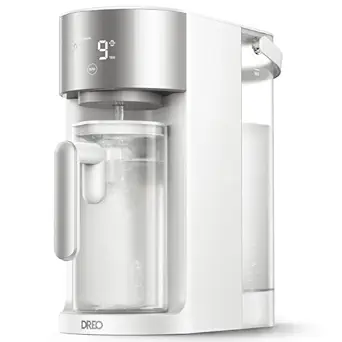 |
Bluevua ROPOT Countertop RO
| Purification Method | Reverse Osmosis |
|---|---|
| Power Source | Corded Electric |
| Maximum Flow Rate | 0.26 liters per minute |
| Supported Water TDS Level Maximum (PPM) | 1000 |
| Capacity | 1700 ml |
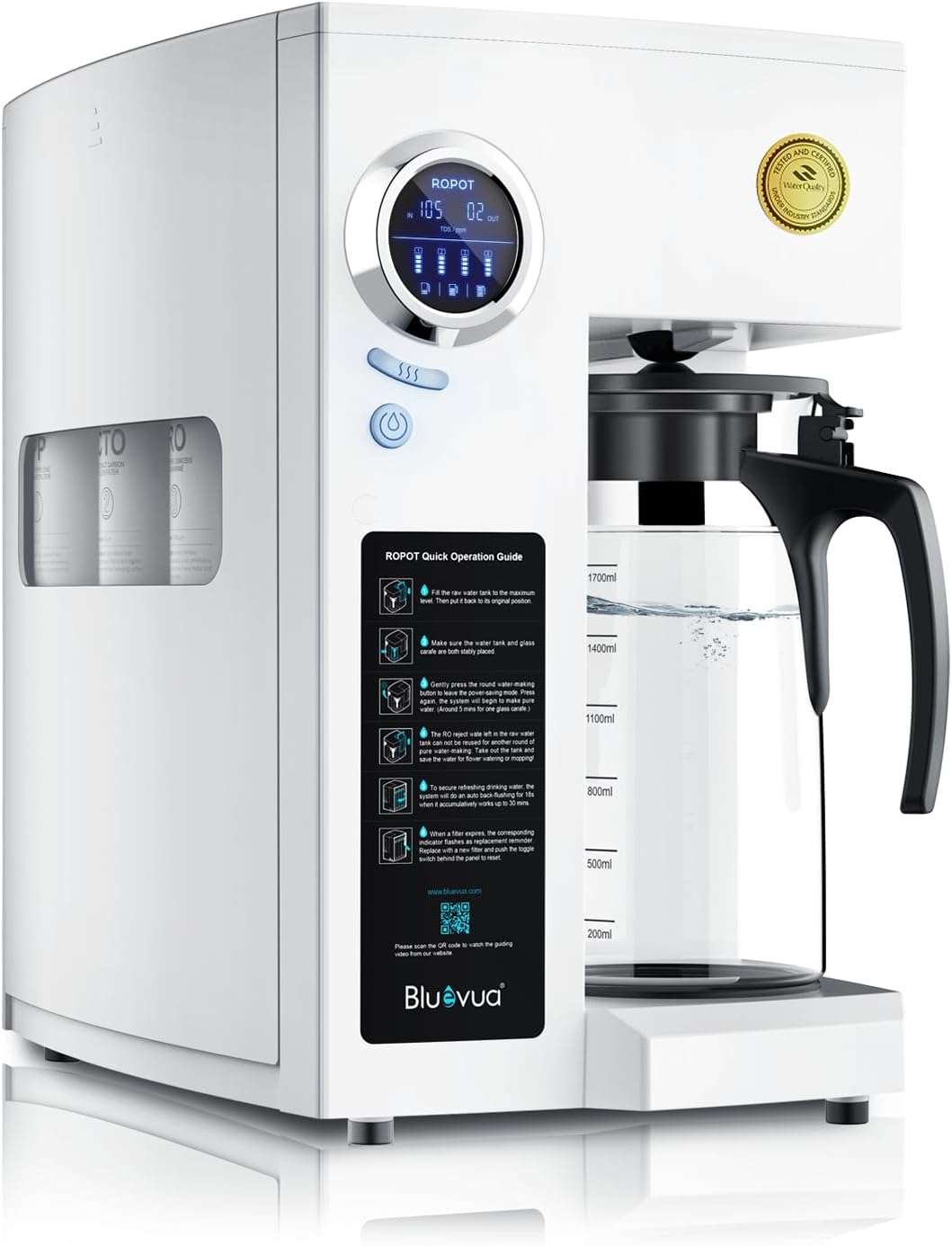
The Bluevua ROPOT is a plug-in countertop reverse osmosis system built to deliver near-bottled water without installation. You fill the glass carafe, start a cycle, and the unit runs a five-stage RO process that removes most contaminants then adds minerals back for better taste. A clear LCD filter-life and TDS readout help you monitor water quality and when to replace cartridges, and the system includes a glass carafe, power adapter, cleaning brush, four filters, and a mineral filter. It claims a strong pure-to-drain ratio and an auto power-saving standby to reduce electricity use between cycles. Practical benefits include the non-plastic borosilicate carafe to avoid secondary contamination and an accessible countertop footprint for renters or kitchens without plumbing options. Important limitations are the modest 1.7 liter capacity and a maximum flow rate around 0.26 L/min, so it is not ideal for supplying large households quickly and replacement filters and periodic maintenance are required to sustain RO performance.
Best for: Buyers who want bottled-quality drinking water from a compact, no-plumbing countertop system and value a glass water reservoir and easy filter monitoring.
Less Ideal for: Large families or users who need fast, high-volume water dispensing for cooking or frequent refills should consider higher-capacity or point-of-use systems.
- Five-stage RO filtration with remineralization for low TDS and improved taste
- Borosilicate glass carafe reduces plastic contact and secondary pollution
- No-plumbing, plug-in countertop design makes setup simple and renter-friendly
- LCD display with filter life and TDS readout for easy maintenance tracking
- Small 1700 ml water capacity limits output between cycles
- Relatively slow maximum flow rate (0.26 L/min) for larger consumption needs
Verdict: Choose the Bluevua ROPOT if you want a renter-friendly, countertop RO that delivers bottled-style drinking water with a glass carafe and easy TDS/filter monitoring.
Big Berkey 2.25-Gallon System

| Capacity | 8.5 liters |
|---|---|
| Purification Method | Black Berkey proprietary filter media |
| Power Source | Gravity |
| Maximum Flow Rate | 0.03 gpm |
| Material Type | Stainless Steel |
The Big Berkey 2.25-gallon system is a gravity-fed stainless steel countertop filter that delivers ready-to-drink water without electricity or installation. You fill the top chamber and water slowly passes through two Black Berkey BB9-2 elements into the lower chamber, where a spigot dispenses filtered water; the unit can also accept up to four elements if you need higher throughput. The Black Berkey elements are independently tested and are rated to reduce over 200 common contaminants, offering long service life—each pair is good for up to about 6,000 gallons under typical conditions—so operating cost per gallon is very low. The polished AISI 304 construction looks durable and is simple to wipe clean, and the compact 2.25-gallon size suits small households or offices. The main limitations are the low flow rate inherent to gravity filtration and the need to periodically primeda nd replace filter elements depending on source-water quality, so it is not ideal where fast on-demand flow or under-sink plumbing integration is required.
Best for: People who prioritize contaminant reduction and long-term filter life and want a reliable countertop system that produces very clean drinking water without electricity or installation.
Less Ideal for: Those who need high-volume, fast-flow dispensing, under-sink plumbing integration, or a built-in household water source for appliances should consider other filter types.
- Gravity-fed design needs no electricity, tools, or plumbing
- Black Berkey BB9-2 elements reduce over 200 common contaminants per third-party testing
- Long element life—each pair filters up to about 6,000 gallons
- Durable AISI 304 stainless steel construction that is easy to clean
- Low flow rate typical of gravity systems (0.03 gpm) limits dispensing speed
- Top-fill and manual operation require occasional attention and priming
Verdict: Choose the Big Berkey 2.25-gallon if you want a compact, high-performance countertop filter that removes hundreds of contaminants without electricity and keeps operating costs very low.
PUR 30-Cup Water Filter Dispenser

| Capacity | 7.09 liters |
|---|---|
| Purification Method | Ion Exchange |
| Filter Life Cycle | 2 months / 40 gallons |
| Supported Water TDS Level Maximum (PPM) | 500 |
The PUR 30-Cup Water Filter Dispenser is a slim countertop pitcher-style dispenser designed to hold chilled, filtered water in the fridge and pour directly from a pull-down spout while filtration continues. It uses a genuine PUR dispenser filter certified to reduce chlorine, mercury, copper, zinc and other chemical and physical substances, and the filter is rated for up to 40 gallons or roughly two months of typical use. The dispenser is lightweight plastic with a carrying handle and LockFit to secure the filter, and most parts are dishwasher safe for easy cleanup. Practical touches like the pull-down spout and space-saving shape make it convenient for families, dorms, or anyone who wants a ready supply of filtered water without installing a tap-mounted system. Limitations include reliance on replacement filters for continued performance and the fact that, like similar pitchers, it does not filter microbes; heavy users will need to budget for filter replacements every couple of months.
Best for: Buyers who want an affordable, no-plumbing solution to improve tap water taste and store chilled filtered water for everyday drinking and cooking.
Less Ideal for: Homes that require microbial or whole-house filtration, or users who prefer a permanently installed under-sink or faucet-mounted filtration system.
- Large 30-cup capacity stores chilled filtered water for family use
- Genuine PUR filter certified to reduce multiple chemicals and improve taste
- Space-saving slim shape fits refrigerator doors and countertops
- Pull-down spout allows pouring while filtration continues
- Dishwasher-safe components and carrying handle simplify refilling and cleaning
- Filter needs replacement every ~40 gallons (about 2 months) to maintain performance
- Does not filter microbes or replace point-of-use treatment where microbiological contamination is a concern
Verdict: A practical, fridge-friendly dispenser that delivers certified chemical reduction and large chilled water capacity without plumbing.
iSpring CKC1C Countertop Water Filter
| Model Number | CKC1C |
|---|---|
| Filter Life | 6-12 months (depends on water quality) |
| Cartridge Type | 5 micron Carbon Block |
| Certifications | ANSI, NSF |
| Included Components | Housing, Carbon Block Filter, Tubing, Wrench, Diverter Valve, O-ring |
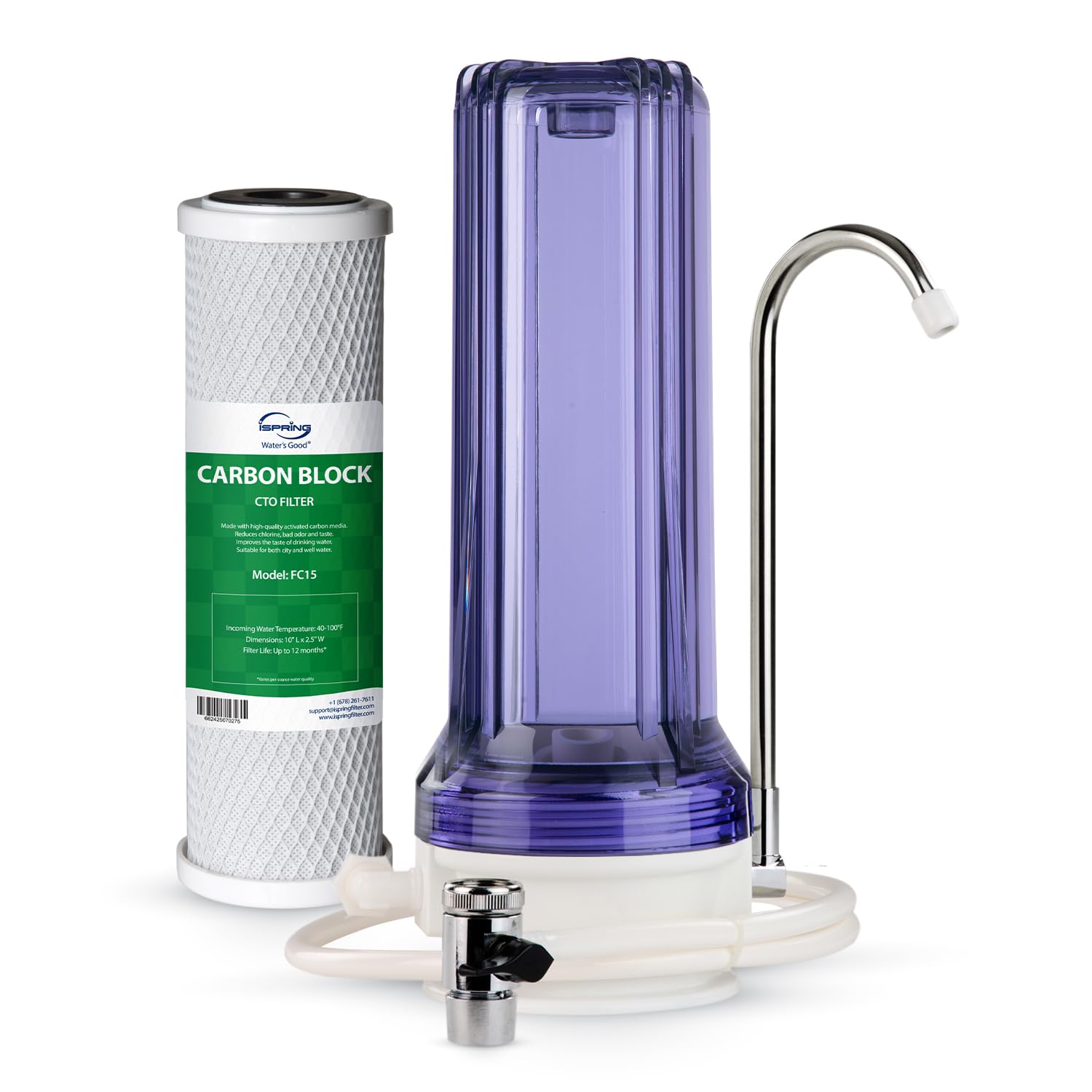
The iSpring CKC1C is a straightforward countertop water filter that installs without drilling and connects to most standard kitchen faucets using the included diverter and adapters. It uses a 5-micron carbon block cartridge housed in a transparent casing so you can visually check filter condition, and independent testing shows it removes about 95% of chlorine, odors, sand, silt, sediment and rust. Setup and switching between filtered and unfiltered water are simple, and the unit is made from food-grade, BPA-free materials with parts such as tubing, wrench, and O-ring included. Expect the cartridge to last roughly 6 to 12 months depending on local water quality, and note this system does not lower dissolved mineral content the way a reverse osmosis unit would. For buyers prioritizing easy installation, visible filter monitoring, and reliable chlorine/sediment reduction on a modest budget, this delivers practical everyday filtered drinking water without plumbing changes.
Best for: Buyers seeking an affordable, no-plumbing countertop filter that reliably removes chlorine and visible sediment and is easy to install and maintain.
Less Ideal for: Users who need heavy-duty contaminant reduction such as TDS or desalination should consider reverse osmosis systems instead.
- Clear housing lets you visually inspect the cartridge for replacement timing
- 5-micron carbon block removes chlorine, odors, sediment, and rust
- No-drill installation with included diverter valve and adapters
- Includes all basic components (housing, filter, tubing, wrench, O-ring) for setup
- Does not reduce total dissolved solids or function like an RO system
Verdict: A budget-friendly, easy-to-install countertop filter that visibly reduces chlorine and sediment for everyday drinking water.
Brita Large 10-Cup Pitcher

| Purification Method | Granular Activated Carbon |
|---|---|
| Filter Life Cycle | 2 months |
| Capacity | 10 ounces |
| Power Source | Manual |
| Supported Water TDS Level Maximum (PPM) | 500 |
The Brita Large 10-Cup Pitcher is a straightforward countertop pitcher for improving tap water taste and reducing specific contaminants such as chlorine, copper, cadmium and mercury. You fill the flip-top reservoir and filtered water collects in the lower pitcher for pouring, making it convenient for fridge storage and everyday drinking. It ships with one Brita Plus filter that the company rates for roughly 40 gallons or two months of typical family use, and the filter combines activated carbon and ion-exchange resin to target taste, odor and some heavy metals. The pitcher is BPA-free and designed to fit refrigerator shelves while replacing many single-use bottles over a year of use. Limitations are inherent to pitcher systems: it does not disinfect microbiologically unsafe water, flow is slower than tap water when filtering, and you will need regular filter replacements to maintain performance. For buyers who want a reliable, no-frills way to improve tap water flavor and cut bottled water waste, this is a practical choice.
Best for: People who prioritize a dependable, low-effort way to improve tap water taste and reduce specific contaminants without installing plumbing changes.
Less Ideal for: Households needing full disinfection or very high contaminant removal should consider certified point-of-use systems or whole-house treatments instead.
- Certified to reduce chlorine taste and odor plus select heavy metals
- BPA-free plastic construction designed to fit refrigerator shelves
- Includes one filter rated for about 40 gallons or two months of use
- Simple flip-top reservoir for easy refilling and pouring
- Not intended to make microbiologically unsafe water safe to drink
- Slower fill and dispense compared with direct-plumbed or under-sink systems
Verdict: A reliable, fridge-friendly pitcher that consistently improves tap water taste and reduces select heavy metals with simple, regular filter changes.
ZeroWater 22-Cup Ready-Read Dispenser

| Capacity | 5.2 liters |
|---|---|
| Purification Method | Ion Exchange |
| Included Components | 22-Cup Dispenser, 5-Stage Filter, TDS Meter |
| Supported Water TDS Level Maximum (PPM) | 1 |
The ZeroWater 22-Cup Ready-Read dispenser is a countertop pitcher-style system that uses a 5-stage ion exchange filter to remove total dissolved solids and heavy metals, and it includes a TDS meter so you can verify water quality at the tap. You fill the top reservoir, the filter processes water into the lower 22-cup tank, and the dispenser spout makes serving straightforward for a family or office. Notable features are the integrated TDS meter with a ready-read display that tells you when the filter needs replacing and IAPMO certifications for reduction of lead, PFOA/PFOS, chromium and mercury. The large capacity reduces refills compared with standard pitchers, and the included TDS meter lets you confirm the filter is delivering near 0 TDS for noticeably cleaner tasting water. Limitations are typical for pour-through systems: filter life depends on incoming water quality so replacements can be frequent if source TDS is high, and the unit requires counter space and occasional cleaning of the reservoir and spout.
Best for: Buyers who prioritize verifiable contaminant reduction and want a simple countertop system they can monitor with objective measurements and visible proof of filter performance.
Less Ideal for: People seeking a plumbed or under-sink solution, or those who want a maintenance-free system with very long filter intervals should consider other types of filters.
- Five-stage ion exchange filtration certified to reduce lead, PFOA/PFOS, chromium and mercury.
- Integrated TDS meter lets you measure dissolved solids and know when to change the filter.
- Large 22-cup capacity reduces refill frequency for families or small offices.
- Includes an ergonomic handle and a dispenser spout for easy pouring.
- Filter replacement frequency varies with source water TDS and can be costly with heavy contamination.
- Pour-through design is slower than inline or plumbed systems and needs manual refilling.
Verdict: Choose this dispenser if you want a countertop filter with certified contaminant reduction and a built-in TDS meter to verify water quality.
DREO RO Countertop WF112

| Purification Method | Reverse Osmosis |
|---|---|
| Capacity | 3 liters |
| Pure to Drain Rate | 3:1 |
| Included Components | Body, RO Filter, Autofill Water Pitcher |
The DREO WF112 is a countertop reverse osmosis purifier designed to deliver low-TDS drinking water without plumbing installation. It combines a 7-stage RO filter with a 3-liter storage tank and an included 1.1-liter autofill pitcher so you can pour filtered water directly or use the pitcher for refrigerated storage. On-device features include a real-time TDS meter and a filter-life indicator, and the system runs an automatic flush routine to help limit internal contamination between uses. Setup is installation-free: place it on a counter and fill the raw-water reservoir; the twist-to-install replacement filter and visible indicators make routine maintenance straightforward. The 3:1 pure-to-drain rate reduces waste compared with many RO units, and the quoted filter life (about 265 gallons) keeps operating costs reasonable for one to two people. Limitations are typical of compact RO systems: capacity is aimed at light household use rather than large families, and filtered output speed depends on input water quality so refills can take time during heavy use.
Best for: Buyers who prioritize reliable, low-maintenance drinking water from a countertop unit and want visible indicators to confirm performance without plumbing work.
Less Ideal for: Those who need high daily output for large families or continuous heavy use should consider larger or plumbed-in RO systems instead.
- 7-stage RO filtration with factory-tested impurity removal for low-TDS drinking water
- Built-in TDS meter and change-filter indicator for easy, risk-averse monitoring
- Autofill pitcher and 3L tank for convenient poured or stored water without plumbing
- Self-cleaning flush routine to help maintain internal hygiene
- Twist-to-install replacement filter simplifies maintenance
- 3-liter tank and 1.1L pitcher limit throughput for larger households
- Filtered flow rate varies with source water so refills can be slow under heavy demand
Verdict: A compact, installation-free RO countertop system that gives risk-averse buyers clear TDS and filter-life feedback for consistently low-TDS drinking water.
Choosing the Right Countertop Water Filter for Drinking Water: Key Factors to Consider
Certified Contaminant Reduction
Look for filters that report certified reduction levels for the specific contaminants you care about. Certification to recognized standards indicates third-party testing and gives confidence in claims about removing chlorine, lead, VOCs, or cysts.
Knowing which contaminants a cartridge targets helps match a system to local water issues. For example, some cartridges emphasize taste and odor control while others include sediment and heavy-metal reduction. If your water source has known issues, choose a cartridge with demonstrated performance against those chemicals or particulates.
Flow Rate And Daily Throughput
Flow rate determines how quickly you can fill a glass, pot, or pitcher, and throughput indicates how much filtered water the system can deliver before the filter media becomes a bottleneck. Faster flow rates improve convenience but may trade off with fine-particle removal in some designs.
Consider household size and typical usage when evaluating throughput. A single person who drinks mostly bottled water will need a lower daily capacity than a family that uses filtered water for cooking and beverages. Look for stated gallons-per-minute or daily-gallon numbers and compare them to your expected demand.
Filter Life And Replacement Costs
Filter lifespan affects both ongoing cost and maintenance frequency. Longer-lasting cartridges reduce the number of replacements and interruptions to service, but they may cost more up front. Check how many gallons or months a cartridge is rated for and whether the system uses multiple replaceable stages.
Also investigate how easy it is to obtain replacement cartridges. Systems with proprietary, hard-to-find parts can drive long-term expense and hassle. Clear labeling of replacement interval and an accessible supply chain are practical advantages.
Installation And Setup
Countertop filters should be straightforward to set up without tools or plumbing modifications. Look for simple faucet adapters, stable bases, and clear step-by-step instructions that a non-technical user can follow.
Easy setup matters because complicated installations discourage timely filter changes and increase the chance of leaks or poor performance. If you rent or move frequently, a tool-free countertop solution preserves flexibility compared with permanently plumbed options.
Maintenance And Cleaning
Routine maintenance includes replacing cartridges and periodic cleaning of housings or reservoirs. Systems with fewer parts and accessible housings speed cleaning and reduce the chance of contamination between changes.
Consider whether the filter media is sealed or user-replaceable and whether the unit design minimizes stagnant water zones. Clear maintenance guidance and visible indicators for end-of-life make it easier to keep the system functioning effectively.
Materials And Build Quality
Materials in contact with drinking water should be food-safe and durable to avoid leaching or premature failure. Look for BPA-free plastics, corrosion-resistant fittings, and sturdy bases that prevent tipping or wobble under use.
Solid construction also affects long-term value. A well-built fixture resists cracking and leaking during cartridge swaps and cleaning, reducing the risk of water damage to countertops.
How Filtration Technologies Differ
Countertop filters use a handful of common technologies, often combined in stages. Activated carbon is widely used for taste and odor improvement and adsorption of many organic contaminants. Mechanical filters and sediment screens remove particles and protect downstream media. Some systems layer ion-exchange resins or catalytic media to target specific dissolved ions.
Understanding these differences helps you prioritize. Carbon-focused cartridges are best when taste and chlorine are the main concern. Multi-stage approaches that include a fine mechanical barrier plus adsorption are more versatile when the water source has varied contaminants.
- Activated carbon: reduces chlorine taste and many VOCs
- Mechanical/sediment: removes visible particles and turbidity
- Ion exchange: targets hardness and certain dissolved metals
- Combined stages: offers broader protection across contaminant classes
Matching A Filter To Your Water Report
If you have access to a municipal water quality report or recent test results, use those findings to select cartridges that address the specific issues highlighted. Reports usually list regulated contaminants and typical concentrations, which helps you pick a filter certified to reduce the relevant items.
Where no report is available, consider a broad-spectrum cartridge that reliably reduces chlorine, sediment, and common organic taste problems. You can also order a simple test for chlorine and lead to clarify priorities before committing to a specific cartridge type.
- Check local water quality tables for lead, chlorine, and hardness.
- Prioritize certified reductions that match the contaminants listed in your report.
Practical Considerations For Countertop Placement
Measure the counter space where you plan to place the unit, including clearance for filling and for replacing cartridges. Some systems have tall housings that need additional vertical room to access internal media. Consider proximity to the faucet and how the unit will route water—shorter hoses reduce drip risk.
Stability and footprint matter if you use the filtered water station frequently. A base that resists tipping and a neat hose connection reduce accidental spills and make daily use smoother.
- Leave clearance above the unit for cartridge swaps.
- Keep the unit close to the faucet to minimize loose tubing.
Understanding Filter Certifications And Labels
Certifications from recognized third-party labs indicate that a filter has been tested to specific performance standards. Pay attention to which contaminants were tested and the reduction percentages. Certification often covers specific claims such as lead reduction or cyst removal, rather than blanket performance across all substances.
Beware marketing phrases that imply broad protection without accompanying test data. Look for clear test parameters and the specific contaminant list to validate a system's effectiveness for your needs.
- Certification is test-specific; read which contaminants were included.
- Look for both percent reduction and the test conditions used.
Long-Term Ownership And Replacement Logistics
Plan for the cadence and cost of replacements before you buy. Systems that require fewer swaps per year are often easier to live with, even if individual cartridges cost more. Also examine how easy the replacement process is—cartridges that twist in or out without tools reduce the chance of misalignment or leaks.
Consider storage space for spare cartridges and whether the manufacturer supplies reminder schemes, simple countdown indicators, or QR-enabled guides to help schedule changes. Reliable access to replacements helps maintain filtration performance over time.
- Buy with replacement frequency in mind to avoid lapses in filtration.
- Prefer designs with straightforward, tool-free cartridge swaps.
How We Chose the Best Countertop Water Filter for Drinking Water
We prioritized products that deliver verifiable contaminant reduction, consistent output flow, and practical daily use features. Key evaluation criteria included certified contaminant removal capabilities, measured flow rate under normal household pressure, filter lifespan and replacement cadence, ease of installation and maintenance for non-technical users, and overall build quality and materials that affect long-term reliability. We also considered spare-parts availability and clarity of replacement scheduling information from manufacturers. To ensure relevance we excluded systems that require permanent plumbing changes or under-sink installation, since this roundup focuses on true countertop units. We skipped products without clear filtration performance data or lacking independent test or certification claims. Where possible we favored filters with multi-stage media or proven adsorption and mechanical filtration methods that target common drinking-water concerns. Our approach balanced laboratory-style performance data with everyday usability to mirror real home use scenarios.
Our full evaluation process is outlined in our review methodology.
FAQ
How often should I change a countertop water filter cartridge?
Replacement intervals vary by cartridge and usage but typically range from two to six months or a specified number of gallons. Heavier household use, poor source-water quality, or higher sediment loads can shorten service life.
Will a countertop filter remove lead from drinking water?
Some countertop filters are certified to reduce lead, but not all. Check the system's contaminant reduction data and certification to confirm lead removal before assuming protection.
Can I install a countertop filter without tools?
Most countertop filters are designed for tool-free setup using faucet adapters or simple hose connections. Read installation steps to ensure compatibility with your faucet style and available counter space.
Does a higher flow rate mean worse filtration?
Not necessarily. Some designs maintain good contaminant reduction at higher flow by using larger filter media or optimized flow paths. However, extremely fast flow in a small cartridge can reduce contact time and lower effectiveness for some contaminants.
Are countertop filters suitable for renters?
Yes. Countertop units are attractive for renters because they do not require permanent plumbing changes and can be moved easily when you relocate.
Final Verdict
When choosing a countertop water filter for drinking water, prioritize verified contaminant reductions that match your water concerns and a flow rate that fits daily use. Balance filter life and replacement logistics with ease of installation and durable materials to minimize hassle over time. Decide which tradeoffs you accept, such as slightly slower flow for finer filtration or higher-capacity cartridges that last longer between replacements. With those priorities clear, you can confidently choose a countertop system that delivers better-tasting, safer drinking water for your kitchen.