
Note: This article contains affiliate links. If you click on these links and make a purchase, we may earn a small commission at no extra cost to you. This helps support our research and content. Read our full affiliate disclosure here.
Picking the right gravity water filter matters whether you need safe drinking water on a weekend trip or a reliable backup at home. These systems use gravity to push water through a filter cartridge, which means no pumping or electricity and predictable, hands-off operation. You want a unit that delivers a usable flow rate, removes the contaminants you care about, and is simple to maintain. This guide shortlists the top gravity water filters across typical use cases and evaluates each one against practical criteria like flow performance and contaminant removal. Read on for clear, buyer-focused guidance and the evaluation factors we used to select the best units.
Top Picks at a Glance
| Best Overall The best all-around choice for most situations | Berkey Travel Water Filter |  |
| Best Quality Built to a higher standard if you want something more solid | Berkey Big 2.25‑Gallon Water Filter |  |
| Best Value The sweet spot between price and what you get | Purewell 3-Stage Gravity Water Filter |  |
| Best Budget The cheapest option that still gets the job done reliably | SimPure Gravity Water Filter 3L |  |
| Top Rated A top-rated pick with lots of positive feedback | MSR AutoFlow XL 10L Gravity Filter |  |
| Most Popular A crowd favorite that many people choose with confidence | Waterdrop Gravity Water Filter Straw | 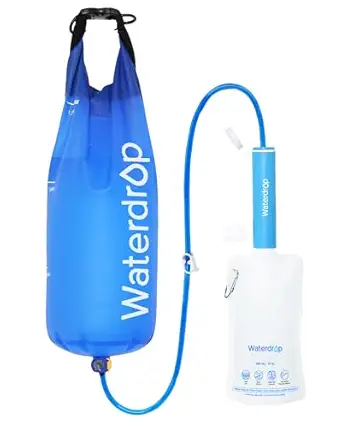 |
| Best Seller A high-volume bestseller chosen again and again | Sawyer Gravity Water Filter System SP160 |  |
Berkey Travel Water Filter

| Capacity | 1.5 gallons |
|---|---|
| Purification Method | Activated Carbon |
| Power Source | Gravity-fed |
| Maximum Flow Rate | 0.05 gpm |
The Travel Berkey is a compact gravity-fed filter built from polished stainless steel that delivers potable water without electricity or plumbing. You fill the top chamber and gravity forces water through two Black Berkey elements into the lower chamber for dispensing via the included spigot, making it suitable for campsites, RVs, or a small household countertop. The Black Berkey elements are independently tested and advertised to remove or greatly reduce over 200 common contaminants and each pair is rated for up to 6,000 gallons, which keeps ongoing cost per gallon low. Its 1.5-gallon capacity and 18-inch assembled height mean it serves one to three people conveniently but requires periodic refilling for larger groups. Build quality is solid stainless steel and the unit is freestanding and portable, though the relatively slow maximum flow rate and manual refill cycle are inherent to gravity systems. Accessories like optional fluoride/arsenic elements and different spigots are available separately if you need additional filtration or a different dispensing feel.
Best for: Buyers who want a durable, portable gravity filter for reliable contaminant reduction at campsites, in RVs, or on a small household countertop and who value long-lasting filters and no electrical requirements.
Less Ideal for: Large families or groups that need high daily output or users who want instant high flow rates or an inline powered filtration system.
- Removes or reduces over 200 common contaminants using independently tested Black Berkey elements
- No electricity, tools, or plumbing required so it works off-grid and while traveling
- Solid AISI 304 stainless steel construction for durability and easy cleaning
- Long-lasting filters rated up to 6,000 gallons per pair, lowering cost per gallon
- Small 1.5-gallon capacity requires frequent refills for more than a few people
- Gravity-fed flow is relatively slow compared with powered filtration systems
Verdict: A compact, no-power gravity filter with durable stainless construction and long-lived Black Berkey elements ideal for travel and small-group use.
Berkey Big 2.25‑Gallon Water Filter

| Capacity | 8.5 liters |
|---|---|
| Purification Method | Black Berkey proprietary filter media |
| Power Source | Gravity |
| Maximum Flow Rate | 0.03 gpm |
| Material Type | Stainless Steel |
The Big Berkey 2.25-gallon system is a countertop gravity filter that turns tap water into drinking water using two Black Berkey BB9-2 filter elements housed in polished stainless-steel chambers. It is filled by pouring water into the top chamber, which then flows through the proprietary filter media into the lower chamber for dispensing at the spigot, so no power or installation is required. The included Black Berkey elements are third-party tested and claimed to reduce over 200 common contaminants and offer a long service life—each pair is rated for up to 6,000 gallons before replacement is recommended. The compact footprint and 2.25-gallon capacity make it suitable for daily household use and small families, and the system can be expanded to add more elements for faster throughput. Important limitations are the slow maximum flow rate typical of gravity systems and the need to buy replacement elements or optional PF-2 cartridges for fluoride/arsenic reduction separately; it also requires occasional cleaning of the stainless chambers to maintain appearance. For buyers who prioritize filtration performance and independence from plumbing or electricity, this system delivers robust contaminant reduction in a simple package.
Best for: Buyers who want high contaminant reduction and reliable, off-grid countertop filtration without plumbing or electricity and who value long filter life and proven media.
Less Ideal for: People who need fast, high-volume dispensing for large households or who require built-in fluoride or arsenic removal without buying additional cartridges.
- Third-party tested Black Berkey BB9-2 elements that reduce 200+ common contaminants
- No electricity, tools, or plumbing required for setup or use
- Durable AISI 304 stainless-steel construction suitable for countertop use
- Expandable filtration capacity by adding extra filter elements for higher throughput
- Gravity-fed design has a slow maximum flow rate compared with powered filters
- Does not include fluoride/arsenic-specific PF-2 elements (sold separately)
Verdict: Choose the Big Berkey if you want a compact, performance-focused gravity system that delivers long-lasting, third-party tested contaminant reduction without electricity.
Purewell 3-Stage Gravity Water Filter

| Purification Method | Activated Carbon, Silver Ion, Hollow Fiber UF Membrane |
|---|---|
| Power Source | Non Electric |
| Upper Temperature Rating | 100 °F |
| Filter Life Cycle | 6 months |
| Capacity | 2.25 gallons |
The Purewell 3-stage gravity filter is a stainless-steel countertop system designed to deliver filtered drinking water without electricity. You fill the upper chamber with tap water and gravity forces it through a composite cartridge combining a 0.01μm hollow fiber UF membrane, activated carbon block, and silver ion treatment into the lower chamber. In practice it removes chlorine, sediment and many organic and microscopic particles while maintaining a useful flow rate (about 4 gallons per hour) and a compact 2.25 gallon capacity. The included 304 stainless housing, stainless spigot and stand make setup simple and sturdy, and replacement cartridges are rated for roughly 3,000 gallons each (6,000 gallons total with two). Because it is gravity-fed there are no power requirements and it works indoors or outdoors, but the limited tank size means frequent refills for larger households and the filter does not reduce TDS. Overall it is a practical, low-maintenance option if you want higher-accuracy filtration in a portable countertop unit without plumbing or power changes.
Best for: Buyers who want a compact, no-power countertop system that delivers higher-accuracy filtration and easy maintenance without plumbing changes.
Less Ideal for: Households needing large-volume continuous dispensing or users who require TDS reduction or RO-level dissolved-solids removal.
- Three-stage composite filtration including 0.01μm hollow fiber UF membrane for fine particle removal
- NSF/ANSI 42 and 372 certifications for chlorine reduction and lead-free materials
- 304 food-grade stainless steel housing and spigot for durability and a leak-resistant fit
- Non-electric gravity operation allows indoor or outdoor use and simple setup
- Replacement filters rated for large total capacity (approximately 6,000 gallons)
- 2.25 gallon capacity requires frequent refilling for families with high daily water use
- Does not lower total dissolved solids (TDS) or remove dissolved salts
Verdict: Choose this Purewell gravity filter if you want a durable, portable countertop system that delivers fine 0.01μm filtration and NSF-certified chlorine reduction without electricity.
SimPure Gravity Water Filter 3L

| Purification Method | Activated Carbon, Hollow Fiber Membrane |
|---|---|
| Maximum Flow Rate | 27 liters per hour |
| Supported Water TDS Level Maximum (PPM) | 1000 |
| Filter Life Cycle | 3.5 years |
| Capacity | 3 liters |
The SimPure gravity water filter is a simple, portable system that hangs from a tree or other support and uses a 0.1-micron hollow fiber membrane plus activated carbon to remove bacteria, reduce chlorine and improve taste. It comes as a 3 liter TPU bag with a filter, a tree strap and an optional extension tube or bottle adapter so you can drink directly, fill a bottle, or run hands-free filtration into a container. With a rated flow of up to 27 liters per hour and a stated lifespan around 5,000 liters (about 3.5 years for typical family use), it is fast and long-lasting for lightweight trips and emergency kits. The unit is non-electric, extremely light when rolled up, and easy to backflush for maintenance. Limitations are that it is a point-of-use gravity system so you need a place to hang it and clear source water works best; very turbid water will require pre-filtering and the bag capacity is modest for larger groups.
Best for: Buyers who need an affordable, ultra-light, no-power water purifier for backpacking, camping, or emergency kits and value portability and long filter life over high capacity.
Less Ideal for: People who need high-volume continuous water supply for large groups or who expect to filter very muddy or heavily sedimented water without pre-filtering.
- Zero-power gravity operation for hands-free filtering
- 0.1-micron hollow fiber plus activated carbon removes bacteria and reduces chlorine and taste
- Lightweight, rollable 3 L TPU bag that packs small for backpacking
- High flow rate up to 27 liters per hour for quick fills
- Long filter life rated around 5,000 liters
- Requires a place to hang the bag for gravity feed
- Bag capacity is limited for larger groups without multiple fills
- Very turbid or silty water may need pre-filtering before use
Verdict: A budget-friendly, ultra-light gravity filter that delivers fast, long-lasting microfiltration for backpacking and emergency use.
MSR AutoFlow XL 10L Gravity Filter

| Purification Method | Hollow Fiber Membrane |
|---|---|
| Capacity | 10 liters |
| Maximum Flow Rate | 1.75 liters per minute |
| Supported Water TDS Level Maximum (PPM) | 1000 |
| Power Source | Battery Powered |
The MSR AutoFlow XL is a lightweight 10-liter gravity filter built for larger backcountry groups and basecamp use. You fill the durable reservoir, hang it from the included strap or clip, and let water pass through the hollow fiber membrane at up to 1.75 L/min without any pumping effort. The filter removes bacteria and protozoa and traps sediment in the reservoir base, and the membrane is user-cleanable for repeated use. The storage bag has a PFAS-free DWR coating and the flat-base reservoir resists wear during use and packing. It comes with hoses, a dirty bag to collect raw water, a stop/start clamp, and a bottle adapter for filling containers. At roughly 12 ounces packed, it balances capacity and portability for small groups, but it is larger and slower to treat than personal straw filters and requires a place to hang for gravity flow. For reliability-focused backcountry users who need hands-off filtration for multiple people, the AutoFlow XL prioritizes durable materials and straightforward maintenance.
Best for: Campers and group leaders who prioritize dependable, low-maintenance filtration for multiple people at basecamp or short trips and value durable, cleanable components.
Less Ideal for: Solo ultralight hikers or users who need immediate on-demand sipping from a personal filter should choose smaller pump or straw-style systems instead.
- High 10-liter capacity suitable for small groups or basecamp
- Hollow fiber membrane removes bacteria and protozoa and is cleanable
- Delivers up to 1.75 liters per minute without pumping
- Durable reservoir with flat base and included dirty bag and hoses
- PFAS-free DWR storage bag and included hang strap and clip for easy setup
- Requires a hang point for gravity operation, limiting some campsite setups
- Slower and bulkier than personal pump or straw filters for solo use
Verdict: A reliable, hands-off gravity filter for small groups that pairs durable construction with a cleanable hollow fiber membrane for consistent backcountry performance.
Waterdrop Gravity Water Filter Straw

| Purification Method | Hollow Fiber Ultrafiltration Membrane |
|---|---|
| Pore Size | 0.1 micron |
| Maximum Flow Rate | 700 milliliters_per_minute |
| Supported Water TDS Level Maximum (PPM) | 300 |
| Capacity | 1400 gallons |
The Waterdrop Gravity Water Filter Straw is a portable gravity filtration kit designed to turn untreated surface water into drinkable water without power. It uses a 0.1 micron hollow-fiber ultrafiltration membrane inside a straw-style filter that connects to the included 1.5 gallon gravity bag or a threaded bottle, letting you hang the bag and collect filtered water by gravity at up to about 700 ml per minute. The kit is aimed at hiking, camping, travel, and emergency preparedness where you need hands-off, high-capacity filtration; the filter is rated for about 1,400 gallons of service life and includes a backwashable mouthpiece to clear buildup and extend performance. Practical benefits include large batch filtering with minimal effort, no batteries or pumps, and easy connection to standard bottles for rinsing or use. Limitations are that it is not an absolute chemical treatment — it reduces particulates, bacteria, and many contaminants but is specified up to 300 ppm TDS and does not replace chemical disinfection for certain viruses or industrial contaminants, and the warranty period is limited.
Best for: Buyers seeking a proven, hands-off gravity filtration solution for group camping, emergency kits, or basecamp water needs who prioritize reliable, well-reviewed products over experimental gear.
Less Ideal for: People who need guaranteed removal of industrial chemicals, heavy metals, or viral pathogens without secondary treatment or those wanting a multi-year manufacturer warranty should consider alternative systems.
- True ultrafiltration membrane (0.1 micron) removes particulates and many microbes without power.
- Includes a 1.5 gallon gravity bag for hands-off batch filtering at campsites or basecamps.
- High stated service life of about 1,400 gallons reduces the need for frequent replacement.
- Backwashable mouthpiece allows occasional cleaning to restore flow and extend filter life.
- Not specified to remove all chemical contaminants or viruses, so additional treatment may be needed in some scenarios.
- Limited 30-day limited warranty period on parts.
Verdict: Choose this gravity kit when you want a highly rated, easy-to-use ultrafiltration setup for group camping or emergency water needs that delivers large-volume, pump-free filtering.
Sawyer Gravity Water Filter System SP160

| Purification Method | Hollow Fiber Membrane |
|---|---|
| Power Source | Gravity Fed |
| Capacity | 1 gallons |
| Supported Water TDS Level Maximum (PPM) | 2000 |
The Sawyer SP160 gravity system pairs a lightweight 1-gallon bladder with Sawyer's dual-threaded MINI 0.1 micron filter to provide hands-free filtered water without pumping. To use, fill the wide-mouth reservoir from a lake, stream, or faucet, hang the bag, attach the included hose and MINI filter, and let gravity pull water through the hollow-fiber membrane into a clean container. The MINI is rated to remove nearly all bacteria and protozoa and is tested to block microplastics, and the dual threads let you cap the filter for easy on/off control while filtering. The kit is compact and packable, includes a cleaning plunger and coupling for maintenance, and requires no batteries or power, making it convenient for backcountry trips or emergency kits. Limitations are its 1-gallon capacity per fill, which means frequent refills for groups, and the system does not remove dissolved salts or very high TDS; very turbid sources will still need pre-filtering or settling for best flow rates.
Best for: Buyers who prioritize proven, low-maintenance protection for drinking water in camping, travel, or emergency kits and want a simple, reliable gravity solution.
Less Ideal for: People needing large-volume continuous water treatment for groups, desalination, or removal of dissolved chemicals should consider different systems.
- High filtration rating (0.1 micron) removes bacteria, protozoa, and microplastics
- Gravity-fed operation needs no power or pumping
- Dual-threaded MINI offers simple on/off cap control
- Includes cleaning plunger, hose, and adapters for upkeep and versatility
- Wide-mouth bladder is fast to fill and easy to hang
- 1-gallon reservoir requires frequent refills for multiple users
- Does not remove dissolved minerals, salts, or chemical contaminants
Verdict: Choose the Sawyer SP160 when you want a compact, proven gravity filter that delivers high-level bacterial and protozoan protection without pumps or power.
Choosing the Right Gravity Water Filter: Key Factors to Consider
Contaminant Removal
Know what the filter actually removes. Gravity water filters employ different media, such as hollow-fiber membranes, activated carbon, and ceramic elements. Some are optimized for bacteria and protozoa removal, while others also reduce chemicals, heavy metals, or taste and odor. Match the filter's certified or documented reduction capabilities to the hazards you expect to encounter.
Certification, third-party testing, or clear lab data is especially important if you plan to treat water of uncertain quality. For routine use with treated municipal sources, carbon-enhanced filters can improve taste and reduce chlorine. For backcountry or disaster scenarios, select filters rated for microbiological protection.
Flow Rate
Gravity-fed systems trade convenience for passive throughput. Flow rate depends on filter surface area, media porosity, and the height difference between reservoirs. A narrow ceramic element will be slower than a wide hollow-fiber module even if both claim similar removal performance.
Consider how much water you need per session. For solo or small-group camping, lower flow may be acceptable. For household emergency storage or groups, prioritize larger-capacity units or systems designed for higher liters-per-hour output to avoid long wait times.
Filter Capacity And Service Life
Capacity is typically stated as liters or gallons before the cartridge needs replacement or cleaning. Higher capacity reduces running cost and maintenance frequency, but larger capacity filters are often bulkier. Also check whether the cartridge can be cleaned or is disposable, and whether replacement parts are readily available.
For frequent use, choose a unit with a long service life and accessible replacements. For occasional emergency use, a lower-capacity, lightweight unit may be fine if stored properly to prevent media degradation.
Build Materials And Durability
Reservoir materials, seams, and fittings determine how well a unit holds up to outdoor use and storage. Durable plastics that resist UV degradation and food-safe silicone or stainless fittings are preferable. Look for leak-resistant closures and stable tripod or flat bases to prevent tip-over during filling.
Portability matters too. Hard-shell, stackable reservoirs are easier to pack and less likely to puncture than thin, flexible bags. For long-term emergency storage, choose materials that do not off-gas or impart taste to stored water.
Ease Of Maintenance
Maintenance affects long-term performance and safety. Filters that allow easy backflushing, cartridge replacement, or surface cleaning will stay effective longer. Systems that require tools or complex disassembly are more likely to be neglected.
Also consider how easy it is to sanitize the system between uses and whether replacement parts are standard sizes. Clear user-accessible parts and straightforward cleaning instructions reduce the risk of biological growth inside the housings.
How Gravity Filtration Works
Gravity filters use height and the force of gravity to move water through a filtration element. Water is poured into an upper reservoir, passes through the filter media, and collects in a lower reservoir as treated water. This passive action removes the need for pumps or power and makes the systems reliable in off-grid situations.
Design choices such as media type, filter surface area, and the distance between reservoirs affect both filtration efficiency and flow rate. Understanding these mechanics helps you pick a model that matches the volume and speed requirements of your use case.
- Upper reservoir holds untreated water
- Filter media removes particulates and pathogens
- Lower reservoir collects treated water for dispensing
Best Uses And Typical Scenarios
Gravity filters are versatile for weekend camping, small-group basecamps, international travel, and emergency home storage. They are particularly valuable when you need a low-effort solution to convert local surface water into potable water without carrying a pump.
Match the unit to the scenario. Lightweight, compact systems suit backpacking or international travel. Larger-capacity units are better for family camping or home emergency kits where you need to produce several liters per day with minimal supervision.
- Backcountry trips: focus on weight and packability
- Car camping or basecamp: look for faster flow and higher capacity
- Emergency home use: prioritize durability, capacity, and long-term storage compatibility
Installation, Setup, And Use Tips
Placement height matters. A higher upper reservoir increases pressure and can notably speed up flow. Make sure the system is stable and level when filling to avoid spills and to maintain consistent throughput.
When filling from suspect sources, pre-filter through a cloth or drip to reduce large sediment and protect the cartridge. Follow manufacturer guidance for priming and initial flush cycles before drinking water from a new cartridge.
- Use a cloth or pre-filter for turbid water
- Keep reservoirs sealed to prevent recontamination
- Prime new cartridges per instructions and discard the first few liters if recommended
Cleaning And Storage Best Practices
Regular cleaning prevents biofilm and keeps flow rates reasonable. For cleanable cartridges, perform recommended backflushing or surface scrubbing after heavy use. Rinse and air-dry housings to prevent mold during storage.
For long-term storage, remove cartridges if recommended and store components in a dry, cool place. Replace cartridges that have been stored wet or for extended periods unless the manufacturer specifies otherwise.
- Air-dry parts before storing
- Follow sanitization steps after treating biologically contaminated sources
- Replace seals or components that show wear to prevent leaks
Accessories And Add-Ons Worth Considering
Useful accessories include spigots or taps compatible with the lower reservoir, stands or suspension kits to increase gravity head, and pre-filters for heavy sediment. A small funnel makes filling easier and reduces splash contamination.
Consider carrying spare O-rings, replacement cartridges, and a simple water-testing strip if you need ongoing verification of chlorine or pH for treated sources.
- Suspension kits increase flow by raising the upper reservoir
- Pre-filters extend cartridge life in turbid conditions
- Spare seals and cartridges reduce downtime in the field
How We Chose the Best Gravity Water Filter
We prioritized factors that matter for everyday use and emergency readiness: contaminant removal performance, realistic flow rate under gravity, filter capacity and service life, build quality and materials, and ease of maintenance. Our selection favors systems with verifiable filtration media specifications and documented reduction claims for common microbiological and particulate contaminants. Flow performance was assessed based on published liter-per-hour figures and how design elements such as filter diameter and reservoir height affect real-world throughput. We excluded devices that rely on electricity, hand pumps, or need complex installation because the focus is strictly gravity-fed filtration. Units with unclear filtration claims, non-replaceable cartridges with no published capacity, or materials prone to contamination were not considered. The final list balances portability for outdoor use with larger-capacity options suited to household emergency storage, ensuring a range that matches different user priorities.
Our full evaluation process is outlined in our review methodology.
FAQ
How long does a gravity water filter cartridge usually last?
Cartridge lifespan varies by media and water quality. Typical capacities range from several hundred to several thousand liters. Heavy sediment or contaminated sources reduce service life, while clear source water extends it. Check published capacity and plan on replacements or cleaning intervals accordingly.
Can gravity filters remove viruses?
Many gravity filters effectively remove bacteria and protozoa, but virus removal often requires either a specialized membrane, chemical disinfection, or a combination approach. If viruses are a concern, choose a system with documented viral reduction or use an additional disinfection step.
Is it safe to store treated water in the lower reservoir?
Treated water is safe short-term if the reservoir is clean and sealed. For longer storage, use food-grade containers and avoid leaving water stagnant for extended periods. Sanitize the reservoir before storing and protect it from heat and sunlight to prevent bacterial growth.
How do I speed up a slow-flowing gravity filter?
Increasing the height difference between upper and lower reservoirs improves flow. Also make sure the filter is not clogged with sediment and that the air vent or spigot is clear. For persistent slow flow, cleaning or replacing the cartridge may be necessary.
Can I use a gravity filter with cloudy or muddy water?
You can, but you should pre-filter very turbid water through a cloth or sediment pre-filter to protect the cartridge. Heavy sediment will clog the media quickly and reduce both capacity and flow, increasing maintenance needs.
Final Verdict
Choose a gravity water filter by matching contaminant reduction capability and flow performance to your intended use. Prioritize certified or documented removal claims when treating high-risk sources and select larger surface-area media or higher-capacity cartridges when you need more throughput. Factor in build materials and maintenance needs to ensure reliable operation in the field or at home. In short, balance the tradeoff between flow rate and filtration specificity. For occasional use, a compact, easy-to-store unit may suffice. For regular group use or household emergency kits, favor durability, accessible replacements, and higher capacity to minimize downtime and maintenance.