
Note: This article contains affiliate links. If you click on these links and make a purchase, we may earn a small commission at no extra cost to you. This helps support our research and content. Read our full affiliate disclosure here.
Controlling humidity in a 3,000-square-foot home or finished basement matters for comfort, mold prevention, and protecting wood and electronics. A wrong-sized unit will run constantly, waste energy, and still fail to reach the target humidity. In this guide we shortlisted the top dehumidifiers suited to roughly 3,000 sq ft spaces, focusing on extraction capacity, long‑term operating cost, and reliable moisture control. Below you will find our top picks for different installation and usability priorities, plus clear criteria to help you match a unit to your layout and climate. Read on for what to check before buying and practical advice on long-term upkeep.
Top Picks at a Glance
| Best Overall The best all-around choice for most situations | Frigidaire 50 Pint Dehumidifier |  |
| Best Quality Built to a higher standard if you want something more solid | DREO DR-HDH004S Dehumidifier |  |
| Best Budget The cheapest option that still gets the job done reliably | Manastin 30-Pint Dehumidifier |  |
| Top Rated A top-rated pick with lots of positive feedback | hOmeLabs 50 Pint Dehumidifier | 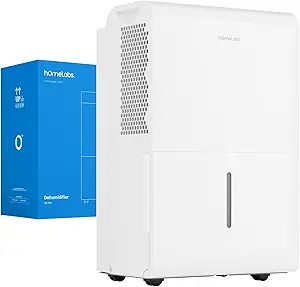 |
| Most Popular A crowd favorite that many people choose with confidence | Midea 35-Pint Dehumidifier MAD35C1AWS |  |
| Best Seller A high-volume bestseller chosen again and again | AEOCKY BOREAS-001 50-Pint Dehumidifier |  |
Frigidaire 50 Pint Dehumidifier

| Capacity | 50 pints |
|---|---|
| Tank Volume | 2.7 gallons |
| Air Flow Capacity | 235 cfm |
| Number of Speeds | 3 |
| Wattage | 470 watts |
This Frigidaire 50 Pint Dehumidifier is a portable unit meant to remove moisture from large residential spaces. It pulls up to 50 pints per day and moves air at about 235 CFM while offering three fan speeds, programmable humidity control, and continuous drain capability for extended unattended use. The washable front filter helps capture dust and is easy to clean, and the front-loading 2.7 gallon tank has a carrying handle and splash guard for simpler emptying when not using the drain option. Built‑in Wi‑Fi and auto shutoff let you monitor and adjust humidity remotely and avoid overfilling. At roughly 470 watts it balances performance and energy use for sustained operation in basements, garages, or multiroom areas. It is a solid all‑around choice for controlling dampness across a large footprint, though its size and weight make it less convenient to move frequently and it requires a nearby drain or occasional tank emptying if not plumbed for continuous drain.
Best for: Buyers who want a robust, feature‑complete dehumidifier to manage humidity across large areas and prefer remote control plus continuous‑drain convenience.
Less Ideal for: People who need a lightweight, highly portable unit for small rooms or who cannot provide a drain line should consider smaller, lighter dehumidifiers instead.
- 50 pint/day dehumidification capacity suitable for large rooms or whole-floor use
- Wi‑Fi and programmable humidity control for remote monitoring and scheduling
- Continuous drain option for long unattended runs
- Washable front filter that captures dust and is easy to clean
- Multiple fan speeds to balance noise and drying speed
- Relatively heavy and bulky which limits portability between rooms
- Consumes about 470 watts during operation which can add to running costs
Verdict: A powerful, Wi‑Fi enabled 50‑pint dehumidifier built to handle large spaces with programmable control and continuous‑drain convenience.
DREO DR-HDH004S Dehumidifier

| Dehumidification Capacity | 95 pints_per_day |
|---|---|
| Floor Area | 3000 square_feet |
| Tank Volume | 1.85 gallons |
| Air Flow Capacity | 163 cfm |
| Number of Speeds | 3 |
The DREO DR-HDH004S is a high-capacity dehumidifier built to remove large volumes of moisture from basements, garages, and open-plan living areas. It delivers up to 95 pints per day and an airflow of 163 CFM, and it runs quietly at around 41 dB so it can operate overnight without being intrusive. Practical controls include three fan speeds, adjustable humidity control, a timer, child lock, and auto-defrost, and a 7 liter (1.85 gallon) tank with continuous drain option reduces the need for frequent emptying. The unit is ENERGY STAR certified and offers energy monitoring and remote control through the brand app to help manage runtime and operating costs. On the downside it is a relatively heavy, full-size machine meant for large spaces rather than portable spot-dehumidifying, and emptying or locating a drain hose will still be necessary in setups without a floor drain. For anyone needing robust, efficient moisture removal across a 3,000 sq ft area, this model covers the practical bases with smart features and quiet operation.
Best for: Buyers who prioritize strong, reliable moisture removal across a whole basement or large home area and want energy-efficient operation with remote monitoring.
Less Ideal for: People who need a lightweight, compact unit for single-room spot treatment or frequent repositioning should consider smaller portable models instead.
- High dehumidification capacity up to 95 pints per day suitable for large areas
- ENERGY STAR certified with app-based energy monitoring to reduce operating costs
- Quiet operation around 41 dB so it can run in living spaces or bedrooms
- 7 L (1.85 gal) tank plus continuous drain option reduces refill interruptions
- Useful controls including adjustable humidity, timer, child lock, and auto-defrost
- Large and relatively heavy, making it less convenient to move between locations
- Requires manual draining or a proper drain setup for continuous unattended use
Verdict: Choose this DREO model if you need a powerful, energy-efficient dehumidifier for whole-basement or large 3,000 sq ft spaces with smart energy monitoring.
Manastin 30-Pint Dehumidifier

| Dehumidification Capacity | 30 pints_per_day |
|---|---|
| Tank Volume | 0.6 gallons |
| Wattage | 245 watts |
| Operation Mode | 3Modes(Auto/manual/drying) |
This compact compressor dehumidifier is built to handle large rooms and basements, offering a 30-pint-per-day moisture removal rate and coverage claimed up to 3,000 sq ft. It is typically used in basements, laundry rooms, or large living areas where persistent humidity and musty smells are a problem. The unit offers three operation modes (auto, manual, and clothes-drying), a timer, child lock, auto-defrost, and both a removable 0.6-gallon tank and an included drain hose for continuous operation. Practical benefits include strong reported airflow (7000 cu ft/hr) and wheels plus a handle for easy repositioning, while the clothes-dry mode helps speed indoor laundry drying. Important limitations are the relatively small tank that means frequent emptying unless you run continuous drain, and compressor units can be louder and use more power than desiccant alternatives in low-temperature environments; the unit also lists an upper temperature rating of 45°F which affects very cold spaces. For buyers prioritizing a low-cost way to control humidity over a large area, this model packs useful features into a compact footprint.
Best for: Buyers looking to reduce humidity in large rooms or basements on a budget who want straightforward features like auto mode, clothes-dry, and a continuous-drain option.
Less Ideal for: Users who need quiet ultra-low-temperature performance, very large commercial spaces, or those who prefer a model with a larger internal reservoir for occasional use.
- Rated for up to 30 pints per day for large-area humidity control
- Multiple modes including auto, clothes-dry, and fan for flexible use
- Includes continuous drain hose plus a removable tank for convenience
- Wheels and handle make it easy to move between rooms
- Auto-defrost and child lock add safety and year-round reliability
- Small 0.6-gallon tank requires frequent emptying if not using continuous drain
- Upper temperature rating of 45°F limits reliable operation in very cold basements
Verdict: A budget-friendly 30-pint compressor dehumidifier with clothes-dry and continuous-drain options that suits large homes and basements needing effective moisture control.
hOmeLabs 50 Pint Dehumidifier
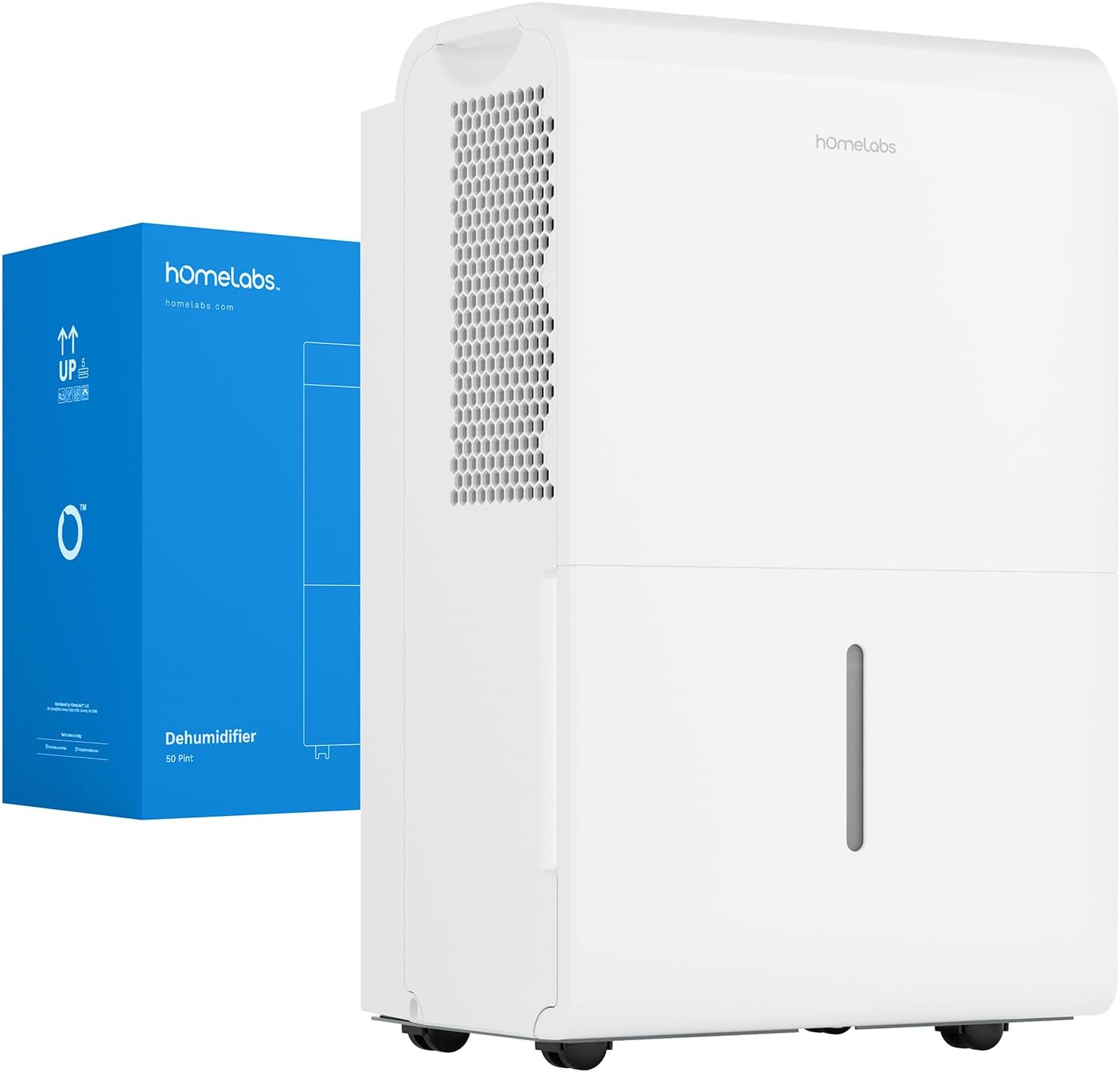
| Dehumidification Capacity | 50 pints_per_day |
|---|---|
| Floor Area | 7000 square_feet |
| Tank Volume | 1.6 gallons |
| Wattage | 322 watts |
| Air Flow Capacity | 165 cfm |
The hOmeLabs 50 Pint Dehumidifier is a floor-standing unit built to control excess moisture in large residential areas. It removes up to 50 pints per day at standard test conditions and is rated to cover very large areas, with continuous operation, automatic shutoff when the tank is full, and a hose outlet for continuous draining. The unit includes two fan speeds, a washable removable filter, touch controls and Wi‑Fi connectivity so you can monitor and adjust settings remotely. Practical benefits include a sturdy compressor-based removal system for steady dehumidification, caster wheels and handles for moving between rooms, and an automatic restart/defrost for reliable operation in varied conditions. Trade-offs are its substantial weight and footprint compared with compact models and the requirement to provide a drain hose for continuous operation if you want unattended long-term use; it also consumes several hundred watts during operation. For a homeowner wanting straightforward, consistent moisture control in basements, open living areas, or multi-room spaces, this model delivers effective, appliance-style performance.
Best for: Buyers who prioritize dependable, appliance-style moisture control for large residential areas and want remote monitoring and basic automated protections.
Less Ideal for: Those who need a lightweight, ultra-compact unit for a single small room or who require the lowest possible power draw for continuous operation.
- Rated to remove up to 50 pints per day for strong moisture removal
- Wi‑Fi control for remote monitoring and adjustments
- Automatic shutoff, restart, and defrost features that support reliable operation
- Removable washable filter and continuous drain option for easier maintenance
- Relatively heavy and large compared with compact dehumidifiers
- Requires separate hose for continuous unattended draining
Verdict: Choose this model if you want reliable, heavy-duty moisture removal and Wi‑Fi monitoring for large residential spaces.
Midea 35-Pint Dehumidifier MAD35C1AWS

| Capacity | 35 pints |
|---|---|
| Tank Volume | 1.6 gallons |
| Wattage | 495 watts |
| Air Flow Capacity | 188 cfm |
| Operation Mode | Sleep |
This Midea 35-pint dehumidifier is built for larger rooms and basements where steady moisture control is needed. It removes up to 35 pints per day and offers adjustable humidity from 35% to 85%, plus modes like Comfort, Turbo, Continuous, and Sleep to match different conditions. The unit includes a 1.6 gallon tank with an automatic shutoff and a gravity-fed continuous drain option, and a reusable washable filter keeps operating costs low. Mobility is straightforward thanks to integrated handles and 360 degree rotating wheels, and practical protections such as auto defrost and auto restart after power loss add reliability. The Wi-Fi and voice control support provide remote monitoring and on/off scheduling through an app, while its 47 dBA rating makes it relatively quiet for overnight use. Expect typical drawbacks of a portable dehumidifier: it draws nearly 500 watts at peak and the tank needs emptying if you do not use continuous drain, and its performance is rated under specific testing conditions so results vary with cooler or very humid environments.
Best for: Buyers who want a reliable, feature-rich dehumidifier for a large basement or multiple large rooms and who prioritize proven performance backed by user feedback.
Less Ideal for: People needing a compact, ultra-low-power unit for a small room or those who cannot provide a continuous drain option should consider smaller or different models.
- Removes up to 35 pints per day suitable for large rooms and basements
- Multiple operating modes including Comfort, Turbo, Continuous, and Sleep for flexible control
- Wi-Fi and voice assistant compatibility for remote monitoring and control
- Washable reusable filter reduces ongoing replacement costs
- Automatic features like auto defrost and auto restart improve reliability
- Consumes around 495 watts which can raise energy use at heavy duty settings
- 1.6 gallon tank requires regular emptying unless you set up continuous drainage
- Performance is specified for particular test conditions and may be lower in cooler or extreme environments
Verdict: A solid, full-featured 35-pint unit that balances strong moisture removal for up to 3,000 sq. ft. with smart controls and practical reliability features.
AEOCKY BOREAS-001 50-Pint Dehumidifier

| Dehumidification Capacity | 50 pints/day |
|---|---|
| Floor Area | 3500 square_feet |
| Tank Volume | 0.8 gallons |
| Wattage | 380 watts |
| Operating Noise (Min-Max) | 40-43 dB |
The BOREAS-001 packs compressor-level dehumidifying into a relatively small cabinet aimed at living spaces and basements. It removes up to 50 pints/day (measured at 95°F, 95% RH) and still offers continuous drainage via the included 2-meter hose and garden-hose adapter, which is useful if you want unattended operation in a 3,000 sq ft home. Controls include adjustable humidity setpoints, a timer, child lock, and multiple fan speeds, and the unit claims advanced humidity sensing and automatic defrost to keep it running in cooler basements. Notable practical benefits are the compact footprint, caster wheels and a reinforced handle for moving between rooms, and an emphasized low-noise design (40–43 dB) so it can run in bedrooms or home offices. Important limitations are the modest 0.8-gallon internal tank that will fill quickly in very damp conditions, so plan to use continuous drainage rather than relying on manual emptying, and the pump is not included. The manufacturer highlights copper tubing, hydrophilic fins, and a three-year machine warranty for longevity, which should appeal to buyers who prioritize reliability.
Best for: Buyers who want a reliable, manufacturer-backed compressor dehumidifier for whole-home use around 3,000 sq ft and who prefer a compact, quieter unit they can move between rooms.
Less Ideal for: People who need a very large onboard tank or integrated pump for long unattended drainage runs or those with extremely large commercial basements requiring higher-capacity industrial units.
- High rated extraction up to 50 pints/day suitable for large residential spaces
- Compact footprint with casters and handle for easy room-to-room mobility
- Included continuous drain hose and garden-hose adapter for unattended operation
- Quiet operation (specified 40–43 dB) suitable for bedrooms and offices
- Auto-defrost and adjustable humidity control for reliable use in cooler basements
- Small 0.8 gallon tank fills quickly in very damp conditions and requires frequent emptying if not using continuous drain
- No built-in condensate pump so gravity drainage placement is necessary for continuous draining
Verdict: A compact, quiet compressor dehumidifier built for reliable whole-home moisture control around 3,000 sq ft when used with continuous drainage.
Choosing the Right Dehumidifier for 3,000 Sq Ft: Key Factors to Consider
Extraction Capacity (Pints Per Day)
Extraction capacity is the single most important spec for a dehumidifier for 3,000 sq ft. Capacity is rated as pints per 24 hours at specified test conditions. For large open plans and multiroom footprints you need a unit whose real-world removal rate matches the moisture load a damp climate or finished basement will introduce.
Undersizing forces the unit to run continuously and reduces lifespan, while oversizing wastes upfront cost and can short-cycle in mild conditions. Consider both the listed capacity and how the manufacturer measures it. Look for units rated for large areas and remember that actual output will vary with ambient temperature and relative humidity.
Energy Use and Long-Term Operating Cost
Energy efficiency matters because a dehumidifier for a 3,000 sq ft space may run many hours each day during humid seasons. Check the energy factor or wattage under typical load and estimate monthly energy use based on your local climate and expected daily runtime.
Features such as auto-humidity control, low-power modes, and variable-speed fans reduce runtime and cost. Higher upfront efficiency can save money over the life of the unit, especially in regions with long, humid summers or in continuously conditioned basements.
Airflow, Placement, and Coverage
A high extraction number is only useful if the unit can move treated air through the space. Look at CFM figures or manufacturer guidance on coverage patterns. For 3,000 sq ft footprints, consider whether one central unit will suffice or whether multiple strategically placed units are needed to avoid pockets of high humidity.
Placement affects performance: raise the unit off the floor in basements prone to pooling, keep doors open between areas you want to condition, and avoid blocking intake or exhaust grilles. Units with flexible ducting or top and front vents provide more options for directing airflow.
Drainage and Continuous Operation
For large spaces you will likely prefer continuous drainage to emptying a tank frequently. Check whether the dehumidifier supports gravity drain, pump-assisted drain, or both. Pump-assisted drainage is helpful when the condensate needs to be routed upward or to a remote drain point.
Also verify hose fittings, recommended hose lengths, and whether the unit has an automatic shutoff or float switch as a backup. Reliable continuous-drain capability reduces maintenance time and allows unattended operation through wet periods.
Noise and Location Considerations
Noise levels become important when a unit serves living spaces rather than an isolated utility room. Large-capacity compressors and high CFM fans can be audible. Check decibel ratings when available and consider models with quieter fan curves or variable speed settings.
If noise is a concern, plan placement in an out-of-the-way location or use ducting to move intake and exhaust. Also think about vibration isolation pads or shelving to minimize transmitted sound to the rest of the house.
Maintenance and Filter Access
Ease of routine maintenance affects long-term performance. Look for units with tool-free access to washable filters, clear drain ports, and simple error indicators. Filter types and replacement intervals influence ongoing cost and indoor air quality.
Inspect how easy it is to clean condensate pathways and whether the manufacturer provides straightforward instructions for seasonal storage. Units designed for large installations should make filter changes and condensate access quick to avoid neglected upkeep.
Sizing Guidance for 3,000 Sq Ft Spaces
Sizing a dehumidifier for roughly 3,000 square feet starts with estimating the moisture load, not just the floor area. Consider the number of exterior walls, ground-contact surfaces, whether the area is finished or unfinished, and the local climate. A finished basement with living space and high humidity requires a higher effective capacity than a lightly used storage area of the same size.
For open plans, a single large-capacity unit can be efficient if placed centrally and paired with good airflow. In segmented floorplans or multi-level homes you may get better results with multiple mid-size units placed to cover separate zones. Factor in seasonal temperature variation because extraction ratings drop at lower temperatures.
- Estimate capacity needs by combining floor area with expected humidity severity.
- Prefer continuous-drain capability for unattended operation.
- Plan airflow or multiple units for segmented spaces.
Placement, Ducting, and Air Distribution
Where you place the dehumidifier affects real-world performance more than raw pints-per-day figures. Position units where air can circulate freely and where the intake and exhaust are not obstructed. Elevating the unit off the floor helps in basements and reduces exposure to dirt or water.
Some units accept ducting on the intake or outlet to move treated air to distant parts of a house. Ducting can help distribute dehumidified air to adjacent rooms but adds complexity and may reduce efficiency if poorly sealed.
- Keep 12 to 24 inches clearance around intake and exhaust.
- Consider short, insulated duct runs to direct air to target zones.
- Avoid placing the unit directly beside heat sources or vents that will skew humidity readings.
Managing Condensate: Gravity Vs Pump Drain
Gravity drain requires the unit to be located above the drain point. It is simple and reliable when the layout allows it, but not every installation has a suitable downstream drain location. Pump-assisted drainage is more flexible; it can lift condensate to a higher drain or route it to a sink or utility line.
Pump systems add mechanical complexity and a maintenance item; choose a pump-capable unit only if gravity drain is impractical. Confirm recommended hose types and lengths and inspect for backflow protections or float switches.
- Use gravity drain where possible for simplicity.
- Choose pump drain when the collection point is below the desired drain outlet.
- Verify hose fittings and maintenance access before installation.
Noise Control and Living Areas
If the dehumidifier will operate near bedrooms or living spaces, noise is a practical concern. Look for variable-speed fans or units with quieter operating modes. Installing the unit in a mechanical room, closet, or basement can mitigate perceived noise but may reduce airflow effectiveness if the space is too enclosed.
Vibration isolation and rubber feet lower transmitted sound through floors. Also consider runtime scheduling to avoid high-noise periods, or prioritize models tested with decibel numbers at typical operating loads.
- Place units away from primary living areas when possible.
- Use isolation pads to reduce vibration noise.
- Prefer variable-speed fans for quieter nighttime operation.
Seasonal Use and Low-Temperature Performance
In cooler seasons or unheated basements, compressor-based dehumidifiers lose efficiency below certain temperatures and may frost up. If you need year-round control in a cool environment, look for models rated for low-temperature operation or ones that include an auto-defrost feature.
Alternatively, consider using the dehumidifier primarily in the warm, humid months and performing occasional checks in cooler months. Knowing the lowest expected ambient temperature helps determine whether low-temperature capability is necessary.
- Check for auto-defrost if basement temperatures dip below recommended levels.
- Expect reduced capacity at low temperatures for standard compressors.
- Plan seasonal checks and storage if you do not need winter operation.
Installation Tips and Safety
Follow manufacturer guidelines for clearance, electrical supply, and drainage connections. Ensure the outlet is on a GFCI-protected circuit if required by local code for basements or utility areas. Avoid extension cords or undersized wiring that can lead to voltage drop and reduced performance.
Keep the intake area free of dust and debris and check filters regularly. Seal nearby sources of moisture such as leaking pipes or poor grading around the foundation to reduce overall load on the unit.
- Use a dedicated circuit if the unit draws significant current.
- Inspect hoses and fittings periodically for leaks.
- Maintain filter cleanliness for efficient airflow.
How We Chose the Best Dehumidifier for 3,000 Sq Ft
We evaluated models based on concrete, buyer-relevant performance and usability metrics for large-space humidity control. Primary filters included rated moisture removal capacity over 24 hours at typical basement temperatures, energy efficiency measured by energy factor or power draw under load, and usable reservoir or continuous-drain options for unattended operation. We also prioritized airflow and distribution capability because moving treated air across large open plans or multiple rooms affects real-world performance. Practical durability and serviceability were considered: units with accessible filters, simple controls, and clear fault indicators scored higher. Noise output under normal operation was included because large-capacity units can run continuously and noise matters in living areas. We excluded small-capacity dehumidifiers and units designed only for single rooms. Equipment lacking continuous drainage or sufficient capacity for a 3,000 sq ft footprint was not considered. The result is a short list of well-rounded options that meet the extraction, efficiency, drainage, airflow, and user-maintenance needs of large-space buyers.
Our full evaluation process is outlined in our review methodology.
FAQ
How many pints per day do I need for a 3,000 sq ft house?
It depends on moisture load and climate, but large footprints typically need high-capacity units rated for large areas or multiple mid-size units. Estimate based on finish level and local humidity, then choose a unit with margin above that baseline.
Can one dehumidifier cover an entire 3,000 sq ft home?
Sometimes. One central, high-capacity unit can work in open plans with good airflow, but homes with multiple floors or closed rooms often benefit from two or more strategically placed units for even humidity control.
Is continuous drain necessary for large spaces?
Continuous drain is highly recommended for large spaces because it avoids frequent emptying of collection tanks and supports unattended operation during humid periods. Choose gravity or pump-assisted drainage based on your layout.
Will a dehumidifier help with mold in a finished basement?
Reducing relative humidity below levels that support mold growth helps control it, but addressing water intrusion, ventilation, and insulation are also necessary. A properly sized dehumidifier is one part of a broader moisture-management plan.
How noisy are large-capacity dehumidifiers?
They can be louder than small-room units because of larger compressors and fans, though many models offer quieter modes or variable speeds. Placement and vibration isolation significantly affect perceived noise.
How often should I maintain or clean the unit?
Check and clean the washable filter every few months, inspect the condensate path and drain fittings seasonally, and follow any manufacturer guidance on coil cleaning or annual service to maintain efficiency.
Final Verdict
For a 3,000 sq ft footprint, prioritize extraction capacity, continuous drainage, and airflow distribution when choosing a dehumidifier. Energy efficiency and noise are important secondary considerations because the unit may run for long periods. If your home has separated zones or multiple levels, favor multiple units or flexible ducting to avoid humidity pockets. Balance upfront capacity with long-term operating cost and maintenance ease. Selecting a model that matches your layout, drainage options, and expected seasonal temperatures will deliver reliable humidity control and protect your home from moisture-related issues.