
Note: This article contains affiliate links. If you click on these links and make a purchase, we may earn a small commission at no extra cost to you. This helps support our research and content. Read our full affiliate disclosure here.
If you grow plants in a 4×4 grow tent, managing humidity is one of the most important steps to protect plants from mold, pests, and slowed growth. The right dehumidifier keeps relative humidity in a predictable range so you can tune temperature and CO2 without fighting condensation or disease. This guide shortlists seven dehumidifiers chosen for tent-sized spaces. We focus on capacity, control precision, energy use, and noise so you can pick a unit that fits your ventilation and crop schedule. Read on for the key factors we evaluated and quick guidance to match a dehumidifier to your tent setup.
Top Picks at a Glance
| Best Overall The best all-around choice for most situations | VIVOSUN AeroDrain D12 |  |
| Best Quality Built to a higher standard if you want something more solid | AC Infinity Hydrone 7 |  |
| Best Value The sweet spot between price and what you get | AIRVIP 34 Pint Dehumidifier |  |
| Best Budget The cheapest option that still gets the job done reliably | Stropum Small Dehumidifier DH-1 |  |
| Top Rated A top-rated pick with lots of positive feedback | hOmeLabs 32-Pint Dehumidifier |  |
| Most Popular A crowd favorite that many people choose with confidence | ToLife C2 Dehumidifier |  |
| Best Seller A high-volume bestseller chosen again and again | Frigidaire 50 Pint Dehumidifier |  |
VIVOSUN AeroDrain D12

| Dehumidification Capacity | 12 liters_per_day |
|---|---|
| Tank Volume | 2 liters |
| Capacity | 1 gallons |
| Operation Mode | Automatic |
The VIVOSUN AeroDrain D12 is a smart dehumidifier built for small grow spaces and residential use, rated to remove up to 12 liters of moisture per day. It pairs high-precision temperature and humidity sensors with app-based control so you can monitor and adjust conditions remotely and integrate it into VIVOSUN's Smart Grow System. Setup is straightforward with tool-free installation, included drain hose for continuous drainage, and built-in handles plus caster wheels for easy positioning inside a 4×4 tent or similar spaces. The unit offers automatic shutoff when the tank is full and auto-restart after power outages, which reduces intervention during multi-day runs. Practical limitations are its 2-liter tank capacity, which means frequent emptying if not using the drain option, and the performance will vary with ambient temperature and tent loading. For growers wanting remote monitoring and simple integration with other VIVOSUN gear, this model covers the key needs without unnecessary complexity.
Best for: Growers who want a compact, smart dehumidifier that integrates with a VIVOSUN grow setup and prioritizes remote monitoring and easy mobility in a 4×4 tent.
Less Ideal for: Anyone needing heavy-duty continuous dehumidification for larger rooms or growers who prefer a much larger onboard water reservoir without using a drain hose.
- Up to 12 liters per day dehumidification capacity suitable for small grow tents
- Smart app control and integration with VIVOSUN Smart Grow System for remote monitoring
- Two drainage options with included drain hose for continuous operation
- Automatic shutoff and auto-restart after power outages for unattended runs
- Built-in handles and caster wheels for easy placement and mobility
- Small 2-liter tank requires use of drain hose or frequent emptying when filling
- Performance depends on ambient temperature and tent size so output may vary
Verdict: A compact, app-connected dehumidifier that gives 4×4 tent growers reliable smart control and easy drain options for maintaining optimal humidity.
AC Infinity Hydrone 7

| Floor Area | 64 square_feet |
|---|---|
| Capacity | 2 liters |
| Number of Speeds | 10 |
| Operation Mode | Intermittent |
The AC Infinity Hydrone 7 is a purpose-built dehumidifier for grow tents that delivers precise moisture control using a PWM-controlled rotary motor and AI-driven humidity/VPD targeting. It offers 10 distinct drying levels and rapid on/off response so you can dial in small incremental changes rather than coarse full-power cycles. Typical use is inside a closed or ducted grow tent for 4 to 6 plants where stable relative humidity and vapor pressure deficit matter; the unit supports ducting through its exhaust and has an optional intake for closed-loop setups. Practical benefits include effective performance across hot and cold conditions, a 2 liter collection capacity, and intermittent operation modes that reduce compressor cycling. Important limitations are its modest 2 L tank capacity which requires more frequent draining in high-load conditions, and the unit is sized specifically for small grow spaces rather than whole basements or large rooms.
Best for: Buyers who prioritize precise, performance-focused climate control in a 4×4 grow tent and want hardware that supports closed-loop or ducted configurations for stable VPD management.
Less Ideal for: People needing a high-capacity dehumidifier for whole rooms or large grow spaces should choose a larger commercial or whole-room unit instead.
- 10-level PWM rotary motor for fine-grain drying control
- AI-driven humidity and VPD control that self-adjusts output
- Designed for both ducted and closed-loop grow tent setups
- Operates effectively across hot and cold environments
- Small 2 liter reservoir requires frequent emptying in heavy-use scenarios
- Designed capacity and coverage are aimed at small grow tents, not larger spaces
Verdict: If you need tight, performance-grade humidity and VPD control for a 4×4 grow tent, the Hydrone 7 is built to deliver precise, adjustable drying in a compact package.
AIRVIP 34 Pint Dehumidifier

| Dehumidification Capacity | 34 pints_per_day |
|---|---|
| Tank Volume | 2.5 liters |
| Wattage | 130 watts |
| Air Flow Capacity | 6700 cubic_feet_per_hour |
| Upper Temperature Rating | 95 °F |
The AIRVIP 34 Pint Dehumidifier is a compact, mobile unit designed to pull up to 34 pints of moisture per day under high‑test conditions while offering a small footprint that fits tight spaces. It has adjustable humidity control with continuous, comfort, and manual modes so you can target specific RH setpoints, plus an auto shutoff and a 6.56 ft drain hose for gravity‑fed continuous drainage. Practical additions include a spill‑proof 2.5 L tank with auto shutoff, 360 degree wheels and a handle for easy repositioning, and frost‑free technology with fast auto defrost for year‑round use. In a controlled environment the unit delivers focused airflow and steady dehumidification, but its rated capacity is measured at very warm, high‑RH conditions so real‑world performance in cooler grow tents will be lower. The unit runs on 130 watts and is reasonably quiet, but growers should plan placement and ducting to avoid disturbing intake/exhaust airflow near plants and lights. Overall, it is a space‑saving, energy‑efficient option for small enclosed grow tents when you need reliable humidity control and either periodic emptying or continuous gravity drainage.
Best for: Growers running one or two small 4×4 tents who prioritize space efficiency and precise, adjustable humidity control and who can route a gravity drain or accept occasional tank emptying.
Less Ideal for: Large commercial racks, multiple full‑size tents, or growers who need maximum extraction in cool, high‑load conditions should choose a higher‑capacity or commercial compressor unit instead.
- Compact footprint that fits into small tents and tight spaces
- Multiple control modes (continuous, comfort, manual) for precise RH targeting
- Includes 6.56 ft drain hose for gravity continuous drainage to a drain or reservoir
- Frost‑free tech and 1‑minute auto defrost for cold or transitional tent environments
- Wheels and handle make it easy to move between tents or rooms
- 34‑pint rating is measured at high temperature and humidity, so capacity drops in cooler tent conditions
- 2.5 L tank is small if you rely on manual emptying without the drain hose
Verdict: A compact, adjustable dehumidifier that fits 4×4 grow tents and gives precise humidity control with the option for continuous gravity drainage.
Stropum Small Dehumidifier DH-1
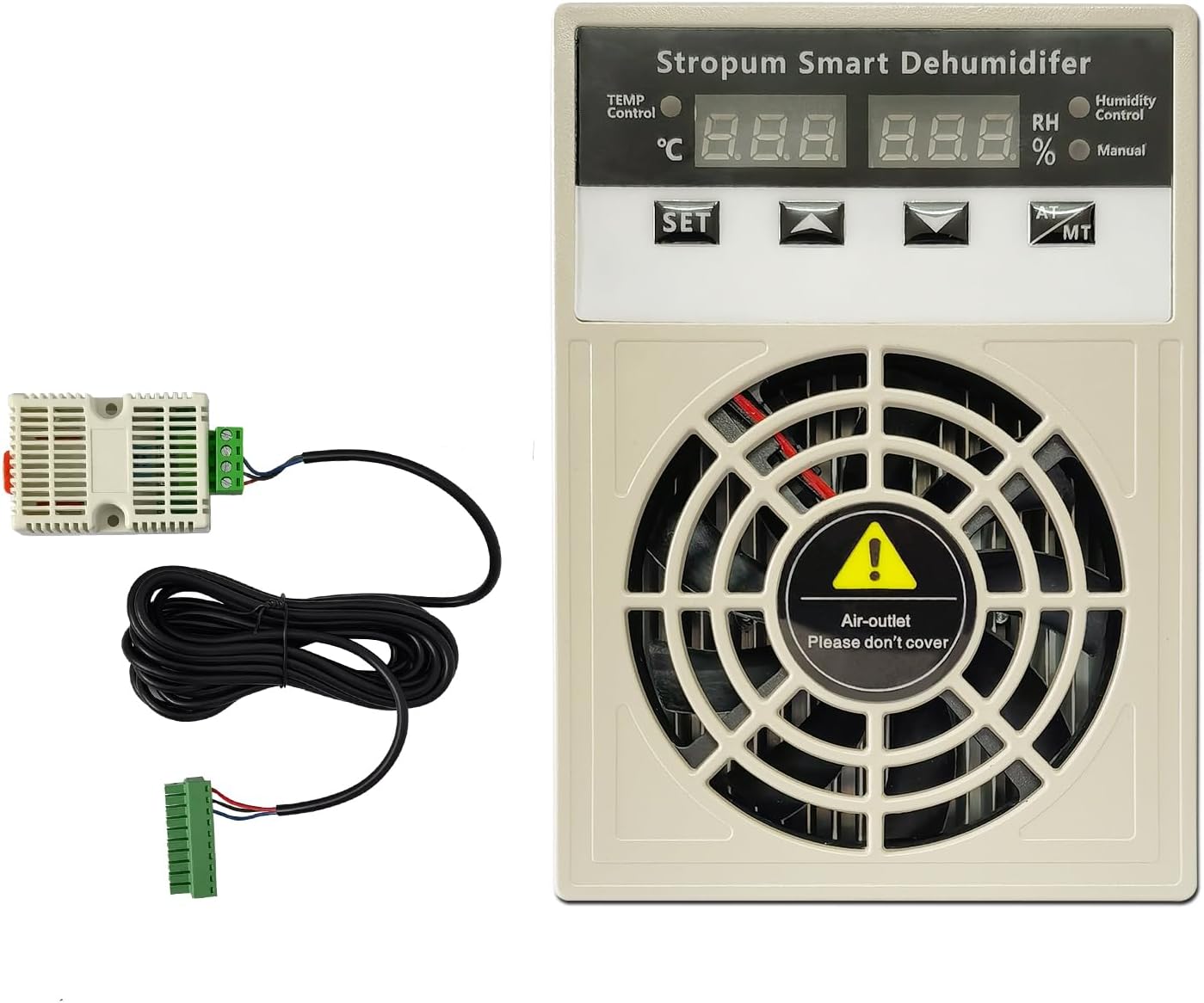
| Capacity | 800 ml |
|---|---|
| Wattage | 45 watts |
| Operation Mode | Comfort |
| Floor Area | 9.3 square_inches |
This compact Stropum DH-1 is a plug-in mini dehumidifier intended for tiny sealed spaces such as electrical boxes, cabinets, closets, or a small section inside a 4×4 grow tent. It uses an 800 ml tank and a 45 W thermoelectric system with adjustable humidity control, an external sensor on a 10 ft cord, and a temperature control switch that can trigger a fan or heater. Installation is flexible with hook or 35 mm DIN-rail mounting and simple wiring for 110–240 V circuits. In practice it is useful for stopping condensation and protecting sensitive equipment or a small corner of a tent; the external sensor and digital display let you set a target and monitor conditions remotely. Trade-offs are obvious: the unit is sized for very small volumes so it cannot dehumidify a full 4×4 tent on its own in humid climates, and the small reservoir requires frequent emptying or a drain solution. Build appears plastic and basic, so buyers should expect a utilitarian, budget-oriented device rather than a heavy-duty greenhouse unit.
Best for: Growers on a tight budget who need a compact, low-power solution to control humidity in a small enclosed area or to protect electrical gear inside a tent, and who plan to supplement it with ventilation or a larger unit.
Less Ideal for: Anyone who needs to dehumidify an entire 4×4 grow tent continuously in high ambient humidity without additional equipment should look at larger-capacity dehumidifiers designed for grow rooms.
- Compact footprint fits tight spaces and offers hook or 35 mm DIN-rail mounting
- External sensor with 10 ft cord lets you monitor humidity/temperature away from the unit
- Adjustable humidity control and temperature switch allow automated on/off control of connected fan or heater
- Works on 110–240 V and draws 45 watts so it is compatible with common circuits and energy-light for short runs
- 800 ml capacity and small airflow make it unsuitable as the sole dehumidifier for a whole 4×4 tent in humid environments
- Plastic construction and budget design limit durability compared with larger grow-grade units
Verdict: Choose the Stropum DH-1 when you need an inexpensive, compact humidity controller for a tiny enclosed space or to protect equipment inside a grow tent corner rather than to dehumidify a whole 4×4 tent.
hOmeLabs 32-Pint Dehumidifier

| Dehumidification Capacity | 35 pints_per_day |
|---|---|
| Capacity | 1.8 gallons |
| Tank Volume | 1.6 gallons |
| Number of Speeds | 2 |
| Floor Area | 4500 square_feet |
This hOmeLabs unit is a straightforward, room‑scale dehumidifier built for large spaces like basements and open living areas. It removes up to 32 pints per day under typical conditions (and higher at very warm, humid extremes), and offers both a removable 1.6 gallon water tank with auto shutoff and a continuous drain outlet for hands‑free operation. The machine includes washable filter media, two fan speeds plus a TURBO mode for faster moisture removal, and smart features such as Wi‑Fi control and voice assistant compatibility so you can monitor and change humidity from your phone. Mobility is simple thanks to built‑in casters and a handle, and safety conveniences include automatic defrost and auto restart after power interruptions. Expect practical, reliable performance for basement humidity control, though it is a single‑hose portable unit so performance will vary with room layout and extreme cold conditions can reduce extraction rates. For buyers who want easy setup, remote control, and reliable daily dehumidification, this model covers the essentials without complex installation.
Best for: Buyers who want a reliable, easy‑to‑use dehumidifier for a basement or large room and value remote control, straightforward maintenance, and portability.
Less Ideal for: People seeking a hard‑plumbed or whole‑house solution or those who need maximum extraction in consistently cold spaces should consider other types of systems.
- Removes up to 32 pints per day with higher capacity at very high temperature and humidity
- Wi‑Fi control and compatibility with Alexa and Google Assistant for remote monitoring and adjustments
- Continuous drain option plus a removable tank with auto shutoff reduces manual emptying
- Washable air filter and caster wheels make maintenance and relocation simple
- Performance drops in cold environments since rated capacity is specified at warmer test conditions
- Only two fan speeds may limit fine control of noise versus extraction rate
Verdict: A portable, Wi‑Fi enabled dehumidifier that delivers dependable moisture removal and easy maintenance for large basements and open rooms.
ToLife C2 Dehumidifier

| Floor Area | 1000 |
|---|---|
| Tank Volume | 95 fluid ounces |
| Number of Speeds | 2 |
| Wattage | 93 watts |
| Air Flow Capacity | 95 liters per minute |
The ToLife C2 is a lightweight, portable dehumidifier intended for bedrooms, bathrooms, basements, and other small spaces. It uses semiconductor condensation technology to pull moisture from the air and stores collected water in a 95 oz removable tank, with automatic shutoff when the tank is full or not seated correctly. Two speed settings include a low-noise sleep mode rated under 30 dB for overnight use and a higher-power mode for faster dehumidification, and a seven-color LED can be locked to serve as an ambient night light. At 93 watts and an advertised coverage up to 1000 sq ft, it offers a balance of modest power and low energy draw for confined spaces. Practical benefits include portability thanks to built-in handles and a quiet operation useful in occupied tents or rooms. Limitations are the semiconductor-style cooling, which is less aggressive than compressor dehumidifiers in very humid or large-volume environments, and the modest airflow rating means it will take longer to drop RH in tightly sealed or high-moisture grows.
Best for: Buyers who prioritize quiet, portable humidity control and want a simple, low-maintenance unit for a small enclosed space and who value reassurance from established user feedback.
Less Ideal for: Growers who need aggressive moisture removal for large tents, high transpiration crops, or very high ambient humidity should choose a higher-capacity compressor dehumidifier instead.
- Large 95 oz removable water tank with automatic shutoff for unattended operation
- Two fan speeds including a low-noise sleep mode under 30 dB for quiet use
- Portable, lightweight design with built-in handles for easy repositioning
- Seven-color LED with lockable color provides usable night-light function
- Uses semiconductor condensation technology which is less effective than compressor units in high-humidity or larger spaces
- Airflow and wattage are modest, so dehumidification will be slower in tightly sealed or very moist environments
Verdict: A quiet, portable choice for maintaining moderate humidity in small grow tents or rooms when a low-noise, easy-to-use unit with a large removable tank is the priority.
Frigidaire 50 Pint Dehumidifier

| Capacity | 50 pints |
|---|---|
| Tank Volume | 2.7 gallons |
| Air Flow Capacity | 235 cfm |
| Wattage | 470 watts |
| Voltage | 115 volts |
The Frigidaire 50 Pint Dehumidifier is a portable moisture extractor intended for continuous home use with Wi‑Fi connectivity and programmable humidity control. It pulls up to 50 pints per day and moves air at about 235 CFM while offering three fan speeds, a 2.7 gallon front-loading tank with splash guard, and the option for continuous draining. The washable filter and front-access bucket simplify maintenance, and Wi‑Fi lets you monitor and adjust humidity remotely. In practice it works best in larger, damp rooms where steady extraction is needed; the 470 watt power draw is typical for this capacity but means noticeable energy use during long runs. For enclosed grow spaces you can use the continuous drain option to avoid frequent emptying, but the unit is sized for much larger square footage than a 4×4 tent so you will need to manage airflow placement and may need to reduce fan output or cycle power to avoid over-drying small tents. Noise and weight are moderate for this class, and the unit is easy to operate and maintain.
Best for: A cautious buyer who wants a reliable, high-capacity dehumidifier that can run continuously with remote monitoring and low-maintenance operation for heavy moisture conditions.
Less Ideal for: Growers seeking a compact, low-power dehumidifier sized specifically for a single 4×4 tent should consider smaller nursery or tent-rated units instead.
- High extraction rate up to 50 pints per day suitable for heavy moisture loads
- Continuous drain option avoids frequent emptying for long unattended runs
- Washable filter and front-loading tank make maintenance straightforward
- Programmable humidity control and Wi‑Fi allow remote monitoring and setpoint adjustments
- Designed for large rooms so it can be oversized for small grow tents without careful duty cycling
- Relatively high power draw at 470 watts during operation
- Unit weight and footprint make placement inside tight spaces awkward
Verdict: Buy this if you want a dependable, high-capacity dehumidifier with continuous drain and Wi‑Fi for hands-off moisture control in heavy-duty spaces.
Choosing the Right Dehumidifier for 4X4 Grow Tent: Key Factors to Consider
Extraction Capacity
Extraction capacity determines how many pints or liters of water the dehumidifier can remove per day under specified conditions. For a 4×4 grow tent, capacity must match the combined moisture load from plant transpiration, soil or medium evaporation, and any humidification you run. Larger extraction capacity gives headroom during peak transpiration but can mean larger footprint and higher power draw.
Choose a unit whose rated capacity at moderate temperatures aligns with your crop load and cycle stage. Avoid underpowered models that will run continuously without reaching target relative humidity, which increases wear and energy cost.
Low-Temperature Performance
Grow tents can run cooler during certain photoperiods or in basements and garages, so the dehumidifier's ability to work at lower ambient temperatures matters. Many refrigeration-cycle dehumidifiers lose efficiency or freeze at lower temperatures, reducing extraction and risking frost buildup.
Look for units with low-temperature modes, auto-defrost, or specifications that list extraction rates at cooler temps. If your tent routinely drops below typical room temperature, prioritize verified low-temp performance to maintain consistent humidity.
Humidity Control and Accuracy
Precise and reliable humidity control is essential in a grow tent. You want set-and-forget capability with a clear digital hygrometer or the ability to connect an external humidistat or controller. Some units have coarse built-in controls that cycle widely, while others allow tight RH bands and timed operation.
Better control reduces humidity swings that promote mold or slow plant growth. Consider units that offer relative humidity setpoints, built-in timers, and the option for remote monitoring or integration with environmental controllers used in grow rooms.
Condensate Handling and Drain Options
How the unit disposes of collected water affects how hands-off the system can be. For an attended grow tent, an internal tank that requires daily emptying may be workable. For longer unattended stretches, continuous gravity drain or condensate pump options are far more convenient.
Check drain port locations and tubing sizes, and whether the unit supports a vertical lift for a pump. Reliable condensate handling reduces the risk of overflow and allows steady operation through wet periods.
Energy Use and Runtime Costs
Dehumidifiers can run for many hours per day in a grow tent, so energy efficiency has a cumulative cost impact. Look beyond advertised wattage and pay attention to extraction per kilowatt-hour or EPA-style energy performance indicators when available.
Consider how runtime varies across the day and whether the unit's compressor cycling fits your electrical budget. Energy-efficient models reduce heat added to the tent per unit moisture removed, which can also lower cooling needs.
Noise and Physical Footprint
Noise matters if the grow tent is in a living area or workspace. Fan and compressor noise will be audible when the dehumidifier runs frequently. Also consider the unit's height and clearance so it fits inside or beside the tent without blocking airflow or access panels.
Check rated noise figures but also consider placement and whether the unit's operation will disturb lights-on or lights-off periods for nearby occupants. Size affects where you can position the unit for optimal airflow through ducting or open tent vents.
Sizing a Dehumidifier for a 4X4 Grow Tent
Sizing starts by estimating the moisture load from plants and any evaporative surfaces, then matching that to a unit's extraction rated at the temperatures you'll run. A 4×4 tent with multiple mature plants during the light cycle can produce a surprisingly large moisture load, so account for peak transpiration rather than just average conditions.
- Calculate tent volume and expected transpiration during peak hours.
- Use manufacturer extraction rates at the nearest listed ambient temperature rather than ideal-room specs.
- Allow 20 to 30 percent headroom to avoid continuous operation during humid days.
Placement and Airflow Best Practices
Where you place the dehumidifier affects how evenly the tent dries and how well the unit senses actual tent humidity. Placing the unit inside the tent increases accuracy but may take up usable space and add heat. Outside placement with sealed ducting preserves tent space but requires careful duct routing to avoid kinks and pressure losses.
- If inside, keep the intake clear of plant canopies and allow several inches of clearance.
- If ducted, use smooth interior ducting and minimize bends to preserve airflow.
- Aim for gentle circulation so the dehumidifier measures representative tent humidity, not a stagnant pocket.
Integrating with Controllers and Timers
Many growers use environmental controllers to coordinate lights, fans, humidifiers, and dehumidifiers. Look for units with external humidistat compatibility or simple on/off relay control so the unit can be triggered only when needed. That reduces runtime and maintains tighter RH bands.
- Use a controller that reads the tent RH at canopy height for accurate feedback.
- Avoid rapid on/off cycles that stress compressors; prefer controllers with minimum run and off times.
- Consider controller safety features that prevent simultaneous operation of humidifier and dehumidifier.
Maintenance and Longevity in Grow Conditions
Routine maintenance extends the life of a dehumidifier in a grow tent. Filter cleaning, coil checks, and ensuring drains remain clear prevents efficiency loss and water damage. Growing environments can be dusty or spore-rich, so inspect and clean intake screens more frequently than for household use.
- Clean or replace air filters on a regular schedule based on dust load.
- Inspect coils and the condensate path for biofilm or buildup.
- Verify the defrost function works if the unit runs in cooler conditions.
Managing Heat Output
Dehumidifiers remove moisture by condensing it and in the process add heat to the space. In a 4×4 grow tent that heat contributes to the overall thermal load the ventilation and cooling system must handle. Account for the device's sensible heat when planning exhaust and intake. If cooling capacity is limited, choose a more efficient model or place the dehumidifier outside the tent with ducting to manage where the heat is introduced. Monitor canopy temperature after installation to verify you have adequate cooling headroom.
- Estimate sensible heat added and compare to your exhaust fan capacity.
- If needed, relocate the unit or enhance tent ventilation to compensate.
- Monitor plant leaf temperature and transpiration after adding the dehumidifier.
How We Chose the Best Dehumidifier for 4X4 Grow Tent
We evaluated candidate dehumidifiers for 4×4 grow tents using criteria that reflect real-world grow-room needs. Primary filters included rated extraction capacity at warm and cool room temperatures, the presence and flexibility of humidity controls, and how the unit integrates with small-space ventilation. We also scored energy efficiency and runtime economy to assess how the unit affects steady-state electrical load across a full grow cycle. We excluded units intended only for whole-home HVAC integration or those lacking continuous-drain or pump options suitable for unattended grow tents. Units with unclear performance specs, missing low-temperature ratings, or inadequate condensate handling were not considered. The final shortlist balances effective moisture removal in a 4×4 footprint, controllability for target RH bands, acceptable noise for nearby workspace, and reliable condensate management for multi-day runs.
Our full evaluation process is outlined in our review methodology.
FAQ
What humidity range should I aim for in a 4×4 grow tent?
Aim for a controlled band that depends on growth stage: higher RH during vegetative growth and lower RH during flowering to reduce mold risk. Typically, target mid-40s to low-60s percent relative humidity, adjusting by species and stage.
Can I use a household dehumidifier inside the grow tent?
Many household dehumidifiers work but check extraction ratings, low-temperature performance, and drain options. Units designed for small spaces or with low-temp modes are generally better suited to tent conditions.
How often will I need to empty the water tank?
Tank frequency depends on plant load and unit capacity. High extraction units or dense plantings may fill tanks daily, while continuous-drain or pump setups can run for days without attention.
Will the dehumidifier affect my tent temperature?
Yes. Dehumidifiers add sensible heat when they condense moisture. That extra heat can alter canopy conditions, so factor it into your cooling and exhaust calculations.
Is it better to place the dehumidifier inside or outside the tent?
Both options work. Inside placement gives the most accurate RH reading and faster response. Outside placement with ducting preserves tent space and concentrates heat externally. Choose based on space, duct routing, and noise concerns.
Final Verdict
For a 4×4 grow tent, prioritize a dehumidifier that matches peak transpiration capacity, maintains performance at your expected ambient temperatures, and offers reliable condensate handling. Balance extraction and energy efficiency against heat and noise impact so the unit integrates cleanly with your ventilation and control systems. Focus on humidity control accuracy and low-temperature capability when making a final choice. That approach reduces disease risk and helps you maintain stable environmental conditions that support consistent plant growth and yields.