
Note: This article contains affiliate links. If you click on these links and make a purchase, we may earn a small commission at no extra cost to you. This helps support our research and content. Read our full affiliate disclosure here.
If you want to control dampness without driving up utility bills, picking an energy efficient dehumidifier matters. The right unit removes moisture effectively while using less electricity and running quietly enough for living spaces. In this guide we shortlisted seven top-performing dehumidifiers that prioritize efficiency, capacity, and ease of use. Each pick was evaluated on practical factors such as energy draw, moisture-extraction rate, daily usability, and maintenance needs. Read on to find a model that fits your space, climate, and efficiency goals.
Top Picks at a Glance
| Best Overall The best all-around choice for most situations | avylo 90-Pint Dehumidifier ADC018 |  |
| Best Quality Built to a higher standard if you want something more solid | AEOCKY RHEA Dehumidifier 80 Pint |  |
| Best Value The sweet spot between price and what you get | KNKA 80-Pint Dehumidifier PD30MA-20 |  |
| Best Budget The cheapest option that still gets the job done reliably | KMFurnila 30-Pint Dehumidifier | 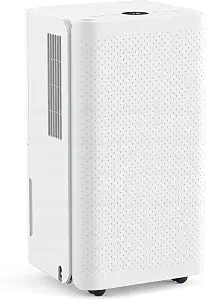 |
| Top Rated A top-rated pick with lots of positive feedback | hOmeLabs 32-Pint Dehumidifier |  |
| Most Popular A crowd favorite that many people choose with confidence | Waykar 80-Pint Dehumidifier JD025CE-80 |  |
| Best Seller A high-volume bestseller chosen again and again | Midea 22 Pint Dehumidifier |  |
avylo 90-Pint Dehumidifier ADC018

| Dehumidification Capacity | 90 pints_per_day |
|---|---|
| Tank Volume | 2.11 gallons |
| Number of Speeds | 3 |
| Wattage | 235 watts |
| Operation Mode | Automatic |
The avylo 90-pint ADC018 is a high-capacity dehumidifier aimed at large basements and open areas, delivering up to 90 pints per day while using a high-efficiency compressor to keep running costs low. It is typically placed in basements, garages, or large living areas and can run continuously using one of three drainage methods: the top-mounted 2.11 gallon tank with full-tank auto shutoff, gravity drain, or the built-in pump with a 15 ft lift and included hose for unattended drainage. The LED display and humidity sensors let you set target humidity and monitor conditions, and quiet operation (around 41 dB) plus a 24-hour timer make it suitable for near-living spaces. Certified ENERGY STAR Most Efficient 2025 and multiple safety certifications mean good energy performance and protections like child lock and compressor safeguards. The unit is relatively heavy and bulky, so moving or storing it between seasons requires effort, and it may be overkill for small rooms or occasional spot use.
Best for: Buyers who want a cost-efficient, high-capacity dehumidifier for large basements or whole-room humidity control and value continuous unattended drainage and energy savings.
Less Ideal for: People who need a lightweight portable unit for small rooms, occasional spot dehumidifying, or who cannot accommodate the physical size and weight.
- High dehumidification capacity up to 90 pints per day suitable for large spaces
- ENERGY STAR Most Efficient 2025 certification for low operating cost and high EER
- Built-in pump with 15 ft lift plus included drain hose enables continuous unattended drainage
- Multiple drainage options and full-tank auto shutoff provide installation flexibility and overflow protection
- Quiet operation around 41 dB with timer and LED humidity display for comfortable daily use
- Relatively heavy and bulky, which makes repositioning difficult
- May be more capacity than needed for small rooms or infrequent use
Verdict: Choose this unit when you need a high-capacity, energy-efficient dehumidifier for large spaces that can run unattended via pump or gravity drain.
AEOCKY RHEA Dehumidifier 80 Pint
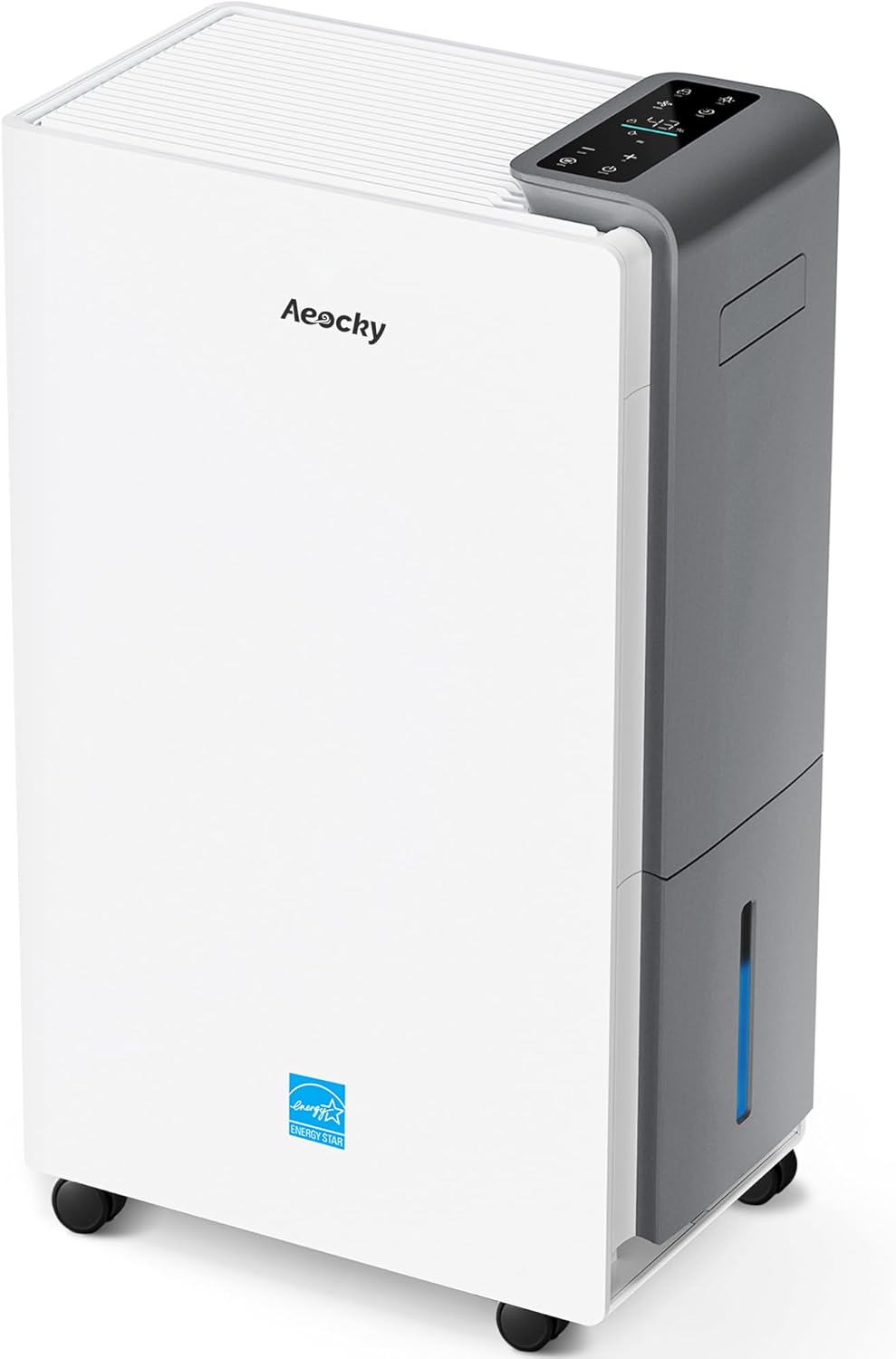
| Capacity | 80 pints per day |
|---|---|
| Tank Volume | 1.45 gallons |
| Wattage | 280 watts |
| Operation Mode | Auto, Constant Humidity, Continuous, Smart Drying, Sleep Mode |
| Air Flow Capacity | 9006 cubic feet per hour |
The RHEA-001 is a high-capacity compressor dehumidifier built to remove up to 80 pints per day and treat large spaces (listed for about 5,500 sq ft). It runs multiple modes including auto, constant-humidity, continuous, smart dry and sleep, and includes a 1.45 gallon internal tank plus a drain hose and garden-hose adapter for continuous drainage. Key selling points are its ENERGY STAR Most Efficient 2025 rating, claimed low-noise operation (reported minimum around 44 dB), and a high-efficiency rotor compressor with an enhanced 3+2 evaporator/condenser layout for faster moisture removal and lower energy draw. Practical benefits include fewer compressor cycles for presumed longer life, millisecond-level humidity sensing for tight humidity control, and low-temperature defrost capability so it can keep working in cool basements. Limitations to consider are its large footprint and weight compared with small-room units and that it uses a single fan speed setting configuration listed as one speed, which may limit fine control of airflow noise and distribution in certain rooms.
Best for: Buyers who prioritize maximum moisture removal and long-term energy savings for large or problem spaces and want a durable, efficient compressor dehumidifier that can run continuously with tight humidity control.
Less Ideal for: People seeking a compact, lightweight bedroom or small-room unit or buyers who need multiple fan speeds for nuanced noise or airflow control should consider smaller or more configurable models instead.
- ENERGY STAR Most Efficient 2025 certification for top-tier energy savings
- High dehumidification capacity up to 80 pints per day suitable for large spaces
- Multiple operation modes and smart humidity control for precise, automated use
- Includes drain hose and garden-hose adapter for continuous drainage
- Designed low-noise operation with a reported low fan noise around 44 dB
- Only one listed fan speed which may reduce airflow control options
- Relatively large unit intended for whole-home or basement use, not small rooms
Verdict: Choose the RHEA if you need a top-tier, ENERGY STAR Most Efficient 2025 compressor dehumidifier that removes large volumes of moisture while minimizing energy use.
KNKA 80-Pint Dehumidifier PD30MA-20

| Capacity | 80 pints per day |
|---|---|
| Tank Volume | 1.45 gallons |
| Wattage | 360 watts |
| Floor Area | 4500 square_feet |
| Operation Mode | AUTO, DRY, SETTING |
The KNKA PD30MA-20 is a performance-focused dehumidifier built for large, damp spaces such as basements. Its high-efficiency compressor can remove up to 80 pints per day under extreme conditions and about 56 pints in typical basement conditions, while an internal 1.45 gallon tank plus a supplied 6.56 ft drain hose enable continuous drainage to avoid frequent emptying. Controls include AUTO, DRY, and a SETTING mode for 30%–80% RH, and the digital display with a color-changing humidity indicator makes it easy to monitor conditions at a glance. The unit is designed to run quietly (40–45 dB), has a washable filter, casters for moving between rooms, cord storage, a 12-hour timer, and a child lock for steady, unattended operation. Expect good energy efficiency thanks to ENERGY STAR certification and a 360 watt power draw, but note that humidity readings come from the air inlet and may differ slightly from a separate hygrometer; the unit also needs upright siting for 24 hours before first use. For heavy-duty basement dehumidification this model balances strong capacity with thoughtful usability features.
Best for: Buyers who need powerful, reliable moisture removal in large basements or very damp rooms and prioritize steady performance and easy continuous drainage.
Less Ideal for: People seeking a compact or ultra-light unit for small rooms or occasional use should consider lower-capacity, more portable models instead.
- High maximum dehumidification capacity up to 80 pints per day for large, very humid spaces
- Includes 6.56 ft drain hose and built-in tank for continuous drainage to reduce manual emptying
- ENERGY STAR certified and uses a high-efficiency compressor for lower operating costs relative to output
- Quiet operation (40–45 dB) and caster wheels make it suitable for basements and living spaces
- Digital display with real-time humidity readout and color indicator simplifies monitoring and control
- Humidity reading is measured at the air inlet and may not match a separate room hygrometer
- Requires upright placement for 24 hours before first use to avoid operational issues
Verdict: Choose this KNKA if you need a strong, ENERGY STAR certified dehumidifier that can handle large basements with continuous-drain capability and quiet operation.
KMFurnila 30-Pint Dehumidifier
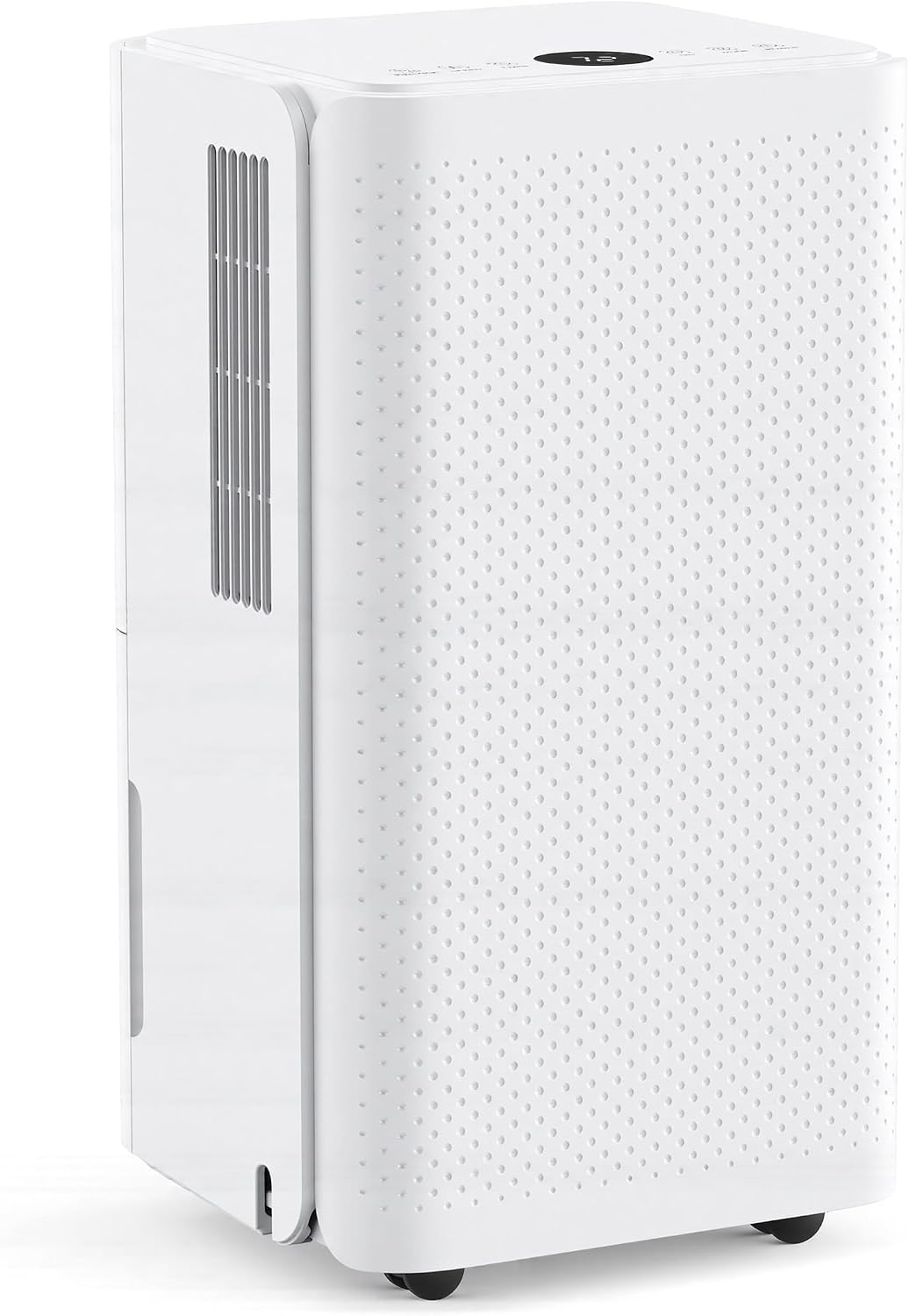
| Dehumidification Capacity | 30 pints_per_day |
|---|---|
| Floor Area | 2000 square_feet |
| Tank Volume | 2 liters |
| Number of Speeds | 4 |
| Operation Mode | Continuous |
This KMFurnila unit is a compact, energy-efficient dehumidifier meant for homes up to about 2,000 sq ft and daily removal of up to 30 pints of moisture. It offers four modes including Auto, Drying, Sleep and Fan-Only, a 24-hour timer, and a color-coded humidity display ring that makes current conditions easy to read at a glance. Continuous drain capability and a removable 2.0 liter tank simplify maintenance, and easy-roll casters let you move it between rooms. The ENERGY STAR certification promises lower running costs compared with non-certified models, and sound levels under 38 dB keep operation unobtrusive during daytime or sleep settings. Limitations include a relatively small internal tank compared with higher-capacity designs, so continuous draining is useful if you need longer unattended runs, and its effectiveness will depend on room layout and ambient temperature like other refrigerant dehumidifiers.
Best for: Buyers prioritizing low operating cost and quiet, everyday dehumidification in medium-sized homes who want simple controls and an ENERGY STAR rated appliance.
Less Ideal for: People who need industrial or whole-house dehumidification or who want a large internal tank for long unattended runs should consider higher-capacity commercial units instead.
- ENERGY STAR certified for lower energy use during continuous operation
- Color-coded humidity ring gives immediate visual feedback
- Multiple modes (Auto, Drying, Sleep, Fan) for flexible operation
- Continuous drain option and removable 2 L tank for easy maintenance
- 2.0 liter tank is small relative to its 30-pint daily capacity, requiring frequent emptying without a drain hose
- Performance depends on room layout and ambient temperature, so peak removal rates may be lower in cooler rooms
Verdict: A quiet, ENERGY STAR certified 30-pint dehumidifier that cuts energy use while providing flexible modes and easy draining for budget-conscious home moisture control.
hOmeLabs 32-Pint Dehumidifier

| Dehumidification Capacity | 35 pints_per_day |
|---|---|
| Capacity | 1.8 gallons |
| Tank Volume | 1.6 gallons |
| Number of Speeds | 2 |
| Floor Area | 4500 square_feet |
This hOmeLabs unit is a straightforward, room‑scale dehumidifier built for large spaces like basements and open living areas. It removes up to 32 pints per day under typical conditions (and higher at very warm, humid extremes), and offers both a removable 1.6 gallon water tank with auto shutoff and a continuous drain outlet for hands‑free operation. The machine includes washable filter media, two fan speeds plus a TURBO mode for faster moisture removal, and smart features such as Wi‑Fi control and voice assistant compatibility so you can monitor and change humidity from your phone. Mobility is simple thanks to built‑in casters and a handle, and safety conveniences include automatic defrost and auto restart after power interruptions. Expect practical, reliable performance for basement humidity control, though it is a single‑hose portable unit so performance will vary with room layout and extreme cold conditions can reduce extraction rates. For buyers who want easy setup, remote control, and reliable daily dehumidification, this model covers the essentials without complex installation.
Best for: Buyers who want a reliable, easy‑to‑use dehumidifier for a basement or large room and value remote control, straightforward maintenance, and portability.
Less Ideal for: People seeking a hard‑plumbed or whole‑house solution or those who need maximum extraction in consistently cold spaces should consider other types of systems.
- Removes up to 32 pints per day with higher capacity at very high temperature and humidity
- Wi‑Fi control and compatibility with Alexa and Google Assistant for remote monitoring and adjustments
- Continuous drain option plus a removable tank with auto shutoff reduces manual emptying
- Washable air filter and caster wheels make maintenance and relocation simple
- Performance drops in cold environments since rated capacity is specified at warmer test conditions
- Only two fan speeds may limit fine control of noise versus extraction rate
Verdict: A portable, Wi‑Fi enabled dehumidifier that delivers dependable moisture removal and easy maintenance for large basements and open rooms.
Waykar 80-Pint Dehumidifier JD025CE-80

| Dehumidification Capacity | 80 pints_per_day |
|---|---|
| Tank Volume | 2.5 gallons |
| Wattage | 270 watts |
| Air Flow Capacity | 165 cfm |
| Operation Mode | Continuous |
The Waykar 80-Pint Dehumidifier is built to handle large, damp areas such as basements by extracting up to 80 pints per day and offering both tank and continuous drain options. It is commonly used running continuously or on a timed schedule to bring basement humidity down to a selected setpoint between 30% and 80% relative humidity, and the 90° auto-swing helps spread airflow for more even drying. Practical features include an included drain hose and connector for gravity drainage, a washable removable filter, automatic defrost and overload protection for low-temperature reliability, and an Energy Star rating to keep running costs lower than noncertified units. At roughly 42 dB it is quieter than many similarly sized machines, making it reasonable for finished basements or nearby living areas. The unit is relatively heavy and targeted at larger spaces, so it is less convenient to move frequently, and the 1.14 gallon tank means emptying is still needed if you do not use continuous drainage. For buyers focused on dependable basement performance and energy efficiency, this model delivers strong moisture removal with sensible protections for extended operation.
Best for: Homeowners who need a reliable, high-capacity dehumidifier to control moisture in large basements and prefer proven features and energy efficiency over portability.
Less Ideal for: People looking for a lightweight, highly portable unit for small rooms or occasional use should consider smaller, easier-to-move models instead.
- High dehumidification capacity rated at 80 pints per day for large basements
- ENERGY STAR certification for better energy efficiency during extended use
- Multiple drainage options with included drain hose for continuous gravity drain
- Auto-defrost and overload protection improve reliability in cool basement conditions
- 90° auto-swing airflow and washable filter help distribute air and simplify maintenance
- Relatively heavy and sized for large spaces, so not ideal for frequent transport
- Water tank is modest at 1.14 gallons if continuous drainage is not used
Verdict: A powerful, Energy Star certified 80‑pint unit that reliably handles large basement humidity with continuous drain and protective auto-defrost features.
Midea 22 Pint Dehumidifier

| Coverage | 1500 square_feet |
|---|---|
| Dehumidification Capacity | 22 pints_per_day |
| Tank Volume | 0.8 gallons |
| Wattage | 295 watts |
| Air Flow Capacity | 135 cfm |
This Midea 22-pint dehumidifier is a compact, energy-efficient unit designed for basements, bedrooms, and other medium-sized spaces. It removes up to 22 pints of moisture per day and offers adjustable humidity from 35% to 85%, a programmable timer, and a turbo mode for faster drying. The unit is Energy Star certified, rated at 295 watts, and reports a quiet 47 dBA operating level, so it can run overnight without being disruptive. Practical features include a reusable washable filter, a 0.8 gallon bucket with automatic shutoff, and a built-in drain port for continuous drainage via a standard hose. Wi‑Fi connectivity with voice control adds remote monitoring and scheduling convenience. Limitations to note: its 22-pint capacity targets single rooms or small basements rather than large damp spaces, and the 0.8 gallon tank means more frequent emptying if you do not use continuous drainage. The machine is straightforward to move on its four-wheel design, and auto-restart and auto-defrost functions improve reliability in variable conditions.
Best for: Buyers who prioritize energy efficiency and reliable, low-noise moisture control for single rooms or small basements and want smart features for remote operation.
Less Ideal for: People needing heavy-duty dehumidification for large, very damp basements or whole-house moisture control should choose a larger-capacity commercial unit.
- Energy Star certified for lower energy use compared with standard models
- Wi‑Fi and voice control for remote monitoring and scheduling
- Quiet operation at about 47 dBA, suitable for bedrooms
- Continuous drain port plus a removable 0.8 gallon tank for flexible drainage
- Reusable washable air filter reduces replacement costs
- 22-pint capacity is modest and may be insufficient for very damp or large basements
- Smaller 0.8 gallon bucket requires frequent emptying without a hose connected
Verdict: Choose this unit if you want a quiet, Energy Star certified dehumidifier with smart controls for efficient humidity control in single rooms or small basements.
Choosing the Right Energy Efficient Dehumidifier: Key Factors to Consider
Rated Capacity Versus Room Size
Match the dehumidifier's rated extraction capacity to the room volume and typical humidity. Manufacturers quote pints or liters per day under specific test conditions. Real-world performance varies with ambient temperature and starting humidity, so choose a capacity with some headroom rather than the bare minimum.
Undersizing leads to long runtimes and higher effective energy cost, while oversizing can cause short cycling that reduces dehumidification efficiency and may increase wear. Consider ceiling height, open-plan areas, and adjacent rooms when estimating the effective space a single unit must handle.
Energy Draw and Efficiency Ratings
Look for measured power consumption at common operating settings, not just labeled wattage. Two units with identical extraction ratings can consume very different amounts of electricity depending on compressor design, fan power, and control logic.
Higher efficiency units often include features such as variable-speed fans, smart humidity sensors, or more efficient compressors that maintain removal rates with lower input power. Consider how often and how long the unit will run in your climate to estimate annual energy use rather than focusing solely on instantaneous draw.
Control Features and Automation
Controls determine how effectively the unit maintains a target humidity with minimal wasted runtime. Digital humidistats, programmable timers, and auto mode let the dehumidifier adjust to changing conditions instead of running continuously at a fixed setting.
Look for models with clear setpoint control and indicators for current relative humidity. Advanced automation such as hysteresis settings or eco modes can reduce cycling and save energy. Ease of changing settings and the readability of the display also matter for everyday convenience.
Water Handling and Continuous Drain
Capacity of the internal reservoir, the placement of the tank, and whether the unit supports a continuous drain all affect how often you need to empty it. Larger tanks mean less frequent emptying but add weight when full, which can be a factor if you move the unit for cleaning or storage.
Continuous drain capability or pump-assisted drainage is useful for basements or locations where emptying is inconvenient. Also consider how easy the tank is to remove and replace, and whether the fill indicator is visible from a standing position.
Noise and Placement Considerations
Operational noise matters when the dehumidifier is used in living areas, bedrooms, or home offices. Manufacturers list decibel levels, but perceived loudness depends on fan speed, tonal character, and placement. A lower fan speed with a quiet compressor can be preferable for overnight use even if it slows extraction slightly.
Plan for placement that allows airflow around the intake and discharge vents. If you need a quieter unit, compare noise ratings at equivalent extraction settings and consider models with sleep or low-noise modes.
Maintenance and Filter Access
Routine maintenance affects long-term efficiency. Check how easily the air filter can be reached and whether filters are reusable or disposable. A clogged filter reduces airflow, lowering extraction efficiency and increasing run times.
Inspectability of coils and the accessibility of components that require occasional cleaning or descaling will influence upkeep. Units with clear maintenance guidance and simple tool-free access reduce the chance of neglect that can degrade energy performance over time.
Estimating How Much You Will Actually Spend To Run a Dehumidifier
To estimate running cost, multiply the unit's average wattage at the setting you expect to use by the number of hours per day you anticipate running it, then convert to kilowatt-hours and multiply by your local electricity rate. Seasonal needs vary widely; damp summer months may require continuous operation while drier seasons need only intermittent use.
Factor in that efficiency changes with room temperature. Most residential dehumidifiers are tested at moderate indoor temperatures. In cooler basements the compressor works less efficiently, which can increase runtime and energy cost for the same moisture removal.
- Record the unit's practical wattage at your preferred setting if possible.
- Estimate daily hours based on local humidity patterns.
- Adjust projections seasonally rather than assuming constant use.
Where to Place a Dehumidifier for Best Efficiency
Place the unit where airflow is unrestricted and where it can draw the most humid air. Centralizing the dehumidifier in a basement or running it in a stairwell can help circulate treated air through adjacent rooms. Avoid cornering the unit or tucking it behind furniture where intakes are blocked.
If the space includes multiple small rooms, consider portable options you can move to the most affected area. For continuous drainage, position the unit near a floor drain or window-level exit to simplify runoff routing.
- Keep at least 12 inches of clearance around intake and exhaust.
- Avoid placing the unit directly against cold exterior walls.
- Elevate units slightly if floor-level dust or debris is a concern.
Using Controls to Maximize Efficiency
Set a sensible humidity target rather than the lowest possible number. Relative humidity in the 45 to 55 percent range is often adequate for comfort and mold prevention while minimizing runtime. Using auto mode or a programmable schedule ensures the unit runs only when needed.
Make use of hysteresis or on/off differentials if available. These settings prevent frequent short cycling, which wastes energy and can shorten compressor life. Timers and app-based scheduling can match operation to times of day when humidity spikes most.
- Prefer steady control over constant maximum-power operation.
- Use a hygrometer to verify the setpoint and track performance.
- Consider low-noise or eco modes for overnight or low-activity periods.
Maintenance Routines That Preserve Efficiency
Regular filter cleaning and occasional coil checks keep airflows high and heat-exchange surfaces effective. Clogged filters, dusty coils, and neglected drains all force the unit to work harder for the same moisture removal.
Schedule brief inspections monthly during heavy-use seasons. Empty and clean the tank as recommended, clear drain lines, and replace or wash filters based on the manufacturer's interval to maintain peak efficiency without unnecessary service.
- Wash reusable filters with mild detergent and let them dry fully before reinstalling.
- Flush condensate lines to prevent blockages that cause overflows.
- Document maintenance dates to stay on a regular schedule.
When to Choose Continuous Drain or a Pump
Continuous drain is convenient for long-running installations. Gravity-fed drains require an outlet below the unit's drain port, while built-in pumps let you route condensate upward or across distances. Pumps reduce manual emptying but add moving parts that may require occasional service.
If you expect frequent heavy extraction, a continuous drain or pump reduces interruptions and the risk of overflow. For intermittent use or rooms where you will be present often, an adequately sized tank may be simpler and quieter.
- Use pump-assisted units when the nearest drain is above floor level.
- Confirm tubing size and attachment method for reliable drainage.
- Consider the tradeoff between convenience and added maintenance for pumps.
How We Chose the Best Energy Efficient Dehumidifier
We focused on attributes that directly affect operating cost, convenience, and real-world dehumidification performance. Primary evaluation criteria included measured energy consumption at typical settings, moisture removal rate for the unit's rated coverage, and the integrated controls that let you optimize runtime. We also considered reservoir and drainage design for low-maintenance operation, fan noise at normal operating speeds, and durability of components that affect long-term efficiency. Products were excluded if they lacked verified energy-consumption data, omitted clear humidity control options, or were intended only for specialty uses such as continuous industrial drying. We prioritized units with a balance of certified energy figures, effective moisture extraction across typical home temperatures, and straightforward user controls. The scoring emphasized energy draw and extraction efficiency while also accounting for noise, autonomy, and ease of maintenance so readers can choose based on the tradeoffs that matter most to home use.
Our full evaluation process is outlined in our review methodology.
FAQ
How large a dehumidifier do I need for a typical basement?
Choose a capacity with some headroom above your estimated moisture load. Basements with active water issues or very high humidity need higher extraction rates. If the space is cooler than the test conditions used to rate the unit, pick a model rated for basement use or one with strong low-temperature performance.
Will a dehumidifier reduce my energy bill overall?
A dehumidifier increases electricity use directly, but it can reduce other costs such as HVAC run time or mold remediation risk. Efficiency-minded units minimize the energy impact by extracting more moisture per kilowatt-hour. Overall savings depend on local climate and how well the unit is sized and controlled.
Is continuous drainage necessary for all installations?
Continuous drainage is not necessary for every setup but is highly convenient for spaces where the unit runs long hours or where emptying the tank is impractical. If you run the unit intermittently in living spaces, an adequately sized tank may suffice.
How much noise should I expect from an efficient dehumidifier?
Noise varies by fan speed and compressor design. Efficient models often use variable fans or quieter motors to balance extraction and acoustics. Expect some background hum; compare decibel ratings at comparable extraction levels if quiet operation is important.
Can I run a dehumidifier continuously during the wet season?
Many units are designed for extended operation, especially with continuous drain. Continuous use is fine if the unit is sized correctly, has proper maintenance, and is installed with good airflow. Monitor performance and empty or maintain the unit as recommended to avoid issues.
Final Verdict
Prioritize units that combine realistic extraction capacity with low measured energy draw and practical controls. Sizing the dehumidifier to your actual room volume and seasonal humidity patterns avoids excessive runtimes and preserves efficiency. Decide whether convenience features such as continuous drain, quieter operation, or smart automation are worth slight compromises in upfront simplicity. With the criteria above, you can select an energy efficient dehumidifier that meets both moisture-control needs and ongoing operating-cost goals.