
Note: This article contains affiliate links. If you click on these links and make a purchase, we may earn a small commission at no extra cost to you. This helps support our research and content. Read our full affiliate disclosure here.
A correctly sized dehumidifier can make the difference between a usable basement and a damp, mold-prone space. A 30 pint capacity is a common sweet spot for many finished or partially finished basements that experience moderate humidity, offering steady moisture removal without the bulk of larger units. In this guide you will find seven shortlisted, practical picks chosen for steady extraction, reasonable energy use, and features that simplify long-term basement operation. Below we explain the key specs and features that matter when selecting a 30 pint basement dehumidifier and present the top options that matched our editorial criteria.
Top Picks at a Glance
| Best Overall The best all-around choice for most situations | VEAGASO VG380 34-Pint Dehumidifier |  |
| Best Quality Built to a higher standard if you want something more solid | LG PuriCare 50 Pint Dehumidifier |  |
| Best Value The sweet spot between price and what you get | AIRPLUS 30-Pint Dehumidifier |  |
| Best Budget The cheapest option that still gets the job done reliably | KMFurnila 30-Pint Dehumidifier | 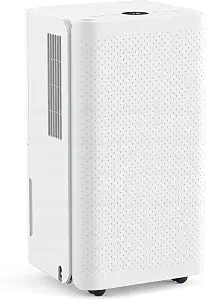 |
| Top Rated A top-rated pick with lots of positive feedback | hOmeLabs 32-Pint Dehumidifier |  |
| Most Popular A crowd favorite that many people choose with confidence | Waykar 34 Pint Dehumidifier |  |
| Best Seller A high-volume bestseller chosen again and again | BEDRED CT11 Dehumidifier |  |
VEAGASO VG380 34-Pint Dehumidifier

| Capacity | 34 pints/day |
|---|---|
| Coverage Area | 2500 square feet |
| Tank Volume | 2 liters (0.53 gallon) |
| Wattage | 230 watts |
| Noise Level | ≤40 dB |
The VEAGASO VG380 is a compressor dehumidifier built for damp spaces like basements, laundry rooms, and large living areas. It removes up to 34 pints per day and offers three modes: DEHU (maintain a target humidity), DRY (faster clothes drying), and CONT (continuous operation for very damp spaces). Controls are handled via an LED touch panel with adjustable humidity from 30 to 80 percent, a 1–24 hour timer, child lock, and a power-failure memory that restores settings after outages. Water is collected in a 0.53 gallon tank with auto shutoff and full indicator, or you can attach the included drain hose for continuous drainage. The unit emphasizes quiet operation (around 35–40 dB) and includes a washable filter, recessed handle, and caster wheels for easy portability. Practical limits are the modest tank size that requires frequent emptying in very humid conditions and the typical power draw of a compressor unit, but the VG380's low operating temperature capability and continuous drain option make it effective for basements that need sustained moisture control.
Best for: Buyers who want a reliable, bedroom-quiet dehumidifier that can also handle damp basements and occasional laundry drying, and who value simple digital controls and continuous drain options.
Less Ideal for: Those needing truly large-capacity commercial drying or users who prefer ultra-low-power desiccant units for very cold, unheated spaces should consider other solutions.
- High dehumidification capacity up to 34 pints per day suitable for large rooms and basements
- Three operating modes (DEHU, DRY, CONT) to match everyday use, laundry drying, or continuous basement dehumidification
- Quiet operation around 35–40 dB for bedroom-friendly use
- Includes continuous drain hose plus a removable tank with auto shutoff and full indicator
- Adjustable humidity control with LED touch panel and power-failure memory for unattended areas
- Relatively small built-in tank (0.53 gallon) can require frequent emptying in very humid conditions
- Uses a compressor so it draws typical mains power and may run more in cold seasons despite low-temperature operation capabilities
Verdict: Choose the VEAGASO VG380 if you want a quiet, versatile compressor dehumidifier that handles basement moisture with continuous-drain capability and easy digital controls.
LG PuriCare 50 Pint Dehumidifier

| Dehumidification Capacity | 50 pints_per_day |
|---|---|
| Tank Volume | 14.3 pints |
| Number of Speeds | 4 |
| Wattage | 480 watts |
The LG PuriCare 50 Pint Dehumidifier is built to remove large amounts of moisture while staying relatively compact. It handles up to 50 pints per day and offers a 14.3 pint tank with side access for one-handed emptying or the option to run a continuous drain hose for unattended use. Controls are straightforward via a clean LED panel and you can monitor and change settings remotely with the LG ThinQ app. Practical features include automatic defrost to maintain performance in cooler basement conditions, an auto-dry cycle after shutoff to limit internal moisture, a filter-clean reminder, and four fan speeds so you can balance quiet operation against faster drying. The unit is Energy Star rated and uses a smart compressor for efficient daily operation, but its 480-watt draw and larger footprint than true 30-pint models mean it is heavier duty than lower-capacity options. For basements that need robust moisture removal and occasional remote monitoring, this model is a strong fit; for small rooms or infrequent use, a smaller 30-pint unit will be easier to move and store.
Best for: Buyers who prioritize strong, consistent moisture removal in basements and want the convenience of remote monitoring and unattended continuous draining.
Less Ideal for: Those seeking a lightweight, highly portable 30-pint replacement for occasional or small-room use should consider smaller models instead.
- High daily dehumidification capacity (50 pints) for damp basements
- Flexible drainage with a 14.3 pint removable tank or continuous hose option
- Wi‑Fi control via LG ThinQ for remote monitoring and alerts
- Auto-defrost and automatic drying help maintain performance in cool conditions
- ENERGY STAR rated and multiple fan speeds for quieter, efficient operation
- Larger, heavier unit compared with 30-pint models which reduces portability
- Higher power draw relative to smaller-capacity dehumidifiers
Verdict: Choose this LG model when you need powerful, efficient daily moisture removal for basements with the convenience of app control and continuous drainage.
AIRPLUS 30-Pint Dehumidifier

| Capacity | 30 pints_per_day |
|---|---|
| Coverage | 2500 sq ft |
| Tank Volume | 2.6 liters |
| Wattage | 305 watts |
| Number of Speeds | 3 |
The AIRPLUS 30-pint dehumidifier is built for large basements and open living areas where steady moisture control is needed. It extracts up to 30 pints per day using a high-efficiency compressor and offers two drainage methods: an included hose for continuous automatic drainage or a 2.6 L removable tank with automatic shutoff when full. Controls include three modes (Rainy Day preset, manual humidity set from 30 to 80 percent, and a Dry mode for speeding laundry drying), plus a 24-hour timer and auto-defrost for cooler conditions. The unit is relatively quiet at around 37 dB and has three fan speeds to balance extraction rate and noise. Practical touches like recessed side grips and a drain hose in the box simplify placement and maintenance. Limitations to consider are typical for this capacity: performance will vary with room conditions and it is sized for large spaces rather than small rooms, and it relies on the hose/tank approach rather than built-in plumbing integration.
Best for: Buyers who want steady, energy-aware moisture control for large basements or open-plan home areas and value quiet operation and flexible drainage options.
Less Ideal for: People who need a compact unit for a single small room or those wanting a hard-plumbed commercial drainage connection should look elsewhere.
- Removes up to 30 pints per day suitable for large basements and open areas
- Two drainage options: continuous drain hose included or 2.6 L removable tank with auto shutoff
- Quiet operation around 37 dB for use in bedrooms or living spaces
- Multiple modes and a 24-hour timer let you tailor humidity control and energy use
- Auto-defrost and three fan speeds improve reliability in cooler conditions
- Performance depends on ambient temperature and humidity so actual pint removal may be below rated capacity
- No built-in plumbing adapter for permanent hardwired drain installations
Verdict: Choose this unit if you need a quiet, 30-pint dehumidifier with flexible drainage and programmable controls for a large basement or open living area.
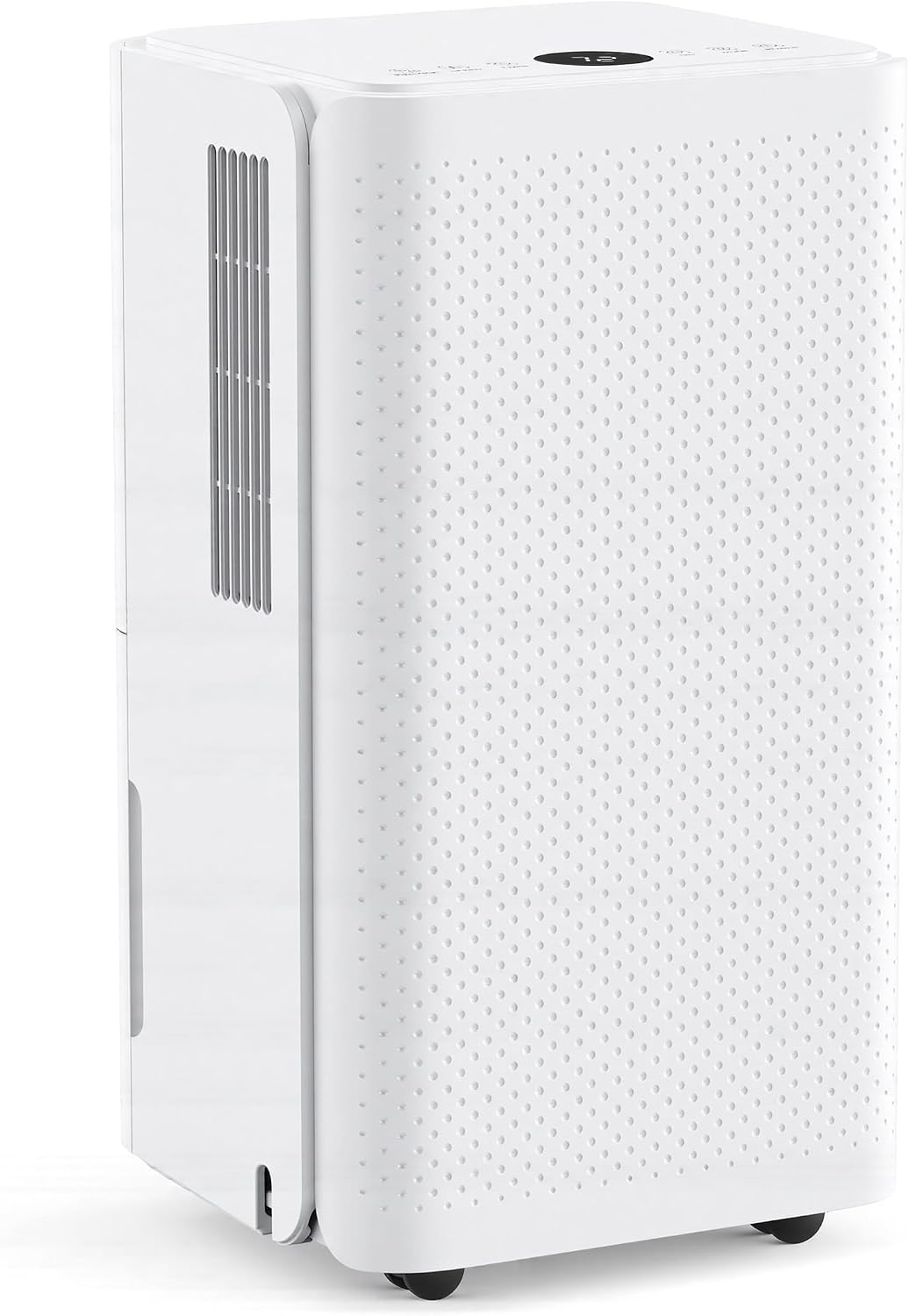
KMFurnila 30-Pint Dehumidifier
| Dehumidification Capacity | 30 pints_per_day |
|---|---|
| Floor Area | 2000 square_feet |
| Tank Volume | 2 liters |
| Number of Speeds | 4 |
The KMFurnila 30-pint dehumidifier is built to remove moisture in medium-to-large rooms and basements, rated to handle up to 2,000 square feet while offering continuous or tank-based drainage. It provides four speed settings plus Auto, Drying, Sleep, and Fan-Only modes so you can balance noise and extraction rate; Sleep mode and the sub-38 dB operating noise make it reasonable for overnight use. The unit includes an easy-roll caster base for moving between rooms, a 2.0 liter removable tank and a continuous drain option for unattended operation, and a color-coded humidity ring for quick visual feedback. ENERGY STAR certification implies better-than-average energy use for its capacity, and added features such as automatic defrost, restart, child lock, and a 24-hour timer increase convenience. Trade-offs are the modest 2 L tank that will require frequent emptying without continuous drainage and the lack of detailed service or warranty information in the listing, so plan to use the drain hose for basements or long runtime sessions.
Best for: Buyers who need an affordable, energy-efficient dehumidifier for damp basements or large rooms and prefer simple controls with the option for continuous draining.
Less Ideal for: People who want a very large onboard water tank for long unattended runs without plumbing or those who require detailed manufacturer service coverage and extended warranty terms.
- Rated 30 pints per day suitable for up to 2,000 sq ft basements and large rooms
- ENERGY STAR certified for more efficient long-run operation
- Multiple modes and four fan speeds let you prioritize quiet or fast dehumidification
- Continuous drain option plus removable tank for flexible unattended use
- Color-coded humidity ring provides fast, at-a-glance moisture status
- Small 2.0 L tank means frequent manual emptying when not using continuous drain
- Listing does not detail warranty or long-term service support
Verdict: A cost-conscious, ENERGY STAR 30-pint unit that delivers practical basement moisture control with continuous drain and quiet sleep operation.
hOmeLabs 32-Pint Dehumidifier

| Dehumidification Capacity | 35 pints_per_day |
|---|---|
| Capacity | 1.8 gallons |
| Tank Volume | 1.6 gallons |
| Number of Speeds | 2 |
| Floor Area | 4500 square_feet |
This hOmeLabs unit is a straightforward, room‑scale dehumidifier built for large spaces like basements and open living areas. It removes up to 32 pints per day under typical conditions (and higher at very warm, humid extremes), and offers both a removable 1.6 gallon water tank with auto shutoff and a continuous drain outlet for hands‑free operation. The machine includes washable filter media, two fan speeds plus a TURBO mode for faster moisture removal, and smart features such as Wi‑Fi control and voice assistant compatibility so you can monitor and change humidity from your phone. Mobility is simple thanks to built‑in casters and a handle, and safety conveniences include automatic defrost and auto restart after power interruptions. Expect practical, reliable performance for basement humidity control, though it is a single‑hose portable unit so performance will vary with room layout and extreme cold conditions can reduce extraction rates. For buyers who want easy setup, remote control, and reliable daily dehumidification, this model covers the essentials without complex installation.
Best for: Buyers who want a reliable, easy‑to‑use dehumidifier for a basement or large room and value remote control, straightforward maintenance, and portability.
Less Ideal for: People seeking a hard‑plumbed or whole‑house solution or those who need maximum extraction in consistently cold spaces should consider other types of systems.
- Removes up to 32 pints per day with higher capacity at very high temperature and humidity
- Wi‑Fi control and compatibility with Alexa and Google Assistant for remote monitoring and adjustments
- Continuous drain option plus a removable tank with auto shutoff reduces manual emptying
- Washable air filter and caster wheels make maintenance and relocation simple
- Performance drops in cold environments since rated capacity is specified at warmer test conditions
- Only two fan speeds may limit fine control of noise versus extraction rate
Verdict: A portable, Wi‑Fi enabled dehumidifier that delivers dependable moisture removal and easy maintenance for large basements and open rooms.
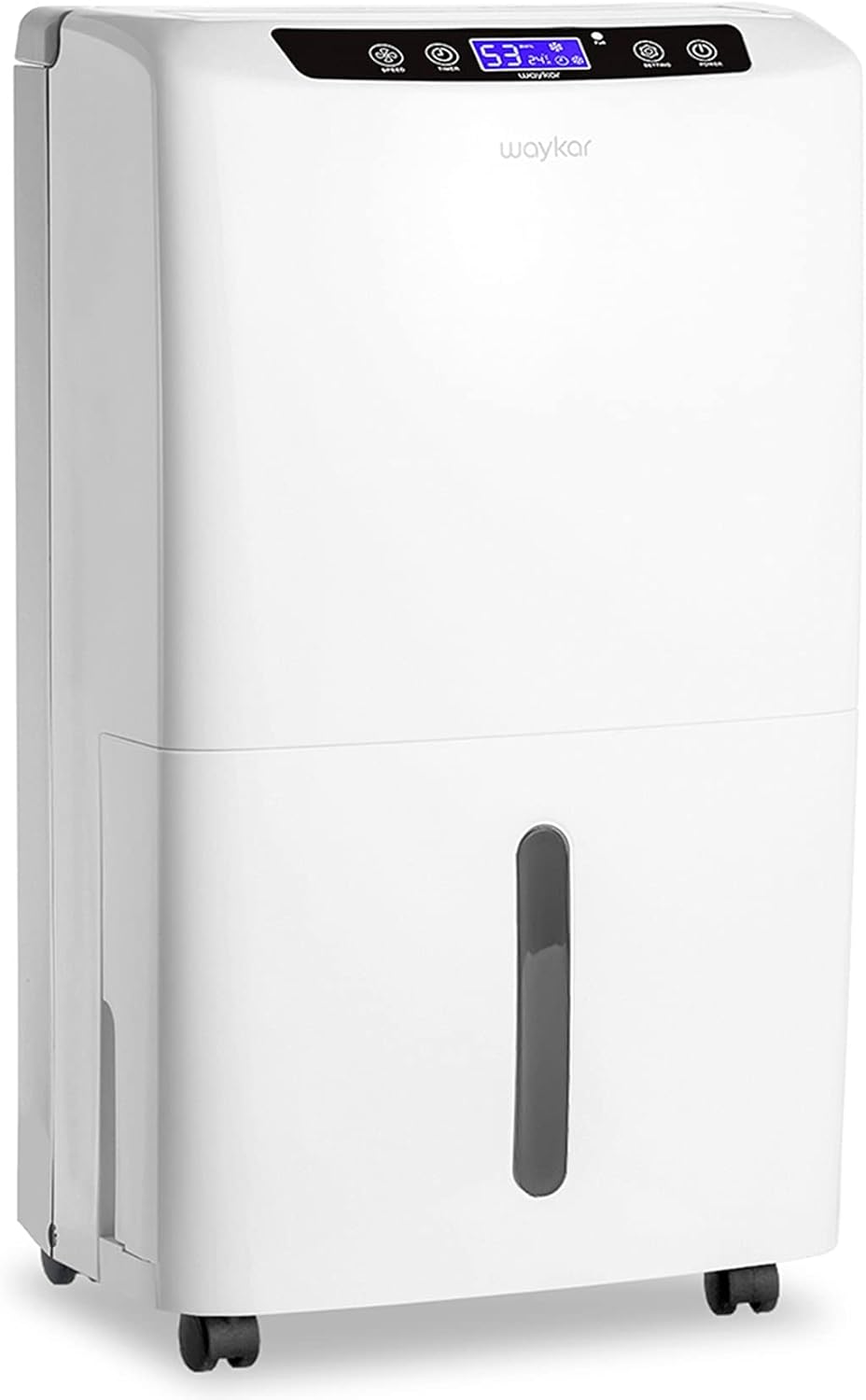
Waykar 34 Pint Dehumidifier
| Capacity | 34 pints |
|---|---|
| Floor Area | 2000 square_feet |
| Tank Volume | 0.66 gallons |
| Wattage | 230 watts |
| Air Flow Capacity | 62 cfm |
The Waykar 34 Pint Dehumidifier is a high-capacity unit made to remove moisture in basements, large rooms, and whole-home spaces up to about 2,000 square feet. It runs in auto or continuous mode, offers two fan speeds, and uses a 2.5L removable tank or the included hose for continuous drainage, which keeps it running during long humid spells. The unit includes smart humidity control from 30% to 80% RH so you can target deeper drying for damp basements, and an AI-style protection system that triggers defrost and overload safeguards to help maintain reliable operation in cooler or continuous-use conditions. Energy Star certification and a 24-hour timer help limit operating costs during extended runs, and the washable filter and ergonomic handle make basic upkeep straightforward. Trade-offs are modest size and weight for a 34-pint machine and a comparatively simple control set without advanced connectivity, but for buyers prioritizing dependable moisture removal and energy efficiency in a basement setting, it delivers practical, no-nonsense performance.
Best for: Buyers who want a proven, energy-efficient dehumidifier that reliably strips excess moisture from basements and large rooms and prefer sensible safeguards and simple operation over smart-home features.
Less Ideal for: People seeking a lightweight travel-friendly unit or those who need remote app control and advanced connectivity should look elsewhere.
- High dehumidification capacity rated 34 pints per day suitable for up to 2,000 sq ft
- Energy Star certified for better real-world energy efficiency during long runs
- Dual drainage options: removable 2.5L tank plus included hose for continuous drainage
- Smart humidity control from 30%–80% and 24-hour timer for targeted, scheduled operation
- Automatic defrost and overload protection for reliable performance in cooler or continuous-use environments
- Controls are basic with no Wi-Fi or app connectivity
- Unit is relatively heavy, which may make placement and moving less convenient
Verdict: A workhorse basement dehumidifier that combines strong 34-pint performance with Energy Star efficiency and practical continuous-drain capability.
BEDRED CT11 Dehumidifier

| Floor Area | 1000 square_feet |
|---|---|
| Tank Volume | 95 fluid ounces |
| Capacity | 5.9 pounds |
| Operation Mode | Intermittent |
| Other Special Features of the Product | 7 Color Ambient Light, Automatic Shutoff, Sleep Mode |
The BEDRED CT11 is a compact thermoelectric dehumidifier intended to reduce humidity in small spaces such as bedrooms, bathrooms, and modest basements up to about 1000 sq ft. It uses semiconductor cooling rather than a compressor, so it runs quietly and is simple to operate with an intermittent operation mode and an automatic shutoff when the 95 oz tank fills. Sleep Mode turns off the lights and lowers noise for overnight use, and the seven-color ambient light gives an optional mood-lighting feature. Practical benefits include easy emptying from the included tank, portability thanks to a lightweight design, and low sound levels that suit living spaces. Important limitations are inherent to semiconductor units: lower capacity compared with compressor dehumidifiers, reduced performance in very cold or very damp basements, and a smaller tank that requires more frequent emptying in high-humidity conditions.
Best for: Buyers who prioritize quiet, low-maintenance dehumidification and want a compact unit that is easy to move and run in living spaces or small basements without frequent intervention.
Less Ideal for: People needing heavy-duty moisture control for large, cold, or very damp basements should choose a higher-capacity compressor dehumidifier instead.
- Quiet thermoelectric operation suitable for bedrooms and living rooms
- Automatic shutoff protects against overfill and simplifies unattended use
- 95 oz removable tank for straightforward water removal
- Sleep Mode and ambient light options for low‑noise nighttime use
- Compact and lightweight for easy placement or moving between rooms
- Semiconductor cooling gives lower moisture removal capacity than compressor models
- Performance drops in cold basement conditions and very high humidity areas
Verdict: Choose the BEDRED CT11 if you want a quiet, portable dehumidifier with auto‑shutoff and sleep‑friendly operation for small basements or living spaces.
Choosing the Right Dehumidifier for Basement 30 Pint: Key Factors to Consider
Capacity and Basement Size
Capacity determines how much water the unit can remove in a 24-hour period and how well it keeps up with your basement's humidity load.
A 30 pint rating is suitable for many basements that are moderately damp or partially finished, but actual effectiveness depends on square footage, ceiling height, and moisture sources. If the basement is larger, has a lot of exposed concrete, or experiences recurring water intrusion, a 30 pint machine may run constantly without bringing humidity into the target range. Conversely, for smaller finished basements a 30 pint unit often cycles on and off, which can improve energy efficiency and reduce wear.
Operating Temperature and Performance
Basements can be colder than living areas, and refrigeration-style dehumidifiers lose efficiency as temperatures fall.
Choose a unit whose performance curve shows reasonable extraction at expected basement temperatures. Some 30 pint models include low-temperature or frost-control modes that allow continued operation down to cooler basement temps. If your basement routinely dips near or below freezing, consider models designed for low-temperature operation or plan for auxiliary heating to keep the unit in its optimal range.
Drain Options and Placement
How you remove collected water affects convenience and whether the unit can run unattended for long periods.
A top or side-access collection bucket is fine for occasional use, but basements often benefit from a gravity drain or pump-assisted drain to a floor drain or sink. Consider unit drain height, hose fittings, and the availability of a nearby drain. Pump-equipped models add installation flexibility for basements without a convenient low drain point, but they increase maintenance needs and slightly more complexity.
Energy Use and Long-Term Cost
Dehumidifiers run for extended periods, especially in humid seasons, so energy efficiency affects operating cost and environmental impact.
Look for clear input wattage or energy-efficiency data, and consider features like auto-humidity control and variable-speed compressors or fans that reduce runtime. While a more efficient unit may have a higher upfront footprint, lower power draw and smarter controls reduce cumulative cost and make it easier to run the dehumidifier continuously when needed.
Noise and Location
Sound matters when the dehumidifier sits under living spaces or near frequently used rooms.
Basement placement, ductwork, and doorways influence how much noise transfers upstairs. Check rated decibel levels and fan design. Quieter units are preferable for finished basements or rooms used as offices or media spaces. If noise is unavoidable, planning placement in a mechanical room or adding simple acoustic isolation can reduce disturbance without sacrificing dehumidification performance.
Maintenance and Filter Access
Regular maintenance keeps a dehumidifier running efficiently and prevents odors or mold build-up in the unit.
Assess how easy it is to remove and clean the air filter, empty or hook up the drain, and access coils for occasional cleaning. Units with visible indicators for full buckets, washable filters, and straightforward user-accessible panels reduce the hassle of seasonal upkeep and lower the likelihood of neglect that can shorten life span.
Basement Placement Tips
Where you position a 30 pint dehumidifier affects airflow, drainage, and noise. Place the unit away from walls and corners to allow unobstructed intake and exhaust. Aim for central placement where possible so the unit can service the largest area, or place it near the most significant moisture source for targeted removal.
Ensure the chosen spot provides a route for continuous drainage if you plan to use a hose. If you must place the dehumidifier on a shelf or elevated surface, verify the drain fitting and bucket access remain usable and stable.
- Keep at least a few inches of clearance on all sides for airflow.
- Avoid locations directly against cold exterior walls where condensation might increase.
- Position near a floor drain or install a pump-enabled unit if gravity drainage is not possible.
Understanding Low-Temperature Operation
Refrigerant-based dehumidifiers rely on condensation and can ice up when basement temperatures are low. Look for units with an automatic defrost or low-temperature mode if your basement runs cool during shoulder seasons. These features reduce cycling and keep moisture removal steady.
If your basement is frequently below the unit's recommended operating temperature, expect reduced extraction and potential freeze-thaw cycles. In those cases, either supplement with gentle heating or select a model specifically rated for cooler environments.
- Automatic defrost prevents icing at lower temps.
- Check manufacturer-specified operating temperature range before buying.
Drainage Setup: Gravity Vs Pump
Gravity drainage is simple and reliable if the dehumidifier can sit higher than the drain point. A hose connected to the unit runs downhill to a floor drain or sump. This setup is low-maintenance and quiet but requires appropriate relative elevation.
Pump-equipped units can lift water to a higher drain or sink and allow more flexible placement, including on the basement floor. Pumps are convenient but add mechanical parts that may need service over time.
- Use a clear, kink-resistant hose for gravity drains to spot blockages early.
- Test pump discharge routing before final placement to ensure reliable clearance.
Managing Humidity Targets
For most finished basements, aim for a relative humidity (RH) between 40 and 50 percent to reduce mold risk while avoiding overly dry conditions that can damage wood and finishes. Many 30 pint units include an adjustable humidistat to set the target RH and an auto mode to maintain it.
Avoid setting the target unreasonably low, which forces the dehumidifier to run continuously and increases wear and energy use. Instead, select a realistic RH and allow the unit to cycle, monitoring performance over a few days to verify it reaches and holds the target.
- Set RH around 45 percent for general basement comfort and mold prevention.
- Use the built-in timer or schedule to avoid unnecessary overnight operation if noise is an issue.
Simple Winter Storage and Off-Season Care
If your dehumidifier is seasonal in your climate, drain and dry the bucket and hoses before storage to prevent mildew. Clean or wash filters and allow the unit to dry completely to prevent odor development.
Store the machine in a dry, temperate place and run a brief cycle on power-up in the next season to ensure pumps and valves are operational before placing it back in the basement.
- Empty and air-dry the water tank before storing.
- Run a maintenance check and clean coils and filters before the next season.
How We Chose the Best Dehumidifier for Basement 30 Pint
We focused on real-world basement conditions when selecting these 30 pint dehumidifiers. Key evaluation criteria included measured moisture removal rate at typical basement temperatures, energy efficiency and running cost, durability and build quality for continuous seasonal use, control features and ease of setup for basement placement, and maintenance factors like accessible filters and drain options. Noise level was also considered because basements often attach to living space and quieter units improve long-term acceptability. We excluded units rated for only crawlspaces or for very small rooms, and we did not include large commercial dehumidifiers whose capacity and operating characteristics differ from household 30 pint models. The result is a list of units that balance consistent water extraction with manageable energy use, sensible controls for basement environments, and practical installation and upkeep characteristics.
Our full evaluation process is outlined in our review methodology.
FAQ
Will a 30 pint dehumidifier be enough for my finished basement?
Often yes for moderately damp basements of average size. Effectiveness depends on square footage, ceiling height, insulation, and moisture sources. Monitor humidity after installation and consider a larger capacity if the unit runs constantly and cannot reach your setpoint.
Can a 30 pint dehumidifier run continuously in a basement?
Many models are designed for continuous operation and include automatic restart after power outages and configurable drain options. Continuous running is common in humid seasons, but watch energy use and maintenance needs like emptying buckets or ensuring an uninterrupted drain.
How important is a pump for basement drainage?
A pump is helpful if you cannot route a hose downhill to a drain. It allows flexible placement and unattended operation, but it adds components that may require occasional maintenance. If a floor drain is accessible, gravity drainage is simpler and more reliable long term.
What humidity level should I set for mold prevention?
Aim for a relative humidity between 40 and 50 percent in finished basements to reduce mold risk while protecting wood finishes and stored items. Very low settings can increase energy use and cause the unit to run excessively.
How noisy are 30 pint dehumidifiers in basement settings?
Noise varies by fan speed and compressor design, and it often carries differently in multi-level homes. Look for lower decibel ratings if the basement is under living spaces. Placement in a mechanical room or behind acoustic baffles can reduce perceived noise.
Final Verdict
Choosing the right 30 pint dehumidifier for a basement comes down to matching capacity to space, ensuring reliable drainage, and prioritizing units that maintain extraction at your typical basement temperature. Balance energy efficiency, noise, and maintenance access against the need for continuous operation during humid months. Focus on models with flexible drain options, good low-temperature performance if your basement is cool, and straightforward filter access so you can keep the unit running effectively with minimal fuss.