
Note: This article contains affiliate links. If you click on these links and make a purchase, we may earn a small commission at no extra cost to you. This helps support our research and content. Read our full affiliate disclosure here.
A dehumidifier for a basement that carries Energy Star certification can make a big difference in comfort, mold prevention, and utility bills. Basements are especially prone to persistent dampness because they are below grade and often have limited airflow. Picking the right Energy Star dehumidifier means matching capacity, drainage options, and efficiency to the size and conditions of your space. This guide highlights seven shortlisted dehumidifiers chosen for basement use with Energy Star performance. We evaluate capacity, energy use, drainage versatility, and durability so you can quickly find a model suited to your square footage and moisture problems. Read on to see which features matter most and how to choose the best fit.
Top Picks at a Glance
| Best Overall The best all-around choice for most situations | yaufey 80-Pint Dehumidifier |  |
| Best Quality Built to a higher standard if you want something more solid | AEOCKY RHEA 80‑Pint Dehumidifier |  |
| Best Value The sweet spot between price and what you get | DGVAM V1 80‑Pint Dehumidifier |  |
| Best Budget The cheapest option that still gets the job done reliably | ToLife Dehumidifier TZ-C2 |  |
| Top Rated A top-rated pick with lots of positive feedback | hOmeLabs 32-Pint Dehumidifier |  |
| Most Popular A crowd favorite that many people choose with confidence | Waykar 80-Pint Dehumidifier JD025CE-80 |  |
| Best Seller A high-volume bestseller chosen again and again | BEDRED CT11 Dehumidifier |  |
yaufey 80-Pint Dehumidifier

| Capacity | 80 pints |
|---|---|
| Tank Volume | 1.06 gallons |
| Air Flow Capacity | 106 cfm |
| Wattage | 275 watts |
| Number of Speeds | 3 |
This yaufey 80-pint dehumidifier is built for large, damp spaces and basement use where sustained moisture control is needed. It removes up to 80 pints per day in very humid conditions and is ENERGY STAR certified to run more efficiently than standard models. You can empty the 1.06 gallon tank manually or hook up a drain hose for continuous unattended operation, which is handy for basements or laundry rooms. The unit offers four simple modes (Sleep, Living, Basement, Continuous) plus three fan speeds and an LED touch panel, so it is easy to set a target humidity and let it maintain it automatically. Practical features include an auto shutoff and memory restart after power loss, and the speced piston compressor and copper tubing suggest robust performance in sustained use. Trade-offs are its single visible tank capacity for manual emptying and a moderate fan airflow relative to the capacity, so very large open areas may need longer run times or multiple units. For energy-conscious basement owners who want straightforward, reliable dehumidification, this unit is a solid choice.
Best for: Buyers who want an energy-efficient, dependable dehumidifier for basements or large rooms and prefer simple mode presets and the option for continuous drainage to minimize maintenance.
Less Ideal for: People needing rapid dehumidification for very large open commercial spaces or those who cannot run a continuous drain and want a large internal tank to avoid frequent emptying.
- High dehumidification capacity rated up to 80 pints per day for humid conditions
- ENERGY STAR certification for improved energy efficiency compared with non-certified models
- Two drainage options: 1.06 gallon tank or continuous drain hose for unattended use
- Multiple modes and 3 fan speeds with a simple LED touch panel for easy humidity control
- Durable design elements listed such as piston compressor and copper tubing for long-term performance
- Visible tank is relatively small, requiring frequent manual emptying if continuous drain is not used
- Airflow is moderate (106 cfm), so dehumidifying very large open areas may take longer
Verdict: A reliable ENERGY STAR 80-pint dehumidifier for basement and large-room use that balances strong moisture removal with efficient, user-friendly controls and continuous drain convenience.
AEOCKY RHEA 80‑Pint Dehumidifier
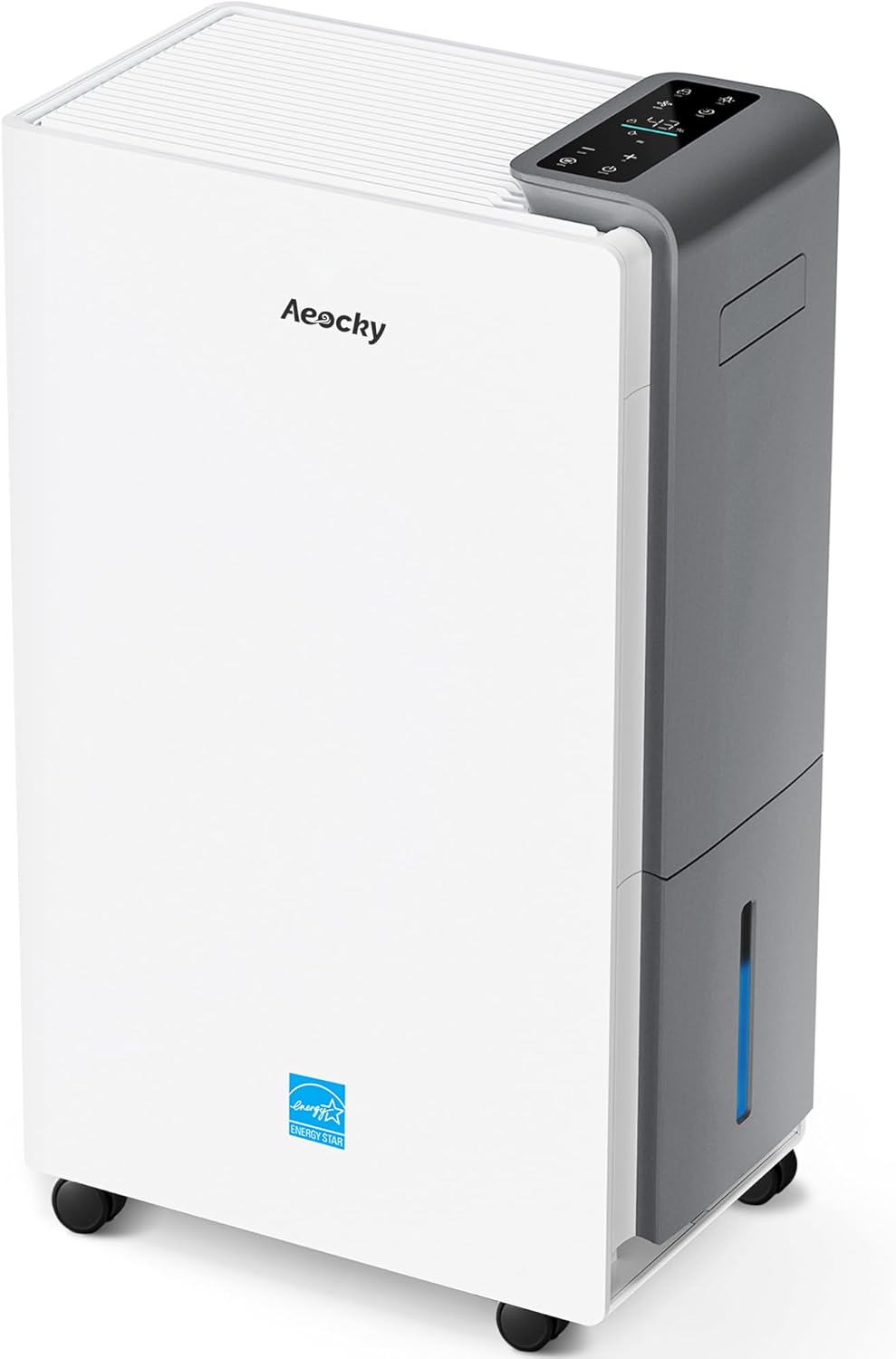
| Capacity | 80 pints |
|---|---|
| Tank Volume | 1.45 gallons |
| Wattage | 280 watts |
| Operation Mode | Auto, Constant Humidity, Continuous, Smart Drying, Sleep |
| Air Flow Capacity | 9006 cubic feet per hour |
The RHEA-001 is a high-capacity compressor dehumidifier engineered for large spaces such as basements and whole houses. It extracts up to 80 pints per day under hot, humid test conditions and includes a 1.45 gallon tank plus continuous drain options for extended unattended operation. Controls include multiple operation modes (Auto, Constant Humidity, Continuous, Smart Drying, Sleep), adjustable humidity setpoints, a timer and child lock for everyday convenience. Its standout points are verified ENERGY STAR Most Efficient 2025 certification and claimed low-noise operation thanks to a compact rotary compressor and a low-speed fan, which make it suitable for living areas and bedrooms adjacent to basements. The unit also advertises improved low-temperature defrost capability to keep running in cool basements where ordinary compressors may frost up. Trade-offs are typical for a unit of this capacity: it is a full-size compressor model that requires floor space and occasional tank emptying unless you use the drain hose, and it draws mains power rather than being ultra-compact. For buyers focused on strong, energy-efficient moisture removal in basements, the RHEA-001 delivers the performance that matters most.
Best for: Buyers who prioritize strong, reliable moisture removal and long-term energy savings in basements or large home areas and who want a dehumidifier built for continuous, high-capacity performance.
Less Ideal for: People seeking a compact, lightweight or travel-friendly dehumidifier for single small rooms or occasional spot use should consider smaller portable or desiccant models instead.
- ENERGY STAR Most Efficient 2025 certification for high energy efficiency
- 80 pints per day dehumidification capacity suitable for large basements and whole-house use
- Multiple operation modes and adjustable humidity control for precise moisture management
- Low-noise design with a rotary compressor and quiet fan for use near living spaces
- Includes drain hose and garden-hose adapter for continuous drain hookup
- Large compressor-style unit requires floor space and is less portable than small models
- Tank volume (1.45 gallons) means you will need the drain option for truly unattended, long-term operation
Verdict: If you need powerful, energy-efficient dehumidification for a basement or large home area, the RHEA-001 delivers top-tier moisture removal backed by ENERGY STAR Most Efficient 2025 certification.
DGVAM V1 80‑Pint Dehumidifier

| Floor Area | 4500 square_feet |
|---|---|
| Dehumidification Capacity | 45 pints_per_day |
| Capacity | 1.72 gallons |
| Operation Mode | Automatic |
The DGVAM V1 is a compressor-style dehumidifier built for damp basements and large living spaces, offering up to 80 pints per day (regular 18–45 pints/day) and coverage for roughly 4,500 sq ft. It runs in automatic mode using a smart humidity control to switch output based on room conditions and includes continuous-drain capability via the supplied drain hose or an internal 1.72 gallon tank with auto shutoff. Other practical features include automatic defrost for cooler areas, a washable removable filter, child lock and 24-hour timer, and multiple operation modes for dry or ventilation use. Noise is advertised around 40 dB for quiet operation suitable for bedrooms, and the unit is designed for extended, energy-conscious use. The V1 is straightforward to move and maintain but is a typical compressor dehumidifier in size and weight, so it is less convenient for very small spaces or frequent relocation. Buyers should also verify energy certifications if strict ENERGY STAR qualification is required.
Best for: Buyers who prioritize effective, hands-off moisture control for large basements or multi-room spaces and want a feature-rich unit that supports continuous drainage and long runtime.
Less Ideal for: People seeking an ultra-compact, lightweight solution for small rooms or frequent travel should look at smaller portable models instead.
- High maximum dehumidification up to 80 pints per day for large or very damp areas
- Smart automatic humidity control that adjusts output for hands-free operation
- Two drainage options: continuous drain hose or 1.72 gallon tank with auto shutoff
- Auto defrost and power-off memory let it run reliably in cooler basements and recover after outages
- Removable washable filter and simple controls make maintenance straightforward
- Relatively heavy for portable use which can make moving between locations less convenient
- Specification lists coverage and pint ranges inconsistently (80 pints vs 18–45 pints regular) which may require clarifying expected performance
Verdict: Choose the DGVAM V1 if you need a powerful, low-maintenance dehumidifier that can handle damp basements and large spaces with optional continuous drainage for hands-free operation.
ToLife Dehumidifier TZ-C2
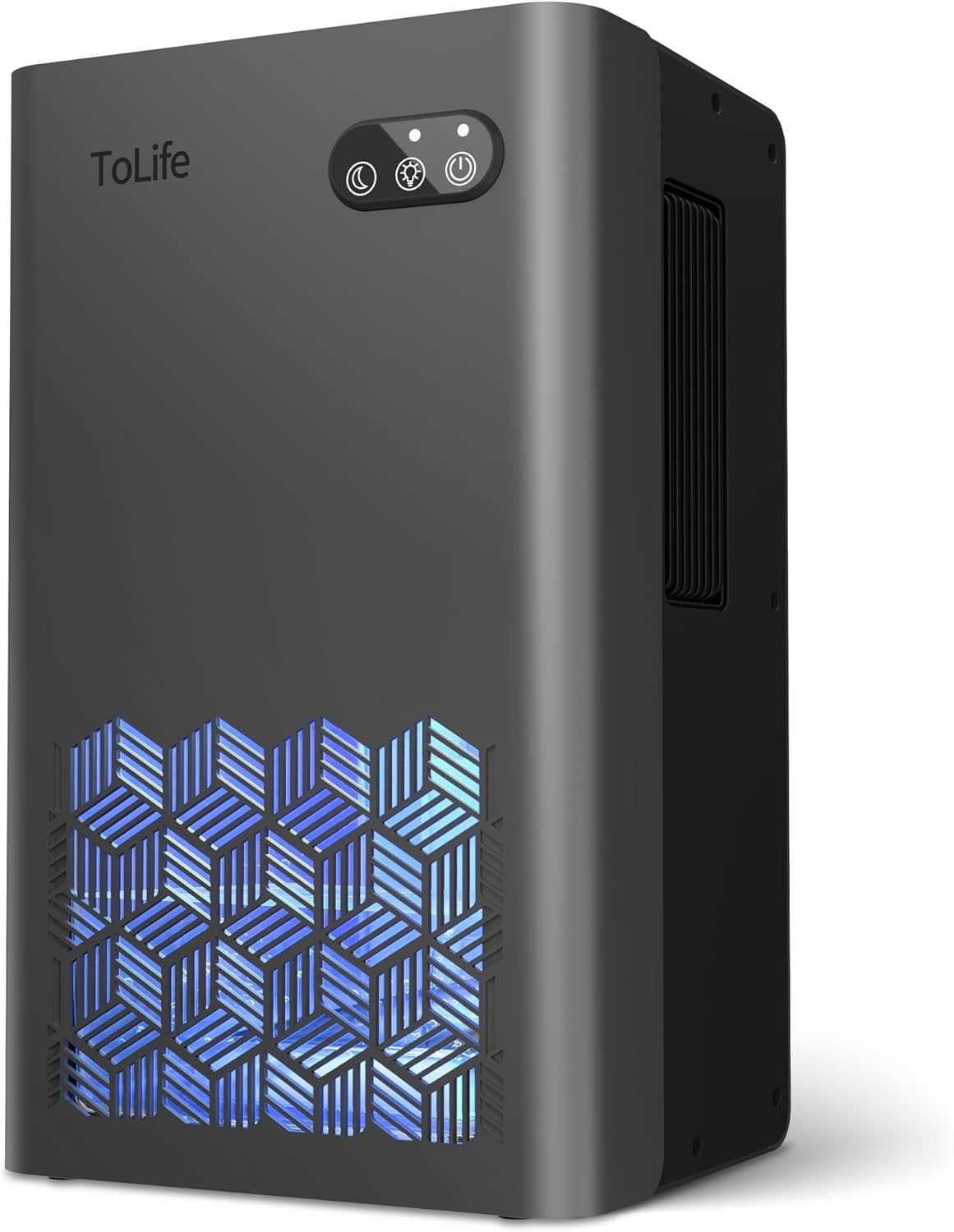
| Floor Area | 1000 |
|---|---|
| Tank Volume | 95 fluid ounces |
| Number of Speeds | 2 |
| Wattage | 93 watts |
| Voltage | 220 volts |
The ToLife TZ-C2 uses semiconductor condensation technology to quietly pull moisture from the air and deposit it into a removable 95 oz tank, making it a straightforward option for damp rooms. It offers two operating modes: a higher-power setting for faster moisture removal and a low-speed sleep mode that runs under 30 dB for overnight use. A seven-color LED can act as a night light and the unit includes automatic shutoff when the tank is full or removed, plus handles for easy moving between rooms. Practical benefits include simple setup, low noise, and a compact footprint that fits in basements, bathrooms, or bedrooms. Limitations are its modest rated dehumidification capacity and stated coverage, which means it will be most effective in smaller basement zones or for spot treatments rather than drying a large, very damp basement quickly. Also this model runs on 220 volts, so electrical compatibility should be confirmed for your location.
Best for: Buyers who need an affordable, portable dehumidifier for spot dehumidifying small basement areas, bathrooms, or bedrooms and who prioritize low noise and easy portability.
Less Ideal for: People looking to dry large, very damp basements or whole-house coverage should consider a higher-capacity compressor dehumidifier instead.
- Large removable 95 oz water tank reduces how often you need to empty it
- Quiet sleep mode under 30 dB suitable for nighttime operation
- Portable design with handles for moving between rooms
- Automatic shutoff prevents overflow when the tank is full
- Dehumidification capacity is modest and may be slow in very damp or large basements
- Requires 220 volt power which may not match all household outlets
Verdict: A compact, budget-friendly portable dehumidifier that is best for quiet, small-area moisture control and occasional basement spot treatments.
hOmeLabs 32-Pint Dehumidifier

| Dehumidification Capacity | 35 pints_per_day |
|---|---|
| Capacity | 1.8 gallons |
| Tank Volume | 1.6 gallons |
| Number of Speeds | 2 |
| Floor Area | 4500 square_feet |
This hOmeLabs unit is a straightforward, room‑scale dehumidifier built for large spaces like basements and open living areas. It removes up to 32 pints per day under typical conditions (and higher at very warm, humid extremes), and offers both a removable 1.6 gallon water tank with auto shutoff and a continuous drain outlet for hands‑free operation. The machine includes washable filter media, two fan speeds plus a TURBO mode for faster moisture removal, and smart features such as Wi‑Fi control and voice assistant compatibility so you can monitor and change humidity from your phone. Mobility is simple thanks to built‑in casters and a handle, and safety conveniences include automatic defrost and auto restart after power interruptions. Expect practical, reliable performance for basement humidity control, though it is a single‑hose portable unit so performance will vary with room layout and extreme cold conditions can reduce extraction rates. For buyers who want easy setup, remote control, and reliable daily dehumidification, this model covers the essentials without complex installation.
Best for: Buyers who want a reliable, easy‑to‑use dehumidifier for a basement or large room and value remote control, straightforward maintenance, and portability.
Less Ideal for: People seeking a hard‑plumbed or whole‑house solution or those who need maximum extraction in consistently cold spaces should consider other types of systems.
- Removes up to 32 pints per day with higher capacity at very high temperature and humidity
- Wi‑Fi control and compatibility with Alexa and Google Assistant for remote monitoring and adjustments
- Continuous drain option plus a removable tank with auto shutoff reduces manual emptying
- Washable air filter and caster wheels make maintenance and relocation simple
- Performance drops in cold environments since rated capacity is specified at warmer test conditions
- Only two fan speeds may limit fine control of noise versus extraction rate
Verdict: A portable, Wi‑Fi enabled dehumidifier that delivers dependable moisture removal and easy maintenance for large basements and open rooms.
Waykar 80-Pint Dehumidifier JD025CE-80

| Dehumidification Capacity | 80 pints_per_day |
|---|---|
| Tank Volume | 2.5 gallons |
| Wattage | 270 watts |
| Air Flow Capacity | 165 cfm |
| Operation Mode | Continuous |
The Waykar 80-Pint Dehumidifier is built to handle large, damp areas such as basements by extracting up to 80 pints per day and offering both tank and continuous drain options. It is commonly used running continuously or on a timed schedule to bring basement humidity down to a selected setpoint between 30% and 80% relative humidity, and the 90° auto-swing helps spread airflow for more even drying. Practical features include an included drain hose and connector for gravity drainage, a washable removable filter, automatic defrost and overload protection for low-temperature reliability, and an Energy Star rating to keep running costs lower than noncertified units. At roughly 42 dB it is quieter than many similarly sized machines, making it reasonable for finished basements or nearby living areas. The unit is relatively heavy and targeted at larger spaces, so it is less convenient to move frequently, and the 1.14 gallon tank means emptying is still needed if you do not use continuous drainage. For buyers focused on dependable basement performance and energy efficiency, this model delivers strong moisture removal with sensible protections for extended operation.
Best for: Homeowners who need a reliable, high-capacity dehumidifier to control moisture in large basements and prefer proven features and energy efficiency over portability.
Less Ideal for: People looking for a lightweight, highly portable unit for small rooms or occasional use should consider smaller, easier-to-move models instead.
- High dehumidification capacity rated at 80 pints per day for large basements
- ENERGY STAR certification for better energy efficiency during extended use
- Multiple drainage options with included drain hose for continuous gravity drain
- Auto-defrost and overload protection improve reliability in cool basement conditions
- 90° auto-swing airflow and washable filter help distribute air and simplify maintenance
- Relatively heavy and sized for large spaces, so not ideal for frequent transport
- Water tank is modest at 1.14 gallons if continuous drainage is not used
Verdict: A powerful, Energy Star certified 80‑pint unit that reliably handles large basement humidity with continuous drain and protective auto-defrost features.
BEDRED CT11 Dehumidifier

| Floor Area | 1000 square_feet |
|---|---|
| Tank Volume | 95 fluid ounces |
| Capacity | 5.9 pounds |
| Operation Mode | Intermittent |
| Other Special Features of the Product | 7 Color Ambient Light, Automatic Shutoff, Sleep Mode |
The BEDRED CT11 is a compact thermoelectric dehumidifier intended to reduce humidity in small spaces such as bedrooms, bathrooms, and modest basements up to about 1000 sq ft. It uses semiconductor cooling rather than a compressor, so it runs quietly and is simple to operate with an intermittent operation mode and an automatic shutoff when the 95 oz tank fills. Sleep Mode turns off the lights and lowers noise for overnight use, and the seven-color ambient light gives an optional mood-lighting feature. Practical benefits include easy emptying from the included tank, portability thanks to a lightweight design, and low sound levels that suit living spaces. Important limitations are inherent to semiconductor units: lower capacity compared with compressor dehumidifiers, reduced performance in very cold or very damp basements, and a smaller tank that requires more frequent emptying in high-humidity conditions.
Best for: Buyers who prioritize quiet, low-maintenance dehumidification and want a compact unit that is easy to move and run in living spaces or small basements without frequent intervention.
Less Ideal for: People needing heavy-duty moisture control for large, cold, or very damp basements should choose a higher-capacity compressor dehumidifier instead.
- Quiet thermoelectric operation suitable for bedrooms and living rooms
- Automatic shutoff protects against overfill and simplifies unattended use
- 95 oz removable tank for straightforward water removal
- Sleep Mode and ambient light options for low‑noise nighttime use
- Compact and lightweight for easy placement or moving between rooms
- Semiconductor cooling gives lower moisture removal capacity than compressor models
- Performance drops in cold basement conditions and very high humidity areas
Verdict: Choose the BEDRED CT11 if you want a quiet, portable dehumidifier with auto‑shutoff and sleep‑friendly operation for small basements or living spaces.
Choosing the Right Dehumidifier for Basement Energy Star: Key Factors to Consider
Dehumidification Capacity (Pints Per Day)
Capacity indicates how much water a unit can extract from the air in 24 hours and is the single most important spec for basements. Basements typically have higher humidity loads, especially if partially finished or prone to seepage, so choose a capacity rated for the square footage and typical relative humidity. Undersizing results in constant run times with limited improvement; oversizing wastes energy and can short-cycle.
When evaluating capacity, factor in room height, the presence of foundations that wick moisture, and whether the basement is finished or used as living space. Look for units rated to handle the specific conditions you face rather than relying on generic room-size charts alone.
Energy Efficiency and Running Cost
Energy Star certification means a unit meets efficiency performance guidelines, but actual operating cost varies with capacity and run time. Basements that require continuous dehumidification will incur higher cumulative energy use, so prioritize models with high efficiency at the capacity you need. Check published power draw at typical operating conditions to estimate monthly cost.
Also consider features that reduce runtime, such as accurate humidistats, timers, and auto-defrost for cool-basement operation. Efficient units reduce long-term expense and lower the environmental impact of continuous moisture control.
Drainage Options and Installation Flexibility
Basement dehumidifiers should offer flexible drainage to avoid frequent emptying. Options include generous internal tanks, gravity drain ports for nearby floor drains, or continuous pump-assisted drainage for routing water upward or to a distant drain. The right drainage method depends on where the unit will sit relative to drains and whether you want unattended operation.
Consider the length and routing of drain hose required, the availability of a floor or utility sink, and whether a condensate pump is needed. Simple, reliable drainage reduces maintenance and prevents accidental overflows.
Durability and Year-Round Reliability
Basement units often run longer than those in conditioned spaces, and they must be durable enough to handle continuous operation and cooler temperatures. Look for robust compressor and coil design, serviceable filters, and accessible parts for maintenance. Features such as auto-defrost help maintain performance in cooler basements.
Longer warranty terms and clear support documentation can also indicate a product built for extended use. Reliability reduces downtime and the chance of humidity-related damage to stored items or finished areas.
Noise Level and Usability
Noise matters when the basement is used as living space, a home gym, or a workshop. Manufacturers list decibel ratings, but real-world perception depends on fan speed settings and placement. Choose models with multiple fan speeds, quiet modes, and programmable humidity targets to balance performance with comfort.
Also evaluate control layout, remote or app control if desired, and the ease of emptying and cleaning the tank and filter. Good usability lowers friction for regular upkeep and ensures the unit actually gets used as intended.
Matching Unit Capacity to Basement Size and Conditions
Estimating the right dehumidifier capacity starts with square footage but should also incorporate ceiling height, insulation quality, and whether the space is finished. A damp, unfinished basement with concrete walls and poor ventilation needs more capacity than a dry, finished lower-level room.
Start by noting the basement area and typical relative humidity. For basements with active water ingress or chronic dampness, err toward higher capacity and plan for continuous or near-continuous operation during humid months. For spaces used occasionally, a lower-capacity Energy Star unit with good controls may be adequate.
- Measure length, width, and ceiling height to refine volume-based needs.
- Assess sources of moisture: soil, seepage, condensation, or high occupant activity.
- Plan for seasonal peaks; consider a slightly larger unit if humidity spikes are common.
Placement and Airflow Considerations
Where you place the dehumidifier affects its effectiveness. Position the unit so it draws from the most humid zones and has 6 to 12 inches of clearance for airflow. Avoid tight corners or placing the unit against insulation or low shelves that block intake or exhaust.
If the basement has multiple zones or poor cross-ventilation, consider moving the unit seasonally or using supplemental fans to promote circulation. Elevated placement on a sturdy platform can help if occasional water on the floor is expected, and it simplifies gravity drainage to nearby drains.
- Keep intake and exhaust clear for best performance.
- Use a single higher-capacity unit rather than multiple small units when possible to reduce energy waste.
- Consider airflow patterns and furniture placement to avoid dead zones.
Managing Condensate: Tank Vs. Continuous Drain
Internal tanks are fine for occasional use but require frequent emptying in damp basements. Continuous drain options let you run a unit unattended by sending condensate to a floor drain or utility sink. Pump-equipped units provide the most flexibility for basements where drains are above the unit.
When using gravity drainage, minimize hose height and avoid long, uphill runs. For pump models, verify the pump head rating and expected service interval. Proper drainage reduces the risk of overflow and simplifies maintenance.
- Choose tank-only units only for small, infrequently damp basements.
- Use gravity drain for simple, low-maintenance routing when a nearby drain exists.
- Select pump models for remote drain locations or when routing uphill.
Operating in Cooler Basements
Basement temperatures often fall below typical room temperatures, which can cause frost to form on coils and reduce extraction if the unit lacks an auto-defrost function. Energy Star units designed for basements will include defrost features or cold-temperature performance ratings.
If your basement is cool year-round, look for units specified to operate efficiently at lower temperatures and that maintain airflow and compressor health in those conditions. Proper operation in cool spaces helps prevent cycling issues and maintains steady humidity control.
- Verify the minimum operating temperature for reliable performance.
- Prefer models with auto-defrost or low-temperature modes for cold basements.
- Monitor humidity at different seasons to confirm consistent performance.
Maintenance Tips to Keep Performance High
Regular maintenance extends the life and efficiency of a dehumidifier. Clean or replace filters on the schedule recommended by the manufacturer, empty and sanitize tanks if used, and inspect coils and drain hoses for blockages. A well-maintained unit maintains airflow and removal capacity while using less energy.
Keep the area around the unit free of dust and obstructions, and check seals and fittings on drainage connections periodically. For long idle periods, follow storage recommendations to prevent mold growth inside the machine.
- Inspect filters monthly during heavy use and clean as needed.
- Flush or disinfect tanks seasonally to prevent odors and biological growth.
- Check drain hoses for kinks or mineral buildup on a quarterly basis.
How We Chose the Best Dehumidifier for Basement Energy Star
We focused on dehumidifiers designed for basement use that meet Energy Star efficiency standards and offer the capacity and features needed in below-grade environments. Our selection criteria prioritize real-world performance dimensions buyers care about: moisture removal capacity relative to basement size, energy use and operating cost, drainage and installation flexibility, durability for continuous or seasonal operation, and noise and user controls for living-space acceptability. We excluded models intended only for small rooms or single-season portable use and any units that lack clear Energy Star certification or published capacity/energy metrics. We also deprioritized products that require complex professional installation, unless they clearly improved long-term performance for larger basements. The result is a shortlist of models that balance moisture-control power with energy efficiency, ease of maintenance, and installation options appropriate for basements. Each candidate was evaluated against the same set of technical and practical criteria so you can compare like for like.
Our full evaluation process is outlined in our review methodology.
FAQ
How large a dehumidifier do I need for my basement?
Size depends on square footage, ceiling height, and how damp the space is. For chronically damp basements, choose a unit with higher daily capacity; for occasional use, a lower-capacity Energy Star model may suffice. Refer to volume and humidity conditions rather than room-size charts alone.
Can an Energy Star dehumidifier run continuously in a basement?
Yes, many Energy Star models are designed for extended operation, but continuous use increases cumulative energy draw. Look for units with efficient motors, accurate humidistats, and robust components built for long runtimes to ensure reliability.
Do I need a pump for basement drainage?
A pump is helpful if the nearest drain is above the unit or not easily accessible. Gravity drain works well when a floor drain is nearby and lower than the unit. Pump-equipped models add flexibility but require occasional maintenance.
Will a dehumidifier remove mildew odors?
Reducing humidity to recommended levels makes conditions less favorable for mildew and can reduce musty odors. However, a dehumidifier does not eliminate existing mold or deeply embedded odors; addressing the source of moisture and cleaning affected materials is also necessary.
What maintenance keeps a basement unit working well?
Regularly clean or replace filters, clear drain hoses of blockages, and sanitize the water collection tank when applicable. Inspect coils, check for frost in cool conditions, and follow the manufacturer's maintenance schedule to preserve efficiency and longevity.
Final Verdict
Focus first on capacity and energy efficiency when choosing a dehumidifier for a basement with Energy Star performance. Match the unit s daily removal rate to your basement volume and humidity load, then confirm drainage options, low-temperature capability, and noise levels for how the space is used. Regular maintenance and proper placement keep any model operating efficiently. Prioritize models that balance robust moisture removal with proven efficiency and simple drainage for unattended operation. That tradeoff will give you reliable humidity control, lower operating costs, and better protection for stored items and finished spaces.