
Note: This article contains affiliate links. If you click on these links and make a purchase, we may earn a small commission at no extra cost to you. This helps support our research and content. Read our full affiliate disclosure here.
High humidity in a bathroom without a vent creates persistent mildew, peeling paint, and musty odors. A dedicated dehumidifier for a bathroom without vent can stabilize moisture after showers, shorten drying times for towels, and reduce mold growth without requiring ductwork or major installation. This guide shortlists seven top dehumidifiers suited to small, enclosed bathrooms. We evaluate each option across the compactness, moisture removal, noise, and ease-of-use criteria that matter most in tight spaces. Read on for practical buying guidance and clear tradeoffs to help you pick the right unit for your layout and daily routine.
Top Picks at a Glance
| Best Overall The best all-around choice for most situations | ToLife Dehumidifier TZ-C2 |  |
| Best Quality Built to a higher standard if you want something more solid | Midea Cube 20 Pint Dehumidifier |  |
| Best Value The sweet spot between price and what you get | Pro Breeze Osmo Moisture Absorber |  |
| Best Budget The cheapest option that still gets the job done reliably | Eva-Dry E-333 Mini Dehumidifier |  |
| Top Rated A top-rated pick with lots of positive feedback | hOmeLabs 32-Pint Dehumidifier |  |
| Most Popular A crowd favorite that many people choose with confidence | Pro Breeze PB-02 Mini Dehumidifier |  |
| Best Seller A high-volume bestseller chosen again and again | BEDRED CT11 Dehumidifier |  |
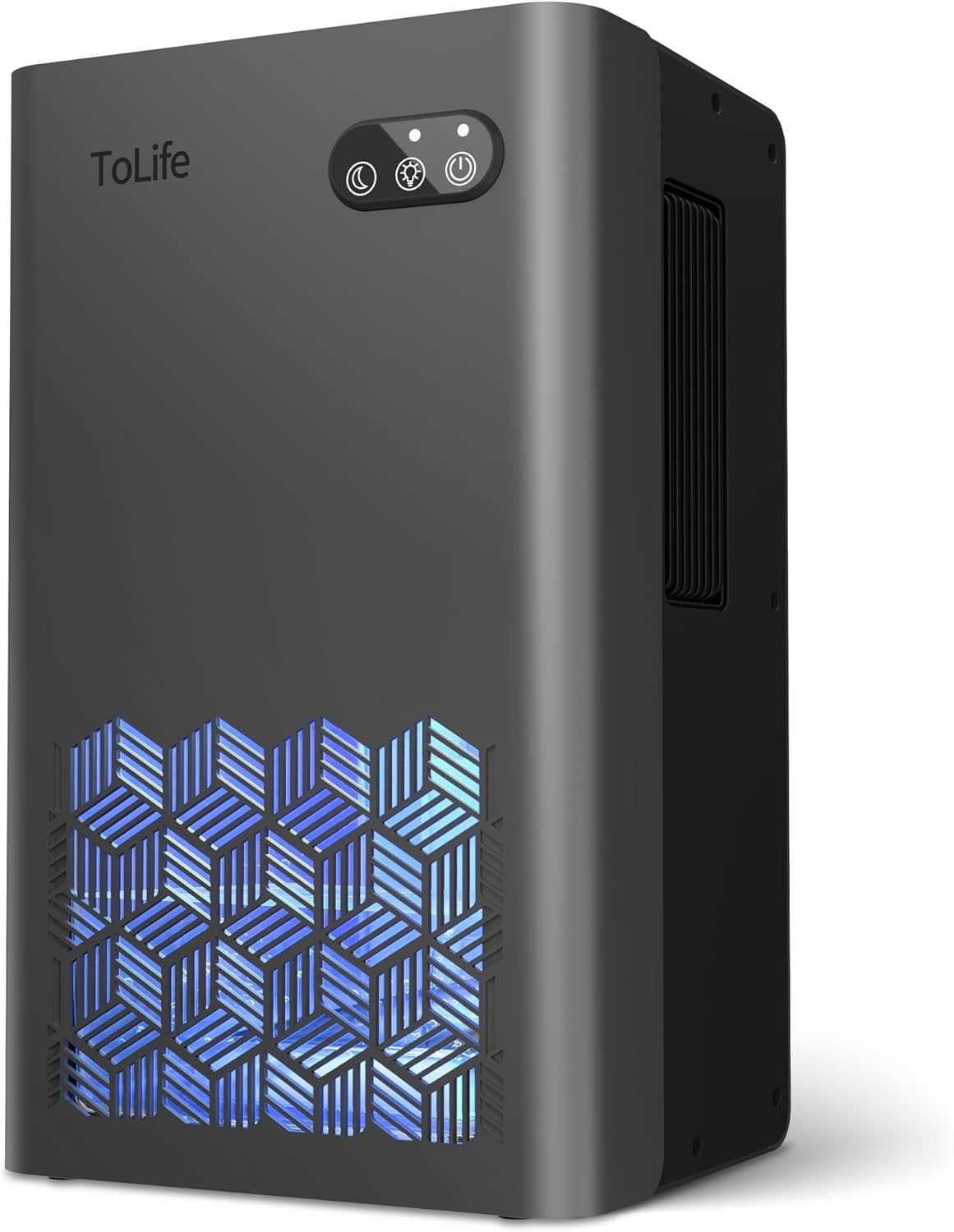
ToLife Dehumidifier TZ-C2
| Floor Area | 1000 |
|---|---|
| Tank Volume | 95 fluid ounces |
| Number of Speeds | 2 |
| Wattage | 93 watts |
| Voltage | 220 volts |
The ToLife TZ-C2 uses semiconductor condensation technology to quietly pull moisture from the air and deposit it into a removable 95 oz tank, making it a straightforward option for damp rooms. It offers two operating modes: a higher-power setting for faster moisture removal and a low-speed sleep mode that runs under 30 dB for overnight use. A seven-color LED can act as a night light and the unit includes automatic shutoff when the tank is full or removed, plus handles for easy moving between rooms. Practical benefits include simple setup, low noise, and a compact footprint that fits in basements, bathrooms, or bedrooms. Limitations are its modest rated dehumidification capacity and stated coverage, which means it will be most effective in smaller basement zones or for spot treatments rather than drying a large, very damp basement quickly. Also this model runs on 220 volts, so electrical compatibility should be confirmed for your location.
Best for: Buyers who need an affordable, portable dehumidifier for spot dehumidifying small basement areas, bathrooms, or bedrooms and who prioritize low noise and easy portability.
Less Ideal for: People looking to dry large, very damp basements or whole-house coverage should consider a higher-capacity compressor dehumidifier instead.
- Large removable 95 oz water tank reduces how often you need to empty it
- Quiet sleep mode under 30 dB suitable for nighttime operation
- Portable design with handles for moving between rooms
- Automatic shutoff prevents overflow when the tank is full
- Dehumidification capacity is modest and may be slow in very damp or large basements
- Requires 220 volt power which may not match all household outlets
Verdict: A compact, budget-friendly portable dehumidifier that is best for quiet, small-area moisture control and occasional basement spot treatments.
Midea Cube 20 Pint Dehumidifier

| Coverage | 1500 square_feet |
|---|---|
| Dehumidification Capacity | 20 pints_per_day |
| Tank Volume | 3.2 gallons |
| Number of Speeds | 3 |
| Wattage | 214 watts |
The Midea Cube is a space‑saving portable dehumidifier that uses a lift‑and‑twist design to switch between nested (compact) and extended (larger tank) modes, letting it run longer between emptying. It removes up to 20 pints per day and offers three fan speeds plus multi‑directional air intake so you can tune performance for a bathroom, basement, or bedroom. Practical features include a 3.2 gallon removable tank, a continuous drain hose option for unattended use, washable filter, auto‑restart after power loss, and Wi‑Fi with voice assistant support for remote control. In real use it balances strong moisture removal with relatively quiet operation and the app control makes scheduling and monitoring humidity simple. Expect the best results in small to medium rooms where you need reliable daily extraction; the compact nested form also helps in tighter bathrooms without a vent. The main compromises are that it is designed for up to 1,500 sq ft so it is not suited to very large damp spaces, and it relies on condensate drainage or bucket emptying when humidity and runtime are high.
Best for: Buyers who prioritize steady daily moisture removal and flexible operation in small to medium rooms and want the convenience of remote control and continuous drain capability.
Less Ideal for: Homes with very large basements, whole‑house dehumidification needs, or users seeking the absolute lightest, most compact travel‑style unit.
- Lift‑and‑twist extendable tank design increases runtime between emptying
- Wi‑Fi and Alexa/Google Assistant support for remote monitoring and control
- Includes continuous drain hose option for unattended operation
- Three fan speeds with multi‑directional air intake for adjustable performance
- Washable filter reduces maintenance costs
- Rated for 1,500 sq ft so may be undersized for very large or extremely damp spaces
- Larger water capacity and features add weight compared with ultra‑portable units
Verdict: Choose this unit if you want a compact but powerful dehumidifier with extendable tank and continuous drain that can be monitored and controlled remotely for reliable bathroom or small room moisture control.
Pro Breeze Osmo Moisture Absorber

| Capacity | 44 fluid ounces |
|---|---|
| Tank Volume | 44 fluid ounces |
| Dehumidification Capacity | 2.11 pints_per_day |
| Floor Area | 108 square_feet |
The Pro Breeze Osmo is a refillable, electricity-free moisture absorber designed for small enclosed areas like bathrooms, closets, or nurseries. It uses a large dissolvable tablet that draws moisture into a 44 fl oz tank and continues to collect liquid after the tablet has dissolved, with the manufacturer claiming up to 100 days of operation depending on conditions. The unit's 360 degree perforated housing promotes passive air circulation and the clear water-level window plus easy-pour spout make emptying straightforward. Because it requires no power, it is completely silent and needs no installation, which is useful for bathrooms without vents or where running an electric dehumidifier is impractical. Limitations are its passive, low daily extraction rate compared with powered dehumidifiers and the need to replace or refill the tablet over time, so it is best as ongoing moisture reduction rather than aggressive drying after flooding or heavy condensation events.
Best for: Buyers who want a low-maintenance, no-power solution to reduce humidity in small bathrooms or other enclosed spaces and who prioritize quiet, reusable products over rapid drying.
Less Ideal for: Not a good fit for rooms that need fast, high-capacity moisture removal after leaks or for large, open bathrooms that require active ventilation or powered dehumidification.
- Reusable refillable tank reduces waste compared with disposable moisture bags
- Operates silently with no electricity or batteries required
- Large 44 fl oz capacity and long-lasting tablet claim for extended periods between maintenance
- 360 degree perforated design promotes passive air circulation and condensation reduction
- Visible water window and easy-pour spout simplify monitoring and emptying
- Passive adsorption yields a relatively low dehumidification rate compared with powered units
- Performance depends strongly on room conditions so results vary by bathroom size and ventilation
Verdict: Choose the Pro Breeze Osmo when you need a silent, reusable, electricity-free dehumidifier for small bathrooms or enclosed spaces where gentle, continuous moisture control is the priority.
Eva-Dry E-333 Mini Dehumidifier

| Floor Area | 333 square_feet |
|---|---|
| Capacity | 6 ounces |
| Dehumidification Capacity | 0.38 pints_per_day |
| Operation Mode | Continuous |
| Voltage | 110 volts |
The Eva-Dry E-333 is a rechargeable, wireless mini dehumidifier that uses crystallized silica gel beads to pull moisture from small, enclosed areas like bathrooms without vents, closets, cabinets, cars, and gun safes. It is simple to use — hang or place the unit, watch the indicator beads change color as they fill, then recharge the beads with heat when needed. The unit is maintenance-light and spill-free since it stores captured moisture in the beads rather than a removable tank, and the cordless design eliminates the need for outlets in tight or damp spots. Practical benefits include a long recharge interval (typically several weeks in low-duty settings) and a 100 percent renewable, long-lived desiccant that the manufacturer rates for years of use. Important limitations are the very small absorption capacity and low dehumidification rate, so it will not control humidity in full-size bathrooms for extended periods and must be recharged more often in high-humidity conditions.
Best for: Buyers who need an inexpensive, maintenance-light way to reduce surface moisture in small, windowless bathrooms or enclosed spaces and prefer a cordless, rechargeable solution over a powered unit.
Less Ideal for: Homes with consistently high humidity or larger bathrooms that require continuous, higher-capacity dehumidification should choose a powered dehumidifier instead.
- Completely cordless and rechargeable so it can sit in bathrooms without an outlet
- Non-toxic silica gel beads provide leak-free moisture capture
- Simple visual moisture indicator shows when recharging is needed
- Compact, hangable design fits tight spaces like cabinets, closets, and small bathrooms
- Very low daily dehumidification rate not suited for large or very damp bathrooms
- Holds only a few ounces of moisture so frequent recharges are needed in high humidity
Verdict: A wallet-friendly, cordless silica-gel dehumidifier that is ideal for reducing moisture in small, ventless bathrooms and other tight spaces.
hOmeLabs 32-Pint Dehumidifier

| Dehumidification Capacity | 35 pints_per_day |
|---|---|
| Capacity | 1.8 gallons |
| Tank Volume | 1.6 gallons |
| Number of Speeds | 2 |
| Floor Area | 4500 square_feet |
This hOmeLabs unit is a straightforward, room‑scale dehumidifier built for large spaces like basements and open living areas. It removes up to 32 pints per day under typical conditions (and higher at very warm, humid extremes), and offers both a removable 1.6 gallon water tank with auto shutoff and a continuous drain outlet for hands‑free operation. The machine includes washable filter media, two fan speeds plus a TURBO mode for faster moisture removal, and smart features such as Wi‑Fi control and voice assistant compatibility so you can monitor and change humidity from your phone. Mobility is simple thanks to built‑in casters and a handle, and safety conveniences include automatic defrost and auto restart after power interruptions. Expect practical, reliable performance for basement humidity control, though it is a single‑hose portable unit so performance will vary with room layout and extreme cold conditions can reduce extraction rates. For buyers who want easy setup, remote control, and reliable daily dehumidification, this model covers the essentials without complex installation.
Best for: Buyers who want a reliable, easy‑to‑use dehumidifier for a basement or large room and value remote control, straightforward maintenance, and portability.
Less Ideal for: People seeking a hard‑plumbed or whole‑house solution or those who need maximum extraction in consistently cold spaces should consider other types of systems.
- Removes up to 32 pints per day with higher capacity at very high temperature and humidity
- Wi‑Fi control and compatibility with Alexa and Google Assistant for remote monitoring and adjustments
- Continuous drain option plus a removable tank with auto shutoff reduces manual emptying
- Washable air filter and caster wheels make maintenance and relocation simple
- Performance drops in cold environments since rated capacity is specified at warmer test conditions
- Only two fan speeds may limit fine control of noise versus extraction rate
Verdict: A portable, Wi‑Fi enabled dehumidifier that delivers dependable moisture removal and easy maintenance for large basements and open rooms.
Pro Breeze PB-02 Mini Dehumidifier

| Floor Area | 215 square_feet |
|---|---|
| Capacity | 16 fluid ounces |
| Tank Volume | 17 fluid ounces |
| Wattage | 21 watts |
| Dehumidification Capacity | 0.25 liters_per_day |
The Pro Breeze PB-02 is a small thermoelectric (Peltier) dehumidifier intended for single rooms such as bathrooms, closets, RVs, or small basements. It runs quietly and uses very little power, collecting roughly 8–9 ounces of water per day into a 16–17 ounce tank and will auto-shutoff when the tank is full, indicated by an LED. Setup is simple — plug in, place near the problem area, and let it run continuously in temperatures above the specified operating range. Its low wattage and near-silent operation make it suitable for overnight use or in noise-sensitive spaces. Because it uses Peltier cooling rather than a compressor, it is less effective in very cold rooms and only removes a small daily volume of moisture, so it is best for light condensation and humidity control rather than heavy dampness or large bathrooms. The unit is lightweight and portable, but users should plan on frequent emptying in persistently humid conditions and periodic dust clearance of the intake to maintain performance.
Best for: Buyers who prioritize quiet, low-energy spot dehumidification for small bathrooms, closets, or RVs and want a compact unit backed by a well-reviewed brand.
Less Ideal for: Homes with severe humidity problems, large bathrooms, or spaces that regularly drop below the unit's minimum operating temperature should consider larger compressor-based dehumidifiers instead.
- Very low power draw for continuous use
- Whisper-quiet Peltier operation suitable for bedrooms and bathrooms
- Auto shutoff and LED indicator when the tank is full
- Compact and lightweight for easy placement and transport
- Limited daily extraction rate, not suited for heavy damp or large spaces
- Does not operate effectively below around 41°F due to thermoelectric design
Verdict: A quiet, energy-frugal mini dehumidifier that is a practical, low-noise choice for light moisture control in small bathrooms and similar spaces.
BEDRED CT11 Dehumidifier

| Floor Area | 1000 square_feet |
|---|---|
| Tank Volume | 95 fluid ounces |
| Capacity | 5.9 pounds |
| Operation Mode | Intermittent |
| Other Special Features of the Product | 7 Color Ambient Light, Automatic Shutoff, Sleep Mode |
The BEDRED CT11 is a compact thermoelectric dehumidifier intended to reduce humidity in small spaces such as bedrooms, bathrooms, and modest basements up to about 1000 sq ft. It uses semiconductor cooling rather than a compressor, so it runs quietly and is simple to operate with an intermittent operation mode and an automatic shutoff when the 95 oz tank fills. Sleep Mode turns off the lights and lowers noise for overnight use, and the seven-color ambient light gives an optional mood-lighting feature. Practical benefits include easy emptying from the included tank, portability thanks to a lightweight design, and low sound levels that suit living spaces. Important limitations are inherent to semiconductor units: lower capacity compared with compressor dehumidifiers, reduced performance in very cold or very damp basements, and a smaller tank that requires more frequent emptying in high-humidity conditions.
Best for: Buyers who prioritize quiet, low-maintenance dehumidification and want a compact unit that is easy to move and run in living spaces or small basements without frequent intervention.
Less Ideal for: People needing heavy-duty moisture control for large, cold, or very damp basements should choose a higher-capacity compressor dehumidifier instead.
- Quiet thermoelectric operation suitable for bedrooms and living rooms
- Automatic shutoff protects against overfill and simplifies unattended use
- 95 oz removable tank for straightforward water removal
- Sleep Mode and ambient light options for low‑noise nighttime use
- Compact and lightweight for easy placement or moving between rooms
- Semiconductor cooling gives lower moisture removal capacity than compressor models
- Performance drops in cold basement conditions and very high humidity areas
Verdict: Choose the BEDRED CT11 if you want a quiet, portable dehumidifier with auto‑shutoff and sleep‑friendly operation for small basements or living spaces.
Choosing the Right Dehumidifier for Bathroom Without Vent: Key Factors to Consider
Moisture Removal Capacity
How much water a dehumidifier can extract in 24 hours matters because bathrooms see short, intense humidity spikes after showers. Choose a unit with a capacity rated for the square footage and typical humidity load of your bathroom rather than for an open living area.
Undersizing leads to long run times and persistent dampness, while oversizing wastes energy and can short-cycle in small rooms. Also consider performance at typical bathroom temperatures, since some compressor-based units lose efficiency at cooler temperatures.
Noise Output
Bathrooms are small, and a loud fan or compressor feels much louder in a compact enclosure. Noise level affects comfort during early mornings and late nights when household members may be asleep in adjacent rooms.
Look for units with low-decibel operation, quiet or sleep modes, or models that use desiccant technology if quietness is a priority. Manufacturers sometimes list decibel numbers; compare those and read real-world user impressions when possible.
Size and Placement Options
Many bathrooms lack free floor space or have limited counter area. Footprint and the ability to place the unit on a shelf, recessed cabinet, or mount it to a wall can determine whether a dehumidifier is practical.
Consider weight for moving and emptying, cord length for accessing power, and whether the design allows vertical or horizontal placement. Units that fit on a small shelf or hang on a towel bar give more installation choices in tight bathrooms.
Drainage and Run Mode Flexibility
Emptying a small water tank multiple times per day is inconvenient. Look for continuous drain options so condensate can run to a nearby floor drain or through tubing to a sink. Automatic pump options are useful when gravity drainage is not possible.
Also check for automatic restart after power outages, programmable run times, and humidistat control so the unit runs only when needed. Flexible drain and run modes reduce daily maintenance and ensure continuous moisture control.
Energy Use and Efficiency
A dehumidifier running for long periods can add noticeable energy consumption. Energy-efficient designs and intelligent controls such as adjustable humidity setpoints, timers, and eco modes reduce electricity use.
Compare energy consumption at realistic run profiles for bathroom use rather than relying on peak extraction numbers. Efficient cycling and the ability to meet target humidity without constant operation provide better long-term value.
Maintenance and Filter Access
Accessible water buckets and washable filters matter for hygiene and long-term operation. Filters that trap lint and mold spores improve air quality but require periodic cleaning or replacement.
Simple, tool-free access to internal parts and clear indicators for full tank, filter cleaning, or error states make upkeep straightforward. Units that complicate maintenance will often be neglected, reducing performance over time.
How Much Capacity Do You Really Need?
Bathroom humidity spikes are short and intense, so a unit with a moderate daily extraction capacity can be enough if it cycles frequently and the humidistat is set correctly. For most small to medium bathrooms, aim for a dehumidifier rated for the room size or slightly higher to handle steam from showers.
If your bathroom is connected to or opens into other rooms, or if it lacks airflow, favor higher capacity within the compact class so the unit can restore relative humidity quickly after use.
- Small bathrooms: choose lower-capacity compact units with reliable humidistats
- Larger or connected bathrooms: pick models with greater extraction and continuous drain options
- Short daily bursts of moisture benefit more from responsive controls than raw extraction alone
Placement and Venting Alternatives
In bathrooms without vents, strategic placement improves performance. Position the unit where it can draw in the moistest air, such as near the shower or bathtub entrance, while ensuring splash protection and safe clearance from water sources.
If floor space is minimal, consider shelf placement or models designed for vertical mounting. Ensure electrical safety by keeping the power connection away from wet zones and using GFCI-protected outlets where applicable.
- Avoid placing directly inside the shower stall or where it can be splashed
- Wall-mounted or shelf-friendly units help save floor space
- Keep the intake unobstructed for best circulation
Quiet Operation Strategies
If noise is a top concern, prefer units with explicit low-noise ratings or sleep modes. Desiccant-style dehumidifiers generally operate more quietly than some compressor models, but they may use more energy in certain conditions.
Run the unit on lower fan speeds overnight and rely on the humidistat to cycle it as needed. Placing a unit on a vibration-damping mat can also reduce rattles and contact noise on hard floors.
- Use lower fan speeds during quiet hours
- Check for vibration isolation or rubber feet to reduce noise transmission
- Choose models with separate fan and compressor noise specifications when available
Managing Condensate: Tanks Vs Continuous Drain
Small collection buckets are easy to replace but require frequent attention in bathrooms used multiple times daily. Continuous drain or pump-equipped units avoid daily bucket emptying and are preferable when a nearby drain or sink is accessible.
If continuous drain is not feasible, pick a unit with a larger tank and clear indicators for full-tank shutoff. Ease of removing and reinserting the tank is an important practical consideration.
- Continuous drain eliminates frequent emptying
- Automatic pump models help when the drain is higher than the unit
- Clear full-tank indicators prevent overflow incidents
Safety and Electrical Considerations
Always use units rated for bathroom or damp locations and plug them into GFCI-protected outlets. Keep cords and power modules away from direct water exposure and maintain recommended clearances from water fixtures.
If in doubt about electrical placement or permanent installation, consult a qualified electrician. Some small units are designed specifically with splash resistance and safety features suitable for bathroom use.
- Use GFCI-protected outlets for bathroom installations
- Follow manufacturer clearance guidelines from tubs and sinks
- Consider models with IP ratings or splash-resistant designs for added safety
How We Chose the Best Dehumidifier for Bathroom Without Vent
We prioritized features and performance that directly affect everyday use in bathrooms without mechanical ventilation. First, moisture removal capacity at realistic bathroom sizes was central. We favored units with proven pint-per-day or liter-per-day ratings appropriate for small, high-humidity rooms and those that deliver measurable dehumidification cycles rather than optimistic peak numbers. Noise level was the second major filter. Bathrooms are small spaces where loud fans or compressors quickly become intrusive, so we selected quieter models or those with low-noise modes. Compact footprint and mounting or placement flexibility were next: many bathrooms have limited floor space or no windowsill, so size, weight, and the availability of wall or shelf placement mattered. Controls and usability were evaluated including automatic humidistats, continuous drain options, and simple timers. Ease of maintenance, like accessible water buckets and washable filters, was another practical criterion. Energy efficiency and run-time cost were considered to avoid models that control humidity but at excessive daily electrical use. We excluded units intended solely for whole-house HVAC integration, products that require external venting, and devices with insufficient performance specifications for bathroom environments. The resulting shortlist emphasizes targeted dehumidification, low noise, manageable size, and straightforward operation.
Our full evaluation process is outlined in our review methodology.
FAQ
Can a small dehumidifier handle steam from a daily shower?
Often, yes. A compact dehumidifier with the right capacity and an accurate humidistat can reduce post-shower humidity quickly. Performance depends on bathroom size and whether the unit can be placed where it draws the moist air efficiently.
Is it better to use a pump or gravity drain in a bathroom?
A pump is better when the nearest drain is above the unit or not adjacent. Gravity drain works well when you can route tubing to a lower floor drain or sink. Pumps add complexity but reduce manual emptying.
How loud are bathroom dehumidifiers at night?
Noise varies by design. Many compact units offer low-noise modes that are tolerable overnight. Desiccant types and models with good vibration isolation tend to be quieter than some compressor-based options.
Do I need a dehumidifier if I only see condensation sometimes?
It depends. Occasional condensation may not require a dedicated unit, but recurrent or persistent moisture that leads to mold or mildew indicates a need for continuous control. A small unit with a humidistat can prevent problems before they escalate.
Are continuous drain setups safe in bathrooms?
Yes when installed correctly. Use appropriate tubing and route condensate to an approved drain point. Ensure the drain path is secure and follow local plumbing and electrical safety recommendations.
Final Verdict
Pick a compact dehumidifier that balances adequate moisture removal with low noise and practical placement options for your bathroom layout. Prioritize reliable humidistat control and convenient drain choices to avoid constant maintenance. Ultimately, the best unit for a bathroom without a vent is one that fits the space, can handle the short humidity spikes from regular use, and operates quietly enough for nearby rooms. Focus on capacity appropriate to your bathroom size, sensible drainage, and ease of upkeep to keep moisture problems under control.