
Note: This article contains affiliate links. If you click on these links and make a purchase, we may earn a small commission at no extra cost to you. This helps support our research and content. Read our full affiliate disclosure here.
Living in a one-bedroom flat often means limited space and a greater sensitivity to damp, condensation, and stale odors. Choosing the right dehumidifier matters because the wrong size or a noisy unit can leave you with persistent humidity and a machine you never use. This guide focuses on compact solutions suited to 1 bed flats and explains why capacity, runtime, and quiet operation are especially important in smaller homes. Below are our shortlisted top picks for a one-bedroom flat, chosen to cover different needs from continuous drainage to ultra-quiet bedroom models. We also walk through the practical criteria used to evaluate each option so you can match a unit to your flat's layout and daily routine.
Top Picks at a Glance
| Best Overall The best all-around choice for most situations | Waykar 34 Pint Dehumidifier |  |
| Best Quality Built to a higher standard if you want something more solid | LG PuriCare 50 Pint Dehumidifier |  |
| Best Value The sweet spot between price and what you get | NineSky CT2 Dehumidifier |  |
| Best Budget The cheapest option that still gets the job done reliably | TABYIK 35OZ Dehumidifier DH-CS01 |  |
| Top Rated A top-rated pick with lots of positive feedback | KeepGlad RX02-B Dehumidifier |  |
| Most Popular A crowd favorite that many people choose with confidence | Pro Breeze Mini Dehumidifier PB-02 |  |
| Best Seller A high-volume bestseller chosen again and again | ToLife Dehumidifier TZ-C2 |  |
Waykar 34 Pint Dehumidifier
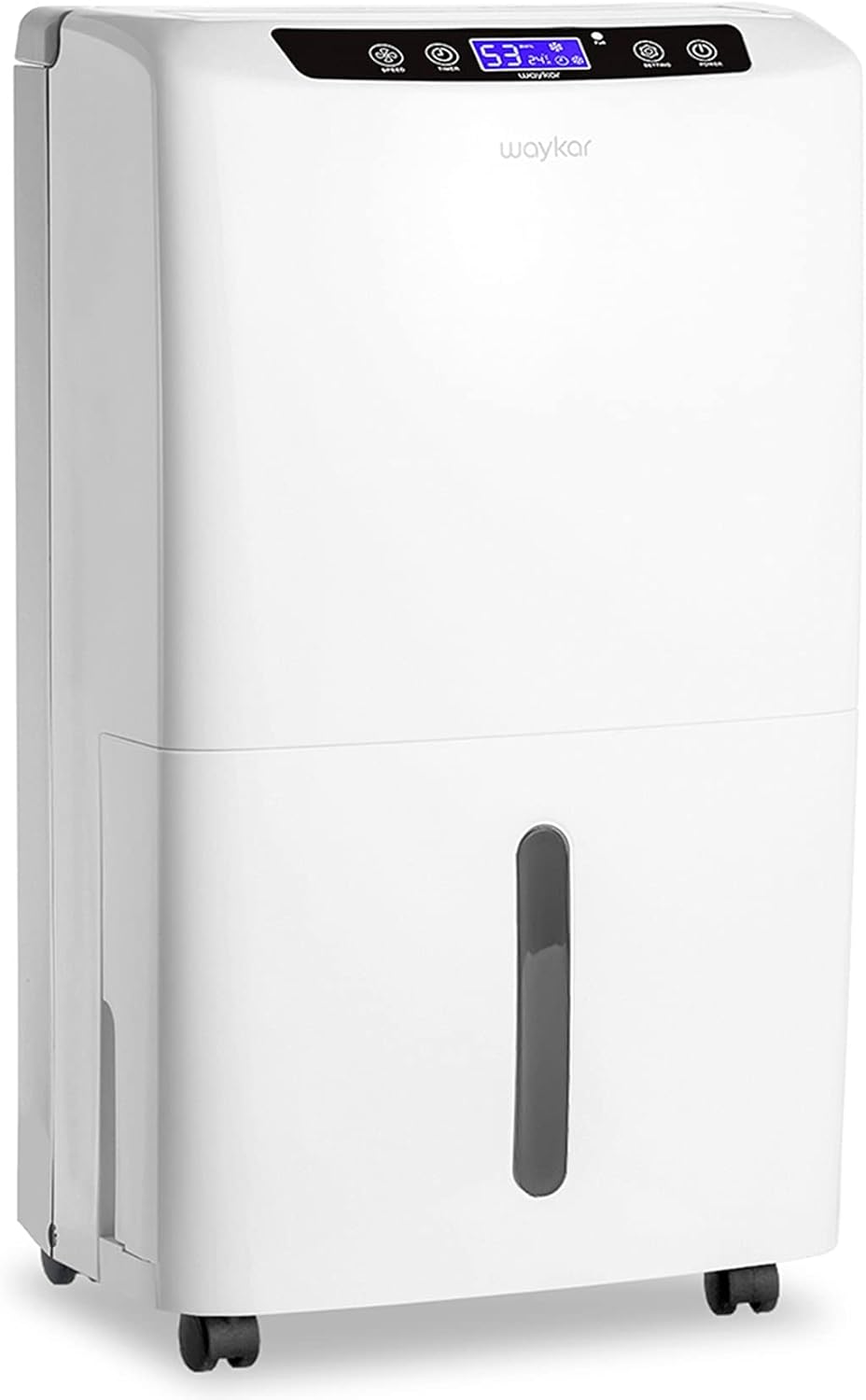
| Capacity | 34 pints per day |
|---|---|
| Floor Area | 2000 square_feet |
| Tank Volume | 0.66 gallons |
| Wattage | 230 watts |
| Operation Mode | Auto Mode, Continuous Mode |
The Waykar 34 Pint Dehumidifier is a mid-size residential unit built to remove up to 34 pints of moisture per day and manage humidity across spaces up to about 2,000 sq ft. It typically runs in auto mode to maintain a target humidity between 30% and 80% or in continuous mode for heavy-duty drying, and includes a 24-hour timer and two fan speeds for simple scheduling and airflow control. Practical features include a removable 2.5 L water tank with an auto shutoff and an included drain hose for continuous drainage, a washable filter, and automatic defrost and overload protection to sustain performance in cooler rooms. Energy Star certification and a claimed optimized compressor aim to keep operating costs and noise lower than older models, while the manual 90° airflow adjustment helps focus drying where needed. The unit is moderately heavy and sized for floor placement, so it is less convenient to move frequently, and it lacks smart connectivity or finer fan speed options found on higher-end models.
Best for: Buyers who want a reliable, energy-efficient unit that can handle a damp one-bedroom flat or basement and prefer straightforward controls and durable core features over smart bells and whistles.
Less Ideal for: Those who need a lightweight, highly portable unit to move between rooms frequently or who require Wi-Fi/app control and advanced automation features.
- High daily dehumidification capacity suitable for multi-room or damp flats
- Energy Star certified for better efficiency than non-certified units
- Dual drainage: removable tank plus included hose for unattended continuous operation
- Auto defrost and overload protection support reliable operation in cooler environments
- 24-hour timer and two fan speeds allow basic scheduling and airflow control
- Relatively heavy and bulky for frequent repositioning around a small flat
- No smart home connectivity or advanced humidity scheduling
Verdict: A strong, energy-efficient dehumidifier that reliably dries a one-bedroom flat or basement using simple controls and continuous drainage options.
LG PuriCare 50 Pint Dehumidifier

| Capacity | 50 pints |
|---|---|
| Tank Volume | 14.3 pints |
| Number of Speeds | 4 |
| Wattage | 480 watts |
| Floor Area | 4500 square_feet |
The LG PuriCare 50 Pint Dehumidifier is built to remove up to 50 pints of moisture per day while offering features that make regular use straightforward in a small apartment or one‑bed flat. It can run automatically to maintain a target humidity, supports continuous drainage via a side hose or internal bucket, and includes a 14.3 pint tank with a one‑hand side access bucket for easier emptying. Quiet low‑speed operation and an auto‑defrost function let it work overnight or in cooler rooms without freezeup, and the filter reminder and internal drying cycle reduce maintenance. Wi‑Fi and the LG ThinQ app allow remote monitoring and control, which is handy for renters or frequent travelers. At 480 watts it is moderately power hungry for continuous heavy use, and its 43.4 lb weight makes it less convenient to move frequently around the flat. The unit is tuned toward steady, reliable dehumidification rather than ultra‑compact portability or ultra‑low energy draw.
Best for: Someone prioritizing strong, reliable moisture removal for a one‑bed flat who values remote control and low‑noise overnight operation.
Less Ideal for: Buyers needing an ultra‑light, highly portable unit for moving between rooms frequently or those who want the absolute lowest continuous energy consumption.
- Removes up to 50 pints per day for effective moisture control in a one‑bed flat.
- Option for continuous drainage or a 14.3 pint internal tank with one‑hand side access for easier maintenance.
- Quiet low‑speed operation suitable for bedroom or living area use.
- Wi‑Fi support and LG ThinQ app enable remote control, alerts, and monitoring.
- Auto‑defrost and automatic drying after use maintain performance in cooler conditions.
- Relatively heavy at over 40 pounds, so not ideal for frequent repositioning.
- 480 watt power draw can add noticeable energy use if run continuously.
- Larger footprint than ultra‑compact models, so requires a bit more floor space.
Verdict: Choose this model if you want dependable 50‑pint daily dehumidification with quiet operation and app control for a one‑bed flat.
NineSky CT2 Dehumidifier
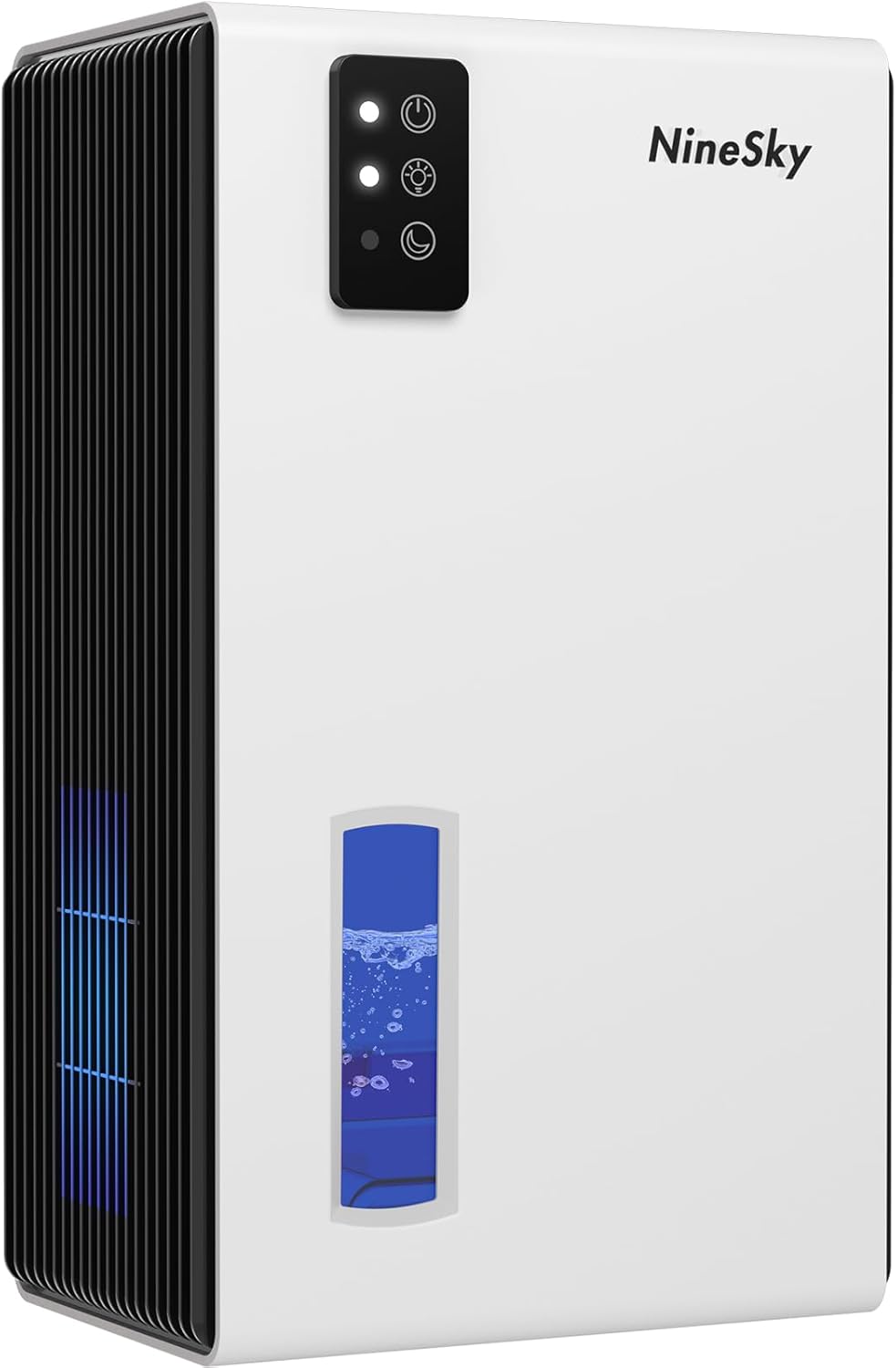
| Floor Area | 1000 square_feet |
|---|---|
| Tank Volume | 95 fluid ounces |
| Capacity | 5.9 pounds |
| Operation Mode | Automatic |
| Other Special Features of the Product | Automatic Shutoff |
The NineSky CT2 is a compact, quiet semiconductor dehumidifier designed to remove moisture from small apartments and individual rooms. It uses an upgraded semiconductor system rather than a compressor, which keeps operation low-noise and suitable for bedrooms or living rooms, and offers a high-speed mode for faster moisture removal plus a night mode that dims the LEDs. The 95 ounce tank and automatic shutoff prevent spills when the reservoir fills or is misaligned, while the unit's small footprint and carryable form make it easy to move between a bedroom, bathroom, closet, or basement area. A seven-color ambient LED can be fixed or cycled to act as a gentle night light but can be turned off for sleep. Because it relies on semiconductor technology, it is best for moderate humidity and smaller spaces rather than heavy basement dampness, and it may extract moisture more slowly than compressor dehumidifiers in very humid conditions.
Best for: Buyers who want a low-noise, space-saving dehumidifier for a one-bedroom flat or individual rooms and prioritize easy portability and user-friendly features.
Less Ideal for: People needing heavy-duty moisture removal for large, very damp basements or whole-house dehumidification should consider higher-capacity compressor units instead.
- Quiet semiconductor operation suitable for bedrooms and living spaces
- Compact, portable footprint that is easy to move between rooms
- Large 95 oz tank with automatic shutoff to prevent overflow
- Night mode and 7-color LED provide a soft ambient light option
- High-speed mode for faster moisture removal when needed
- Semiconductor dehumidification generally removes less moisture than compressor units in very damp environments
- Not ideal as the sole solution for large or very humid basements
Verdict: A quiet, portable choice for controlling humidity in a one-bedroom flat that combines a large detachable tank and automatic shutoff with low-noise semiconductor operation.
TABYIK 35OZ Dehumidifier DH-CS01

| Tank Volume | 1000 ml |
|---|---|
| Wattage | 40 watts |
| Operation Mode | Continuous |
| Dehumidification Capacity | 0.45 liters_per_day |
| Floor Area | 280 square_feet |
This TABYIK 35 oz dehumidifier is a simple, low-power unit intended for small spaces like bedrooms, bathrooms, closets, or an RV. It uses Peltier technology to pull moisture from the air and stores condensate in a 1000 ml (35 oz) removable tank with an auto shutoff that stops the unit when the reservoir is nearly full. The unit claims a maximum collection of about 16 oz (0.45 liters) per day under warm, humid conditions and runs at roughly 40 watts, so it adds very little to household energy use. Controls are one-button and the unit includes a separate multi-color night light with seven colors and a low-noise rating around 28 dB that is suitable for sleep. Practical limits are the modest daily extraction rate and single fan speed, so it works best in small, enclosed rooms rather than damp large flats or basements; you will need to empty the tank periodically and clean the intake filter to maintain performance. Overall it is a compact, budget-friendly option when you need light-duty dehumidification and quiet operation in a 1-bedroom flat.
Best for: Buyers seeking an inexpensive, energy-efficient dehumidifier for a small one-bedroom flat or single room who prioritize quiet, plug-and-play operation and easy portability.
Less Ideal for: Anyone needing fast moisture removal for basements, whole-apartment drying, or rooms with persistent high humidity should choose a larger compressor dehumidifier with higher extraction rates and adjustable settings.
- Compact and portable with a built-in handle for moving between bedroom, bathroom, or RV
- Low power draw (about 40 watts) keeps running costs down
- Very quiet operation (~28 dB) suitable for overnight use
- Transparent 35 oz tank with auto shutoff prevents overflow and notifies when full
- Low maximum dehumidification rate (~0.45 liters/24 hr) limits effectiveness in very damp or large spaces
- Single-speed operation offers no humidity setpoint control or faster drying mode
Verdict: A low-cost, low-energy, and ultra-quiet dehumidifier that fits small rooms in a one-bedroom flat when modest moisture removal is all you need.
KeepGlad RX02-B Dehumidifier

| Floor Area | 1000 square_feet |
|---|---|
| Capacity | 98 fluid ounces |
| Number of Speeds | 3 |
| Wattage | 90 watts |
| Air Flow Capacity | 30 cfm |
The KeepGlad RX02-B is a small, plug-and-play dehumidifier aimed at controlling moisture in rooms up to about 1000 sq ft. It uses a dual semiconductor system and a 90 W motor to move air across a condensate system, collecting moisture in a 98 oz tank or sending it away via the included drain hose for continuous operation. Controls are digital with a precise humidity display and a programmable 4/8/12 hour timer, and three fan speeds let you pick quiet low-speed operation or stronger drying when needed. The unit includes a washable filter, automatic shutoff when the tank is full, and a quiet mode that claims noise around 28 dB so it can run overnight in a bedroom. Practical limitations are modest dehumidification capacity listed as 2.5 pints per day and a 30 cfm airflow, so it is best for single-room use rather than heavy damp basements; also the plastic construction and smaller compressorless design mean it is less powerful than full-size refrigerant dehumidifiers. For a one-bedroom flat needing reliable, low-noise humidity control and optional continuous drain, this model is a sensible compact choice.
Best for: Someone renting or living in a one-bedroom flat who wants a quiet, easy-to-use unit to control everyday humidity and prevent mustiness without moving a large appliance.
Less Ideal for: Homes with chronically high moisture or large damp basements that require high-capacity refrigerant dehumidifiers for faster water removal.
- Compact unit with 98 oz removable tank and included drain hose for continuous operation
- Digital humidity display and programmable 4/8/12 hour timer for precise control
- Three fan speeds plus a very quiet sleep mode suitable for bedrooms
- Washable air filter and automatic shutoff to prevent overflow
- Rated dehumidification capacity is low at about 2.5 pints per day, limiting heavy-duty use
- Relatively low airflow (30 cfm) and semiconductor design make it slower at drying large or very damp spaces
Verdict: A compact, quiet dehumidifier with continuous-drain capability that is well suited to maintaining comfortable humidity in a one-bedroom flat.
Pro Breeze Mini Dehumidifier PB-02

| Floor Area | 215 square_feet |
|---|---|
| Capacity | 16 fluid ounces |
| Tank Volume | 17 fluid ounces |
| Wattage | 21 watts |
| Dehumidification Capacity | 0.25 liters_per_day |
The Pro Breeze Mini Dehumidifier PB-02 is a small thermoelectric unit intended to reduce humidity in compact spaces such as bedrooms, bathrooms, closets and small flats. It uses Peltier cooling to run quietly and efficiently, drawing roughly 21 watts while collecting up to about 9 ounces (0.25 liters) of water per day into a 16–17 oz tank with automatic shutoff and a full-tank LED indicator. Typical use is plug-and-play: place it near damp walls or windows and empty the removable tank when full; the low noise and low power draw make it suitable for overnight operation. Notable features include ultra-quiet operation, a lightweight portable design, and five speed settings for modest airflow control. The main limitations are its low daily extraction rate and compact tank, so it is best for mild humidity problems or spot treatment rather than drying an entire flat after flooding or for sustained high-humidity climates. It also requires operation within its recommended temperature range to perform as expected.
Best for: Buyers who prioritize quiet, energy-efficient spot humidity control and want a compact unit backed by broad customer feedback and a standard one-year warranty.
Less Ideal for: People needing to dry large rooms, combat persistent mold or heavy condensation, or handle post-flood moisture should choose a higher-capacity compressor dehumidifier instead.
- Very quiet Peltier-based operation suitable for bedrooms
- Low power consumption (around 21–23 W) keeps running costs minimal
- Auto shutoff with LED indicator prevents overflows
- Compact and lightweight for moving between rooms
- Five speed settings offer basic airflow control
- Low dehumidification capacity (about 0.25 L/day) not suited for serious damp issues
- Small tank requires frequent emptying in persistently humid conditions
Verdict: A low-power, whisper-quiet mini dehumidifier that works well for spot treatment in a one-bedroom flat but is intended for mild humidity issues rather than heavy-duty drying.
ToLife Dehumidifier TZ-C2
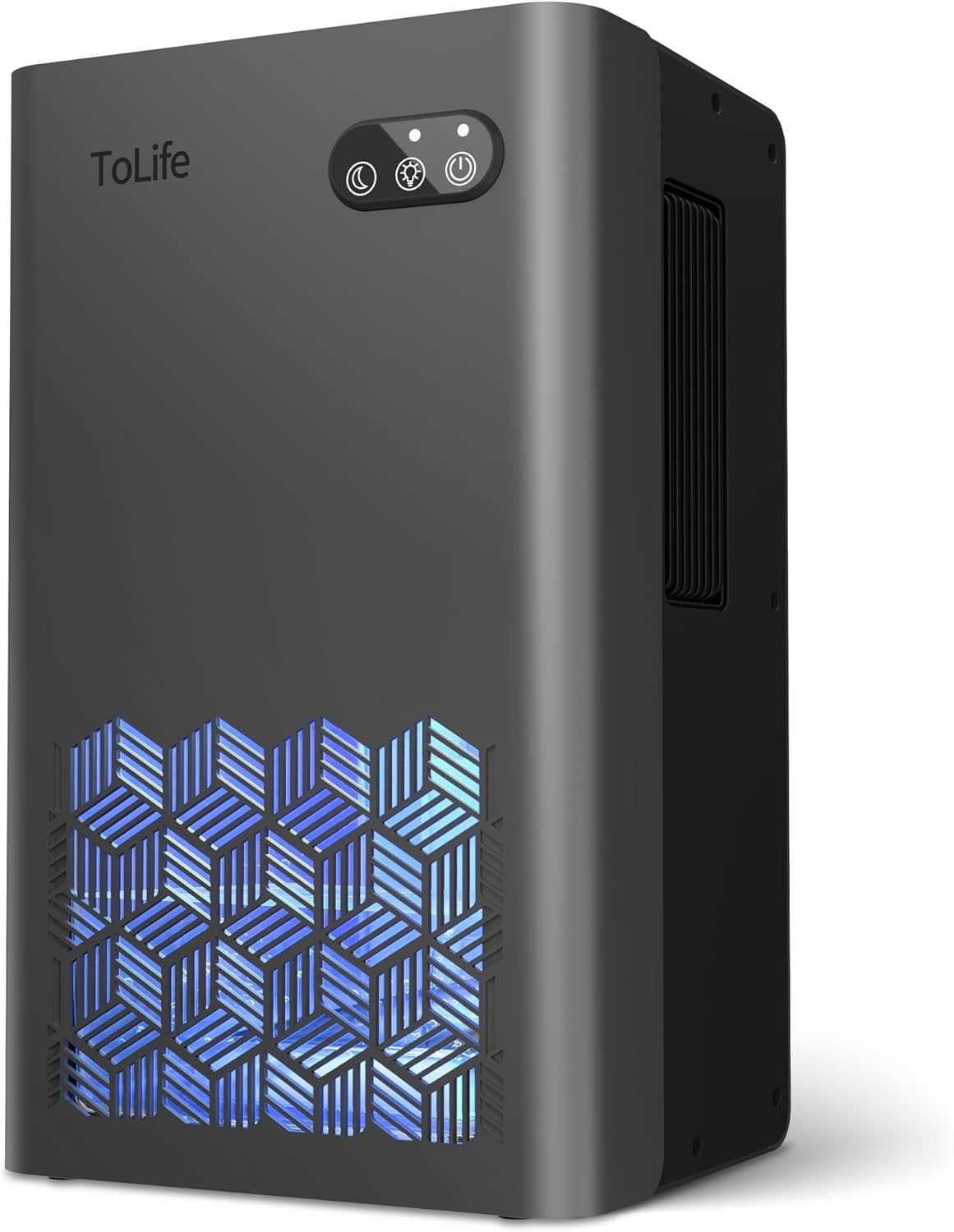
| Floor Area | 1000 |
|---|---|
| Tank Volume | 95 fluid ounces |
| Number of Speeds | 2 |
| Wattage | 93 watts |
| Voltage | 220 volts |
The ToLife TZ-C2 uses semiconductor condensation technology to quietly pull moisture from the air and deposit it into a removable 95 oz tank, making it a straightforward option for damp rooms. It offers two operating modes: a higher-power setting for faster moisture removal and a low-speed sleep mode that runs under 30 dB for overnight use. A seven-color LED can act as a night light and the unit includes automatic shutoff when the tank is full or removed, plus handles for easy moving between rooms. Practical benefits include simple setup, low noise, and a compact footprint that fits in basements, bathrooms, or bedrooms. Limitations are its modest rated dehumidification capacity and stated coverage, which means it will be most effective in smaller basement zones or for spot treatments rather than drying a large, very damp basement quickly. Also this model runs on 220 volts, so electrical compatibility should be confirmed for your location.
Best for: Buyers who need an affordable, portable dehumidifier for spot dehumidifying small basement areas, bathrooms, or bedrooms and who prioritize low noise and easy portability.
Less Ideal for: People looking to dry large, very damp basements or whole-house coverage should consider a higher-capacity compressor dehumidifier instead.
- Large removable 95 oz water tank reduces how often you need to empty it
- Quiet sleep mode under 30 dB suitable for nighttime operation
- Portable design with handles for moving between rooms
- Automatic shutoff prevents overflow when the tank is full
- Dehumidification capacity is modest and may be slow in very damp or large basements
- Requires 220 volt power which may not match all household outlets
Verdict: A compact, budget-friendly portable dehumidifier that is best for quiet, small-area moisture control and occasional basement spot treatments.
Choosing the Right Dehumidifier for 1 Bed Flat: Key Factors to Consider
Room Size and Measured Capacity
Capacity matters because a unit rated for a larger room will remove moisture faster but may cycle on and off inefficiently in a small flat. Estimate the square footage of the area you want to dehumidify and match it to a unit's realistic daily removal rating rather than its peak claim.
In practice, a one-bedroom flat needs a compact device sized for a single living area plus bedroom. Overpowering the room can waste energy and create short cycling, while an undersized unit will run continuously without reaching the target humidity.
Noise and Nighttime Use
Noise is a primary consideration in small homes where the dehumidifier may operate near sleeping areas. Look for published decibel ratings and quiet or sleep modes that lower fan speed without disabling humidity control.
Also consider whether the unit's vibration or fan tone will carry through lightweight walls or wooden floors. A marginally lower-capacity but quieter model can be a better real-world choice for bedrooms.
Water Removal Method and Maintenance
Tank capacity and drainage options determine how hands-on you must be. Small tanks require frequent emptying, which may be inconvenient in a compact flat. Continuous-drain capability or a gravity-fed hose option lets the unit run unattended for longer stretches, especially useful during prolonged damp weather.
Also check how easy the tank and filter are to access and clean. Removable, washable filters and clear tank-level indicators reduce maintenance time and help maintain performance over the long term.
Energy Use and Running Cost
Because dehumidifiers often run for hours or days, energy consumption impacts monthly bills. Compare wattage and look for energy-saving features such as programmable timers, auto-humidistats, and low-power modes.
Consider whether you will run the unit continuously or intermittently. An efficient unit with precise humidity control can cost less overall than a higher-capacity model that cycles inefficiently in a small space.
Placement, Footprint, and Portability
Space is limited in one-bedroom flats, so the unit's footprint and whether it can be tucked into a closet or corridor matter. A narrower, taller unit may fit in tight spaces better than a wide model.
Also evaluate caster quality and handle design if you plan to move the unit between rooms. Lightweight units with stable bases are easier to reposition for laundry, bathroom, or bedroom use.
Choosing the Right Capacity for a One-Bedroom Flat
Match the unit's dehumidification capacity to the flat's typical humidity load. Flats with poor ventilation or a bathroom without an extractor fan will need higher daily removal than well-ventilated apartments. Think in terms of realistic operating conditions—room temperature and relative humidity greatly affect a unit's output.
If you intend to treat the whole flat, choose a unit sized for the combined living area. For targeted control, such as a damp bedroom or bathroom, pick a compact model designed for single-room performance. In most one-bedroom flats, a medium-small capacity unit provides the best balance of performance and efficiency.
- Use the bedroom's square footage plus any adjoining living space to estimate coverage.
- Expect lower listed capacities at cool room temperatures common in winter.
- Prioritize continuous drainage if you cannot empty a tank daily.
Noise Strategies for Bedroom Use
If you plan to run a dehumidifier in or near a sleeping area, choose models with sleep or low modes that reduce fan speed and display brightness. Look for units with decibel ratings under typical conversation levels when on low setting.
Placement can also reduce perceived noise. Put the unit on a padded surface to reduce vibration, keep it away from shared walls where possible, and avoid placing it directly under a bed or against a thin partition.
- Aim for night-mode noise under 40 dBA for minimal sleep disruption.
- Use vibration-damping pads if hardwood or laminate floors amplify sound.
Effective Placement and Airflow Considerations
A dehumidifier needs unobstructed airflow to work efficiently. Leave at least a few inches of clearance on all sides and avoid tight cabinets or behind curtains. Position the unit where moisture sources are strongest, like near the bathroom door or drying area for laundry.
In a narrow flat, central placement helps circulation. If you will move the unit between rooms, consider a model with good casters and a handle rather than a heavy, stationary device.
- Keep the intake clear of furniture and fabrics.
- For best results, run on a continuous setting during damp spells and use a timer to reduce runtime once humidity drops.
Maintenance Tips for Long-Term Performance
Regular filter cleaning and tank emptying preserve efficiency and indoor air quality. Clean or rinse washable filters monthly in dusty environments, and inspect the tank for mold or residue.
If using a continuous drain, check hoses for blockages and ensure the drain endpoint is lower than the unit if using gravity drainage. Periodic descaling may be needed in hard-water areas where condensate leaves mineral deposits.
- Wipe the tank dry when not in use to prevent odor.
- Schedule filter inspection every month during heavy use seasons.
Energy-Saving Habits and Settings
Use the built-in humidistat to avoid unnecessary runtime. Set a realistic target relative humidity—typically 45 to 55 percent for comfort without overdrying. Combine dehumidifier use with ventilation, extractor fans, and limiting indoor moisture sources to reduce workload.
Run the unit on lower fan settings overnight and boost during laundry or cooking. Timers and eco modes can keep energy use reasonable while still protecting against mold and condensation.
- Aim for 45 to 55 percent relative humidity as a practical home target.
- Use timers to avoid running at full power when moisture sources are low.
How We Chose the Best Dehumidifier for 1 Bed Flat
We selected machines that are sized and specified for small flats and single-room use, prioritizing real-world performance metrics over marketing claims. Core evaluation criteria included daily dehumidification capacity at typical indoor temperatures, meaning how many liters the unit removes in realistic conditions rather than lab peaks. We also checked tank capacity and continuous-drain options to gauge suitability for users who prefer low-maintenance operation. Because flats often have shared walls and thin floors, noise level and fan speed control were a major filter. We favored units with published dBA ratings or clear quiet modes suitable for bedrooms. Energy efficiency and runtime mattered as well, especially for renters who want low operating cost without running the machine constantly. Portability and footprint were evaluated to ensure the units fit hallways, closets, or small living rooms without blocking vents or walkways. We excluded large basement and whole-house systems that exceed the scope for a one-bedroom flat. Units lacking clear specifications for capacity, noise, or drainage options were not considered. The resulting list favors compact dehumidifiers that balance moisture removal, quiet operation, and manageable upkeep.
Our full evaluation process is outlined in our review methodology.
FAQ
How big a dehumidifier do I need for a one-bedroom flat?
Size depends on the flat's square footage and humidity level. For typical one-bedroom flats, choose a compact or medium-small unit rated for single-room use or the combined living area; prioritize realistic daily removal numbers rather than peak claims.
Is continuous drainage necessary in a small flat?
Continuous drainage is convenient if you are away often or want to avoid frequent tank emptying. If you can easily empty a tank daily, it is not strictly necessary, but continuous drain reduces maintenance during prolonged damp periods.
Will a dehumidifier reduce energy bills?
A dehumidifier itself consumes electricity, so it does not directly lower energy bills. However, improving humidity control can make heating systems feel more effective and prevent moisture-related issues that might increase maintenance costs. Choosing an energy-efficient model and using timers helps limit operating cost.
Where should I place a dehumidifier in a small apartment?
Place it where moisture accumulates or where airflow allows the unit to pull damp air from the whole flat, such as a central hallway, near the bathroom, or the room where laundry dries. Keep clearances around the unit for good airflow.
How often do I need to clean the filter and tank?
Inspect filters monthly during heavy use and wash or replace as the manufacturer recommends. Empty and rinse the tank weekly or more often if it fills quickly to prevent odors or microbial growth.
Final Verdict
For a one-bedroom flat, prioritize a compact dehumidifier that balances realistic moisture removal with low noise and manageable maintenance. Focus on units with transparent capacity specs, a useful humidistat, and tank or drainage options that fit your routine. Expect tradeoffs: the quietest models may have lower peak output, while higher-capacity units can require more frequent upkeep. Choose the combination of capacity, noise, and drainage that matches how and where you will run the unit to keep your flat comfortable and mold-free.