
Note: This article contains affiliate links. If you click on these links and make a purchase, we may earn a small commission at no extra cost to you. This helps support our research and content. Read our full affiliate disclosure here.
Living in a dorm often means smaller rooms, shared ventilation, and limited storage space. A dorm-friendly dehumidifier helps prevent musty smells, protects clothes and textbooks from moisture damage, and makes sleeping more comfortable without taking over your limited square footage. This guide focuses on compact, low-noise units designed to fit dorm-room constraints and daily routines. Below are our top shortlisted picks for dorm dehumidifiers, each selected for space efficiency, quiet operation, or user-friendly controls. Read on to see the practical features we evaluated and how to match a model to your room and habits.
Top Picks at a Glance
| Best Overall The best all-around choice for most situations | OWAAE TZ-C4S Dehumidifier |  |
| Best Quality Built to a higher standard if you want something more solid | BEDRED CT11 Dehumidifier |  |
| Best Value The sweet spot between price and what you get | Pro Breeze Mini Dehumidifier PB-02 |  |
| Best Budget The cheapest option that still gets the job done reliably | Eva-Dry E-333 Mini Dehumidifier |  |
| Top Rated A top-rated pick with lots of positive feedback | Semzodax D01 Dehumidifier |  |
| Most Popular A crowd favorite that many people choose with confidence | TABYIK 35OZ Dehumidifier DH-CS01 |  |
| Best Seller A high-volume bestseller chosen again and again | ToLife Dehumidifier TZ-C2 |  |
OWAAE TZ-C4S Dehumidifier

| Floor Area | 1000 |
|---|---|
| Capacity | 95 fluid ounces |
| Operation Mode | Automatic |
| Other Special Features of the Product | Quiet Operation |
The OWAAE TZ-C4S is a small, portable dehumidifier intended for bedrooms, dorms, bathrooms, closets, and RVs where humidity builds up. It collects moisture into a 95 ounce tank and shuts off automatically when the tank is full or incorrectly seated, which reduces spill risk and lets the unit run unattended. The unit emphasizes quiet operation with a sleep mode under 30 dB, making it suitable for overnight use, and it includes a 7-color LED for soft ambient lighting. Setup is simple: place it in the room, plug in, and let the automatic mode manage humidity without complex controls. Practical strengths are its compact footprint and portability, so it fits on small surfaces and can be carried by the built-in handle. Limitations are that it is sized for modest spaces rather than whole apartments, and buyers wanting precise humidity readouts or continuous drain plumbing will need a different model. For dorm rooms or other tight spaces where quiet, hands-off moisture control matters, this unit delivers convenient, low-noise performance.
Best for: Students or renters who need a compact, quiet dehumidifier for a dorm, bedroom, or small enclosed space and prefer a simple, low-maintenance device.
Less Ideal for: People who need whole-apartment moisture control, built-in continuous drain capability, or precise humidity setpoint control should choose a larger or more feature-rich model.
- 95 oz water tank with automatic shutoff reduces spills and need for constant emptying
- Ultra-quiet sleep mode operating under 30 dB suitable for overnight use
- Compact, lightweight design with built-in handle for easy placement and portability
- Automatic operation simplifies use—set and forget for everyday moisture control
- Designed for small to moderate rooms and not intended to dehumidify large open areas
- No spec listed for continuous drain option or digital humidity readout
Verdict: A compact, very quiet plug-and-play dehumidifier that is ideal for dorm rooms and other small spaces needing hands-off moisture control.
BEDRED CT11 Dehumidifier

| Floor Area | 1000 square_feet |
|---|---|
| Tank Volume | 95 fluid ounces |
| Capacity | 5.9 pounds |
| Operation Mode | Intermittent |
| Other Special Features of the Product | 7 Color Ambient Light, Automatic Shutoff, Sleep Mode |
The BEDRED CT11 is a compact thermoelectric dehumidifier intended to reduce humidity in small spaces such as bedrooms, bathrooms, and modest basements up to about 1000 sq ft. It uses semiconductor cooling rather than a compressor, so it runs quietly and is simple to operate with an intermittent operation mode and an automatic shutoff when the 95 oz tank fills. Sleep Mode turns off the lights and lowers noise for overnight use, and the seven-color ambient light gives an optional mood-lighting feature. Practical benefits include easy emptying from the included tank, portability thanks to a lightweight design, and low sound levels that suit living spaces. Important limitations are inherent to semiconductor units: lower capacity compared with compressor dehumidifiers, reduced performance in very cold or very damp basements, and a smaller tank that requires more frequent emptying in high-humidity conditions.
Best for: Buyers who prioritize quiet, low-maintenance dehumidification and want a compact unit that is easy to move and run in living spaces or small basements without frequent intervention.
Less Ideal for: People needing heavy-duty moisture control for large, cold, or very damp basements should choose a higher-capacity compressor dehumidifier instead.
- Quiet thermoelectric operation suitable for bedrooms and living rooms
- Automatic shutoff protects against overfill and simplifies unattended use
- 95 oz removable tank for straightforward water removal
- Sleep Mode and ambient light options for low‑noise nighttime use
- Compact and lightweight for easy placement or moving between rooms
- Semiconductor cooling gives lower moisture removal capacity than compressor models
- Performance drops in cold basement conditions and very high humidity areas
Verdict: Choose the BEDRED CT11 if you want a quiet, portable dehumidifier with auto‑shutoff and sleep‑friendly operation for small basements or living spaces.
Pro Breeze Mini Dehumidifier PB-02

| Floor Area | 215 square_feet |
|---|---|
| Capacity | 16 fluid ounces |
| Tank Volume | 17 fluid ounces |
| Wattage | 21 watts |
| Dehumidification Capacity | 0.25 liters_per_day |
The Pro Breeze Mini Dehumidifier PB-02 is a small, portable unit that uses thermoelectric (Peltier) cooling to quietly pull moisture from confined spaces such as dorm rooms, bathrooms, closets, and RVs. It collects roughly 8–9 ounces of water per day into a 16–17 ounce tank and shuts itself off automatically when the tank is full, while an LED indicates when it needs emptying. With very low power draw (around 21–23W) and near-silent operation, it is practical for continuous overnight use without disturbing roommates. The unit is best used in temperatures above about 41–59°F and performs most effectively in small rooms up to roughly 215 sq ft; it is not intended for whole-apartment dehumidification or heavy-duty basement use. Controls are simple and the compact footprint makes it easy to tuck onto a desk or shelf, but buyers should expect modest daily extraction and to empty the tank regularly if humidity is high. The PB-02 is a straightforward, energy-efficient option when you need light, quiet humidity control in a small space.
Best for: Buyers who prioritize small, energy-efficient, and quiet humidity control for a single room or dormitory space and want a plug-and-play unit that is easy to move and run continuously.
Less Ideal for: Not a good fit for users who need to dehumidify large rooms, entire apartments, or very damp basements where higher-capacity compressor units are required.
- Compact, lightweight design for easy placement in small rooms or dorms
- Very low power consumption suitable for continuous use
- Whisper-quiet Peltier operation that is unobtrusive during sleep or study
- Automatic shut-off with LED full-tank indicator for safe unattended use
- Low extraction rate makes it unsuitable for large or very damp spaces
- Must be emptied frequently in high-humidity environments due to small tank capacity
Verdict: A compact, energy-sipping dehumidifier ideal for quiet, low-maintenance moisture control in a dorm room or other small personal space.
Eva-Dry E-333 Mini Dehumidifier

| Floor Area | 333 square_feet |
|---|---|
| Capacity | 6 ounces |
| Dehumidification Capacity | 0.38 pints_per_day |
| Operation Mode | Continuous |
| Wattage | 22.5 |
The Eva-Dry E-333 is a cordless, rechargeable mini dehumidifier that uses crystallized silica gel to pull moisture from small enclosed areas like dorm closets, bathrooms, cars, and safes. It works passively: place or hang the unit where humidity is a problem and the indicator beads change color to show when the unit needs recharging. The device is rated to handle up to about 333 square feet and captures roughly 4 to 6 ounces before requiring regeneration, with an advertised runtime of 20 to 30 days between charges depending on conditions. Because it contains no compressor, it is silent and spill-free and needs no power during normal use, though it must be heated to restore the beads. Practical benefits include portability, long service life, and zero operating noise. The main limitations are modest daily dehumidification capacity and the need to periodically recharge rather than automatic continuous extraction, so it is best for small, intermittent humidity control rather than whole-room drying in persistently damp conditions.
Best for: Students or renters needing a low-cost, maintenance-light way to control humidity in compact personal spaces who prioritize quiet, portable solutions over aggressive drying.
Less Ideal for: Rooms with persistent high humidity or larger dorm rooms that need continuous dehumidification should consider an active electric dehumidifier instead.
- Cordless, rechargeable design requires no batteries or cords during use
- Silent, passive silica gel operation avoids leaks and compressor noise
- Small and portable for closets, dorm rooms, cars, and safes
- Visual moisture indicator shows when regeneration is needed
- Advertised long service life and renewable beads reduce replacement frequency
- Limited moisture capacity and low daily extraction rate not suited for large or very damp rooms
- Requires periodic recharging to restore absorbent beads rather than continuous automatic operation
Verdict: An inexpensive, cordless mini dehumidifier that delivers quiet, maintenance-light moisture control for small dorm spaces.
Semzodax D01 Dehumidifier

| Capacity | 63 fluid ounces |
|---|---|
| Operation Mode | Auto Dehumidify |
| Other Special Features of the Product | Automatic Defrost, Automatic Shutoff, Night Light, Timer, Ultra Quiet |
| Floor Area | 0.67 square_meters |
The Semzodax D01 is a small, bedroom-friendly dehumidifier designed to remove excess moisture in compact spaces like dorm rooms, closets, bathrooms, or RVs. It offers two operating modes: Auto Dehumidify, which maintains preset humidity targets (60% or 70%), and Continuous mode for nonstop moisture removal. Practical features include an auto-defrost function that keeps the unit working at lower temperatures, an auto shut-off when the 63 oz tank fills, and a programmable timer for 6/8/10-hour runs. The unit is notably quiet at around 35 dB and includes a removable tank that makes emptying and cleaning straightforward. The 7-color flowing night light adds a soft glow useful in bedrooms but can be distracting if you want total darkness. Its small footprint and roughly 3 lb weight make it easy to move, though coverage is limited to very small areas. For someone wanting a reliable, low-noise solution for one small room, the D01 handles basic dehumidifying tasks well, but it is not suited for larger rooms or heavy-duty moisture problems.
Best for: Students or residents who need a dependable, low-noise dehumidifier for a single small room and value simple automatic controls and portability.
Less Ideal for: People needing to dehumidify large rooms, whole apartments, or spaces with serious water intrusion should choose a larger capacity unit or a model intended for higher airflow.
- Very quiet operation around 35 dB suitable for bedrooms and study spaces
- Large 63 oz removable tank with auto shut-off reduces trips to empty
- Auto-defrost and auto-shutoff protect the unit and extend usable temperature range
- Portable and lightweight design easy to move between small rooms or an RV
- Designed for very small floor areas so it will not handle larger dorm suites or damp basements
- Night light cycles through colors which may bother users who prefer complete darkness
Verdict: A compact, quiet, and easy-to-use dehumidifier that reliably handles moisture control for a single small dorm room.
TABYIK 35OZ Dehumidifier DH-CS01

| Tank Volume | 1000 ml |
|---|---|
| Dehumidification Capacity | 0.45 liters_per_day |
| Floor Area | 280 square_feet |
| Wattage | 40 watts |
| Noise Level | 28 dB |
The TABYIK 35OZ Dehumidifier is a small, portable Peltier unit intended to remove excess moisture from bedrooms, bathrooms, RVs, and closets. It runs continuously with a single-speed fan and collects up to about 16 oz (450 ml) per day under the stated test conditions, storing water in a transparent 1000 ml tank that auto shuts off when near full. Setup and use are simple: plug in, press the single button to start, and optionally enable the 7-color night light or turn it off for sleeping. The unit is energy efficient (about 1 kWh/day max) and very quiet at roughly 28 dB, so it can run overnight without disturbing sleep. Practical limitations are its modest daily dehumidification rate and single-speed operation, which makes it best suited to small, semi-enclosed spaces rather than damp basements or large rooms; performance also drops at lower humidity or temperature extremes. The built-in handle and removable tank make emptying and cleaning straightforward, and a washable back intake filter helps maintain airflow if cleaned regularly.
Best for: Students or renters who need a low-noise, easy-to-use dehumidifier for small spaces like dorm rooms, bathrooms, or closets and who prioritize simple operation and space savings.
Less Ideal for: People needing to dry large, very damp areas, basements, or whole-apartment dehumidification should choose a larger compressor-based unit with higher daily capacity.
- Compact and portable with a built-in handle for easy placement and moving
- Large transparent 35 oz (1000 ml) tank with simple groove for removal and cleaning
- Very quiet operation around 28 dB suitable for bedrooms and dorm rooms
- Auto shut-off prevents overflow and flashes an indicator when the tank is nearly full
- Low power draw (about 40 W, under 1 kWh per day) keeps energy use minimal
- Rated dehumidification is low (about 0.45 L/day) so it is not suitable for large or very damp spaces
- Single-speed operation limits control over dehumidification rate and noise level
Verdict: A compact, whisper-quiet dehumidifier that fits dorm rooms and small spaces for low-maintenance moisture control.
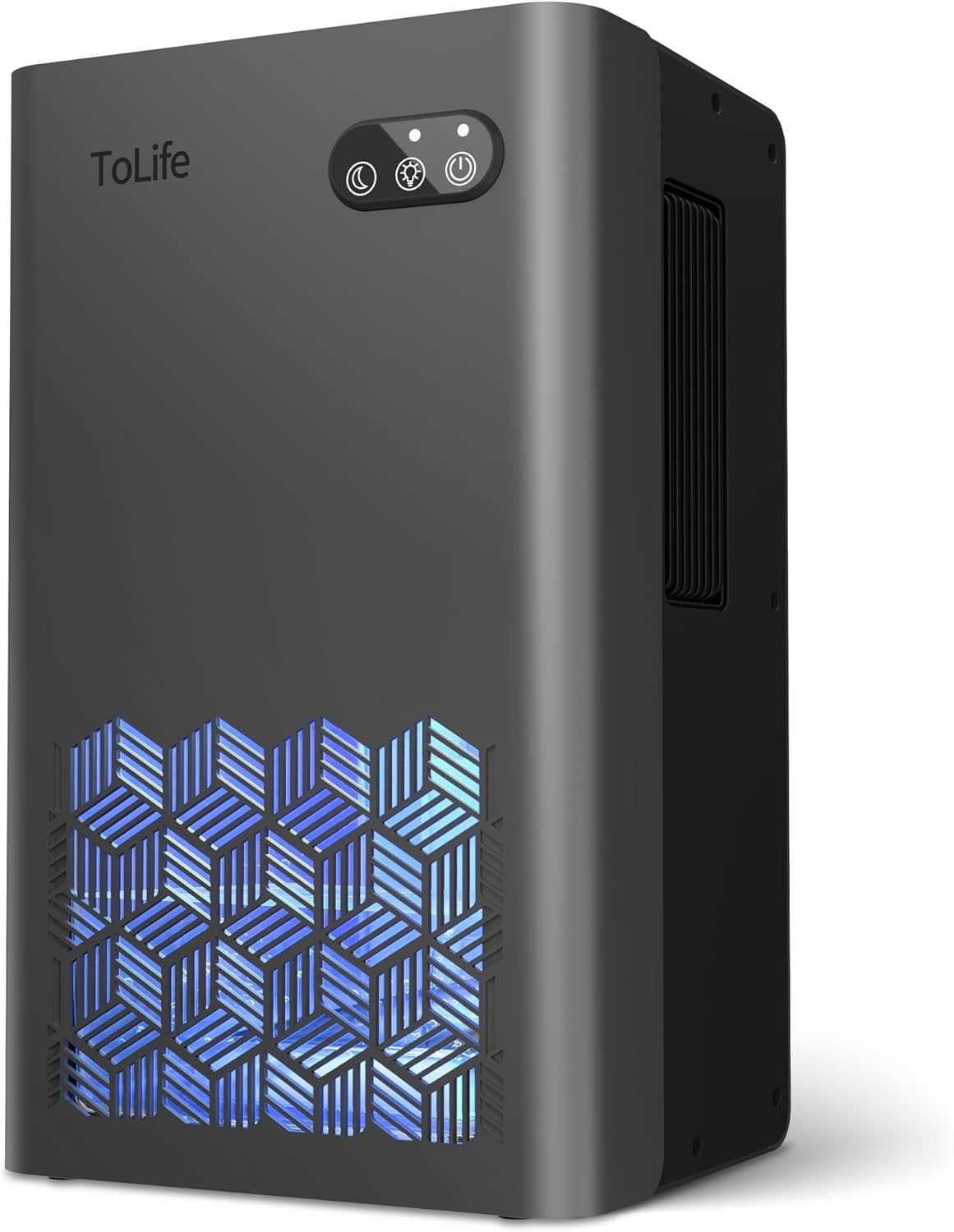
ToLife Dehumidifier TZ-C2
| Floor Area | 1000 |
|---|---|
| Tank Volume | 95 fluid ounces |
| Number of Speeds | 2 |
| Wattage | 93 watts |
| Voltage | 220 volts |
The ToLife TZ-C2 uses semiconductor condensation technology to quietly pull moisture from the air and deposit it into a removable 95 oz tank, making it a straightforward option for damp rooms. It offers two operating modes: a higher-power setting for faster moisture removal and a low-speed sleep mode that runs under 30 dB for overnight use. A seven-color LED can act as a night light and the unit includes automatic shutoff when the tank is full or removed, plus handles for easy moving between rooms. Practical benefits include simple setup, low noise, and a compact footprint that fits in basements, bathrooms, or bedrooms. Limitations are its modest rated dehumidification capacity and stated coverage, which means it will be most effective in smaller basement zones or for spot treatments rather than drying a large, very damp basement quickly. Also this model runs on 220 volts, so electrical compatibility should be confirmed for your location.
Best for: Buyers who need an affordable, portable dehumidifier for spot dehumidifying small basement areas, bathrooms, or bedrooms and who prioritize low noise and easy portability.
Less Ideal for: People looking to dry large, very damp basements or whole-house coverage should consider a higher-capacity compressor dehumidifier instead.
- Large removable 95 oz water tank reduces how often you need to empty it
- Quiet sleep mode under 30 dB suitable for nighttime operation
- Portable design with handles for moving between rooms
- Automatic shutoff prevents overflow when the tank is full
- Dehumidification capacity is modest and may be slow in very damp or large basements
- Requires 220 volt power which may not match all household outlets
Verdict: A compact, budget-friendly portable dehumidifier that is best for quiet, small-area moisture control and occasional basement spot treatments.
Choosing the Right Dehumidifier for Dorm: Key Factors to Consider
Room Size and Capacity
Match the dehumidifier's rated daily or hourly moisture removal capacity to the dorm room's volume. A unit sized for small rooms will remove condensation and excess humidity more efficiently and cycle less frequently, which reduces runtime and noise.
Overpowered units can waste energy in tight spaces while underpowered units may run continuously without reaching target humidity. Look for specifications that list coverage or liters/pints removed per day and compare that to typical small-room guidance rather than open-room or whole-house ratings.
Noise Output and Night Use
Because dorms are small and often shared or thin-walled, noise matters. Check measured or manufacturer-listed decibel ratings and prefer units with quieter fan speeds or a dedicated 'sleep' mode.
Lower noise levels make it more likely you'll keep the unit running overnight, which is important for controlling nighttime condensation. Remember that advertised noise figures are often measured at maximum fan speed, so models with multi-speed fans let you balance sound and drying power.
Size, Weight, and Placement
Dorm rooms have limited floor and storage space, so a compact footprint and manageable weight are critical. Consider whether the unit fits comfortably under a desk, in a closet, or on a shelf, and whether it has built-in handles or casters for moving between rooms.
Also think about where the unit will intake and exhaust air. Placing a dehumidifier too close to walls or curtains can restrict airflow and reduce efficiency, so a slim profile that still allows clearance is ideal.
Water Handling and Continuous Drain Options
Smaller dehumidifiers often use a removable water tank; check tank capacity and how often you'll need to empty it. Larger or more convenient tanks reduce trips to empty the reservoir but add size and weight.
If you prefer set-and-forget operation, look for a continuous-drain option or a gravity-fed hose connection that lets moisture drain to a floor drain or sink. Confirm the drain orientation and hose compatibility before relying on this feature in a dorm setting.
Controls, Humidistat, and Automation
A built-in humidistat and clear controls simplify maintaining a target humidity level without constant attention. Look for straightforward buttons or dials, programmable timers, and indicator lights that show when the tank is full or when the unit is in defrost or sleep mode.
Automation features reduce the likelihood of over-drying and save energy. For shared living arrangements, choose an interface that is simple for roommates to understand and adjust if necessary.
Maintenance and Filter Care
Regular maintenance keeps a dehumidifier effective and hygienic. Check how accessible the air filter and water tank are for cleaning and whether replacement filters are readily available and affordable.
Mold and bacteria can grow in neglected tanks or filters, so choose a unit whose parts are easy to remove and rinse. Some models offer antimicrobial-treated components or washable filters that reduce ongoing costs and upkeep time.
Sizing Your Dehumidifier for Typical Dorm Layouts
Estimate the square footage and ceiling height of your dorm room to pick a suitable capacity. Small single rooms and shared suites have very different moisture loads; a compact unit designed for 100 to 300 square feet is usually sufficient for a standard dormitory bedroom.
Consider adjacent moisture sources like en suite bathrooms or frequent cooking in a kitchenette. If the room connects directly to a bathroom or has poor ventilation, opt for a unit with slightly higher capacity or faster moisture removal to keep humidity in check.
- Measure usable floor area and factor in high-moisture activities.
- Choose higher capacity if the room lacks ventilation or has a private bathroom.
- Avoid oversized units that cycle on and off inefficiently in tiny spaces.
Placement Tips to Maximize Performance
Place the dehumidifier away from walls and large obstacles to ensure good airflow. A clearance of several inches on intake and exhaust sides helps the unit operate efficiently and reduces strain on the fan.
Elevating a small dehumidifier a few inches off the floor can improve condensate collection and make draining easier. Avoid placing the unit directly on soft bedding, carpet piles, or against curtains where airflow can be blocked.
- Keep at least 6 to 12 inches of clearance around the unit.
- Position near typical moisture sources for targeted control.
- Ensure the drain outlet is accessible if you use a continuous hose.
Managing Power and Safety in Dorms
Dorm rooms often have circuit limits and shared outlets. Use a dedicated outlet when possible and avoid daisy-chaining extension cords or power strips at high fan speeds. Check that the unit's plug and cord are in good condition and that the voltage matches campus standards.
Look for overheat protection and tip-over or spill safeguards. A compact unit with an auto-shutoff for full tanks reduces flood risk if you forget to empty it.
- Verify outlet availability and avoid overloading circuits.
- Prefer models with safety shutoffs and thermal protection.
- Follow campus policies about appliances in residence halls.
Energy Use and Running Costs
Dehumidifiers consume electricity while running, and smaller dorm units can run frequently in humid climates. Check rated power draw and consider models with eco modes or adjustable fan speeds to reduce runtime.
Using a humidistat to maintain a moderate humidity target can cut energy use compared with running on high all day. For occasional use, a smaller unit that you turn on only when humidity spikes may be the most economical option.
- Look for multi-speed fans and eco or auto modes.
- Set a realistic humidity target to avoid continuous operation.
- Unplug or store the unit during months of low humidity.
Cleaning and Preventing Odors
Empty and dry the water tank regularly to prevent mold and bad smells. Wipe the interior with a mild detergent and rinse thoroughly, and allow the tank to air dry before reinstalling.
Clean or rinse the air filter on the schedule recommended by the manufacturer or more often in dusty dorm environments. Periodic vacuuming of the intake grill will also help maintain airflow and efficiency.
- Empty tanks frequently in high-humidity periods.
- Wash filters and dry tanks to limit microbial growth.
- Use low-odor cleaning agents and avoid bleach near parts that contact air supply.
How We Chose the Best Dehumidifier for Dorm
We focused on features and performance that matter most in small, often shared living spaces. Key evaluation criteria included moisture removal capacity relative to small-room size, measured or reported noise levels for nighttime use, and physical footprint and weight for storage and portability. We also assessed ease of use factors such as control simplicity, auto-shutoff or continuous-drain options, and maintenance needs like filter access and reservoir cleaning. Additional editorial filters excluded large whole-home dehumidifiers and units intended for basement or garage use, since those are inappropriate for dorm-room volume and power constraints. We prioritized models with clear capacity ratings for rooms under 300 square feet, reliable humidity controls or humidistats, and safety features suitable for a residence hall environment. Units lacking basic user-accessible maintenance or with poor noise performance were not considered for the shortlist.
Our full evaluation process is outlined in our review methodology.
FAQ
How big of a dehumidifier do I need for a standard dorm room?
Usually a unit rated for small rooms or about 100 to 300 square feet is sufficient. If the room has a bathroom attached or poor ventilation, choose a slightly higher capacity to maintain comfortable humidity levels.
Will a dehumidifier help with mold in a dorm?
A dehumidifier reduces the humidity that allows mold to grow, which helps prevent new mold formation. It will not remove mature mold colonies, so any visible mold should be cleaned and source moisture addressed.
Are dehumidifiers noisy to run overnight in a dorm?
Noise varies by model and fan speed. Look for units with lower decibel ratings, a sleep mode, or multi-speed fans to keep sound low enough for sleeping. Running on a lower setting overnight can balance noise and moisture control.
How often do I need to empty the water tank?
Frequency depends on the tank size and ambient humidity. In very humid conditions you may need to empty it daily, while drier periods can stretch that to several days. Continuous-drain setups eliminate regular emptying if a suitable drain is available.
Can I use a dehumidifier in a carpeted dorm room?
Yes, but ensure the unit has stable footing and keep it elevated slightly off thick carpet to prevent airflow restriction. Monitor for any moisture trapped under furniture or carpets and run the unit until the room reaches the desired humidity.
Final Verdict
For dorm living, prioritize a compact dehumidifier that matches your room size, keeps noise low for sleeping, and offers simple water-handling options. Balance capacity against footprint so the unit is effective without dominating limited space. Finally, pick a model that is easy to move and maintain so you will actually run and care for it. Focus on the tradeoffs between speed of moisture removal and sound, and choose a unit with a clear drain or suitably sized tank for your usage pattern. Those priorities will help you pick a dorm-appropriate dehumidifier that keeps your room comfortable and belongings protected.