
Note: This article contains affiliate links. If you click on these links and make a purchase, we may earn a small commission at no extra cost to you. This helps support our research and content. Read our full affiliate disclosure here.
A musty basement signals excess moisture that can damage belongings and encourage mold growth. Choosing the right dehumidifier for a musty basement matters because capacity, airflow, and reliability determine how quickly the space dries and how long the result lasts. You want a unit sized to the room, with effective condensation handling and controls that let you prevent recurring dampness. This guide shortlists six top dehumidifiers for musty basements. We evaluated each option against practical home-use factors like moisture removal rate, energy consumption, drainage options, and maintenance demands to help you pick a machine that restores dry, odor-free air. Read on for the criteria we used and the additional guidance to match a unit to your basement conditions.
Top Picks at a Glance
| Best Quality Built to a higher standard if you want something more solid | AprilAire E080 Pro 80-Pint Dehumidifier |  |
| Best Value The sweet spot between price and what you get | KNKA 34-Pint Dehumidifier |  |
| Best Budget The cheapest option that still gets the job done reliably | BEDRED CT11 Dehumidifier |  |
| Top Rated A top-rated pick with lots of positive feedback | KeepGlad 80‑Pint Dehumidifier |  |
| Most Popular A crowd favorite that many people choose with confidence | hOmeLabs 50 Pint Dehumidifier | 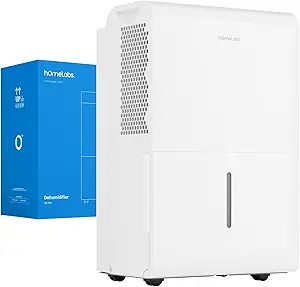 |
| Best Seller A high-volume bestseller chosen again and again | ToLife C2 Dehumidifier |  |
AprilAire E080 Pro 80-Pint Dehumidifier
| Capacity | 80 pints per day |
|---|---|
| Area Coverage | Up to 4,400 sq ft |
| Air Flow Capacity | 185 cfm |
| Wattage | 612 watts |
| Voltage | 120 V, 60 Hz |
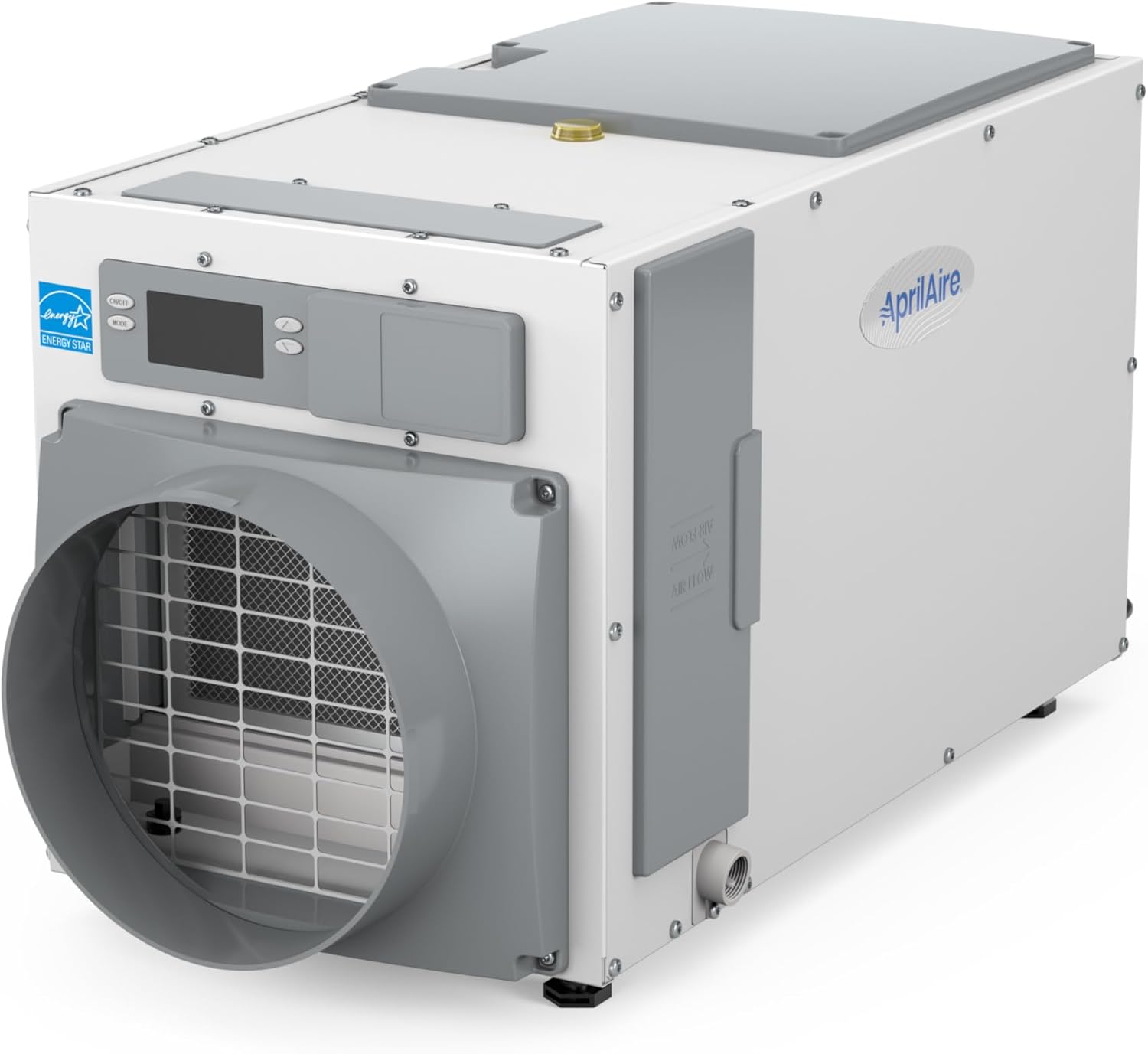
The AprilAire E080 Pro is a commercial-grade dehumidifier built to control heavy basement and whole-home moisture. It uses automatic humidity sensing to start and stop based on your setpoint and can remove up to 80 pints (12 gallons) per day while moving air at 185 CFM. Typical installation places it in a basement or sealed crawl space with options for top or front-mounted controls, leveling feet, and duct collars for hard-ducted setups. The unit is ENERGY STAR Most Efficient rated and runs on standard 120V power with a 5.1 amp draw, which helps limit operating cost for continuous duty. Practical touches include corrosion-resistant aluminum coils, washable MERV 8 filter, continuous drain compatibility so there is no bucket to empty, and a digital display for straightforward control. It is a single-speed, purpose-built machine, so you get robust moisture removal but less fine-grain fan control or ultra-quiet low-speed operation compared with variable-speed models. The E080 is roomy and heavy, intended for fixed installations rather than casual portability, and it requires appropriate drainage or ducting for best results.
Best for: Buyers who need serious, reliable moisture removal for a musty basement or whole-house application and prioritize performance and durability over portability or whisper-quiet operation.
Less Ideal for: If you need a lightweight portable dehumidifier for occasional use, a smaller multi-speed or quieter consumer model is a better choice.
- High removal capacity up to 80 pints per day for large or very damp basements
- ENERGY STAR Most Efficient rating helps reduce long-term energy use
- Automatic humidity sensing with programmable setpoint simplifies set-and-forget operation
- Continuous drain and included collars make permanent installation and ducting straightforward
- Corrosion-resistant aluminum coils and washable filter improve longevity and maintenance
- Single-speed fan limits quieter low-power operation and finer humidity control
- Large and heavy unit intended for permanent installation rather than frequent relocation
Verdict: Choose the AprilAire E080 Pro when you need high-capacity, energy-efficient moisture removal and a durable unit built for continuous basement or whole-house service.
KNKA 34-Pint Dehumidifier

| Capacity | 34 pints |
|---|---|
| Floor Area | 2500 square_feet |
| Tank Volume | 3 liters |
| Wattage | 230 watts |
| Number of Speeds | 2 |
The KNKA 34-pint dehumidifier is a compact, portable unit built to control humidity in basements and other large rooms up to about 2,500 sq ft. It removes up to 34 pints per day and offers three operating modes — DEHU for set-humidity control, DRY for fast clothes drying, and CONT for nonstop operation — plus two fan speeds. The unit includes a 0.79 gallon internal tank with auto shutoff, a 3.3 ft drain hose for continuous draining, and the option to add a larger external tank for longer unattended runs. Practical touches such as 360-degree wheels, a soft leather handle, a washable filter, child lock, timer, and a color-changing LED humidity indicator make it easy to move, monitor, and maintain. Performance is backed by a compressor and runs quietly; sleep mode further reduces noise and lights. Limitations to consider are the modest tank capacity for heavy continuous use and the recommendation to keep the unit upright and windows closed for best results, which affects placement and setup in some basements.
Best for: Buyers who want a practical, easy-to-move dehumidifier to manage persistent basement dampness and prefer simple smart controls and low noise.
Less Ideal for: Those who need industrial-scale moisture removal or very long unattended operation without an upgraded external tank or permanent drain connection.
- Removes up to 34 pints per day, suitable for damp basements and large rooms
- Three modes (DEHU, DRY, CONT) and two fan speeds for flexible humidity control
- Includes drain hose and supports continuous drainage or optional external tank
- Quiet operation with a sleep mode and color-changing LED humidity indicator
- Portable design with 360° wheels, soft handle, and washable filter for easy maintenance
- Internal tank is relatively small, requiring frequent emptying without continuous drain
- Drain hose length is short, which may limit placement relative to a drain
Verdict: A quiet, portable 34-pint dehumidifier that balances effective basement moisture control with easy maintenance and smart, user-friendly features.
BEDRED CT11 Dehumidifier

| Floor Area | 1000 square_feet |
|---|---|
| Tank Volume | 95 fluid ounces |
| Capacity | 5.9 pounds |
| Operation Mode | Intermittent |
| Other Special Features of the Product | 7 Color Ambient Light, Automatic Shutoff, Sleep Mode |
The BEDRED CT11 is a compact thermoelectric dehumidifier intended to reduce humidity in small spaces such as bedrooms, bathrooms, and modest basements up to about 1000 sq ft. It uses semiconductor cooling rather than a compressor, so it runs quietly and is simple to operate with an intermittent operation mode and an automatic shutoff when the 95 oz tank fills. Sleep Mode turns off the lights and lowers noise for overnight use, and the seven-color ambient light gives an optional mood-lighting feature. Practical benefits include easy emptying from the included tank, portability thanks to a lightweight design, and low sound levels that suit living spaces. Important limitations are inherent to semiconductor units: lower capacity compared with compressor dehumidifiers, reduced performance in very cold or very damp basements, and a smaller tank that requires more frequent emptying in high-humidity conditions.
Best for: Buyers who prioritize quiet, low-maintenance dehumidification and want a compact unit that is easy to move and run in living spaces or small basements without frequent intervention.
Less Ideal for: People needing heavy-duty moisture control for large, cold, or very damp basements should choose a higher-capacity compressor dehumidifier instead.
- Quiet thermoelectric operation suitable for bedrooms and living rooms
- Automatic shutoff protects against overfill and simplifies unattended use
- 95 oz removable tank for straightforward water removal
- Sleep Mode and ambient light options for low‑noise nighttime use
- Compact and lightweight for easy placement or moving between rooms
- Semiconductor cooling gives lower moisture removal capacity than compressor models
- Performance drops in cold basement conditions and very high humidity areas
Verdict: Choose the BEDRED CT11 if you want a quiet, portable dehumidifier with auto‑shutoff and sleep‑friendly operation for small basements or living spaces.
KeepGlad 80‑Pint Dehumidifier

| Capacity | 80 pints_per_day |
|---|---|
| Tank Volume | 1.84 gallons |
| Wattage | 300 watts |
| Floor Area | 4500 square_feet |
| Voltage | 115 volts |
The KeepGlad 80‑pint dehumidifier is built for sustained operation in large, moisture-prone areas like basements and garages. It actively removes up to 80 pints per day under extreme conditions and uses multiple modes — Comfort, Dry, Turbo, Continuous and Sleep — to match different needs from steady humidity control to rapid drying. Practical features include a visible tank with full‑tank protection, continuous drain hose option, 90° adjustable airflow, washable filter, child lock and a 24‑hour timer. The unit also claims quiet operation (about 35–40 dB) and an AI-driven protection system that triggers defrost cycles and overload cutoffs to limit downtime. Energy Star 2025 certification and a 300 W rating mean it aims to balance strong performance with lower energy use. Expect a fairly large, portable cabinet with ergonomic handles and a detachable filter that requires occasional cleaning; continuous drain is most convenient for long runs. If you need a dependable, high‑output dehumidifier for a basement that runs for long stretches, this model focuses on steady removal, energy efficiency and protective safeguards to reduce failure risk.
Best for: Buyers who prioritize a durable, high‑capacity dehumidifier for large basements or storage areas and want energy-efficient continuous operation with protective safety features.
Less Ideal for: Those who need a compact, lightweight unit for small rooms or infrequent use should consider lower‑capacity, more portable models instead.
- Very high dehumidification capacity up to 80 pints per day for large or very damp basements
- ENERGY STAR 2025 certification for lower energy use compared with similar output units
- Continuous drain option and full‑tank protection reduce maintenance during long runs
- Multiple modes including Turbo and Continuous let you tailor drying speed and humidity targets
- AI protection with auto‑defrost and overload cutoff helps prevent damage during continuous operation
- Relatively large physical footprint compared with low‑capacity models
- Requires periodic filter cleaning and occasional drain management for continuous use
Verdict: If you need reliable, energy‑efficient moisture removal for a large basement, this 80‑pint KeepGlad unit is built to run continuously with protective safeguards that minimize failure risk.
hOmeLabs 50 Pint Dehumidifier
| Dehumidification Capacity | 50 pints_per_day |
|---|---|
| Floor Area | 7000 square_feet |
| Tank Volume | 1.6 gallons |
| Wattage | 322 watts |
| Air Flow Capacity | 165 cfm |
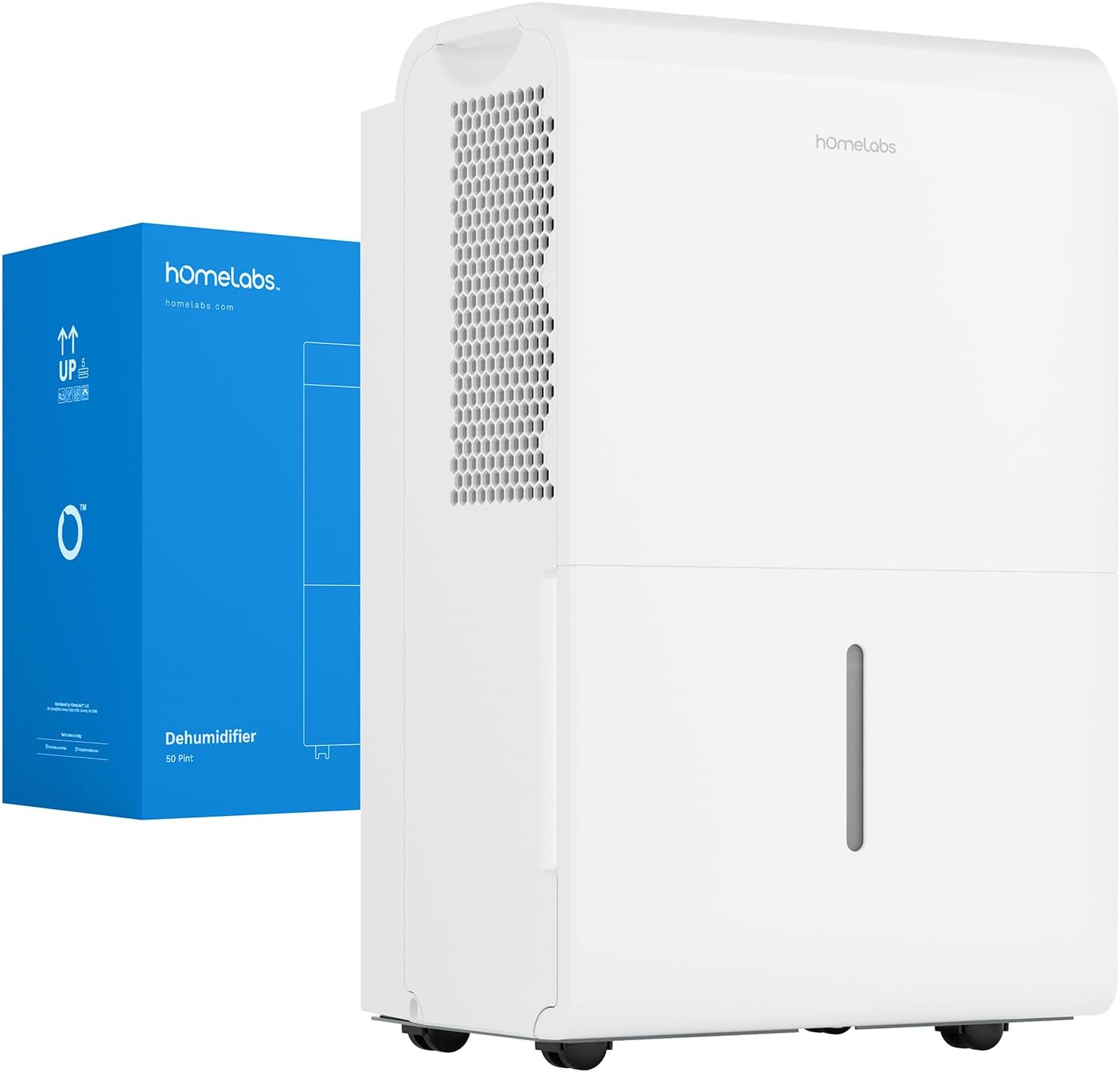
This hOmeLabs 50 Pint dehumidifier is a large-capacity unit built to manage moisture in big rooms and basements up to 7,000 sq ft. It removes up to 50 pints per day at standard test conditions and can reach higher output in very hot, humid conditions, and it offers continuous operation with auto shutoff when the 1.6 gallon tank is full or optional continuous drainage via a hose outlet. The unit includes Wi‑Fi control for remote adjustments, a touch control panel, two fan speeds plus a Turbo mode for faster drying, and a washable filter for maintenance. Wheels and handles make moving it between basement zones straightforward, and automatic defrost and restart help it run reliably in cooler basement temperatures. Trade-offs are its household-scale power draw and weight that reflect its capacity, and continuous drainage requires a hose and suitable drain placement. For musty basements this model brings strong moisture removal, remote control convenience, and practical features to keep operation simple and dependable.
Best for: Buyers who want a powerful, reliable dehumidifier for musty basements and large home areas and who prioritize proven performance and remote control convenience.
Less Ideal for: People needing a lightweight, ultra-quiet bedroom unit or those who cannot run a drain hose or accommodate higher-capacity appliances.
- Handles large areas up to 7,000 sq ft and removes up to 50 pints per day
- Wi‑Fi control lets you monitor and adjust settings remotely
- Continuous drain option and 1.6 gallon removable tank for flexible water management
- Features automatic defrost, auto restart, and Turbo fan mode for faster drying
- Washable filter and touch controls simplify maintenance and use
- Relatively heavy and more cumbersome to move than smaller units
- Requires a hose and nearby drain for continuous unattended operation
Verdict: A robust, Wi‑Fi‑enabled dehumidifier built to remove large amounts of moisture from musty basements and big home spaces.
ToLife C2 Dehumidifier

| Floor Area | 1000 square_feet |
|---|---|
| Capacity | 95 fluid ounces |
| Number of Speeds | 2 |
| Wattage | 93 watts |
| Operation Mode | Comfort |
The ToLife C2 is a small, user-friendly dehumidifier that uses semiconductor condensation to remove moisture quietly from confined rooms. It is intended for bedrooms, bathrooms, closets and similar small spaces and claims coverage up to 1,000 sq ft while collecting water in a removable 95-ounce tank with automatic shutoff when full. Controls include two fan speeds and a low-noise sleep mode below 30 dB for nighttime use, plus a continuous seven-color LED that can be locked as a night light. Practical benefits are simple portability thanks to its compact footprint and handle, straightforward tank emptying, and safety from overflow via the auto-shutoff. Important limitations are its modest stated dehumidification rate (1 liter per day in the spec sheet) and semiconductor system, which generally extracts less moisture than compressor units in cold, very damp basements; it will be best in small, mildly musty rooms rather than large, wet basement spaces that need higher capacity. The unit runs on 93 watts and is best used in enclosed rooms with doors and windows closed for visible results.
Best for: A buyer who prioritizes quiet, simple operation and safety features for small, enclosed rooms and wants an easy-to-maintain unit with a large tank and night-light option.
Less Ideal for: Homes that need strong moisture removal in large or persistently wet basements should choose a higher-capacity compressor dehumidifier instead.
- Large 95 oz removable tank with automatic shutoff to avoid overflow
- Quiet sleep mode rated under 30 dB for night use
- Two fan speeds for basic control of airflow and noise
- Portable, compact design with handle for moving between rooms
- Seven-color LED that can be locked and used as a night light
- Low reported dehumidification capacity (1 L/day) compared with compressor models
- Semiconductor condensation tech is less effective in cold or very damp basements
Verdict: Choose the ToLife C2 if you need a quiet, portable dehumidifier with a large removable tank and automatic shutoff for small, mildly musty rooms.
Choosing the Right Dehumidifier for Musty Basement: Key Factors to Consider
Capacity and Room Size
Capacity is usually expressed as pints removed per day. For a musty basement you should size the dehumidifier to the whole area, accounting for ceiling height. A unit rated for a larger space will cycle less frequently and often maintain lower relative humidity, which helps reduce odors and mold growth.
Undersized units can run continuously without making meaningful progress, increasing wear and energy cost. Measure the basement square footage and match it to the manufacturer guidance for damp or very damp spaces rather than relying on living-space ratings.
Moisture Removal at Low Temperatures
Basements are often cooler than above-grade rooms. Check a dehumidifier's rated performance at lower ambient temperatures or its defrost capabilities. Some compressors struggle below a certain temperature and either lose capacity or ice up, which reduces effectiveness against mustiness.
Units with auto-defrost or designs optimized for cool environments keep extracting moisture when temperatures dip. That consistency prevents recurring damp pockets that cause persistent odors.
Drainage Options and Run Time
How condensate is handled matters for basements where emptying a bucket frequently is impractical. Look for continuous drainage options: a gravity drain hose exit for down-slope setups, or a built-in pump for pushing water up to a sink or out of the room.
A dependable continuous-drain setup lets the dehumidifier run unattended for long stretches, which is essential during wet seasons and when addressing entrenched mustiness.
Energy Efficiency and Operating Cost
Dehumidifiers can run many hours a day in a musty basement, so energy efficiency has a direct impact on monthly bills. Compare energy factor ratings or pints per kilowatt-hour when available. More efficient units remove the same moisture using less electricity, and modern variable-speed compressors or fan controls improve seasonal performance.
Consider units with programmable humidity setpoints and timers so the machine runs only as much as needed to maintain target conditions.
Filtration and Odor Control
A dehumidifier that also filters air will help reduce particulates and some odor-causing compounds, which complements moisture removal for fresher basements. Look for washable prefilters and optional carbon or HEPA-style media if odor and dust are concerns.
Filters should be easy to access and clean; a clogged filter reduces airflow and lengthens run time, undermining both energy performance and odor mitigation.
Maintenance, Durability, and Serviceability
Basement units often run long cycles, so build quality and ease of maintenance are important. Check access to the water bucket, filter cleaning, and whether the unit has a clear maintenance schedule. Durable compressors and robust coils reduce failure risk over years of continuous use.
Consider how simple it is to clean the condensate path and whether replacement parts or service information are readily available. Long-lived, serviceable machines minimize downtime when addressing long-term moisture problems.
Sizing a Dehumidifier to Your Basement
Start by measuring the basement area and assessing current humidity. For very damp, musty basements choose a unit sized for the larger end of the manufacturer range rather than a minimal rating. Factor in open stairways and adjoining rooms that share air.
Ceiling height matters. If your basement has higher than standard ceilings, increase the recommended capacity proportionally. Also consider moisture sources such as unsealed concrete walls, plumbing leaks, or appliances that add humidity; these may require a higher-capacity unit or multiple units placed strategically.
- Measure square footage and note ceiling height
- Account for continuous moisture sources when sizing
- Consider multiple units for large, segmented basements
Placement and Airflow Best Practices
Place the dehumidifier where airflow is unobstructed and where it can draw air from the mustiest areas. Avoid placing the unit in a corner or directly against a wall. Elevating the unit a few inches off a cold floor can improve airflow and protect the intake from debris.
Ensure the exhaust has clear space to push drier air back into the room. For multiroom basements, position the unit near open stairwells or central locations so air can circulate and humidity is reduced evenly.
- Keep 12 to 24 inches clearance around intake and exhaust
- Elevate unit slightly on a platform if floor is cold or wet
- Use a small fan if needed to circulate air from stagnant corners
Managing Drainage and Preventing Backups
If you choose continuous gravity drain, route the hose with a consistent downhill grade to a floor drain or sump. Avoid loops that trap water. For built-in pumps, verify the vertical lift capability and expected run-time between maintenance checks.
Check hose fittings for secure connections and install a simple float switch or secondary overflow safeguard if the basin might be inaccessible. Regularly inspect condensate lines for algae or mineral buildup that can restrict flow.
- Grade gravity drains downhill with no traps
- Verify pump lift height before installation
- Inspect and clean drainage lines seasonally
Controls, Monitoring, and Automation
Programmable humidity setpoints and reliable digital controls help keep a basement at a stable humidity without wasting energy. Look for units with clear displays and accurate humidity sensors. Some models offer built-in humidity reports or smart-home connectivity for remote monitoring.
Timers and auto-restart on power loss are useful in basements subject to intermittent power. Automated defrost functions also ensure steady performance in cooler conditions without manual intervention.
- Choose clear digital controls with accurate humidity readouts
- Prefer units with auto-defrost for cool basements
- Consider remote or app monitoring for unattended spaces
Dealing with Persistent Odors Beyond Dehumidification
Removing moisture often reduces mustiness significantly, but persistent odors may also come from mold, organic debris, or seepage. Combine dehumidification with targeted cleaning: dry and clean damp materials, treat moldy surfaces according to safety guidelines, and address sources such as clogged drains or poor ventilation.
Adding a carbon filter or running an air purifier designed for basements can complement the dehumidifier by capturing odor-causing particles and volatile compounds. However, these are supplementary measures and do not replace the need to control moisture.
- Dry and clean affected surfaces to remove odor sources
- Use filtration to reduce airborne odor compounds
- Investigate and remediate underlying water entry or seepage
How We Chose the Best Dehumidifier for Musty Basement
We focused on real-world dehumidifier features that matter most in musty basements. Primary evaluation criteria included moisture removal capacity measured in pints per day at typical basement temperatures, energy efficiency and run-time cost, drainage flexibility including pump and gravity options, and filtration and odor-control features for reducing stale smells. We also considered durability factors such as compressor type, defrost performance for cool basements, and ease of maintenance including filter access and condensate cleaning. To keep recommendations practical we prioritized units sized appropriately for basement square footage and typical ceiling heights rather than those marketed only on peak numbers. We excluded specialty commercial-only machines and tiny personal dehumidifiers unsuitable for whole-basement use. Editorial filters favored models with clear drainage solutions and serviceable parts, since basements commonly run long cycles and need reliable continuous operation. Overall, selections reflect machines that balance moisture removal, operating cost, and homeowner convenience for long-term odor and mildew control.
Our full evaluation process is outlined in our review methodology.
FAQ
How low should I set humidity in a musty basement?
Aim for a relative humidity between 45 and 50 percent to reduce mold risk while avoiding over-drying. Lower settings may be acceptable short-term, but maintaining mid-40s is usually sufficient to control mustiness without causing other issues.
Can a dehumidifier alone eliminate musty smells?
Often moisture removal greatly reduces mustiness, but if odors stem from mold, soaked materials, or seepage you will also need to clean and dry affected items and fix the water source. Filtration helps but is usually a complementary measure.
Is continuous drain necessary for a basement unit?
Continuous drain is highly recommended for basements because units often run for long periods. It removes the need to empty buckets and reduces the risk of overflow when addressing persistent humidity.
Will a dehumidifier work in a cold basement?
Some dehumidifiers lose efficiency and can ice up in cool conditions. Choose a unit with cold-climate performance or auto-defrost if your basement temperatures frequently drop below typical room temperature.
How often do I need to clean the dehumidifier filter?
Clean washable prefilters every 1 to 3 months depending on dust load. More frequent cleaning is needed if the basement is dusty or uses construction materials that shed. Keeping filters clean preserves airflow and efficiency.
Final Verdict
Pick a dehumidifier that matches your basement size, runs efficiently at lower temperatures, and offers reliable drainage options for continuous operation. Prioritize moisture removal rate and drainage flexibility if mustiness is severe, and favor energy-efficient units with accessible maintenance points for long-term use. Balancing capacity, cold-climate performance, and practicable maintenance will produce the best outcome: a drier, less odorous basement with lower mold risk and manageable operating costs. Use the criteria above to match a unit to your space and expected moisture load.