
Note: This article contains affiliate links. If you click on these links and make a purchase, we may earn a small commission at no extra cost to you. This helps support our research and content. Read our full affiliate disclosure here.
Choosing the right dehumidifier for a nursery matters because infants are more sensitive to humidity-related issues like congestion, mold growth, and dust mite proliferation. The wrong unit can be noisy, overly aggressive, or fail to maintain a healthy range, so you need a solution that balances capacity, quiet operation, and reliable humidity control. This guide covers seven carefully shortlisted dehumidifiers for nurseries, each selected for performance, usability, and safe daily operation. Below you will find the criteria we used to evaluate models and concise guidance to help you pick the best fit for your nursery layout and ventilation setup.
Top Picks at a Glance
| Best Overall The best all-around choice for most situations | Midea 22 Pint Dehumidifier |  |
| Best Quality Built to a higher standard if you want something more solid | Waykar 34 Pint Dehumidifier |  |
| Best Value The sweet spot between price and what you get | UBBO Z18 95oz Dehumidifier |  |
| Best Budget The cheapest option that still gets the job done reliably | Eva-Dry E-333 Mini Dehumidifier |  |
| Top Rated A top-rated pick with lots of positive feedback | Tenergy Sorbi 1000ml Dehumidifier |  |
| Most Popular A crowd favorite that many people choose with confidence | TABYIK 35oz Dehumidifier DH-CS01 |  |
| Best Seller A high-volume bestseller chosen again and again | BEDRED CT11 Dehumidifier |  |
Midea 22 Pint Dehumidifier

| Capacity | 22 pints |
|---|---|
| Floor Area | 1500 square_feet |
| Tank Volume | 0.8 gallons |
| Wattage | 295 watts |
| Air Flow Capacity | 135 cfm |
The Midea 22 Pint Dehumidifier is a compact, portable unit designed to remove up to 22 pints of moisture per day and cover spaces to about 1,500 sq ft. It offers an adjustable humidity range (35% to 85%), two fan speeds including a turbo mode, and a programmable timer so you can set target humidity and run times. For everyday use it has a reusable washable filter, 360-degree rotating wheels and handles for easy room-to-room movement, and a 0.8 gallon tank with the option to attach a hose for continuous drainage. Smart features include Wi-Fi control through an app and voice operation with Alexa or Google Assistant, which is useful for remote monitoring. The unit is Energy Star certified and rated at about 47 dBA for relatively quiet operation. Limitations to note are the modest bucket size that requires emptying if you do not use continuous drain and the 22-pint capacity may be undersized for very damp or large nursery spaces where faster removal is needed.
Best for: Parents or caregivers who want a quiet, energy-efficient dehumidifier with smart controls and easy mobility to help maintain comfortable humidity in a nursery or similar room.
Less Ideal for: Homes with large, very damp basements or rooms that need rapid, high-volume moisture removal should consider higher-capacity units instead.
- Wi-Fi and voice control for remote monitoring and adjustments
- Energy Star certified for lower energy use compared with standard models
- Quiet operation around 47 dBA suitable for living spaces
- Portable design with 360° rotating wheels and handles for easy repositioning
- 0.8 gallon tank is relatively small if continuous drain is not used
- 22-pint capacity may be insufficient for very damp or large rooms
Verdict: A quiet, energy-efficient 22-pint dehumidifier with smart controls and easy portability that fits well for maintaining comfortable humidity in a nursery.
Waykar 34 Pint Dehumidifier
| Capacity | 34 pints |
|---|---|
| Floor Area | 2000 square_feet |
| Tank Volume | 0.66 gallons |
| Wattage | 230 watts |
| Air Flow Capacity | 62 cfm |
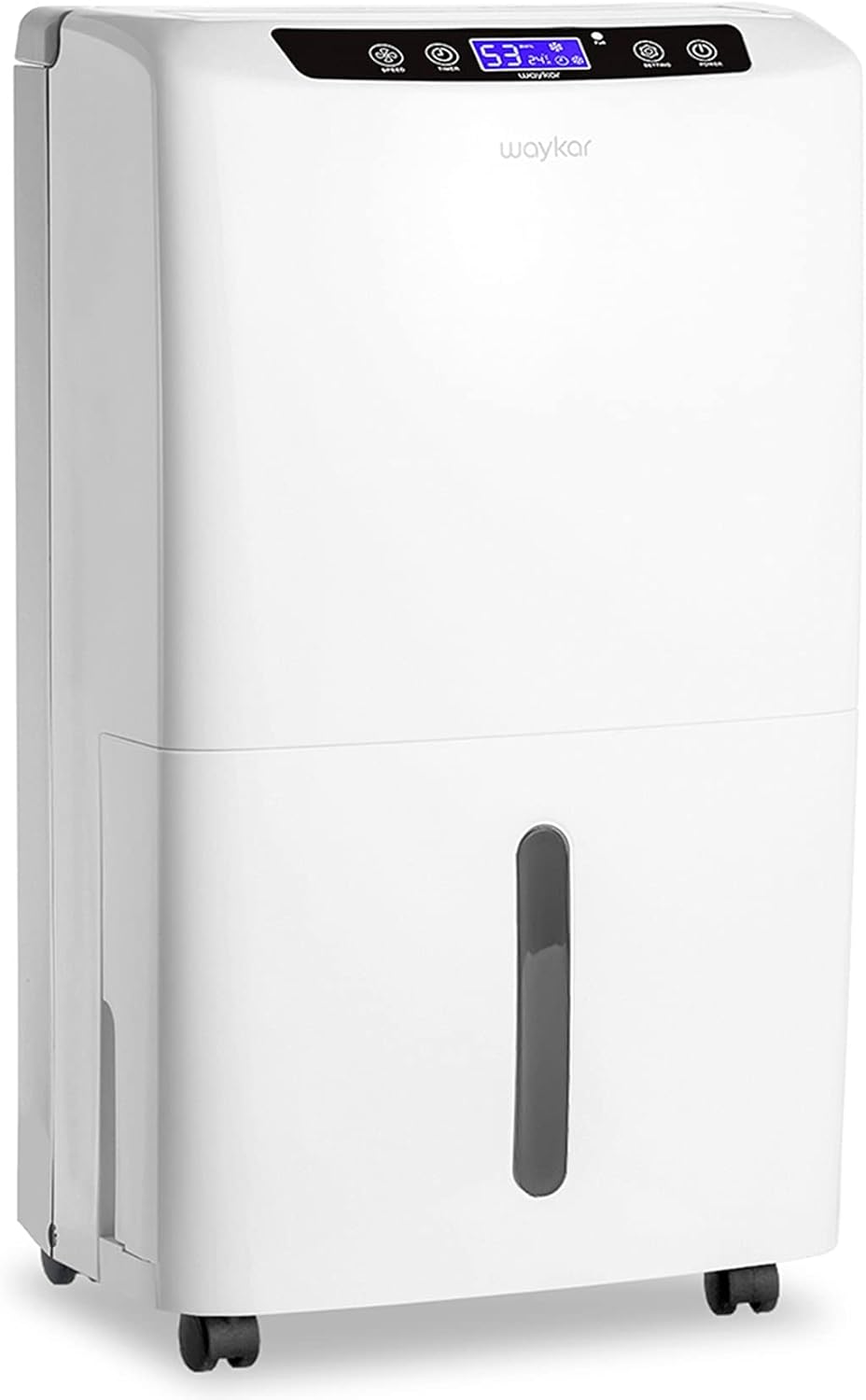
The Waykar 34 Pint Dehumidifier is a high-capacity, portable unit meant to remove excess moisture across larger rooms or multiple connected spaces. It operates in Auto or Continuous mode, offers two fan speeds, and can target humidity between 30% and 80% so you can dial in a specific level for a nursery. Practical features include a 0.66 gallon removable tank with a continuous drain hose for unattended runtime, a 24-hour timer, washable filter, and a manual 90° airflow direction to focus dry air where needed. The unit is ENERGY STAR certified and includes automatic defrost and overload protection to keep it running in cooler conditions. Trade-offs to consider are its relatively loud compressor activity compared with ultra-quiet nursery-specific units and a moderate airflow rating that is optimized for larger spaces rather than a single small room. The design is straightforward and user-friendly, making it suitable for continuous daytime or scheduled nighttime use when placed at a reasonable distance from a crib to minimize vibration and sound exposure.
Best for: Buyers who prioritize steady, performance-focused moisture control across larger rooms or connected living areas and want tight humidity setpoints and unattended continuous drainage for a low-maintenance nursery environment.
Less Ideal for: People seeking the quietest small-room dehumidifier specifically optimized for a single nursery or those who need a very compact, lightweight bedside unit.
- High 34-pint daily dehumidification capacity suitable for large rooms and basements
- Wide 30%–80% humidity set range for precise control including lower nursery-safe targets
- ENERGY STAR certified for better real-world efficiency during extended run times
- Dual drainage options (removable tank or included hose) for unattended continuous operation
- Automatic defrost, overload protection, and washable filter simplify maintenance and reliability
- Not marketed as an ultra-quiet model, so it may be louder than small-room units optimized for nurseries
- Airflow (62 cfm) is oriented toward larger spaces rather than focused single-room circulation
Verdict: Choose this unit if you need strong, energy-efficient moisture removal and precise humidity control for larger rooms or multi-room nursery setups where continuous, unattended operation matters.
UBBO Z18 95oz Dehumidifier

| Floor Area | 1000 square_feet |
|---|---|
| Capacity | 95 fluid ounces |
| Dehumidification Capacity | 1.2 liters_per_day |
| Operation Mode | Automatic |
The UBBO Z18 is a small, quiet dehumidifier made for tight spaces like nurseries, bathrooms, and RVs. It uses dual semiconductor condensers to pull up to 1.2 liters (about 40 oz) of water per day under optimal conditions and stores collected moisture in a 95 oz tank, with an included drain hose for continuous drainage. Controls include a timer with 8/16/24 hour settings, a sleep mode that reduces noise to around 35 dB, and automatic shutoff plus overflow protection with audible and visual alerts. A washable filter and removable tank make basic maintenance straightforward, and a soft multi-color night light can be disabled or locked to avoid disturbing a sleeping baby. Limitations are the modest daily dehumidification rate, which means it is best for small rooms or to supplement HVAC in larger spaces, and semiconductor-based cooling typically performs slower than compressor units in very humid or large rooms. For nursery use the unit balances low noise, simple controls, and easy drainage.
Best for: Parents or caregivers looking for a low-noise, easy-to-use dehumidifier for a small nursery or bedroom who prioritize quiet operation and simple maintenance.
Less Ideal for: Homes with large damp basements or rooms with persistent high humidity where a higher-capacity compressor dehumidifier is needed.
- Very quiet operation with a sleep mode around 35 dB suitable for bedrooms or nurseries
- Includes removable 95 oz tank plus a drain hose option for continuous unattended drainage
- Timer function (8/16/24 hours) and automatic shutoff with overflow protection for safety
- Washable filter and simple maintenance make upkeep easy
- Maximum dehumidification rate (1.2 L/day) is modest and may be insufficient for large or very damp rooms
- Semiconductor condenser design is generally less powerful than compressor-based units in high humidity
Verdict: Choose the UBBO Z18 if you need a whisper-quiet, low-maintenance dehumidifier for a small nursery or bedroom.
Eva-Dry E-333 Mini Dehumidifier

| Floor Area | 333 square_feet |
|---|---|
| Capacity | 6 ounces |
| Dehumidification Capacity | 0.38 pints_per_day |
| Operation Mode | Continuous |
| Voltage | 110 volts |
The Eva-Dry E-333 is a rechargeable, wireless mini dehumidifier that uses crystallized silica gel beads to pull moisture from small, enclosed areas such as closets, bathrooms, cars, and nurseries. You hang or place it where humidity is a problem and the moisture indicator beads change color to show when the unit needs recharging; each cycle typically lasts several weeks depending on conditions. Its cordless design and lack of a water tank mean no leaks, no pumps, and no continuous power draw, which keeps operation simple and silent. The dehumidification capacity is modest (about 0.38 pints per day) and it holds roughly 6 fluid ounces of moisture, so it is intended for prevention of dampness and odors rather than drying large rooms or tackling severe condensation. Rechargeability and long service life make it low-maintenance, but heavy humidity or large-volume spaces will require a larger active dehumidifier. For nursery use the quiet, chemical-safe operation and compact footprint are advantages, though monitoring and periodic recharging are necessary to maintain protection against excess moisture.
Best for: Buyers who need an inexpensive, low-maintenance way to control mild humidity in small nursery spaces and prefer a quiet, cordless solution over an electrically powered unit.
Less Ideal for: Do not choose this for whole-room moisture control, heavy dampness, or spaces that need continuous automatic humidity regulation.
- Cordless, rechargeable silica gel design eliminates cords, pumps, and spill risk
- Moisture indicator beads show when recharging is needed
- Small, lightweight profile fits closets, cabinets, cars, and nursery nooks
- Silent operation suitable for noise-sensitive spaces
- Renewable unit that can be reused for years with periodic recharging
- Very low daily dehumidification rate not suitable for large or very damp rooms
- Requires manual recharging every few weeks depending on humidity levels
Verdict: A very affordable, silent, cordless moisture absorber that is ideal for keeping small nursery areas dry and odor-free when only light dehumidification is needed.
Tenergy Sorbi 1000ml Dehumidifier

| Tank Capacity | 1000 ml |
|---|---|
| Dehumidification Capacity | 0.75 liters_per_day |
| Floor Area | 200 square_feet |
| Rated Power | 45 watts |
| Filter | H13 HEPA filter |
The Tenergy Sorbi combines a small-capacity Peltier dehumidifier with an H13 True HEPA filter so it both removes moisture and captures airborne particulates in small spaces. It is typically used in bathrooms, closets, offices, and small nursery spaces where humidity and air quality need gentle control; the unit holds a 1.0 liter tank, removes up to about 750 ml per day under ideal conditions, and shuts off automatically when full. Touch controls and two fan speeds make it simple to operate and the 45 W rated power keeps energy use low. The HEPA filtration and quiet noise range (around 35–42 dB) are useful for rooms with sleeping infants, and the purifier and dehumidifier can run simultaneously. Important limits are its modest daily dehumidification rate and single-speedsetting layout, so it is best for small, mildly damp rooms rather than basements or large spaces, and it should not be used below 50°F. Filter replacement every few months is recommended to maintain air cleaning performance.
Best for: Parents or caregivers who prioritize steady, low-noise humidity control and improved air cleanliness in a small nursery or bedroom and want a simple reliable unit that is easy to move and maintain.
Less Ideal for: Homes that need rapid drying or coverage for large or very damp spaces should choose a higher-capacity dehumidifier instead.
- True H13 HEPA filter captures fine particulates while dehumidifying
- Compact, lightweight and portable for moving between small rooms
- Auto shutoff and water-full indicator for safe unattended use
- Low power draw (45 W) and relatively quiet operation suited to sleeping areas
- Modest moisture removal capacity (about 0.75 liters/day) not suited for very damp or large rooms
- Single fan speed limits control granularity compared with multi-speed models
Verdict: Choose the Sorbi when you need a quiet, portable dehumidifier that also filters air for a small nursery or bedroom.
TABYIK 35oz Dehumidifier DH-CS01

| Tank Volume | 1000 ml |
|---|---|
| Dehumidification Capacity | 0.45 liters_per_day |
| Wattage | 40 watts |
| Operation Mode | Continuous |
This TABYIK 35 oz dehumidifier is a small, portable unit built for bedrooms, bathrooms, closets, RVs and other confined spaces; it uses a Peltier-style design to collect up to about 16 oz (450 ml) per day under warm, very humid conditions while drawing roughly 40 watts. Operation is simple: one-button start, a visible 1000 ml tank with an auto shutoff that stops the unit when the tank is nearly full and flashes a light, plus a separate 7-color light function you can turn off for night use. The unit is very quiet at about 28 dB, making it suitable for sleeping areas and nurseries where low noise matters. Practical benefits include low energy use, a built-in handle and an easy-to-remove tank for emptying and cleaning. Important limits are its modest daily extraction rate and single-speed operation, so it is best for maintaining comfort in small, mildly damp rooms rather than tackling basement-level humidity or large open spaces.
Best for: Parents or caregivers seeking a quiet, low-energy dehumidifier to reduce mild humidity and odors in small nursery or bedroom spaces where sleeping comfort and simple operation matter most.
Less Ideal for: People who need rapid moisture removal for large rooms, basements, or persistently high-humidity problems should choose a higher-capacity mechanical dehumidifier instead.
- Quiet operation around 28 dB suitable for sleeping spaces
- Auto shutoff and visible 1000 ml tank make emptying safe and straightforward
- Low power consumption (about 40 watts) for economical continuous use
- Compact, lightweight and portable with a built-in handle
- Low dehumidification capacity (about 0.45 liters/16 oz per day) limits use to small, mildly damp rooms
- Single speed control offers no adjustable drying intensity
Verdict: A very quiet, energy-efficient small-room dehumidifier that is well suited for maintaining comfortable humidity in nurseries and bedrooms.
BEDRED CT11 Dehumidifier

| Floor Area | 1000 square_feet |
|---|---|
| Tank Volume | 95 fluid ounces |
| Capacity | 5.9 pounds |
| Operation Mode | Intermittent |
| Other Special Features of the Product | 7 Color Ambient Light, Automatic Shutoff, Sleep Mode |
The BEDRED CT11 is a compact thermoelectric dehumidifier intended to reduce humidity in small spaces such as bedrooms, bathrooms, and modest basements up to about 1000 sq ft. It uses semiconductor cooling rather than a compressor, so it runs quietly and is simple to operate with an intermittent operation mode and an automatic shutoff when the 95 oz tank fills. Sleep Mode turns off the lights and lowers noise for overnight use, and the seven-color ambient light gives an optional mood-lighting feature. Practical benefits include easy emptying from the included tank, portability thanks to a lightweight design, and low sound levels that suit living spaces. Important limitations are inherent to semiconductor units: lower capacity compared with compressor dehumidifiers, reduced performance in very cold or very damp basements, and a smaller tank that requires more frequent emptying in high-humidity conditions.
Best for: Buyers who prioritize quiet, low-maintenance dehumidification and want a compact unit that is easy to move and run in living spaces or small basements without frequent intervention.
Less Ideal for: People needing heavy-duty moisture control for large, cold, or very damp basements should choose a higher-capacity compressor dehumidifier instead.
- Quiet thermoelectric operation suitable for bedrooms and living rooms
- Automatic shutoff protects against overfill and simplifies unattended use
- 95 oz removable tank for straightforward water removal
- Sleep Mode and ambient light options for low‑noise nighttime use
- Compact and lightweight for easy placement or moving between rooms
- Semiconductor cooling gives lower moisture removal capacity than compressor models
- Performance drops in cold basement conditions and very high humidity areas
Verdict: Choose the BEDRED CT11 if you want a quiet, portable dehumidifier with auto‑shutoff and sleep‑friendly operation for small basements or living spaces.
Choosing the Right Dehumidifier for Nurseries: Key Factors to Consider
Noise Level and Fan Operation
Noise matters in a nursery because infants sleep frequently and are more easily disturbed. Look for units that publish dBA levels at low and high settings and prioritize models with low-speed night modes or built-in quiet cycles.
A quieter fan also makes it easier to place the unit closer to the crib or changing area if needed without disrupting naps. Consider how fan speed interacts with dehumidification performance; the quietest setting will reduce noise but may also lower extraction rate.
Humidity Control and Accuracy
Accurate humidity sensing and stable setpoint control prevent fluctuations that can cause condensation or overly dry air. Choose a unit with an adjustable humidistat and clear display so you can set a target relative humidity and trust the unit to maintain it.
Hysteresis and sensor placement can affect cycling behavior. Units that support small increments in target humidity let you dial in the comfortable 40 to 50 percent range commonly recommended for infant rooms.
Capacity and Room Coverage
Capacity determines how quickly a dehumidifier can remove moisture from a nursery. Match the unit's rated extraction to the nursery's square footage and ceiling height. Smaller rooms need less capacity but may benefit from faster extraction if the space is prone to dampness.
Also think about seasonal variation. A unit sized for moderate extraction in summer may still be adequate in cooler months but confirm that the machine can operate effectively across expected temperature ranges.
Safety and Childproofing
Safety features reduce risk in rooms with young children. Look for stable cabinets, tip-over protection, automatic shutoff on full tanks, and controls that can be locked to prevent accidental changes.
Materials and grille design matter too; avoid models with easily removable front panels or exposed fast-moving parts at child height. Clear indicators for water-level and filter status help caregivers monitor the unit without needing to open it frequently.
Maintenance and Drainage Options
Maintenance frequency affects ongoing convenience. Units with washable filters and accessible trays make routine care quick. Check how easy the water tank is to remove and empty, and whether the unit supports continuous gravity drain or a pump-assisted option for unattended operation.
Consider filter replacement intervals and the availability of washable pre-filters that trap dust. Simpler maintenance reduces the chance that a unit will fall out of regular use.
Energy Use and Operating Cost
A dehumidifier that runs often can add to household electricity usage. Energy efficiency ratings and low-power modes help limit cost while still keeping humidity in check. Compare extraction per energy use when possible.
Programmable schedules and an auto mode that only runs when needed will reduce runtime. For nurseries where units run overnight, efficiency can have a meaningful effect on monthly operating cost and household comfort.
Setting Humidity Targets for Infant Comfort
Aim for a relative humidity range that minimizes mold growth and respiratory irritation while avoiding overly dry air that can irritate skin and nasal passages. A typical target band for nurseries is 40 to 50 percent relative humidity. This range balances comfort and health without stressing fabrics or encouraging dust mites.
Use a dehumidifier with a reliable humidistat and small setpoint increments so you can fine-tune conditions. Place a separate room hygrometer at crib level to verify that the unit maintains the intended range, especially after placement changes or season shifts.
- Target 40–50% relative humidity for most nurseries
- Verify with an independent hygrometer placed at infant breathing height
- Adjust gradually if nasal congestion or dry skin appears
Placement and Ventilation Tips
Position the unit where it can draw and return air freely. Avoid corners and tight alcoves that restrict airflow. If the nursery has an attached bathroom, run that space's exhaust fan during and after baths to reduce the dehumidifier load.
Keep the dehumidifier at least a few feet from the crib and away from direct airflow onto the infant. If you use ducting or a continuous drain hose, route it discreetly and safely to avoid tripping hazards and moisture pooling.
- Leave clearance around intake and exhaust grilles
- Avoid placing directly beside the crib or changing table
- Use continuous drain to minimize tank changes if accessible
Night Mode, Timers, and Smart Controls
Night modes reduce fan speed and brightness to avoid sleep disruption. Look for units with dimmable displays or an off display option. Timers and programmable schedules let you limit operation to times when humidity spikes are most likely, such as after baths or during damp weather.
Smart controls can offer remote monitoring and alerts, but prioritize reliable local controls and lock functions so inadvertent changes do not occur. If using Wi-Fi features, ensure they are secure and that notifications are actionable for caregivers.
- Prefer units with a dedicated quiet or night mode
- Use timers to avoid unnecessary overnight operation
- Lockable controls prevent accidental setting changes
Cleaning and Allergen Considerations
Regular cleaning prevents mold growth inside the cabinet and keeps filters effective. Choose units with washable pre-filters and easy-to-access internals for periodic wipe-downs. Emptying and drying the tank daily in humid climates reduces odor and microbial growth.
For households with allergy concerns, a dehumidifier that traps dust and pollen in an accessible filter will reduce airborne particles. Consider pairing with an air purifier if allergy control is a high priority.
- Wash or replace filters per manufacturer guidance
- Dry the water collection tank between uses to prevent odors
- Consider combined air purification if allergens are a major concern
Seasonal Use and Temperature Limits
Dehumidifier performance varies with room temperature. Many refrigerant-based units lose efficiency in cooler rooms, while desiccant models handle low temperatures better. Know the expected nursery temperature range and select a unit that operates effectively across that span.
If the unit will be stored in or used intermittently through winter, follow manufacturer guidance for low-temperature operation and winterizing to avoid coil icing or component damage.
- Confirm operating temperature range for reliable year-round use
- Desiccant models perform better in cold rooms
- Follow storage and winterizing instructions when not in use
How We Chose the Best Dehumidifier for Nurseries
We focused on characteristics that directly affect comfort, health, and safe everyday use in a nursery. Key evaluation criteria included noise level under typical settings, humidity control accuracy and programmable setpoints, appropriate capacity for small to medium nursery spaces, and safety features such as tip-over protection and childproof controls. We also considered energy efficiency and the ease of maintenance because units in family spaces often run frequently and should be inexpensive and simple to upkeep. Products were excluded if they lacked published noise data, had no clear humidity control range, or relied solely on consumer-grade claims without spec backing. We prioritized units that offer consistent performance in real-world room sizes typical of nurseries and those that provide straightforward controls for caregivers. The result is a set of picks that emphasizes quiet operation, precise humidity management, safety features, and manageable maintenance requirements.
Our full evaluation process is outlined in our review methodology.
FAQ
What humidity level is safe for a nursery?
A relative humidity of about 40 to 50 percent is generally recommended for infant rooms. This range reduces mold risk and dust-mite activity while avoiding excessively dry air that can irritate skin and airways.
Will a dehumidifier keep the nursery dry enough without ventilation?
A dehumidifier helps control moisture but should complement proper ventilation. Use exhaust fans during showering or when moisture sources are present, and run the dehumidifier to maintain a stable humidity setpoint rather than relying on it alone.
How noisy are dehumidifiers in nursery use?
Noise varies by model and fan speed. Many nursery-appropriate dehumidifiers offer night modes and low-speed settings that are noticeably quieter. Check published dBA figures and consider models with low-speed quiet cycles for overnight use.
How often do I need to empty the water tank?
Tank frequency depends on extraction rate and room conditions. In very damp conditions a small tank may need daily emptying, while larger tanks or continuous drain setups reduce manual intervention. Choose a unit with an easy-to-remove tank or continuous drain if frequent emptying is a concern.
Are dehumidifiers safe to run around infants?
Yes, when used as directed and with appropriate safety features. Look for tip-over protection, full-tank auto-shutoff, covered fan grilles, and lockable controls. Place the unit so cords and hoses are out of reach and ensure stable placement.
Final Verdict
Focus on quiet operation, accurate humidity control, and safety when choosing a dehumidifier for a nursery. Balance capacity with typical room size and seasonal temperature variation, and prefer units that offer night modes, easy maintenance, and secure controls. Prioritizing these tradeoffs will help you maintain a comfortable, healthy nursery environment without unnecessary noise or upkeep.