
Note: This article contains affiliate links. If you click on these links and make a purchase, we may earn a small commission at no extra cost to you. This helps support our research and content. Read our full affiliate disclosure here.
Living in a townhouse often means shared walls, limited airflow, and pockets of lingering humidity. A properly sized dehumidifier improves comfort, prevents musty smells, and reduces the risk of mold growth in basements, bathrooms, and other damp spots. This guide shortlists the seven most practical dehumidifier options for townhouse living and explains the factors that matter most when you choose one. Below you will find clear evaluation criteria, the key features to compare, and concise advice that helps you match capacity, placement, and energy use to a townhouse layout. Read on to find the right fit for your space and humidity goals.
Top Picks at a Glance
| Best Overall The best all-around choice for most situations | AEOCKY RHEA 80-Pint Dehumidifier |  |
| Best Quality Built to a higher standard if you want something more solid | Midea 50-Pint Dehumidifier |  |
| Best Value The sweet spot between price and what you get | VEAGASO VG380 34-Pint Dehumidifier |  |
| Best Budget The cheapest option that still gets the job done reliably | TABYIK 35OZ Dehumidifier DH-CS01 |  |
| Top Rated A top-rated pick with lots of positive feedback | hOmeLabs 50 Pint Dehumidifier | 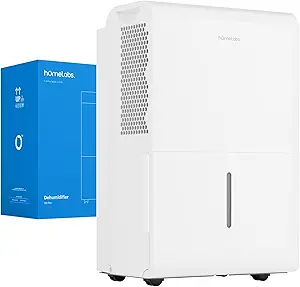 |
| Most Popular A crowd favorite that many people choose with confidence | Waykar 80-Pint Dehumidifier JD025CE-80 |  |
| Best Seller A high-volume bestseller chosen again and again | ToLife Dehumidifier TZ-C2 |  |
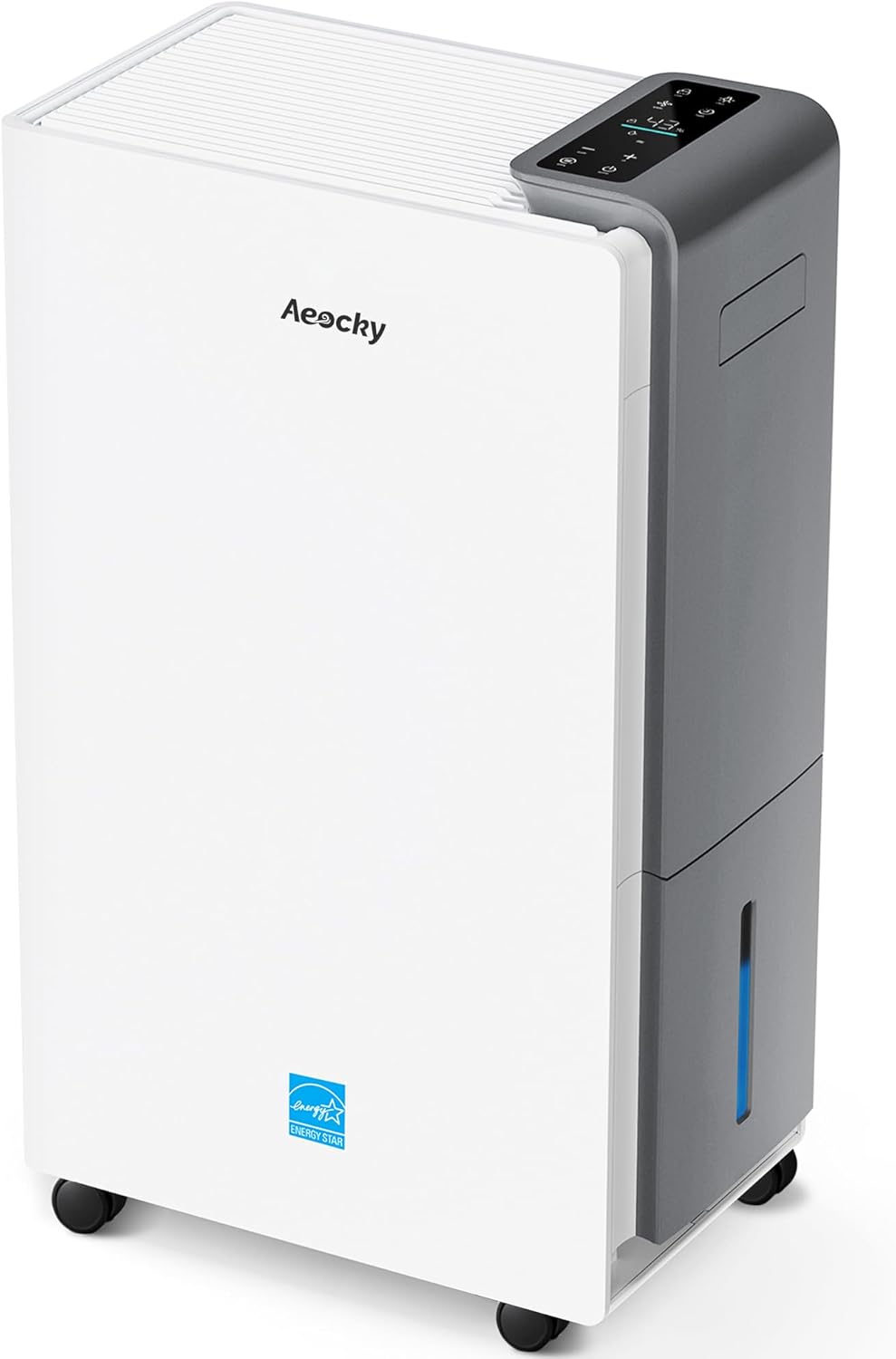
AEOCKY RHEA 80-Pint Dehumidifier
| Capacity | 80 pints/day |
|---|---|
| Tank Volume | 1.45 gallons |
| Wattage | 280 watts |
| Operation Mode | Auto, Continuous, Sleep, Constant Humidity, Smart Drying |
| Air Flow Capacity | 9006 cubic feet/hour |
The AEOCKY RHEA is a high-capacity compressor dehumidifier designed for large spaces such as basements and multi-room townhouses. It extracts up to 80 pints per day and targets wide coverage with an advertised service area up to 5500 sq ft, while offering multiple modes including auto, continuous, sleep, constant humidity, and smart drying for flexible use. Notable features include an ENERGY STAR Most Efficient 2025 rating, a 1.45 gallon tank plus included drain hose and garden-hose adapter for continuous drainage, and a high airflow rating intended to move lots of air quickly. The unit emphasizes energy efficiency and low-noise operation, with the manufacturer claiming quiet operation down to the mid-40 dB range and robust low-temperature defrost performance so it continues running in cool basements. Real-world trade-offs are size and handling considerations typical of 80-pint compressors and the need to manage tank emptying or drainage for continuous operation, but the RHEA's efficiency and feature set make it a strong option for homeowners who need sustained moisture control across large townhouse footprints.
Best for: Homeowners who want an energy-efficient, high-capacity dehumidifier to control humidity across a townhouse or large basement and who prioritize steady performance and low noise over compact portability.
Less Ideal for: People who need a lightweight, very compact unit for a single small room or frequent moving between floors should consider smaller, more portable dehumidifiers instead.
- ENERGY STAR Most Efficient 2025 certified for high energy efficiency
- High dehumidification capacity up to 80 pints/day suitable for large areas
- Multiple operating modes including auto, sleep, continuous, and smart drying
- Includes drain hose and garden-hose adapter for optional continuous drainage
- Designed for quiet operation with low minimum noise levels
- Large-capacity compressor units are heavier and less portable than small models
- Tank is 1.45 gallons so frequent emptying is needed unless using continuous drain
- Only one fan speed is listed which may limit fine-grained airflow control
Verdict: If you need a quiet, energy-efficient dehumidifier that can handle a townhouse or large basement reliably, the AEOCKY RHEA 80‑pint model is a top-performing, cost-effective choice.
Midea 50-Pint Dehumidifier

| Capacity | 50 pints |
|---|---|
| Coverage | 4,500 square_feet |
| Tank Volume | 1.6 gallons |
| Number of Speeds | 3 |
| Wattage | 470 watts |
The Midea 50-Pint Dehumidifier is built to remove up to 50 pints of moisture per day and cover large spaces up to 4,500 sq. ft., making it suitable for basements, large living areas, or townhouse common spaces. It offers adjustable humidity from 35% to 85%, three fan speeds including a low quiet mode, and a 1.6 gallon internal tank with a garden-hose adapter for continuous drainage. The unit is Wi‑Fi enabled for remote control via the SmartHome app and supports voice assistants for hands-free adjustments. Practical touches include a washable air filter, 360° rotating wheels and handles for portability, a digital display with timer, and an automatic shutoff and restart tied to the tank. On the downside it is a fairly heavy, full‑size unit and its daily removal rating may require a larger model in very humid climates or poorly ventilated areas. For buyers prioritizing steady, programmable moisture control across sizable rooms, the Midea balances strong capacity, smart controls, and usable mobility.
Best for: Buyers who need reliable, high-capacity moisture removal across large townhouse rooms or basements and want smart, programmable control and easy portability.
Less Ideal for: People looking for a lightweight, compact solution for small rooms or those who need ultra-quiet, bedroom-grade operation at very low noise levels.
- Removes up to 50 pints per day suitable for large rooms and basements
- Wi‑Fi and voice assistant support for remote and hands-free control
- Continuous drain option with built-in hose adapter for long unattended runs
- Washable reusable air filter and digital controls simplify maintenance
- Four 360° wheels and handles make it easy to move between rooms
- Relatively heavy full‑size unit which can be cumbersome to lift
- May be undersized for extremely humid climates or very poorly ventilated large spaces
Verdict: A performance-focused, smart 50-pint dehumidifier that combines strong moisture removal with app and voice control for maintaining dry townhouse spaces.
VEAGASO VG380 34-Pint Dehumidifier

| Capacity | 34 pints per day |
|---|---|
| Coverage | 2500 square feet |
| Tank Volume | 2 liters (0.53 gal) |
| Wattage | 230 watts |
| Noise Level | ≤40 dB |
The VEAGASO VG380 is a compressor dehumidifier built to remove up to 34 pints per day and cover spaces up to about 2,500 sq ft, making it a fit for townhouse basements, large living areas, or laundry rooms. It offers three modes — automatic humidity control, a higher-intensity dry mode for faster clothes drying, and continuous operation for persistently damp spaces — all set from a simple LED touch panel that displays real-time humidity. The unit includes a 0.53 gallon tank with auto shutoff plus a drain hose for continuous hands-free drainage, and a power-failure memory that restores settings after outages. Noise tops out around 40 dB on low speed, so it can run overnight without disturbing sleep. Key practical advantages are the built-in auto defrost for cool rooms, caster wheels and a recessed handle for moving between floors, and a child lock for safe homes. Expect regular emptying in very humid climates unless you use continuous drain, and note the compressor-based design performs best above about 41°F, so efficiency drops in colder unheated spaces despite the defrost feature.
Best for: Buyers who want an efficient, mover-friendly dehumidifier that can handle large townhouse rooms and basements while minimizing noise and hands-on maintenance.
Less Ideal for: People needing a unit for unheated spaces that routinely drop below refrigerator temperatures or buyers who prefer very large tank capacity without using a continuous drain.
- High dehumidification capacity rated at 34 pints per day suitable for large rooms and basements
- Three operating modes (auto, dry, continuous) for tailored moisture control including faster clothes drying
- Included continuous drain hose plus auto shutoff tank for flexible maintenance options
- Relatively quiet operation under 40 dB with sleep features and dimmable display for nighttime use
- Power failure memory and auto defrost increase reliability in basements and cold areas
- Tank is small (0.53 gallon) so frequent emptying is likely without continuous drain in very humid conditions
- Performance depends on compressor operation so efficiency falls near or below its lowest operating temperature around 41°F
Verdict: A quiet, high-capacity dehumidifier with flexible drainage and smart controls that suits townhouse basements and large rooms where reliable, low-noise moisture control is the priority.
TABYIK 35OZ Dehumidifier DH-CS01

| Tank Volume | 1000 ml |
|---|---|
| Wattage | 40 watts |
| Dehumidification Capacity | 0.45 liters_per_day |
| Operation Mode | Continuous |
| Floor Area | 280 square_feet |
The TABYIK 35OZ DH-CS01 is a small Peltier dehumidifier made for bedrooms, bathrooms, closets and RVs where space and noise matter. It runs continuously on about 40 watts and collects up to 16 oz (450 ml) per day in warm, humid conditions while storing water in a transparent 35 oz (1000 ml) tank that is easy to remove and pour. Controls are simple—one-button operation plus a light toggle that cycles seven colors for ambient lighting. The unit is quiet at about 28 dB, has an auto shutoff when the tank nears full, and is light and portable with a built-in handle. Expect modest dehumidifying performance: it is tuned for small rooms and performs best above 45% relative humidity and within the recommended temperature range. It does not replace larger compressor dehumidifiers for basements or whole-house moisture problems, and output falls at lower temperatures. For townhouse bedrooms or bathrooms where you want a low-cost, low-noise fix, this model is straightforward and easy to maintain.
Best for: Buyers looking for an inexpensive, low-noise dehumidifier to manage light moisture in single rooms such as bedrooms, bathrooms, closets or small townhouse spaces.
Less Ideal for: People needing rapid moisture removal for basements, large open-plan areas, or homes with persistent damp problems should choose a higher-capacity compressor dehumidifier.
- Compact, lightweight design with built-in handle for easy placement and transport
- Very quiet operation (~28 dB) suitable for bedrooms and offices
- Large transparent 35 oz (1000 ml) tank with easy remove-and-pour groove
- Auto shutoff protects against overflow and signals when tank is nearly full
- Low power draw (~40 watts) for budget-conscious daily use
- Low dehumidification rate (about 0.45 L / day) makes it unsuitable for high-moisture or large spaces
- Performance depends on warm, humid conditions and drops at lower temperatures
Verdict: A compact, energy-sipping dehumidifier that delivers quiet, budget-friendly moisture control for single rooms in a townhouse.
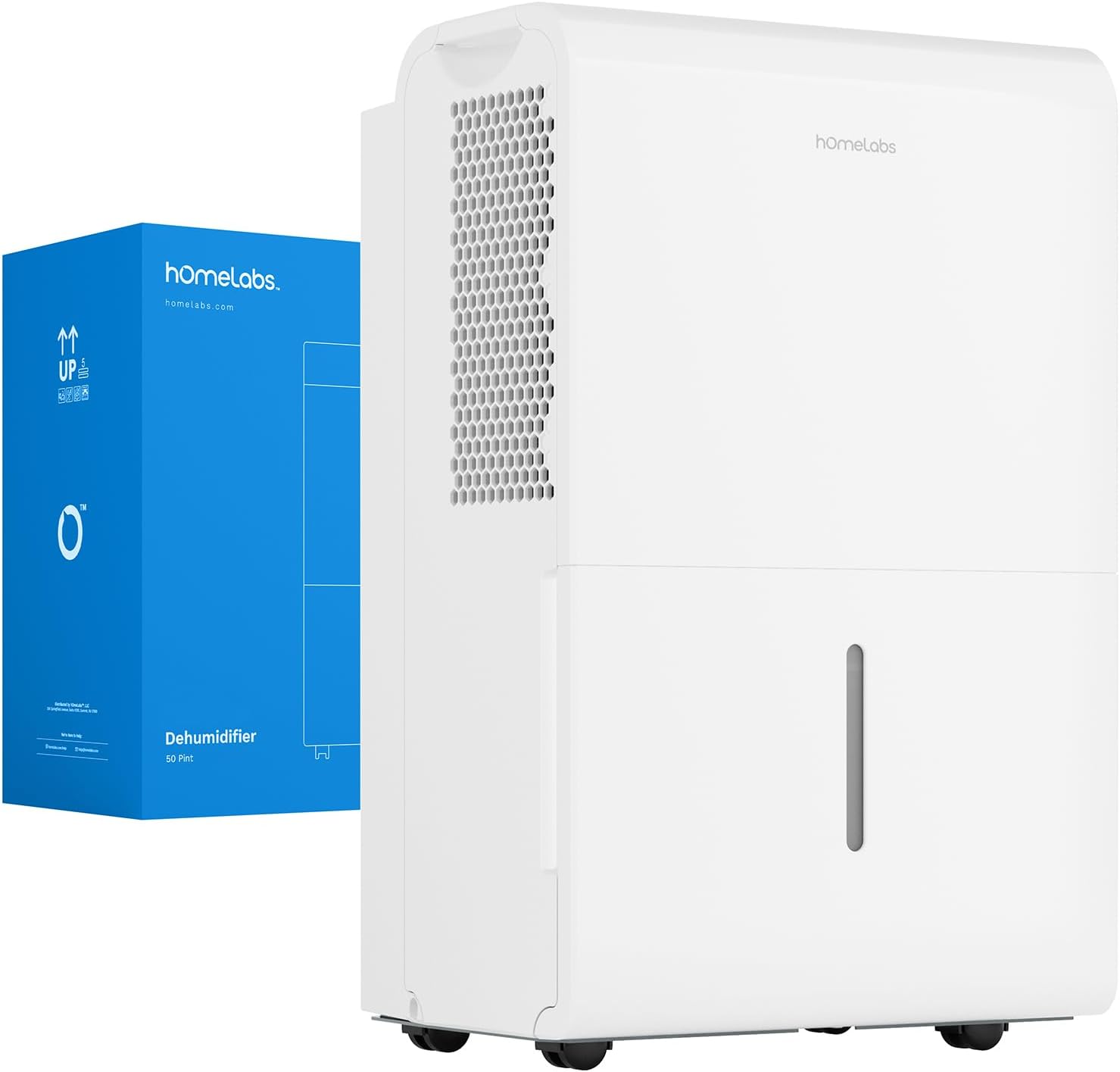
hOmeLabs 50 Pint Dehumidifier
| Dehumidification Capacity | 50 pints_per_day |
|---|---|
| Floor Area | 7000 square_feet |
| Wattage | 322 watts |
| Air Flow Capacity | 165 cfm |
| Operation Mode | Continuous |
This hOmeLabs 50‑pint dehumidifier is built to handle high-humidity rooms in homes and townhouses, offering Wi‑Fi control, continuous operation, and both tank and hose drainage options. It removes up to 50 pints per day (with a higher-rated peak capacity at extreme conditions) and has two fan speeds including a Turbo mode for faster moisture removal. The unit includes a removable washable filter, an automatic shutoff when the tank is full, automatic defrost and restart, and a touch control panel for simple operation. Wheels and handles make it portable for moving between basement, laundry room, or finished lower levels, while the quieter fan and modest airflow help it run without dominating living spaces. Important limitations are its power draw and weight compared with smaller portable models, and continuous drainage requires a hose and setup. For townhouse use the combination of smart controls, automatic protections, and sturdy moisture removal make it a practical option for keeping multiple rooms dry.
Best for: Buyers who prioritize a dependable, whole-room dehumidifier for multi-level townhouse spaces and want remote monitoring plus automatic safeguards for hands-off operation.
Less Ideal for: People who need an ultralight or ultra-compact unit for a single small room or who prefer a model that includes a drain hose and lighter power consumption.
- Wi‑Fi remote control for adjusting settings from anywhere
- Removes up to 50 pints per day with Turbo mode for faster dehumidification
- Automatic shutoff, defrost, and restart protect the unit and simplify operation
- Continuous drain option and removable washable filter for low-maintenance use
- Portable design with wheels and handles for easy relocation around the home
- Relatively heavy and higher power draw compared with smaller portable units
- Hose for continuous drainage is not included and requires setup
Verdict: A reliable, Wi‑Fi‑enabled 50‑pint dehumidifier that balances strong moisture removal and automatic protections for townhouse environments.
Waykar 80-Pint Dehumidifier JD025CE-80

| Dehumidification Capacity | 80 pints_per_day |
|---|---|
| Tank Volume | 2.5 gallons |
| Wattage | 270 watts |
| Air Flow Capacity | 165 cfm |
| Operation Mode | Continuous |
The Waykar 80-Pint Dehumidifier is built to handle large, damp areas such as basements by extracting up to 80 pints per day and offering both tank and continuous drain options. It is commonly used running continuously or on a timed schedule to bring basement humidity down to a selected setpoint between 30% and 80% relative humidity, and the 90° auto-swing helps spread airflow for more even drying. Practical features include an included drain hose and connector for gravity drainage, a washable removable filter, automatic defrost and overload protection for low-temperature reliability, and an Energy Star rating to keep running costs lower than noncertified units. At roughly 42 dB it is quieter than many similarly sized machines, making it reasonable for finished basements or nearby living areas. The unit is relatively heavy and targeted at larger spaces, so it is less convenient to move frequently, and the 1.14 gallon tank means emptying is still needed if you do not use continuous drainage. For buyers focused on dependable basement performance and energy efficiency, this model delivers strong moisture removal with sensible protections for extended operation.
Best for: Homeowners who need a reliable, high-capacity dehumidifier to control moisture in large basements and prefer proven features and energy efficiency over portability.
Less Ideal for: People looking for a lightweight, highly portable unit for small rooms or occasional use should consider smaller, easier-to-move models instead.
- High dehumidification capacity rated at 80 pints per day for large basements
- ENERGY STAR certification for better energy efficiency during extended use
- Multiple drainage options with included drain hose for continuous gravity drain
- Auto-defrost and overload protection improve reliability in cool basement conditions
- 90° auto-swing airflow and washable filter help distribute air and simplify maintenance
- Relatively heavy and sized for large spaces, so not ideal for frequent transport
- Water tank is modest at 1.14 gallons if continuous drainage is not used
Verdict: A powerful, Energy Star certified 80‑pint unit that reliably handles large basement humidity with continuous drain and protective auto-defrost features.
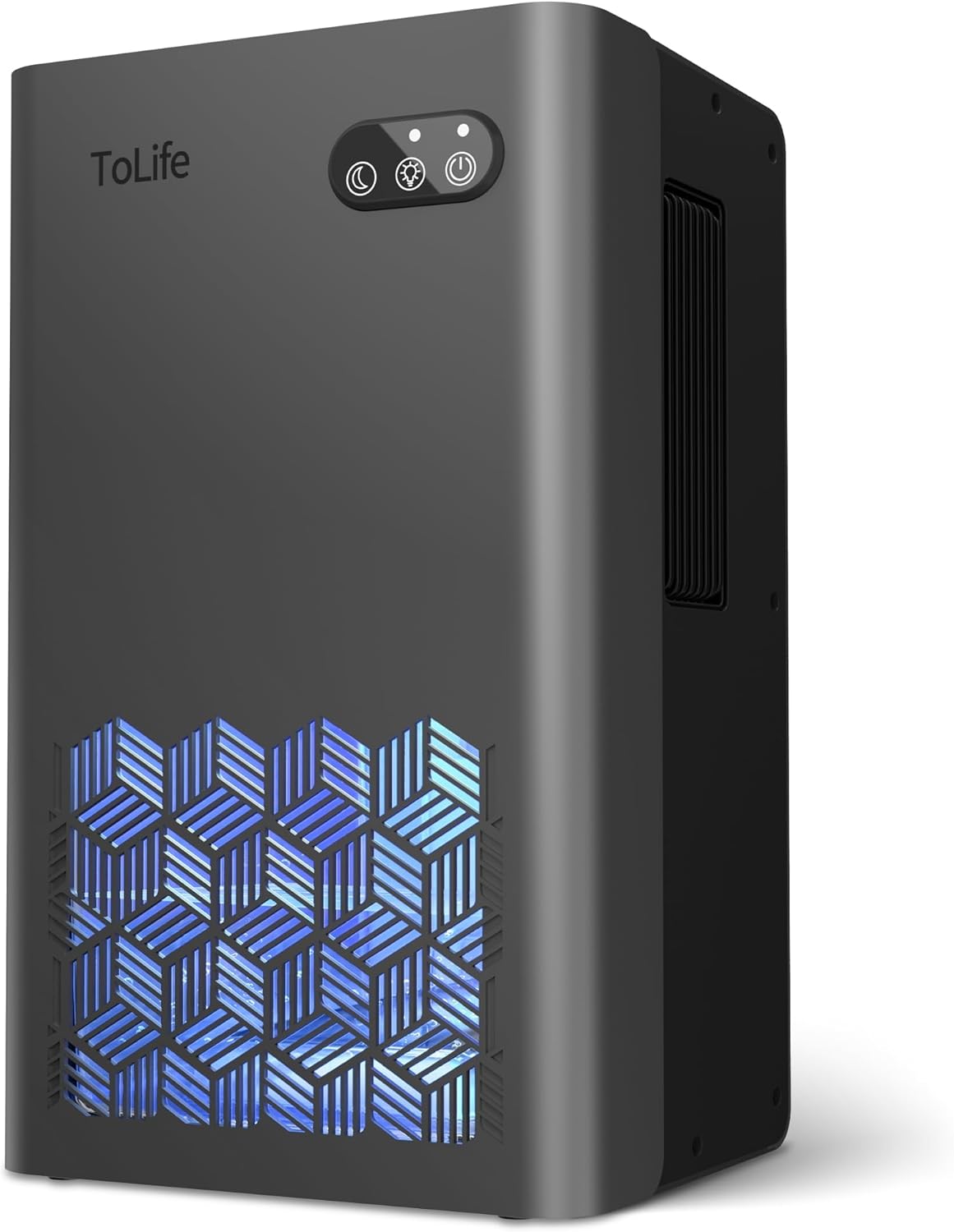
ToLife Dehumidifier TZ-C2
| Floor Area | 1000 |
|---|---|
| Tank Volume | 95 fluid ounces |
| Number of Speeds | 2 |
| Wattage | 93 watts |
| Voltage | 220 volts |
The ToLife TZ-C2 uses semiconductor condensation technology to quietly pull moisture from the air and deposit it into a removable 95 oz tank, making it a straightforward option for damp rooms. It offers two operating modes: a higher-power setting for faster moisture removal and a low-speed sleep mode that runs under 30 dB for overnight use. A seven-color LED can act as a night light and the unit includes automatic shutoff when the tank is full or removed, plus handles for easy moving between rooms. Practical benefits include simple setup, low noise, and a compact footprint that fits in basements, bathrooms, or bedrooms. Limitations are its modest rated dehumidification capacity and stated coverage, which means it will be most effective in smaller basement zones or for spot treatments rather than drying a large, very damp basement quickly. Also this model runs on 220 volts, so electrical compatibility should be confirmed for your location.
Best for: Buyers who need an affordable, portable dehumidifier for spot dehumidifying small basement areas, bathrooms, or bedrooms and who prioritize low noise and easy portability.
Less Ideal for: People looking to dry large, very damp basements or whole-house coverage should consider a higher-capacity compressor dehumidifier instead.
- Large removable 95 oz water tank reduces how often you need to empty it
- Quiet sleep mode under 30 dB suitable for nighttime operation
- Portable design with handles for moving between rooms
- Automatic shutoff prevents overflow when the tank is full
- Dehumidification capacity is modest and may be slow in very damp or large basements
- Requires 220 volt power which may not match all household outlets
Verdict: A compact, budget-friendly portable dehumidifier that is best for quiet, small-area moisture control and occasional basement spot treatments.
Choosing the Right Dehumidifier for Townhouse: Key Factors to Consider
Capacity and Room Coverage
Dehumidifier capacity determines how much moisture the unit can remove in 24 hours. In a townhouse you will likely need to match capacity to the specific room or area where humidity is highest, such as a basement, bathroom, or laundry room. Oversizing can waste energy and cause short cycling, while undersizing will leave humidity elevated and prolong run times.
Measure the square footage and ceiling height of the target space, then choose a capacity rating appropriate for that area and the typical humidity level. For very damp basements select a higher-capacity unit; for smaller bedrooms or bathrooms a compact model is usually sufficient.
Drainage and Water Management
How the unit handles condensate affects convenience and suitability for continuous operation. A removable bucket is fine for occasional use, but a continuous gravity drain or built-in condensate pump is preferable for basements or any location where frequent emptying is impractical.
Confirm the drain port orientation and whether the unit can be plumbed to a nearby floor drain or sink. For multilevel townhouses, a pump-equipped dehumidifier lets you route water upward to a drain, which reduces maintenance and the chance of overflow.
Energy Efficiency and Operating Cost
Dehumidifiers can run many hours per day, especially in damp seasons, so energy use matters. Look for models with favorable energy ratings and variable-speed compressors or fan controls that reduce power draw when humidity nears the set point. A unit that runs efficiently will lower monthly electricity consumption and is less likely to overwork in continuous-duty scenarios.
Also consider features like built-in humidistats and timers that prevent unnecessary runtime. Evaluating energy use alongside capacity gives a realistic picture of long-term operating cost rather than relying on capacity numbers alone.
Noise and Placement
Noise level is important in close-quarter townhouse living. A basement unit used only when you are away can be louder, but units placed near living spaces, bedrooms, or home offices should be quiet. Look for decibel ratings and models with lower fan speeds or a dedicated quiet mode.
Consider placement options that isolate noise, such as a utility closet with ventilation or a basement corner. Also check the unit footprint so it fits narrow hallways or storage areas without impeding traffic.
Humidistat Control and Automation
Accurate humidity control prevents over-drying and saves energy. A built-in humidistat with adjustable target settings lets you maintain a comfortable relative humidity range without constant manual monitoring. Automatic restart after power loss and programmable timers add convenience and protect against moisture spikes after outages.
Some units offer digital displays and memory functions for preferred settings. These features are particularly useful in townhouses where humidity can vary between floors and rooms.
Maintenance and Filter Access
Regular upkeep keeps a dehumidifier running efficiently. Easy access to the dust filter and washable components simplifies routine cleaning, which preserves airflow and dehumidification performance. A design that allows quick bucket removal or easy hose access reduces the time spent on upkeep.
Consider how often the filter requires cleaning and whether replacement parts are readily available. Simpler maintenance translates to better long-term reliability in households with busy schedules.
Sizing for Different Townhouse Spaces
Townhouses include a mix of microclimates: basements, bathrooms, kitchens, and upper-level bedrooms may all have different humidity levels. Start by identifying the single most humid area you need to control and size the dehumidifier for that space rather than the entire house.
For basements and laundry rooms choose higher-capacity units rated for damp or very damp conditions. For bedrooms and living rooms a smaller, quieter unit provides ample control without excessive energy use. If multiple rooms are problematic, consider one unit per area or a strategically placed unit in a central corridor.
- Basements: higher capacity, drainage pump recommended
- Bathrooms and laundry areas: compact units with quick drainage
- Bedrooms/living rooms: lower-noise models with modest capacity
Placement Tips to Improve Performance
Ideal placement ensures even air circulation and efficient moisture capture. Keep the unit a few inches from walls and obstacles, and place it where airflow is not blocked by furniture. Positioning near the dampest source, such as by a laundry closet or basement stairwell, yields faster humidity reduction.
Avoid placing the unit directly in outdoor air paths or against exterior walls that might be colder. In multi-level townhouses, run the unit on the level where humidity concentrates rather than on a different floor, unless you are using ducted airflow or a whole-house approach.
- Leave clear space around intake and exhaust
- Place on level, stable surfaces to prevent tipping
- Use hose drains or pumps for unattended areas
Managing Noise Without Sacrificing Performance
If noise is a concern, prioritize models with multiple fan speeds and a quiet mode. Running at lower fan speeds reduces sound but also lowers moisture removal rate, so balance noise tolerance with how quickly you need to reach the target humidity.
Supplementary measures like placing the unit on vibration-dampening pads or inside ventilated cabinetry can cut perceived noise. Just ensure adequate airflow so performance is not impaired.
- Choose quieter fan profiles for bedrooms
- Use timers to run higher speeds when rooms are unoccupied
- Vibration pads can reduce rattles on hard floors
Continuous Drain Vs. Bucket Use
For a townhouse, continuous drain options minimize maintenance. If the dehumidifier will run frequently in a basement or laundry room, connect it to gravity drainage or choose a model with a pump that moves water to a higher sink or drain.
Buckets are fine for intermittent use in bedrooms or seasonal humidity control, but be prepared to empty them regularly. Automatic shutoff on full tanks is a useful safety feature, but it still interrupts continuous dehumidification unless a drain is used.
- Gravity drain for ground-level drain access
- Built-in pump for uphill drainage
- Bucket with full-tank indicator for occasional use
Seasonal Use and Storage
In many townhouses humidity spikes during certain months. Running a dehumidifier seasonally reduces wear during dry months and saves energy. Before storing a unit, dry it thoroughly to prevent mold inside the housing.
If you plan to store the unit, clean filters and coils and run a short cycle to evaporate residual moisture. Store in a dry area with the bucket removed or empty.
- Run periodically in shoulder seasons to maintain dryness
- Clean and dry thoroughly before long-term storage
- Keep hoses and fittings organized to avoid damage
How We Chose the Best Dehumidifier for Townhouse
We evaluated candidates for townhouse use with practical, measurable filters that reflect real homeowner priorities. Primary considerations were moisture removal capacity, energy consumption, and room-size suitability. We looked for units with reliable drainage options and humidity control so they can handle continuous operation in spaces like basements and bathrooms. Noise level and physical footprint were included because townhouses often have close quarters and limited storage. Additional criteria included ease of maintenance, such as accessible filters and washable components, plus safety features like auto-shutoff and tilt protection for household environments. We excluded specialty commercial dehumidifiers and units intended solely for large open-plan industrial spaces. Also filtered out models lacking basic humidity readouts or adjustable humidistats, since precise control matters in multiroom homes. The shortlisted products all met minimum thresholds for daily condensate removal, offered practical drain or pump options, and balanced operational cost with dryness performance. This approach ensured selections were suitable for typical townhouse layouts and everyday use.
Our full evaluation process is outlined in our review methodology.
FAQ
What size dehumidifier do I need for a townhouse basement?
Size depends on square footage, ceiling height, and how damp the space is. For very damp basements choose a higher-capacity unit rated for basement conditions; for mildly damp basements a moderate-capacity model may suffice. Measure the space and compare against capacity guidance to pick an appropriate size.
Can I run a dehumidifier all day in a townhouse?
Yes, continuous operation is common in damp areas and most modern units are designed for long runtimes. Use a model with continuous drain or a pump to avoid frequent emptying and monitor energy use with an efficient unit to keep operating costs reasonable.
How noisy are dehumidifiers and will they disturb sleep?
Noise varies by model and fan speed. Many units offer low-noise modes suitable for bedrooms. If noise is a concern, look for lower-decibel ratings, run the unit at reduced speed overnight, and place it away from sleeping areas.
Do I need a pump for drainage in a townhouse?
A pump is helpful when you need to move condensate uphill to a sink or drain, or when gravity drain access is not convenient. If the drain point is below the unit outlet, a pump simplifies installation and allows unattended operation.
How often should I clean the filter and coils?
Clean or check the filter every few weeks during heavy use and at least monthly in damp seasons. Coils should be inspected periodically and cleaned if dust or debris buildup reduces airflow. Regular maintenance preserves efficiency and prevents odors.
Final Verdict
Choosing the right dehumidifier for a townhouse means balancing capacity, noise, drainage, and running cost against the specific layout and moisture sources in your home. Prioritize accurate humidistat control and a drainage solution that matches where you plan to run the unit. In spaces where quiet operation matters, favor models with lower fan speeds and effective moisture removal at reduced sound levels. With a focus on correct sizing, efficient operation, and straightforward maintenance, you can control humidity, deter mold, and improve comfort across townhouse spaces. Pick the configuration that matches the damp area you need to treat and the level of hands-on maintenance you are willing to perform.