
Note: This article contains affiliate links. If you click on these links and make a purchase, we may earn a small commission at no extra cost to you. This helps support our research and content. Read our full affiliate disclosure here.
Large storage spaces need reliable humidity control to protect inventory, prevent mold, and keep equipment functioning. A properly sized dehumidifier for warehouse settings makes the difference between occasional damp spots and persistent moisture problems that damage goods and structure. This guide covers seven shortlisted, top-performing options selected for heavy-duty capacity, robustness, and long-term operating efficiency. We evaluate each unit on output capacity, energy and maintenance demands, and durability under continuous use. Read on to find models that match your space, airflow needs, and serviceability requirements before the product summaries.
Top Picks at a Glance
| Best Overall The best all-around choice for most situations | AVAHUM DV160PB-1 160-Pint Dehumidifier |  |
| Best Quality Built to a higher standard if you want something more solid | ALORAIR Storm LGR Extreme 180 PPD |  |
| Best Value The sweet spot between price and what you get | DECIUU 100-Pint Dehumidifier |  |
| Best Budget The cheapest option that still gets the job done reliably | AIRPLUS 70-Pint Dehumidifier |  |
| Top Rated A top-rated pick with lots of positive feedback | KNKA 80-Pint Dehumidifier PD30MA-20 |  |
| Most Popular A crowd favorite that many people choose with confidence | Waykar 150 Pint Dehumidifier |  |
| Best Seller A high-volume bestseller chosen again and again | AEOCKY RHEA 80-Pint Dehumidifier |  |
AVAHUM DV160PB-1 160-Pint Dehumidifier
| Capacity | 160 pints |
|---|---|
| Floor Area | 7500 square_feet |
| Wattage | 950 watts |
| Dehumidification Capacity | 20 gallons_per_day |
| Voltage | 120 volts |
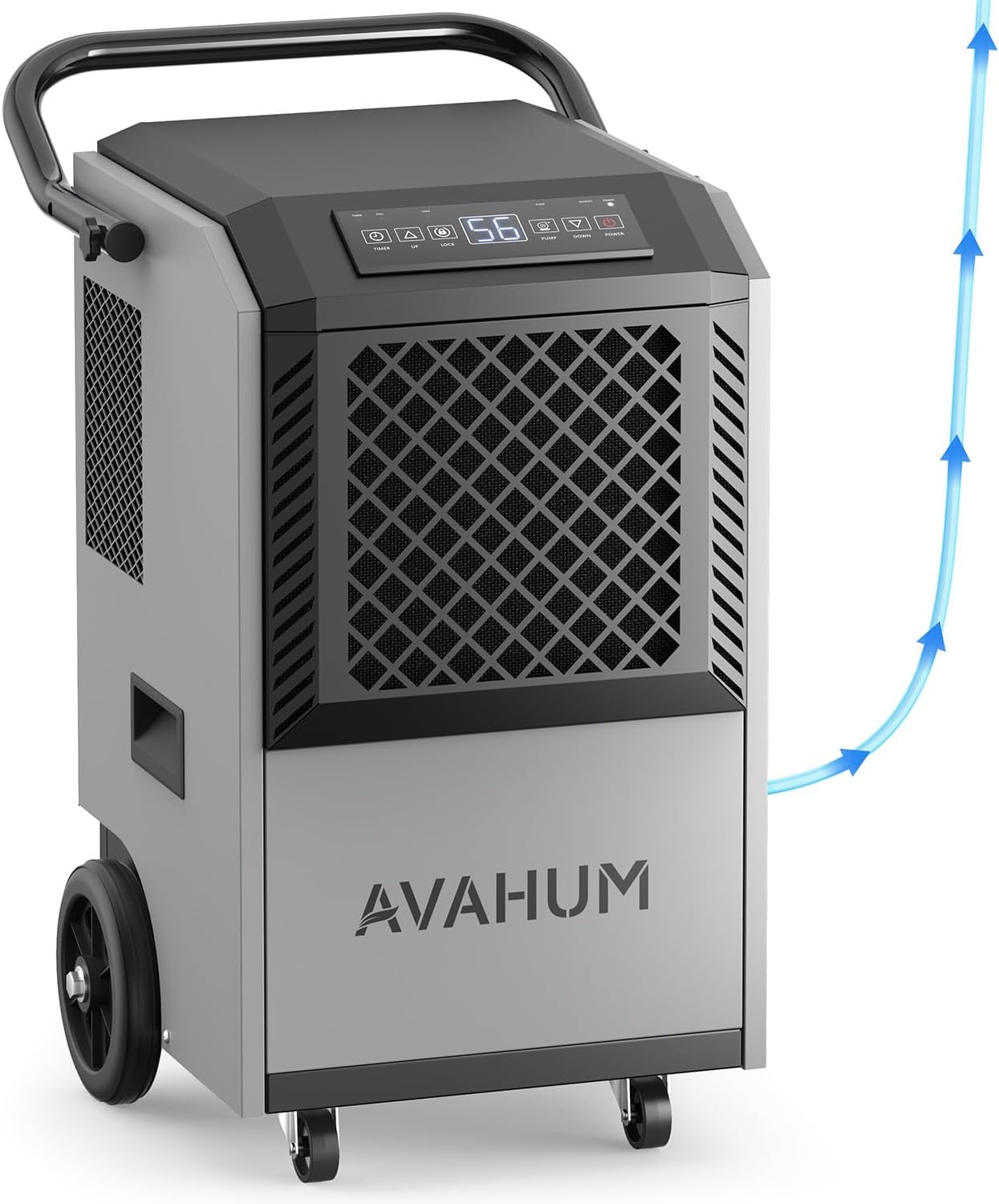
The AVAHUM DV160PB-1 is a heavy-duty dehumidifier built for large commercial and industrial spaces such as warehouses and flooded job sites. It pulls up to 160 pints per day (rated at 95°F, 90% RH) and is intended for continuous operation, with a built-in condensate pump that can lift water up to 16.4 feet plus an included drain hose for gravity drainage. The digital control lets you set a target humidity from 10% to 98% RH and offers a 24-hour timer, automatic restart, and auto-defrost so the unit can keep working in cooler conditions. Practical touches include a washable MERV-1 filter, wheels and handles for portability, and safety features like overheat protection and water-level indicator. The machine is fairly powerful at 950 watts and aimed at steady moisture removal across large footprints, though its size and power draw mean it is best suited to commercial settings rather than small rooms. Expect basic factory support and a one-year manufacturer warranty with optional longer limited warranty coverage from the brand.
Best for: Buyers who need a robust, continuous-duty dehumidifier for large warehouses, job sites, or storage areas and prioritize high extraction and reliable automatic drainage.
Less Ideal for: Those looking for a compact, energy-minimizing unit for small rooms or occasional home use should consider smaller residential dehumidifiers instead.
- High extraction capacity rated up to 160 pints per day for rapid moisture removal in large spaces
- Built-in condensate pump with 16.4 ft lift plus gravity drain option for true continuous operation
- Digital humidity control from 10%–98% with timer, auto-restart, child lock and water-level indicator for unattended use
- Auto-defrost and low-temperature rating allow stable operation in cooler environments
- Washable MERV-1 filter and caster wheels make maintenance and relocation straightforward
- Rated extraction is at high temperature/humidity conditions so real-world pints/day can be lower in cooler environments
- Relatively high power consumption at 950 watts compared with smaller commercial units
- Warranty coverage listed as one year from manufacturer on product page
Verdict: If you need steady, high-capacity moisture removal with automatic pump drainage for large warehouse spaces, this AVAHUM 160-pint unit is built for the job.
ALORAIR Storm LGR Extreme 180 PPD
| Capacity | 180 pints |
|---|---|
| Air Flow Capacity | 210 cfm |
| Wattage | 646 watts |
| Operation Mode | Continuous |
| Voltage | 115 |
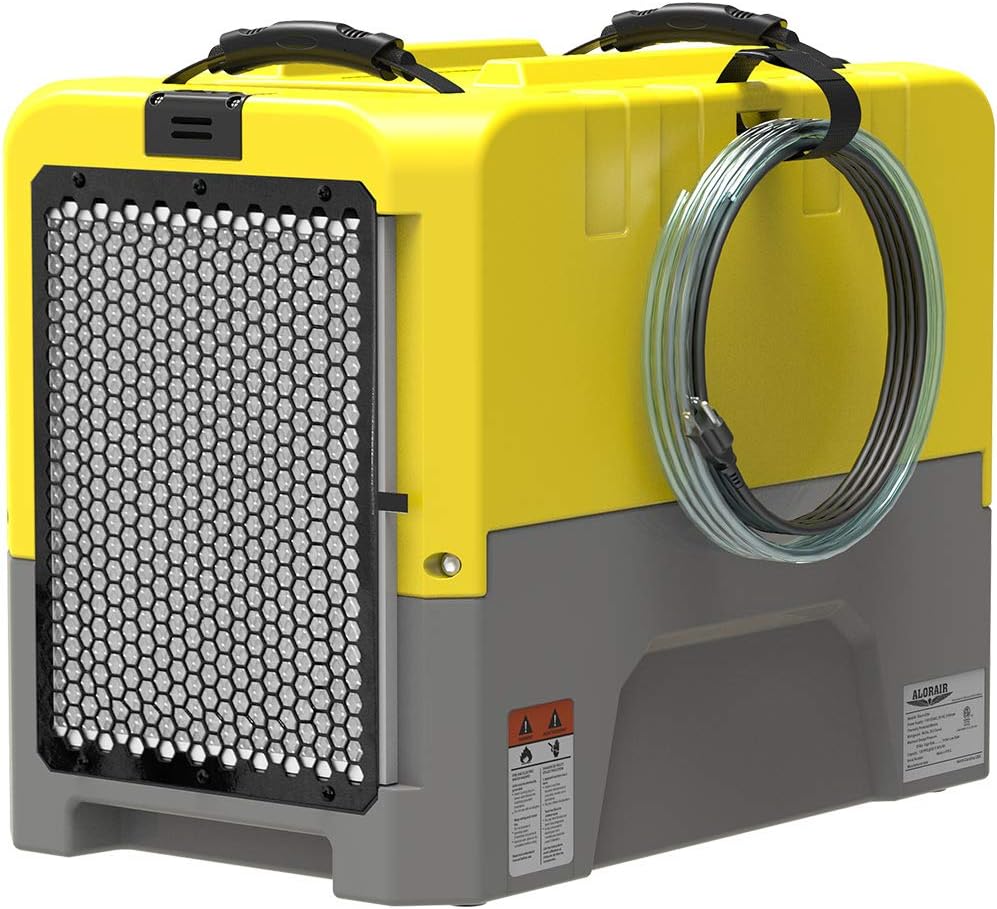
The ALORAIR Storm LGR Extreme is a job-site focused low-grain refrigerant dehumidifier built to remove large volumes of water quickly and run with minimal supervision. It delivers up to 180 pints per day at saturation and 85 PPD by AHAM while moving air at 210 CFM, making it effective for warehouses, basements, and water-damage restoration scenarios. Practical features include a built-in condensate pump with a long hose and high lift for flexible placement, automatic defrost and auto-restart after power loss, adjustable humidity control and memory start so it resumes prior settings, and a compact stackable design with carrying handles for transport and tight spaces. The unit runs on 115 V and draws around 646 W, so expect significant continuous power use during heavy duty drying. It is commercial-grade and intended for continuous operation, but its size and power draw mean it is overkill for small rooms and requires appropriate electrical capacity and ventilation for best performance.
Best for: Buyers who need fast, reliable drying for large or water-damaged warehouse spaces and prioritize continuous high-volume moisture removal and on-site drain flexibility.
Less Ideal for: Those seeking a quiet, low-power solution for small rooms, light seasonal humidity, or portable home use should consider smaller residential dehumidifiers instead.
- High moisture removal capacity up to 180 pints per day at saturation for fast drying
- Built-in pump with long hose and substantial vertical lift for unattended drainage
- Automatic defrost and auto-restart for reliable continuous operation
- Compact, stackable housing with top handles for easier placement in tight or confined spaces
- Requires substantial continuous power and appropriate 115 V circuit for heavy-duty use
- Designed for commercial use so may be louder and less refined than residential units
Verdict: Choose this unit when you need a rugged commercial dehumidifier that rapidly removes large volumes of moisture and drains automatically for warehouse-scale drying.
DECIUU 100-Pint Dehumidifier

| Capacity | 100 pints per day |
|---|---|
| Tank Volume | 1.45 gallons |
| Air Flow Capacity | 9396 cubic_feet_per_hour |
| Wattage | 300 watts |
| Operation Mode | Continuous |
This DECIUU unit is built to handle large, damp spaces by removing up to 100 pints of moisture per day under high-humidity conditions and controlling relative humidity between 35% and 80% RH. It is typically used in basements, garages, storage rooms, and larger work areas where sustained moisture extraction is needed; the machine supports continuous operation via a 1.45 gallon tank, a supplied drain hose, or a garden-hose connection for long runs. Notable features include ENERGY STAR Most Efficient 2024 recognition for better energy use, auto defrost for cool environments, a washable filter, child lock, 24-hour timer, and three fan speeds to balance airflow and power draw. Practical benefits are straightforward: strong extraction capacity, flexible drainage that reduces manual emptying, and caster-mounted mobility to move between zones. Limitations are its focus on residential electrical specs and single-unit airflow; warehouses with extremely large open layouts may need multiple units or ducted commercial equipment to cover floor area continuously.
Best for: Facility managers or operators who need a practical, energy-efficient dehumidifier to control persistent humidity in medium-sized storage areas, basements, or garages and prefer easy drainage and low-maintenance operation.
Less Ideal for: Large industrial warehouses or expansive open-floor commercial spaces that require industrial-grade, hardwired dehumidification or centralized ducting solutions.
- High dehumidification capacity up to 100 pints per day for heavy moisture loads
- ENERGY STAR Most Efficient 2024 rating for lower energy consumption during continuous use
- Three drainage options including continuous drain hose and garden-hose connection for unattended operation
- Auto defrost and adjustable humidity control for reliable performance in varied temperatures
- Washable filter and caster-mounted design for easy maintenance and mobility
- Rated for residential 120V power, which may limit runtime or coverage in large commercial zones
- Single unit airflow may be insufficient to evenly dehumidify very large open warehouses without multiple units
Verdict: A powerful, energy-efficient dehumidifier with flexible drainage and easy mobility that suits medium to large damp spaces needing reliable, low-maintenance humidity control.
AIRPLUS 70-Pint Dehumidifier

| Dehumidification Capacity | 70 pints_per_day |
|---|---|
| Floor Area | 4500 square_feet |
| Tank Volume | 2.8 liters |
| Other Special Features of the Product | Adjustable Fan Speed, Adjustable Humidity Control, Automatic Shutoff, Continuous Drainage, Timer |
This AIRPLUS dehumidifier is a high-capacity unit aimed at large rooms and commercial-style spaces such as warehouses and basements. It extracts up to 70 pints per day under high-humidity test conditions and supports continuous drainage via a hose connection to avoid frequent emptying. Controls are straightforward with adjustable humidity setpoints, selectable fan speeds, a drying mode for faster moisture removal, and a timer for scheduled on/off. The 2.8 liter internal tank and automatic shutoff give a fallback when continuous drainage is not used, and the included activated carbon/HEPA filter helps catch particles as air is circulated. In practical use it will move a lot of moisture for the price and is suitable where steady dehumidification is needed across a large open area, though performance will vary with ambient temperature and humidity. Expect basic construction and controls rather than commercial-grade refinements, but the unit delivers solid moisture removal for routine warehouse or large-room humidity control.
Best for: Buyers seeking an affordable, high-capacity dehumidifier to manage persistent moisture in large open spaces who prioritize moisture removal over commercial-grade construction.
Less Ideal for: Facilities that require heavy-duty industrial equipment with hardened components and service contracts should consider purpose-built commercial dehumidifiers instead.
- High dehumidification rate up to 70 pints per day suitable for large spaces
- Continuous drainage option reduces need to manually empty the tank
- Multiple modes and adjustable fan speeds for flexible moisture control
- Simple controls and timer make scheduled operation easy
- Not built to industrial commercial finish standards so durability may lag heavier-duty units
- Performance specified at high temperature and humidity conditions which may be lower in cooler environments
Verdict: A budget-friendly, high-capacity dehumidifier that delivers strong moisture removal for large warehouse-style spaces without the cost of industrial equipment.
KNKA 80-Pint Dehumidifier PD30MA-20

| Capacity | 80 pints per day |
|---|---|
| Tank Volume | 1.45 gallons |
| Wattage | 360 watts |
| Floor Area | 4500 square_feet |
| Operation Mode | AUTO, DRY, SETTING |
The KNKA PD30MA-20 is a performance-focused dehumidifier built for large, damp spaces such as basements. Its high-efficiency compressor can remove up to 80 pints per day under extreme conditions and about 56 pints in typical basement conditions, while an internal 1.45 gallon tank plus a supplied 6.56 ft drain hose enable continuous drainage to avoid frequent emptying. Controls include AUTO, DRY, and a SETTING mode for 30%–80% RH, and the digital display with a color-changing humidity indicator makes it easy to monitor conditions at a glance. The unit is designed to run quietly (40–45 dB), has a washable filter, casters for moving between rooms, cord storage, a 12-hour timer, and a child lock for steady, unattended operation. Expect good energy efficiency thanks to ENERGY STAR certification and a 360 watt power draw, but note that humidity readings come from the air inlet and may differ slightly from a separate hygrometer; the unit also needs upright siting for 24 hours before first use. For heavy-duty basement dehumidification this model balances strong capacity with thoughtful usability features.
Best for: Buyers who need powerful, reliable moisture removal in large basements or very damp rooms and prioritize steady performance and easy continuous drainage.
Less Ideal for: People seeking a compact or ultra-light unit for small rooms or occasional use should consider lower-capacity, more portable models instead.
- High maximum dehumidification capacity up to 80 pints per day for large, very humid spaces
- Includes 6.56 ft drain hose and built-in tank for continuous drainage to reduce manual emptying
- ENERGY STAR certified and uses a high-efficiency compressor for lower operating costs relative to output
- Quiet operation (40–45 dB) and caster wheels make it suitable for basements and living spaces
- Digital display with real-time humidity readout and color indicator simplifies monitoring and control
- Humidity reading is measured at the air inlet and may not match a separate room hygrometer
- Requires upright placement for 24 hours before first use to avoid operational issues
Verdict: Choose this KNKA if you need a strong, ENERGY STAR certified dehumidifier that can handle large basements with continuous-drain capability and quiet operation.
Waykar 150 Pint Dehumidifier
| Capacity | 150 pints |
|---|---|
| Floor Area | 7000 square_feet |
| Tank Volume | 2.11 gallons |
| Wattage | 750 watts |
| Air Flow Capacity | 159 cfm |
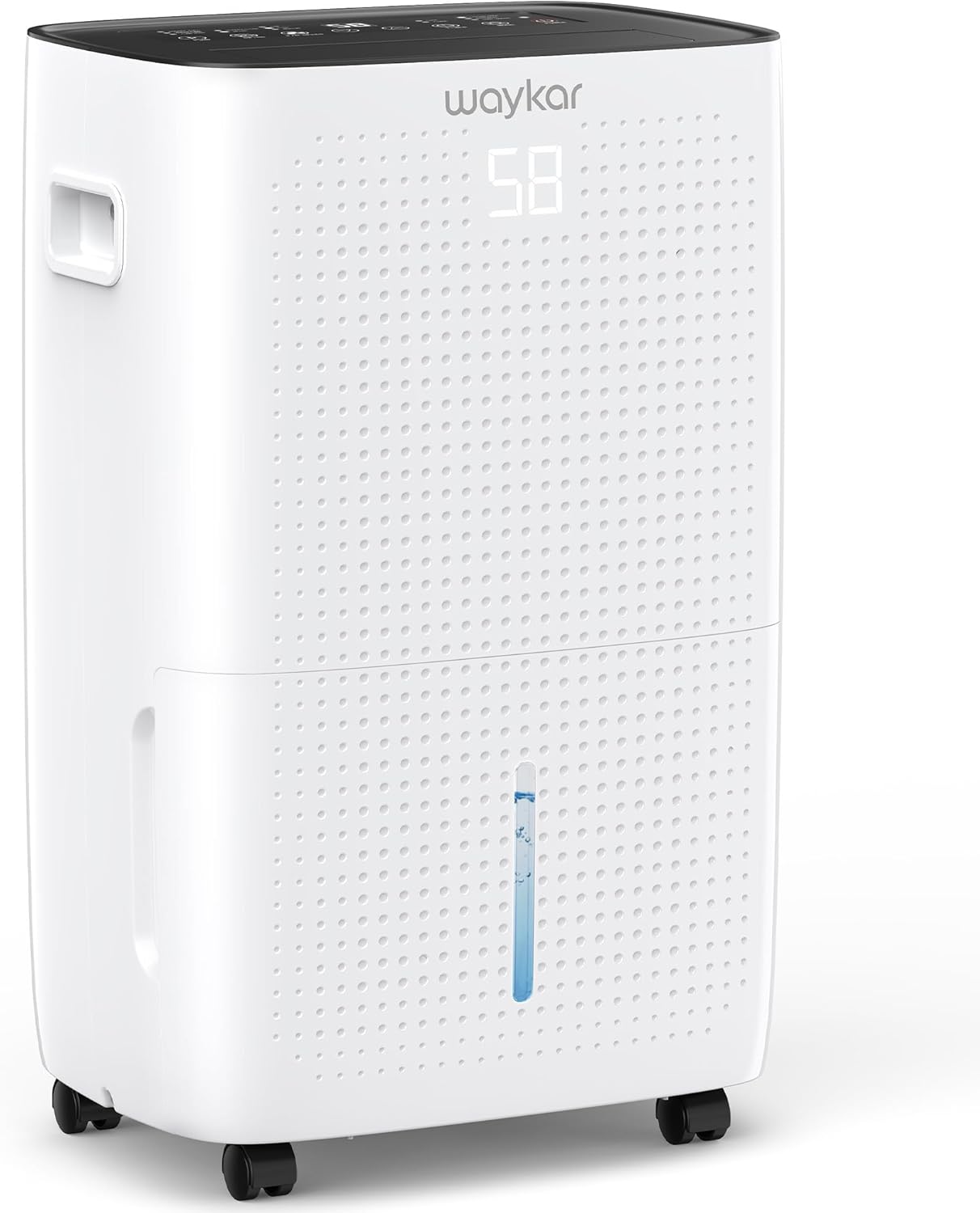
The Waykar 150 Pint dehumidifier is built for high-demand spaces such as warehouses, basements, and whole-house jobs where rapid moisture removal is required. It removes up to 150 pints per day and combines a large 2.11 gallon tank with a supplied drain hose for continuous gravity drainage, so it can run for long stretches without frequent emptying. The unit offers a 90 degree auto-swing airflow to spread dry air more evenly across wide areas, two fan speeds, and multiple modes including Continuous and Dry to match variable site conditions. Practical touches include a visible water window, detachable washable filter, control-lock to prevent accidental changes, auto-defrost for low-temperature operation, and a 24-hour timer. On the downside, it is a heavy, floor-standing commercial-style unit and consumes substantial power under heavy load, so it is best when stationary and on a dedicated circuit. Noise and size are typical for its capacity and may be noticeable in quiet office areas. For large warehouses or damp storage rooms this model delivers substantial moisture removal with flexible drainage and protective features for continuous use.
Best for: Buyers who need robust, continuous moisture removal in large or commercial spaces and prioritize proven performance and protective features over compactness.
Less Ideal for: People seeking a quiet, lightweight unit for a small living room or occasional spot use should choose a smaller residential dehumidifier instead.
- High removal capacity up to 150 pints per day suitable for large spaces
- Included drain hose plus 2.11 gallon tank supports continuous gravity drainage
- 90° auto-swing airflow improves coverage across wide areas
- Auto-defrost and overload protection support reliable continuous operation
- High power draw consistent with commercial-capacity operation
- Relatively heavy and large, which limits portability around sites
- Noise level is higher than smaller household units
Verdict: A heavy-duty dehumidifier built for warehouses and large commercial spaces that need continuous, high-volume moisture removal with flexible drainage options.
AEOCKY RHEA 80-Pint Dehumidifier
| Capacity | 80 pints/day |
|---|---|
| Tank Volume | 1.45 gallons |
| Wattage | 280 watts |
| Air Flow Capacity | 9006 cubic_feet_per_hour |
| Operation Mode | Auto, Constant Humidity, Continuous, Smart Drying, Sleep |
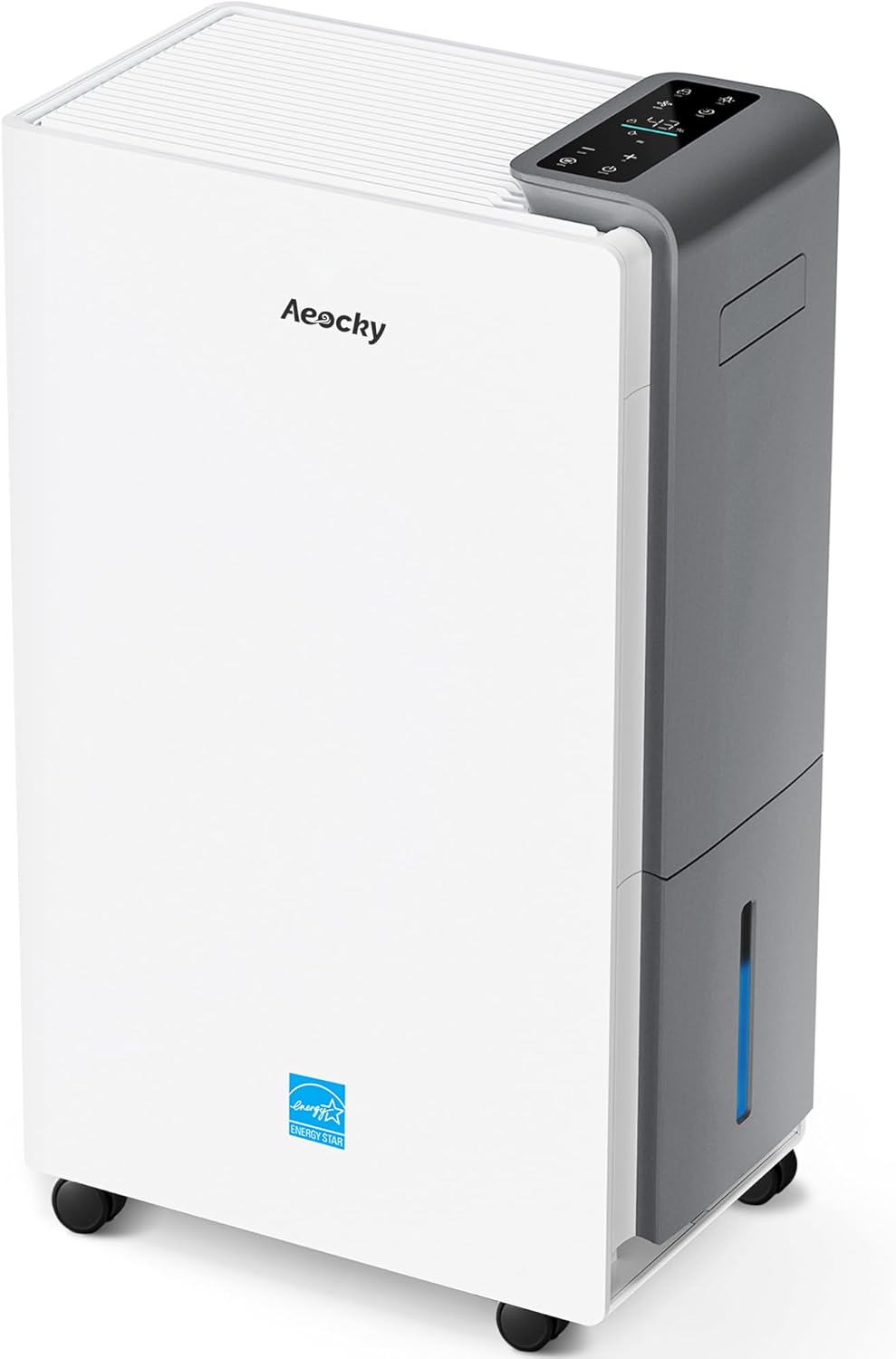
The AEOCKY RHEA-001 is a heavy-duty compressor dehumidifier built to remove up to 80 pints of moisture per day and cover very large areas. It is designed for continuous household use and offers multiple operation modes including Auto, Constant Humidity, Continuous, Smart Drying, and Sleep, plus an adjustable humidistat and timer for set-and-forget operation. The unit emphasizes energy efficiency, carrying an ENERGY STAR Most Efficient 2025 designation and a high airflow rating that helps it move a lot of air quickly. Practical touches include a 1.45 gallon tank, included drain hose and garden-hose adapter for continuous drainage, a low-noise design claimed around mid 40 dB, and power-off memory that restarts settings after outages. Trade-offs are typical for this capacity class: it is relatively large and meant for sustained use in big rooms or warehouse-like spaces, it has a single fan speed reported in specs, and it does not include a built-in pump on this configuration, so gravity or hose routing are needed for drainage. For buyers who prioritize verified efficiency and robust moisture removal, the RHEA-001 is engineered to run continuously with lower energy draw than many competitors.
Best for: Industrial or facility buyers who want a verified, energy-efficient dehumidifier that can run continuously to control humidity in large indoor areas and prioritize long-term reliability.
Less Ideal for: Small-room users or buyers who need a compact, pump-equipped unit for upstairs installations where gravity drainage is impractical.
- High dehumidification capacity rated at 80 pints per day for large spaces
- ENERGY STAR Most Efficient 2025 certification for strong energy savings
- Multiple operation modes and an adjustable humidistat for precise control
- Includes drain hose and garden-hose adapter for continuous drainage
- No built-in condensate pump in this model, so drainage must be gravity-fed or routed externally
- Single reported fan speed limits fine-grained airflow control
Verdict: Choose the RHEA-001 when you need a high-capacity, independently verified energy-efficient dehumidifier that can run continuously across large indoor spaces.
Choosing the Right Dehumidifier for Warehouse: Key Factors to Consider
Capacity and Sizing
Correct capacity is the single most important factor for warehouse dehumidification. Capacity should be chosen based on the volume of the space, typical ambient humidity, the expected moisture load from stored goods or processes, and whether the area is conditioned. Undersizing leads to continuous run times with limited effectiveness, while oversizing increases upfront cost and may cause short cycling in small subzones.
Calculate room volume and estimate required pints or liters per day at the temperatures you actually see in the warehouse. Consider seasonal extremes and whether doors open frequently. Where possible, plan for a system with some headroom to handle peak loads and to maintain a lower target relative humidity reliably.
Duty Cycle and Durability
Warehouses typically demand long run times and rugged construction. Look for units rated for continuous or commercial duty cycles, with heavy-gauge cabinets, protective coatings on coils, and compressors sized for extended operation. Components that tolerate dust and occasional impact will last longer in busy storage areas.
Also check condensate management options. Hard-drain or pump-assisted removal prevents daily emptying and reduces maintenance chores. Corrosion-resistant materials and easily replaceable service parts will minimize downtime and repair costs in the long run.
Energy Use and Operating Cost
A dehumidifier running many hours a day can become a significant energy expense. Compare moisture removal capacity against power draw to assess overall efficiency. Many commercial units publish liters or pints removed per kilowatt-hour; use that metric when possible.
Energy-efficient components such as variable-speed fans or compressors with duty modulation can reduce runtime and cost. Also consider control strategies like humidistats, timers, or integration with building management systems to avoid unnecessary operation during low-humidity periods.
Airflow, Distribution, and Placement
Removing moisture from a large volume depends as much on airflow and distribution as on raw extraction capacity. High airflow helps mix air in tall or partitioned warehouses, ensuring even drying and preventing isolated damp pockets. Look at rated CFM and whether the unit can be ducted to reach remote zones.
Placement matters: position units to create good circulation rather than pulling very dry or very humid air across short paths. For multiple zones, use several strategically located units or ducting to avoid dead spots around shelving, walls, and loading doors.
Maintenance and Serviceability
Frequent, simple maintenance keeps commercial dehumidifiers running reliably. Choose models with easy access to filters, coils, and service panels. Removable, cleanable filters and washable drip trays reduce labor. A clear condensate management plan—either hard plumbing, a built-in pump, or an accessible condensate bucket—will dictate daily upkeep needs.
Availability of replacement parts and the ability to perform field service on compressors, fans, and controls are important for minimizing downtime. Units with diagnostic indicators or simple control interfaces reduce technician time and help nontechnical staff manage daily operation.
Controls and Integration
Good control options let you run the dehumidifier efficiently without constant oversight. Built-in humidistats, adjustable setpoints, timers, and options for remote monitoring are valuable in warehouse contexts. Integration with a facility automation system or simple wired outputs for alarms can prevent unnoticed failures that allow humidity to rise.
Consider models that offer scalable control when you plan multiple units, so the entire system behaves predictably and avoids conflicting cycles that could lower overall effectiveness.
Sizing a Dehumidifier for Large Open Spaces
For large, open-plan warehouses, start by calculating cubic footage and estimating moisture sources such as incoming wet goods, processes that produce steam, or frequent exterior air infiltration. Convert the target humidity reduction into a daily moisture removal requirement to choose a unit rated for that output at realistic ambient temperatures.
When ceilings are very high, treat the space as a volume problem rather than a floor-area problem. Consider staged installation with multiple units or ducted distribution to move conditioned air through racks and wall cavities where moisture can collect.
- Measure actual temperature and RH during peak and off-peak conditions
- Account for door activity and loading dock influences
- Plan for modular capacity if inventory or processes change
Installation Considerations and Drainage Options
Drainage is a practical constraint in warehouses. Hard-piped drains or units with condensate pumps reduce daily labor and prevent accidental overflows. If plumbing is not available, choose units with large buckets and clear alerts, but expect higher maintenance.
Mounting and placement also affect performance. Floor-mounted, wall-mounted, or suspended installations each have tradeoffs for airflow, service access, and security. Protect units from forklift traffic and keep clear service zones for maintenance.
- Prefer hard-drain or pump models for continuous operation
- Ensure service access of at least a few feet around the unit
- Consider protective cages or mounting to avoid impact damage
Managing Noise and Staff Comfort
Industrial dehumidifiers can be noisy, particularly at high airflow settings. If staff spend extended time near operating units, plan acoustic mitigation such as locating equipment in mechanical rooms, using ducting to move intake and discharge, or selecting units with lower fan speed options.
Noise is also a consideration where humidity control is used near offices or packing stations. Evaluate rated sound levels and test or simulate expected acoustic conditions during peak operation.
- Place noisy units away from occupied areas when possible
- Use ducting or baffling to reduce perceived sound
- Balance airflow needs against fan speed and noise ratings
Controls, Monitoring, and Automation
Remote monitoring and simple automation can prevent large humidity excursions. Choose units with reliable humidistats, alarm outputs, and optional networked monitoring if you need continuous logging or alerts. Automated setpoints reduce the chance of manual error and lower energy use by avoiding unnecessary operation.
For multiple-unit installations, coordinate controls so units cycle in a complementary way rather than fighting each other. Centralized or grouped control strategies improve efficiency and make it easier to scale capacity.
- Use humidity setpoints that reflect the inventory's tolerance
- Consider logging RH trends to spot developing issues
- Automate warnings for full condensate or maintenance intervals
Seasonal and Environmental Challenges
Warehouses experience seasonal swings in temperature and humidity that affect dehumidifier performance. Cold conditions reduce coil effectiveness for refrigerant-based units, so choose equipment rated for lower temperature operation or plan supplemental heating in cold months.
Dust, salt air, and chemical fumes can accelerate corrosion and clog coils. In harsh environments, specify corrosion-resistant finishes, washable prefilters, and maintenance schedules that include coil cleaning to maintain capacity and efficiency.
- Specify cold-rated performance if temperatures drop below typical indoor levels
- Plan increased maintenance in dusty or corrosive atmospheres
- Consider humidity buffering strategies for highly variable operations
How We Chose the Best Dehumidifier for Warehouse
We focused on factors that matter for continuous, commercial-scale moisture control rather than small-room convenience. Selection began with units designed for large-volume environments and industrial duty cycles, then filtered for verified moisture removal capacity at realistic warehouse temperatures and humidity levels. We prioritized models with clear performance data for pints or liters removed per day at moderate and cool conditions, plus measured airflow and rated coverage area. Long-term durability was a major screen: compressors, coils, and condensate handling designs that tolerate extended run times and dusty conditions were preferred. Energy efficiency and operating cost were weighed through reported power consumption relative to moisture removal, since warehouses often run dehumidifiers continuously. Serviceability and parts access were another filter: units with modular components, accessible filters, and straightforward condensate management reduce downtime. Noise and integration—fan noise and ducting or ductless adaptability—were considered for warehouses with staff presence or sensitive processes. We excluded consumer-grade, small-room units and any models lacking clear capacity or duty-cycle data. The final selections reflect a balance of high-capacity drying, durability under continuous operation, energy efficiency, and maintainability.
Our full evaluation process is outlined in our review methodology.
FAQ
How do I calculate the right dehumidifier capacity for my warehouse?
Estimate the warehouse volume in cubic feet and identify moisture sources such as wet goods or frequent door openings. Convert your target relative humidity reduction into a daily moisture removal need and select a unit rated to remove that amount at your typical operating temperature.
Can I use residential dehumidifiers in a warehouse?
Residential units are generally not designed for continuous, large-volume operation and may fail quickly under warehouse duty cycles. Commercial or industrial-rated units are built for extended runtimes, larger airflow, and more robust condensate management.
What drainage option is best for continuous operation?
Hard-piped drainage or a built-in condensate pump is preferable for continuous operation because it eliminates daily bucket emptying and reduces overflow risks. Where plumbing is unavailable, choose larger buckets and reliable full-bucket alerts, but expect more routine maintenance.
How often should I service a warehouse dehumidifier?
Service frequency depends on environment and usage, but inspect filters and coils monthly in dusty settings and perform more thorough maintenance quarterly. Replace or service any worn fans, belts, or pumps promptly to avoid major failures under continuous operation.
Will a dehumidifier help with condensation on windows and doors?
Yes. By lowering interior humidity, a properly sized dehumidifier reduces surface condensation on windows and doors. Ensure adequate airflow near those surfaces and address cold spots that can still condense moisture despite lower ambient humidity.
Are there special considerations for cold-storage warehouses?
Cold spaces reduce the effectiveness of refrigerant-based dehumidifiers because coils can ice up. Use units rated for low-temperature operation or consider desiccant-based systems and supplemental heating to maintain effective moisture removal in chilled environments.
Final Verdict
Selecting a dehumidifier for warehouse use is about matching capacity, duty-cycle robustness, and practical installation needs to the real operating conditions of the space. Prioritize units that deliver the moisture removal rate you calculated, are built for continuous operation, and offer easy condensate management and service access. Balance energy efficiency against runtime requirements and choose controls that let you automate operation to avoid unnecessary energy use. If you plan for airflow distribution, maintenance access, and seasonal performance, you can choose a system that protects inventory and structure while minimizing operating cost and downtime. Focus on the tradeoffs between capacity, durability, and serviceability to make a confident choice.