
Note: This article contains affiliate links. If you click on these links and make a purchase, we may earn a small commission at no extra cost to you. This helps support our research and content. Read our full affiliate disclosure here.
A damp basement can lead to mold, musty odors, and accelerated wear on stored items and finishes. Choosing the right dehumidifier for home basement use matters because basements often have larger volumes, cooler temperatures, and persistent sources of moisture that ordinary room units cannot handle. This guide covers seven shortlisted dehumidifiers selected for basement conditions and explains the practical factors that matter for installation, ongoing cost, and humidity control. Read on to see the key strengths we evaluated and which features matter most for typical basement setups.
Top Picks at a Glance
| Best Overall The best all-around choice for most situations | KNKA 80-Pint Dehumidifier PD30MA-20 |  |
| Best Quality Built to a higher standard if you want something more solid | AEOCKY RHEA Dehumidifier |  |
| Best Value The sweet spot between price and what you get | VEAGASO VG380 Dehumidifier |  |
| Best Budget The cheapest option that still gets the job done reliably | BEDRED CT11 Dehumidifier |  |
| Top Rated A top-rated pick with lots of positive feedback | FYHXZYB 100-Pint Dehumidifier |  |
| Most Popular A crowd favorite that many people choose with confidence | hOmeLabs 50 Pint Dehumidifier | 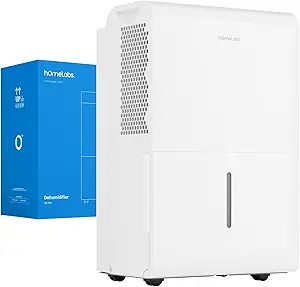 |
| Best Seller A high-volume bestseller chosen again and again | ToLife Dehumidifier TZ-C2 |  |
KNKA 80-Pint Dehumidifier PD30MA-20

| Capacity | 80 pints per day |
|---|---|
| Tank Volume | 1.45 gallons |
| Wattage | 360 watts |
| Floor Area | 4500 square_feet |
| Operation Mode | AUTO, DRY, SETTING |
The KNKA PD30MA-20 is a performance-focused dehumidifier built for large, damp spaces such as basements. Its high-efficiency compressor can remove up to 80 pints per day under extreme conditions and about 56 pints in typical basement conditions, while an internal 1.45 gallon tank plus a supplied 6.56 ft drain hose enable continuous drainage to avoid frequent emptying. Controls include AUTO, DRY, and a SETTING mode for 30%–80% RH, and the digital display with a color-changing humidity indicator makes it easy to monitor conditions at a glance. The unit is designed to run quietly (40–45 dB), has a washable filter, casters for moving between rooms, cord storage, a 12-hour timer, and a child lock for steady, unattended operation. Expect good energy efficiency thanks to ENERGY STAR certification and a 360 watt power draw, but note that humidity readings come from the air inlet and may differ slightly from a separate hygrometer; the unit also needs upright siting for 24 hours before first use. For heavy-duty basement dehumidification this model balances strong capacity with thoughtful usability features.
Best for: Buyers who need powerful, reliable moisture removal in large basements or very damp rooms and prioritize steady performance and easy continuous drainage.
Less Ideal for: People seeking a compact or ultra-light unit for small rooms or occasional use should consider lower-capacity, more portable models instead.
- High maximum dehumidification capacity up to 80 pints per day for large, very humid spaces
- Includes 6.56 ft drain hose and built-in tank for continuous drainage to reduce manual emptying
- ENERGY STAR certified and uses a high-efficiency compressor for lower operating costs relative to output
- Quiet operation (40–45 dB) and caster wheels make it suitable for basements and living spaces
- Digital display with real-time humidity readout and color indicator simplifies monitoring and control
- Humidity reading is measured at the air inlet and may not match a separate room hygrometer
- Requires upright placement for 24 hours before first use to avoid operational issues
Verdict: Choose this KNKA if you need a strong, ENERGY STAR certified dehumidifier that can handle large basements with continuous-drain capability and quiet operation.
AEOCKY RHEA Dehumidifier

| Capacity | 105 pints |
|---|---|
| Dehumidification Capacity | 100 pints_per_day |
| Tank Volume | 1.45 gallons |
| Wattage | 400 watts |
| Operation Mode | Auto, Constant Humidity, Continuous, Smart Drying, Sleep |
The AEOCKY RHEA is a performance-focused compressor dehumidifier built to handle very large, damp spaces like basements. It removes up to 100–105 pints per day under heavy conditions and is marketed for coverage up to 6000 sq ft, using a rotary compressor and a 3-row evaporator/condenser layout to prioritize fast moisture removal and energy efficiency. The unit offers multiple modes including Auto, Constant Humidity, Continuous, Smart Drying and Sleep, plus adjustable humidity from 40 to 80 percent and a child lock, timer and fan-speed control for daily convenience. Practical features include an included drain hose and garden-hose adapter for continuous drainage and an auto-defrost routine that helps the machine keep running in cooler basement temperatures. Trade-offs to consider are the relatively large water tank compared with its daily capacity, so continuous drainage is useful for heavy use, and the unit is substantial in size and weight, which affects placement and portability. For buyers focused on raw dehumidifying power and operating efficiency in basements, the RHEA is a strong contender.
Best for: Buyers who prioritize fast, reliable moisture removal and lower operating costs in large or very damp basements and want a robust, energy-efficient compressor unit that can run continuously.
Less Ideal for: People who need a compact, lightweight dehumidifier for small rooms, occasional use, or frequent moving between rooms should consider smaller, more portable models instead.
- Very high dehumidification capacity up to ~100–105 pints per day for rapid moisture removal
- ENERGY STAR Most Efficient rating indicating strong energy performance
- Smart humidity control with adjustable setpoint, multiple operation modes, and child lock for precise, safe operation
- Auto-defrost and continuous-drain capability suitable for cool basements and unattended use
- Includes drain hose and garden-hose adapter for easy continuous drainage
- Large daily capacity makes the internal tank fill slowly relative to output so continuous drainage is often needed
- Physically large and heavy which can limit easy relocation or tight placement
Verdict: Choose the RHEA when you need industrial-level dehumidifying performance and top-tier energy efficiency to control humidity in large basements and other very damp spaces.
VEAGASO VG380 Dehumidifier

| Capacity | 34 pints per day |
|---|---|
| Coverage Area | Up to 2500 square feet |
| Tank Volume | 0.53 gallon (2 liters) |
| Wattage | 230 watts |
| Noise Level | ≤40 dB |
The VEAGASO VG380 is a compact compressor dehumidifier designed for large rooms and basements that need steady moisture control. It removes up to 34 pints per day and offers three operating modes: an automatic DEHU mode that holds a set humidity, a higher-intensity DRY mode for drying laundry, and a CONT mode for nonstop operation in very damp spaces. The unit includes a 0.53 gallon removable tank plus a drain hose for continuous drainage, an LED touch panel with adjustable humidity set points and a 1–24 hour timer, and features like auto defrost and power-failure memory so it resumes settings after outages. Practical touches—360 degree swivel casters, recessed handle, washable filter, and a child lock—make it easy to move and maintain. Noise levels are kept under 40 dB in low-speed/sleep modes, suitable for bedrooms adjacent to basements. Trade-offs are typical of compressor units: you will need to empty the small tank if not using the drain hose and performance drops at lower temperatures, though this model claims operation down to about 41°F with auto defrost.
Best for: Buyers who prioritize steady, hands-off moisture control in basements or large rooms and want a portable unit with continuous-drain capability and quiet overnight operation.
Less Ideal for: People needing dehumidification in unconditioned, consistently freezing spaces or those who prefer silent thermoelectric units for very small rooms.
- High dehumidification capacity rated at 34 pints per day for large rooms and basements
- Three modes (DEHU, DRY, CONT) to match everyday humidity control, laundry drying, or continuous basement use
- Continuous drain hose included plus a removable tank with auto shutoff to prevent overflow
- Quiet operation under 40 dB in low/sleep mode for use near living spaces
- Practical features like touch LED controls, power-failure memory, washable filter, casters, and child lock
- Small built-in tank (0.53 gallon) requires frequent emptying without continuous drain
- Compressor-type units become less efficient in very cold environments despite auto defrost
- No humidity sensor calibration details provided beyond the displayed reading
Verdict: A practical, portable compressor dehumidifier that delivers high daily moisture removal and continuous drain options ideal for basements and large rooms.
BEDRED CT11 Dehumidifier

| Floor Area | 1000 square_feet |
|---|---|
| Tank Volume | 95 fluid ounces |
| Capacity | 5.9 pounds |
| Operation Mode | Intermittent |
| Other Special Features of the Product | 7 Color Ambient Light, Automatic Shutoff, Sleep Mode |
The BEDRED CT11 is a compact thermoelectric dehumidifier intended to reduce humidity in small spaces such as bedrooms, bathrooms, and modest basements up to about 1000 sq ft. It uses semiconductor cooling rather than a compressor, so it runs quietly and is simple to operate with an intermittent operation mode and an automatic shutoff when the 95 oz tank fills. Sleep Mode turns off the lights and lowers noise for overnight use, and the seven-color ambient light gives an optional mood-lighting feature. Practical benefits include easy emptying from the included tank, portability thanks to a lightweight design, and low sound levels that suit living spaces. Important limitations are inherent to semiconductor units: lower capacity compared with compressor dehumidifiers, reduced performance in very cold or very damp basements, and a smaller tank that requires more frequent emptying in high-humidity conditions.
Best for: Buyers who prioritize quiet, low-maintenance dehumidification and want a compact unit that is easy to move and run in living spaces or small basements without frequent intervention.
Less Ideal for: People needing heavy-duty moisture control for large, cold, or very damp basements should choose a higher-capacity compressor dehumidifier instead.
- Quiet thermoelectric operation suitable for bedrooms and living rooms
- Automatic shutoff protects against overfill and simplifies unattended use
- 95 oz removable tank for straightforward water removal
- Sleep Mode and ambient light options for low‑noise nighttime use
- Compact and lightweight for easy placement or moving between rooms
- Semiconductor cooling gives lower moisture removal capacity than compressor models
- Performance drops in cold basement conditions and very high humidity areas
Verdict: Choose the BEDRED CT11 if you want a quiet, portable dehumidifier with auto‑shutoff and sleep‑friendly operation for small basements or living spaces.
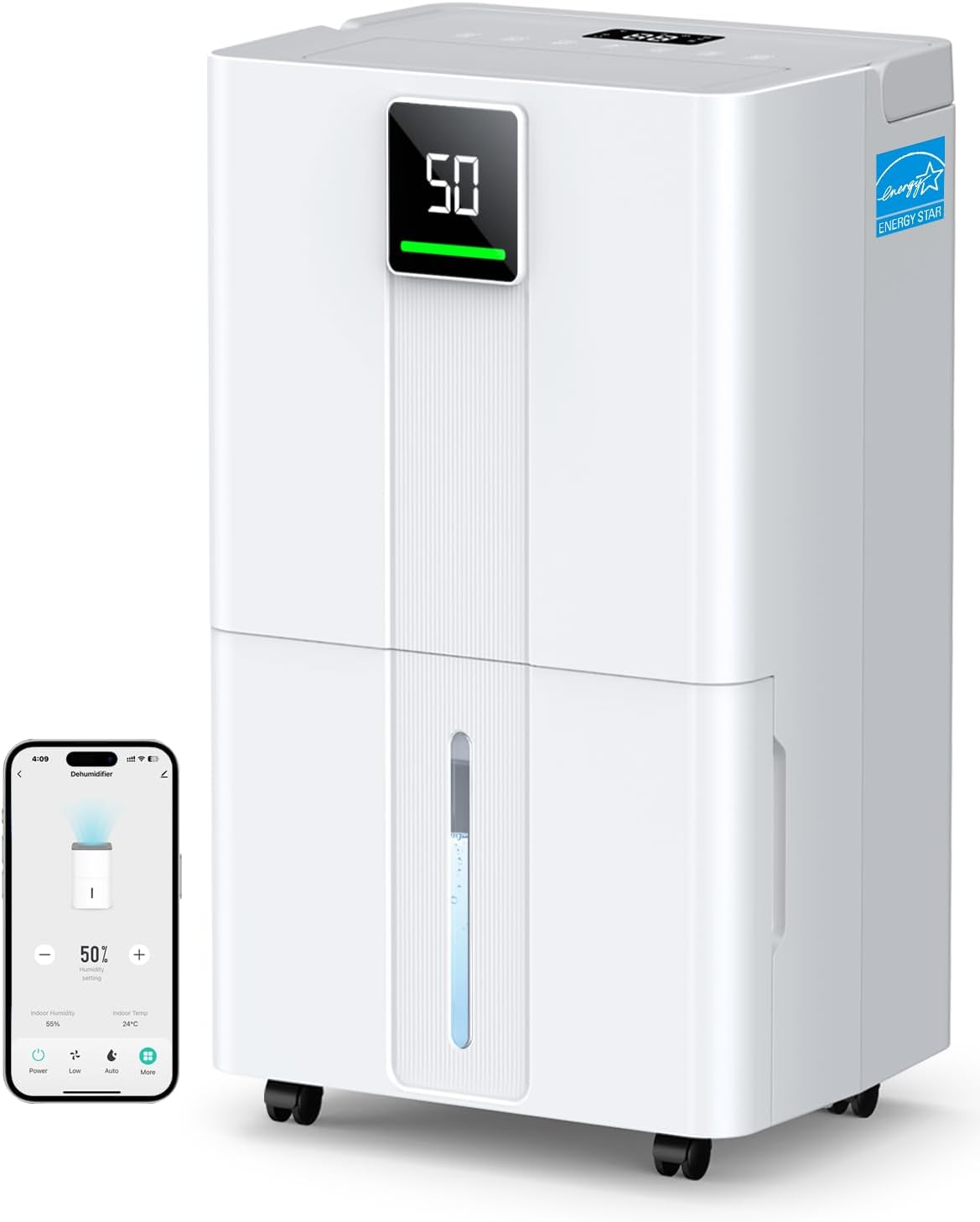
FYHXZYB 100-Pint Dehumidifier
| Capacity | 100 pints |
|---|---|
| Tank Volume | 1.45 gallons |
| Wattage | 270 watts |
| Air Flow Capacity | 165 cfm |
| Operation Mode | Auto, Fan, Continuous, Sleep, 24H Timer |
This FYHXZYB dehumidifier is built to remove large amounts of moisture from big rooms and basements, rated to extract up to 100 pints per day under test conditions and covering up to 6,000 sq ft. It offers multiple operation modes including Auto, Continuous, Fan, Sleep, and a 24-hour timer, plus Wi‑Fi control through the Smart Life app for remote scheduling and monitoring. Practical features include a visible 1.45 gallon removable tank with automatic shutoff, an included drain hose for continuous gravity drain, washable rear filter, auto air swing for wider coverage, and four 360° casters for easy moving between rooms. The unit is Energy Star certified and uses a compressor with enhanced heat-exchange components and auto-defrost for all-climate operation, which helps maintain reliable performance. On the downside it is a large-capacity appliance that requires space and a power source and will produce typical compressor noise when running at higher speeds despite a quoted 36 dB sleep mode. For homeowners who need dependable, whole-room moisture control in basements or large living spaces, this unit offers robust performance and thoughtful service features.
Best for: Homeowners seeking a reliable, high-capacity dehumidifier to control humidity across large rooms or basements who prioritize consistent performance and energy efficiency.
Less Ideal for: People who need a very small, ultra-quiet or highly portable unit for single small rooms or who cannot accommodate the device's size and continuous drain requirements should consider smaller models instead.
- High dehumidification capacity up to 100 pints per day for large spaces
- Energy Star certified with a compressor and enhanced heat-exchange design for efficient operation
- Wi‑Fi app control and 24-hour timer for remote scheduling and monitoring
- Multiple drainage options including removable visible tank with auto shutoff and included drain hose
- Auto-defrost, auto air swing, washable filter, child lock, and caster wheels for practical everyday use
- Large physical footprint and weight mean it needs floor space and may be cumbersome to move without effort
- Compressor-based operation can be audible at higher fan speeds compared with non-compressor or desiccant units
Verdict: Choose this model if you need an Energy Star certified, high-capacity dehumidifier that delivers dependable, whole-basement moisture control with smart remote scheduling.
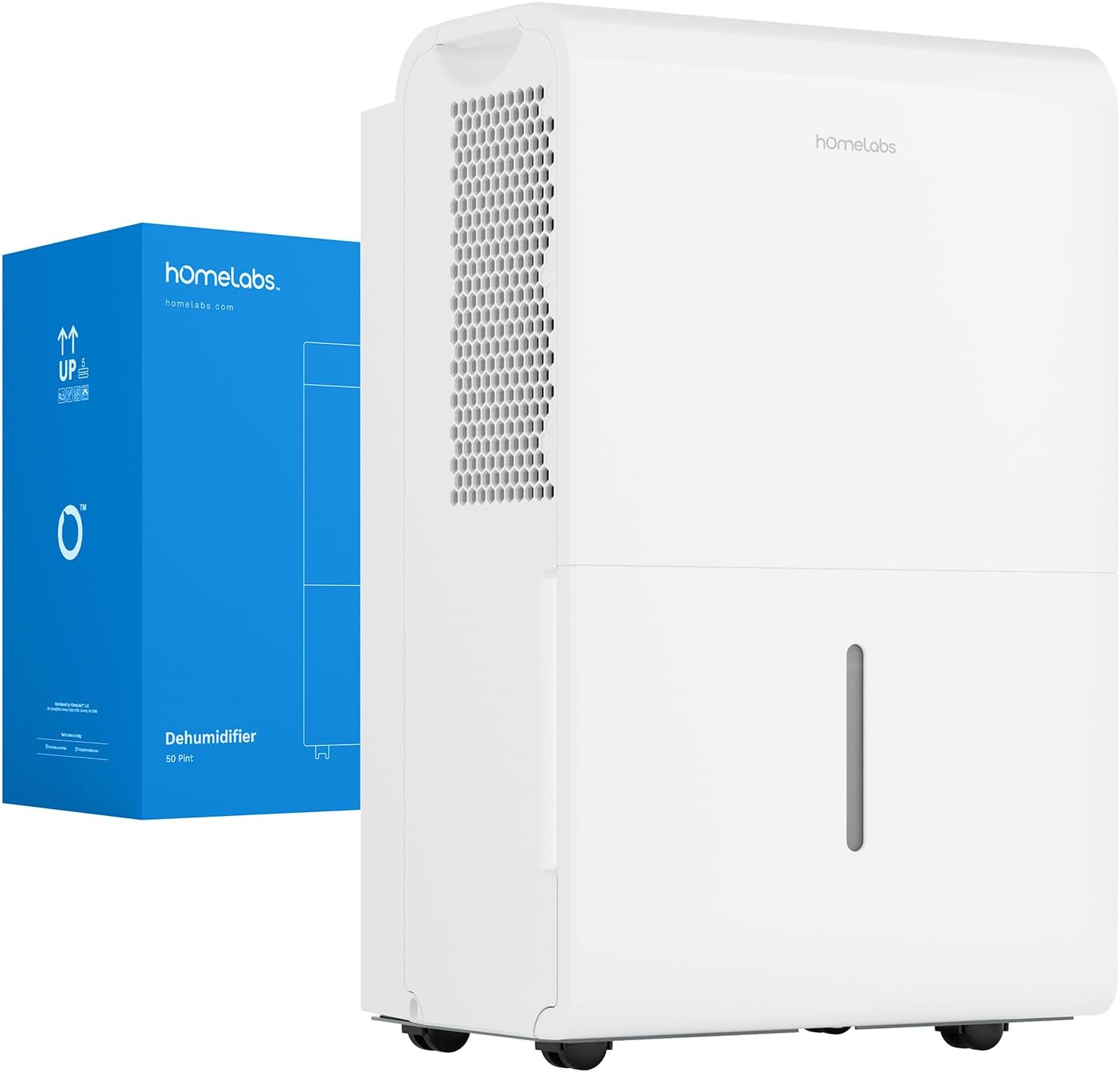
hOmeLabs 50 Pint Dehumidifier
| Dehumidification Capacity | 50 pints/day |
|---|---|
| Floor Area | 7000 square_feet |
| Tank Volume | 1.6 gallons |
| Wattage | 322 watts |
| Air Flow Capacity | 165 cfm |
This hOmeLabs unit is a large-capacity dehumidifier intended for whole-room or basement use that combines strong moisture removal with smart controls. It is rated to handle up to 7,000 sq ft and removes up to 50 pints per day under standard conditions, with continuous operation and an auto shutoff when the removable 1.6-gallon tank fills. The unit includes Wi‑Fi so you can monitor and change settings remotely, plus a hose outlet for continuous drainage and a washable filter to reduce maintenance costs. Two fan speeds and a turbo mode let you balance quiet operation versus faster drying, and built-in features such as automatic defrost and restart help it run reliably in cooler basement conditions. Trade-offs are typical for this size: it is a heavy, freestanding appliance and will use household power while running, and you will still need to empty the tank or set up a drain line unless you use the continuous drainage option. For damp basements that need serious dehumidification and the convenience of remote control, this model is a sensible choice.
Best for: Homeowners needing robust, reliable humidity control for basements or large rooms who value remote control and continuous drainage options.
Less Ideal for: People who need a compact, lightweight travel or small-room dehumidifier or who cannot accommodate a heavier appliance in limited space.
- High dehumidification rate suitable for large residential spaces
- Wi‑Fi connectivity for remote monitoring and control
- Continuous drain outlet plus removable 1.6-gallon tank for flexible water management
- Washable filter and automatic defrost/restart for lower maintenance and reliable cold-room operation
- Turbo and two-speed fan options to prioritize speed or quieter operation
- Large and relatively heavy compared with small portable units
- Consumes significant power during extended heavy-duty use
Verdict: Choose this unit if you want strong, Wi‑Fi‑enabled basement humidity control with flexible drainage and reliable cold‑room features.
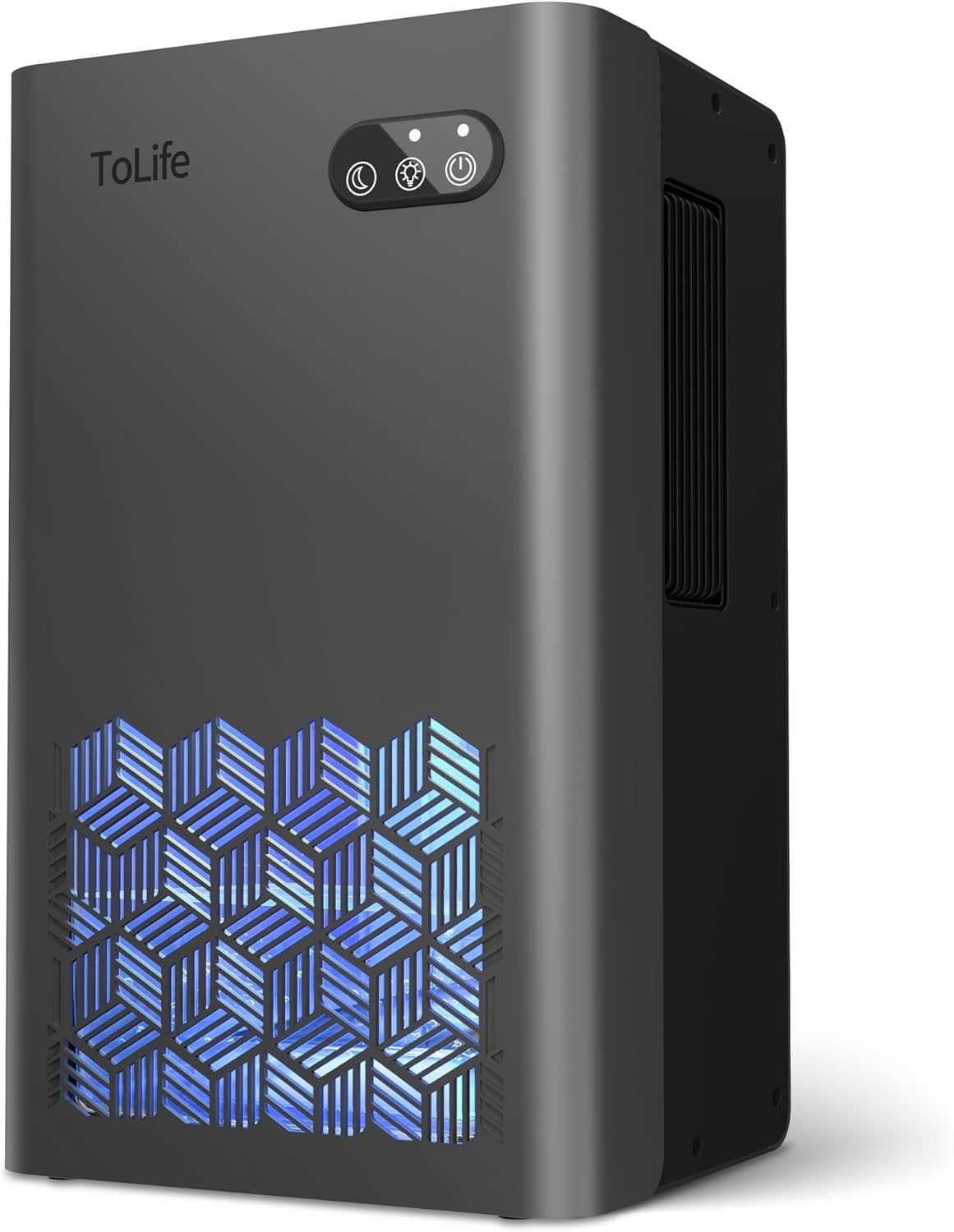
ToLife Dehumidifier TZ-C2
| Floor Area | 1000 |
|---|---|
| Tank Volume | 95 fluid ounces |
| Number of Speeds | 2 |
| Wattage | 93 watts |
| Voltage | 220 volts |
The ToLife TZ-C2 uses semiconductor condensation technology to quietly pull moisture from the air and deposit it into a removable 95 oz tank, making it a straightforward option for damp rooms. It offers two operating modes: a higher-power setting for faster moisture removal and a low-speed sleep mode that runs under 30 dB for overnight use. A seven-color LED can act as a night light and the unit includes automatic shutoff when the tank is full or removed, plus handles for easy moving between rooms. Practical benefits include simple setup, low noise, and a compact footprint that fits in basements, bathrooms, or bedrooms. Limitations are its modest rated dehumidification capacity and stated coverage, which means it will be most effective in smaller basement zones or for spot treatments rather than drying a large, very damp basement quickly. Also this model runs on 220 volts, so electrical compatibility should be confirmed for your location.
Best for: Buyers who need an affordable, portable dehumidifier for spot dehumidifying small basement areas, bathrooms, or bedrooms and who prioritize low noise and easy portability.
Less Ideal for: People looking to dry large, very damp basements or whole-house coverage should consider a higher-capacity compressor dehumidifier instead.
- Large removable 95 oz water tank reduces how often you need to empty it
- Quiet sleep mode under 30 dB suitable for nighttime operation
- Portable design with handles for moving between rooms
- Automatic shutoff prevents overflow when the tank is full
- Dehumidification capacity is modest and may be slow in very damp or large basements
- Requires 220 volt power which may not match all household outlets
Verdict: A compact, budget-friendly portable dehumidifier that is best for quiet, small-area moisture control and occasional basement spot treatments.
Choosing the Right Dehumidifier for Home Basement: Key Factors to Consider
Capacity and Basement Size
Basement cubic footage and ceiling height determine the required extraction capacity. A unit rated for larger square footage will remove more pints per day, which matters when humidity sources include groundwater infiltration, wet laundry, or unfinished walls.
Under-sizing leads to long run times and persistent dampness, while over-sizing increases upfront energy draw and cycling. Match capacity to the basement's conditions rather than just floor area; cooler spaces reduce extraction efficiency, so choose a model with extra capacity if temperatures regularly fall below typical room temperatures.
Performance at Cool Temperatures
Basements are often cooler than living spaces, and many dehumidifiers lose extraction rate as ambient temperature drops. Look for units with proven low-temperature performance or an auto-defrost function that maintains operation near chilly basement temperatures.
A model that sustains reasonable moisture removal at lower temperatures avoids constant cycling and reduces mold risk. For unfinished or cold basements, prioritize specs and user feedback about extraction at 50 degrees Fahrenheit or lower.
Drainage Options and Continuous Operation
Basements benefit from continuous drainage to avoid frequent emptying. Choose between gravity-fed hose outlets, built-in condensate pumps, or large removable buckets depending on floor drains and placement.
Gravity drainage requires a higher drain point or a sloped hose run, while pump-equipped units can discharge upward to a sink or drain. Consider how often you want to check the bucket and whether automatic shutoff on a full tank is acceptable for your setup.
Energy Use and Long-Term Cost
Dehumidifiers can run for many hours in humid basements, making energy efficiency a major operating cost factor. Look for models with efficient refrigerant cycles, smart humidity controls, and programmable timers to limit runtime when not needed.
A slightly higher-efficiency unit can pay back over a season of heavy use. Also consider how precise the humidistat is; better control reduces unnecessary runtime and energy waste.
Noise, Location, and Vibration
Basement units may run near living spaces or finished rooms above, so noise and vibration matter. Look for units identified as quiet or with low-vibration feet, and plan placement away from shared walls or ceilings where possible.
Pumps, fans, and compressors produce different sound profiles, so consider measured decibel levels and user reports. Vibration isolation and a stable placement surface will reduce noise transfer and make long unattended operation less intrusive.
Maintenance, Filter Access, and Durability
Regular cleaning of filters and coils keeps performance high and prevents odor issues. Choose units with easily accessible filters, clear maintenance indicators, and corrosion-resistant drain fittings that withstand basement humidity.
Durable housings and accessible service panels simplify upkeep. Consider how straightforward it is to replace filters or access the condensate tank without moving a heavy unit.
Sizing Your Basement Dehumidifier
Estimate basement volume rather than only floor area when choosing capacity. Multiply floor area by ceiling height to get cubic feet, then pick a unit rated to handle that volume under the expected humidity load.
Factor in sources of moisture such as sump pits, uncovered soil, frequent laundry, or wet concrete. For cooler basements, choose a model with a higher rated extraction to compensate for reduced efficiency at low temperatures.
- Use extra capacity for unfinished or frequently wet basements
- Smaller finished basements with minimal moisture may need only a moderate-capacity unit
- Check manufacturer specs for extraction at lower temperatures if your basement is chilly
Choosing Drainage and Installation Setup
Decide whether you need continuous drain capability. If a floor drain is nearby, a hose-equipped unit can run unattended. If not, a model with a built-in condensate pump provides more installation flexibility.
Plan hose routing and slope for gravity drain setups and confirm the outlet thread and connector type to match your hose. For pump units, confirm the maximum vertical lift to your chosen drain point.
- Gravity drain is simple but needs a downhill route
- Pump-assisted drainage allows mounting below drain level
- Ensure condensate pump capacity matches your expected daily output
Placement and Airflow Considerations
Locate the dehumidifier where air can circulate freely on all sides, not tucked into a corner. Position it centrally for even dehumidification, or use multiple smaller units for large irregular basements.
Keep the intake and exhaust clear of obstructions and at least several inches from walls or stored items. Elevate the unit slightly if the floor is occasionally wet to prevent water ingress into the base.
- Allow manufacturer-recommended clearance around the unit
- Avoid placing directly against drywall or insulation that could trap moisture
- Use a drip pan or platform if the floor is prone to puddling
Managing Noise and Vibration
Measure or estimate where sound will be noticeable. If noise is a concern, look for units with lower reported decibel ratings and vibration-dampening feet. Placement on a rubber mat can significantly reduce structure-borne noise.
Consider timed operation or scheduling higher-speed modes for daytime hours while using quieter settings at night to minimize disturbance.
- Rubber feet or isolation pads reduce vibration transfer
- Choose lower fan speeds for quieter long-run operation
- Avoid placing near rooms above if possible to limit sound transmission
Seasonal Use and Winter Considerations
If your basement is used seasonally and temperatures drop low in winter, check whether the unit has an auto-defrost mode or is rated for low-temperature operation. Some units may cycle off below a threshold to protect the compressor.
For year-round humidity control, prioritize models designed to run at lower ambient temperatures to avoid loss of function when the basement is colder.
- Auto-defrost prevents icing in cool conditions
- Some units include a low-temperature extraction spec
- Consider storing or protecting units if temperatures drop below operational range
Portable Vs Hardwired Options
Most home basement dehumidifiers are plug-and-play portable units. These are simple to reposition and usually require no installation beyond a drain hose or bucket placement. Hardwired or dedicated-line models are less common for residential basements but can be considered where local code or long-term installation plans justify it.
Portable units allow you to reposition for seasonal needs or when using the basement for different activities. Confirm cord length and outlet location before final placement.
- Portable units are flexible and easy to replace
- Hardwired installations may require an electrician and local code compliance
- Check power requirements to ensure the circuit can handle continuous operation
How We Chose the Best Dehumidifier for Home Basement
We focused on performance and real-world suitability for basement environments. Key evaluation criteria included moisture removal capacity at low temperatures, energy efficiency and operating cost, reliability of continuous or gravity-drain options, ease of installation and maintenance, and controls for target humidity and auto-defrost behavior. Products that could not sustain rated extraction in cool or marginal conditions were excluded, as were models lacking effective drainage options for continuous operation. We also prioritized units with clear control interfaces and accessible filters because basements are often out of sight and need low-maintenance operation. Durability and corrosion resistance were considered, since basements are a higher-moisture environment. Finally, we inspected warranty terms and documented features that reduce user effort, such as pump-assisted drainage or large buckets, while excluding specialty commercial units that are oversized for typical home basements. The result is a group of seven options balanced for basement size, temperature, and continuous-use scenarios.
Our full evaluation process is outlined in our review methodology.
FAQ
How often should I run a dehumidifier in a basement?
Often it runs continuously in humid seasons until relative humidity stabilizes at your target. Many basements require near-continuous operation during warm, damp months; using a humidistat helps avoid unnecessary runtime.
Can I place a dehumidifier directly on a basement floor?
You can, but elevating the unit slightly is better if the floor occasionally gets wet. Elevation improves airflow and protects the unit from standing water and debris.
Is a condensate pump necessary for basement use?
A condensate pump is helpful if you need to route discharge uphill or to a distant drain. If a suitable gravity drain is close by, a simple hose connection may be sufficient.
What relative humidity should I keep in a basement?
Aim for 40 to 50 percent relative humidity to limit mold growth and odor while avoiding over-drying. The precise target depends on comfort and preservation needs for stored items.
Will a dehumidifier prevent mold completely?
It reduces the chance of mold by lowering humidity, but it will not address mold caused by ongoing water leaks or poor ventilation. Fixing moisture sources and improving airflow are also necessary for full prevention.
Final Verdict
Pick a dehumidifier sized for your basement volume and moisture load, and prioritize models that maintain extraction at cooler temperatures if your space is chilly. Continuous drainage capability, energy efficiency, and straightforward maintenance are the most impactful tradeoffs for long-term use. Balance capacity, drainage, and noise so the unit can run as needed without excessive upkeep. With the right priorities, you can control humidity, reduce mold risk, and protect stored items and finishes effectively.