
Note: This article contains affiliate links. If you click on these links and make a purchase, we may earn a small commission at no extra cost to you. This helps support our research and content. Read our full affiliate disclosure here.
If you manage basements, open-plan living areas, or commercial rooms, the right dehumidifier for large spaces makes a tangible difference in comfort and upkeep. High-capacity units remove moisture faster, reduce mold risk, and help HVAC systems run more efficiently, but not every high-output model suits every layout or usage pattern. This guide covers a short list of top-performing dehumidifiers that are suitable for large rooms and open areas. We evaluated extraction capacity, run time, and energy use to shortlist reliable options and to help you pick the best fit for your space. Keep reading to see which features matter most and which tradeoffs to expect when choosing a dehumidifier for larger environments.
Top Picks at a Glance
| Best Overall The best all-around choice for most situations | Waykar 150 Pint Dehumidifier |  |
| Best Value The sweet spot between price and what you get | DGVAM V1 Dehumidifier |  |
| Best Budget The cheapest option that still gets the job done reliably | AIRPLUS 70-Pint Dehumidifier |  |
| Top Rated A top-rated pick with lots of positive feedback | hOmeLabs 50 Pint Dehumidifier | 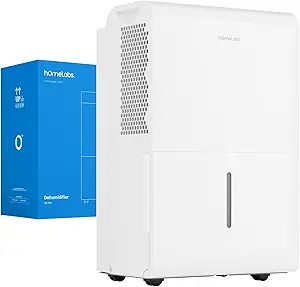 |
| Most Popular A crowd favorite that many people choose with confidence | Waykar 120 Pint Dehumidifier |  |
| Best Seller A high-volume bestseller chosen again and again | MIONJO V3 Dehumidifier |  |
Waykar 150 Pint Dehumidifier
| Capacity | 150 pints |
|---|---|
| Floor Area | 7000 square_feet |
| Tank Volume | 2.11 gallons |
| Wattage | 750 watts |
| Air Flow Capacity | 159 cfm |
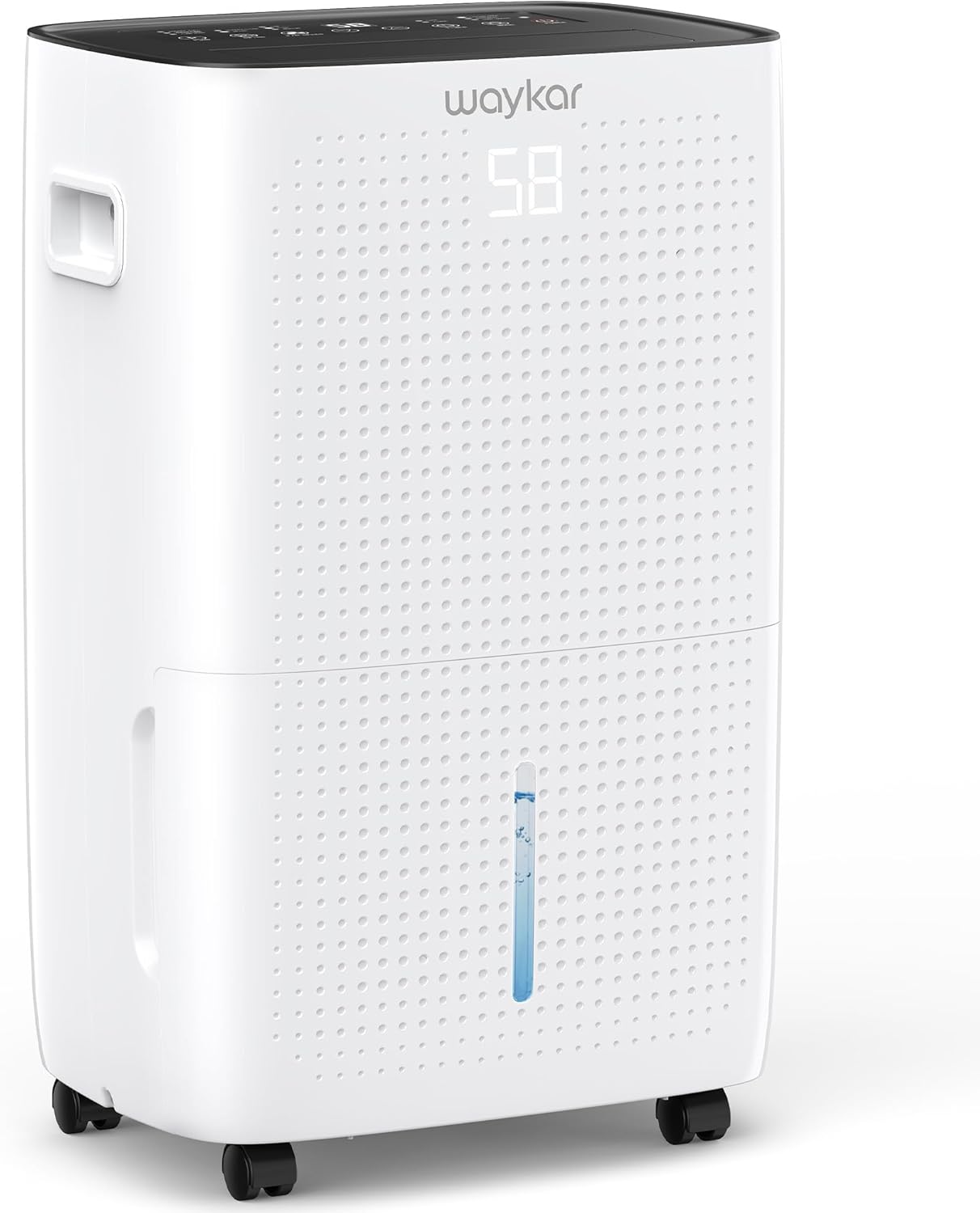
This Waykar unit is a heavy-duty 150-pint dehumidifier built for large rooms, basements, garages, and commercial spaces. It removes up to 150 pints per day (measured at 95°F, 90% RH), offers continuous and manual drainage via the included hose or the 2.11 gallon visible tank, and uses a 90° auto-swing fan to distribute drier air more evenly across wide areas. Controls include two fan speeds, modes for Continuous, Dry, and Fan, a 24-hour timer, and a control-lock to prevent accidental changes. The unit also has auto-defrost and an AI-style protection system to manage frost and overload for reliable operation in cooler or continuous-use environments. Practical benefits include strong moisture removal for whole-house or commercial use, less frequent tank emptying, and energy-conscious design with a 750W compressor and claimed efficiency improvements. Trade-offs are its size and weight compared with smaller home units, and it may be overkill for small rooms or occasional use where a lower-capacity model would be quieter and use less power.
Best for: Buyers needing a robust, energy-aware dehumidifier for whole basements, large open-plan homes, or commercial spaces who prioritize strong continuous moisture removal and reliable long-run performance.
Less Ideal for: People looking for a lightweight, ultra-quiet unit for a single bedroom or infrequent use should consider lower-capacity residential models instead.
- Very high moisture removal rate suitable for spaces up to 7,000 sq ft
- 90° auto-swing fan improves air distribution for more even dehumidification
- Multiple drainage options with included hose and large visible 2.11 gal tank
- Auto-defrost and overload protection support reliable continuous operation
- 24-hour timer, control lock, and multiple modes give flexible, user-friendly control
- Relatively high power draw and larger physical footprint compared with residential compact models
- Only two fan speeds limit finer airflow control
Verdict: If you need powerful, continuous dehumidification for large spaces, this 150-pint Waykar is built to handle the job reliably and efficiently.
DGVAM V1 Dehumidifier

| Floor Area | 4500 square_feet |
|---|---|
| Dehumidification Capacity | 45 pints_per_day |
| Capacity | 1.72 gallons |
| Operation Mode | Automatic |
The DGVAM V1 is a powerful dehumidifier aimed at large rooms and damp basements; it claims up to 80 pints per day at peak and a regular 18–45 pints per day range while covering up to 4,500 sq ft. It is used for continuous moisture control either with the removable 1.72 gallon tank and auto shutoff or via the included drain hose for unattended operation. Controls include automatic humidity sensing, multiple operating modes (high-power, continuous dehumid, dry, and ventilation), a 24-hour timer, child lock, and power-off memory for convenient day-to-day use. Practical benefits include quiet operation reported around 40 dB for night use, automatic defrost for cooler spaces, and an energy-conscious design for extended runtime. Important limitations are that the listed dehumidification rates span a wide range so real-world output will depend on room conditions, and the unit is relatively heavy which may affect portability despite built-in mobility features.
Best for: Buyers who prioritize reliable, hands-free humidity control across large rooms or damp basements and want the flexibility of continuous drain or tank operation to minimize maintenance.
Less Ideal for: People who need a very lightweight, ultra-compact dehumidifier for small rooms or those who will move the unit frequently between locations might prefer a smaller, more portable model.
- High peak dehumidification capability suitable for large spaces up to 4,500 sq ft
- Includes both removable 1.72 gallon tank with auto shutoff and a drain hose for continuous unattended operation
- Automatic humidity control and multiple modes reduce the need for manual adjustments
- Auto defrost and power-off memory support reliable year-round use and restart after outages
- Actual daily moisture removal will vary with ambient temperature and humidity despite the 80 pint/day claim
- Unit weight may make moving it between floors or rooms more difficult
Verdict: Choose the DGVAM V1 when you need a robust, low-maintenance dehumidifier built to handle large rooms and continuous drainage for long-term moisture control.
AIRPLUS 70-Pint Dehumidifier

| Dehumidification Capacity | 70 pints_per_day |
|---|---|
| Floor Area | 4500 square_feet |
| Tank Volume | 2.8 liters |
| Other Special Features | Adjustable Fan Speed, Adjustable Humidity Control, Automatic Shutoff, Continuous Drainage, Timer |
| Material | Plastic, Activated Carbon/Hepa Filter |
The AIRPLUS 70-pint dehumidifier is a high-capacity unit meant for large spaces up to 4,500 sq ft and continuous-operation scenarios like basements or damp living areas. It pulls moisture efficiently—rated at 70 pints per day under specified test conditions—and offers useful modes including dehumidify, dry-clothes, and fan-only. The unit supports continuous drainage via hose as well as an internal 2.8 liter tank with automatic shutoff when full, so you can run it unattended for long stretches. Controls are simple five-button operation with adjustable humidity setpoint, fan speeds, and a timer for scheduled runtime. Practical touches include washable filtration and a timer for start/stop convenience, but expect typical compressor noise and steady power draw when running at high extraction rates. The design and controls are straightforward, making it easier to manage humidity across large areas, though it is a basic feature set compared with more premium smart dehumidifiers.
Best for: Buyers who need an affordable, high-capacity dehumidifier for large rooms or basements and prefer straightforward controls and continuous drainage over smart features.
Less Ideal for: Users who want a compact, whisper-quiet unit for small spaces or who need Wi-Fi integration and app-based monitoring should consider other models.
- High extraction capacity rated at 70 pints per day suitable for large, damp spaces
- Continuous drain option with included hose plus 2.8 liter tank and auto shutoff for unattended use
- Multiple modes (dehumidify, dry-clothes, fan-only) and adjustable fan speed for flexible operation
- Simple five-button controls with timer and adjustable humidistat for easy set-and-forget use
- No built-in smart/Wi-Fi features or remote control for off-site monitoring
- Larger units typically produce noticeable operational noise at higher fan speeds
Verdict: If you need an affordable, no-frills dehumidifier that can handle large rooms and continuous drainage, this 70-pint AIRPLUS unit delivers strong moisture removal and simple controls.
hOmeLabs 50 Pint Dehumidifier
| Dehumidification Capacity | 50 pints/day |
|---|---|
| Floor Area | 7000 square_feet |
| Wattage | 322 watts |
| Air Flow Capacity | 165 cfm |
| Number of Speeds | 2 |
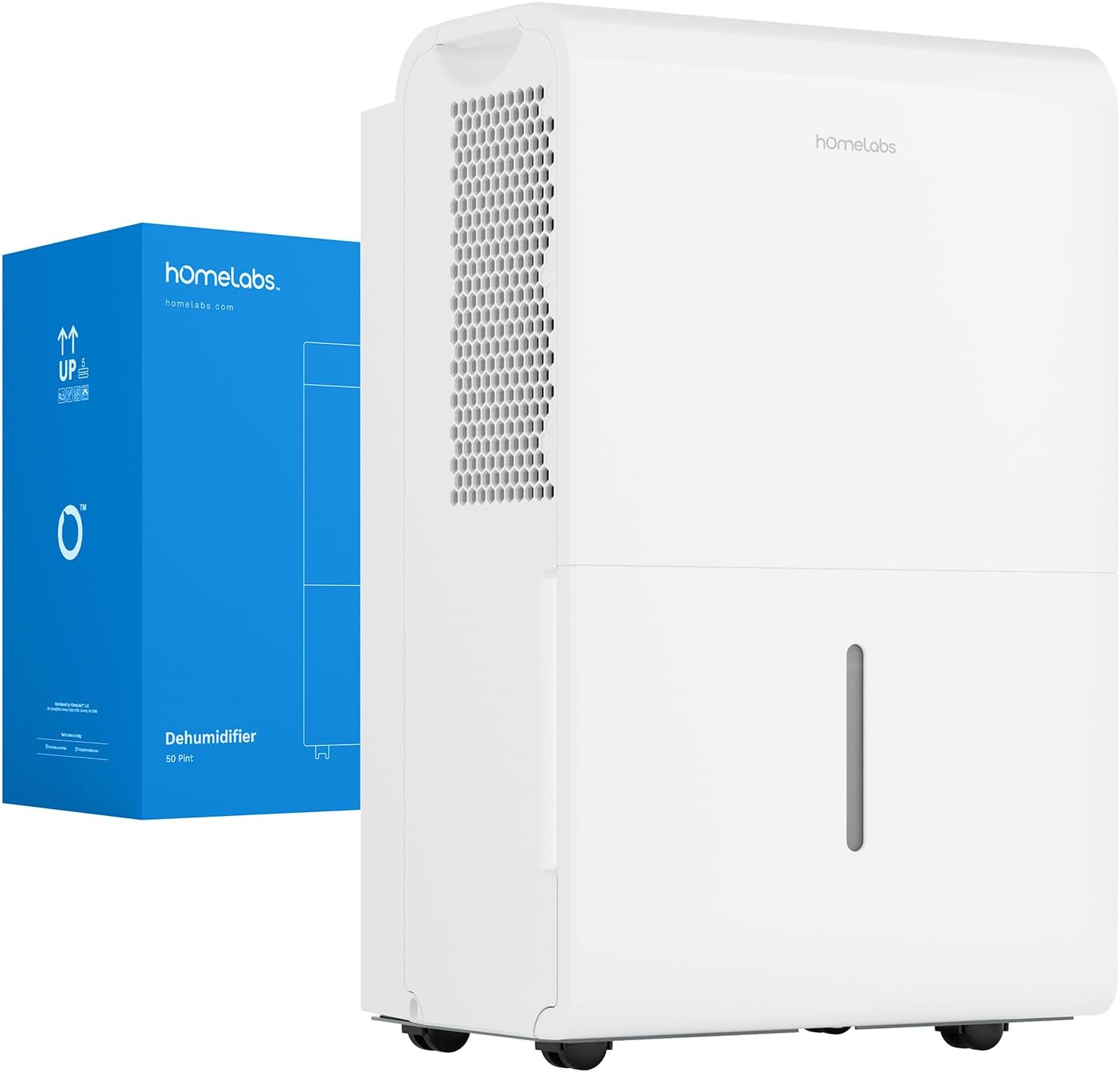
This hOmeLabs 50 Pint dehumidifier is built for large rooms and basements, removing up to 50 pints per day at standard test conditions and handling very high humidity loads at higher temperatures. It connects to Wi‑Fi so you can monitor and change settings remotely, and the touch control panel plus timer make routine adjustments simple. Practical features include a removable washable filter, continuous drainage outlet for long unattended runs, an auto shutoff when the tank is full, and a portable design with wheels and handles for moving between spaces. Performance-wise it delivers substantial airflow (165 cfm) and offers two fan speeds including a Turbo/High mode for faster moisture removal, though it does consume several hundred watts when running at higher capacity. Noise is kept reasonably low for sustained use but it is still a working appliance rather than whisper-quiet. Overall it is a sensible, feature-forward choice for keeping large, damp areas under control when reliability and remote control matter most.
Best for: Buyers who prioritize dependable moisture control for large spaces and want remote monitoring and straightforward maintenance to minimize hands-on oversight.
Less Ideal for: People looking for a compact, ultra-quiet unit for small bedrooms or those who need the lowest possible energy draw for constant operation.
- Wi‑Fi remote control for monitoring and adjusting humidity from anywhere
- Designed for large areas up to 7,000 sq ft with 50 pints/day capacity
- Continuous drain option for unattended long runs
- Removable washable filter and touch controls for easy maintenance
- Portable with wheels and handles to move between rooms
- Relatively heavy to lift despite wheels
- Consumes several hundred watts at higher operating modes
Verdict: Choose this model when you need robust, remotely controllable humidity removal for large spaces with easy maintenance and continuous‑drain capability.
Waykar 120 Pint Dehumidifier

| Capacity | 120 pints |
|---|---|
| Covers up to | 6000 square_feet |
| Tank Volume | 1.24 gallons |
| Wattage | 470 watts |
| Air Flow Capacity | 230 cfm |
The Waykar 120 Pint Dehumidifier is built for big, damp spaces such as basements and large rooms, extracting up to 120 pints per day under test conditions and supporting continuous drainage with the included hose. It offers Auto Comfort, Continuous, and Standard modes plus a 30%–80% adjustable humidity range so you can set or let the unit manage target humidity automatically. Practical touches include a removable 1.24-gallon tank, washable filter, built-in wheels and handle for portability, and a rear cord wrap for tidy storage. Waykar emphasizes quiet operation with a low setting around 40 dB and added protections like auto-defrost down to 42°F and overflow/hose-backflow safeguards for unattended use. Energy efficiency is a highlight since it meets 2025 ENERGY STAR standards, which should lower runtime costs compared with older, less efficient units. Limitations to note: the quoted 120-pint rate applies to very hot, high-humidity test conditions and real-world removal will be lower at typical home temperatures, and this model does not include a pump for uphill drainage so gravity drain planning is required for some basements.
Best for: Buyers who want a high-capacity, energy-efficient unit for large basements or whole-floor dehumidifying and prefer a model with automated humidity control and robust safety features.
Less Ideal for: People who need pump-assisted drainage for locations without a lower drain or buyers seeking a very compact, low-capacity bedroom unit.
- High rated extraction capacity suitable for large spaces up to 6,000 sq ft
- Meets 2025 ENERGY STAR efficiency standards to reduce electricity use
- Auto Comfort mode with temperature-based humidity targets for hands-off operation
- Quiet low-speed operation (~40 dB) and washable filter for low-maintenance use
- Includes drainage hose and protections like auto-defrost and overflow prevention for continuous operation
- Removal rate is specified at 95°F/90% RH so real-world pint/day will be lower in typical home conditions
- No built-in condensate pump, so uphill or long-distance drainage requires external planning
Verdict: If you need an ENERGY STAR, high-capacity dehumidifier for large basements or whole-home rooms with smart auto-humidity control, this Waykar 120-pint model is a strong, energy-efficient choice.
MIONJO V3 Dehumidifier

| Dehumidification Capacity | 80 pints_per_day |
|---|---|
| Capacity | 1.72 gallons |
| Operation Mode | Automatic |
| Other Special Features | 90° adjustable air outlet / humidity sensing / sleep mode / child lock / 24-hour timer |
| Energy Certification | Energy Star |
The MIONJO V3 is a compressor dehumidifier designed for large homes and basements, with a rated capacity of up to 80 pints per day and claimed coverage around 4,500 sq ft. It is typically used to control high humidity in basements, laundry rooms, gyms, and large living areas, and can speed drying of wet laundry using its 90 degree adjustable outlet. Notable features include Energy Star certification for lower energy use, an internal humidity sensor with adjustable set points, auto defrost and overload protection for reliable continuous operation, and dual drainage via a 1.72 gallon tank or included drain hose. Practical benefits include quiet operation down to about 40 dB, caster wheels for easy room-to-room portability, washable filter for simple maintenance, and a sleep mode for lower noise at night. Important limitations are that the 1.72 gallon tank still requires emptying if the drain hose is not used and the unit's performance in very cold unheated spaces depends on the auto-defrost cycle; buyers should verify placement and drainage for unattended continuous use.
Best for: Buyers who prioritize a reliable, energy-efficient compressor dehumidifier for large rooms or basements and want quiet, low-maintenance operation with safety features for continuous use.
Less Ideal for: People who need a simple, ultra-compact unit for a single small room or those who cannot provide a drain hookup for continuous unattended operation.
- High dehumidification capacity rated at 80 pints per day suitable for large spaces
- Energy Star certified for better energy efficiency during long run times
- Auto defrost and overload protection improve reliability in continuous operation
- Dual drainage with 1.72 gallon tank plus included drain hose supports unattended use
- Quiet operation around 40 dB and a sleep mode make it suitable for living areas and bedrooms
- Relatively small internal tank requires a drain hose for true hands-off continuous use
- Performance in very cold rooms may rely on defrost cycles and could be reduced at low temperatures
Verdict: A powerful, energy-efficient compressor dehumidifier built for large spaces that balances high drying capacity with quiet, reliable operation.
Choosing the Right Dehumidifier for Large Spaces: Key Factors to Consider
Extraction Capacity (Pints Per Day)
Extraction capacity determines how much moisture the unit can remove under standard conditions during a 24-hour period. For large spaces you need a higher rated capacity so the unit can lower relative humidity in a reasonable time frame and keep it stable afterward.
A higher capacity reduces runtime when humidity spikes after activities like drying laundry or heavy rain, and it can prevent repeated cycling that wears components. However, capacity ratings are often given at idealized lab conditions. Look for capacity figures specified for realistic temperature and humidity levels and consider units with a bit more capacity than calculated for your space to handle peak loads.
Energy Efficiency and Operating Cost
Running a dehumidifier in a large space can represent a meaningful portion of household energy use, especially in humid climates where it runs frequently. Energy efficiency affects monthly running cost and is influenced by compressor design, fan motor efficiency, and automatic control features.
Features that reduce energy use include programmable humidistats, automatic restart after power loss, and low-temperature modes if the area can get cool. Check energy performance metrics and plan for how many hours per day the unit will typically run when estimating annual operating cost.
Coverage Area and Airflow Management
Coverage rating and measured airflow determine how quickly a unit can circulate air through its coils and dehumidify evenly across an open or partitioned space. In large rooms, placement and airflow patterns matter more than absolute capacity; a high-capacity unit with poor airflow may create localized dry spots while leaving other areas damp.
Consider models with directional vents, variable fan speeds, and higher cubic feet per minute (CFM) ratings. For irregular layouts or multi-room basements, you may need to supplement with fans or choose a unit with stronger airflow to ensure whole-space efficiency.
Noise and Placement Constraints
Noise becomes a practical concern when a dehumidifier runs for long periods in living areas, bedrooms, or workspaces. Larger compressors and higher fan speeds typically increase decibel output, which can be intrusive in quiet rooms.
Look for noise specifications and multiple fan speeds so you can reduce sound during occupied hours. Consider placement options that distance the unit from seating or sleeping areas without compromising airflow, and weigh whether quieter, slightly less powerful operation fits your usage pattern better than a louder, maximum-capacity unit.
Drainage, Reservoir Size, and Maintenance
Large-space dehumidifiers should offer practical water-handling options because a large reservoir fills quickly. Continuous drain capability via gravity or pump is useful for long unattended runs; otherwise you will need to empty the tank frequently. Reservoir size affects how often you interact with the unit and how suitable it is for remote locations like basements.
Maintenance matters too. Accessible filters, washable screens, and corrosion-resistant components reduce lifetime upkeep. Check how easily the tank or drain fittings are accessed and whether the design accommodates routine cleaning without tools.
Durability and Build Quality
In heavy-use settings a robust build extends service life and reduces the chance of breakdowns. Durable features include reinforced casings, heavy-duty casters for moving between rooms, and protective grills for coils and fans.
Also consider warranty scope and the availability of replaceable parts. Units designed for frequent operation tend to use sturdier compressors and better condensate management, which lowers the long-term total cost of ownership and reduces the chance of corrosion or mechanical failure.
Sizing Your Dehumidifier for Open Layouts
Large open-plan areas behave differently than single enclosed rooms. Heat sources, cross-ventilation, and floor plans change how humidity distributes. Begin by measuring the square footage and factoring in ceiling height and moisture sources such as attached crawlspaces, frequent showers, or laundry.
For uneven layouts, select a unit with stronger airflow rather than relying solely on nominal capacity. Placement near the center of a large room or close to the primary moisture source helps the unit capture humid air more effectively.
- Measure square footage and note ceiling height.
- Identify primary moisture sources and airflow paths.
- Prioritize airflow and vent direction for open plans.
Continuous Drain Vs. Tank: Which Works Best?
If your dehumidifier will run uninterrupted for long stretches, continuous drain capability greatly reduces maintenance. Gravity drains are simple when a nearby floor drain or window is lower than the unit. Pump-assisted drains are useful when you need to move condensate uphill or across a distance.
Reservoir-only units can work in living areas where you prefer portability and occasional emptying. For basements or utility rooms, a continuous drain is safer and more convenient.
- Choose gravity drain when a lower drain point is available.
- Select pump-equipped units when you must transport water uphill.
- Use reservoir-only models for occasional, portable use.
Managing Noise in Shared Spaces
Dehumidifier noise depends on fan speed, compressor cycles, and panel vibration. When the unit must operate in living rooms or offices, opt for multiple fan speeds and sleep or low modes to reduce disruption. Placement also affects perceived noise; positioning behind furniture or in a closet with airflow openings can muffle sound.
If using ducted or remote-location installation is not an option, choose a model with sound-attenuating design features and check measured decibel ratings for realistic expectations.
- Use low or sleep modes during occupied periods.
- Place unit away from seating and sleeping areas if possible.
- Check vibration isolation and fan design for quieter operation.
Low-Temperature Performance and Basement Use
Basement temperatures can drop low enough to cause frost on coils, which reduces extraction efficiency. Models with an auto-defrost mode or low-temperature setting maintain performance in cooler conditions and reduce the need for manual intervention.
If your large space tends to be cool, prioritize a dehumidifier explicitly rated for low-temperature operation and check for defrost cycle behavior and sensors that prevent icy buildup.
- Prefer units with automatic defrost for cool environments.
- Confirm cold-weather ratings if basement temperatures fall near freezing.
- Monitor performance the first few weeks to ensure reliable defrost cycles.
Placement and Airflow Tips for Best Coverage
Even the most powerful dehumidifier needs good placement to perform well. Avoid corners and position the unit where it can draw air from the entire room. Keep intake and exhaust vents unobstructed and allow several feet of clearance where possible.
For very large or segmented spaces, use supplemental fans to move humid air toward the dehumidifier. This approach is often more effective and less costly than oversizing a single unit.
- Leave clear space around intake and exhaust vents.
- Use box or oscillating fans to aid circulation in zoned areas.
- Place units near primary humidity sources for faster stabilization.
How We Chose the Best Dehumidifier for Large Spaces
We focused on criteria that matter most when selecting dehumidifiers for large spaces and applied practical filters to exclude units better suited to small rooms. Primary evaluation dimensions included extraction capacity measured in pints per day at common household conditions, continuous runtime and reservoir management options, and energy efficiency metrics to estimate ongoing operating cost. We also weighed airflow and coverage specifications to judge how effectively a unit moves and dehumidifies air in open or multi-room layouts. Noise output was assessed because large-capacity compressors and fans can be disruptive in living and work areas. Durability and serviceability were considered by reviewing build features such as heavy-duty casters, corrosion-resistant coils, and accessible filters. We excluded compact or portable models rated only for small rooms and any products without clear performance specifications for typical home humidity conditions. The result is a shortlist that prioritizes real-world extraction, long-run reliability, manageable maintenance, and reasonable energy consumption for larger interiors.
Our full evaluation process is outlined in our review methodology.
FAQ
How large a dehumidifier do I need for a 1,200-square-foot open living area?
You should base sizing on square footage, ceiling height, and moisture load. For a 1,200-square-foot open area, choose a unit with higher extraction capacity than for a single room; plan for peak conditions and prioritize airflow so the unit can move humid air across the whole space.
Can I run a dehumidifier continuously and is that safe?
Yes, many units are designed for continuous operation and include features like continuous drain and automatic shutoff for safety. Ensure proper drainage and choose a model rated for long runtimes to avoid unnecessary wear.
Will a dehumidifier reduce odors and mold risk in large spaces?
Reducing relative humidity helps suppress mold growth and reduces musty odors. A correctly sized and well-placed dehumidifier will lower moisture levels and make conditions less favorable for mold, but it may not eliminate existing mold without cleaning and remediation.
Is it better to use multiple smaller units or one large dehumidifier?
It depends on layout. Multiple units can provide better zonal control and reduce ducting or airflow issues in segmented spaces. A single larger unit can be effective in open layouts if it has strong airflow and proper placement.
How often should I clean or replace filters and coils?
Clean washable filters every few weeks or as indicated by the unit's indicators, and inspect coils seasonally. Frequency depends on dust levels and usage. Regular cleaning maintains airflow and efficiency, while periodic professional service can extend component life.
Final Verdict
For large spaces the right dehumidifier balances extraction capacity, airflow, and energy use. Prioritize a unit with sufficient daily extraction capacity for peak loads, good airflow for whole-room coverage, and drainage options that match how you plan to run the machine. Expect tradeoffs between raw power and noise; quieter models often require placement or supplemental airflow adjustments. With attention to sizing, placement, and ongoing maintenance you can control humidity effectively and reduce mold risk, odors, and moisture-related damage.