
Note: This article contains affiliate links. If you click on these links and make a purchase, we may earn a small commission at no extra cost to you. This helps support our research and content. Read our full affiliate disclosure here.
A very wet basement needs more than a small appliance that runs constantly. You want a unit that removes large volumes of moisture quickly, stands up to continuous duty, and minimizes the risk of mold and structural damage. This guide shortlists the top dehumidifiers for very wet basements and explains why each type made the cut. Below we evaluate units on capacity, durability, drainage options, and energy use so you can pick a solution that restores dry, usable space instead of a perpetual damp problem.
Top Picks at a Glance
| Best Overall The best all-around choice for most situations | Waykar 120-Pint Dehumidifier CTH120A |  |
| Best Quality Built to a higher standard if you want something more solid | AprilAire E100 100-Pint Dehumidifier |  |
| Best Value The sweet spot between price and what you get | DECIUU 100-Pint Dehumidifier |  |
| Best Budget The cheapest option that still gets the job done reliably | AIRPLUS 70-Pint Dehumidifier |  |
| Top Rated A top-rated pick with lots of positive feedback | hOmeLabs 50 Pint Dehumidifier | 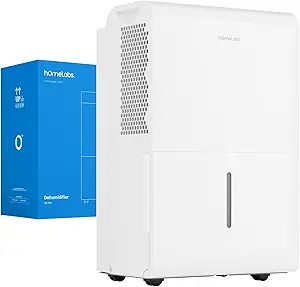 |
| Most Popular A crowd favorite that many people choose with confidence | Waykar 80-Pint Dehumidifier JD025CE-80 |  |
| Best Seller A high-volume bestseller chosen again and again | BEDRED CT11 Dehumidifier |  |
Waykar 120-Pint Dehumidifier CTH120A

| Capacity | 120 pints |
|---|---|
| Tank Volume | 1.24 gallons |
| Wattage | 470 watts |
| Air Flow Capacity | 230 cfm |
| Operation Mode | Auto Comfort, Continuous, Standard |
The Waykar CTH120A is a heavy-duty home dehumidifier built to remove large amounts of moisture from basements and other damp spaces, rated to handle up to 6,000 sq ft and remove as much as 120 pints per day under ideal conditions. It offers Auto Comfort, Continuous, and Standard modes plus a smart comfort algorithm that adjusts target humidity based on temperature, which simplifies day-to-day use in variable basement climates. Practical features include a removable 1.24-gallon tank with overflow protection and an included 6.56 ft drain hose for continuous gravity drainage, ETL listing, washable filter, wheels and handle for portability, and an Energy Star 2025 efficiency rating to limit operating cost. Noise on low is marketed at about 40 dB, making it usable near living spaces. Important limitations are the relatively small internal tank compared with its output (so continuous drainage is recommended) and the lack of a built-in condensate pump for uphill drainage, which restricts placement unless a floor drain or long hose run is available.
Best for: Buyers who need a high-capacity, energy-efficient unit to manage persistent basement moisture across large areas and prefer automated humidity control that minimizes manual adjustments.
Less Ideal for: People who need a unit for tight spaces without floor drains or who require pump-assisted uphill drainage should consider alternatives with built-in pumps or larger internal reservoirs.
- High capacity rated for up to 120 pints per day and coverage up to 6,000 sq ft
- Meets 2025 ENERGY STAR efficiency standards to reduce power consumption
- Smart Auto Comfort mode adjusts humidity targets based on temperature
- Includes drain hose and overflow protections for continuous unattended drainage
- Designed for quiet operation around 40 dB on low and includes wheels for mobility
- Built-in tank is relatively small (1.24 gallons) compared with maximum extraction, so relying on continuous drainage is necessary
- No integrated condensate pump, limiting uphill drainage options without additional plumbing
Verdict: A powerful, energy-smart choice for very wet basements that need automated humidity control and continuous drainage capability.
AprilAire E100 100-Pint Dehumidifier
| Capacity | 100 pints_per_day |
|---|---|
| Floor Area | 5500 square_feet |
| Air Flow Capacity | 280 cfm |
| Wattage | 828 watts |
| Voltage | 120 volts_of_alternating_current |
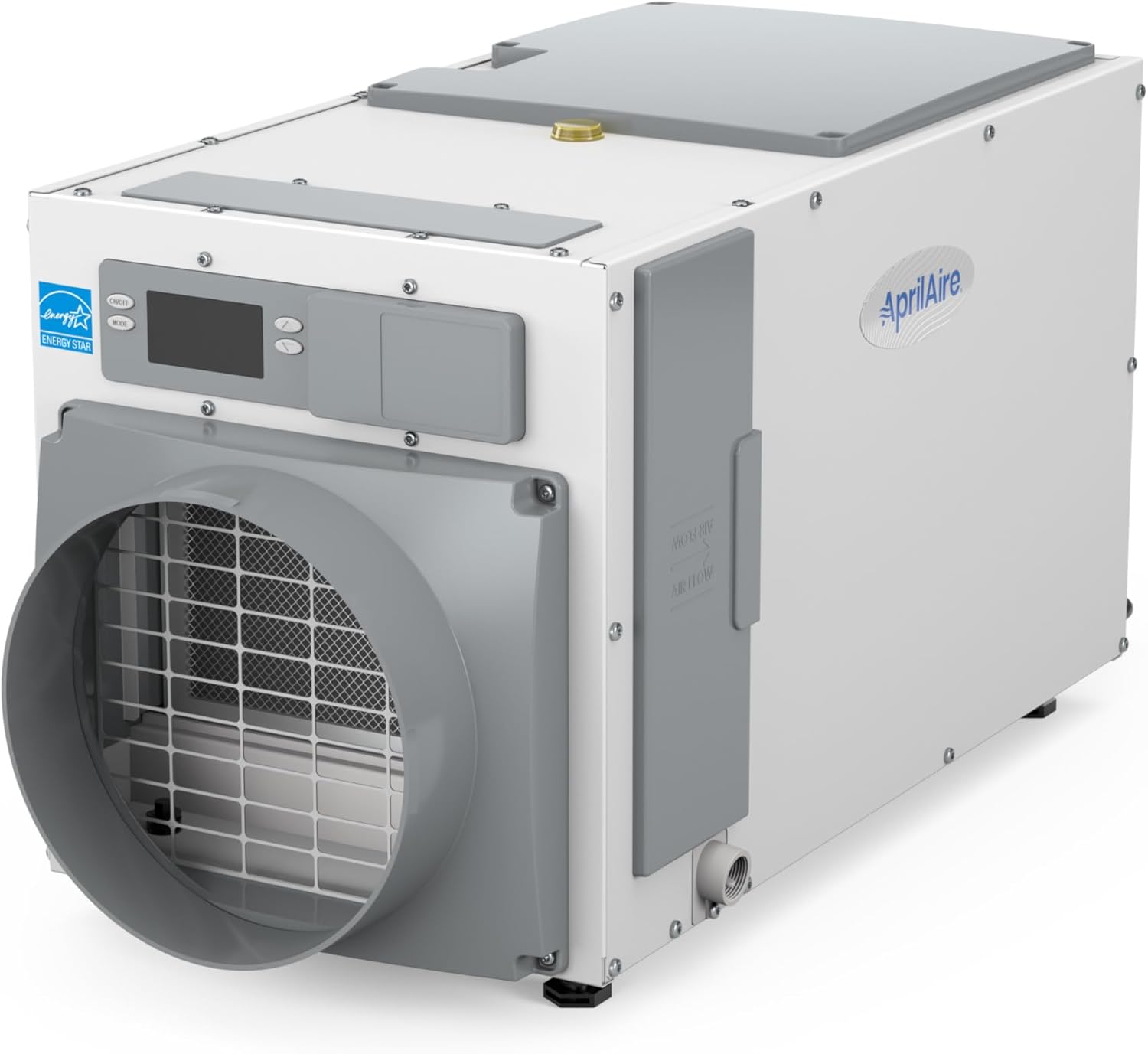
The AprilAire E100 is a heavy-duty whole-home dehumidifier built to manage very damp spaces like wet basements and sealed crawlspaces. It automatically controls humidity with a digital display and smart sensing that turns the unit on and off based on relative humidity set points, and it can be ducted into HVAC for centralized operation. Practical features include continuous draining or hose hookup so there is no tray to empty, a washable MERV 8 filter for low-maintenance upkeep, corrosion-resistant aluminum coils for durability, and a 5-year manufacturer warranty. With 280 CFM airflow and an Energy Star Most Efficient rating, it removes up to 100 pints per day while using about 828 watts, which helps keep running costs reasonable for its capacity. The unit is large and built of metal, so installation typically requires floor space, ducting or drain access, and basic setup; it is single-speed which limits fine-grain fan control, and it requires 120 VAC, 60 Hz power. For very wet basements where continuous high-capacity moisture removal is needed, the E100 delivers reliable, low-maintenance performance.
Best for: Buyers looking for a high-capacity, performance-focused dehumidifier to control persistent moisture in very wet basements or whole houses and who prioritize reliable continuous operation over compactness.
Less Ideal for: If you need a small portable unit for occasional use, tight spaces, or precise multi-speed fan control, choose a compact or multi-speed consumer model instead.
- Removes up to 100 pints per day suitable for very wet basements and whole-home use
- Energy Star Most Efficient rating for lower energy consumption at high capacity
- Continuous drain option and no water tray reduces maintenance and prevents overflow
- Corrosion-resistant aluminum coils and metal construction for long-term durability
- Ductable design and top-or-front control mounting for flexible installation
- Single-speed operation limits precise airflow control
- Large footprint and commercial build require adequate space and professional-style installation
Verdict: For very wet basements that need continuous, high-capacity moisture removal, the AprilAire E100 delivers robust, energy-efficient performance and low-maintenance operation.
DECIUU 100-Pint Dehumidifier

| Capacity | 100 pints |
|---|---|
| Floor Area | 5000 square_feet |
| Tank Volume | 1.45 gallons |
| Wattage | 300 watts |
| Air Flow Capacity | 9396 cubic_feet_per_hour |
This DECIUU unit is built to tackle very damp basements and large spaces up to 5,000 sq ft by removing up to 100 pints of moisture per day under high-humidity conditions. It offers adjustable humidity control with a 24-hour timer and three fan speeds so you can dial in comfort or run continuous dehumidification. Practical features include a 1.45 gallon removable tank, an included drain hose plus garden-hose adapter for continuous drainage, washable filter, auto defrost for cool environments, and caster wheels for moving between rooms. Energy-efficient operation carries an ENERGY STAR Most Efficient 2024 designation and the unit runs at 300 watts, which helps limit electricity draw during extended use. Expect reliable moisture removal in basements, garages, and laundry areas, though the tank still requires emptying if you do not use the continuous drain option and the unit is moderately heavy to lift despite wheels. Controls are straightforward, and the child lock adds safety for family use.
Best for: Buyers who prioritize reliable, energy-efficient moisture removal in very wet basements or large damp rooms and want flexible drainage options for continuous operation.
Less Ideal for: People who need a lightweight, ultra-compact unit for small rooms or who cannot install a continuous drain connection should consider smaller or more portable models.
- High moisture removal capacity up to 100 pints per day for very damp spaces
- Multiple drainage options including tank, supplied drain hose, and garden hose adapter for continuous use
- ENERGY STAR Most Efficient 2024 rating for lower energy draw during long runs
- Auto defrost and adjustable humidity control for reliable performance in varied temperatures
- Washable filter and caster wheels simplify maintenance and repositioning
- Tank is only 1.45 gallons, which requires frequent emptying unless using continuous drainage
- Unit weight makes initial placement and lifting awkward despite casters
Verdict: A powerful, energy-efficient dehumidifier designed to remove large volumes of moisture from very wet basements while offering flexible continuous-drain options.
AIRPLUS 70-Pint Dehumidifier

| Dehumidification Capacity | 70 pints_per_day |
|---|---|
| Floor Area | 4500 square_feet |
| Tank Volume | 2.8 liters |
| Other Special Features | Adjustable Fan Speed, Adjustable Humidity Control, Automatic Shutoff, Continuous Drainage, Timer |
| Material | Plastic, Activated Carbon/Hepa Filter |
The AIRPLUS 70-pint dehumidifier is a heavy-duty portable unit intended to remove large amounts of moisture from basements and large rooms. It pulls up to 70 pints per day (under stated test conditions) and is advertised to cover spaces up to 4,500 sq ft, making it suitable for very damp basements and whole-level dehumidification. Controls let you set target humidity, change fan speed, and choose modes for dehumidify, dry-clothes, or fan-only operation, while a timer and two-way timing simplify scheduled use. Continuous-drain capability with included hose connection lets it run without frequent tank emptying, and an automatic shutoff protects against overflow when the 2.8-liter tank is used. The unit includes an activated carbon/HEPA filter for basic air cleaning, but it is a substantial appliance so noise and energy draw can be expected at high extraction rates. For buyers on a budget, it offers strong moisture removal and useful features, though you should confirm operating conditions and expect higher runtime in very cold environments where compressor efficiency drops.
Best for: Buyers who need strong, budget-friendly moisture removal for very wet basements and prefer a unit with continuous drainage and simple controls to run continuously without much intervention.
Less Ideal for: Those seeking ultra-quiet, low-energy units for small rooms or buyers who want advanced smart-home connectivity and detailed performance testing in cold environments.
- High dehumidification capacity up to 70 pints per day for very damp spaces
- Continuous drainage option reduces need to manually empty the tank
- Adjustable humidity control, fan speeds, and multiple modes for flexible use
- Built-in filter provides basic air filtration and helps capture particulates
- 2.8 liter tank is small for the extraction rate when not using continuous drain
- Performance figures are condition-dependent and may drop in cooler basement temperatures
Verdict: If you need powerful, budget-conscious moisture removal for a very wet basement and want continuous drainage and basic filtration, this AIRPLUS 70-pint unit is a practical choice.
hOmeLabs 50 Pint Dehumidifier
| Dehumidification Capacity | 50 pints_per_day |
|---|---|
| Floor Area | 7000 square_feet |
| Tank Volume | 1.6 gallons |
| Wattage | 322 watts |
| Air Flow Capacity | 165 cfm |
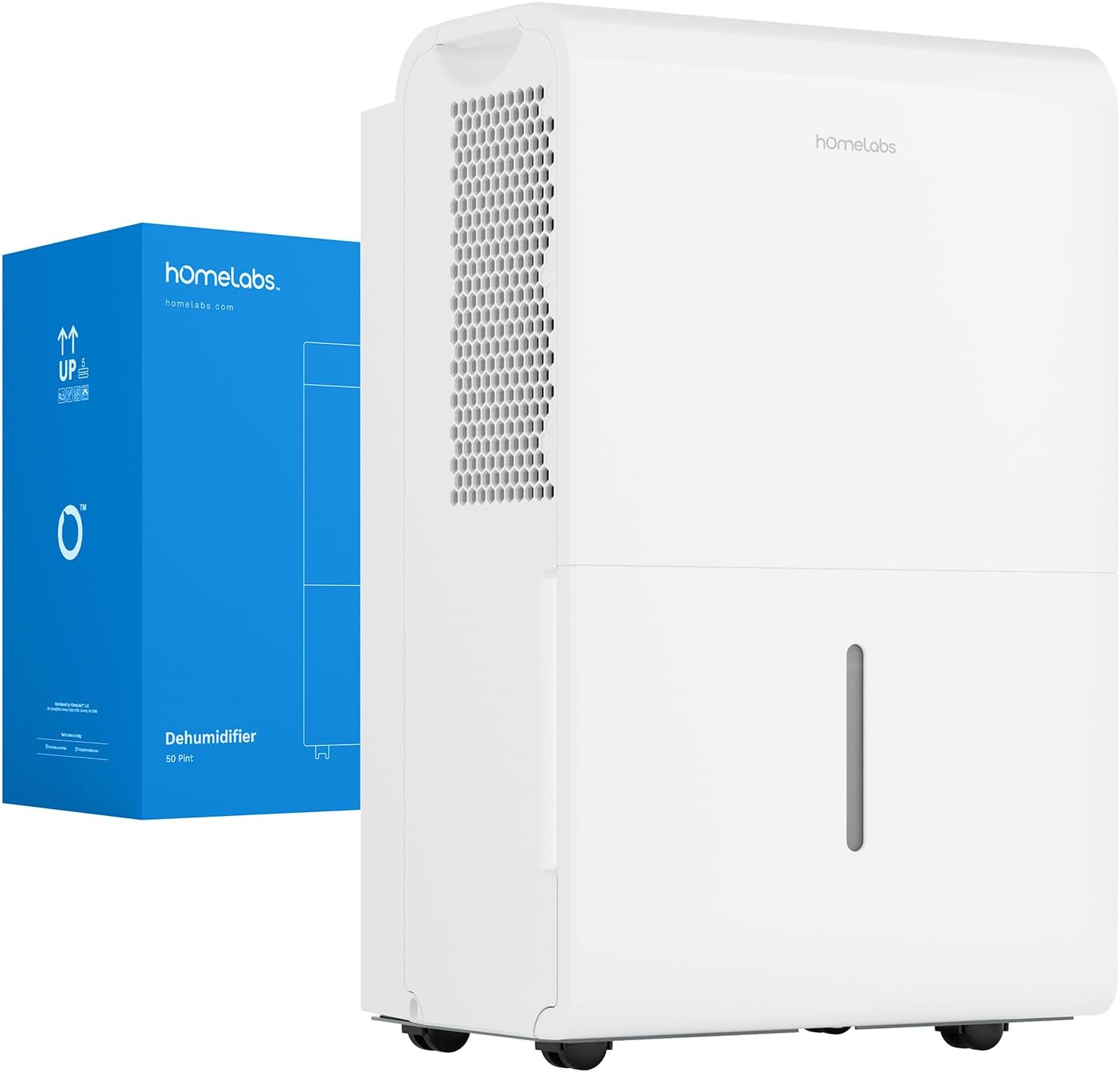
The hOmeLabs 50 Pint Dehumidifier is built for heavy-duty home use and targets very damp areas like basements. It pulls up to 50 pints per day at standard test conditions and has a continuous drain outlet for long runtimes, plus an automatic shutoff when the 1.6‑gallon tank fills. The unit offers two fan speeds, a touch control panel with timer, washable filter, and automatic defrost and restart functions that keep it running reliably through temperature and power variations. Wi‑Fi control lets you adjust settings remotely, which is handy if you monitor a basement from another part of the house. Practical strengths are its portability with handles and casters and a relatively high airflow for faster moisture removal. The trade-offs are the single compressor capacity (so recovery can be slower in very large or severely flooded spaces) and a moderate power draw typical of this class that may run frequently in persistently wet basements.
Best for: Buyers who prioritize steady, dependable moisture removal for basements and want a unit that can run unattended with remote monitoring and simple maintenance.
Less Ideal for: Not the best choice for commercial sites, very large industrial spaces, or situations that need rapid water removal after major flooding where a higher‑capacity or pump‑out commercial unit is required.
- Removes up to 50 pints per day for strong dehumidification in damp rooms
- Continuous drain option for unattended long‑term operation
- Automatic defrost, restart, and shutoff increase reliability in changing conditions
- Wi‑Fi remote control for adjusting settings without visiting the basement
- Washable filter and casters make maintenance and placement easier
- Single‑unit capacity may be insufficient for extremely large or flooded basements without supplemental dehumidification
- Runs frequently in very wet conditions which increases energy use
Verdict: A reliable, Wi‑Fi enabled 50‑pint dehumidifier that handles very wet basements with unattended continuous‑drain capability and dependable automatic protections.
Waykar 80-Pint Dehumidifier JD025CE-80

| Dehumidification Capacity | 80 pints_per_day |
|---|---|
| Tank Volume | 2.5 gallons |
| Wattage | 270 watts |
| Air Flow Capacity | 165 cfm |
| Operation Mode | Continuous |
The Waykar 80-Pint Dehumidifier is built to handle large, damp areas such as basements by extracting up to 80 pints per day and offering both tank and continuous drain options. It is commonly used running continuously or on a timed schedule to bring basement humidity down to a selected setpoint between 30% and 80% relative humidity, and the 90° auto-swing helps spread airflow for more even drying. Practical features include an included drain hose and connector for gravity drainage, a washable removable filter, automatic defrost and overload protection for low-temperature reliability, and an Energy Star rating to keep running costs lower than noncertified units. At roughly 42 dB it is quieter than many similarly sized machines, making it reasonable for finished basements or nearby living areas. The unit is relatively heavy and targeted at larger spaces, so it is less convenient to move frequently, and the 1.14 gallon tank means emptying is still needed if you do not use continuous drainage. For buyers focused on dependable basement performance and energy efficiency, this model delivers strong moisture removal with sensible protections for extended operation.
Best for: Homeowners who need a reliable, high-capacity dehumidifier to control moisture in large basements and prefer proven features and energy efficiency over portability.
Less Ideal for: People looking for a lightweight, highly portable unit for small rooms or occasional use should consider smaller, easier-to-move models instead.
- High dehumidification capacity rated at 80 pints per day for large basements
- ENERGY STAR certification for better energy efficiency during extended use
- Multiple drainage options with included drain hose for continuous gravity drain
- Auto-defrost and overload protection improve reliability in cool basement conditions
- 90° auto-swing airflow and washable filter help distribute air and simplify maintenance
- Relatively heavy and sized for large spaces, so not ideal for frequent transport
- Water tank is modest at 1.14 gallons if continuous drainage is not used
Verdict: A powerful, Energy Star certified 80‑pint unit that reliably handles large basement humidity with continuous drain and protective auto-defrost features.
BEDRED CT11 Dehumidifier

| Floor Area | 1000 square_feet |
|---|---|
| Tank Volume | 95 fluid ounces |
| Capacity | 5.9 pounds |
| Operation Mode | Intermittent |
| Other Special Features of the Product | 7 Color Ambient Light, Automatic Shutoff, Sleep Mode |
The BEDRED CT11 is a compact thermoelectric dehumidifier intended to reduce humidity in small spaces such as bedrooms, bathrooms, and modest basements up to about 1000 sq ft. It uses semiconductor cooling rather than a compressor, so it runs quietly and is simple to operate with an intermittent operation mode and an automatic shutoff when the 95 oz tank fills. Sleep Mode turns off the lights and lowers noise for overnight use, and the seven-color ambient light gives an optional mood-lighting feature. Practical benefits include easy emptying from the included tank, portability thanks to a lightweight design, and low sound levels that suit living spaces. Important limitations are inherent to semiconductor units: lower capacity compared with compressor dehumidifiers, reduced performance in very cold or very damp basements, and a smaller tank that requires more frequent emptying in high-humidity conditions.
Best for: Buyers who prioritize quiet, low-maintenance dehumidification and want a compact unit that is easy to move and run in living spaces or small basements without frequent intervention.
Less Ideal for: People needing heavy-duty moisture control for large, cold, or very damp basements should choose a higher-capacity compressor dehumidifier instead.
- Quiet thermoelectric operation suitable for bedrooms and living rooms
- Automatic shutoff protects against overfill and simplifies unattended use
- 95 oz removable tank for straightforward water removal
- Sleep Mode and ambient light options for low‑noise nighttime use
- Compact and lightweight for easy placement or moving between rooms
- Semiconductor cooling gives lower moisture removal capacity than compressor models
- Performance drops in cold basement conditions and very high humidity areas
Verdict: Choose the BEDRED CT11 if you want a quiet, portable dehumidifier with auto‑shutoff and sleep‑friendly operation for small basements or living spaces.
Choosing the Right Dehumidifier for Very Wet Basement: Key Factors to Consider
Extraction Capacity (Pints Per Day)
Extraction capacity is the most important specification for a very wet basement because it determines how quickly a unit can remove water from the air. Look at the rated pints-per-day at realistic basement temperatures and humidity levels rather than only lab-ideal figures. Higher-capacity units prevent continuous run cycles and reduce the time the space spends above safe humidity thresholds.
If your basement has standing water or repeated water intrusion, choose a unit with significantly more capacity than the immediate need to allow headroom during stormy seasons or when drying wet materials.
Continuous Drainage and Pumping
Continuous drainage options let the dehumidifier run unattended for long periods without manual emptying, which is essential in very wet basements. Gravity drain outlets are fine when the unit can be placed near a floor drain. Where a floor drain is not available or the drain outlet sits higher, an internal condensate pump that can lift water to a drain is highly valuable.
Consider the length and vertical lift rating of any included pump, and plan routing so condensate lines slope downward. A reliable continuous-drain setup minimizes maintenance and prevents overflowing collection buckets during heavy events.
Durability and Continuous-Run Design
Basements with persistent moisture demand a dehumidifier built for continuous or frequent long-run cycles. Check for robust compressors, corrosion-resistant coils or coatings, and solid cabinet construction. Units designed for crawlspaces or intermittent use may not tolerate constant duty and can fail prematurely.
Also evaluate filter accessibility and serviceability so routine maintenance can be done quickly; longer life and easier repairs lower total ownership hassle in a demanding environment.
Humidity Control and Sensor Accuracy
Accurate humidity sensing and reliable controls let you set a target relative humidity and trust the unit to maintain it without over- or under-drying. A precise humidistat reduces run time and energy use while keeping conditions safe for finishes and stored items. Look for adjustable setpoints, clear displays, and a good auto-restart feature for power interruptions.
Advanced features like built-in timers, washable filters reminders, and auto-defrost cycles for cooler basement temperatures can improve performance and reduce oversight.
Energy Use and Operating Costs
A high-capacity dehumidifier can use significant electricity if it runs constantly. Consider the unit's energy consumption relative to its extraction capacity to estimate ongoing costs. Energy-efficient compressors and variable-speed fans or compressors can cut runtime and draw, especially when the device throttles back as the space dries.
Balance capacity needs against efficiency features; oversizing unnecessarily raises upfront and operating costs, while undersizing may mean the unit never reaches the target humidity.
Sizing Your Dehumidifier for Very Wet Conditions
To size a unit for a very wet basement, start with the square footage and multiply by ceiling height to estimate volume. Then factor in how wet the space is: frequent water intrusion, high evaporation from stored items, or visible condensation all increase the required capacity. Manufacturers often publish charts showing pints-per-day for various room sizes and conditions; use those as a baseline and round up when in doubt.
For basements that experience standing water or repeated leaks, select a unit with a capacity at least 25 to 50 percent higher than the chart suggests for moderate dampness. That buffer handles worst-case events without constant overload.
- Calculate room volume and assess moisture sources
- Round capacity up for recurring water events
- Consider multiple smaller units for large or divided basements
Placement and Drainage Best Practices
Correct placement affects efficiency and noise. Position the dehumidifier where air circulation is unobstructed and where condensate can be routed easily. Keep it away from walls and stored items to allow airflow and prevent recirculating damp pockets.
Plan your drainage path before installing. Gravity drains require lower-level exits or nearby floor drains. If those are not available, an integrated pump or external condensate pump provides flexible routing to a sink or drain at a higher elevation. Secure and slope condensate hoses to avoid kinks and backflow.
- Allow at least 12 inches clearance around intake and discharge
- Install on a level, stable surface to ensure reliable condensate collection
- Run a test cycle after installation to check for leaks and proper drainage
Managing Noise and Vibration
High-capacity dehumidifiers can be noisy because of larger compressors and fans. If your basement is finished or contains living spaces above, noise and vibration matter. Choose units with vibration-damping feet and place them on a rubber mat or a small platform to reduce transmission through concrete.
If noise is a primary concern, consider locating the unit in an adjacent mechanical space or closet with adequate ventilation. Ensure any enclosure still provides sufficient airflow to avoid overheating and reduced extraction rates.
- Use anti-vibration pads to minimize noise transfer
- Keep service access clear for filter changes and maintenance
- Check published sound ratings and balance with capacity needs
Seasonal Use and Winter Operation
Basement temperatures can drop in winter, affecting dehumidifier performance and the risk of coil icing. Units with auto-defrost cycles maintain extraction at lower temperatures and reduce downtime. If the basement routinely falls below recommended operating temperatures, choose equipment rated for cool basements or plan to supplement with low-level heat.
When temperatures drop, monitor humidity setpoints carefully; colder air holds less moisture so the unit may cycle differently. Regularly clear vents and check defrost operation before the winter season to avoid downtime when condensation events still occur.
- Verify low-temperature operating specs and defrost features
- Consider supplemental heat if the basement is near freezing
- Perform seasonal maintenance on filters and coils
Maintenance Tips to Prolong Service Life
Routine maintenance keeps a dehumidifier operating efficiently in a demanding basement environment. Clean or replace washable filters on the schedule recommended by the manufacturer, and inspect coils periodically for dust or corrosion. Ensure condensate hoses remain clear and that gravity drains are not blocked.
Schedule brief inspections after heavy storms or known water events to confirm the unit handled the event without overflow or damage. Promptly address any unusual noises, reduced extraction, or persistent cycling to avoid larger failures.
- Clean washable filters monthly during heavy use
- Inspect condensate lines and fittings for leaks
- Test humidistat accuracy annually and recalibrate if needed
How We Chose the Best Dehumidifier for Very Wet Basement
We focused on products that handle sustained, high-moisture loads typical of very wet basements. Core evaluation criteria included extraction capacity in pints per day at realistic basement temperatures, continuous drainage and pump options for unattended operation, and build durability for prolonged, heavy-duty use. Energy efficiency was weighed to understand operating cost over months of frequent use, while controls and humidity sensing were assessed for ease of maintenance and reliable humidity control. Noise and installation flexibility were considered because basements often need units located near living spaces or in tight mechanical rooms. We excluded small, portable units designed only for light dampness and products intended for single-room, intermittent use. We also filtered out units without clear continuous-drain capability or insufficient documented extraction rates for very wet spaces. The result is a shortlist of robust dehumidifiers suited to long run times, high extraction demands, and simple, low-maintenance operation.
Our full evaluation process is outlined in our review methodology.
FAQ
How big of a dehumidifier do I need for a very wet basement?
For very wet basements choose a unit rated for high extraction at basement temperatures. Start with capacity charts, then size up 25 to 50 percent for recurring water events or standing moisture to ensure the unit can keep up.
Is continuous drainage necessary in a very wet basement?
Continuous drainage is highly recommended because manual emptying will be impractical. A gravity drain works when a nearby floor drain is available; otherwise an internal pump or external condensate pump lets the unit run unattended.
Can a dehumidifier run all the time in a basement?
Yes, but you should pick a model designed for continuous or heavy-duty operation. Continuous-run designs, corrosion-resistant components, and proper drainage are important to avoid premature wear when a unit runs frequently.
Will a dehumidifier prevent mold in a very wet basement?
A properly sized and installed dehumidifier reduces humidity, which limits mold growth. It is not a complete solution if there are ongoing leaks or standing water. Address water intrusion and ventilation issues alongside dehumidification for best results.
How do I manage noise from a high-capacity dehumidifier?
Reduce noise by using anti-vibration pads, placing the unit on a rubber mat, or locating it in an adjacent mechanical area with ventilation. Maintain clearance for airflow to prevent higher noise from overworking the unit.
Final Verdict
For very wet basements prioritize extraction capacity, continuous drainage, and durability. A unit with sufficient pints-per-day, a reliable drain or pump option, and a design built for frequent running will dry the space faster and reduce mold risk. Balance energy use and noise against capacity needs, and plan placement and maintenance to keep the unit working reliably. Choose the highest-capacity unit you can accommodate safely and that offers a practical continuous-drain solution. That tradeoff between raw extraction power and long-term serviceability is the single best way to protect a very wet basement.