
Note: This article contains affiliate links. If you click on these links and make a purchase, we may earn a small commission at no extra cost to you. This helps support our research and content. Read our full affiliate disclosure here.
A dehumidifier with a hose for basement use makes continuous drainage practical and reduces the need to empty collection buckets. In damp basements where standing water, condensation, or musty odors are common, the right unit keeps relative humidity in a safe range to protect stored items and improve comfort. This guide shortlists the most useful dehumidifiers for basements and explains how we evaluated extraction performance, drainage options, energy use, and durability. Read on to find options that match your basement size, setup, and maintenance preferences.
Top Picks at a Glance
| Best Overall The best all-around choice for most situations | yaufey 80-Pint Dehumidifier |  |
| Best Quality Built to a higher standard if you want something more solid | AprilAire E070 70-Pint Dehumidifier |  |
| Best Value The sweet spot between price and what you get | VEAGASO VG380 34-Pint Dehumidifier |  |
| Best Budget The cheapest option that still gets the job done reliably | ubbo Z18 95oz Dehumidifier |  |
| Top Rated A top-rated pick with lots of positive feedback | KNKA 80-Pint Dehumidifier PD30MA-20 |  |
| Most Popular A crowd favorite that many people choose with confidence | Waykar 34 Pint Dehumidifier |  |
| Best Seller A high-volume bestseller chosen again and again | AEOCKY BOREAS-001 Dehumidifier |  |
yaufey 80-Pint Dehumidifier

| Capacity | 80 pints per day |
|---|---|
| Tank Volume | 1.06 gallons |
| Floor Area | 5000 square_feet |
| Wattage | 275 watts |
| Air Flow Capacity | 106 cfm |
The yaufey 80‑pint dehumidifier is built to remove large volumes of moisture from basements and big rooms, offering both a 1.06‑gallon visible tank and a continuous drain option for hands‑free operation. It is typically used in basements, garages, and large living areas where humidity can reach damaging levels; the unit runs in preset modes (Sleep, Living, Basement, Continuous) and offers three fan speeds so you can balance quiet operation against faster drying. Notable features include ENERGY STAR certification for better efficiency, an LED touch panel with millisecond‑precision humidity sensing, and a piston compressor intended for reliable long‑term performance. Practical benefits are fewer trips to empty the tank when using the drain hose, simple preset modes that remove guesswork, and lower energy use compared with non certified models. Limitations include a relatively small internal tank for an 80‑pint capacity which makes continuous drainage the more convenient choice for heavy use, and its performance specs are optimized for warm, humid conditions so output will vary in cooler basements. Overall it is a capable, efficiency‑minded option for large, damp spaces that need steady dehumidification.
Best for: Buyers who want a powerful, energy‑efficient dehumidifier for large basements or whole rooms and prefer a unit that can run continuously with a drain hose and simple preset controls.
Less Ideal for: People needing a compact, lightweight unit for small rooms or occasional spot use should consider smaller dehumidifiers instead.
- High dehumidification rate up to 80 pints per day for very humid conditions
- ENERGY STAR certified for improved energy efficiency during continuous use
- Two drainage options: visible 1.06‑gal tank plus continuous drain hose for hands‑free operation
- Multiple preset modes and 3 fan speeds for simple, situation‑specific control
- Piston compressor and reinforced heat‑exchange components aimed at long service life
- Small internal tank relative to capacity makes the drain hose preferable for heavy use
- Performance varies with ambient temperature so output will be lower in cool basements
Verdict: A robust, ENERGY STAR certified 80‑pint dehumidifier with continuous drain and easy preset modes that suits large basements and spaces needing steady, low‑energy moisture control.
AprilAire E070 70-Pint Dehumidifier

| Capacity | 70 pints_per_day |
|---|---|
| Area Coverage | up to 2200 square_feet |
| Air Flow Capacity | 200 cfm |
| Wattage | 696 watts |
| Voltage | 120 volts_of_alternating_current |
The AprilAire E070 is a commercial-grade 70‑pint dehumidifier built for sealed crawl spaces, basements, or homes up to about 2,200 square feet. It removes up to 70 pints (9 gallons) per day and includes a 10‑foot drain tube and barbed fitting for continuous gravity or condensate-line draining so you do not need to empty a reservoir. The unit runs on standard 120 VAC power, uses corrosion-resistant aluminum coils and a washable MERV 8 filter, and has a front-mounted digital control for setpoint operation and automatic on/off based on relative humidity. With 200 CFM airflow and a single-speed fan it offers steady moisture removal while its compact footprint and leveling feet make placement in tight crawl spaces easier. Important limits are its single fan speed and lack of advanced variable-speed controls, so it may run louder or less efficiently than inverter-driven commercial units under light loads. Installation is straightforward for those comfortable with basic ducting and drain runs, but professional installation may be warranted in complex setups. For buyers focused on reliable, heavy-duty moisture removal in basements or crawl spaces, the E070 is a practical, low-maintenance option.
Best for: Buyers who prioritize strong, dependable moisture removal for crawl spaces or basements and want a low‑maintenance, front‑control unit that can run continuously via hose drain.
Less Ideal for: Users who need ultra‑quiet, variable‑speed operation or built‑in pumping for uphill condensate removal should consider different models or accessories.
- Removes up to 70 pints per day suitable for spaces up to 2,200 sq ft
- Includes 10‑ft drain tube and barbed fitting for continuous draining without emptying a tank
- Front-mounted digital control with automatic on/off by %RH for simple setpoint operation
- Corrosion-resistant aluminum coils and washable MERV 8 filter for durability and low maintenance
- Compact footprint and leveling feet allow installation in tight crawl spaces
- Single fan speed only, so it lacks variable-speed efficiency and quieter operation at low loads
- No built-in pump for automatic uphill discharge; requires gravity drain or external pump
Verdict: Choose the AprilAire E070 when you need rugged, high-capacity continuous draining performance for crawl spaces or basements up to 2,200 sq ft.
VEAGASO VG380 34-Pint Dehumidifier

| Capacity | 34 pints |
|---|---|
| Tank Volume | 2 liters |
| Coverage Area | 2500 square_feet |
| Wattage | 230 watts |
| Operation Mode | Continuous, Dry, Dehumidify |
The VEAGASO VG380 is a compressor-based dehumidifier intended for larger rooms and basements, removing up to 34 pints per day and offering either the included 0.53 gallon tank or a continuous drain hose for hands-off operation. It runs in three modes — automatic humidity targeting, a high-intensity dry mode for laundry, and continuous runtime for persistently damp spaces — all controlled from an LED touch panel that displays real-time humidity and supports a 1–24 hour timer. Practical features include a child lock, power-failure memory that restores settings after an outage, auto defrost for operation in cool environments down to about 41°F, and quiet operation around 35–40 dB for bedroom-friendly use. The unit is portable with recessed handles and swivel casters, and it includes a washable filter for maintenance. Limitations to expect are the modest 0.53 gallon tank which means frequent emptying in very humid conditions unless you use the drain hose, and the unit's airflow/dehumidification specs are sized for home basements and large rooms rather than commercial wet spaces.
Best for: Buyers who want a practical, reliable basement dehumidifier that can run continuously with a drain hose and restore settings after power interruptions, prioritizing quiet operation and easy controls.
Less Ideal for: Those needing industrial-strength moisture removal for large commercial spaces or who want a very large onboard water reservoir should consider higher-capacity commercial units instead.
- 34 pints per day compressor dehumidification suitable for basements and large rooms
- Includes continuous drain hose for unattended, 24/7 drainage
- Quiet operation rated ~35–40 dB for overnight or bedroom use
- LED touch panel with adjustable humidity target, timer, and power-failure memory
- Auto defrost and washable filter for reliable year-round performance
- Small internal tank (0.53 gallon) requires frequent emptying if not using continuous drain
- Two fan speeds may limit fine-grained airflow control compared with multi-speed models
Verdict: A quiet, basement-ready 34-pint unit with continuous drain and power-restart memory that makes hands-off moisture control simple.
ubbo Z18 95oz Dehumidifier

| Floor Area | 1000 square_feet |
|---|---|
| Capacity | 95 fluid ounces |
| Dehumidification Capacity | 1.2 liters_per_day |
| Operation Mode | Automatic |
The ubbo Z18 is a small, budget-friendly dehumidifier meant for confined spaces like bathrooms, bedrooms, closets, and RVs; it uses dual semiconductor condensers and is rated to remove about 1.2 liters (95 oz) per day under ideal conditions. Setup is straightforward: fill the tank for intermittent use or attach the included drain hose for unattended continuous drainage, and the unit will auto shut off when the tank is full. Controls include a timer with 8/16/24 hour options, a sleep mode that drops noise to around 35 dB, and a soft multi-color night light that can be turned off or locked. Practical benefits are quiet operation, a washable filter and removable tank for cleaning, and overflow protection with audible and visual alerts. Limitations are its modest daily capacity and floor-area recommendation (about 1,000 sq ft appears optimistic for real-world basement humidity control), so it is best for spot drying or small damp areas rather than whole-basement dehumidification. Energy use and performance will lag behind larger compressor dehumidifiers in very humid environments.
Best for: Buyers looking for an inexpensive, quiet dehumidifier to handle small damp spaces or to spot-treat problem areas in a basement or finished room.
Less Ideal for: Homes with large, persistently wet basements or high-humidity areas that need whole-room or whole-basement moisture control should choose a larger compressor dehumidifier with higher daily capacity.
- Includes drain hose for continuous draining and an auto shut-off to prevent overflow
- Very quiet in sleep mode (about 35 dB) suitable for bedrooms
- Timer, washable filter, and removable tank make maintenance simple and flexible
- Low dehumidification rate (1.2 L/day) limits usefulness in very damp basements
- Small tank capacity requires frequent emptying if not using the drain hose
Verdict: A compact, affordable unit with a drain hose and quiet sleep mode that works well for small damp spots but not for whole-basement dehumidification.
KNKA 80-Pint Dehumidifier PD30MA-20

| Capacity | 80 pints per day |
|---|---|
| Tank Volume | 1.45 gallons |
| Wattage | 360 watts |
| Floor Area | 4500 square_feet |
| Operation Mode | AUTO, DRY, SETTING |
The KNKA PD30MA-20 is a performance-focused dehumidifier built for large, damp spaces such as basements. Its high-efficiency compressor can remove up to 80 pints per day under extreme conditions and about 56 pints in typical basement conditions, while an internal 1.45 gallon tank plus a supplied 6.56 ft drain hose enable continuous drainage to avoid frequent emptying. Controls include AUTO, DRY, and a SETTING mode for 30%–80% RH, and the digital display with a color-changing humidity indicator makes it easy to monitor conditions at a glance. The unit is designed to run quietly (40–45 dB), has a washable filter, casters for moving between rooms, cord storage, a 12-hour timer, and a child lock for steady, unattended operation. Expect good energy efficiency thanks to ENERGY STAR certification and a 360 watt power draw, but note that humidity readings come from the air inlet and may differ slightly from a separate hygrometer; the unit also needs upright siting for 24 hours before first use. For heavy-duty basement dehumidification this model balances strong capacity with thoughtful usability features.
Best for: Buyers who need powerful, reliable moisture removal in large basements or very damp rooms and prioritize steady performance and easy continuous drainage.
Less Ideal for: People seeking a compact or ultra-light unit for small rooms or occasional use should consider lower-capacity, more portable models instead.
- High maximum dehumidification capacity up to 80 pints per day for large, very humid spaces
- Includes 6.56 ft drain hose and built-in tank for continuous drainage to reduce manual emptying
- ENERGY STAR certified and uses a high-efficiency compressor for lower operating costs relative to output
- Quiet operation (40–45 dB) and caster wheels make it suitable for basements and living spaces
- Digital display with real-time humidity readout and color indicator simplifies monitoring and control
- Humidity reading is measured at the air inlet and may not match a separate room hygrometer
- Requires upright placement for 24 hours before first use to avoid operational issues
Verdict: Choose this KNKA if you need a strong, ENERGY STAR certified dehumidifier that can handle large basements with continuous-drain capability and quiet operation.
Waykar 34 Pint Dehumidifier
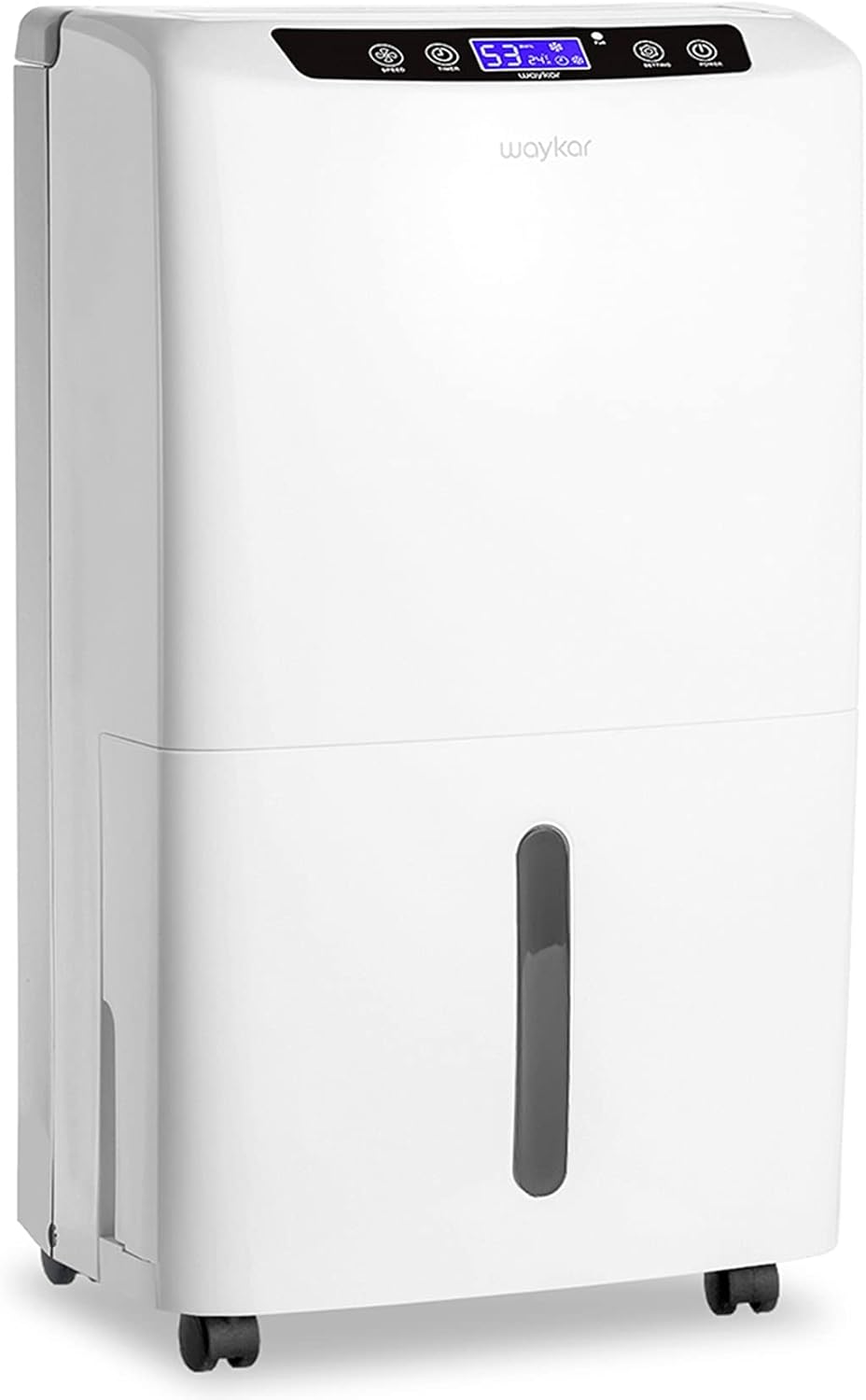
| Capacity | 34 pints |
|---|---|
| Floor Area | 2000 square_feet |
| Tank Volume | 0.66 gallons |
| Wattage | 230 watts |
| Air Flow Capacity | 62 cfm |
The Waykar 34 Pint Dehumidifier is built to remove excess moisture from basements and large rooms up to about 2,000 sq ft, using a compressor-based system and an ENERGY STAR rating to keep operating costs lower than conventional units. It offers automatic humidity control between 30% and 80% RH, two fan speeds, a 24-hour timer, and a manual 90° swing to direct airflow where you need it most. Water can be collected in the 0.66 gallon removable tank or routed through the included drain hose for continuous unattended operation, which is useful in basements or during long humid stretches. Practical protections such as automatic defrost, overload protection, and auto-restart after power loss help it run reliably in cooler or variable conditions. The unit is moderately heavy and sized for stationary placement, and the tank capacity means frequent emptying if used without the drain hose in very damp environments. Controls are straightforward but not advanced smart-home connected, so expect simple manual setup and monitoring.
Best for: Buyers who want a reliable, energy-efficient dehumidifier for basements or large rooms and plan to use a drain hose or leave the unit running for extended periods.
Less Ideal for: Those needing a very lightweight, ultra-compact unit for occasional use in small rooms or users who require smartphone connectivity and remote monitoring features.
- Energy Star certified for more efficient daily operation
- Dual drainage: removable tank plus included hose for continuous drain
- Wide humidity set range (30%–80%) for deeper basement drying
- Automatic defrost and overload protection for reliable low-temperature use
- 24-hour timer and two fan speeds for flexible scheduling and airflow control
- Relatively small 0.66 gallon tank requires frequent emptying without continuous drain
- No built-in Wi-Fi or advanced remote monitoring features
Verdict: A reliable, ENERGY STAR 34-pint dehumidifier that is well suited for basement use when you plan to use continuous hose drainage for uninterrupted moisture removal.
AEOCKY BOREAS-001 Dehumidifier

| Dehumidification Capacity | 50 pints/day |
|---|---|
| Tank Volume | 0.8 gallons |
| Floor Area | 3500 square_feet |
| Wattage | 380 watts |
| Operation Mode | Continuous |
The BOREAS-001 is a compact, compressor-based dehumidifier designed to handle damp basements and other residential spaces while staying quiet and portable. It extracts up to 50 pints per day (measured at 95°F/95% RH) and includes a 2 meter drain hose plus a 3/4" garden-hose adapter for continuous gravity drainage, which is useful in basements where the tank would otherwise fill quickly. Controls include adjustable humidity (40% to 80%), a timer, child lock and fan speeds, and the unit uses an auto-defrost system to keep running in cooler conditions. Practical benefits are its small footprint and casters that make placement and moving between rooms easy, quieter operation claimed around 40 to 43 dB, and copper tubing with hydrophilic fins aimed at durability. Important limitations are the fairly small 0.8 gallon tank that necessitates using the gravity drain for heavy-duty basement use, and while the brand emphasizes energy efficiency, claimed savings will depend on runtime and local electricity costs. For users who need a quiet, space-saving compressor unit with hose drainage, this model is a solid option.
Best for: Buyers who prioritize a quiet, space-saving compressor dehumidifier for basements or living areas and who prefer the convenience of included drainage hardware to avoid frequent emptying.
Less Ideal for: Users who need a very large onboard tank or who require a built-in pump for uphill drainage should consider larger models or units with integrated pumps.
- High dehumidification capacity up to 50 pints/day for its compact size
- Includes 2 m drain hose and 3/4" garden-hose adapter for continuous gravity drainage
- Quiet operation claimed around 40–43 dB, suitable for living spaces
- Auto-defrost and adjustable humidity control for reliable performance in cooler basements
- Built with copper tubing and hydrophilic fins for improved durability
- Small 0.8 gallon tank fills quickly in damp environments, making continuous drainage advisable
- No built-in condensate pump, so gravity drainage or a higher drain point is required for some setups
Verdict: Choose the BOREAS-001 when you want a quiet, compact compressor dehumidifier with included hose drainage that can handle heavy basement moisture without taking up much space.
Choosing the Right Dehumidifier with Hose for Basement: Key Factors to Consider
Extraction Capacity Versus Basement Size
Extraction capacity, usually quoted as pints per 24 hours, determines how quickly a dehumidifier removes moisture from the air. A unit with insufficient capacity will run constantly without reaching target humidity, while an oversized unit cycles frequently and wastes energy.
Match capacity to the square footage and typical dampness of your basement. Consider whether the space is finished, contains a lot of stored items, or has ongoing water intrusion; these conditions increase required extraction. Also account for seasonal variation since basements can be colder and require a model that maintains performance at lower temperatures.
Drainage Options and Hose Compatibility
Basement use often favors continuous drainage to a floor drain, sump, or utility sink. Check that the unit supports a gravity-fed hose or an internal pump if you need to lift condensate to a higher drain point.
Hose attachments should be standard sizes to work with common drain fittings, and the condensate outlet location affects where you can place the dehumidifier. A model with a dedicated hose port and clear instructions for secure connections reduces the risk of leaks or spills during long unattended runs.
Low-Temperature and Cold-Climate Performance
Basements are frequently cooler than the rest of the house, and many dehumidifiers lose efficiency or freeze up at lower temperatures. Choose a unit rated for low-temperature operation or that includes automatic defrost to prevent ice buildup on the coils.
Reliable cold-weather function ensures the dehumidifier continues to extract moisture during shoulder seasons and in colder climates. This reduces the chance of condensation and mold growth during cooler months when basements may be humid but cold.
Energy Use for Continuous Operation
Dehumidifiers intended for basement use often run for many hours or continuously. Energy efficiency matters because long runtimes translate to noticeable operating cost. Look for machines with higher extraction per kilowatt-hour and energy-saving features such as adjustable humidistats or eco modes.
Consider actual runtime expectations based on your basement conditions. A slightly more efficient model can save substantially over a season when compared to an inefficient unit that has to run continually to maintain the same humidity level.
Ease of Maintenance and Filter Access
Basements collect dust, lint, and airborne particulates that can clog coils and filters. A dehumidifier with easy-to-access, washable filters and straightforward coil access cuts maintenance time and helps sustain performance.
Maintenance considerations also include the clarity of drain ports, whether hose fittings are removable for cleaning, and how simple it is to service or replace parts. Lower maintenance burden reduces downtime and prolongs useful life in the dusty basement environment.
Sizing the Unit to Your Basement Layout
Calculating the right capacity starts with basement area and extends to ceiling height, finish level, and moisture sources. For unfinished basements with exposed concrete and higher humidity, plan for a higher extraction rate than for small finished basements. If you have a multiroom or partially open basement, place the dehumidifier where airflow is least obstructed and hose routing is straightforward.
- Measure square footage and ceiling height to estimate cubic footage.
- Assess visible water, condensation, and musty odor intensity.
- Place unit centrally or where it can drain easily without long uphill hose runs.
Routing the Drain Hose Safely
Plan the hose run before installing the unit. Gravity drainage requires a continuous downhill slope to the drain point. Avoid long horizontal runs that trap condensate and add a slight downward grade to keep water moving. Where a gravity drain is not possible, choose a unit with a built-in condensate pump or allow room for a small external pump.
- Use dedicated plumbing-friendly hose that resists kinking.
- Secure the hose connection with clamps or threaded fittings where provided.
- Test the drain setup for leaks and slow spots before leaving the unit unattended.
Managing Noise and Location Considerations
Basements can be adjacent to living areas or host sleeping rooms above, so consider noise output when selecting placement. Larger extraction-capacity units often produce more noise, but mechanical isolation, distance, or sound-damping mats can reduce transmission. If the basement doubles as a workshop or media room, prioritize quieter units or place them in an insulated closet with adequate airflow.
- Measure noise levels if you are sensitive to sound from HVAC equipment.
- Avoid placing the dehumidifier directly under bedrooms when possible.
- Use rubber feet or an isolation pad to reduce vibration transfer.
Safety and Winter Care
If the dehumidifier will run in a cold basement or an unheated space during winter, protect the condensate line from freezing. Insulate exposed hose sections and ensure the drain outlet is inside warm plumbing when possible. Follow electrical safety by placing the unit on a level, non-flammable surface and keeping clearance from walls and stored materials for proper airflow.
- Empty or bypass the unit correctly when you shut it down for the season.
- Keep the power cord away from water and traffic paths.
- Verify that any built-in pump is protected against dry-run conditions.
Placement for Best Airflow and Coverage
A dehumidifier performs best with unobstructed airflow. Keep the intake and outlet clear of shelves, boxes, and walls. For large basements, you may need more than one unit or to move a single unit periodically to cover different zones effectively. Avoid corners and tight spots where air circulation is restricted. Elevating the unit slightly off the floor can help if you plan to route a hose directly into a nearby drain fitting.
- Leave at least several inches of clearance around the appliance.
- Orient the outlet away from stored items to avoid redistributing moisture.
- Consider a circulation fan for stubborn corners to improve overall air mixing.
How We Chose the Best Dehumidifier with Hose for Basement
We focused on features that matter specifically for basement moisture control and continuous operation. Selection began with models designed to run for extended periods and to handle basement-sized volumes of air. Primary evaluation criteria included extraction rate at typical basement temperatures, flexible drainage options including hose compatibility, energy efficiency during long runs, and build elements that support durability and low maintenance in dusty or unfinished spaces. We excluded small room-only units and units that lack a stable, reliable continuous-drain option. We also filtered out devices with inadequate low-temperature performance or limited serviceability. The final list emphasizes extraction capacity per 24 hours, condensate management and hose hookups, energy consumption for long-operation scenarios, and practical features such as washable filters and simple controls. Noise and footprint were considered because basements are often near living spaces or house mechanical equipment.
Our full evaluation process is outlined in our review methodology.
FAQ
Can I run a basement dehumidifier with a hose into a sump pit?
Often yes. Many dehumidifiers allow continuous gravity drain to a sump pit or utility sink. Confirm the outlet height and whether you need a pump if the drain point is higher than the unit. Secure, leak-free connections and checking for backflow risk are important.
Will a dehumidifier freeze in a cold basement?
It can if the unit is not rated for low-temperature operation. Models with automatic defrost or low-temperature settings are better for cold basements. Also consider placing the unit where temperature rarely drops below the manufacturer minimum.
How long should I expect to run a basement dehumidifier each day?
Runtime depends on basement humidity, size, and unit capacity. In very damp basements a dehumidifier may run many hours or nearly continuously until humidity drops into the target range. Proper sizing reduces excessive runtimes.
Do I need a pump for basement drainage?
Not always. If you have a floor drain or sink at a lower elevation, gravity drainage works. A pump is necessary when you must lift condensate to a higher drain or travel a long horizontal distance that prevents reliable gravity flow.
How often should I clean the filter and coils?
Inspect the air filter monthly in dusty basements and clean or wash it as recommended. Clean coils annually or as needed if performance drops. Regular maintenance keeps extraction efficient and reduces risk of mold growth on components.
Final Verdict
For basements, prioritize extraction capacity matched to space, reliable continuous-drain capability, and low-temperature performance. Energy efficiency and straightforward maintenance are important because these units often run for extended periods. Balance a slightly higher initial capacity against energy use and noise to find a unit that maintains target humidity without excessive runtime. Focus on hose routing options and whether you need a pump before choosing a unit. With the right fit you will reduce moisture, control odors, and protect stored items while keeping maintenance manageable.