
Note: This article contains affiliate links. If you click on these links and make a purchase, we may earn a small commission at no extra cost to you. This helps support our research and content. Read our full affiliate disclosure here.
If your garage collects condensation, musty smells, or shows early signs of rust, a purpose-built desiccant dehumidifier can make a big difference. Garages present a mix of temperature swings, airborne dirt, and occasional high humidity that refrigerant units can struggle with. Desiccant dehumidifiers use moisture-absorbing media and are better at low temperatures and for quick humidity control in semi-enclosed spaces. This guide shortlists seven top desiccant dehumidifiers for garages and explains the performance, durability, and operating costs that matter most. We evaluate moisture removal efficiency, robustness for workshop conditions, noise, and ease of maintenance to help you pick the right model for your space. Read on for the criteria we used and practical buying guidance before the product list.
Top Picks at a Glance
| Best Overall The best all-around choice for most situations | Ivation 19 Pint Desiccant Dehumidifier |  |
| Best Quality Built to a higher standard if you want something more solid | EVA-DRY EDV4000 Dehumidifier |  |
| Best Value The sweet spot between price and what you get | Ivation 13-Pint Desiccant Dehumidifier |  |
| Best Budget The cheapest option that still gets the job done reliably | SereneLife SLARP800BK Dehumidifier |  |
| Top Rated A top-rated pick with lots of positive feedback | Globexis CS10D Dehumidifier |  |
| Most Popular A crowd favorite that many people choose with confidence | Eva-Dry E-333 Mini Dehumidifier |  |
| Best Seller A high-volume bestseller chosen again and again | AEOCKY X1-Pro Dehumidifier |  |
Ivation 19 Pint Desiccant Dehumidifier

| Dehumidification Capacity | 19 pints_per_day |
|---|---|
| Floor Area | 410 square_feet |
| Tank Volume | 0.75 gallons |
| Number of Speeds | 2 |
| Operation Mode | Comfort, Continuous |
The Ivation 19 Pint Desiccant Dehumidifier uses a desiccant rotor to pull moisture from the air and is built for small, enclosed areas such as garages, laundry rooms, or closets where temperatures can drop. It offers two fan speeds, adjustable humidity control, and an easy-to-read LCD that also lets you set a timer, dim the display, and enable continuous or comfort modes. The unit has a 0.5 gallon internal reservoir and includes a hose for continuous drain so you can run it unattended for long periods; a washable filter and auto-shutoff add convenience. Because it is a desiccant model it works at lower temperatures than many compressor units and runs quietly, though the drying capacity is oriented to small-area jobs rather than whole-garage dehumidification in very large or heavily damp spaces. Its lightweight plastic build and carry handle make it portable but mean it is not as rugged as heavier shop-grade units. Overall this is a practical, easy-to-use option when you need reliable low-temperature moisture control in a modest garage or similar space.
Best for: Someone wanting dependable low-temperature moisture control for a small garage, workshop, or utility space who values portability and simple digital controls.
Less Ideal for: Owners with large garages or severe humidity problems who need heavy-duty, high-capacity compressor dehumidifiers for whole-space drying.
- Desiccant rotor maintains performance at lower temperatures where compressor units often struggle
- Compact and lightweight with a carry handle for easy placement and transport
- LCD display with adjustable humidity, timer, and dimmable screen for simple control
- Includes continuous drain hose and a 0.5 gallon tank for unattended operation
- Washable filter and auto-shutoff help reduce maintenance and protect the unit
- 19‑pint capacity is intended for small-area use and may be underpowered for large or very damp garages
- Plastic construction is less durable than heavier commercial units
Verdict: A compact, quiet desiccant dehumidifier that delivers reliable low‑temperature moisture control for small garages and similar spaces.
EVA-DRY EDV4000 Dehumidifier

| Floor Area | 4000 square_feet |
|---|---|
| Wattage | 21 watts |
| Air Flow Capacity | 4000 cubic_feet_per_hour |
| Number of Speeds | 2 |
The EVA-DRY EDV4000 uses rotary desiccant technology to pull moisture from air in medium to large rooms and enclosed spaces up to about 4000 cubic feet without a compressor. It runs in automatic mode with two fan speeds and a built-in humidistat, and offers continuous drain capability or a removable high-capacity water catch basin for manual emptying. Practical features include a timer, dryer mode with adjustable louvers to direct warm air for faster drying, a built-in ionizer and a silver-coated filter that reduces bacteria, and relatively quiet operation at 34 dB on low and 51 dB on high. At 21 watts it is energy efficient compared with compressor units, and its compressorless design suits spaces sensitive to oil or refrigerant. Limitations include the need for a drain hose for continuous operation and the unit weight that may affect portability; desiccant-style performance can also be less efficient in very warm, extremely humid conditions compared with some high-capacity refrigerant dehumidifiers.
Best for: Buyers who prioritize reliable dehumidification and low-noise operation for garages, workshops, or enclosed storage spaces and want a compressor-free unit with automated controls.
Less Ideal for: People seeking maximum water-extraction in hot, extremely humid climates or those who need the lightest possible portable unit for frequent moving between sites.
- Compressorless rotary desiccant system removes moisture without refrigerants
- Quiet operation with two fan speeds (34 dB low, 51 dB high) suitable for occupied spaces
- Built-in humidistat and 8-hour timer for automated humidity control
- Dryer mode and adjustable louvers help speed drying of clothes and rugs
- Continuous drain option plus removable high-capacity water basin for flexible use
- Requires a drain hose for unattended continuous draining (hose not included)
- Desiccant units can be less efficient than refrigerant models in very warm, high-humidity environments
Verdict: For performance-focused garage use, the EDV4000 delivers quiet, compressor-free moisture control with automated features and continuous-drain flexibility.
Ivation 13-Pint Desiccant Dehumidifier
| Dehumidification Capacity | 13 pints_per_day |
|---|---|
| Floor Area | 270 square_feet |
| Tank Volume | 3.8 pints |
| Wattage | 470 watts |
| Operation Mode | Comfort, Continuous |
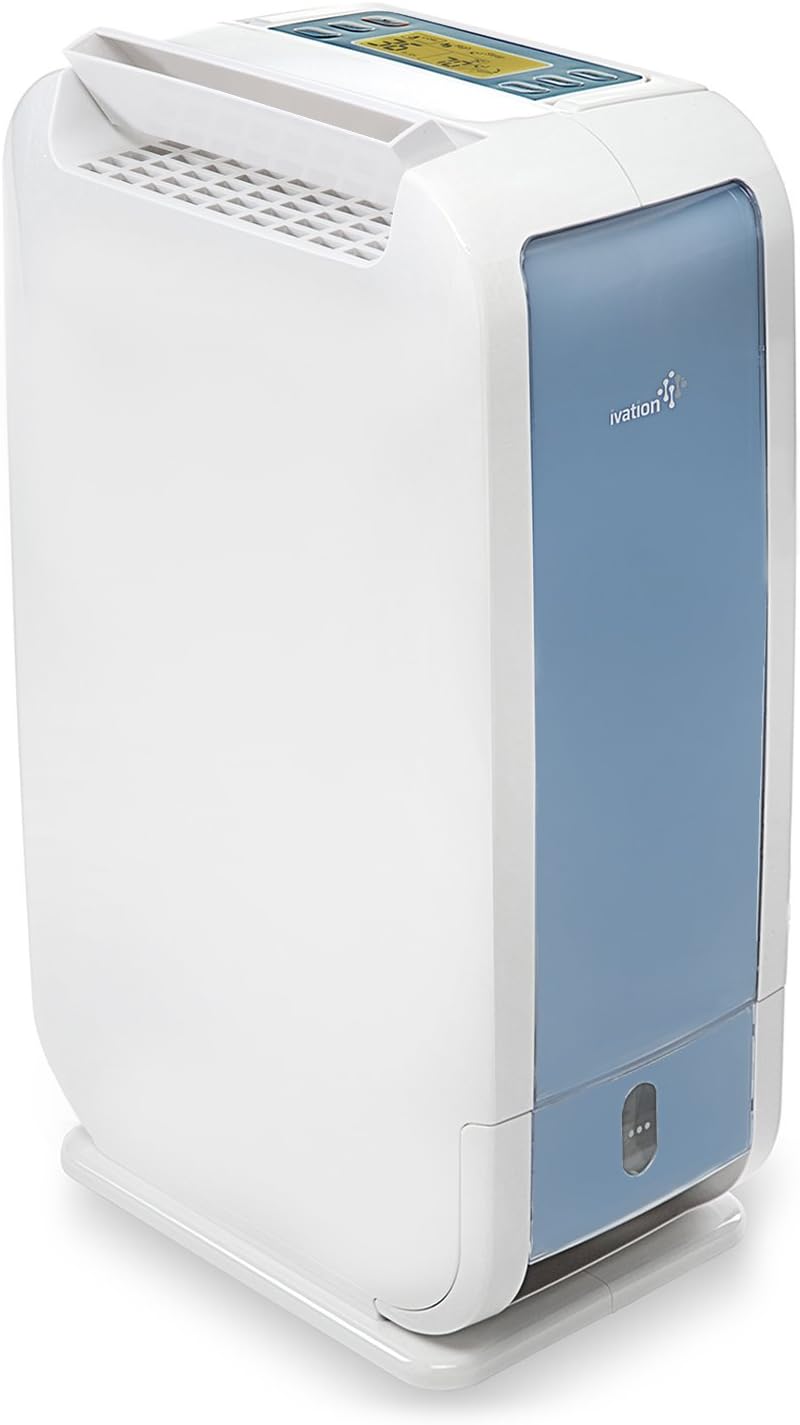
This Ivation desiccant dehumidifier uses a rotor-based desiccant system to extract up to 13 pints of moisture per day at typical indoor conditions, making it suited to tight, often-cold areas where compressor units underperform. It offers two fan speeds and high/low power modes (470W/280W) so you can balance drying speed and energy use, and a removable 3.8‑pint reservoir or included continuous drain hose for hands-free operation. The digital LCD control panel with humidity target, timer and sleep mode makes it easy to set and monitor conditions, while auto-restart and an overflow auto-stop add safety. Because it gently warms the air while running, it remains effective in colder garage corners or unheated spaces. Trade-offs are typical for desiccant units: it consumes more power than the most efficient compressor models and the internal reservoir needs emptying if not using the drain hose. For small garage bays, workbenches, and storage nooks this unit provides reliable humidity control where compressor dehumidifiers struggle.
Best for: Buyers who need dependable moisture control in unheated or cooler garage spaces and prefer flexible drain options and straightforward digital controls for hands-off operation.
Less Ideal for: Those who need very large-room capacity or the lowest possible running cost should consider larger compressor-style units instead.
- Effective in lower temperatures thanks to desiccant rotor technology
- Choice of removable 3.8‑pint tank or continuous drain hose for unattended operation
- Digital LCD with humidity target, timer and sleep mode for easy control
- Auto-restart and overflow auto-stop add safety after power interruptions
- Higher power draw on high setting compared with many compressor dehumidifiers
- Smaller internal tank requires frequent emptying if continuous drain is not used
Verdict: A compact desiccant unit built for small, cooler garage spaces that need reliable moisture removal and the convenience of continuous drain.
SereneLife SLARP800BK Dehumidifier

| Floor Area | 216 square_feet |
|---|---|
| Capacity | 5.3 pounds |
| Tank Volume | 91 fluid ounces |
| Number of Speeds | 2 |
| Operation Mode | Automatic |
The SereneLife SLARP800BK is a portable desiccant-style dehumidifier that combines a removable silica-gel cylinder with a drying base for flexible moisture control. It is intended for spot use in bedrooms, bathrooms, closets, or garages where quiet operation matters, and it runs at roughly 50 dB for low-noise environments. The unit offers automatic humidity detection with a target range of 45–55 percent, two fan speeds, a timer with 6/12/24-hour options, sleep mode, and safety features like full-tank indicator, auto shutoff, and a defrost function. The cylinder can be used in tight spaces and then recharged on the base in about 2–3 hours, which removes the need to empty water buckets. Practical benefits include simple, tool-free portability and easy maintenance via the rechargeable drying base. Limitations are its modest capacity and floor-area rating around 216 sq ft, so it works best for local damp spots rather than whole-garage moisture problems, and it lacks the continuous extraction power of compressor dehumidifiers for very humid or large spaces.
Best for: A buyer wanting an inexpensive, low-noise desiccant unit to address localized damp spots in a garage or storage area and who prioritizes portability and low maintenance over high extraction rates.
Less Ideal for: People needing to dehumidify an entire large garage, workshop, or very humid space continuously should choose a higher-capacity compressor or whole-room dehumidifier instead.
- 2-in-1 removable cylinder plus drying base lets you treat tight spaces and recharge without emptying tanks
- Whisper-quiet operation (~50 dB) suitable for bedrooms or shared spaces
- Automatic humidity detection and auto shutoff for hands-off operation
- Timer and sleep modes provide energy-conscious runtime control
- Rated for about 216 sq ft so not ideal as the sole solution for a full-size garage
- Smaller capacity compared with compressor units limits continuous water removal
Verdict: A budget-friendly, quiet desiccant solution for treating localized damp spots in a garage where portability and low maintenance matter most.
Globexis CS10D Dehumidifier
| Capacity | 2.5 liters |
|---|---|
| Dehumidification Capacity | 2.2 liters_per_day |
| Floor Area | 1500 square_feet |
| Number of Speeds | 2 |
| Wattage | 270 watts |
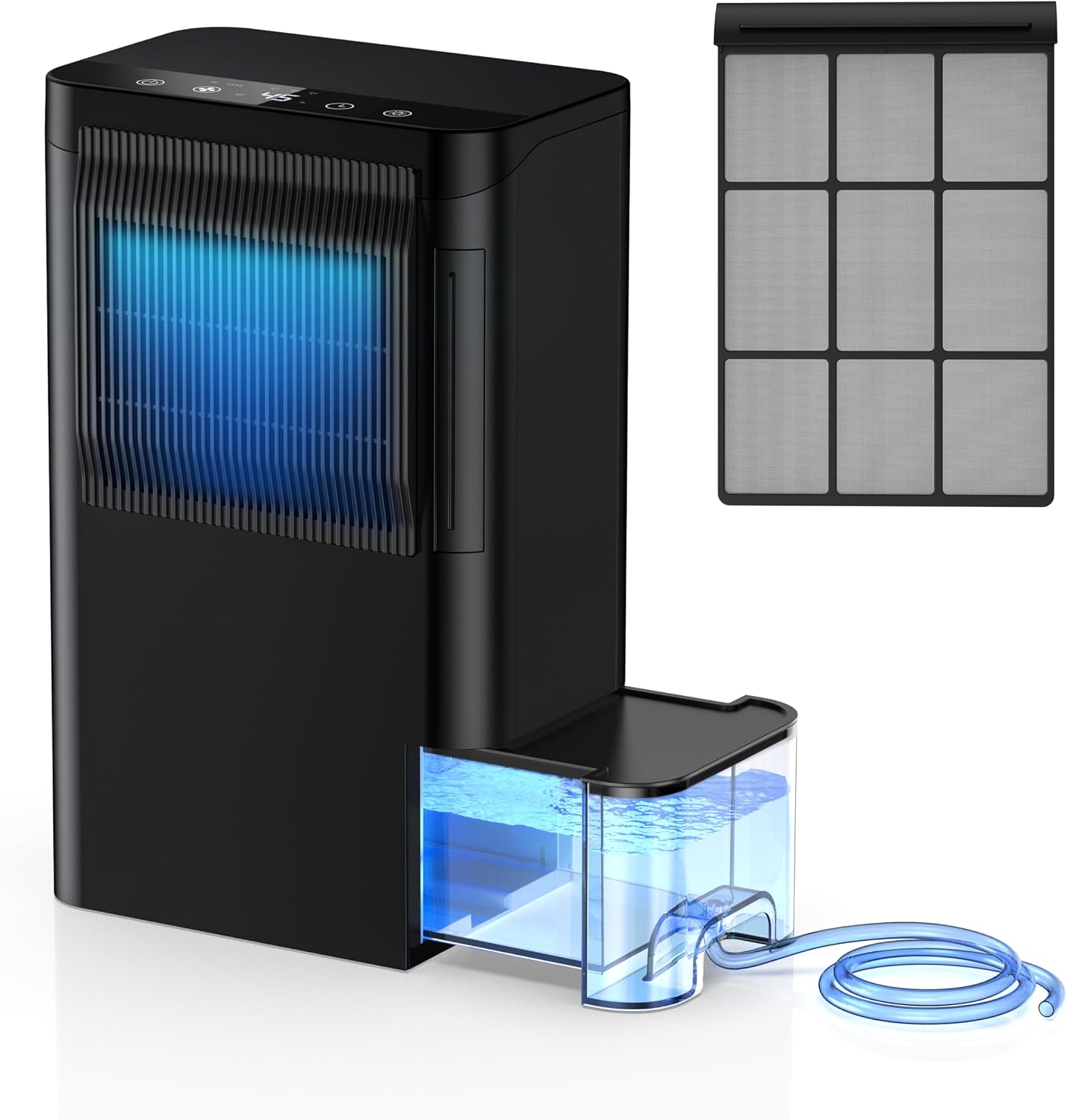
The Globexis CS10D is a small rotary-technology dehumidifier intended for continuous daytime or unattended use in spaces like basements, garages, or bedrooms. It removes about 2.2 liters per day and offers a 2.5 liter tank plus a included drain hose for continuous draining and auto shutoff when full. The unit runs quietly at about 35 dB, has two fan speeds, an easy touch control panel, a soft ambient LED indicator, and safety features such as overheat protection and a washable dust filter. Notably this model is rated to operate down to 34°F, which helps prevent freeze-up in colder garages and unheated spaces where compressor units struggle. Practical limits are its modest daily capacity, so it is best for small to medium damp areas rather than large, very wet rooms, and it relies on the small internal reservoir unless the drain hose is used. Build is typical for the category with ABS housing and a lightweight design that is easy to move between locations.
Best for: Buyers who prioritize dependable, year-round operation in cool or unheated spaces and want a lightweight unit they can move between a garage, basement, or laundry area.
Less Ideal for: People needing high-capacity moisture removal for large, very wet garages or whole-house dehumidification should choose a larger commercial or high-capacity model instead.
- Operates down to 34°F so it will run in cold garages and unheated spaces
- Includes 2.5L tank plus drain hose for continuous unattended draining
- Runs quietly (~35 dB), suitable for nearby living spaces or offices
- Simple touch controls, two speeds, and a washable filter for easy maintenance
- Built-in safety features like overheat and overload protection
- 2.2 liters per day dehumidification is modest for very damp or large garage areas
- Small tank means frequent emptying if continuous drain is not used
Verdict: Choose the Globexis CS10D when you need a reliable, low-temperature dehumidifier that can run unattended in cool garages and small to medium damp spaces.
Eva-Dry E-333 Mini Dehumidifier

| Floor Area | 333 square_feet |
|---|---|
| Capacity | 6 ounces |
| Dehumidification Capacity | 0.38 pints_per_day |
| Operation Mode | Continuous |
| Voltage | 110 volts |
The Eva-Dry E-333 is a cordless desiccant unit that passively pulls moisture from small enclosed areas using crystallized silica gel beads. It is designed to be hung or placed inside closets, cabinets, cars, gun safes or other tight spaces and advertises an absorption capacity of roughly 4 to 6 ounces before needing recharge. The unit is rechargeable and requires no batteries or power cords during normal use, and an indicator bead color change shows when recharging is needed. Practical benefits include simple, maintenance-free operation, portability, and a long service life for the silica gel media when recharged correctly. Limitations for garage use are its small capacity and low daily extraction rate, so it is only suitable for small, contained compartments within a garage rather than open workshop areas; it also does not actively control humidity or run continuously like powered dehumidifiers. If you need a low-cost, no-fuss moisture absorber for boxes, cabinets, or tool chests in a garage, this model does the job, but larger or damp garages will require a higher-capacity powered unit.
Best for: Buyers who want a low-maintenance, cordless moisture solution to protect small enclosed areas inside a garage and prefer a simple reusable desiccant over running a powered unit.
Less Ideal for: People who need to dry large garage bays, workshops, or consistently damp environments should choose a higher-capacity powered dehumidifier instead.
- Cordless, rechargeable design requires no batteries or continuous power
- Visible moisture indicator beads that signal when to recharge
- Compact and portable for placement in small, enclosed spaces
- Non-toxic silica gel desiccant suitable for closets, safes, and vehicles
- Very small moisture capacity not suitable for open garage spaces
- Low daily extraction rate compared with powered dehumidifiers
Verdict: A simple, cordless desiccant option for protecting small enclosed spots in a garage where a low-maintenance, rechargeable absorber is preferred over a powered dehumidifier.
AEOCKY X1-Pro Dehumidifier

| Capacity | 10 pints |
|---|---|
| Tank Volume | 85 fluid ounces |
| Wattage | 340 watts |
| Operation Mode | Automatic |
The AEOCKY X1-Pro is a portable rotary desiccant dehumidifier built for tight, cool, or seasonally cold spaces where compressors underperform. It uses a zeolite molecular-sieve core and a 340W thermal regeneration system to adsorb and then expel moisture into an 85 oz tank, or send water away via the included drain hose for continuous operation. Controls include a hygostat with custom 40%–80% humidity setpoints, a 24-hour timer, and a quiet Sleep Mode that drops noise to around 25 dB. Practical benefits for garages and similar spaces are frost-free operation down to 34°F, low noise for nearby work areas, and lightweight portability for moving between rooms, RVs, or storage areas. Limitations include a modest peak capacity that is best suited to small garages or single bays rather than large, open garages, and a heat and slight baking odor during initial runs as the desiccant is regenerated. The unit lacks power-outage memory, so settings reset after mains interruptions.
Best for: Homeowners who prioritize reliable, frost-free dehumidification in small garages, work bays, or unheated storage spaces and want a quiet, portable unit that is simple to control.
Less Ideal for: Those needing rapid, high-volume moisture removal for large or multiple-car garages should consider higher-capacity compressor models instead.
- Frost-free desiccant design works reliably in cold or unheated spaces
- Included drain hose and 85 oz tank enable hands-free continuous drainage
- Quiet operation with a Sleep Mode that reduces noise to about 25 dB
- Custom hygrostat and timer let you lock to specific humidity targets for precise control
- Lightweight and portable for moving between garages, workshops, and RVs
- 10 pints/day capacity is modest and not intended for large or heavily flooded garages
- Generates warm exhaust and a brief baking scent during regeneration, which may be noticeable in small enclosed areas
Verdict: Choose the X1-Pro when you need a compact, frost-free dehumidifier that quietly and reliably controls humidity in small or chilly garage spaces.
Choosing the Right Desiccant Dehumidifier for Garages: Key Factors to Consider
Low-Temperature Performance
Garages often fall below standard indoor temperatures, especially in winter. Refrigerant-type dehumidifiers lose effectiveness as temperatures drop because coils can freeze or become inefficient. Desiccant units maintain extraction rates at lower temperatures because the desiccant medium adsorbs moisture without depending on condensation cycles.
When choosing a desiccant dehumidifier for a garage, check the manufacturer's rated extraction at temperatures that match your local winter lows. Units with explicit low-temperature ratings or thermostatic controls will perform more reliably and avoid cycles of frost or shutdown.
Moisture Removal Capacity
Capacity is typically quoted as pints or liters removed per day, but real-world performance depends on ambient temperature and relative humidity. For garages with heavy dampness, higher capacity units reduce runtime and reach target relative humidity faster.
Estimate the size of your garage and how damp it gets after storms or snowmelt. Oversizing a unit slightly gives headroom for seasonal spikes and reduces continuous runtime, but extremely oversized choices can waste energy in milder conditions.
Durability and Serviceability
Garage use exposes equipment to dust, grit, and occasional contact with tools or chemicals. Look for corrosion-resistant housings, reinforced casings, and designs that make routine servicing straightforward. Replaceable desiccant cartridges or rotors, accessible filters, and visible drain connections simplify upkeep.
A model with modular parts and clear access panels will be easier to maintain. Check for IP ratings or splash-resistant design features if your garage sees occasional moisture intrusion or pressure washing.
Drainage and Continuous Operation
Desiccant dehumidifiers can be used intermittently or continuously. For garages prone to persistent humidity, continuous drainage is critical to avoid frequent emptying of internal tanks. Options include gravity drain ports, pump-assisted drain systems, or compatibility with external drain lines.
Consider the slope and routing possibilities in your garage when selecting drain style. Pumped drains add installation flexibility but increase maintenance complexity. Confirm the drain connection size and accessibility before installing the unit.
Noise, Venting, and Placement
Many garages double as workshops, hobby rooms, or storage spaces where noise matters. Desiccant systems employ blowers and sometimes heaters for desiccant regeneration, so noise levels and airflow direction affect placement choices. Pay attention to dB ratings and recommended clearances around the unit.
Place the unit where intake and exhaust airflow will not blow dust onto stored items or interfere with workspace tools. If noise is a concern, look for units with variable fan speeds or night modes that reduce sound during occupied hours.
Operating Cost and Energy Use
Desiccant dehumidifiers can consume more energy per hour than refrigerant units, especially models that use heat to regenerate desiccant material. Compare rated power draw and consider run-time estimates based on your garage size and typical humidity cycles.
Energy-saving features such as programmable timers, humidistats that prevent unnecessary cycles, and smart controls that adapt to ambient conditions reduce lifetime operating costs. Balance initial capacity needs against ongoing electricity consumption for a total-cost perspective.
Sizing Your Garage and Choosing Capacity
To pick the right capacity, measure the square footage and ceiling height of your garage to calculate volume. Then consider how damp the space gets after rain, melting snow, or during humid summer nights. A small, occasionally damp garage needs a lower extraction rate than a large, climate-exposed workshop.
When in doubt, choose a unit that can cycle the air in the space multiple times per day rather than relying solely on a daily pint rating. That approach prevents localized pockets of humidity near vehicles, tool cabinets, and stored items.
- Calculate cubic feet: length × width × height.
- Match extraction rate to typical seasonal conditions, not just mild days.
- Allow additional capacity for workshops or garages with water sources.
Placement and Airflow Tips
Mount or position the dehumidifier where it can draw air freely and discharge without obstruction. Avoid corners or locations directly behind large shelving where airflow will stagnate. Most manufacturers recommend a minimum clearance for intake and exhaust; follow these to ensure rated performance.
If your garage contains valuable woodworking or metalworking tools, orient the exhaust away from those areas to avoid accelerating dust deposition. Consider elevating smaller units off the concrete floor to reduce dust intake and improve airflow.
- Keep intake and exhaust clear of 12 inches at minimum.
- Place near the most humid zone when practical, such as near exterior doors or leaky areas.
- Elevate on a platform for cleaner intake air and easier drain routing.
Noise Management for Workshop Garages
If you use the garage for projects, noise from the dehumidifier can be disruptive. Look for units with variable fan speeds so you can reduce noise during focused work. Sound dampening panels or strategic placement behind a workbench can also mitigate perceived noise without blocking airflow.
Keep in mind that higher extraction rates often correspond to louder operation. If you need both strong moisture control and a quiet workspace, consider zoning the garage or scheduling higher-output operation for overnight hours.
- Use lower fan settings while working and higher settings overnight.
- Install rubber feet or pads to reduce vibration transfer to floors.
- Maintain filters and rotor components to prevent rattles and increased noise over time.
Maintenance Routines That Extend Life
Regular maintenance keeps performance steady and prevents breakdowns. Cleaning or replacing intake filters prevents dust buildup on the desiccant rotor and fan assembly. Check and clean condensate drain paths or pump inlets to avoid clogs.
Inspect external housings for dents, corrosion, or seal failures and address small issues before they grow. Schedule a quick inspection after seasonal changes, and plan deeper service at least once a year for units running constantly.
- Clean or replace intake filters monthly in dusty garages.
- Flush or inspect drain hoses every 3 months for blockages.
- Check electrical connections and mounts annually.
Safety and Installation Considerations
Install the unit away from combustible chemicals, fumes, or strong solvents commonly stored in garages. Ensure electrical circuits can handle continuous operation and that outlets are protected from splashes. If using a pumped drain, route the discharge to a safe, code-compliant location.
Use appropriate mounting hardware for wall or ceiling installations and follow clearance recommendations for safe operation. Keep the unit accessible so routine maintenance and emergency shutdowns are straightforward.
- Avoid placing units directly under exposed wiring or flammable storage.
- Confirm dedicated circuit capacity for continuous-duty models.
- Follow local codes for condensate disposal where applicable.
How We Chose the Best Desiccant Dehumidifier for Garages
We focused on attributes that matter most for garages and similar semi-conditioned spaces. First, we evaluated moisture removal performance across a range of temperatures and humidity levels, since garages often drop below typical room temperatures. We prioritized units with consistent low-temperature extraction and clear RH control options. Durability and build quality were next. Garage environments expose appliances to dust, splashes, and occasional bumps, so we favored rugged enclosures, serviceable parts, and corrosion-resistant finishes. Energy efficiency and operating cost were considered because garages can run continuously during wet seasons; we looked at power draw relative to moisture removal and any energy-saving modes. Noise and ventilation requirements were assessed for users who convert garages into workshops or hobby areas. Maintenance factors such as access to the desiccant rotor or cartridge, filter cleaning, and drain options mattered for long-term ownership. We excluded units designed solely for small closets or electronics cabinets and any products lacking clear performance specs for low-temperature operation. The final list favors practical, serviceable designs with measurable extraction and durability features.
Our full evaluation process is outlined in our review methodology.
FAQ
Can a desiccant dehumidifier work in an unheated garage?
Yes. Desiccant dehumidifiers are designed to perform at lower temperatures better than refrigerant models. They keep removing moisture even when the space drops close to freezing, though extraction rates still depend on actual temperature and humidity.
How often should I empty the water collection tank?
If you use gravity drain or continuous drainage, tank emptying can be avoided. For models with internal tanks, frequency depends on humidity and unit capacity. In very damp conditions you may need daily checks, whereas moderate climates might only require weekly attention.
Will a desiccant unit dry out stored wood or paint in the garage?
Desiccant dehumidifiers reduce ambient relative humidity, which helps prevent absorption of moisture by stored materials. Monitor RH levels and aim for a safe range recommended for your specific materials to avoid over-drying sensitive items.
Are desiccant dehumidifiers more expensive to run?
They can consume more energy, especially during desiccant regeneration cycles that use heat. However, efficiency varies by design. Look for units with timed or demand-based regeneration, programmable humidistats, and good extraction-to-watt ratios to control operating costs.
How do I prevent dust from clogging the desiccant rotor?
Use intake filters and clean them regularly. Elevated placement and prefiltering for particularly dusty garages reduce the amount of particulate reaching the rotor. Periodic inspection and professional servicing, if the design allows, will maintain rotor effectiveness.
Final Verdict
For garage environments, prioritize reliable low-temperature extraction, robust construction, and practical drain options. Capacity should match volume and seasonal humidity spikes more than occasional damp days. Balance extraction needs against energy use and noise, and choose a model that offers straightforward maintenance features such as accessible filters and easy drain routing. A well-chosen desiccant dehumidifier reduces condensation, protects tools and stored items from rust, and can keep a workshop comfortable. Focus on the tradeoffs described here to pick a durable, serviceable unit that fits your garage layout and operating habits.