
Note: This article contains affiliate links. If you click on these links and make a purchase, we may earn a small commission at no extra cost to you. This helps support our research and content. Read our full affiliate disclosure here.
Picking the right ductless air conditioner matters because it directly affects how comfortable, efficient, and affordable room-by-room cooling will be in your home. You want a system that matches the size of the space, installs cleanly, and runs quietly without spiking utility bills. This guide gathers the top shortlisted ductless air conditioners across common home use cases so you can compare how they stack up on cooling capacity, efficiency, and installation needs. Below we summarize the key strengths of the best options and the criteria we used to evaluate them, then walk through factors buyers should weigh before choosing a unit.
Top Picks at a Glance
| Best Overall The best all-around choice for most situations | Albott 12,000 BTU Mini Split SAC001 |  |
| Best Quality Built to a higher standard if you want something more solid | MRCOOL EasyPRO 12K |  |
| Best Value The sweet spot between price and what you get | Rellytech Mini Split 9000 BTU |  |
| Best Budget The cheapest option that still gets the job done reliably | GarveeHome 12000 BTU Mini Split |  |
| Top Rated A top-rated pick with lots of positive feedback | MEPTY 12000BTU Mini Split |  |
| Most Popular A crowd favorite that many people choose with confidence | Senville LETO 24000 BTU Mini Split |  |
| Best Seller A high-volume bestseller chosen again and again | Senville LETO 12000 BTU Mini Split | |
Albott 12,000 BTU Mini Split SAC001

| Cooling Power | 12000 BTU |
|---|---|
| SEER | 18 |
| Voltage | 115 volts |
| Noise | 29 db |
| Refrigerant | R32, GWP: 675 |
The Albott 12,000 BTU mini split SAC001 is a ductless air conditioner and heat pump designed for year-round comfort in medium rooms. It uses an inverter compressor and R32 refrigerant to deliver efficient cooling and heating, with a SEER2 rating of 18 and claimed coverage up to 750 square feet. Controls include a remote and built-in WiFi for app control, plus practical modes like sleep, timer, dehumidify, and an auto-clean function to reduce maintenance. The indoor unit is quiet at around 29 dB and includes a mesh filter and removable air blades for cleaning. Installation requires a separate outdoor unit and a licensed or experienced installer is recommended, though the package includes basic installation components. Trade-offs include the need for proper installation and potential additional refrigerant or setup for long line runs, and the unit runs on 115V power which may limit placement compared with 208–230V systems. For buyers seeking a relatively quiet, energy-conscious mini split with smart controls and year-round capability, this is a well-rounded option; buyers wanting plug-and-play simplicity or those who need multi-room zoning from a single indoor unit should look elsewhere.
Best for: Buyers who want a quiet, energy-conscious ductless system with smart controls and year-round heating and cooling for a single medium-sized room.
Less Ideal for: People who need a DIY plug-and-play portable solution or who want a single unit to serve multiple separate rooms without a multi-zone outdoor unit.
- Inverter compressor with SEER2 18 for improved energy efficiency
- Built-in WiFi plus remote control for convenient app and local operation
- Multi-mode operation including cooling, heating, dehumidify, fan, sleep, and 24-hour timer
- Low noise level around 29 dB suitable for bedrooms or living areas
- Self-cleaning function and removable mesh filter simplify maintenance
- Requires a new compatible outdoor unit and professional installation for best performance
- 115V model may not match every installation wiring standard or higher-voltage outdoor options
Verdict: A balanced, energy-efficient 12,000 BTU mini split that delivers quiet, smart-controlled cooling and heating for a single medium room.
MRCOOL EasyPRO 12K

| Cooling Power | 12000 BTU |
|---|---|
| Refrigerant | R-454B |
| Voltage | 115 volts |
| Wattage | 586 watts |
| Noise | 43 db |
The MRCOOL EasyPRO 12K is a ductless inverter mini split that delivers both heating and cooling for spaces roughly up to 550 sq ft, using a 12,000 BTU capacity and a variable-speed compressor for efficient temperature control. It is intended for wall-mounted installation as part of a split system and pairs with a new outdoor unit, offering app, remote, voice, and push-button controls for flexible operation. Notable features include inverter technology for quieter, more consistent cycling and a relatively high SEER2 rating for the class, which helps reduce run-time and energy use. The unit supports dehumidifying mode and uses R-454B refrigerant while reporting low noise around 43 dB during operation. Important limitations are the requirement for a compatible outdoor condenser and the modest 2-year compressor warranty, so plan on professional HVAC support for outdoor hookup and long-term service. For buyers focused on steady, efficient performance in a single-room application, this model balances power, controls, and efficiency effectively.
Best for: Buyers who prioritize steady, energy-efficient performance for a single room and want flexible controls and quieter operation rather than the lowest upfront price.
Less Ideal for: People who need whole-house cooling, want a self-contained portable solution, or who cannot arrange professional installation for the outdoor condenser.
- 12,000 BTU inverter compressor provides steady heating and cooling for ~550 sq ft
- Multiple control options including app, remote, voice, and push-button
- Relatively quiet operation at about 43 dB
- High SEER2 efficiency rating for lower energy consumption
- Requires a new compatible outdoor unit, so full installation is needed
- Limited 2-year compressor warranty
Verdict: A performance-focused 12,000 BTU ductless mini split that delivers efficient, quiet heating and cooling for a single room with flexible smart and remote controls.
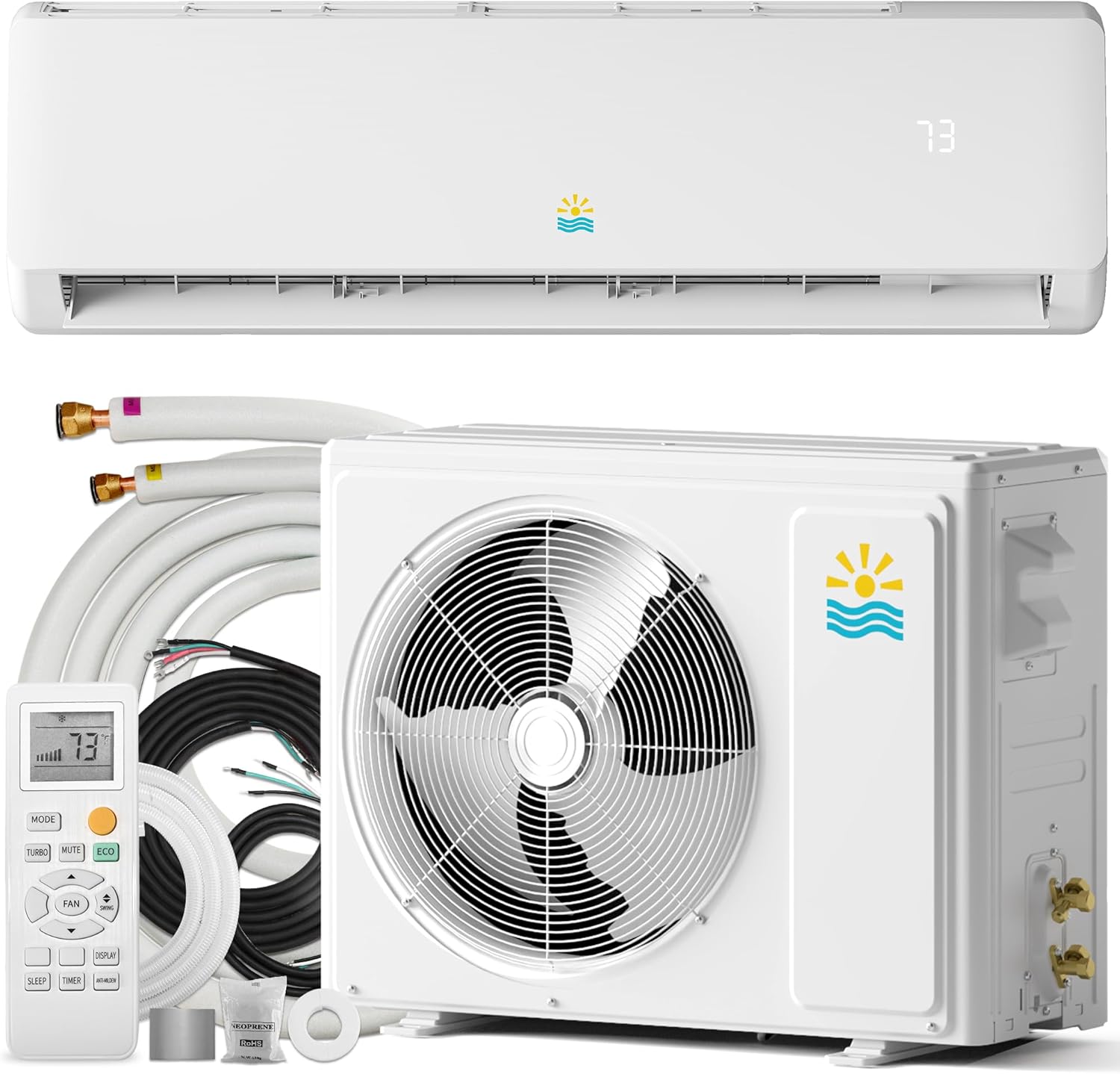
Rellytech Mini Split 9000 BTU
| Cooling Power | 9000 BTU |
|---|---|
| SEER | 19 |
| Refrigerant | R-32 |
| Voltage | 115 volts |
| Floor Area | 450 square_feet |
The Rellytech 9000 BTU mini split is a ductless heat pump sized for bedrooms, home offices, and similar rooms where targeted heating and cooling matter. It uses an inverter compressor and R‑32 refrigerant to deliver faster temperature changes and steady operation while using less power, and the 19 SEER2 / HSPF2 8.5 ratings indicate solid seasonal efficiency. Controls include a full remote, a 24‑hour timer, sleep mode and four fan speeds with a vertical swing to spread conditioned air across the space. The unit is offered as an indoors/outdoors kit with basic installation hardware included but professional installation is recommended for refrigerant handling and mounting. Practical benefits are quiet operation (about 42 dB), simple app/remote control convenience on Wi‑Fi‑enabled models in the series, and energy savings compared with non‑inverter systems. Limitations are that it is a single‑zone 115 V model sized for roughly 450–550 sq ft so it is not suitable as a whole‑home solution, and installation still requires a wall penetration and outdoor condensers so plan for professional labor and placement considerations.
Best for: Buyers who want an efficient, quiet ductless system to control temperature in a single room or defined living space and prioritize lower operating costs and steady comfort.
Less Ideal for: People seeking a whole‑home HVAC replacement, multiroom zoning without additional heads, or a plug‑and‑play window unit should look elsewhere.
- Inverter compressor with R‑32 refrigerant for improved efficiency and stable temperature control
- Cools and heats year‑round with 9000 BTU capacity and HSPF2 heating support
- Quiet operation around 42 dB suitable for bedrooms
- Includes indoor and outdoor units plus an installation kit with basic hardware
- Remote control, timer and sleep mode for convenient daily use
- Single‑zone capacity limits use to one room or zone, not whole‑home coverage
- Professional installation is recommended, adding to total cost
Verdict: Choose this mini split if you need an energy‑efficient, quiet single‑room ductless heat pump that delivers year‑round comfort with inverter performance.
GarveeHome 12000 BTU Mini Split

| Cooling Power | 12000 BTU |
|---|---|
| Heating Capacity | 12,300 BTU |
| SEER | 17 |
| Voltage | 230 volts |
| Refrigerant | R-32 |
This GarveeHome mini split is a 12,000 BTU inverter split system designed for year-round comfort in a single large room or open-plan area. It provides cooling, heating, dry, fan, and turbo modes, and uses inverter technology to keep temperature steady while improving efficiency. The unit includes 2D swing, three fan speeds, a remote with IFEEL sensing, washable mesh filter, auto-clean and auto-defrost functions, and operates quietly at about 30 dB. Performance-wise it aims to cover roughly 750 sq. ft. and reports SEER2 17 efficiency with HSPF2-rated heating; the outdoor unit must be new since it is a split system. Practical benefits include lower running costs from the inverter compressor, built-in air filtration, and simple remote control for day-to-day use. Limitations to note are the need for professional installation of the outdoor unit and refrigerant lines, a 230V power requirement, and that warranties and documentation vary by seller which may affect support. For buyers focused on budget, this model balances features and efficiency but plan for installation costs when comparing total spend.
Best for: Buyers who want an energy-conscious ductless unit with heating and cooling in one package and who are prioritizing lower operating costs over a plug-and-play solution.
Less Ideal for: People looking for a self-contained portable solution or those unwilling to budget for professional outdoor installation and electrical work.
- Inverter compressor for steady temperature control and improved energy efficiency
- Five operating modes plus IFEEL remote sensing for more precise comfort
- SEER2 17 efficiency and HSPF2-rated heating for lower annual energy use
- Includes washable mesh filter, auto-clean, and auto-defrost for easier maintenance
- Requires a new outdoor unit and professional installation, adding to total cost
- Needs 230V power which may not match existing home wiring
Verdict: A feature-rich, energy-efficient 12,000 BTU ductless mini split that gives year-round comfort while keeping running costs down for budget-minded buyers who can arrange professional installation.
MEPTY 12000BTU Mini Split

| Cooling Power | 12000 british thermal units |
|---|---|
| SEER | 19 |
| Floor Area | 750 square_feet |
| Voltage | 230 volts |
| Heating Capacity | 12500 BTU |
The MEPTY 12000BTU Mini Split is a ductless inverter air conditioner and heat pump meant for single-zone climate control in rooms up to about 750 square feet. It delivers cooling and heating, dehumidifying and fan-only modes, and uses an inverter compressor with R32 refrigerant for more efficient, steady temperature control. Notable features include a 19 SEER2 efficiency rating, multiple fan speeds, 4-way swing for wider air distribution, a turbo function for faster temperature changes, and a handheld remote plus 24-hour timer for convenience. Noise is low in standard operation and the listed mute level is quiet for bedrooms or living spaces. Practical benefits are faster warm-up and cool-down compared with basic on/off systems and reduced energy use from the inverter. Important limitations are that it requires a matching outdoor unit to install and it runs on 230V power, so installation needs a licensed HVAC technician and appropriate electrical service. The package includes the indoor unit and remote but not the outdoor condenser or installation hardware, so buyers should budget for professional installation and any outdoor unit purchase.
Best for: Buyers who prioritize a reliable, energy-efficient single-zone ductless system for year-round comfort and are prepared to arrange professional installation.
Less Ideal for: People seeking a plug-and-play portable unit or those who need multi-zone coverage without adding additional outdoor equipment should look elsewhere.
- Inverter compressor with 19 SEER2 rating for improved energy efficiency
- Provides both cooling and heating plus dehumidifier and fan modes
- Quiet operation suitable for bedrooms and living spaces
- Remote control and 24-hour timer for easy, hands-off scheduling
- Requires a new outdoor unit and professional installation
- Operates on 230V which may need electrical updates in some homes
Verdict: A quiet, energy-efficient single-zone mini split that delivers dependable cooling and heating when paired with a matched outdoor unit.
Senville LETO 24000 BTU Mini Split

| Cooling Power | 24000 BTU |
|---|---|
| SEER | 18.7 |
| Capacity | 2 tons |
| Floor Area | 1250 square_feet |
| Voltage | 220 volts |
The Senville LETO 24000 BTU mini split is a wall-mounted ductless heat pump designed to cool, heat, dehumidify, and circulate air for larger rooms or open-plan areas. It uses a DC inverter compressor for steady, efficient operation and is rated with an 18.7 SEER, which helps lower runtime and energy use compared with fixed-speed systems. The unit supports app and Alexa control and comes with a remote and a 16 ft line set pre-charged for up to 25 ft, making it practical for standard installations by a qualified HVAC technician. Noise is listed at about 34 dB, so the indoor unit runs quietly in living spaces. Practical benefits include multi-mode operation (cooling, heating to around 5F, dehumidifying, fan) and included installation kit pieces that simplify contractor work. Important limitations are that professional installation is required, labor is not covered by the stated warranty, and the listed SEER and wattage reflect typical operating conditions rather than guaranteed in-field savings. For buyers focused on proven performance and support, this model balances efficiency, smart control, and a solid compressor warranty.
Best for: Buyers who prioritize an efficient, smart-controlled ductless system backed by many user reviews and a long compressor warranty, and who plan to use professional installation.
Less Ideal for: People seeking a plug-and-play portable solution or those who cannot arrange professional HVAC installation and service coverage.
- Inverter DC compressor improves efficiency and maintains stable temperatures
- App and Alexa support for remote control and routines
- Multi-mode operation: cooling, heating to low temperatures, dehumidifying, and fan
- Includes indoor unit, outdoor condenser, remote, and 16 ft pre-charged line set
- Quiet indoor operation at approximately 34 dB
- Requires professional installation and labor is not included in the warranty
- Warranty covers parts and compressor but labor is excluded
- SEER and wattage are manufacturer figures that may vary in real-world installations
Verdict: A high-capacity, energy-efficient ductless heat pump with smart controls and a strong compressor warranty for buyers who want a proven fixed installation.
Senville LETO 12000 BTU Mini Split
| Cooling Power | 12000 british thermal units |
|---|---|
| SEER | 20.8 |
| Voltage | 110 volts |
| Capacity | 1 tons |
| Floor Area | 700 square_feet |
The Senville LETO 12,000 BTU mini split is a ductless heating and cooling system sized for single rooms or open living spaces up to about 700 sq ft. It pairs an indoor air handler with an outdoor condenser, uses a DC inverter compressor for steadier temperatures and improved efficiency, and supports app or voice control with Alexa in addition to the included remote. In practice the unit cools and heats quietly—listed noise is around 28 dB—and runs as a multi-function system that also dehumidifies and circulates air via fan and turbo modes. Installation requires a professional but the kit includes a 16 ft line set and comes precharged for runs up to 25 ft. Notable benefits are a high SEER rating (20.8) and built-in smart control, which help lower energy use and let you schedule or start the system remotely. Trade-offs are the need for professional mounting and refrigerant hookup, and that the 110/120V electrical requirement limits placement options compared with higher-voltage multi-zone setups.
Best for: Buyers who want a reliable, energy-efficient single-zone ductless unit with smart controls and quiet operation and prefer a product backed by manufacturer support and warranties.
Less Ideal for: People seeking a DIY window or portable solution, or those needing multi-zone climate control for several rooms should consider other system types.
- High seasonal efficiency (SEER 20.8) for lower running costs
- DC inverter compressor for steady temperatures and quieter operation
- Alexa and app control plus remote for convenient scheduling and remote access
- Includes indoor and outdoor units plus a 16 ft line set precharged for up to 25 ft
- Multi-function operation: cooling, heat pump, dehumidifier, fan, and turbo modes
- Professional installation required and labor is not included
- Precharge covers limited line length so longer refrigerant runs may need additional service or refrigerant
- Listed noise and weight may still be noticeable in very small rooms during operation
Verdict: A quiet, energy-efficient single-zone mini split with smart controls that suits homeowners who want reliable comfort and lower operating costs.
Choosing the Right Ductless Air Conditioner: Key Factors to Consider
Cooling Capacity and Room Sizing
Getting the right cooling capacity is the single most important decision for a ductless air conditioner. Capacity is typically stated in BTUs and should be matched to the square footage, ceiling height, sun exposure, and occupancy of the room. Oversized units cycle on and off more frequently, which reduces dehumidification and can increase wear. Undersized units will run continuously and fail to deliver comfortable temperatures.
Estimate load conservatively and check manufacturer room-size guidance. If a space has unusual heat gains, such as large windows or high ceilings, choose a higher capacity step rather than a marginal fit.
Energy Efficiency and Operating Cost
Efficiency determines how much electricity the unit will use to remove heat and is commonly shown as SEER or HSPF ratings for cooling and heat-pump models. Higher efficiency reduces monthly operating costs, which matters most if the unit will run many hours per day or if electricity prices are high. Efficiency at part-load conditions is particularly relevant for real-world use because units rarely run at full capacity.
Consider programmable thermostat features or inverter-driven compressors, which tend to maintain set temperatures with lower energy use. Pay attention to standby or fan-only power draw when estimating annual energy consumption.
Installation Requirements and Placement
Ductless systems require both an indoor air-handling unit and an outdoor condensing unit, with a refrigerant line set and a small wall or ceiling penetration between them. Installation complexity affects cost and feasibility: some homes allow a straightforward single-hole pass-through and short line set runs, while others need longer runs or special brackets for mounting the outdoor unit.
Plan placement to allow good airflow, easy access for service, and minimal line routing. Confirm whether the chosen unit requires a drain route for condensate and that you have a suitable place to discharge it during cooling and defrost cycles.
Sound Levels and Occupant Comfort
Noise matters because ductless units sit inside the living space. Look at both indoor and outdoor sound ratings: indoor noise affects sleep and conversation, while outdoor noise can matter for neighbors. Manufacturers report sound levels in decibels across modes; quieter units often use variable-speed compressors and thoughtfully designed indoor fans.
Consider where the indoor head will be mounted relative to seating or sleeping areas. Sound profile and low-frequency rumble are as important as the numeric decibel rating for perceived quietness.
Maintenance, Filtration, and Longevity
Routine maintenance is straightforward for many ductless heads but is essential to preserve efficiency and indoor air quality. Look for units with easily removable washable filters, clear access panels, and straightforward procedures for cleaning the drain and coils. Units that require specialized tools or frequent professional service can increase long-term ownership cost.
Filter type and filtration efficiency matter if you want to manage dust or pollen. Also consider warranty coverage and parts availability when thinking about expected system life and repairability.
Sizing a Ductless System for Different Rooms
Start by mapping each room you want to condition and assign a cooling load based on area, ceiling height, window area, and sun exposure. Small bedrooms usually need one indoor head sized for the square footage, while larger open-plan living areas might require multiple heads or a higher-capacity unit to deliver even comfort.
When exact load calculations are impractical, use conservative manufacturer guidance and round up capacity rather than down. Remember that higher capacity can be managed with inverter-driven modulation, but relying on that alone is less efficient than proper sizing.
- Measure floor area and note ceiling height for each room.
- Account for windows, skylights, and direct sunlight.
- Consider occupant count and typical internal heat gains.
Indoor Unit Styles and Mounting Options
Ductless indoor units come in several styles including wall-mounted heads, ceiling cassettes, and floor consoles. Wall-mounted units are the most common and are easy to service, while ceiling cassettes can distribute air more evenly in central locations. Floor consoles are useful where wall space is limited.
Choose a style that fits the room layout, interior aesthetics, and maintenance access. Each style also has distinct airflow patterns that affect how evenly the space will be cooled.
- Wall-mounted: simple install, good for most rooms.
- Ceiling cassette: even distribution, needs ceiling access.
- Floor console: good for retrofits with low wall space.
Controls, Scheduling, and Connectivity
Controls range from simple remote controls to wall-mounted thermostats and Wi-Fi-enabled apps. Basic timers and setpoint controls are sufficient for many rooms, but programmable schedules and remote access can improve efficiency by avoiding unnecessary run time.
If multiple indoor heads are installed, consider whether the system supports group control or independent zoning. Integration with home automation or energy management systems may be useful but should not be a mandate for reliable day-to-day operation.
- Look for clear, easy-to-use controls and basic scheduling.
- Check if Wi-Fi control is optional and how it affects security.
- Confirm whether multiple heads can be controlled individually.
Condensate Management and Drain Options
Ductless indoor units produce condensate that must be drained to a safe discharge point. Common solutions include gravity drains, condensate pumps, or internal evaporation systems. The chosen drain method affects where the indoor unit can be mounted and whether additional equipment is necessary.
Ensure the installer confirms a reliable path for condensate that prevents leaks and avoids routing through living spaces. In cold climates, consider how freeze cycles and defrost operation influence condensate behavior.
- Gravity drain is simplest but requires proper elevation.
- Condensate pumps add flexibility for placement below drain level.
- Check for internal float switches or overflow protections.
Permits, Local Codes, and Professional Installation
Installation requirements vary by jurisdiction. Many locations require permits for refrigerant work and electrical connections. Hiring a licensed professional ensures compliance with codes and safe, refrigerant-tight line connections.
A professional installer also sizes refrigeration lines, verifies charge, and tests for leaks and proper airflow. Even when DIY-friendly mounting is possible, professional commissioning often results in better long-term performance and reliability.
- Confirm permit needs before scheduling installation.
- Use licensed HVAC technicians for refrigerant and electrical work.
- Request a startup test showing measured airflow and operating current.
How We Chose the Best Ductless Air Conditioner
We selected units that deliver reliable room cooling while minimizing installation complexity and operating cost. Our editorial filters prioritized proven cooling capacity for specified room sizes, steady part-load efficiency ratings, and practical installation requirements that most homeowners or HVAC pros can meet. Performance stability under sustained use and low operational noise were required to ensure comfortable daytime and overnight operation. Durability and serviceability were important: we favored designs with accessible filters and simple routine maintenance steps. Controls and connectivity were evaluated for clarity and basic programmability rather than a laundry list of features. We excluded specialty commercial units, systems that require extensive ductwork, and any product with unclear efficiency or capacity specifications. Final selections balance matching capacity to room area, real-world seasonal efficiency, installation footprint, sound levels, and maintenance needs.
Our full evaluation process is outlined in our review methodology.
FAQ
How do I choose the right BTU size for a room?
Choose capacity based on room area, ceiling height, sun exposure, and typical occupancy. Use manufacturer sizing charts as a baseline and round up for high heat gain rooms. When in doubt, consult an installer for a simple load estimate.
Can I install a ductless air conditioner myself?
Some parts of the installation, like mounting the indoor head and routing the line set, are accessible to handy homeowners. However, refrigerant handling and final system charging generally require a licensed technician. Many regions also require permits for HVAC work.
Are ductless systems energy efficient year-round?
Yes, many ductless systems are efficient, especially those with inverter compressors that modulate output. Efficiency depends on correct sizing, proper installation, and usage patterns. Seasonal ratings and part-load performance are useful indicators.
How noisy are ductless units inside the room?
Indoor noise varies by model and mode. Quiet models operate at low decibel levels on low fan settings, while higher fan speeds produce more sound. Placement of the indoor head relative to sleeping or seating areas affects perceived noise more than small numerical differences.
What maintenance does a ductless unit need?
Routine maintenance includes cleaning or replacing filters regularly, checking and clearing the condensate drain, and keeping outdoor coils free of debris. Periodic professional inspections of refrigerant charge and electrical connections help maintain performance.
Final Verdict
When choosing a ductless air conditioner, prioritize correct sizing, realistic efficiency expectations, and an installation plan that minimizes line length and simplifies condensate routing. Tradeoffs typically occur between upfront installation complexity and long-term operating cost, so consider how often the unit will run and where it will be mounted. Focus on systems that balance appropriate BTU capacity, efficient part-load performance, and accessible maintenance. With those priorities in mind, you can select a ductless solution that delivers comfortable, quiet cooling and predictable operating costs for the rooms you want to condition.