
Note: This article contains affiliate links. If you click on these links and make a purchase, we may earn a small commission at no extra cost to you. This helps support our research and content. Read our full affiliate disclosure here.
If you need portable cooling without ductwork or window exhaust, a ventless air conditioner can be a practical option for small rooms, rental units, and temporary installs. Choosing the right ventless unit matters because output, operating noise, and how it removes heat and humidity determine real-world comfort and usability. This guide covers the seven shortlisted ventless air conditioners that stood out for efficiency, setup simplicity, and suitability for confined spaces. Below we explain the evaluation criteria used and walk through what matters when picking a ventless option for your home or workspace.
Top Picks at a Glance
| Best Overall The best all-around choice for most situations | AEROZY Gale DL3 |  |
| Best Quality Built to a higher standard if you want something more solid | fancole Windowless Air Cooler TS03Y |  |
| Best Value The sweet spot between price and what you get | FODFINU Evaporative Air Cooler GDS-620 |  |
| Best Budget The cheapest option that still gets the job done reliably | TIOKVIOP MX003 Portable Air Conditioner |  |
| Top Rated A top-rated pick with lots of positive feedback | BIGoose JDAC76R Portable Air Cooler |  |
| Most Popular A crowd favorite that many people choose with confidence | CENSTECH DL3 Portable Air Cooler |  |
| Best Seller A high-volume bestseller chosen again and again | SYUDTY GDS-820 Evaporative Cooler |  |
AEROZY Gale DL3

| Mounting Type | Freestanding |
|---|---|
| Controls Type | Remote |
| Reservoir Capacity | 2 gallons |
| Number of Speeds | 3 |
| Operation Mode | automatic |
The AEROZY Gale DL3 is a freestanding, ventless evaporative air cooler designed for spot cooling and humidification in small rooms. It uses a bladeless tower design with three fan speeds, four operating modes (Cool, Natural, Sleep, ECO), wide 120 degree oscillation, and a large 2-gallon tank so it can run longer between refills. Setup is simple since it needs no window venting, and the included ice boxes boost cooling effect on hot days; a 15-hour timer and remote let you change settings from across the room. Practical benefits include quiet operation suitable for bedrooms, an oversized reservoir that reduces refill frequency, and energy use reported at about 65W max so it is inexpensive to run. Expect limitations typical of evaporative coolers: performance depends on ambient humidity so it works best in dry climates and it will not match the spot-lowering power of a refrigerant-based portable air conditioner. The unit is best for users who want an easy-to-use, low-energy ventless cooler rather than a full HVAC substitute.
Best for: Buyers who want a simple, low-energy ventless cooler for bedrooms or small living spaces and prioritize easy setup, quiet operation, and longer runtime between refills.
Less Ideal for: People in humid climates or anyone who needs rapid, large-room temperature drops should choose a refrigerant-based air conditioner instead.
- Ventless design requires no window installation or exhaust hose
- Large 2-gallon water reservoir reduces how often you need to refill
- Multiple modes, 3 speeds, 120 degree oscillation, and remote control for flexible operation
- Low power consumption (around 65W max) keeps running costs down
- Evaporative cooling effectiveness falls off in high-humidity environments
- Not as cold or fast at lowering room temperature as refrigerant portable air conditioners
Verdict: Choose the Gale DL3 if you want an easy-to-use, energy-efficient ventless cooler that delivers quiet spot cooling and long run times without window installation.
fancole Windowless Air Cooler TS03Y

| Capacity | 4 liters |
|---|---|
| Wattage | 50 |
| Voltage | 120 |
| Noise | 25 db |
| Coverage | up to 300 sq. ft |
The fancole TS03Y is a ventless evaporative air cooler designed to deliver focused airflow and humidity control without window installation. It works as a fan, humidifier, or enhanced evaporative cooler when you add water and ice packs, and it offers three speeds and four operating modes including a quiet sleep setting. Notable features include a large 4L base tank for extended runtime, four reusable ice packs for extra cooling, a 120 degree auto swing for broader coverage, and both touch and 20 ft remote control for convenient adjustments. The unit runs on low power (around 50 to 65W) and claims coverage up to about 300 sq ft in ideal conditions, making it a low-energy option for bedrooms or small living areas. Practical limitations stem from the evaporative cooling method: performance drops in very humid climates and it does not match the temperature reduction of a refrigerant-based air conditioner. The 4L tank reduces refill frequency but still requires maintenance and occasional cleaning. For renters or rooms that need quick, installation-free airflow and added humidity, this model balances power, noise, and runtime effectively.
Best for: Buyers who prioritize low-energy, installation-free cooling and want a unit that adds humidity while delivering strong directed airflow for bedrooms or small living spaces.
Less Ideal for: People who need reliable, large temperature drops in humid climates or whole-home cooling should choose a refrigerant air conditioner instead.
- Three speeds and four modes including a very quiet sleep mode (≈25 dB)
- Large 4L water tank with water level indicator for up to 24 hours continuous cooling
- Includes four reusable ice packs to extend chill time without extra power draw
- 120° auto swing and extended outlet to distribute airflow across a wider area
- Low power consumption (50–65W) for energy-efficient operation
- Evaporative cooling effectiveness falls off in high-humidity environments compared with refrigerant AC
- Not a true refrigerant air conditioner so it cannot deliver large indoor temperature drops
Verdict: Choose the fancole TS03Y when you want a ventless, low-power cooler that adds humidity and delivers strong, quiet airflow without any installation.
FODFINU Evaporative Air Cooler GDS-620

| Air Flow Capacity | 650 cfm |
|---|---|
| Reservoir Capacity | 6.87 gallons |
| Floor Area | 400 square_feet |
| Wattage | 65 watts |
| Noise | 45 db |
The FODFINU GDS-620 is a ventless evaporative cooler designed to deliver breezy, humidified cooling where a refrigerant AC is not practical. It works as a fan, humidifier, aromatherapy unit, or an ice-enhanced swamp cooler using the included ice packs and a 3.5-gallon tank that claims up to 10 hours runtime. Operation is straightforward via the top touch panel or a 20-foot remote and the unit sits on swivel casters for easy placement. Notable features include a washable filter, 120° oscillation to spread airflow, three fan speeds, and a child lock for safer use. At about 65 watts and 650 cfm airflow, it is energy efficient compared with compressor-based portable ACs and runs at a quoted 45 dB on low, making it reasonable for bedrooms or offices. Limitations are inherent to evaporative technology: it cools best in dry climates and adds humidity, so results will be modest in very humid areas and it will not lower room temperature like a refrigerant AC. The plastic build and periodic refilling and maintenance of the tank and filter are typical upkeep buyers should expect.
Best for: Buyers who prioritize low-energy, portable cooling without installation and want a practical, easy-to-move unit for bedrooms, offices, or other indoor spaces where added humidity is acceptable.
Less Ideal for: Those needing strong, temperature-lowering air conditioning in humid climates or anyone who requires precise cooling comparable to a refrigerant-based AC.
- Multiple modes: fan, humidifier, aromatherapy, and ice-boosted evaporative cooling.
- Large removable water tank for extended run time up to about 10 hours.
- Remote plus top touch controls and 120° oscillation for convenient, room-filling airflow.
- Washable filter and caster wheels make maintenance and repositioning simple.
- Low power draw (65 watts) and relatively quiet operation around 45 dB on low.
- Performance depends on dry ambient conditions and will be limited in high humidity climates.
- Made of plastic with basic construction that may feel less durable than higher-end units.
Verdict: Choose the GDS-620 when you want a low-power, portable ventless cooler that delivers extended, easy-to-use evaporative cooling for dry indoor spaces.
TIOKVIOP MX003 Portable Air Conditioner

| Cooling Power | 0.01 KW |
|---|---|
| Noise | 40 db |
| Voltage | 5 volts |
| Wattage | 10 watts |
| Capacity | 40 fluid ounces |
The TIOKVIOP MX003 is a small, ventless personal air cooler designed to lower local temperature and add humidity using dual atomizers and a 40 oz reservoir. You fill the tank with water and optional ice, select one of three fan speeds and one of three mist levels, then aim the unit at your seating or sleeping area for faster perceived cooling. It runs off 5V USB power and includes a remote for about 16 feet of control, plus a 2/4/6/8 hour timer and seven ambient light colors for nighttime use. Practical benefits include very low power draw and quiet operation around 40 dB, plus long runtime between refills thanks to the oversized tank. Limitations are inherent to ventless evaporative-style coolers: it cools a personal zone rather than a whole room and works best in dry climates; it will add moisture to the air and will not match the temperature drop of a refrigerant-based air conditioner.
Best for: Buyers seeking the cheapest, lowest-energy way to chill a single seat or bedside area who prioritize portability, low running cost, and long between-refill runtime.
Less Ideal for: People who need strong whole-room cooling, live in humid climates, or require precise temperature control should choose a refrigerant-based or vented unit instead.
- Large 40 oz water tank for extended run time between refills
- Three fan speeds and three mist settings for customizable cooling
- USB 5V power keeps energy use very low and allows battery or power-bank use
- Includes remote control and timer for convenient hands-off operation
- Quiet operation around 40 dB suitable for bedrooms or offices
- Provides localized evaporative cooling rather than whole-room refrigerant cooling
- Adds humidity to the space which can be undesirable in already humid environments
Verdict: If you want an inexpensive, ultra-low-power personal cooler for dry climates or spot cooling, this USB-powered unit delivers long runtime and quiet operation.
BIGoose JDAC76R Portable Air Cooler

| Wattage | 85 watts |
|---|---|
| Capacity | 3.2 gallons |
| Noise | 45 db |
| Control Method | Remote, Touch |
| Timer | 1-12H |
The BIGoose JDAC76R is a plug-and-play windowless evaporative air cooler that combines fan, humidifier, and swamp-cooler functions for spot and small-room comfort. It is typically used freestanding in bedrooms, living rooms, offices, or workshops where a hose or window kit is not practical. Notable features include a 3.2-gallon dual removable tank for long runtimes, four modes and four speeds for 16 airflow combinations, 90° horizontal oscillation, a low-water alert that switches the unit to Natural Mode, and a 12-hour timer with remote and touch controls. Practical benefits are simple setup, long refill intervals thanks to the large tank and top-fill design, and quiet operation suitable for sleep or work. Important limitations are that it is an evaporative cooler, so cooling performance depends heavily on ambient humidity and it will not match a refrigerated air conditioner in very humid climates or when you need precise temperature control; noise at full speed and the 85W motor are further trade-offs relative to higher-powered refrigerated units.
Best for: Buyers who prioritize a low-maintenance, easy-to-install cooling solution for dry climates and want long run times between refills with simple controls and mobility.
Less Ideal for: People in consistently humid regions or anyone needing precise, low-temperature cooling for larger spaces should choose a refrigerated air conditioner instead.
- Large 3.2-gallon removable bottom tank for extended run time without frequent refills
- No exhaust hose or window installation required for true plug-and-play use
- Multiple modes and four speeds plus 90° oscillation let you tailor airflow patterns
- Remote and touch controls with a timer and low-water alert for convenient, unattended operation
- Evaporative cooling effectiveness falls off in high-humidity environments and will not match refrigerated ACs
- Performance claims (coverage, rapid temperature drop) depend on testing conditions and may vary in real rooms
Verdict: Choose the BIGoose JDAC76R when you want a portable, windowless evaporative cooler with long runtime and easy, hose-free setup for dry indoor spaces.
CENSTECH DL3 Portable Air Cooler
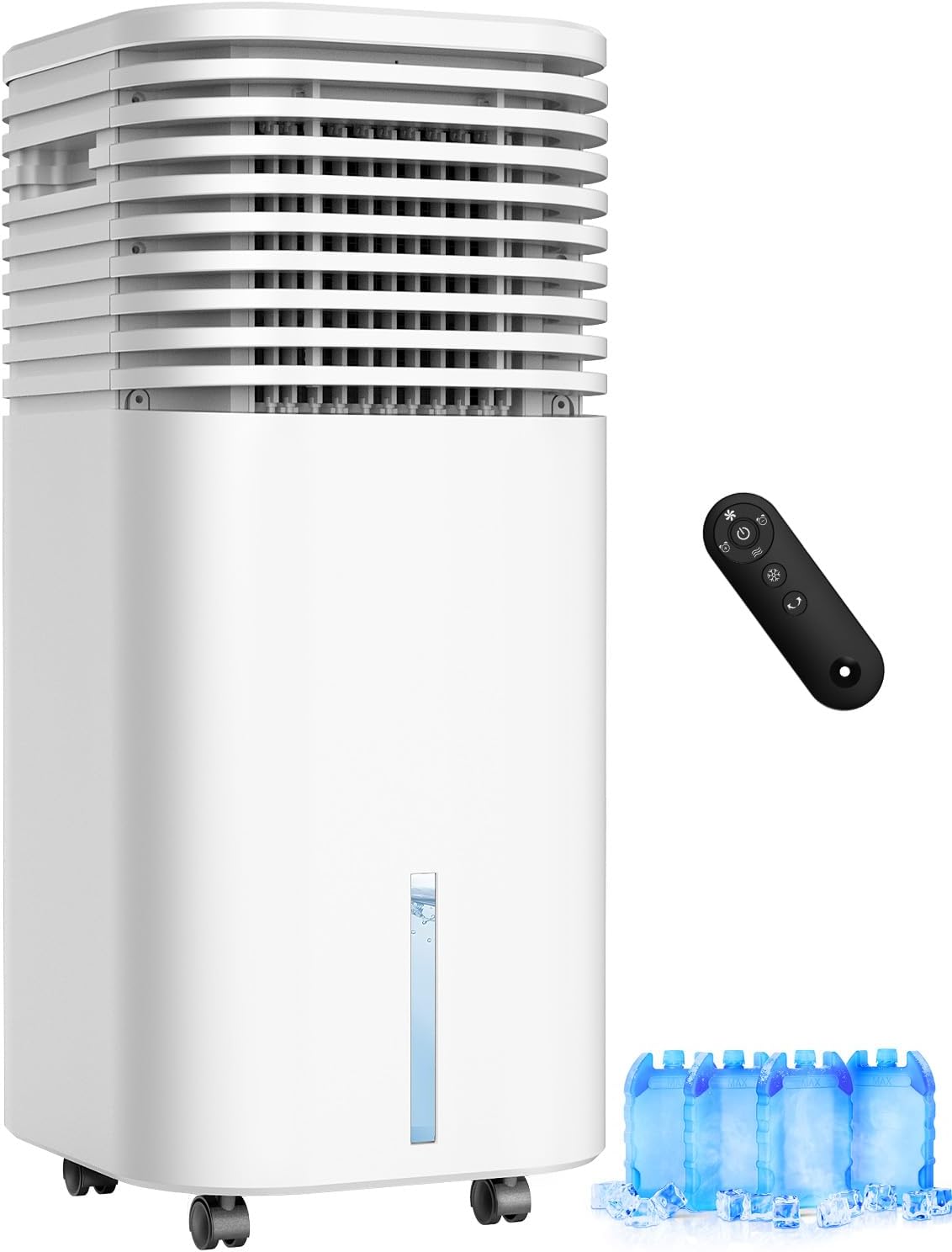
| Wattage | 65 watts |
|---|---|
| Noise | 25 db |
| Capacity | 3 gallons |
| Controller Type | Remote Control |
The CENSTECH DL3 is a ventless evaporative air cooler designed to deliver fast, energy-efficient spot and small-room cooling without an exhaust hose or installation. It circulates air using a high-flow motor and an advertised 1800 CFM airflow with 120° horizontal oscillation and a 3-gallon water tank that can run up to about 24 hours per fill. Controls include a backlit panel and a remote with roughly 20 ft range, and the unit offers four modes (including Sleep and Cooling) and three fan speeds for flexible use. Practical benefits include very low running power (65W), quiet Sleep mode under 25 dB for night use, reusable leak-proof ice packs for added cooling, and lockable tank and 360° silent wheels for safe, portable operation. Important limitations are inherent to evaporative coolers: performance is best in dry climates and it will add humidity to the room, and unlike a refrigerant air conditioner it cannot lower temperatures as effectively in hot, humid conditions. Buyers should also expect periodic refills and occasional maintenance of the honeycomb filter.
Best for: Buyers who prioritize simple, plug-and-play ventless cooling that is inexpensive to run and want a portable unit backed by strong customer feedback and clear product controls.
Less Ideal for: People in consistently humid climates or anyone needing a true refrigerated AC to significantly lower room temperature across large, enclosed spaces.
- Windowless design needs no hose or installation so you can move it room to room.
- Large 3-gallon tank and included ice packs extend runtime up to about 24 hours per fill.
- Very low power draw (65W) makes it cheap to run compared with compressor AC.
- Remote control and backlit panel provide convenient dual control up to about 20 ft.
- Quiet Sleep mode under 25 dB suitable for bedrooms or study spaces.
- Works by evaporative cooling so effectiveness falls off in high-humidity environments.
- Cannot match the temperature drop of a refrigerant air conditioner for whole-home cooling.
Verdict: Choose the DL3 if you want a quiet, low-energy ventless cooler that delivers portable evaporative cooling and long runtime for dry climates.
SYUDTY GDS-820 Evaporative Cooler

| Air Flow Capacity | 3000 cfm |
|---|---|
| Reservoir Capacity | 6.87 gallons |
| Wattage | 150 watts |
| Noise | 52 db |
| Number of Speeds | 3 |
The SYUDTY GDS-820 is a ventless evaporative cooler intended to deliver quick, humidified airflow in dry indoor spaces. It uses a high-density cooling pad and a 2026-upgraded motor to push up to 3000 CFM and includes a 6.87 gallon reservoir with two ice boxes for extra chill. Controls are available on a top touch panel and by remote, with three fan speeds, four operation modes, 120 degree oscillation, and a 1–15 hour timer for overnight use. Setup is simple: add water and snap on the included 360 degree casters to move it between rooms without tools. Practical benefits include low power draw (150 watts) compared with compressor ACs, quieter operation than many portable ACs at the listed 52 dB, and built-in humidifying and aromatherapy functions that help in arid climates. Important limitations are that evaporative coolers work best in dry environments and will not lower humidity or match the dehumidifying and temperature control of refrigerant air conditioners in humid regions, and cooling performance depends on ambient humidity and ventilation.
Best for: Buyers seeking a simple, low-energy, windowless cooling option for dry climates who prioritize ease of setup, mobility, and humidified airflow rather than strict temperature control.
Less Ideal for: People living in humid climates or those who need precise temperature control and dehumidification should consider refrigerated or ducted cooling alternatives.
- High airflow rated at 3000 CFM for rapid air movement
- Large 6.87 gallon reservoir with ice boxes for extended cooling bursts
- Remote and touch controls with 120° oscillation and a 1–15 hour timer
- Low energy consumption at 150 watts compared with compressor-based units
- Effectiveness drops significantly in high-humidity environments
- Not a refrigerated air conditioner so it cannot dehumidify to the same degree as compressor ACs
Verdict: Choose this ventless evaporative cooler if you want an easy-to-move, energy-efficient way to add humidified cooling in dry indoor spaces.
Choosing the Right Ventless Air Conditioner: Key Factors to Consider
Cooling Capacity Relative to Space
A ventless air conditioner must match the size of the room to provide effective cooling. Look at the unit's rated BTU or stated room square footage and compare that to your room; undersized units will run continuously with poor comfort, while oversized units cycle frequently and can create humidity problems.
Also factor in ceiling height, sun exposure, and occupancy. A compact living room or bedroom needs less cooling than a sunlit studio. Be realistic about airflow; furniture layouts and obstructions reduce effective coverage.
Energy Efficiency and Operating Cost
Ventless units vary in electrical draw and how efficiently they move heat. Check the energy consumption at typical operating settings rather than peak numbers alone. More efficient units cost less to run and produce less heat and strain during extended use.
Because ventless systems evacuate heat differently than vented models, pay attention to how long a unit must run to maintain a set temperature. Continuous operation will increase energy use, so features like variable-speed fans and smart thermostatic control can meaningfully improve real-world efficiency.
Humidity Control and Condensate Management
Ventless air conditioners remove heat and moisture from air without exhausting outside, so how they handle condensate matters. Some units evaporate condensate internally, while others require periodic emptying of a collection tank or a simple gravity drain.
If the unit relies on an internal evaporation system, expect reduced maintenance but watch for reduced dehumidification in very humid climates. If it uses a tank, consider ease of access and indicator warnings so you do not have overflow issues. For spaces where humidity control is critical, prioritize units with strong moisture-handling specs.
Noise Level and Fan Design
Because ventless air conditioners are often used in bedrooms and home offices, noise performance is a practical concern. Check published decibel ratings at common fan speeds and look for multiple speed settings or quiet modes intended for nighttime use.
Fan design and housing also influence perceived noise. Units that isolate the compressor and include vibration damping will sound less intrusive. If you plan to place the unit close to a sleeping area, give extra weight to lower noise ratings and user-friendly speed controls.
Installation, Portability, and Footprint
One advantage of ventless units is minimal installation, but portability and physical footprint still vary. Measure doorways and floor space to ensure the unit fits and that you can move it if needed. Consider caster quality, handle placement, and overall weight for repositioning.
Also evaluate how the unit connects to drains or condensate lines. Units that require little to no permanent installation are better for renters. Think about where you will store accessories and how easily filters can be accessed for cleaning.
Controls, Safety Features, and Maintenance
Practical controls and safety features improve daily use. Look for programmable timers, thermostat control, and clear indicator lights for condensate levels and filter maintenance. Child locks or automatic shutoffs add safety in busy households.
Maintenance accessibility matters: removable, washable filters and tool-free access panels reduce the time needed to keep the unit running efficiently. Consider warranty length and the availability of straightforward replacement parts for long-term ownership.
How Ventless Cooling Works
Ventless air conditioners cool a room by circulating indoor air through a refrigeration loop that extracts heat. Because they do not exhaust air outside, the removed heat is either stored and dissipated internally or transferred in a way that does not require ducting.
Understanding the basic thermodynamics helps set realistic expectations. These units are best suited for small to medium rooms where modest cooling is required and where installing a vent or window kit is impractical.
- Circulates and cools indoor air without exterior venting
- Handles condensate via internal evaporation or drain tank
- Best for small spaces and temporary installs
Placement Tips for Best Performance
Place the unit near the center of the room or along a wall that allows unobstructed airflow. Avoid tucking the unit behind furniture or inside closets where airflow and heat dispersion are restricted.
Keep the intake clear and leave several inches of clearance around the unit. If you plan to use the unit in multiple rooms, consider how door positions and interior layout will affect circulation and whether you will need supplemental fans to help distribute cooled air.
- Allow 6 to 12 inches clearance around the unit
- Avoid direct sunlight on the unit
- Use a small oscillating fan to improve circulation in larger spaces
Maintenance Routines That Keep Units Efficient
Regular maintenance keeps a ventless air conditioner operating at peak efficiency. Clean or replace filters per the manufacturer schedule and wipe dust from grills and coils when accessible. For units with condensate tanks, empty and sanitize the reservoir periodically to avoid odors or bacterial growth.
Seasonal storage care matters for portable units. Drain any remaining condensate, clean filters, and store the unit in a dry area to prevent mold and component degradation.
- Clean filters every 2 to 4 weeks in dusty environments
- Inspect condensate tank or drain lines monthly
- Perform a light coil and grill cleaning before storage
When a Ventless Unit Is a Good Fit
Ventless air conditioners are appropriate when exterior venting is impossible or undesirable. They suit renters, temporary spaces, workshops, and small rooms where a compact unit can provide adequate cooling without installation.
They are less ideal for large open-plan areas or very humid climates that demand strong dehumidification and continuous high-capacity cooling. In those cases, alternative cooling strategies or supplemental dehumidification may be necessary.
- Good for bedrooms, offices, and small studios
- Not recommended as the sole cooling method for large, open spaces
- Consider supplemental dehumidification in very humid climates
Energy-Saving Habits to Stretch Runtime
You can reduce runtime and energy use by combining the unit with simple behavior changes. Improve insulation in the targeted room, keep windows and doors closed while the unit runs, and use blackout curtains to reduce solar gains during peak sun.
Lowering thermostat setpoints by a degree or two can significantly affect runtime. Use timers and programmable schedules to avoid running the unit while rooms are unoccupied.
- Close doors and windows while operating
- Use shades or curtains during the hottest part of the day
- Run the unit on a scheduled timer for occupied periods
How We Chose the Best Ventless Air Conditioner
We focused on the practical traits that matter for ventless air conditioners in everyday use. Key evaluation criteria included cooling capacity relative to unit size, energy efficiency during typical duty cycles, how the unit handles humidity and condensate, installation and portability, and operating noise. We also considered control features and safety safeguards because simple, reliable operation is important in temporary or rental environments. Products were excluded if they relied on external venting, required permanent ductwork, or lacked clear specifications for cooling capacity and power draw. We prioritized units with transparent performance specs and documented condensate handling. Usability factors such as intuitive controls, included accessories, and clear maintenance access informed the shortlist. Finally, we balanced measured efficiency with real-world convenience to highlight options that fit compact spaces without excessive installation work.
Our full evaluation process is outlined in our review methodology.
FAQ
Can a ventless air conditioner cool an entire apartment?
It often depends on the apartment size and layout. Ventless units are best for single rooms or small studios; they usually cannot maintain comfortable temperatures across multiple rooms or large open-plan areas without supplemental cooling or fans.
Do ventless units increase indoor humidity?
That depends on the unit's condensate handling. Some ventless designs evaporate condensate internally, which can slightly increase humidity. Units with effective condensate removal or external drains generally manage moisture better and limit humidity gains.
How often do I need to empty the condensate tank?
Frequency varies with humidity and runtime. In humid conditions you may need to empty the tank every few days; in drier climates it may only require weekly attention. Choose a unit with clear indicators or a continuous drain option if you want less maintenance.
Are ventless air conditioners noisy?
Noise levels vary by design and fan speed. Many ventless units offer multiple fan settings and quieter night modes. If sound is a concern, compare decibel ratings at different speeds and prioritize models with vibration-reducing construction.
Can I use a ventless unit in a bedroom overnight?
Yes, provided the unit has a quiet mode and suitable noise ratings. Also consider the unit's condensate system and timer options to avoid interruptions during sleep.
Final Verdict
When picking a ventless air conditioner, prioritize a unit sized for the room, dependable condensate management, and acceptable noise levels. Balance cooling capacity against footprint and power draw so the unit delivers comfort without excessive runtime or maintenance. Focus on practical tradeoffs: a slightly less powerful but quieter and easier-to-maintain unit can be a better daily choice than a marginally stronger model that is loud or high-maintenance. With attention to placement and basic upkeep, a well-chosen ventless air conditioner will provide convenient, temporary cooling for small spaces.