
Note: This article contains affiliate links. If you click on these links and make a purchase, we may earn a small commission at no extra cost to you. This helps support our research and content. Read our full affiliate disclosure here.
Picking the right easy knife sharpener matters because a dull blade slows prep, creates safety risks, and ruins the pleasure of cooking. With so many simple sharpeners on the market, you need a shortlist that balances how quickly they restore an edge, how safe and repeatable the process is, and whether they work across your common kitchen knives. This guide covers seven top easy knife sharpeners chosen for consistent sharpening results, straightforward operation, and minimal maintenance. Read on to see which devices match your skill level and kitchen routine, plus the testing criteria we used to evaluate them.
Top Picks at a Glance
| Best Overall The best all-around choice for most situations | AccuSharp Knife Sharpener ACCU-001C |  |
| Best Quality Built to a higher standard if you want something more solid | Warthog V-Sharp A4 |  |
| Best Value The sweet spot between price and what you get | Amazon Basics 4-in-1 Knife Sharpener |  |
| Best Budget The cheapest option that still gets the job done reliably | Smith's 2-Step Knife Sharpener CCKS |  |
| Top Rated A top-rated pick with lots of positive feedback | Work Sharp MK2 Knife Sharpener |  |
| Most Popular A crowd favorite that many people choose with confidence | KITCHELLENCE 3-Stage Knife Sharpener KS37 P |  |
| Best Seller A high-volume bestseller chosen again and again | Sharp Pebble 1000/6000 Whetstone |  |
AccuSharp Knife Sharpener ACCU-001C

| Material Type | Acrylonitrile Butadiene Styrene |
|---|---|
| Grit Type | Coarse |
| Included Components | Sharpener |
| Manufacturer | Accu Sharp |
The AccuSharp ACCU-001C is a simple pull-through sharpener that restores and hones straight and serrated kitchen knives in seconds. You place the blade in the guide and pull through the carbide sharpening blades while holding the ergonomic handle; the reversible tungsten carbide edges give you coarse sharpening for repairing dull blades and a consistent angle for everyday touch-ups. Its compact, lightweight design and full-length finger guard make it easy and safe to use at a prep counter, while the plastic body is dishwasher safe for simple cleanup. The carbide wheels are durable and can be reversed for longer life, and many users report years of use before replacement is needed. Limitations are its coarse grit which is best for blunt or moderately dull blades rather than fine polishing, and the pull-through format removes metal faster than stones so it is not ideal for precision sharpening or restoring expensive knives to factory-edge geometry.
Best for: Buyers who want a fast, no-fuss way to keep everyday kitchen and utility knives sharp with minimal skill or maintenance.
Less Ideal for: Those seeking precision stropping, mirror finishes, or restoration of high-end knives should choose whetstones or professional sharpening systems instead.
- Very quick to use for getting a usable edge in about 10 seconds
- Ergonomic full-length handle and finger guard improve safety and control
- Diamond-honed tungsten carbide blades are durable and reversible for extended life
- Compact, lightweight, and dishwasher safe for easy storage and cleaning
- Coarse grit is not suitable for fine honing or polishing edges
- Pull-through action removes more metal than stones, limiting precision sharpening
Verdict: If you want a safe, foolproof tool to quickly revive dull kitchen knives without learning traditional sharpening, this AccuSharp is an effective and durable choice.
Warthog V-Sharp A4

| Included Components | Knife Sharpener |
|---|---|
| Material Type | Alloy Steel |
| Grit Type | Coarse |
| Model Number | A4RD |
The Warthog V-Sharp A4 is a compact, metal-framed sharpening system that uses a patented V-guided mechanism and spring-loaded hones to sharpen both sides of a blade simultaneously. It offers four preset angles (15°, 20°, 25°, 30°), a 325-grit natural diamond hone for shaping, and a hardened hone steel for finishing, so you can tune an edge for fine kitchen blades or thicker outdoor knives. The solid rubber base and powder-coated metal frame keep the unit stable during use, and the simultaneous dual-side honing speeds up the process compared with stropping or single-rod systems. For maintenance it reduces the need to send knives out for professional sharpening, and the coarse grit gets work done quickly on dull edges. Limitations are typical of fixed-angle V-systems: it is best for repeatable bevels rather than complicated custom profiles, and very fine polishing beyond the provided steel may require finer stones or strops.
Best for: Buyers who prioritize repeatable, performance-driven sharpening and want a tool that quickly restores a working edge on kitchen and outdoor knives without professional service.
Less Ideal for: Users seeking ultra-fine polishing to razor-sharp finishes or those who need fully custom bevel geometry should consider stone-and-strop systems instead.
- Adjustable preset angles (15°, 20°, 25°, 30°) for consistent bevels
- 325-grit natural diamond hone quickly restores dull edges
- Spring-loaded hones sharpen both sides simultaneously to save time
- Sturdy metal frame and rubber base provide stability during use
- Coarse grit limits how polished the final edge will be without additional finer hones or strops
- Not suited for creating unusual or highly customized edge profiles
Verdict: If you want a fast, repeatable, performance-focused sharpener that restores working edges on kitchen and outdoor knives, the Warthog V-Sharp A4 delivers.
Amazon Basics 4-in-1 Knife Sharpener
| Material Type | Metal, Plastic |
|---|---|
| Grit Type | Coarse, Medium, Fine |
| Included Components | Knife Sharpener |
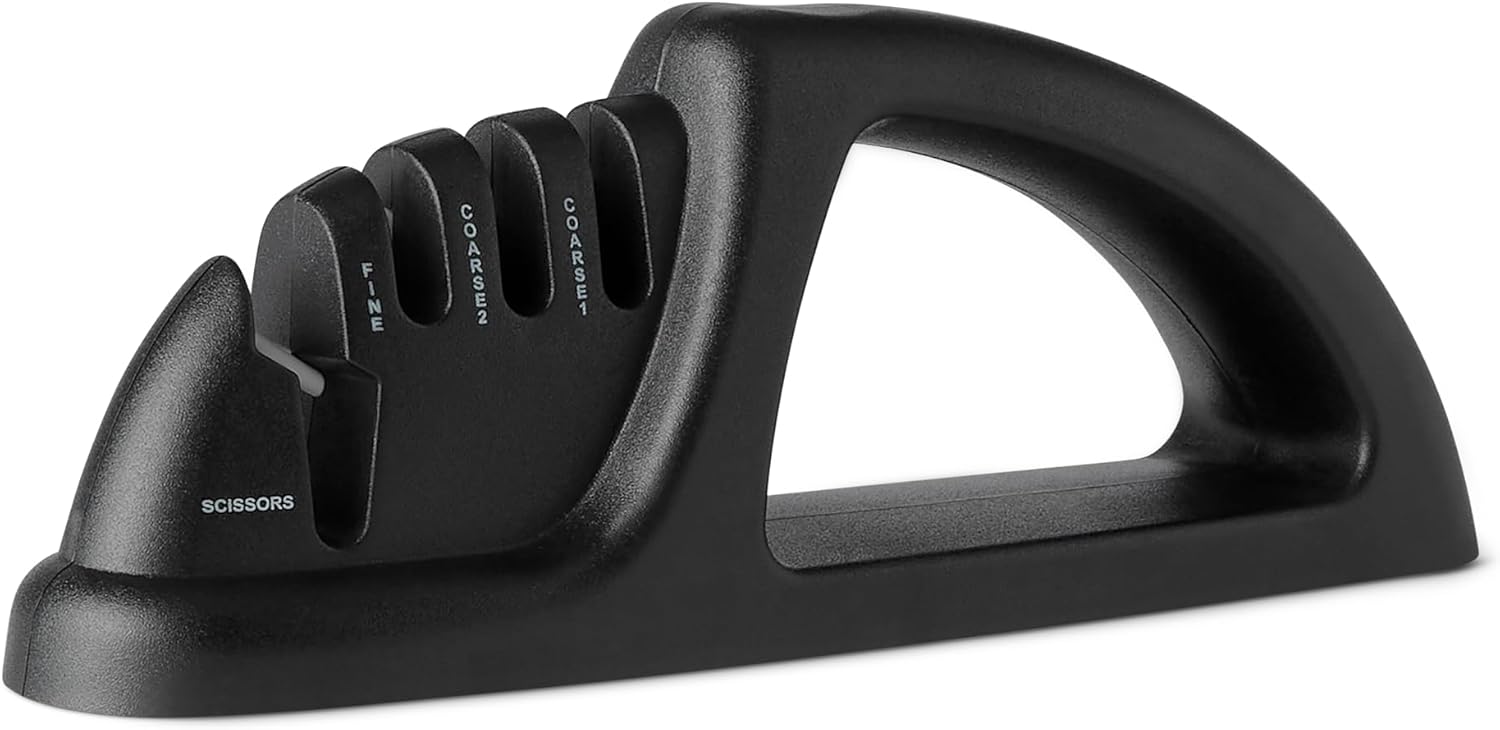
This Amazon Basics 4-in-1 knife sharpener is a simple, no-frills tool for keeping straight-edge kitchen, pocket, and hunting knives sharp. It uses three dedicated stages—coarse, medium, and fine—so you can restore a dull edge and then refine it for everyday cutting tasks, plus a separate slot for basic scissor sharpening. The nonslip silicone base and included cut-resistant glove improve safety and control during use, and the small plastic/metal body is easy to rinse clean after use. It does not handle serrated blades or complex bevels, and because it is a manual slot sharpener it relies on consistent user angle and pressure to get repeatable results. For routine home maintenance and quick touch-ups it is fast and approachable, but it will not replace a professional sharpening service or a guided system for precision knives.
Best for: Buyers who want an affordable, straightforward way to keep everyday straight-edge knives and scissors usable without learning complex sharpening techniques.
Less Ideal for: Users who need precision, professional-level reprofiling or who primarily own serrated or specialty blades should look at guided or professional sharpening options instead.
- Three-stage coarse-to-fine sharpening covers restoration and edge refinement for straight blades
- Dedicated scissor slot expands usefulness beyond just kitchen knives
- Nonslip silicone base improves stability during sharpening
- Includes cut-resistant glove for safer handling
- Not suitable for serrated blades or specialized bevels
- Manual slot system depends on user technique for consistent results
Verdict: A practical, budget-friendly 4-in-1 sharpener that makes routine edge maintenance quick and safe for everyday straight-edge knives and basic scissors.
Smith's 2-Step Knife Sharpener CCKS

| Included Components | 1 sharpener |
|---|---|
| Material Type | Synthetic |
| Grit Type | Coarse,Fine |
Smith's CCKS 2-Step Knife Sharpener is a small, portable pull-through tool that combines crossed tungsten carbide blades for coarse re-profiling and crossed ceramic rods for honing to a fine edge. It is used by pulling a dull blade through the preset coarse slot three or four times, then finishing with the ceramic stage for a smoother, sharper edge. The sharpener is lightweight, includes non-slip rubber feet and a lanyard hole for attaching to a keychain or pack, and even floats for use around water. Its preset angles make it fast and easy for anglers, hunters, and casual home cooks who need a reliable, no-fuss edge in the field or at the sink. The simplicity comes with limits: preset angles mean you cannot change edge geometry for specialty knives, and pull-through sharpeners remove more metal than stropping or guided stones when used aggressively. For buyers who want an inexpensive, grab-and-go way to maintain or restore common blades, this model delivers predictable results without any setup or skill required.
Best for: Buyers looking for a cheap, easy-to-use sharpener to quickly restore or maintain everyday and outdoor knives without skills or setup.
Less Ideal for: Users seeking precision edge control for high-end kitchen knives or knife makers who need adjustable-angle sharpening systems.
- Two-stage system (tungsten carbide coarse and ceramic fine) for both re-profiling and honing
- Very compact and lightweight with a lanyard hole for easy carry
- Non-slip rubber feet add stability during use
- Floats in water, useful for fishing or boating environments
- Preset angles cannot be adjusted for custom edge geometry
- Pull-through carbide slots can remove more metal than stone-based methods if overused
Verdict: A no-frills, budget-friendly two-stage pull-through sharpener that reliably restores and hones common knives for everyday and outdoor use.
Work Sharp MK2 Knife Sharpener

| Included Components | Abrasive Belts, Knife Sharpener |
|---|---|
| Model Number | WSKTS2 |
| Material Type | Plastic |
| Grit Type | Medium |
The Work Sharp MK2 is an electric belt-based sharpener designed to restore edges on kitchen knives, pocket knives, serrated blades, scissors and garden tools. It uses flexible abrasive belts that conform to a blade edge, letting you sharpen bevels and even use the belts like a small grinding surface for heavier tools. The unit offers two motor speeds so you can choose more power for thicker or damaged blades and a lower speed for light touch touch-ups. An integrated edge guide helps keep a consistent angle and the compact footprint makes it easy to store in a drawer or on a workbench. Because it accepts a wide range of cutting tools and does not rely on fixed stones, it is faster for routine maintenance and repairs than manual whetstones for many users. The main limitations are that belt systems remove metal relatively quickly compared with fine stones and will require replacement belts over time, and achieving hair‑thin polished edges may still need stropping or finer finishing steps.
Best for: Buyers who value a reliable, fast way to restore and maintain many types of cutting tools will appreciate this unit for kitchen and workshop use.
Less Ideal for: If you seek the absolute finest polished razor edge for straight‑razor style sharpening or prefer a fully manual, low-waste process, a traditional whetstone or strop-focused system is a better choice.
- Flexible abrasive belts that conform to different blade shapes for faster, repeatable sharpening
- Two motor speeds give extra power for heavy-duty tools and controlled sharpening for knives
- Edge guide helps maintain a consistent sharpening angle for repeatable results
- Compact, bench- or drawer-friendly footprint that is easy to store and set up
- Belts remove metal faster than fine stones, so careful technique is required to avoid over-grinding
- Replacement abrasive belts are consumables and add long-term maintenance cost
Verdict: A dependable, compact electric sharpener that quickly rehabs knives and tools using flexible belts and selectable motor speeds.
KITCHELLENCE 3-Stage Knife Sharpener KS37 P
| Brand Name | KITCHELLENCE |
|---|---|
| Number of Items | 1 |
| Material Type | Plastic |
| Included Components | Yes |
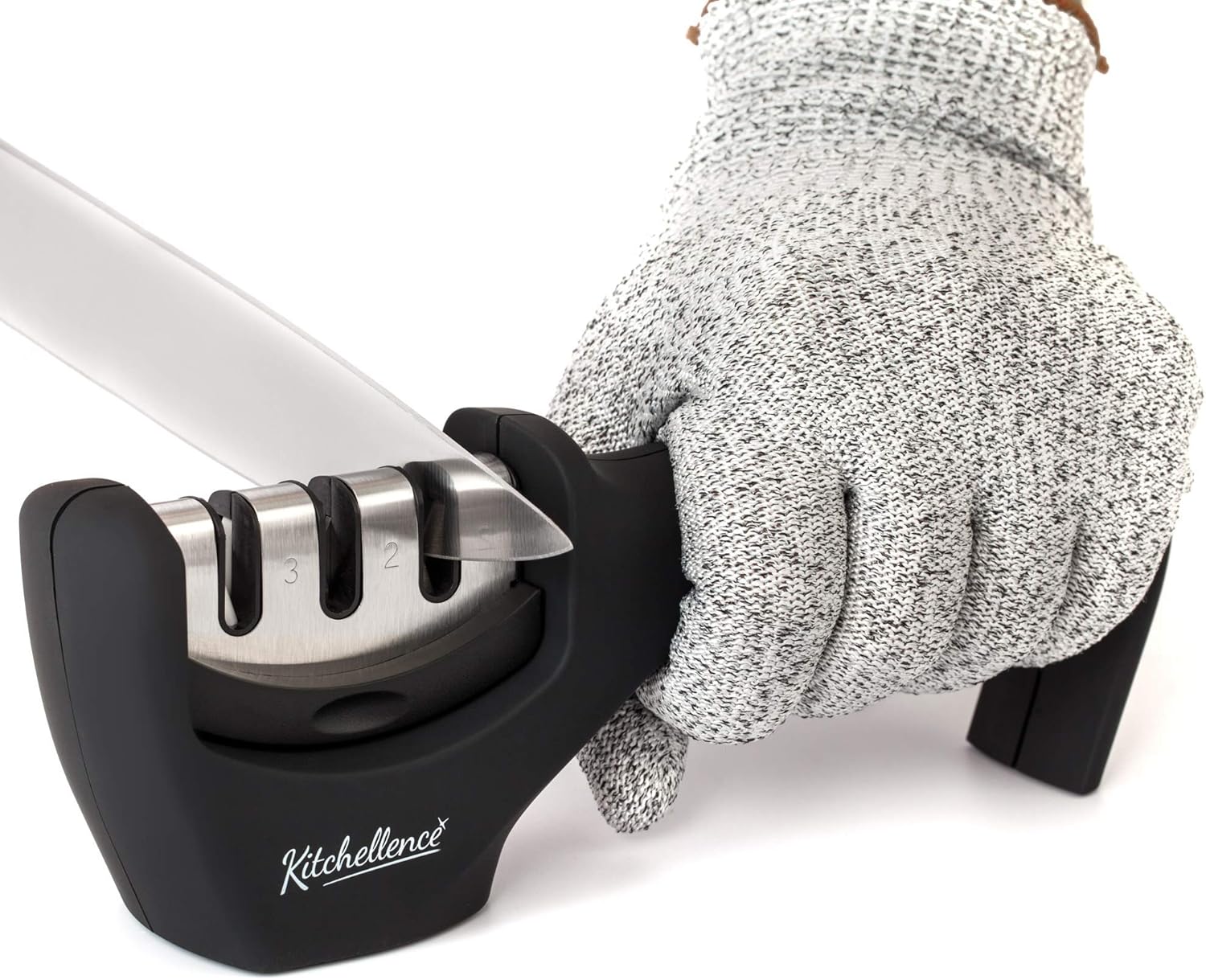
This compact 3-stage sharpener offers a simple, step-by-step way to restore dull kitchen knives. The first diamond rod straightens damaged edges, the second slot reprofiles the bevel to restore a cutting edge, and the third slot polishes and refines the blade for smoother slicing. The unit has an ergonomic, non-slip base and handle so you can pull blades through the slots with control, and the included cut-resistant glove adds a safety layer while you work. Made from ABS plastic it is lightweight and intended for quick home touch-ups rather than professional shop use. It works best on standard kitchen knives and is easy for left- or right-handed users to operate, but it cannot replace full manual sharpening with stones for high-end blades or reset badly damaged edges repeatedly. For everyday home cooks who want a fast, reliable way to revive dull knives, this kit is a practical, low-effort option.
Best for: Buyers who want a quick, low-effort way to refresh household knives and value a product with strong user feedback and included safety gear.
Less Ideal for: Users who need professional-level sharpening, collect high-end knives, or require repeated full regrinds should choose a bench stone or professional service instead.
- Three distinct sharpening stages for repair, sharpening, and polishing
- Ergonomic non-slip handle and base for controlled use
- Includes a cut-resistant glove to improve user safety
- Diamond sharpening rod in the first stage for effective edge repair
- Constructed from ABS plastic so it is lightweight but not professional-grade
- Not suitable for fully restoring severely damaged or specialty steel blades
Verdict: A simple, safe 3-stage sharpener that reliably revives everyday kitchen knives for fast at-home maintenance.
Sharp Pebble 1000/6000 Whetstone

| Grit | 1000/6000 |
|---|---|
| Material Type | Corundum |
| Included Components | Angle guide, bamboo base, instruction manual |
| No Oil Required | Yes |
The Sharp Pebble 1000/6000 whetstone is a two-sided waterstone kit aimed at making home knife sharpening simple and reliable. You soak or wet the stone and use the included angle guide and non-slip bamboo base to hold the blade steady while working the coarse 1000 grit side to repair dull or nicked edges, then finish on the 6000 grit side for a razor-polish. The kit includes instructions, an angle guide, and a base so beginners can get consistent results without guessing blade angle. The corundum abrasive is formulated to cut efficiently and resist dishing so the stone stays flatter longer than bargain stones. Because no oil is required, cleanup is just water and a quick wipe down. Limitations: using a whetstone takes more time and care than pull-through or electric sharpeners and requires basic technique for best results, and the kit does not include a flattening stone for long-term maintenance if the surface does wear over many sessions.
Best for: Home cooks who want a reliable, low-cost way to restore and polish kitchen knives themselves and prefer guided, easy-to-follow tools that reduce user error.
Less Ideal for: People who need the fastest possible sharpening with minimal technique or who prefer automated electric sharpeners for repeated, rapid use.
- Dual 1000/6000 grit covers both edge repair and polishing in one stone
- Included angle guide and bamboo base help beginners hold a consistent angle
- No oil required so setup and cleanup are simple
- Corundum composition resists chipping and stays flat longer than cheaper stones
- Takes more time and practice than electric or pull-through sharpeners
- Does not include a flattening stone for surface maintenance
Verdict: A well-rounded, beginner-friendly whetstone kit that gives consistent, professional-quality edges without oil or complicated setup.
Choosing the Right Easy Knife Sharpener: Key Factors to Consider
Sharpening Method and Abrasive Type
Different easy sharpeners use fixed abrasives, ceramic rods, or carbide elements. The abrasive type determines how much metal is removed per pass and how quickly you restore a keen edge. Carbide or diamond-coated slots cut aggressively and can fix very dull blades rapidly, while ceramic or fine-grit slots are better for honing and refining the bevel.
Understanding the abrasive matters because aggressive materials make quick work of dull knives but can shorten a blade's lifespan if overused. Conversely, milder abrasives preserve steel but may require more passes and time. For everyday kitchen use you want a balance: a coarse stage to reshape the edge when needed and a finer stage to polish and refine for smooth slicing.
Angle Control and Guided Slots
Most easy sharpeners present fixed-angle slots to simplify achieving a consistent bevel. Good angle control matters because the edge geometry affects cutting performance and durability. A slot that matches common kitchen blade angles will make it easier to reestablish a proper bevel without guesswork.
If a sharpener gives multiple angle options or intuitively positions the blade, you reduce the chance of creating an improper edge profile. For cooks who use a mix of Western-style and thinner Asian-style knives, look for designs that either accommodate those angles or maintain a neutral setting that works well for general kitchen tasks.
Safety Features and Stability
Because these sharpeners are handheld or countertop tools, non-slip bases, finger guards, and secure handholds are essential. Safety features prevent accidental contact with the abrasive surfaces and keep the sharpener from sliding during use.
Stability also affects consistency. A wobbly base or flimsy handle can change the sharpening angle mid-stroke and produce uneven edges. Choose a model with a stable footprint and clear protective features to reduce risk during repeated passes.
Maintenance and Replaceability
Over time the abrasive surfaces will wear or clog with metal particles. Some easy sharpeners offer replaceable cartridges or accessible stones that you can clean or swap out. Maintenance matters because it affects both long-term performance and cost of ownership.
Consider whether the unit is easy to disassemble for cleaning, whether the abrasives are rated for many cycles, and if replacement parts are available. Low-maintenance designs are ideal for busy home cooks who want consistent results without periodic overhaul.
Versatility With Different Knife Types
Home kitchens typically include a variety of blades: chef's knives, paring knives, serrated blades, and sometimes specialty knives. Not all easy sharpeners handle every blade type equally well. Many devices work best on straight-edge blades and cannot sharpen serrations or very thin Japanese-style edges.
Evaluate whether the sharpener supports the knives you use most often. If you have serrated knives or very thin specialty blades, seek a model that explicitly accommodates those profiles or plan on keeping a separate method for serrations and delicate edges.
Speed and Number of Passes Needed
One of the main appeals of easy sharpeners is saving time. Some units restore a usable edge in a single quick pass, while others need several sweeping pulls through progressively finer stages. Speed matters for cooks who sharpen frequently during prep.
Faster sharpening is convenient but watch for tradeoffs. Very quick aggressive sharpening can remove more metal than necessary. Ideally choose a tool that balances quick edge restoration with a fine finishing stage to maintain a sharp, long-lasting edge without excessive material removal.
When an Easy Sharpener Is the Right Choice
Easy sharpeners excel when you want fast, repeatable sharpening with minimal skill. They are great for refreshing mildly dull kitchen knives between proper sharpening sessions and for cooks who prefer a tool-and-go approach rather than a detailed stone or guided system routine.
- Best for routine maintenance and quick edge touch-ups
- Not ideal as the only method for very damaged or chipped blades
- Useful for busy cooks who need consistent results with little training
Common Limitations to Expect
Recognizing limitations helps set realistic expectations. Many easy sharpeners cannot reprofile badly rolled or chipped edges, and some are too aggressive for delicate thin-bevel knives. Also, a single fixed-angle slot may not be optimal for every blade geometry, which can affect final performance.
- Usually not suitable for serrated edges unless explicitly stated
- May remove metal quickly if used excessively
- Limited control for users who prefer precise angle management
Maintenance Tips to Prolong Performance
Regular maintenance keeps an easy sharpener working reliably. Wipe metal shavings away after each use, and periodically clean carbide or ceramic elements with a soft brush. For models with replaceable cartridges, follow the manufacturer's recommendations on when to replace them to preserve consistent results.
- Clean abrasive slots after several sharpening cycles
- Avoid using excessive pressure that accelerates abrasive wear
- Store the unit in a dry place to prevent corrosion of any metal parts
Safe Sharpening Technique for Home Users
Position the sharpener on a stable countertop and hold it with a secure grip. Insert the blade tip-first and make smooth, controlled pulls without forcing the blade through the slot. Let the abrasive do the work and keep your fingers away from the sharpening path. Start with the coarsest stage only when the edge is noticeably dull, and finish with the finer stage to polish. Test the edge on a tomato or paper to check for uniformity rather than relying on fingertip feel alone.
- Use light, consistent pressure and steady strokes
- Always work away from your body and keep fingers clear of the blade path
- Check progress frequently to avoid over-sharpening
How We Chose the Best Easy Knife Sharpener
We focused on tools that deliver consistent, repeatable edges with minimal technique. Editorial screening prioritized devices that require little setup, protect users from contact with the abrasive surfaces, and work across common blade geometries found in home kitchens. We examined manufacturer specs for abrasive materials and angle guides, and we considered user reports on long-term edge retention and whether repeated passes remove excessive metal. Criteria that mattered include sharpening effectiveness on both straight and slightly curved blades, ease of achieving the correct sharpening angle, safety features such as non-slip bases and guarded slots, and durability of the abrasive elements. We excluded specialty or professional-only systems that demand extensive skill or bench mounting. We also filtered out models that only accept one narrow blade width or that lack replaceable sharpening components. Our process balanced practical homeowner needs: fast usable results, low learning curve, clear safety design, and reasonable maintenance demands. The scoring metrics align with these priorities so you can compare devices quickly.
Our full evaluation process is outlined in our review methodology.
FAQ
Can an easy knife sharpener fix a chipped blade?
Usually not. Easy sharpeners are designed for routine sharpening and edge maintenance. Small chips may be removed with repeated coarse passes, but significant chips require a more aggressive sharpening method or professional repair.
Will an easy sharpener work on serrated knives?
Most do not sharpen serrations effectively. Some models offer a dedicated serration slot or a small ceramic rod for serrations. If you have many serrated knives, verify that the device supports them or keep a separate tool for serrations.
How often should I use an easy knife sharpener?
It depends on use. Frequent home cooking may benefit from a quick touch-up every few weeks, while lighter use may only need occasional sharpening. Avoid daily aggressive passes to prevent excessive metal removal.
Do easy sharpeners remove a lot of metal?
They can if you use the coarse stage often or apply heavy pressure. Using the finer stage for regular maintenance and reserving the coarse stage for very dull blades helps limit material removal.
Are these sharpeners safe for beginners?
Yes, most are designed for novice users with guided slots and safety features. Still, follow the recommended technique and keep hands clear of the blade path to avoid accidents.
Final Verdict
When choosing an easy knife sharpener, prioritize consistent sharpening results, clear angle guidance, and a stable, safe design. Expect a tradeoff between speed and material removal: aggressive abrasives restore edges fast but should be used sparingly to preserve blade life. For most home cooks, a two-stage device with a coarse reshaping slot and a finer finishing stage offers the best balance of quick results and long-term edge maintenance. Focus on the features that match your knives and sharpening habits, and treat easy sharpeners as part of a broader sharpening routine rather than the sole method for damaged blades. With the right choice you will get reliable, low-effort edges that make food prep smoother and safer.