
Note: This article contains affiliate links. If you click on these links and make a purchase, we may earn a small commission at no extra cost to you. This helps support our research and content. Read our full affiliate disclosure here.
Picking the right electric baseboard heater matters because it determines how evenly a room warms, how much it costs to run, and how much installation or upkeep you will need. Whether you want to replace an older unit or add supplemental heat to a chilly room, the right heater keeps temperatures comfortable without constant tinkering. This guide covers our shortlisted picks for the category and explains the technical and practical tradeoffs you should weigh. We evaluated units for heat output, installation and wiring complexity, safety features, and daily operating efficiency. Read on for concise guidance to match a heater to room size, wiring limits, and your DIY comfort level.
Top Picks at a Glance
| Best Overall The best all-around choice for most situations | Dimplex Linear Convector 30" |  |
| Best Quality Built to a higher standard if you want something more solid | Dimplex Proportional Baseboard Heater PC3512W31 |  |
| Best Value The sweet spot between price and what you get | BEYOND HEAT Baseboard Heater BH650 |  |
| Best Budget The cheapest option that still gets the job done reliably | Comfort Zone CZ600 Baseboard Heater |  |
| Top Rated A top-rated pick with lots of positive feedback | Stelpro Prima Baseboard Heater ASPRM0371W |  |
| Most Popular A crowd favorite that many people choose with confidence | Cadet F Series 24in Baseboard Heater |  |
| Best Seller A high-volume bestseller chosen again and again | Cadet F Series 36" Baseboard Heater |  |
Dimplex Linear Convector 30"

| Heat Output | 1000 watts |
|---|---|
| Voltage | 208 volts |
| Heating Method | Convection |
| Mounting Type | Floor Mount |
| Heating Coverage | 300 square feet |
The Dimplex 30" Linear Convector is a slim floor‑mounted electric baseboard heater designed to warm single rooms using convection. It pushes heat into the room through a top discharge and a shark‑fin tubular element that speeds heat transfer, so you feel warmth in the room faster than with many traditional baseboards. It is intended for bedroom, office, or study use and claims coverage up to about 300 square feet at its 1000‑watt output and 208‑volt rating. Safety is addressed with an automatic full‑length overheat shutoff and a robust enclosed nickel‑chromium element, and the painted steel housing is meant to resist fading and abrasion. The heater is compact compared with conventional models, which makes placement easier but also means it is a single‑room solution rather than a whole‑house heater. Installation requires a hardwired 208/240V circuit and basic mounting, so plan for electrician time if you lack electrical experience.
Best for: Buyers who want a compact, efficient baseboard heater to warm a single bedroom or home office with reliable safety features and quicker room warmup than older baseboard designs.
Less Ideal for: Homes needing whole‑house heating or users who want a plug‑in portable heater or much higher output for large open rooms.
- Fast top discharge speeds room warmup compared with standard baseboards
- Compact, low‑profile housing fits more locations and is less visually obtrusive
- Enclosed nickel‑chromium element and full‑length overheat shutoff improve safety and longevity
- Requires a 208‑240V hardwired connection, not a plug‑in option
- 1000W output is suitable for single rooms only, not large open areas
Verdict: A compact, faster‑warming electric baseboard that fits discreetly in bedrooms or offices and prioritizes safety and durability.
Dimplex Proportional Baseboard Heater PC3512W31

| Heat Output | 1250 watts |
|---|---|
| Voltage | 240 volts |
| Amperage | 5.21 A |
| Heating Method | Convection |
| Mounting Type | Floor Mount |
The Dimplex PC3512W31 is a 35-inch electric convector baseboard heater designed for indoor floor-mount installation and continuous room heating. It delivers 1250 watts at 240 volts and uses an electronic proportional thermostat to modulate output rather than simple on/off cycling, which helps keep room temperature steadier and can reduce energy use during moderate load periods. Typical use is in bedrooms, home offices, or living rooms where discreet, low-profile heat is desired; installation replaces or supplements existing baseboard units and connects to a dedicated 240V circuit. The unit is corded electric and relies on convection to move warm air from the heater along the floor level. Practical benefits include a factory-integrated thermostat for simpler control and a slim pedestal form factor that blends under windows and along walls. Important limitations are the fixed wattage and voltage requirements, so it must match the room circuit and may require electrician installation, and convection heating is slower to change room temperature compared with forced-air or radiant systems.
Best for: Buyers who prioritize consistent, proportional baseboard heat for bedrooms or living spaces and want a factory-built thermostat for simpler, energy-aware control.
Less Ideal for: Those who need rapid warm-up or portable heating, or who cannot provide a dedicated 240V circuit should consider other heater types.
- Proportional electronic thermostat provides smoother temperature control and reduced cycling
- 1250W heat output suitable for heating small to medium rooms on a 240V circuit
- Slim, floor-mount convector design fits neatly along baseboards under windows
- Factory-integrated thermostat removes need for separate control devices
- Requires 240V circuit and correct amperage so professional wiring may be needed
- Convection-only heating is slower to change room temperature compared with fans or radiant options
Verdict: Choose this Dimplex baseboard heater when you want steady, proportional convected heat with a built-in thermostat for bedroom or living-area installations.
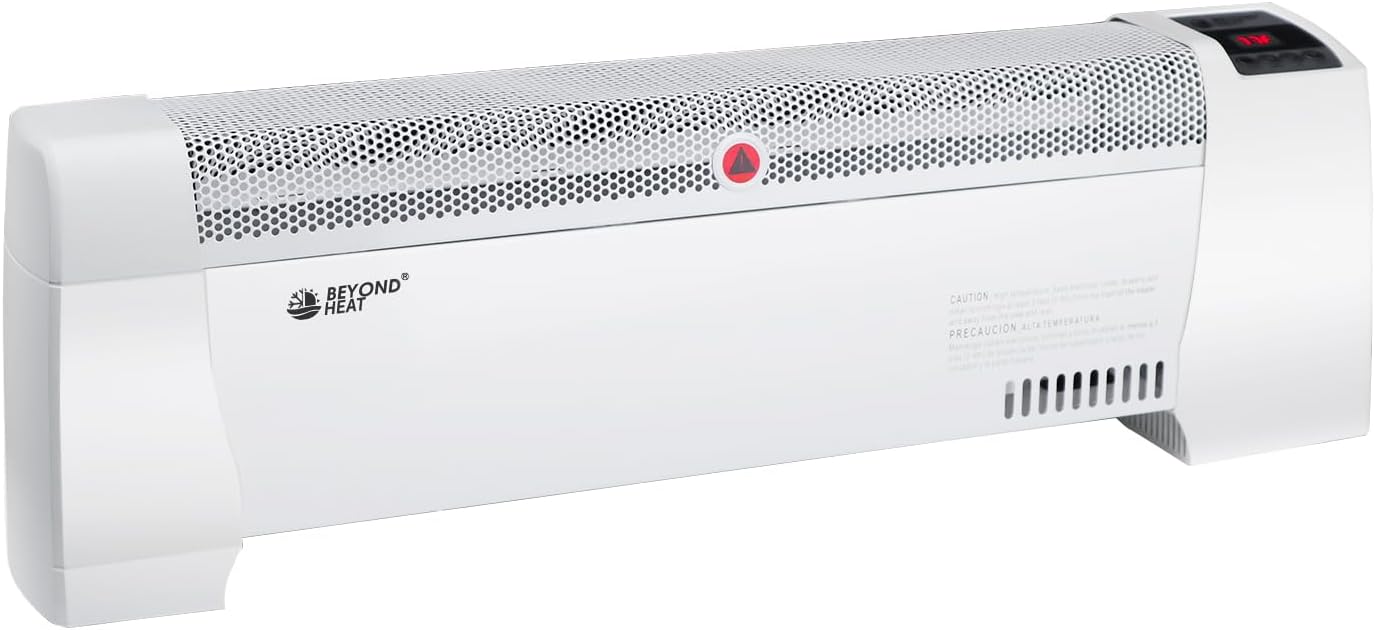
BEYOND HEAT Baseboard Heater BH650
| Heat Output | 1500 watts |
|---|---|
| Heating Method | Convection |
| Number of Speeds | 2 |
| Min Temperature Setting | 40 °F |
| Max Temperature Setting | 90 °F |
The BEYOND HEAT BH650 is a corded baseboard convection heater intended to provide quiet, steady warmth for bedrooms, home offices, or small living spaces. It offers two heat settings (750/1500W) and a digital adjustable thermostat with a 40 to 90°F range so you can dial in room temperature and let the unit maintain it. Because it uses convection heating and a stay-cool body with dent-proof end panels, operation is nearly silent and the design stays unobtrusive along a wall. Safety features include ETL approval, overheat protection and a tip-over switch, which are useful if the heater is used in high-traffic areas or homes with pets. The unit is compact and portable for a baseboard-style heater, but it is a plug-in corded model rather than a hardwired replacement, so mounting and placement are straightforward. If you need fast, whole-room blast heat or advanced controls like Wi-Fi scheduling, this model is limited, but for steady background warmth and simple temperature control it performs as expected.
Best for: Buyers who prioritize simple, reliable room heating and want a quiet, safe baseboard-style heater they can set and forget for bedrooms or home offices.
Less Ideal for: Those seeking rapid high-output heating, integrated smart home control, or a direct hardwired replacement for factory-installed baseboard units should consider other options.
- Digital adjustable thermostat for straightforward temperature control
- Two power settings (750W and 1500W) to match room heating needs
- Quiet convection operation suitable for bedrooms and offices
- Built-in safety features including overheat protection and tip-over switch
- No smart controls or advanced scheduling features
- Plug-in corded design may not replace existing hardwired baseboard units
Verdict: A straightforward, quiet 1500W baseboard heater with a digital thermostat and basic safety features for reliable background heating in small to medium indoor rooms.
Comfort Zone CZ600 Baseboard Heater

| Power Source | Corded Electric |
|---|---|
| Watts | 1,500 W |
| Heating Coverage | 300 sq. ft. |
| Number of Speeds | 2 |
| Voltage | 120 |
The Comfort Zone CZ600 is a low-profile 1,500W electric baseboard heater intended to warm medium-size rooms. It offers two power settings (1,500W and 750W) and a manual thermostat knob so you can dial in a comfortable temperature without extra controls. The unit relies on convection/radiant heating, runs quietly, and has dent-resistant end panels for a tidy look along walls. Built-in safety features include a tip-over switch, overheat protection, and a stay-cool exterior, which make it suitable for bedrooms, offices, or dorm rooms where safety and quiet matter. Because it is a simple plug-in corded unit with a basic knob controller, there are no timers, Wi-Fi, or advanced energy-management modes, so temperature control is manual and straightforward. Installation is minimal since it is baseboard-mounted, but buyers should plan for a dedicated 120V circuit and be aware this is for indoor use only. For the money it delivers straightforward, reliable zone heating for single rooms without frills.
Best for: Buyers looking for an affordable, no-frills way to add targeted heat to a single room who prioritize simple controls, quiet operation, and basic safety features.
Less Ideal for: People who want smart, programmable heating, whole-home integration, or outdoor-rated equipment should consider other options.
- Provides two heat output options for basic energy management
- Adjustable manual thermostat for simple temperature control
- Multiple safety features including tip-over cut-off and overheat protection
- Quiet convection operation suitable for bedrooms and offices
- No advanced controls or programmable schedule features
- Designed for indoor use only and requires a suitable 120V circuit
Verdict: A budget-friendly, safety-focused baseboard heater that gives reliable zone heating with simple manual controls.
Stelpro Prima Baseboard Heater ASPRM0371W

| Heat Output | 375 watts |
|---|---|
| Voltage | 120 volts |
| Heating Coverage | 37 sq. ft. |
| Heating Method | Convection |
| Amperage | 3.1 A |
The Stelpro Prima ASPRM0371W is a low-profile electric baseboard heater built for steady convection heating in small rooms. It mounts to the wall or under a window and connects to hardwired 120V circuits, delivering 375 watts intended for spaces up to about 37 sq ft. The unit uses a stainless steel sheathed tubular element with boxed aluminum fins and a bottom inlet/top outlet layout to promote quiet, even circulation; floating end sleeves and full-length thermal protection with automatic reset improve operational reliability. The removable front panel clicks off for easier cleaning and the housing is designed to limit access to the element for safety. It requires a wall thermostat (not included) though an optional internal single-pole electronic thermostat can be fitted in the junction box. Practical limits are its single fixed heat output and need for hardwired installation and a separate thermostat, so it is best where simple, dependable zone heat is required rather than variable fan-forced warmth or portable use.
Best for: Buyers who prioritize a durable, quietly performing in-wall heating solution for a dedicated small room and want a straightforward, low-maintenance unit that pairs with a wall thermostat.
Less Ideal for: People who need portable, multi-speed, or instant high-output heating for large or frequently moved spaces should look at other heater types.
- Compact low-profile design fits under windows and along baseboards
- Stainless steel sheathed element with aluminum fins for even, quiet convection heat
- Safety-focused housing and full-length thermal protection with automatic reset
- Two-click removable front panel for easier cleaning and maintenance
- Optional built-in single-pole electronic thermostat or external wall thermostat compatibility
- Hardwired 120V installation required, not plug-and-play
- Single fixed wattage means no onboard variable heat setting without a thermostat
Verdict: Choose the Stelpro Prima for a compact, safety-minded baseboard heater that reliably delivers quiet, even convection heat to small rooms.
Cadet F Series 24in Baseboard Heater

| Heat Output | 1195 BTU |
|---|---|
| Wattage | 350/262 Watt |
| Voltage | 240/208 Volt |
| Heating Coverage | 35 square feet |
| Power Source | Corded Electric |
The Cadet F Series 24-inch baseboard heater is a simple, no-frills electric convection heater designed to deliver steady, quiet warmth in small rooms. It mounts at floor level and connects to house power; universal wiring at either end makes it straightforward to wire into existing baseboard runs or replace an old unit. The built-in thermostat and high-temperature safety shutoff add practical safety and control so the heater can maintain a room temperature without constant attention. With a rated output around 350 watts (1195 BTU at 240V), it is best suited to supplement heat in bedrooms, small living spaces, or drafty corners rather than serving as a primary heater for large areas. The unit emphasizes reliability and simple installation over advanced features, and its whisper-quiet convection operation keeps bedrooms free of fan noise. Buyers should plan electrical circuit capacity accordingly and expect modest heating power compared with fan-forced or whole-home systems.
Best for: Buyers wanting a dependable, quietly operating baseboard unit to supplement heat in small rooms who value ease of installation and proven performance backed by positive user feedback.
Less Ideal for: People looking for rapid room warm-up, whole-room primary heating, or units with remote controls and advanced features should consider other heater types.
- Whisper-quiet convection heating suitable for bedrooms and quiet spaces
- Built-in thermostat for steady temperature control
- High-temperature safety shutoff for added protection
- Universal wiring at either end simplifies installation and replacement
- Low wattage limits it to small rooms or supplemental heat
- No fan or forced-air option for faster heat distribution
Verdict: Choose this Cadet F Series unit if you want a quietly operating, easy-to-install baseboard heater that reliably provides supplemental heat for small rooms.
Cadet F Series 36" Baseboard Heater

| Heat Output | 750 watts |
|---|---|
| Voltage | 240/208 Volt |
| Heating Coverage | 125 sq ft |
| Amperage | 3.13 A |
The Cadet F Series 36" baseboard heater provides steady, quiet convection heat for rooms up to roughly 125 square feet. It installs as a fixed baseboard or wall-mounted unit and offers universal wiring with pre-punched knockouts to simplify hookup. The heater runs on 240/208 volts and is rated at 750 watts (563 watts at the lower voltage), making it suitable for bedrooms, home offices, or small living spaces where silent background heat is preferable to forced-air options. A high-temperature automatic shutoff adds a safety layer, and the metal housing and simple design suggest long-term durability. Limitations are its fixed installation and single heat output range, so it is not portable and requires proper circuit capacity and wiring; temperature control depends on pairing with a compatible wall thermostat rather than built-in variable controls. For those wanting unobtrusive, reliable convection heat the unit performs as expected, but plan for a professional or competent DIY electrical install.
Best for: Buyers who prioritize a low-maintenance, factory-quality fixed heater for steady background warmth and who prefer proven, safety-minded products over portable electric heaters.
Less Ideal for: People needing a portable or plug-in heater, those who want built-in digital controls or multiple heat settings, and rooms that exceed the stated coverage where higher output is required.
- Quiet convection heating suitable for bedrooms and home offices
- Universal wiring and pre-punched knockouts simplify installation
- Built-in high-temperature automatic shutoff for added safety
- Compact 36-inch form fits standard baseboard mounting locations
- Requires hardwired installation and an appropriate circuit; not portable
- No integrated thermostat or variable controls included
Verdict: A reliable, safety-focused fixed baseboard heater that delivers quiet convection warmth for small to medium rooms.
Choosing the Right Electric Baseboard Heater: Key Factors to Consider
Room Size and Heat Output
Electric baseboard heater wattage directly determines how well a unit can heat a given room. Higher-watt units deliver more heat but require heavier wiring and may not be appropriate for small rooms. Calculate required wattage by room square footage and typical insulation quality to avoid undersizing.
Matching heater output to room size affects comfort and operating cost. An undersized heater will run continuously and still fail to reach set temperatures, while an oversized unit can short-cycle or drive unnecessary energy use. Consider layout too; long, narrow rooms or rooms with high ceilings may need higher output or more than one unit.
Wiring and Electrical Capacity
Installation requirements vary by wattage and local electrical code. Higher-wattage baseboard heaters often require dedicated circuits and 240V service, while lower-watt models can run on existing 120V branch circuits. Assess your breaker panel capacity and whether you have available circuit slots before choosing a higher-capacity unit.
Wiring complexity affects installation cost and whether you can do the work yourself. If the home uses older wiring or the run to the room is long, account for voltage drop and conductor sizing. Confirm whether a hardwired thermostat or a line-voltage thermostat is required as that determines wiring changes and control options.
Thermostat Compatibility and Control
Electric baseboard heaters use either low-voltage thermostats with relays or line-voltage thermostats that switch current directly. The control type affects precision, energy management options, and installation complexity. Low-voltage systems integrate with centralized thermostats and programmable controls more easily, while line-voltage thermostats are simpler but offer fewer smart features.
Consider whether you want a basic dial, digital programmable, or smart thermostat. Programmable controls and setback schedules can materially reduce runtime and cost. Also confirm compatibility with multi-stage heating setups or existing home automation if you plan to coordinate with other heat sources.
Safety Features and Placement
Look for built-in thermal limiters, overheat cutoffs, and sealed element designs that minimize fire and burn risks. Proper placement away from flammable materials, curtains, and furniture is essential for safe operation. Units with protective grills and rounded edges reduce burn hazards in households with children or pets.
Permanent mounting and secure connections prevent movement that could stress wiring. Consider moisture-rated units for bathrooms or laundry rooms. Safety features and correct placement both reduce the risk of nuisance tripping and extend service life.
Long-Term Operating Cost and Efficiency
Electric resistance heat is nearly 100 percent efficient at converting electricity to heat at the point of use, but operational cost depends on runtime and how well the heater distributes warmth. Units with better convection profiles or longer element runs can produce more even heat, reducing thermostat overshoot and runtime.
Insulation quality, thermostat programming, and zoning are bigger drivers of cost than small differences between baseboard models. Still, choose a heater with control options that let you reduce setpoints when rooms are unoccupied. Consider element accessibility and serviceability to keep long-term maintenance straightforward.
Sizing a Baseboard Heater to Your Room
Start by measuring the room square footage and estimating the heat loss factors such as ceiling height, window area, and insulation quality. A rule-of-thumb starting point is about 10 watts per square foot for well-insulated rooms, but colder climates or rooms with poor insulation often require more. For tall ceilings or sun-exposed windows, increase capacity accordingly.
- Measure length and width to calculate square footage.
- Adjust for ceiling height above standard 8 feet.
- Add capacity for large windows or exterior doorways.
Line-Voltage Vs Low-Voltage Controls
Understand the difference between line-voltage (120/240V) thermostats that switch the heater directly and low-voltage systems that use a relay or contactor. Line-voltage setups are simpler to wire for single-room control, while low-voltage systems integrate with centralized thermostats and allow finer programmable control. Choose the control type that matches your existing wiring and desired thermostat features.
- Line-voltage thermostats: simpler, direct control.
- Low-voltage thermostats: better integration, advanced programming.
- Confirm wiring type before buying replacement units.
Installation Tips for a Clean Retrofit
When replacing an existing baseboard unit, preserve mounting points and wiring routes where possible to minimize drywall work. Turn off power at the breaker, verify voltage at the heater connections, and follow local code for conductor sizing and junctions. If you are not comfortable with electrical work, hire a qualified electrician to ensure proper breaker sizing and secure wiring.
Bullets are optional for clarity and safe practices.
- Label and photograph existing wiring before removal.
- Use proper strain relief and junction boxes.
- Seal gaps around the heater to prevent drafts.
Placement, Clearance, and Room Layout
Placement along exterior walls under windows is typical because it helps counter cold drafts and promote better air circulation. Maintain manufacturer-recommended clearances from curtains, furniture, and floor coverings to avoid heat buildup and fire hazards. Consider installing multiple smaller units for very long walls to distribute heat more evenly than a single oversized unit.
- Avoid blocking units with furniture or drapes.
- Keep recommended clearance above and in front of heaters.
- For long walls, use two smaller units spaced apart.
Maintenance and Seasonal Care
Regularly vacuum dust from grills and use a soft brush to clean fins if accessible; accumulated dust reduces heat transfer and creates a fire risk. Inspect wiring connections annually for discoloration or looseness and check that mounting hardware remains secure. In humid or coastal environments, inspect for corrosion and consider corrosion-resistant finishes or coatings.
- Vacuum grills seasonally to keep airflow clear.
- Schedule an annual visual wiring inspection.
- Replace damaged covers or fins promptly to maintain safety.
How We Chose the Best Electric Baseboard Heater
To identify the top electric baseboard heaters we applied a focused set of practical filters that reflect real buyer priorities. First, we assessed heat output and room-matching capability using published wattage and btu-equivalent figures so units that can reliably heat common room sizes were prioritized. Second, we looked at installation factors including wiring requirements, mounting options, and whether a unit is designed for easy retrofit into existing baseboard spaces. Third, we examined safety and durability attributes such as built-in thermal cutoffs, rugged element construction, and corrosion-resistant enclosures that reduce long-term service needs. Fourth, we evaluated user-facing controls and compatibility with common thermostats, which affect daily convenience and energy management. Finally, we considered long-term operating efficiency and maintenance needs by checking element type and replaceability. We excluded specialty radiant panels and convection fan-forced room heaters because they use different distribution methods and installation requirements. Units that lacked clear wiring or safety specs were also omitted. The result is a set of reliable, broadly applicable baseboard heaters that balance output, installation ease, safety, and running cost.
Our full evaluation process is outlined in our review methodology.
FAQ
How do I calculate the right wattage for my room?
Estimate room square footage and multiply by a baseline wattage, typically around 10 watts per square foot for well-insulated spaces. Increase the value for poor insulation, high ceilings, or colder climates and verify that your electrical system can support the selected wattage.
Can I install a baseboard heater myself?
You can install smaller 120V units if you are comfortable turning off breakers and following wiring diagrams, but any work that changes circuit capacity or involves 240V should be done by a licensed electrician to comply with code and ensure safety.
What thermostat type should I choose?
If you want simple room-level control, a line-voltage thermostat is straightforward. For programmable schedules, integration with central controls, or smarter energy management, choose low-voltage systems or thermostats designed to work with relays and contactors.
Are electric baseboard heaters safe in bathrooms?
You can use appropriately rated units in bathrooms, but they must have the correct moisture rating and be installed with proper clearances. Follow local code and consider a unit with extra safety cutoffs for wet environments.
How long do baseboard heaters typically last?
Lifespan depends on build quality and usage patterns but many well-maintained electric baseboard heaters can last decades. Regular cleaning and ensuring stable electrical connections help prevent premature failure.
Final Verdict
Choose a baseboard heater by matching wattage to room size, confirming wiring and thermostat compatibility, and prioritizing safety features that suit your household. Installation complexity and wiring needs will often determine whether a DIY approach is reasonable or if a professional is required. Balance output, control options, and maintainability to get steady, efficient warmth without unnecessary service calls. Focus on the factors that affect daily operation and long-term cost rather than small feature differences. With the right sizing, wiring, and controls, an electric baseboard heater is an effective, low-maintenance way to provide reliable zone heat in your home.