
Note: This article contains affiliate links. If you click on these links and make a purchase, we may earn a small commission at no extra cost to you. This helps support our research and content. Read our full affiliate disclosure here.
Picking the right electric wall heater matters because it directly affects comfort, energy use, and how easy the unit is to install and maintain. Whether you need supplemental heat for a chilly room or a primary source for a small area, the right wall-mounted heater can deliver steady warmth without taking up floor space. This guide highlights seven shortlisted options that represent the best choices across typical home scenarios, focusing on effective heat output, installation practicality, noise, and control options. Below you will find concise product summaries and clear evaluation criteria to help you choose a unit that fits your room size, wiring, and thermostat preferences.
Top Picks at a Glance
| Best Overall The best all-around choice for most situations | DREO Smart Wall Heater DR-HSH017S |  |
| Best Quality Built to a higher standard if you want something more solid | Cadet Energy Plus Wall Heater CEC163TW |  |
| Best Value The sweet spot between price and what you get | GiveBest Wall Heater UPH300M |  |
| Best Budget The cheapest option that still gets the job done reliably | ROVSUN 1500W Wall Heater |  |
| Top Rated A top-rated pick with lots of positive feedback | Lueptexx 1500W Wall Panel Heater |  |
| Most Popular A crowd favorite that many people choose with confidence | Heat Storm Phoenix HS-1500-PHX-WIFI |  |
| Best Seller A high-volume bestseller chosen again and again | Dreo Smart Wall Heater WH719S |  |
DREO Smart Wall Heater DR-HSH017S

| Heat Output | 1500 watts |
|---|---|
| Heating Method | Forced Air, PTC |
| Heating Coverage | 150 square feet; 750 square feet |
| Voltage | 120 volts |
| Min–Max Temp | 41 °F–95 °F |
The DREO Smart Wall Heater is a wall-mounted electric unit designed to provide quiet, controllable heat for bedrooms and living areas. It uses a PTC heating element with forced-air output rated at 1500 watts and a strong airflow design to move warm air across a room; manual 30° oscillation helps distribute heat to a targeted area. Controls include a digital thermostat with a 41–95 °F range, ECO mode for energy-aware set-and-hold operation, a handheld remote, and app integration plus Alexa voice control for scheduling and calibration. The unit is relatively quiet at about 28 dB and includes standard safety features such as overheat protection and an IP24 splash rating for added peace of mind. Installation is simplified with a mounting template and a long power cord. Limitations are its manual-only oscillation angle and the stated coverage guidance—best as a primary heater for about 150 sq ft or a supplemental source up to 750 sq ft—so larger or poorly insulated rooms may not reach target temperatures as quickly as a central system would.
Best for: Buyers who want a wall-mounted, smart-controlled heater that balances quiet operation, precise temperature control, and easy scheduling for single rooms or spot heating.
Less Ideal for: Those needing fast, whole-house heat or a heater for very large, poorly insulated spaces should consider a higher-capacity or central option instead.
- Smart controls: app, remote and Alexa voice control allow scheduling and remote adjustments.
- Precise thermostat: adjustable 41–95 °F range with ECO mode and temperature calibration for stable comfort.
- Quiet operation: low noise (~28 dB) suitable for bedrooms and offices.
- Strong airflow and forced-air PTC element provide rapid heat delivery from a wall-mounted unit.
- Oscillation is manual and limited to 30°, so you may need to reposition furniture for best coverage.
- Coverage guidance suggests it is best for small to medium rooms; not intended to replace whole-house heating.
Verdict: A quiet, smart wall-mounted heater that delivers precise, app- and voice-controlled room heating for small to medium spaces.
Cadet Energy Plus Wall Heater CEC163TW

| Heating Coverage | 30 square feet |
|---|---|
| Heat Output | 1500 watts |
| Power Source | Electric |
| Form Factor | Wall-mounted heater with fan-forced design and digital thermostat |
| Special Features | Programmable Thermostat |
The Cadet Energy Plus is a wall-mounted electric heater designed to deliver consistent warmth to small rooms while keeping energy use down. It installs into a standard wall can and automatically senses 120, 208, or 240 volts to deliver 1000, 1500, or 1600 watts without manual configuration. The built-in backlit digital thermostat and programmable setback modes make it simple to set and maintain a target temperature, and the auto-adjusting fan speed helps hold the room within about one degree of the set point. A quiet variable-speed fan and a fan-only mode provide year-round air circulation, and a high-temperature safety shutoff and tamperproof settings increase safety and control. Practical limits include coverage geared to roughly 30 square feet and the need for hardwiring by a qualified electrician, so it is best for targeted room heating rather than whole-house use.
Best for: Buyers who want an efficient, performance-focused room heater that holds temperature precisely and replaces an existing wall heater with minimal wall work.
Less Ideal for: Those looking to heat large open areas, portable heating, or users unwilling to arrange a hardwired installation should consider other options.
- Auto multi-voltage sensor that matches 120/208/240V and supplies appropriate wattage automatically
- Built-in backlit digital thermostat with programmable Night and Away setback modes
- Auto-adjusting variable-speed fan maintains stable temperature within about 1 degree
- Quiet operation with fan-only mode for year-round air circulation
- Includes complete Com-Pak assembly for straightforward replacement installs into existing wall cans
- Designed for small spaces with about 30 sq ft coverage, not for heating large rooms
- Requires hardwired electrical installation by a qualified electrician
Verdict: Choose this when you need a quiet, energy-conscious wall heater that holds temperature tightly and upgrades easily into an existing wall can.
GiveBest Wall Heater UPH300M

| Heat Output | 1500 watts |
|---|---|
| Heating Element | PTC |
| Heating Coverage | up to 200 square feet |
| Number of Speeds | 3 |
| Voltage | 120 volts |
The GiveBest UPH300M is a wall-mounted 1500W electric heater aimed at quickly warming well-insulated rooms up to about 200 square feet. It combines a PTC heating element with three power/speed settings and a precision thermostat so you can choose rapid full-power heat or an ECO cycling mode to save energy. Controls include an LED touch panel, a handheld remote, and WiFi app support with scheduling so you can preheat a bedroom or manage settings from a phone; it also works with voice assistants. Installation is straightforward using the included template and wall hooks for a space-saving mount. Safety features include ETL-listed overheat and tip-over protection and flame-retardant materials. Expect steady performance in small to medium rooms, though ECO mode cycles heating so temperature will fluctuate more than in continuous high-power modes. The unit is not intended as a primary heat source for large, open, or poorly insulated spaces and requires a standard 120V circuit.
Best for: Buyers who want a compact, wall-mounted heater with smart controls and energy-saving options to efficiently warm single rooms and avoid using bulky floor units.
Less Ideal for: People seeking whole-home heating or a primary heater for large, open, or poorly insulated areas should consider higher-capacity or central heating options.
- 1500W PTC element delivers fast heat for rooms up to 200 sq ft
- WiFi, remote, and touch controls plus scheduling for convenient preheating
- ECO mode and precision thermostat to reduce energy use
- Wall-mounted design frees floor space and installs with included template
- Built-in safety: ETL-listed overheat and tip-over protection and flame-retardant materials
- ECO mode causes temperature cycling that can feel unstable in larger or poorly insulated rooms
- Not suitable as the sole heater for very large or open spaces
Verdict: A smart, space-saving 1500W wall heater that pairs fast heating with WiFi scheduling and an ECO thermostat for efficient single-room comfort.
ROVSUN 1500W Wall Heater

| Heat Output | 1500 watts |
|---|---|
| Heating Coverage | 200 sq.ft |
| Form Factor | Freestanding & Wall-Mounted |
| Number of Speeds | 3 |
| Min/Max Temp | 40 °F–95 °F |
This ROVSUN heater is a flexible, budget-friendly option for adding quick, localized heat to small rooms. It delivers up to 1500 watts through a PTC ceramic element that claims to produce noticeable warmth in about three seconds and offers three power settings plus an adjustable temperature range from 40 to 95 F. You can mount it on the wall to save floor space or place it on the floor with the freestanding configuration, and the included remote and LED touch controls make daily use straightforward. Practical features include a 1–12 hour timer, tip-over and overheat protection, and relatively quiet operation under 45 dB, which is useful in bedrooms or home offices. Trade-offs are its modest 200 sq. ft. coverage and single-zone heating focus, so it works best as a supplemental heater rather than a primary home heating source. For buyers who want a low-cost, easy-to-install unit with basic safety and convenience features, this model hits the mark.
Best for: Buyers looking for an affordable, no-frills space heater to quickly warm a single room or to add supplemental heat where needed while keeping installation simple.
Less Ideal for: People who need to heat large open areas, whole apartments, or want Wi-Fi/smart-home control and multi-zone temperature management.
- 2-in-1 wall-mounted or freestanding design saves floor space and adds placement flexibility
- Fast-start PTC heating element with three power settings for quick, targeted warmth
- Remote control and LED touch display plus 1–12 hour timer for convenient operation
- Safety features include tip-over shutoff and overheat protection and quiet operation under 45 dB
- Designed for supplemental heating with roughly 200 sq ft coverage, not whole-house use
- Limited to three heat settings and no advanced smart-home integration
Verdict: A practical, low-cost 2-in-1 wall or freestanding 1500W heater that delivers fast, quiet supplemental warmth for small rooms.
Lueptexx 1500W Wall Panel Heater

| Heat Output | 1500 watts |
|---|---|
| Heating Coverage | 150-300 sq.ft |
| Heating Method | Convection |
| Voltage | 120 volts |
The Lueptexx 1500W wall panel heater uses convection heating to warm rooms quietly without a fan, making it suitable for bedrooms, home offices, and living areas. It installs on the wall or sits on included universal wheels for temporary placement, and offers an LED touch display plus a remote for convenient adjustments. Practical features include an ECO mode and a 24-hour timer to limit runtime and cut energy use, a child lock and overheat/tip-over protections for safety, and an aluminum frame that keeps the unit lightweight yet sturdy. Because it is fanless and convection-based, heat distribution is gradual rather than instant, so it performs best as a steady supplemental heater for spaces within the 150 to 300 sq ft range rather than as a rapid spot heater. Overall the unit balances silent operation, straightforward controls, and built-in safety, with the main compromise being slower warm-up compared with fan-forced space heaters.
Best for: Buyers who prioritize a reliable, low-maintenance heater that runs quietly and safely as a steady supplemental heat source in bedrooms, home offices, or living rooms.
Less Ideal for: People who need rapid, focused heat or a primary heater for very large open spaces should consider higher-output or fan-forced options instead.
- Quiet fanless convection delivers heating without audible noise
- Remote control and LED touch display make operation convenient from across the room
- ECO mode and 24-hour timer help reduce energy use during typical home schedules
- Built-in safety features including child lock, overheat and tip-over protection
- Convection design provides slower initial warm-up compared with fan-forced heaters
- Heat is best suited for whole-room steady warming rather than rapid spot heating
Verdict: A reliable, quiet wall-mounted convection heater with convenient controls and safety features ideal for steady supplemental heating in small to medium rooms.
Heat Storm Phoenix HS-1500-PHX-WIFI
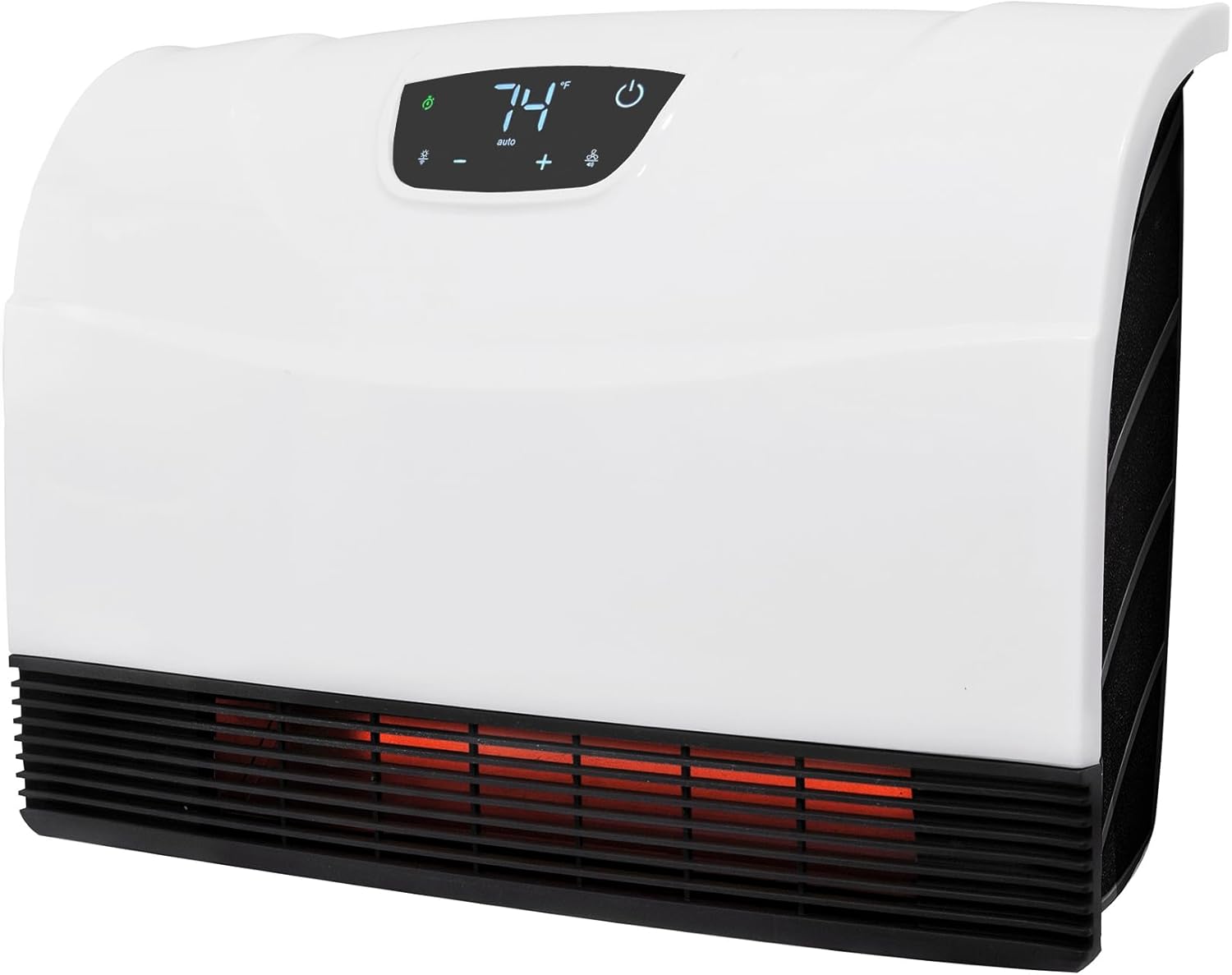
| Power | 1500 W |
|---|---|
| Voltage | 110 volts |
| Heating Method | Infrared |
| Heating Coverage | 150 ft² primary, 750 ft² secondary |
The Heat Storm Phoenix HS-1500-PHX-WIFI is a 1500 watt infrared wall heater that provides targeted zone heating for bathrooms, bedrooms, small garages, or offices where floor space is limited. It mounts on the wall, plugs into a standard 110V outlet, and offers Wi‑Fi control plus one-touch Bluetooth setup so you can schedule heat and adjust temperature remotely. The unit uses radiant infrared heating to warm people and surfaces directly rather than forcing hot air, which can feel quicker in small spaces and reduce drafts. It includes a touchscreen digital thermostat, remote, washable filter, and built‑in safety features like tip‑over protection and a cool-to-touch grill for wall installation. Practical limits are its intended coverage: it is sized for primary heating of ~150 sq ft and supplemental heating of up to ~750 sq ft depending on insulation, so it is not meant to heat large open-plan areas. Install is straightforward for a wall mount but you should confirm outlet placement for hiding the cord when mounting above the receptacle.
Best for: Buyers who want a compact, controllable wall-mounted heater for single rooms and value smart controls and quick radiant warmth backed by many user reviews.
Less Ideal for: People looking to heat large open areas or whole-house solutions should choose a higher-capacity heating system instead.
- Wi‑Fi and Bluetooth one-touch setup allow remote control and scheduling from a phone
- Wall mount design saves floor space and keeps the heater out of the way
- Infrared radiant heating warms people and surfaces quickly without blowing air
- Includes touchscreen thermostat, remote, and washable filter for convenience
- Intended primarily for small rooms so it will not be effective as a sole heater for large open spaces
- Requires a nearby 110V outlet positioned appropriately if you want to hide the cord when wall mounting
Verdict: Choose the Heat Storm Phoenix for a wall-mounted, Wi‑Fi controllable infrared heater that delivers quick, space-saving zone heating for small rooms.
Dreo Smart Wall Heater WH719S

| Heat Output | 1500 watts |
|---|---|
| Heating Coverage | 200-750 sq.ft. |
| Min Temperature Setting | 41 °F |
| Max Temperature Setting | 95 °F |
| Number of Speeds | 3 |
The Dreo Smart Wall Heater WH719S is a wall-mounted 1500W PTC ceramic heater designed to warm bedrooms and living spaces with an adjustable thermostat and 120° vertical oscillation. It is typically installed on a wall and used as a primary heater for smaller rooms or as supplemental heat for larger areas; the package includes mounting accessories and a drilling guide to simplify installation. Notable features include a digital display with 1°F temperature increments from 41 to 95°F, a 24-hour timer, three fan speeds, a reusable filter and detachable front for easier cleaning, plus remote control and Wi-Fi support through the Dreo app with Alexa and Google Assistant voice control. In practice the heater delivers fast, even warm-air distribution thanks to forced-air PTC technology and the wide oscillation, and the auto-dim LED and low-noise operation suit bedroom use. Important limitations are typical of wall units: you need a suitable mounting location and basic installation work, and running at full 1500W will draw household-level power when used as the main heat source for larger rooms.
Best for: Buyers who prioritize reliable, easy-to-control wall-mounted heating for bedrooms or home offices and want smart controls and quieter operation for night use.
Less Ideal for: People who need a truly portable heater or those unwilling to perform wall installation should look at freestanding models instead.
- 120° vertical oscillation for broader heat distribution
- Precise electronic thermostat with 1°F increments for accurate temperature control
- Wi‑Fi, app and voice control plus included remote for flexible scheduling and remote operation
- Detachable front and reusable filter simplify maintenance
- Includes mounting accessories and drilling guide for easier installation
- Requires wall mounting and basic installation work before use
- Consumes up to 1500W which may be significant if used as sole heat source in large uninsulated rooms
Verdict: Choose the Dreo WH719S if you want a smart, wall-mounted 1500W heater that delivers precise, quiet, widely distributed warmth with easy app and voice control.
Choosing the Right Electric Wall Heater: Key Factors to Consider
Heat Output and Room Coverage
Heat output, usually expressed in watts or BTUs, determines how effectively an electric wall heater can raise and maintain air temperature in a space. Matching output to room size prevents undersized units that run constantly and oversized units that cycle too frequently.
Consider the room dimensions, ceiling height, insulation quality, and window area when estimating required output. A properly sized heater should reach target temperature without excessive runtime, which improves comfort and limits electricity waste.
Thermostat Type and Control Precision
The thermostat controls comfort and runtime. Mechanical dial thermostats are simple and reliable, while digital thermostats offer finer temperature control and programmable schedules. Precision affects how closely the heater holds temperature and how often it cycles on and off.
If you need consistent overnight comfort or want to limit spikes in energy use, favor units with accurate or programmable thermostats. Also consider compatibility with wall-mounted room thermostats if you prefer centralized control.
Installation Requirements and Wiring
Electric wall heaters have varied installation needs, from simple plug-in or hardwired 120V models to 240V hardwired units requiring dedicated circuits. Assess your existing wiring, available breaker capacity, and whether you can access a suitable mounting wall.
Installation complexity impacts total cost and suitability. Units that need a dedicated double-pole breaker or conduit may not be appropriate for every room. Confirm clearances, wall construction, and whether a retrofit will require drywall or trim work.
Noise and Fan Design
Noise matters in bedrooms, offices, and living areas. Some wall heaters use convection only and are virtually silent, while fan-forced models deliver quicker heat but can introduce noticeable sound. The fan design, speed settings, and vibration dampening impact audible performance.
Consider the intended room use: choose quieter convection styles for sleeping areas and fan-forced units where rapid temperature recovery is more important than absolute silence.
Safety Features and Certifications
Electric wall heaters operate at high temperatures and must include safety measures to prevent fire or electrical hazard. Look for built-in overheat protection, tip and obstruction sensing for models with external grills, and thermal cutoffs that shut the unit down if temperatures exceed safe limits.
Check for third-party safety certifications and ensure the unit's installation instructions specify required clearances from furniture, curtains, and combustible materials.
Maintenance, Access, and Serviceability
Ease of maintenance affects long-term performance. Units with accessible grilles, washable filters, or simple fan access make periodic cleaning straightforward. Dust buildup reduces airflow and efficiency, so filterless or easy-to-clean designs are preferable for low-effort upkeep.
Also consider the availability of replacement parts like thermostats and fans. Serviceable designs extend usable life and simplify repairs if components wear out.
Sizing Your Electric Wall Heater
Calculating the right heater size starts with the room's square footage and factors in insulation levels, window area, and ceiling height. A basic rule of thumb uses watts per square foot, adjusted upward for drafty rooms or high ceilings.
For rooms with poor insulation or large windows, plan for higher output to maintain comfortable temperatures. If you are unsure about exact needs, choose a slightly larger unit with a reliable thermostat to avoid continuous runtime.
- Measure room floor area and ceiling height.
- Adjust wattage recommendations for insulation and window exposure.
- Account for adjacent cold rooms or exterior walls when sizing.
Hardwired Vs Plug-In Models
Hardwired wall heaters are permanently connected to the household electrical system and often provide higher wattage and cleaner installation. Plug-in models are easier to move and replace but are typically limited to lower-power applications.
Decide based on electrical capacity and whether you want a permanent heating solution. Hardwired installations usually require a qualified electrician and adherence to local codes, while plug-in units are a simpler option for temporary or rental situations.
- Hardwired: higher wattage, permanent, requires electrician.
- Plug-in: flexible placement, limited power, easier to replace.
Thermostat Options and Room-Level Control
Some heaters include built-in thermostats while others can connect to remote or wall-mounted thermostats. Built-in thermostats are convenient but may be influenced by the heater's airflow, which can affect perceived accuracy. Remote or wall-mounted thermostats measure ambient room temperature more reliably when placed away from the heater.
Programmable thermostats allow temperature setbacks when rooms are unoccupied, which saves energy. Consider models that offer multiple fan speeds or eco modes to fine-tune comfort and efficiency.
- Built-in thermostat: convenience versus potential bias from heat source.
- Remote thermostat: better ambient sensing and placement flexibility.
- Programmable settings reduce runtime and energy use.
Placement, Mounting, and Clearance
Correct placement ensures effective circulation and reduces risk. Mount heaters on interior walls where possible, away from draperies, furniture, and direct obstructions. Follow clearance guidelines from the manual to keep the unit safe and efficient.
Mounting height affects airflow patterns; many installs specify a floor-to-unit distance to optimize convection. For rooms with furniture along walls, plan placement so that airflow is not blocked and heat distribution remains even.
- Avoid mounting directly under windows with heavy curtains.
- Keep recommended clearances from furniture and combustibles.
- Follow specified mounting heights for best airflow.
Energy Use and Running Costs
Electric wall heaters are nearly 100 percent efficient at converting electricity to heat, but runtime determines bills. Using a thermostat to avoid prolonged high-power operation is the most effective way to manage costs. Fan models may cycle more often to maintain setpoints but can reach comfort faster, possibly reducing total runtime.
Consider zones and supplemental heating strategies. Heating only the rooms you occupy with a wall heater often costs less than raising central heat for the whole house.
- Thermostatic control minimizes wasted runtime.
- Use setbacks and programmable schedules to lower energy use.
- Zone heating reduces overall household energy expenditure.
How We Chose the Best Electric Wall Heater
We shortlisted units that meet real-world needs for home heating and straightforward wall installation. Our selection filters prioritized measured heat output relative to room size, reliable thermostatic control, and installation compatibility with standard residential electrical circuits. We also emphasized low operating noise, durable construction for long service life, and accessible maintenance like grille cleaning and component access. Excluded from consideration were models that require specialized commercial electrical infrastructure, units without thermostatic control, or heaters lacking basic safety features such as overheat protection. In practical terms we focused on units that balance steady wattage ratings with appropriate mounting options, clear thermostat behavior, and simple user controls. The editorial criteria reflect what most homeowners and renters need: correct sizing, safe wiring and mounting, meaningful temperature control, quiet operation, and durability under regular household use.
Our full evaluation process is outlined in our review methodology.
FAQ
Can I install an electric wall heater myself?
It depends on the model and your electrical skills. Plug-in models with a standard outlet are straightforward, but hardwired units, especially 240V heaters, usually require a licensed electrician to meet code and ensure safe wiring.
How do I choose between convection and fan-forced wall heaters?
Convection units provide quieter, slower heat and are ideal for bedrooms, while fan-forced units heat a room faster at the cost of some noise. Choose based on whether rapid temperature recovery or minimal sound is more important for the room's use.
What safety features should I look for?
Prioritize overheat protection, thermal cutoffs, and clear installation clearance requirements. Third-party safety certification and a robust grille design to prevent accidental contact are also important for peace of mind.
Will a wall heater raise my whole-home temperature?
Wall heaters are best used for room-level or zone heating. They are not intended to replace central systems for whole-home heating unless multiple units are installed and wired to appropriate circuits.
How often should I service or clean a wall heater?
Inspect and clean the grille and any filters at least annually, or more often in dusty environments. Fan motors and thermostats may need periodic checks to ensure reliable operation and to prevent dust-related performance loss.
Final Verdict
When selecting an electric wall heater, prioritize correct sizing and the thermostat type that matches how you use the space. Confirm installation requirements and circuit compatibility before committing, and weigh noise versus speed when choosing between convection and fan-forced designs. Focus on safety features, serviceability, and realistic runtime expectations. With those tradeoffs in mind, you can confidently pick a wall-mounted heater that provides comfortable, efficient warmth for the rooms that need it most.