
Note: This article contains affiliate links. If you click on these links and make a purchase, we may earn a small commission at no extra cost to you. This helps support our research and content. Read our full affiliate disclosure here.
Basements pose unique heating challenges: limited ceiling height, variable insulation, and higher moisture levels. Choosing the right electric heater for basements matters because the wrong unit can underperform, waste energy, or create safety hazards in an enclosed, often damp space. This guide presents seven carefully shortlisted electric heaters designed to handle basement conditions and explains the practical tradeoffs you should consider. We evaluated each option on output, safety, and energy use so you can match a heater to your basement size and layout. Read on for a concise breakdown of what to look for and the features that make certain heaters better suited for basement use.
Top Picks at a Glance
| Best Overall The best all-around choice for most situations | DR. Infrared Heater DR-968 |  |
| Best Quality Built to a higher standard if you want something more solid | Duraflame 3D Infrared Electric Stove |  |
| Best Value The sweet spot between price and what you get | VOCRS PTC-903B Ceramic Space Heater |  |
| Best Budget The cheapest option that still gets the job done reliably | Amazon Basics Ceramic Space Heater |  |
| Top Rated A top-rated pick with lots of positive feedback | DREO Space Heater HSH006 |  |
| Most Popular A crowd favorite that many people choose with confidence | Lasko Ceramic Tower Heater 751320 |  |
| Best Seller A high-volume bestseller chosen again and again | DREO Tower Space Heater DR-HSH003 |  |
DR. Infrared Heater DR-968

| Wattage | 1500 Watts |
|---|---|
| Heating Coverage | 576 square feet |
| Number of Speeds | 3 |
| Voltage | 120 |
The DR. Infrared Heater DR-968 uses a dual heating system—infrared quartz tube plus a PTC element—paired with a high-pressure, low-noise blower to warm rooms quickly and evenly. It is typically used as a portable supplemental heater in bedrooms, living rooms, home offices, or basements where you need targeted warmth; caster wheels and a remote make it easy to move and control from across the room. Notable features include Auto energy-saving mode that cycles between high and low power to hold a set temperature, a 12-hour timer, electronic thermostat adjustable from 50 to 85°F, and built-in tip-over and overheat protection for safer unattended operation. Practical benefits for basement use are strong heat delivery for its 1500 W rating, wide claimed coverage, and quieter operation than many fan heaters. The unit is heavier than compact space heaters and requires a dedicated floor spot, and while the manufacturer highlights superior heat transfer, performance will still depend on basement insulation and air leakage; it does not replace whole-house heating but works well as a focused supplemental source.
Best for: Buyers who want a robust, quieter supplemental heater to quickly warm a single basement space and value programmable temperature control and safety features.
Less Ideal for: People seeking a lightweight, ultra-compact heater to move between floors frequently or those who need whole-basement or whole-house central heating solutions.
- Dual heating system (infrared quartz + PTC) for faster, more even warmth
- Auto energy-saving mode and electronic thermostat maintain set temperature efficiently
- Quiet high-pressure blower reduces noise compared with many fan heaters
- Remote control and caster wheels for easy placement and operation
- Multiple safety features including tip-over and overheat protection
- Relatively heavy for a portable heater so it is less convenient to lift
- Effectiveness depends on basement insulation and room sealing rather than the heater alone
Verdict: A powerful, safety-focused 1500 W infrared heater that delivers fast, quiet supplemental warmth for individual basement rooms.
Duraflame 3D Infrared Electric Stove

| Power Source | Corded Electric |
|---|---|
| Power Consumption | 1500 watts |
| Heating Coverage | 1000 sq ft |
| Heat Output | 5200 british thermal units |
This Duraflame infrared electric stove combines decorative realism with practical supplemental heat. It uses 1500 watts of infrared quartz heat to warm rooms up to 1,000 square feet while preserving humidity better than some fan heaters, and the flame effect has five brightness settings that run with or without heat for year-round ambiance. Controls are simple: a digital thermostat and onboard panel plus a full-function remote make temperature adjustments and timer settings easy from across a basement or living area. The metal body, side viewing windows, and an operable beveled glass door give it a sturdy, traditional look and the unit stays cool to the touch for safer placement around kids and pets. On the downside it is a plug-in freestanding unit so floor space and a nearby outlet are required, and as a 1500 W electric heater its runtime cost will reflect local electricity rates when used as primary heat in very cold basements. For someone wanting a combination of usable heat and convincing fireplace ambiance in a basement rec room, this model balances style and performance effectively.
Best for: Buyers who need a performance-focused supplemental heater that also provides realistic fireplace ambiance in a basement or large recreation space and who value controllable, humidity-friendly infrared heat.
Less Ideal for: Those seeking whole-house primary heating, hardwired installation, or a permanently mounted solution should consider HVAC upgrades or dedicated furnace options instead.
- Infrared quartz heat rated to cover up to 1,000 sq ft for effective supplemental heating
- 3D flame effect with five brightness levels that can run without heat for year-round ambiance
- Digital thermostat plus remote control and timer for convenient temperature management
- Durable metal construction with side windows and an operable glass door for realistic looks
- Requires a nearby 120V outlet and occupies floor space as a freestanding unit
- 1500 W power draw can be costly if used as the primary heat source in very cold basements
Verdict: A strong choice for basement owners who want efficient infrared supplemental heat with a convincing, adjustable fireplace effect.
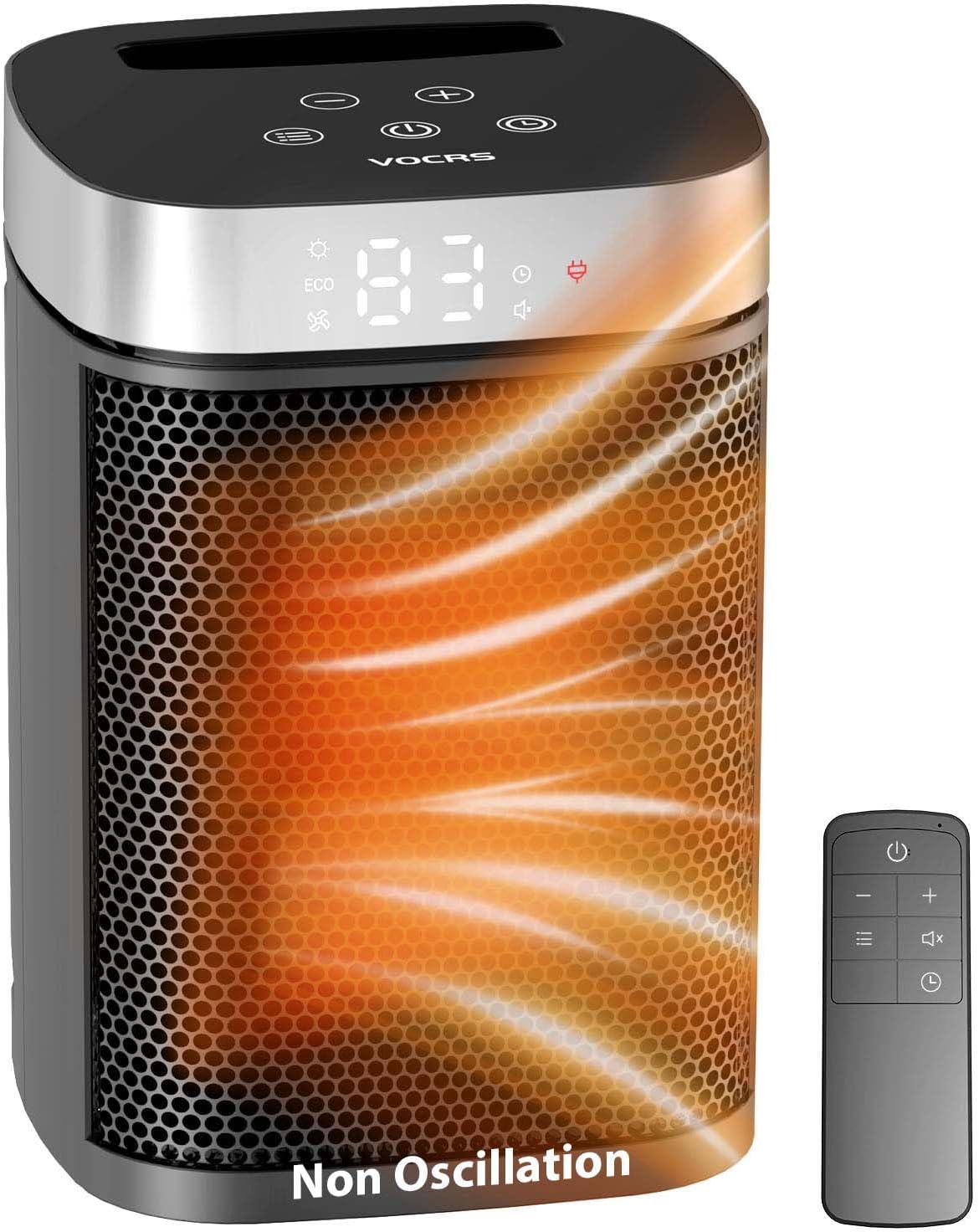
VOCRS PTC-903B Ceramic Space Heater
| Heat Output | 1500 watts |
|---|---|
| Heating Coverage | 200 sq.ft |
| Number of Speeds | 3 |
| Timer | 1–12 hours |
The VOCRS PTC-903B is a small portable ceramic tower heater designed to deliver quick, localized warmth in rooms up to about 200 sq ft. It offers three power settings (700W, 1000W, 1500W) and a digital thermostat so you can dial in comfort and balance energy use, and a 1–12 hour timer and remote make hands-off operation convenient. Safety features include overheat protection and tip-over shutoff, and its carry handle and slim tower form let you move it between a basement corner, bedroom, or home office without fuss. Because it is a 1500W electric unit, expect modest operating costs at the highest setting for long continuous runs and limited ability to heat large, poorly insulated basements. The small footprint is easy to tuck away but also means the heater is best used for spot heating rather than whole-basement heating. For someone wanting a straightforward, safety-minded portable heater to supplement a basement's main heating, this model is a solid, no-frills option.
Best for: Buyers who want a portable, safety-focused supplemental heater to quickly warm a single basement zone or small finished basement area and control runtime remotely.
Less Ideal for: People needing to heat a large, open, or poorly insulated basement as a primary heat source should choose a higher-capacity or whole-room heating solution instead.
- Three adjustable heat levels (700W/1000W/1500W) for flexible spot heating
- Digital display plus remote control for easy temperature and mode changes from across the room
- 1–12 hour timer for scheduled run times and energy savings
- Built-in safety features including overheat protection and tip-over automatic shutoff
- 1500W output is suitable for small to medium rooms but may not heat large or poorly insulated basements effectively
- Compact tower form focuses heat locally rather than distributing warmth across large open basement areas
Verdict: A compact, safety-minded 1500W ceramic heater that provides convenient spot heating and simple remote/timer control for small basement zones.
Amazon Basics Ceramic Space Heater

| Heat Output | 1500 watts |
|---|---|
| Number of Speeds | 3 |
| Power Source | Corded Electric |
| Max Temperature Setting | 130 °F |
This Amazon Basics ceramic heater is a small, portable convection heater designed to warm a single room quickly. It offers three settings — high (1500W), low (900W), and fan-only — and an adjustable thermostat so you can dial in comfort for short sessions at a desk, bedroom, or basement workspace. The ceramic element delivers rapid heat with relatively low noise (about 43 dB), and safety features include tip-over and overheat protection plus a power indicator light. Its lightweight, tabletop/floor form makes it easy to move where needed, and the simple controls keep operation straightforward. Important limitations for basement use are typical for a compact personal heater: it is intended for spot heating rather than warming large or poorly insulated spaces, and the manufacturer advises against using it in high-humidity areas like laundry rooms. If you need a small, inexpensive heater to take the chill out of a nearby workbench or seating area in a finished basement, this model does that job reliably; for heating whole basements or damp spaces you will want a larger, moisture-rated solution.
Best for: Buyers who need an inexpensive, portable heater to quickly warm a small area in a finished basement or workspace and prioritize simple controls and safety features.
Less Ideal for: People who need to heat an entire basement, large open rooms, or uninsulated, damp spaces should consider a larger or moisture-rated heating solution.
- 1500W ceramic element provides fast, efficient spot heating
- Three settings including 900W low and fan-only for flexible use
- Built-in tip-over and overheat protection for safer operation
- Compact, lightweight design is easy to move and place on tables or floors
- Designed for spot heating and not intended to heat large or poorly insulated basements
- Not rated for use in high-humidity areas
Verdict: A budget-friendly, portable ceramic heater that reliably provides quick spot heat and basic safety features for finished basement work areas or seating zones.
DREO Space Heater HSH006

| Heat Output | 1500 watts |
|---|---|
| Heating Coverage | 200 sq.ft |
| Heating Element | PTC Ceramic |
| Number of Speeds | 4 |
| Min Temperature Setting | 41 °F |
This DREO tower heater is a compact, 1500W PTC ceramic forced-air heater designed to warm single rooms up to about 200 sq ft. It offers four fan speeds and multiple modes including Power, ECO, and Fan-only, plus an adjustable thermostat that sets from 41 to 95°F in 1°F increments and a 12-hour timer for hands-off operation. The unit heats quickly thanks to the PTC element and funnel design and keeps noise low with a brushless DC motor rated around 34 dB, which helps if you want quiet background heat in a basement hobby space. Built-in safety features such as tip-over detection, overheat protection, flame-retardant materials, ETL listing, and a safety plug make it suitable for unattended use. The small footprint and carry handle make placement flexible, and the included remote and memory function simplify repeated use. Limitations are its 200 sq ft coverage, which may not heat larger or open-plan basements effectively, and as a forced-air ceramic heater it does not provide residual radiant warmth the way an oil-filled radiator does.
Best for: Buyers who want a reliable, safety-minded space heater to provide fast, controllable heat in a small to medium basement zone and value quiet continuous operation.
Less Ideal for: People looking to heat a large or open basement as a primary heat source or those who prefer slow-radiating oil-style heaters for lingering warmth.
- 1500W PTC ceramic element for fast warm-up
- Adjustable thermostat with 1°F increments for precise control
- Multiple modes and 12-hour timer for flexible energy use
- Comprehensive safety features including tip-over and overheat protection
- Designed for rooms up to ~200 sq ft so larger basements may need additional heat sources
- Forced-air design provides less lingering radiant heat compared with oil radiators
Verdict: A compact, safety-focused 1500W heater that delivers quick, quiet, and precise heat for small to medium basement zones.
Lasko Ceramic Tower Heater 751320

| Heat Output | 1500 watts |
|---|---|
| Heating Method | Forced Air |
| Heating Element | Ceramic |
| Timer | 7-hour |
| Voltage | 110 volts |
The Lasko 1500W Ceramic Tower Heater is a slim, portable electric heater designed to warm small to medium rooms using a ceramic heating element and forced-air circulation. It is typically placed on the floor in bedrooms, home offices, or basements where targeted, quick warmth is needed; widespread oscillation helps distribute heat rather than concentrating it in one spot. Controls are electronic with a multi-function remote and on-board storage, and the unit includes an adjustable thermostat and a seven-hour auto-off timer for scheduled use. Safety features include overheat protection, a cool-touch housing, and an ETL listing which make it reasonable for occupied living spaces. The advantages are simple operation, convenient remote control, and a narrow footprint that is easy to move with the built-in handle. Limitations to note are the two heat settings rather than a wider range of power levels and the modest coverage suited for single rooms rather than large open basements; performance depends on room insulation and ceiling height.
Best for: Buyers who prioritize a proven, well-reviewed, safety-focused portable heater for spot-warming single rooms and who value simple controls and remote convenience.
Less Ideal for: People needing to heat large or poorly insulated basements for long periods or who require many power levels or a higher-capacity heater should consider larger dedicated heating solutions.
- 1500W ceramic element provides quick, effective warm-up for small to medium rooms
- Widespread oscillation helps circulate heat across the room rather than a single direction
- Electronic thermostat and 7-hour timer allow basic temperature control and scheduled shutoff
- Includes remote control with on-board storage for convenient adjustments from across the room
- Built-in safety features such as overheat protection and cool-touch housing increase peace of mind
- Only two heat settings which limit fine-grained power control
- Coverage is intended for single rooms and may be insufficient for large, uninsulated basements
Verdict: A compact, safety-minded 1500W ceramic tower that reliably heats single rooms and is easy to control with its remote.
DREO Tower Space Heater DR-HSH003

| Heat Output | 1500 watts |
|---|---|
| Heating Coverage | 270 sq.ft. |
| Heating Element | PTC |
| Oscillation | 70° |
| Number of Speeds | 5 |
This DREO tower heater is a straightforward electric heater designed to warm medium to large rooms quickly using a 1500W PTC ceramic element and forced-air convection. It offers a digital adjustable thermostat (41 to 95°F) and ECO mode that steps power between about 1000W and 1500W to maintain temperature more efficiently, plus five fan speeds, 70° oscillation for broader coverage, and a 12-hour timer. Practical touches include a remote control and a quiet fan design rated near 34 dB, which helps if you want heat in a basement while sleeping or watching TV. Safety is emphasized with ETL listing, tip-over and overheat protection, a V0 flame-retardant enclosure, and a long flat 6 ft cord. Limitations are typical of compact electric towers: it must be plugged directly into a wall outlet (no extension cords), and sustained heating relies on 1500W electric output so it is best for insulated basements or smaller sections rather than poorly insulated large open spaces. The unit is portable and simple to operate, making it a sensible backup or primary supplemental heater for finished basements.
Best for: Buyers who prioritize safe, easy-to-use supplemental heating for finished or insulated basement rooms and want a quiet heater with basic smart controls and energy-saving modes.
Less Ideal for: Not a good choice for heating large, uninsulated basements or whole-house heating where higher output or hydronic solutions are required.
- 1500W PTC ceramic heating for quick warm-up
- Adjustable digital thermostat with ECO mode for energy-conscious temperature control
- 70° oscillation and multiple fan speeds to spread heat across the room
- ETL-listed safety with tip-over and overheat protection and flame-retardant housing
- Remote control and 12-hour timer for convenient hands-free operation
- Requires direct wall outlet use and should not be run on an extension cord
- 1500W output can struggle to heat very large or poorly insulated basement spaces effectively
Verdict: A safe, quiet, and energy-conscious 1500W tower heater that works well as a supplemental or spot heater for finished basement spaces.
Choosing the Right Electric Heater for Basements: Key Factors to Consider
Heat Output and Room Size
Basement volumes and layouts vary widely, so matching heater output to the specific space is essential. Look at the unit's BTU equivalent or wattage and compare that to your basement square footage and ceiling height. Higher output is important for poorly insulated or partially finished basements, but oversized heaters can cycle frequently and waste energy.
Also consider how the heater distributes warmth. Convection units move air slowly and work well for whole-room heat, while fan-forced or infrared options can provide quicker localized warmth. Think about how many heaters you need and where they will sit to avoid cold pockets.
Safety Features
Safety is a top priority in basements, which are often less supervised and sometimes damp. Built-in overheat protection and tip-over switches reduce the risk of fire if a heater is blocked or knocked over. Look for models with cool-touch surfaces, automatic shutoff timers, and sealed heating elements to prevent accidental contact.
A heater with clear safety certifications or testing for indoor use offers extra assurance. If your basement has higher humidity, choose units with designs that minimize exposed heating coils or that specify suitability for damp locations.
Energy Efficiency and Controls
Electric heat can be expensive to operate, so efficiency and precise control are important. Adjustable thermostats, multiple heat settings, and programmable timers let you target warmth only when needed. Some heaters include ECO or energy-saving modes that cycle power intelligently to maintain comfort while minimizing draw.
Smart or remote controls add convenience for basements with limited access, but simple mechanical thermostats are effective and often more reliable in harsh environments. Consider how often you will run the heater and whether features like thermostatic control or a built-in fan will impact electricity use.
Placement, Portability, and Installation
Basements often have confined spaces, low ceilings, or irregular furniture and storage, so placement flexibility matters. Portable units offer the easiest solution for spot heating and can be moved as needs change. Wall-mounted or permanently installed heaters free up floor space but require planning for clearance and wiring.
Check clearance requirements and whether the unit needs a dedicated circuit. Consider the unit's footprint and whether it fits near stairways, laundry areas, or shelving without creating a hazard. For rooms with uneven levels or concrete floors, a stable base and tip-over protection are especially important.
Moisture and Dust Resistance
Basements are prone to higher humidity and dust accumulation, which can affect heater performance and longevity. Choose heaters with sealed controls, enclosed elements, or IP ratings that indicate some protection against moisture. Components that are easy to clean extend service life; removable filters or grills simplify maintenance when dust builds up.
Avoid designs with exposed heating coils in areas where dampness or splashing is possible. Regular cleaning and occasional inspection are important to prevent dust buildup that reduces airflow and increases fire risk.
Noise and Air Movement
Noise matters in basements used as media rooms, workshops, or offices. Fan-forced heaters produce noticeable airflow noise, which can be distracting during prolonged use. Convection or radiant heaters typically run quieter but heat more slowly.
Consider whether background noise from a utility room or HVAC system masks heater sounds. If quiet operation is a priority, prioritize units marketed for low-noise performance or those that rely on radiant heat rather than high-speed fans.
Sizing Your Heater to Basement Layout
Start by measuring the basement area you want to heat, including ceiling height and any open stairwells that connect to other floors. Multiply square footage by a recommended wattage per square foot for basement conditions, increasing the allowance for poor insulation or high ceilings.
Think in terms of zones. If your basement has separate areas for storage, living space, or a workshop, a single central heater may not provide even warmth. Using multiple smaller units or combining a central convection unit with portable spot heaters gives more flexibility.
- Account for insulation and exposed concrete which increase heat loss.
- Place heaters to promote airflow and avoid blocked intake or exhaust.
- Consider temporary placement before committing to permanent mounting.
Types of Electric Heaters That Work Well in Basements
Convection heaters gradually warm the air and are good for maintaining steady temperature in enclosed basements. They are usually quieter and better for whole-room comfort but take longer to raise temperature.
Fan-forced models heat and move air quickly, making them useful for warming cold floors or localized areas. Infrared units heat objects and people directly and can feel warmer faster, which is helpful for spot heating but less ideal for even whole-room distribution.
- Convection: Quiet, steady whole-room heat.
- Fan-forced: Quick warm-up, louder, good for drafts.
- Infrared: Immediate radiant warmth, best for occupants or work areas.
Placement Tips to Maximize Efficiency and Safety
Place heaters away from stored items, laundry equipment, and water sources. Maintain manufacturer clearances to combustible materials and avoid blocking air intakes. If you must place a heater near shelving, ensure there is adequate airflow around the unit to prevent overheating.
Elevate small portable units slightly if the floor is cold or damp, but follow stability guidance to prevent tipping. When mounting units, choose walls that allow even heat spread and keep controls accessible for adjustments.
- Keep at least the recommended clearance from combustible materials.
- Avoid placing heaters directly under stairs or in narrow walkways.
- Use thermostats or timers to prevent continuous, unattended operation.
Maintaining a Basement Heater
Regular maintenance preserves performance and safety. Clean dust and lint from grills and vents, inspect power cords for damage, and test safety cutoffs periodically. For units with filters, follow the recommended cleaning or replacement schedule.
In damp basements, inspect for rust or corrosion and ensure electrical connections remain dry. If controls become sticky or unreliable, service or replace the unit rather than attempting complex repairs in the basement environment.
- Unplug before cleaning and allow the heater to cool.
- Schedule seasonal inspections before winter usage peaks.
- Keep a small hand vacuum or brush for routine dust removal.
When to Consider Permanent Installation
Permanent wall-mounted or in-wall electric heaters reduce floor clutter and can provide more even, long-term heating for finished basements. Consider permanent installation when you have a consistent need for basement warmth and have planned clearances and wiring.
Hire a qualified electrician if the heater requires hardwiring or a dedicated circuit. Permanent units can be more cost-effective in the long run but require upfront planning around layout and control placement.
- Confirm clearance, wiring, and thermostat placement before installation.
- Permanent units typically need less frequent repositioning and are less likely to be obstructed.
How We Chose the Best Electric Heater for Basements
Our selection focused on real-world basement needs rather than generic room heating. We prioritized units with proven heat output relative to footprint, robust safety engineering for enclosed or damp spaces, and practical controls that reduce runtime and energy waste. Portability and mounting options were considered for flexible placement in cramped or awkward basement layouts. We also favored models with durable construction and straightforward maintenance to minimize issues in basements that tend to be dustier or more humid. Excluded were heaters poorly rated for indoor use in limited-clearance areas, designs lacking built-in overheat or tip-over protection, and models with control systems that require complex installation. The primary evaluation dimensions were heat output and distribution, safety features, energy efficiency and controls, durability in basement conditions, and ease of placement and installation. These criteria reflect the most relevant tradeoffs for basement owners choosing an electric heater.
Our full evaluation process is outlined in our review methodology.
FAQ
Can I use any electric heater in a damp basement?
Often not. Many electric heaters are designed for dry indoor spaces. For damp basements choose models with sealed elements or explicit suitability for damp locations and ensure controls and plugs stay dry.
How many watts do I need to heat a typical basement?
It depends on insulation and layout, but a general rule is to plan wattage based on square footage with extra allowance for poor insulation. Larger or uninsulated basements usually require higher wattage or multiple units.
Are wall-mounted heaters better than portable units for basements?
Wall-mounted units save floor space and can provide steady, permanent heat, which is useful for finished basements. Portable heaters offer flexibility for spot heating and are easier to move as needs change.
What safety features should I prioritize for basement heaters?
Prioritize overheat protection, tip-over shutoff, cool-touch surfaces, and sealed heating elements. Timers and thermostats that prevent continuous unattended operation also enhance safety.
Will an electric heater increase basement humidity?
Electric heaters do not produce moisture themselves, but they can change airflow and temperature which affects perceived humidity. In very damp basements consider addressing moisture sources and ventilation in addition to heating.
Final Verdict
Choosing the right electric heater for basements means balancing heat output, safety, and how you plan to use the space. Prioritize units with adequate wattage for your basement size, built-in safety protections, and controls that let you limit runtime to reduce energy use. For finished basements, permanent or wall-mounted heaters provide tidy, reliable warmth, while portable options give flexible spot heating for workshops or storage areas. Weigh the tradeoffs between quick warm-up and quiet, steady heat, and plan placement to avoid blocking airflow or creating hazards. With the right balance of power, safety, and installation, you can keep a basement comfortable and safe through colder months.